Category Archives: WORLD

Pyramids Discovered In Russia Twice As Old As Egyptian Could Rewrite Human History

Pyramids Discovered In Russia Twice As Old As Egyptian Could Rewrite Human History

The discovery of the world’s earliest pyramids on the Kola Peninsula may confirm the existence of an ancient civilisation on Russian territory. The civilization likely predates the Egyptian civilization for a long time.

Archaeological excavations of the Kola Peninsula’s pyramids, which are believed to be at least two times older than Egyptian pyramids, have been resumed last year. It is still not known by whom or how they were built.

The mystery of the pyramids of Kola Peninsula

Pyramids Discovered In Russia Twice As Old As Egyptian Could Rewrite Human History

The Kola Peninsula is a peninsula located in the Murmansk area of Russia’s European portion. The Barents and White Seas flow across it. The area is around 100,000 square kilometres. The north has tundra vegetation, whereas the south has forest tundra and taiga. The peninsula’s climate is somewhat chilly all the year.

The extraordinary discovery of the world’s oldest pyramids on the Kola Peninsula indicates the existence of the legendary Hyperborea. The Kola Peninsula has recently become a fascinating place for scientific researchers and enthusiasts.

Many of the scientists who made a scientific expedition to this enigmatic place believe that the Kola peninsula may be the ancestral home to Earth’s most ancient civilization. Scientists’ discoveries of step pyramids and massive stone slabs that were precisely cut 9000-40000 years ago provide compelling evidence for this incredible idea.

Were the Hyperboreans responsible for the Kola Pyramids?

Archaeologists have studied intriguing pyramid structures on the Kola peninsula, which have the potential to rewrite our history. The pyramids have been built with precision and are thought to be at least 9,000 years old, which could be even older than Göbekli Tepe, the world’s oldest temple.

The earliest known investigation of the Kola pyramids took place in the early 1920s when Russian scholar Alexander Vasilyevich Barchenko (1881–1938) arrived with a scientific team to explore the enigmatic, undiscovered ancient monuments in Russia’s unexplored part. However, Barchenko was not a mainstream scientist, and to date, his beliefs are controversial, as well as intriguing at the same time.

Barchenko became persuaded that the Kola pyramids were built by the lost civilisation of Hyperborea, a mythological island according to the ancient Greeks. Hecataeus of Miletus (550 BC-476 BC), the earliest recorded Greek historian, believed the Hyperborean holy site located “on an island in the ocean…beyond the country of the Celts.”

According to Diodorus Siculus (90 BC-30 BC), a Greek historian, God Apollo visited the unknown country of Hyperborea on his swan drawn chariot on a regular basis.

“Opposite to the coast of Celtic Gaul there is an island in the sea, not smaller than Sicily, situated to the north—which is inhabited by the Hyperboreans, who are so named because they live beyond the North Wind,” Diodorus said. “This island has a pleasant climate, fertile soil, and is abundant in everything, producing twice a year.”

According to the Diodorus’ statement in Historic Library, Greek goddess Leto, the daughter of the Titans Coeus and Phoebe, the sister of Asteria, and the mother of Apollo and Artemis, was born in Hyperborea, and as a result, the locals worship Apollo more than any other God. They are, in a sense, his priests, because they constantly praise him and lavish him with awards.

“There is a lovely Apollo grove on this island, as well as a spectacular circular temple decorated with many dedicated offerings. There is also a city dedicated to the same God, the majority of whose residents are harpers who constantly play their harps at the temple and sing songs to the God praising his deeds. The Hyperboreans speak a unique dialect and have a strong connection to the Greeks, particularly the Athenians and the Delians…”

It is also said that the moon appears very close to the earth in this island, that certain eminences of a terrestrial form can be clearly seen in it, that Apollo visits the island once every nineteen years, during which period the stars complete their revolutions, and that for this reason, the Greeks distinguish the cycle of nineteen years by the name of “the great year.”

Hyperborea has never been discovered, but that, according to many theorists, doesn’t imply it didn’t exist. Hyperborea’s submerged ancient remains may yet be unearthed. Could the abandoned Kola Pyramids in Russia’s North be the remnants of a long-lost, sophisticated ancient civilization about which we know almost nothing?

According to Barchenko’s view, people came from the northern areas around 12,000 years ago. A massive flood drove Aryan tribes residing there to flee the area during the so-called Golden Age, which occurred around 10,000-12,000 years ago. The Aryan tribes left the Kola Peninsula and travelled to the south.

After studying Masonic literature, the late Russian scientist gradually came to believe that the Hyperboreans were a highly sophisticated society capable of atomic energy, levitation, and flight. He also believed that Sami shamans living on the Kola Peninsula were the keepers of Hyperborea’s old wisdom.

Bashenko was a keen student of religious and mystical matters, and while his hypotheses were never proven, they are nevertheless of considerable interest to scholars of alternative ancient history. On April 25, 1938, Bashenko was killed in Moscow as part of the Great Purge.

Inside the Kola Pyramids, there are unknown voids and chambers

Later in 2007, a Russian expedition team attempted to investigate the Kola Pyramids. Among these experts were Pulkovo Observatory press secretary Sergey Smirnov, candidate of physical and mathematical sciences, Valery Chudinov, Professor of the Russian Academy of Natural Sciences, and Dmitry Subetto, Professor, doctor of geological and geographical sciences.

The voyage was more arduous and risky than the researchers had anticipated. The Kola Pyramids are in a secluded area, and the inhabitants, the Lapps, we’re hesitant to show them the route.

According to one of the team members, Russian experts viewed the pyramids from a helicopter, but owing to extensive foliage, not all buildings were visible from the air.

Their chopper nearly crashed, but they made it to the old site and studied these strange buildings. The Kola pyramids, according to Russian geologists, are two 50-meter-high structures linked by a bridge and aligned to the cardinal points.

“We carried a unique device, the most sophisticated geophysical equipment – the Oko georadar – on the expedition,” one of the researchers explained.

Like an x-ray, the instrument “shines through” the interior space of any item. The geologists reached an unambiguous conclusion: the heights are anthropogenic in origin; hence, they are not natural hills, but man-made pyramids ― the product of human hands. Inside the pyramids, there are gaps and undiscovered rooms.

The Russian pyramids’ function, purpose and who constructed them are still unclear. They might have been utilised as an astronomical observatory in ancient times or might be used as sacred ground. For now, what is known about the Kola Pyramids is that they are far older than the Egyptian pyramids, and their presence adds another intriguing segment to human history. In the end, the enigma of the Russian Pyramids in the Kola Peninsula has remained unexplained to this day.
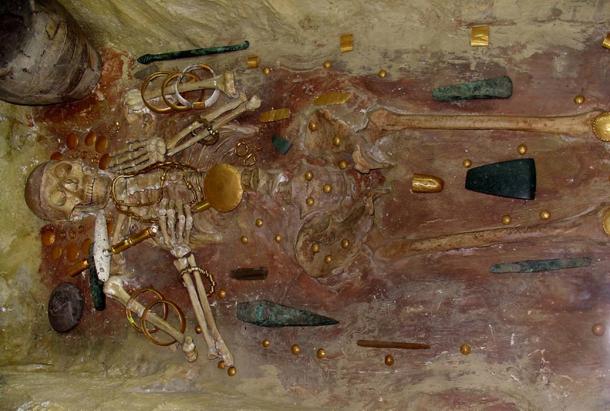
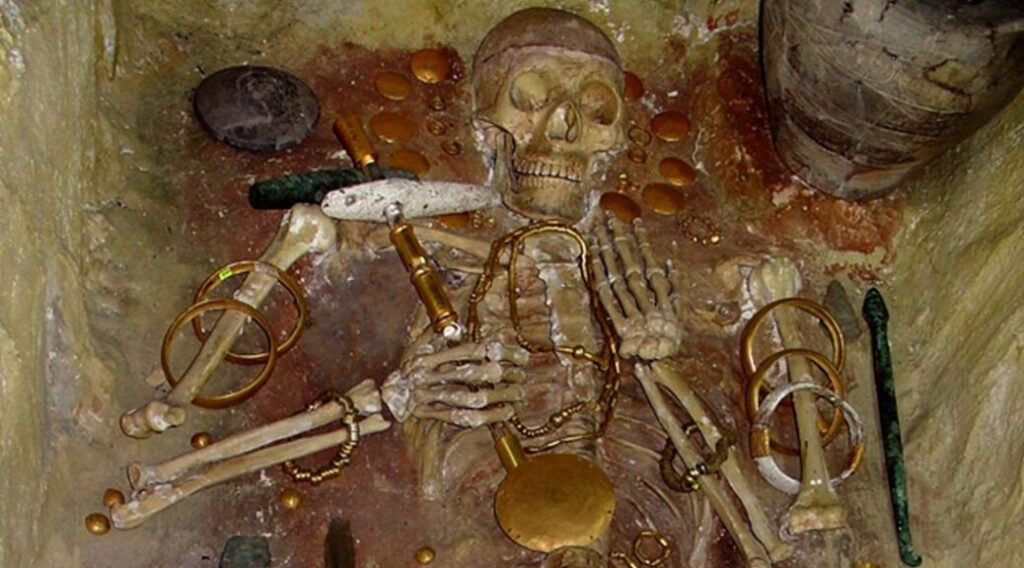
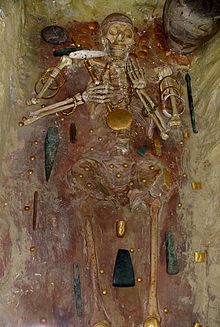
The Varna Man, who lived around the 5th Millennium BC, is the wealthiest burial at that time

The Varna Man, who lived around the 5th Millennium BC, is the wealthiest burial at that time

The site, located on the outskirts of the Black Sea resort of Varna, was discovered accidentally when tractor operator Raicho Marinov was cutting a trench to lay an electric cable for a local factory.

He suddenly noticed small squares of shiny yellow metal, bracelets of the same material, green-coloured artefacts, and flakes of flint.

Rushed to the local museum, the objects were soon identified as prehistoric stone tools, corroded copper axes, and, clearly associated with them, golden ornaments. The association was what mattered: the implication was that the gold artefacts were older than any others ever discovered anywhere.

The Varna Man, who lived around the 5th Millennium BC, is the wealthiest burial at that time
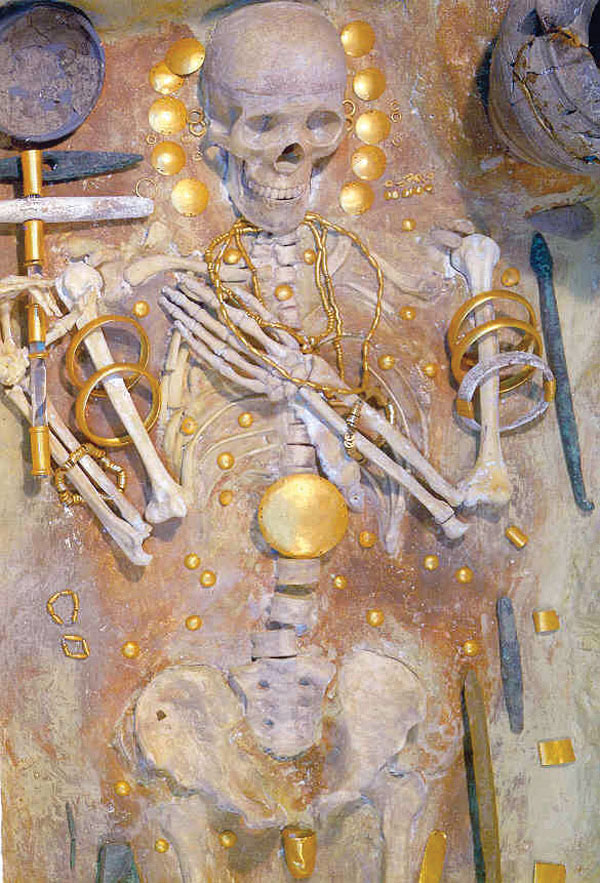
The Varna man burial has some of the world’s oldest gold jewelry.

Museum curator Michail Lazarov and Sofia University professor Georgi Georgiev immediately set about organising a rescue excavation, and the museum’s young archaeologist, Ivan Ivanov, was appointed to lead it.

Ivanov’s team eventually uncovered 281 graves, more than half with grave goods, 18 of them exceptionally rich, and one of them among the richest graves ever excavated.

The date of the cemetery has recently been pushed back to the 5th millennium BC. A radiocarbon determination now gives it as c.4500 BC.

The discoveries

About 200 crouched or, far more commonly, extended inhumations have been uncovered in the two-thirds of the cemetery so far excavated. Both males and females are represented.

The bodies were placed in flat graves formed of shallow pits without mounds. The remaining graves are ‘cenotaph graves’ – where nobody is present but where grave goods have been laid out – or ‘mask graves’, where a life-size ceramic mask has been substituted for an actual body.

Three cenotaph graves, three mask graves, and a number of the inhumations are extremely rich. The total assemblage includes 3,000 gold artefacts weighing over 6kg.

The richest burial is of a man in his mid-40s buried with no less than 990 separate gold objects, including beads, rings, and a variety of decorations for body, clothing, and hair, among them a penis sheath. This man was also buried with copper axes, other copper tools, and a sceptre in the form of a perforated stone axe or mace.

The Varna man burial has some of the world’s oldest gold jewelry.

In addition to gold and copper, the exotic materials represented among the grave goods include graphite, spondylus shell, dentalium shell, carnelian, and marble. Ceramic containers were also present in many graves.

The deductions

Varna implies three major developments in the mid-5th millennium BC. First, given the range of exotic material, Varna must have been part of an extensive trading network, allowing some members of this Early Chalcolithic community to become rich and powerful.

Second – presumably because of its role in trade – the Varna community appears to have developed extreme social differentiation at a very early date, judging by the fact that most graves contain no or few grave goods, while a minority are exceptionally rich. The social gap between the many unfurnished inhumations and the Grave 43 man seems huge.

A reconstruction of Grave 43 at Varna.

Third, on the evidence of Grave 43 – by implication that of a warrior, a ruler, and perhaps, given the common character of early chieftainship, some sort of priest-king – the transition from a more matriarchal Neolithic to a more patriarchal Chalcolithic/Bronze Age form of social organisation was well advanced at Varna.

The presence of bull-shaped objects among the goldwork – most of which is otherwise non-representative –coupled with the penis sheath certainly implies a cultural preoccupation with virility and male power.

ANCIENT EROTICA Pornographic Pompeii wall paintings reveal the raunchy services offered in ancient Roman brothels 2,000 years ago

ANCIENT EROTICA Pornographic Pompeii wall paintings reveal the raunchy services offered in ancient Roman brothels 2,000 years ago

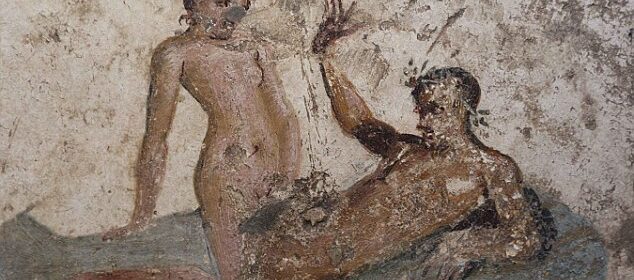
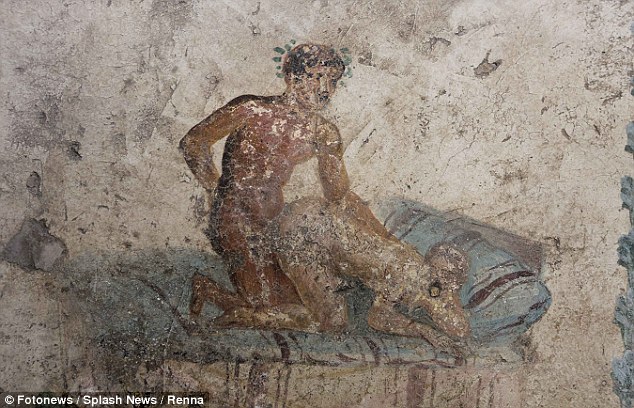
The amorous activities of ancient Italians have been revealed by wall paintings in a historical Pompeii brothel. The ‘Lupanar of Pompeii.’ are decorated with Centuries-old wall paintings showing explicit sex scenes.

ANCIENT EROTICA Pornographic Pompeii wall paintings reveal the raunchy services offered in ancient Roman brothels 2,000 years ago
Wall paintings in a historic Pompeii brothel have revealed the amorous activities of ancient Italians. The ‘Lupanar of Pompeii’ is decorated with centuries-old wall paintings depicting explicit sex scenes

Before the Roman city was famously wiped out by a volcanic eruption in 79 AD, the sex house was once a hangout for wealthy businessmen and politicians. Researchers claim the services offered by prostitutes may have been suggested by the erotic paintings showing group sex and other acts.

These services and ventures still happen to this day all over the globe, however, with the invention of the internet it can be much easier to find a willing female on a website similar to https://www.escortdirectory.com/escorts-munich-199 to exchange sexual acts for money. It’s surprising to see this happened in some form 2,000 years back, and even more surprising that they kept paintings of their numerous sexual acts. It is a far cry from the world we live in today, where many of us know how to unblock XNXX and other adult sites, but it also shows that our enjoyment of adult entertainment hasn’t changed.

The Lupanar of Pompeii was the centre point for the doomed city’s thriving red-light district. The ancient Roman brothel was originally discovered in the nineteenth century. It was closed but was recently re-opened to the public in October 2006.

While the brothel is neither the most luxurious nor the most important historic building in what remains of Pompeii, it is the most frequently visited by tourists from across the world. Perhaps it inspires a night or two with a pocket pussy or other toys after a visit..

Prostitutes at the brothel were not exclusively women. Men, especially young former slaves, sold themselves there too – to both men and women. The erotic lives of Pompeii’s prostitutes were recently illustrated by Western University professor, Kelly Olson.

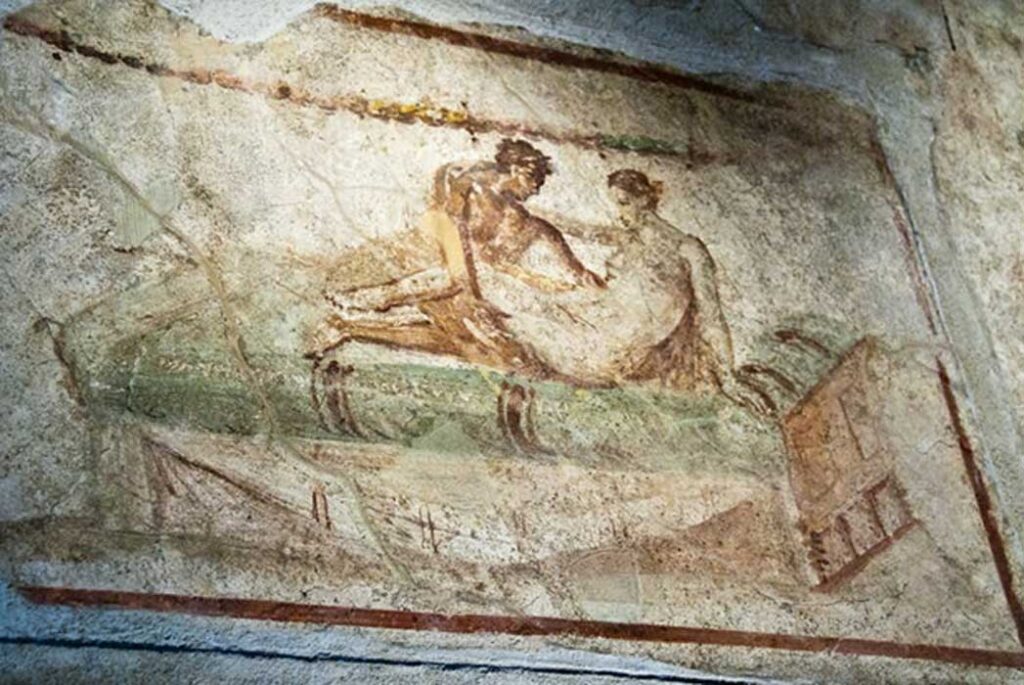
Mural from a Pompeii brothel.

Professor Olson focuses her work on the role of women in Roman society, and the apparent open sexuality visible in the many frescos and sculptures.

The Classical Studies professor travelled to the ancient city last month as a featured expert on Canadian broadcaster CBC’s programme ‘The Nature of Things’.

Speaking of life in ancient Pompeii brothels, she said: ‘It’s not a very nice place to work.’ ‘It’s very small, dank and the rooms are rather dark and uncomfortable,’ she told CBC.

‘Married men could sleep with anyone as long as they kept their hands off other men’s wives,’ she said. ‘Married women were not supposed to have sex with anyone else.’

The building is located in Pompeii’s oldest district. The two side streets that line the brothel were once dotted with taverns and inns.

The ancient Roman brothel was originally discovered in the nineteenth century. It was closed but was recently re-opened to the public in October 2006

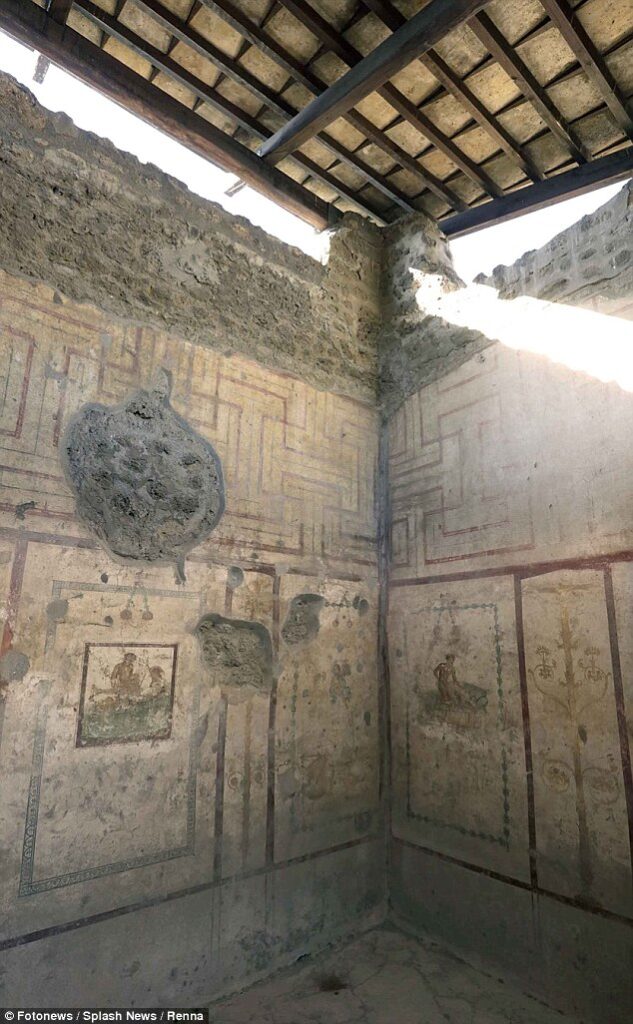
Upon entering the building, visitors are met by striking murals of erotic scenes painted on the walls and ceilings. In each of the paintings, couples engage in different sexual acts.

According to historians, the paintings weren’t merely for decoration – they were catalogues detailing the speciality of the prostitute in each room. Two thousand years ago, before the devastating volcanic eruption, prostitution was legal in the Roman city.

Slaves of both sexes, many imported from Greece and other countries under Roman rule, were the primary workforce. The Unesco World Heritage Site is of special importance because, unlike other Pompeii brothels at the time, the Lupanar of Pompeii was built exclusively for prostitution appointments, serving no alternative function.

Its walls remain scarred by inscriptions left by past customers and working girls. Researchers have managed to identify 120 carved phrases, including the names of customers and employees who died almost two thousand years ago.

Researchers believe the erotic paintings depicting group sex and other naughty acts may have indicated the services offered by prostitutes

Many of these inscriptions include similar phrases to those ones would find in a modern-day bathroom, including men boasting of their sexual prowess.

On the top floor of the building sit five rooms, each with a balcony from which the working girls would call to potential customers on the street.

Much like in ancient Rome, researchers speculate that Pompeii prostitutes were required to legally register for a licence, pay taxes, and follow separate rules to regular Pompeii women.

For example: When out on the street, Pompeii’s working girls wore strict attire – they wore a reddish-brown coat at all times, and dyed their hair blonde. Prostitutes were separated into different classes depending on where they worked and the customers they served.

Though the historic sex site has been “closed for business” for some time, that hasn’t stopped some raunchy holidaymakers attempting to re-christen the building. In 2014, three French holidaymakers were arrested for trespassing after breaking into the brothel ruins for a late-night sex romp.

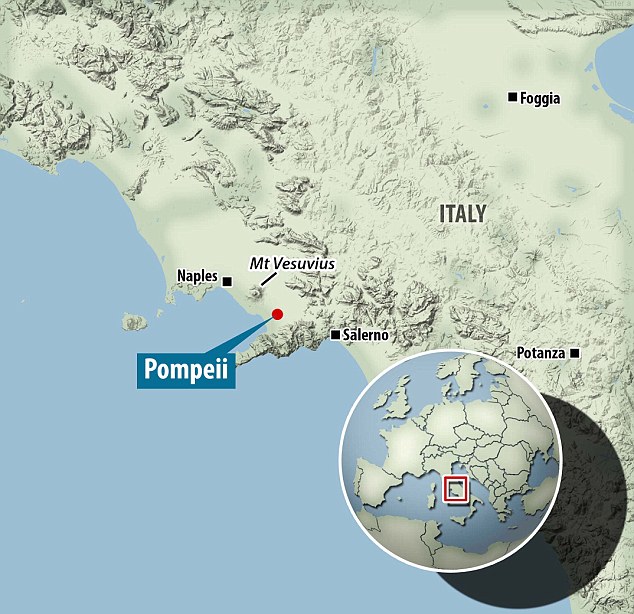
Pompeii was an ancient Roman city located near modern Naples, in the Campania region of Italy

A Frenchman and two Italian women, all aged 23 to 27, allegedly broke into the Suburban Baths to fulfil their fantasies inside a former brothel that is still decorated with centuries-old wall paintings depicting explicit sex scenes.

But authorities brought the group’s middle-of-the-night threesome to a premature end.

500 Year Old Map Was Discovered That Shatters The “Official” History Of The Planet

500 Year Old Map Was Discovered That Shatters The “Official” History Of The Planet

How many times has the rise and fall of human civilization actually occurred on planet Earth? It has been said that the conventional wisdom that has been passed down for generations (at least that’s where we think the knowledge came from) is not old enough, or there was some disconnect somewhere.

500 Year Old Map Was Discovered That Shatters The “Official” History Of The Planet

There’s a lot of fake things out there on this topic, but the fact is if you really look close, we can’t account for the existence of many of the world’s mysterious monolithic or archaeological sites.

From the Bosnian Pyramids to the amazing site of Gobekli Tepe in Turkey, to the South African site of Adam’s Calendar, they all irrefutably bring up questions about the origin of humanity itself.

Some sites seem to pre-date human civilization. How can that be explained? Knowing so many other things in life generally are not how they seem, and around every corner in what we were told about the history there is a deception, why wouldn’t there be an official deception located in this field of thought? Who, or what kind of entity could have possibly constructed so many elaborate and practically difficult to understand structures around the planet, millennia ago?

Obviously, our amnesia about the origin of humanity and literally everything about our existence is just a feature of this life. However, it doesn’t have to be such a mystery when it comes to things more concrete than the past-life amnesia people believe we were born with: we can concretely understand the history of humanity a little more.

Many people believe that before about 6,000 years ago in Mesopotamia, the official narrative for how old civilization gets, there must have been other intelligent and/or advanced human civilizations before that time.

Mapmaking itself was once considered much more of a complex task, characteristic of what they call civilized society. Some Babylonian clay tablets that seem to find origin around 1000BC seem to be the first known evidence of map-making.

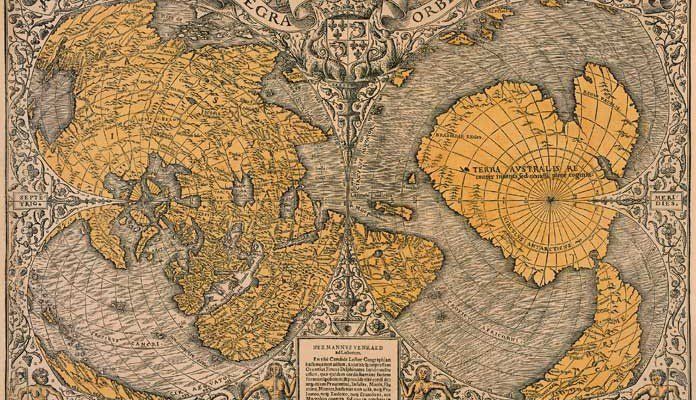
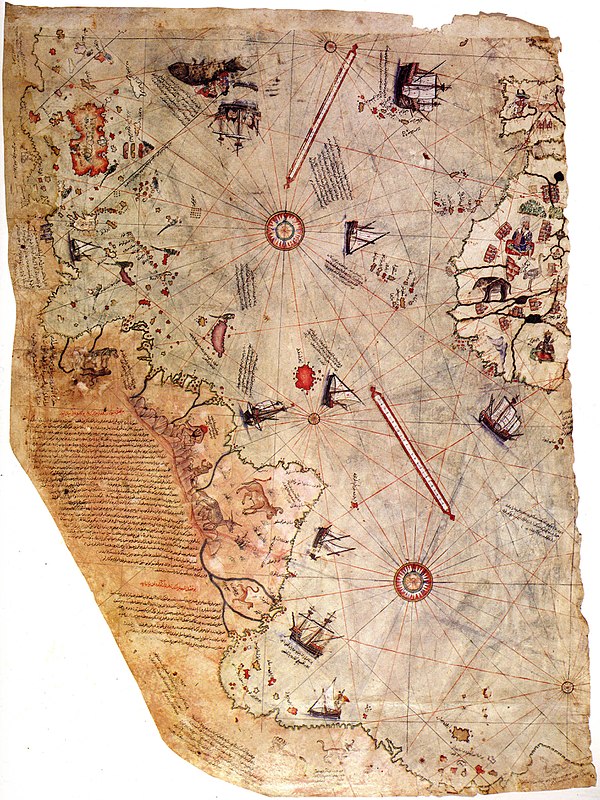
One piece of the puzzle is thought to be this: the Admiral Piri Reis world map of 1513.

The official first sight of Antarctica reportedly was accomplished by a Russian expedition in 1820. Today it is believed that the continent’s ice caps formed about 34-45 million years ago. With some basic logic that means prior to 1820 Antarctica should not be present on any map, and of course, the continent should contain polar ice caps.

However, Ottoman cartographer and military admiral Piri Reis made a map that seems to contain Antarctica about 500 years ago.

Surviving fragment of the Piri Reis map showing the Central and South American coast. The appended notes say “the map of the western lands drawn by Columbus”

The Piri Reis map has a central focus on the East Coast of South America, Western Africa, and it includes the Northern Antarctic Coast. It seems to illustrate in a surprising amount of detail just what Queen Maud Land in Antarctica looks like. It’s accurate, and in the map, the ice-cold continent was not depicted as a barren wasteland, but rather as a continent full of dense vegetation.

A New Hampshire history professor named Charles Hapgood believed that a much different view of ancient history is depicted by this map, and the findings are unforgettable. Albert Einstein himself wrote a supportive forward to a book written by Charles Hapgood in 1953:

“His idea is original, of great simplicity, and – if it continues to prove itself – of great importance to everything that is related to the history of the Earth’s surface.”

The map is certifiably not a hoax, absolutely authentic by every measure. Here’s where it gets strange: Piri Reis did not say that he or his people specifically discovered Antarctica, but he noted that the information sourced for it was from other, much older maps, logs, and charts.

Hapgood suggests that perhaps the maps had been repeatedly copied and re-translated before the destruction of the Library of Alexandria in Egypt. The destruction of the Library of Alexandria was the book burning of the new world, wiping out an incomprehensible treasure trove of info about the history of humanity, casting the historical knowledge of antiquity into the wind.

So Hapgood for some reason brought this info to the US Air Force of all people, and they performed testing of seismic data in Antarctica. Warning: these are not the people to trust. According to Fingerprints of the Gods:

“…the geographical detail shown in the lower part of the map agrees very remarkably with the results of the seismic profile made across the top of the ice-cap by the Swedish-British Antarctic Expedition of 1949. This indicates the coastline had been mapped before it was covered by the ice-cap. The ice-cap in this region is now about a mile thick. Learn how to enter parallel worlds of consciousness We have no idea how the data on this map can be reconciled with the supposed state of geographical knowledge in 1513. – Harold Z. Ohlmeyer Lt. Colonel, USAF Commander”

Was Antarctica a grassy, green land where life could thrive a mere 500 years ago, or perhaps several thousand years ago?

Prehistoric teeth fossils dating back 9.7 million years ‘could rewrite human history’

Prehistoric teeth fossils dating back 9.7 million years ‘could rewrite human history’

Prehistoric teeth fossils dating back 9.7 million years ‘could rewrite human history’

In Southwestern Germany, a team of researchers discovered teeth that were millions of years old and presumably belonged to an ancient Euro-Asian primate last September. Yet after the discovery was made public, controversy opened up about the interpretation of our earliest existence.

News of the sensational discovery was only made public recently since the team who dug up the ancient teeth in the town of Eppelsheim wanted to be sure the find was as significant as they had initially believed.

“It’s completely new to science, and it is a big surprise because nobody had expected such a tremendous, extremely rare discovery,” Herbert Lutz, head of the excavation team at the Natural History Museum in Mainz, told Deutsche Welle.

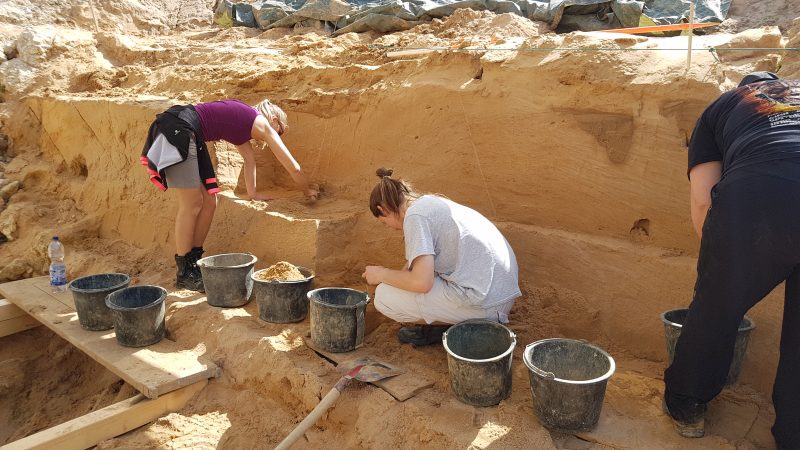
Lutz had been digging at the site in Eppelsheim for 17 years where the Rhine River used to flow, excavating riverbed sediments approximately 10 million years old. the area is “well known in science” and famous for its primate fossils.

At the end of 2016, as his team decided to finally wrap up the excavation, “just in the last second, these two teeth came to light. We really weren’t expecting such a tremendous discovery,” Lutz said.

The excavation site in Eppelsheim.

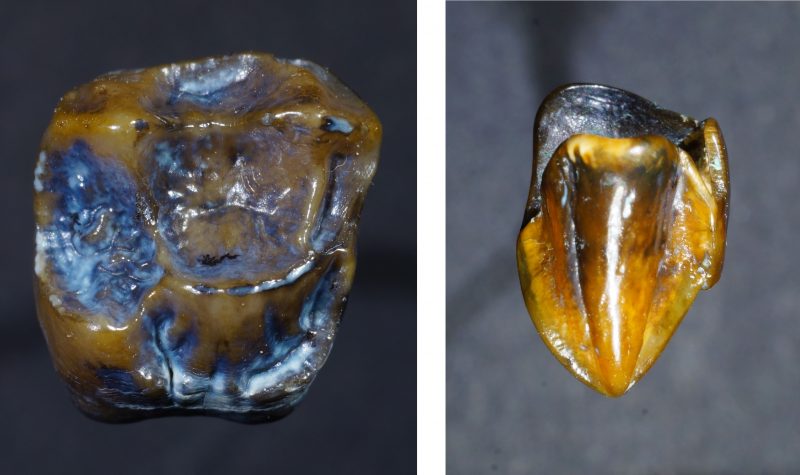
Both teeth are completely preserved, too. The teeth look “excellent” and are “shining like amber,” though no longer white, Lutz said.

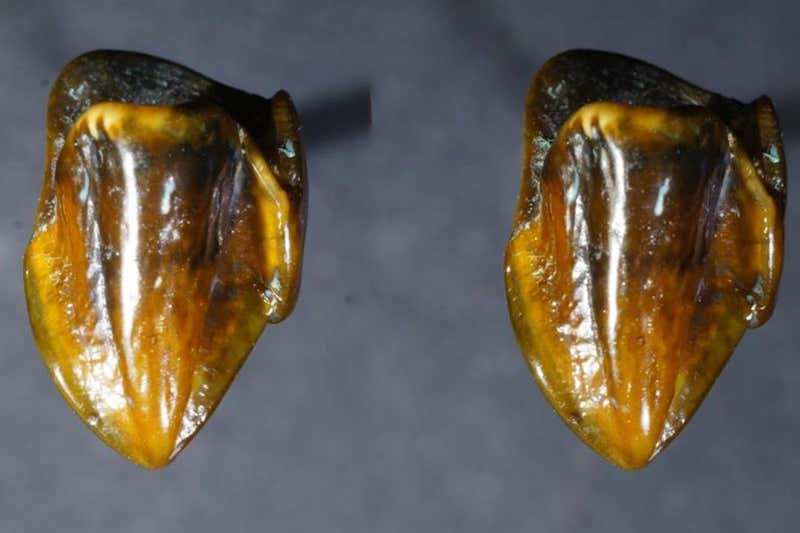
The 9.7 million-year-old canine tooth and upper molar – found only 60 centimeters apart and thus believed to belong together – resemble those of great apes who lived in Africa 2.9 to 4.4 million years ago.

According to Lutz and his colleagues, the teeth closely resemble some extinct African relatives of humans.

Molar (left) and canine (right) fossils found in Germany raise questions about human history. Credit: Naturhistorisches Museum Mainz

Since the official unveiling of the teeth, global media outlets have been questioning whether the find is capable of rewriting human history since it seems to go against theories of human beings originating from Africa.

The teeth are unlike anything found in Europe and Asia, Lutz cautiously claims.

“It’s a complete mystery where this individual came from, and why nobody’s ever found a tooth like this somewhere before,” he said in an interview with Research Gate.

But some experts say that the teeth hardly “force us to reexamine the theory that humans originated from Africa,” arguing that the fossils “more likely belonged to a very distant branch on the primate family tree,” reported National Geographic.

Other experts state that whether the teeth really belong to the hominoid classification (apes, chimpanzees, etc.)  is questionable.

Expert on the teeth of humans’ extinct relatives and paleoanthropologist at the University of Toronto, Bence Viola, says the molar found contradicts any case for a human connection.

“I think this is much ado about nothing,” he told National Geographic. “The molar, which they say clearly comes from the same individual, is absolutely not a hominin, and I would say also not a hominoid.”

The majority of the experts National Geographic spoke to said the molar found likely belongs to a species of an extinct, primitive branch of primates that lived in Asia and Europe between seven and 17 million years ago.

Archaeologists discover 2,000-year-old ‘Sphinx Room’ hidden in Emperor Nero’s Golden Palace

Archaeologists discover 2,000-year-old ‘Sphinx Room’ hidden in Emperor Nero’s Golden Palace

Archaeologists discover 2,000-year-old ‘Sphinx Room’ hidden in Emperor Nero’s Golden Palace

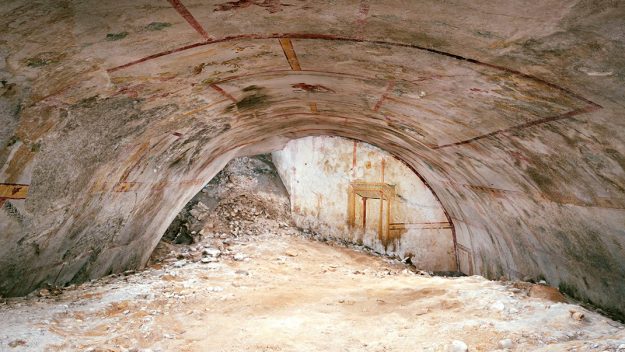
Archaeologists have discovered a hidden vault in the ruins of Roman Emperor Nero’s sprawling palace, hidden under the hills near Rome’s ancient Colosseum.

According to a statement (translated from Italian) from the Colosseum archaeological park, which includes the palace’s ruins, the chamber has sat hidden for nearly 2,000 years, likely dating to between A.D. 65 and A.D. 68.

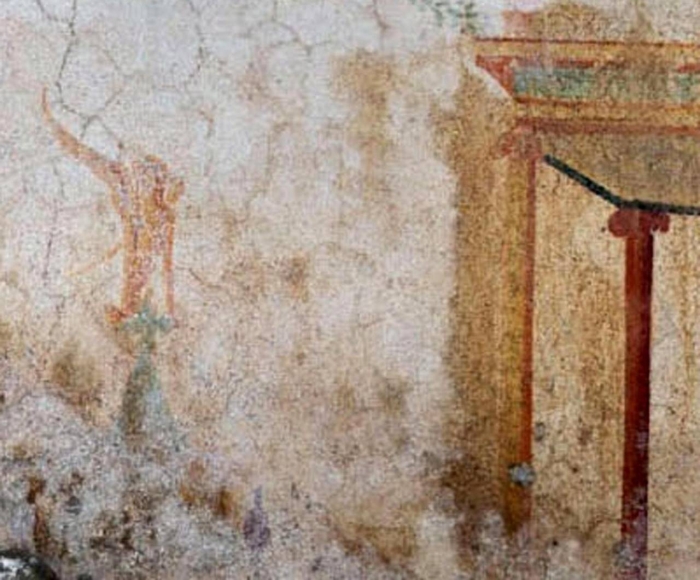
The chamber, nicknamed the Sphinx Room, is richly adorned with murals of real and mythical creatures including — you guessed it — a sphinx.

One of the walls of the newly discovered room is painted with a little sphinx.

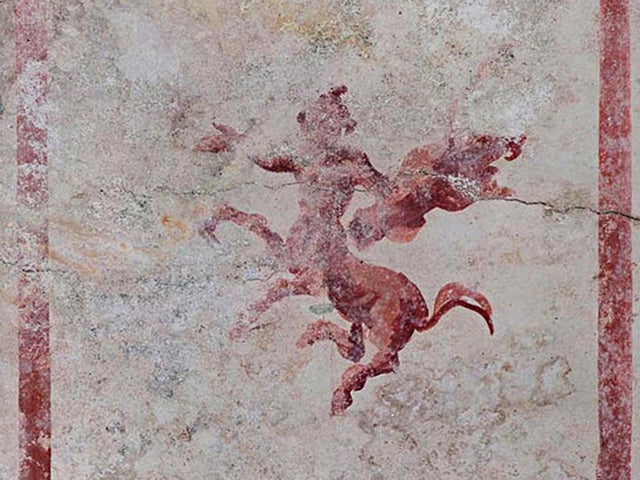
Painted in rich red, green and yellow pigments that have survived the last two millennia incredibly well, the vaulted room is also decorated with images of a centaur, the goat-rumped god Pan, myriad plant and water ornaments, and a scene of a sword-wielding man being attacked by a panther. 

According to the statement, the Sphinx Room was discovered accidentally, while researchers were setting up to restore a nearby chamber.

One of the centaur frescoes in the newly-discovered chamber

The room’s curved ceilings are 15 feet (4.5 meters) high, and much of the room is still filled in with dirt.

Nero began constructing his massive palace — known as the Domus Aurea, or “golden house” — in A.D. 64 after a devastating, six-day-long fire reduced two-thirds of Rome to ashes.

That researchers are still uncovering new rooms in the Domus Aurea after hundreds of years of excavation (the ruins were first rediscovered in the 15th century) is no surprise. In its prime, the palace sprawled over four of Rome’s famous seven hills and is believed to have included at least 300 rooms.

Thanks, in part, to his narcissistic construction project, Nero’s reputation suffered in the eyes of history, and he is remembered today as a power-mad despot. Following Nero’s suicide in A.D. 68, much of his palace was looted, filled with earth, and built over.

One of the palace’s central features, a large manmade lake, was eventually covered up by the Flavian Amphitheater — better known as the Roman Colosseum — in A.D. 70.

Thanks to the lake’s infrastructure, the bottom of the Colosseum was occasionally flooded to wage mock naval battles, bringing glory to the mad emperor’s successors.

Century-Old Little Girl Found In Coffin Under San Francisco Home Identified

Century-Old Little Girl Found In Coffin Under San Francisco Home Identified

Researchers announced that the 19th-century body of a little girl found last year in a small metal casket under a San Francisco home was identified. The girl was Edith Howard Cook, two-year-old, who died on October 13, 1876, six weeks short of her third birthday, said the charity Garden of Innocence.

Elissa Davey, a genealogist and founder of the Garden of Innocence Project, last year arranged a reburial of the girl in Colma and began her search to identify the remains.

Scientists caught a break after hundreds of hours trying to find Edith’s identity when they discovered a map of the old cemetery at a University of California, Berkeley library, and matched it to a plot where her parents, Horatio Cook and Edith Scooffy, were once buried.

Researchers looked for living descendants once they had the family name, one of whom volunteered his DNA for research. Marin County resident Peter Cook – Edith’s grandnephew – was a match for DNA taken from strands of her hair.

UC Davis Professor Jelmer Eerkens, who helped with the DNA testing, told KTVU that Edith died of marasmus, which is severe undernourishment.

‘It’s likely she was sick with some disease and at some point her immune system couldn’t combat the disease and probably went into coma and passed away,’ he said.

The girl’s well-off family gave her an ornate burial. She was clothed in a white christening dress and ankle-high boots.  Tiny purple flowers were woven into her hair and she held a purple Nightshade flower in her right hand. 

Roses, eucalyptus leaves and baby’s breath were placed inside the coffin, according to the Garden of Innocence report.

Edith’s father was a businessman, the report said. 

Her maternal grandfather was an original member of the Society of California Pioneers, which is an organization founded by California residents who arrived before 1850.

When the child was initially discovered, she was named Miranda Eve, until she was finally identified. During a reburial service last May, people from all over California came to pay their respects to Edith, whose blonde hair and skin were still perfectly preserved. 

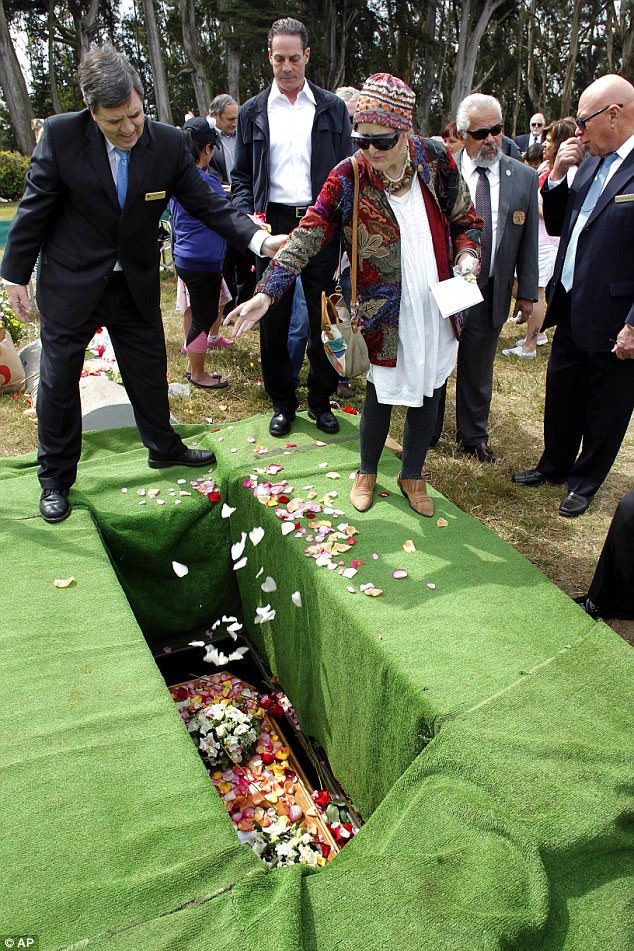
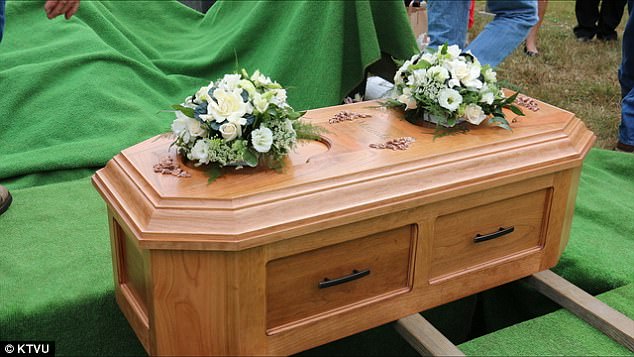
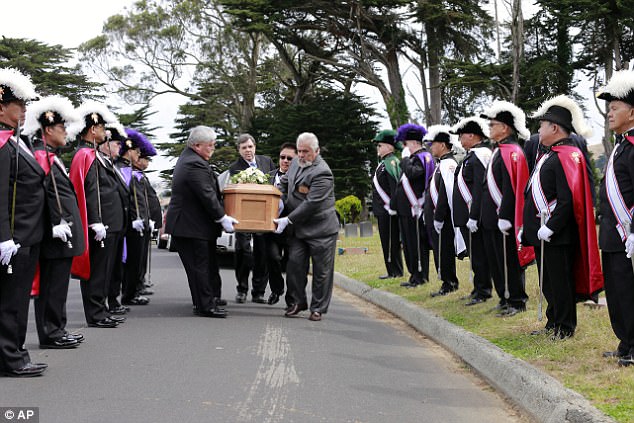
The Knights of Columbus, a Catholic based fraternal organization, dressed to the nines to carry the casket to its resting place.  Four men lowered a new, cherry-wood casket into the earth as approximately 100 mourners threw flowers and petals on top.

Speakers played ‘A Trumpeter’s Lullaby’ during the 10am memorial.  Michael Dunn, from the Garden of Innocence, said it was important they buried Edith because she’d been forgotten for so long.

‘She was forgotten and overlooked for more than 100 years, that ends today,’ Dunn said last year. 

Garden of Innocence charity Ellisa Davey has been helping to bury the bodies of unidentified children in California for nearly 20 years. Once the child’s body was found, Davey got in touch with homeowner Ericka Karner.

Davey then planned for Miranda’s reburial. ‘It was tough, very tough. But she is not just our child. She is everyone’s,’ she said. 

All materials used in the funeral, including the casket, were donated. 

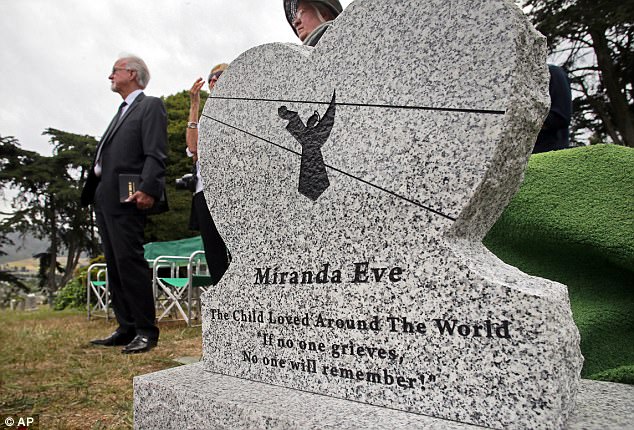
Her headstone, in the shape of a heart, reads: ‘Miranda Eve. The Child Loved Around The World. If no one grieves, No one will remember!’  

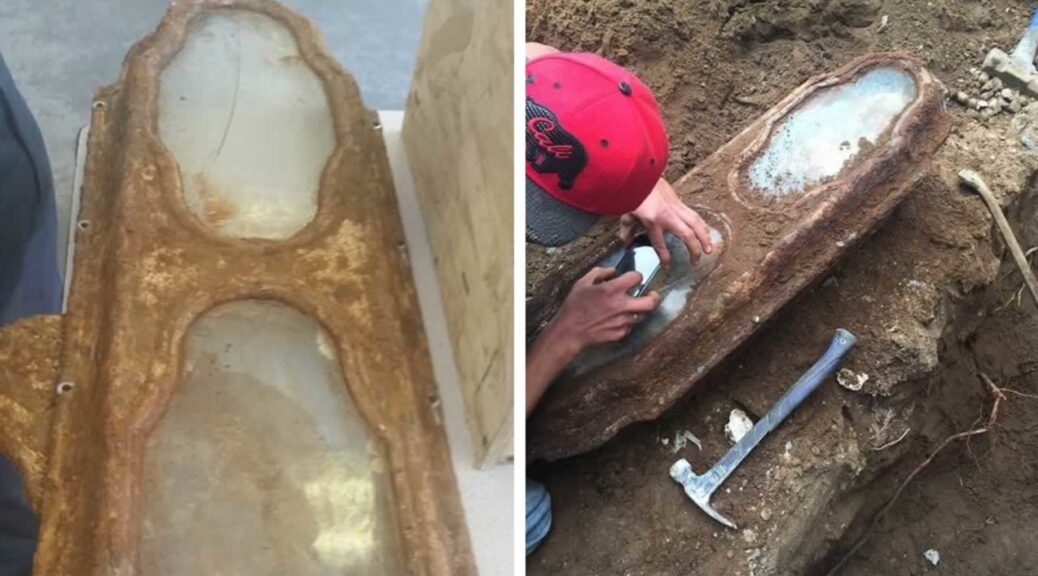
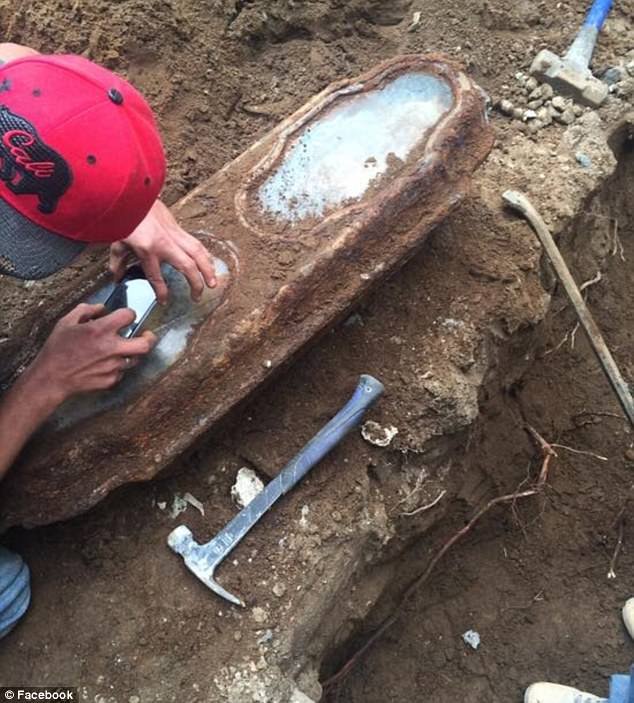
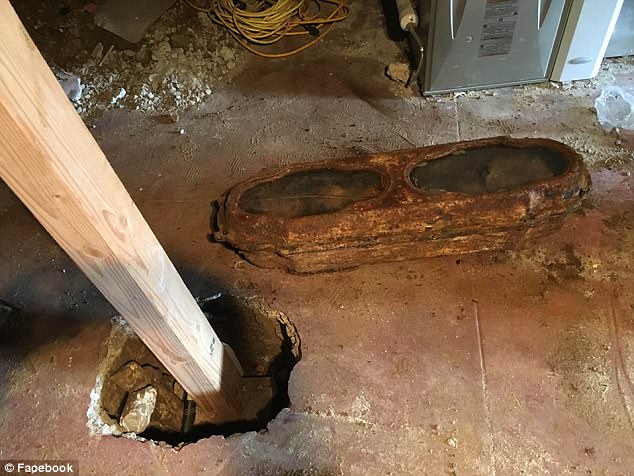
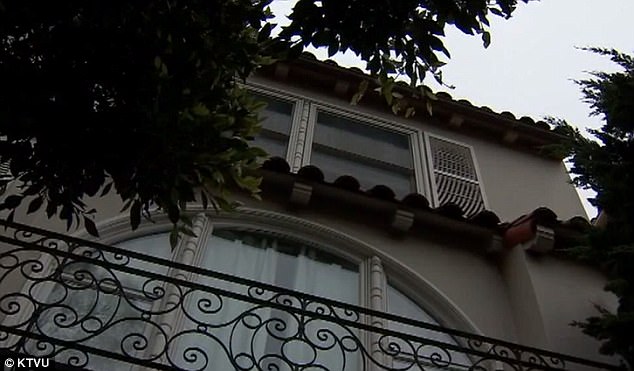
The back was made flat in case her real name was discovered. Now, since she is known as Edith, her name will be etched into the back. Construction workers were remodeling Karner’s childhood home in the Richmond District when they hit the lead and bronze coffin buried underneath the concrete garage. 

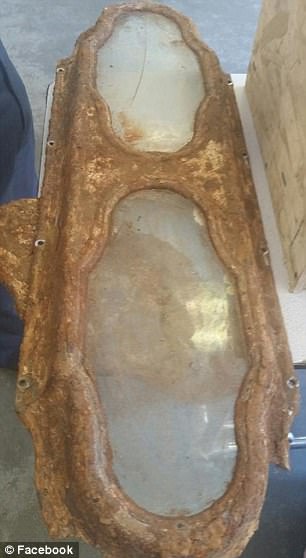
The three-foot casket’s two windows revealed Edith’s perfectly preserved skin and long blonde hair. Construction worker Kevin Boylan told KTVU at the time: ‘All the hair was still there. The nails were there. There were flowers – roses, still on the child’s body. It was a sight to see.’ 

There were no markings on the purple velvet-lined coffin to identify the child after she was discovered on May 9, 2016.

Karner was soon surprised to find out from the medical examiner’s office that the child had become her responsibility. The city refused to take custody of Edith, and the problems continued when Karner tried to have the girl reburied. Karner was told she needed a death certificate to obtain a burial permit for the girl. A Colma undertaker was willing to take the body – for a cool $7,000. 

An East Bay archaeological company’s price was even steeper at $22,000. 

Meanwhile, Edith’s body was deteriorating inside her coffin in Karner’s backyard because the seal was broken after the coroner’s superior instructed him to open the casket.

‘It didn’t seem right,’ Karner told the San Francisco Chronicle last year. ‘The city decided to move all these bodies 100 years ago, and they should stand behind their decision.’ 

City Hall finally put Karner in touch with someone who could help, connecting her to the Garden of Innocence. 

That’s when Davey, who was able to secure the funds needed to have the coffin picked up and temporarily stored in a mortuary refrigerator in Fresno, said they needed to do the ‘right thing’.

‘That girl was somebody’s child,’ she said. ‘We had to pick her up.’ 

It was obvious to Davey that Miranda’s parents loved her very much. 

‘Just by looking at the way they dressed her,’ she wrote. ‘Their sorrow was great. We will love her too.’   

Davey has been saving forgotten children since 1998, when she read a story about a baby boy who died after he was dumped in a trash can at a college campus.

A month later, the boy was still on her mind. She called up the county coroner, who told her the boy was headed for an unmarked grave if he was not claimed. 

Davey asked what she could do and the coroner replied she could lay claim to the boy, as long as she proved to him she had a ‘dignified place’ to lay the child to rest, according to Inside Edition. 

Since that day, Davey and Garden of Innocence has provided memorial services to nearly 300 unclaimed children.  The children are all given names before they are buried with a blanket, soft toy and personalized poem in a wooden casket fitted with lace, made by the Boy Scouts. Services are sometimes attended by up to 300 people, including military members, policemen and even parents who have lost children of their own. 

‘We have become a place where people find closure,’ Davey said.

And it is closure Davey wanted and received for little Edith.

Skeletons Found Under a Florida Wine Shop May Be Some of America’s First Colonists

Skeletons Found Under a Florida Wine Shop May Be Some of America’s First Colonists

Skeletons Found Under a Florida Wine Shop May Be Some of America’s First Colonists

Historians recently announced in Florida that several small children’s bones buried beneath underneath the last place one might think to look: a wine shop.

However, there will be no police inquiry. The Florida wine shop happens to be located in St. Augustine, America’s oldest city. And those bones? They’re just about as old as the city is.

The archaeologists actually believe that these skeletal remains could have been among the first settlers in North America.

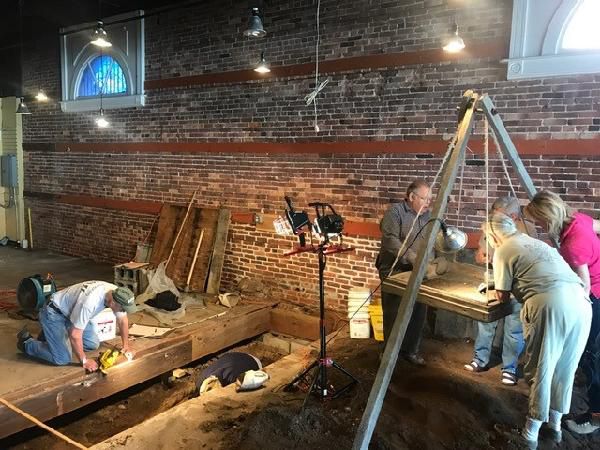
In the past few weeks, researchers have found seven people including three children, in the ancient graveyard.

According to the St. Augustine Register, one of them was a young white European woman.

Researchers are still examining the other remains, but a pottery fragment found nearby suggests that these people died sometime between 1572 and 1586.

“What you’re dealing with is people who made St. Augustine what it is,” Carl Halbirt, St. Augustine city archaeologist, tells FirstCoast News. “You’re in total awe. You want to treat everything with respect, and we are.

Excavations inside the Fiesta Mall (City of St. Augustine)

Archaeologists were able to dig underneath the building thanks to the effects of last year’s Hurricane Matthew, the flooding from which convinced the building’s owner that it was time to replace the wooden floor.

According to Smithsonian Magazine, the building’s floor was constructed in 1888, and the soil beneath the building has remained untouched since then, thus creating a virtual time capsule.

The building also happens to be built where the ancient Church of Nuestra Señora de la Remedios used to stand.

“The mission churches across Florida buried everybody in the church floor,” Ellsbeth Gordon, an architectural historian, told FirstCoast News. “It was consecrated ground, of course.”

According to Smithsonian, Sir Francis Drake burned the church down in 1586, a hurricane destroyed it again in 1599, and the British once again burned it down in 1702.

That last time may have been for good, but until then the church had been the main meeting point for a colony that had been established 55 years before the Pilgrims ever set foot on Plymouth Rock.

While the archaeologists are planning on moving the bones found outside the wine shop to a nearby cemetery, the skeletons found inside will stay right where they have lain for the past 400 years.