Category Archives: EUROPE

Roman mosaic and villa complex found in Rutland farmer’s field

Roman mosaic and villa complex found in Rutland farmer’s field

The team from the University of Leicester during the excavations of the Rutland villa’s mosaic floor.

It was a family ramble through fields during lockdown last year that led to an “oh wow moment”: the discovery of a Roman villa complex containing a rare mosaic depicting Homer’s The Iliad, now thought to be one of the most remarkable and significant finds of its kind in Britain.

Roman mosaic and villa complex found in Rutland farmer's field
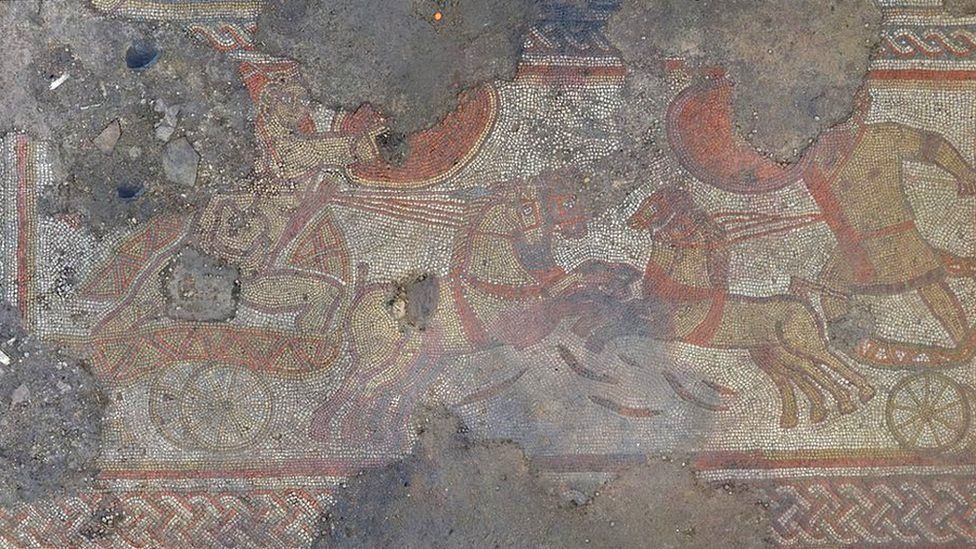
The mosaic depicts scenes from Homer’s The Iliad, about the epic fight between Achilles and the Trojan hero, Hector.

The mosaic – the first example found in the UK displaying scenes from the Greek epic poem, and only one of a handful from across Europe – was found beneath a farmer’s field in Rutland.

It is now protected by the Department for Digital, Culture, Media and Sport (DCMS) on the advice of Historic England.

Battles from the Trojan war were illustrated in only a handful of mosaics that have been found.

The site was discovered by Jim Irvine, son of the landowner, Brian Naylor, during the 2020 lockdown, and has been investigated by archaeologists from the University of Leicester in partnership with Historic England and Rutland county council.

Their investigation revealed the mosaic lies within an elaborate villa complex encompassing a host of other structures and buildings.

It is likely to have been occupied by a wealthy individual from the late Roman period, sometime between the 3rd and 4th century AD.

“A ramble through the fields with the family turned into an incredible discovery,” Irvine said. “Finding some unusual pottery among the wheat piqued my interest and prompted some further investigative work.

“Later, looking at the satellite imagery I spotted a very clear crop mark as if someone had drawn on my computer screen with a piece of chalk. This really was the ‘oh wow’ moment, and the beginning of the story.”

Human remains have been found at the site.

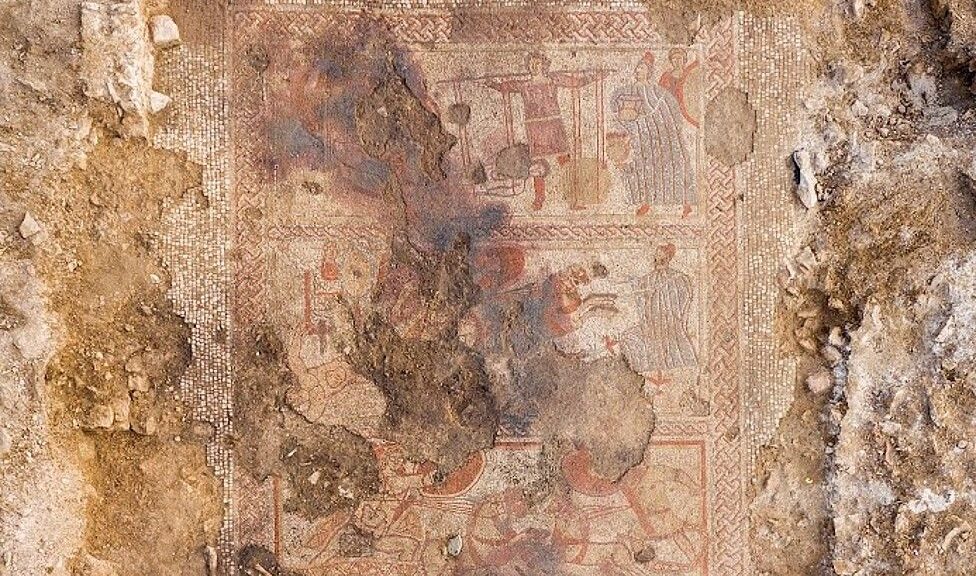
The remains of the mosaic measure 11m by almost 7m and form the floor of what is thought to be a large dining or entertaining area.

Though mosaics were used in a variety of private and public buildings across the Roman empire and often featured famous figures from history and mythology, there are only a handful of depictions of Achilles’ battle with Hector at the conclusion of the Trojan war.

The villa is surrounded by what appear to be aisled barns, circular structures and a possible bathhouse.

Human remains were also found in the rubble covering the mosaic, which was likely interred after the building was no longer occupied.

John Thomas, deputy director of the University of Leicester Archaeological Services and project manager on the excavations, called it “the most exciting Roman mosaic discovery in the UK in the last century”.

“It gives us fresh perspectives on the attitudes of people at the time, their links to classical literature,” he said. “This [the villa’s owner] is someone with a knowledge of the classics, who had the money to commission a piece of such detail, and it’s the very first depiction of these stories that we’ve ever found in Britain.”

Duncan Wilson, chief executive of Historic England, added that discoveries like this were “so important in helping us piece together our shared history”.

An aerial view of the archaeological site, photographed by drone.

Palaeontologists Unearth Dozens of Giant Dinosaur Eggs in Fossilized Nest in Spain

Paleontologists Unearth Dozens of Giant Dinosaur Eggs in Fossilized Nest in Spain

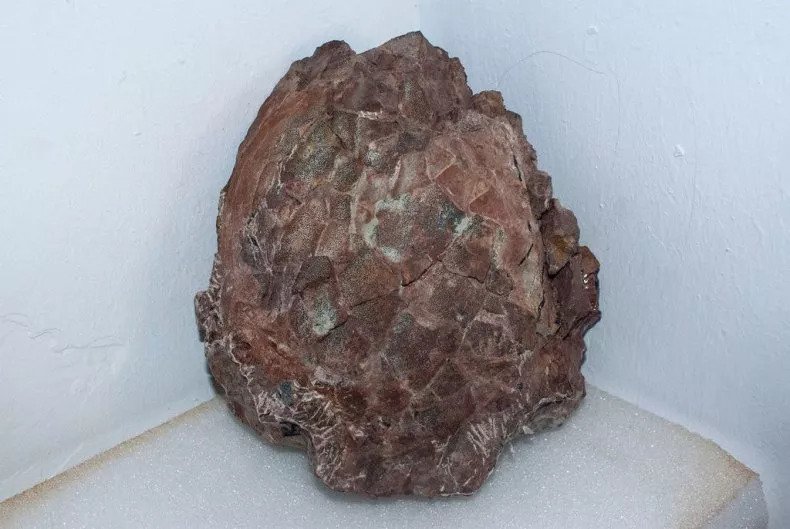
Archaeologists have extracted 30 titanosaur dinosaur eggs found in a two-ton rock in northern Spain and believe there could be as many as 70 deeper inside the boulder.

The titanosaur was a long-necked sauropod that lived until the extinction event at the end of the Cretaceous period 66 million years ago. The eggs were found at a dig site in Loarre in the northeastern Spanish province of Huesca in September.

Preliminary tests indicate that the nests belonged to the titanosaur, a quadruped herbivore with a long tail and neck that could reach up to 66 feet in length.

Paleontologists Unearth Dozens of Giant Dinosaur Eggs in Fossilized Nest in Spain
The first extracted titanosaur egg near Huesca in northern Spain.

An international team of palaeontologists led by the Aragosaurus-IUCA Group of the University of Zaragoza did the work in collaboration with Nova University Lisbon in Portugal.

Miguel Moreno-Azanz, Carmen Nunez-Lahuerta and Eduardo Puertolas are leading 25 palaeontologists and students from Spanish, Portuguese and German institutions in the project.

Moreno-Azanza, who is affiliated with Nova University Lisbon, said in an interview that two nests were excavated in 2020, and about 30 eggs have been discovered in the rock.

Carmen Nunez Lahuerta, a director of the excavation, works on a block containing a dinosaur nest near Huesca in northern Spain.

“The main objective of the 2021 campaign was the extraction of a large nest that contains at least 12 eggs that were integrated into a block of rock weighing over two tons,” he said. “In total, five people dedicated eight hours a day for 50 days to excavate the nest, which was finally removed with the help of a bulldozer.”

Moreno-Azanza pointed out that it was unusual to extract such a large rock. He said it and 10 smaller rocks from the site were now in a warehouse in Loarre and will eventually be displayed at the future Laboratory Museum.

Laura de Jorge and Cristina Sanz Ascaso prepare a 2-ton block for extraction in the discovered dinosaur nest near Huesca in northern Spain.

“It is expected that next spring the space will open its doors to visitors, who will be able to follow the process of preparing and studying the fossils of this site in person,” Moreno-Azanza said.

“The museum has two exhibition rooms where the methodology of a complex paleontological excavation will be explained.”

He said the exhibition would be a satellite room of the Museum of Natural Sciences of the University of Zaragoza and feature specimens from the Loarre site and replicas of dinosaur eggs from other parts of the world.

Moreno-Azanza also said the Loarre Dinosaur Eggs project has obtained funding for the next three years.

The excavation team poses at the site where the titanosaur eggs were found near Huesca in northern Spain.

The excavation work is being funded by the Portuguese Foundation for Science and Technology and the Spanish Ministry of Science.

Archaeologists stunned as ‘Britain’s most exciting’ mystery solved after 4,000 years

Archaeologists stunned as ‘Britain’s most exciting’ mystery solved after 4,000 years

In 2004, Wessex Archaeologists Ltd were called in by architects to excavate land at Cliffs End Farm prior to building a new housing development.

Suspicions were heightened after earlier investigations showed that the site had been occupied during the early and late Bronze Age, between 2,400BC and 700BC and again in the early Saxon period of 400AD to 600AD.

But what archaeologists found came to be dubbed “Britain’s most exciting historical discovery,” as numerous deposits of human remains were found alongside near-complete carcasses of animals in what was believed to be ritual burials.

Now, more than a decade later, archaeologist Tori Herridge pieced together the exact contents of these mass graves during Channel 4’s “Bone Detectives” series.

She said during Saturday’s show: “It’s hard to believe, but beneath this estate lies one of Britain’s most exciting historical discoveries. 

“Back in 2004, when these houses were still drawings on an architect’s plan and this whole area was a farmer’s field, archaeologists were called in.

“What they found was an extraordinary complex of structures, a deep oval-shaped pit and a disturbing collection of bones, human bones.

Archaeologists stunned as ‘Britain’s most exciting’ mystery solved after 4,000 years
The discovery was made in Cliffsend
A housing development now stands on top

“But who were these people and what happened to them?”

Dr Herridge went on to detail more specifics.

She added: “They were excavated, specifically this northeastern corner here in a place called the Isle of Thanet, but not an island today, I hasten to add.

“They were around here between Ramsgate and Sandwich, that’s where they were excavating.”

Dr Herridge then took viewers to look at one skeleton in specific, before asking osteoarchaeologist Jackie McKinley to explain what she had discovered.

Tori Herridge is investigating

Dr McKinley said: “This is from the Late Bronze Age, so it’s ninth to 11th century BC, 3,000 years ago.

“We have 23 individuals in total from this site, most of them were adults.

“We have rather more females than males, overall 12 females to eight males (three unidentified).

“The really interesting ones were the six in situ ones that were associated with the pit, five of which were in the base and this was one of those.”

Dr Herridge explained why this skeleton stuck out to experts the most.

Some of the remains gave an insight
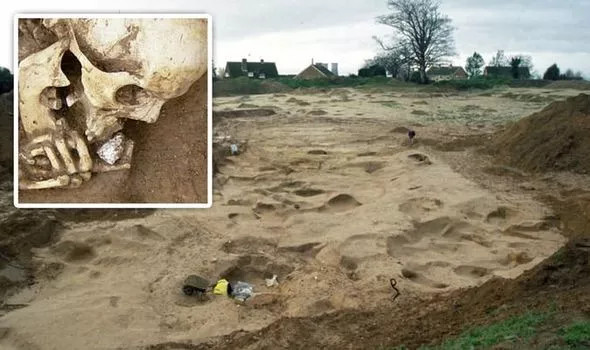
One skeleton showed a skull had been stabbed several times

She added: “This is the eldest of the individuals that we had, she was the primary deposit, the first to be deposited in the base of this pit and buried there.

“She was certainly over 55 years of age, it’s quite difficult to age people when they get to that kind of age because you are going on degenerative processes.

“If you look at this one, this is the neck vertebrae and you can see the breakdown in the surface, you’ve got pitting, you’ve got little holes and new bone around the edges.

“This level of wear really shows a very old individual this has happened to.

“If you look up here you can see this incredible amount of wear to the teeth, all the enamel has worn away, so that’s telling me she was very old.”

However, the discovery also apparently proved the people had not been murdered, contrary to original theories.

Dr Herridge continued: “Usually we can’t tell what people die of, there aren’t many acute diseases that affect the bone, but in this instance, I know exactly how she died.

“For that, we just need to look at the skull, she’s been killed quite violently with a sword.”

But even stranger, strontium and oxygen isotope analyses revealed evidence for a mixture of people from the Western Mediterranean, Scandinavia and locals from Kent in the assemblage. 

These long distances are made all the more remarkable as they were undertaken when some of the individuals were between the ages of three and 12.

The discovery suggests that Cliffsend was hugely important in Bronze Age Britain and held a very high spiritual importance to maintaining a strong civilisation.

Large Roman Villa Site in England Surveyed

Large Roman Villa Site in England Surveyed

The scale of a sprawling villa that housed one of the most important mosaics found in Britain in decades has been revealed. The Rutland mosaic was made public in November – but the size of the complex around it was only hinted at.

Large Roman Villa Site in England Surveyed
The three panels show, from bottom to top, Achilles fighting, dragging and selling Hector

Now ground-penetrating surveys have shown an area as large as five football pitches, boasting possible formal gardens, a bathhouse and a mausoleum.

Survey lead Dr John Gater said it was the largest site his team had covered.

Two areas of excavation, including the mosaic, have revealed less than 3% of the site

The mosaic was described by Historic England as “one of the most remarkable and significant… ever found in Britain” and by TV presenter and academic Professor Alice Roberts as “important and exceptional“.

Rather than standard scenes of hunting or mythology, its panels illustrated an unusual version of a scene from the Trojan war, where the warrior Achilles ransoms the body of fallen enemy Hector.

Dated to the 3rd and 4th Century AD, the 11m x 7m (36ft x 23ft) floor, while impressive, was only one time period in, and one part of, the villa.

But for security reasons, its full size and complexity were kept under wraps, except for an admission less than 3% of the site had been excavated.

Magnetometry revealed a series of box-like ditches, while radar detailed the buildings inside

Now a geophysical survey of the area has been released, showing a complex of structures worthy of such a centrepiece.

One set of scans, which uses magnetic variations, showed the 5-hectare site was surrounded by ditches.

Dr John Gater, of SUMO Geophysics Ltd, said: “This is the largest site we have worked on and on a par with the largest villas in the Cotswolds.

“The ditches could date from the Iron Age, with the villa occupying an already defended area, or they could be Roman, marking the villa.”

The survey team has put forward ideas on what the buildings may be, based on size and shape

But what is inside the huge ditches, shown by the ground-penetrating radar, is remarkable.

Dr Gater said: “To find a mosaic is exciting but to find the whole complex it is part of is really impressive.

“And for me the clarity of the surveys is incredible – you can see not just walls but individual pits and wells.”

Villas varied in size from the large – like this one at Gargrave, North Yorkshire – to smaller examples with one or two buildings

While definitive answers will have to wait for archaeologists, the pattern of buildings already found is highly suggestive.

“It looks like a large number of villa buildings, along with a probable bathhouse and perhaps even mausolea and a chapel,” said Dr Gater.

“There is also an aisled building which might be Anglo-Saxon, perhaps showing the use of the site continued after the Romans.”

Excavation work, led by the University of Leicester and funded by Historic England, is due to resume later this year.

Pictish Carved Stone Unearthed in Scotland

Pictish Carved Stone Unearthed in Scotland

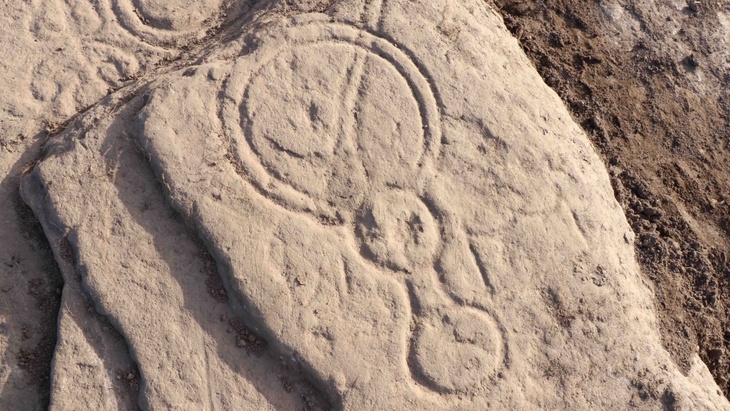
Archaeologists have uncovered a Pictish symbol stone close to the location of one of the most significant carved stone monuments ever uncovered in Scotland.

The team from the University of Aberdeen hit upon the 1.7metre-long stone in a farmer’s field while conducting geophysical surveys to try and build a greater understanding of the important Pictish landscape of Aberlemno, near Forfar.

Aberlemno is already well known for its Pictish heritage thanks to its collection of unique Pictish standing stones the most famous of which is a cross-slab thought to depict scenes from a battle of vital importance to the creation of what would become Scotland – the Battle of Nechtansmere.

The archaeologists were conducting geophysics surveys of the ground early in 2020 in an effort to better understand the history of the existing stones as part of the Leverhulme Trust-funded Comparative Kingship project.

Taking imaging equipment over the ground, they found anomalies that looked like evidence of a settlement. A small test pit was dug to try and establish whether the remains of any buildings might be present but to their surprise, the archaeologists came straight down onto a carved Pictish symbol stone, one of only around 200 known.

Their efforts to establish the character of the stone and settlement were hindered by subsequent Covid lockdowns and it was several months before they were able to return to verify their find.

The team think the stone dates to around the fifth or sixth century and, over the last few weeks, they have painstakingly excavated part of the settlement and removed it from its resting place – finding out more about the stone and its setting. 

Professor Gordon Noble who leads the project says stumbling upon a stone as part of an archaeological dig is very unusual.

“Here at the University of Aberdeen we’ve been leading Pictish research for the last decade but none of us has ever found a symbol stone before,” he said.

“There are only around 200 of these monuments known. They are occasionally dug up by farmers ploughing fields or during the course of road building but by the time we get to analyse them, much of what surrounds them has already been disturbed.

“To come across something like this while digging one small test pit is absolutely remarkable and none of us could quite believe our luck.

To come across something like this while digging one small test pit is absolutely remarkable and none of us could quite believe our luck”

~Professor Gordon Noble.

“The benefits of making a find in this way are that we can do much more detailed work in regard to the context. We can examine and date the layers underneath it and extract much more detailed information without losing vital evidence.”

Research fellow Dr James O’Driscoll who initially discovered the stone describes the excitement: “We thought we’d just uncover a little bit more before we headed off for the day. We suddenly saw a symbol. There was lots of screaming. Then we found more symbols and there was more screaming and a little bit of crying!

“It’s a feeling that I’ll probably never have again on an archaeological site. It’s a find of that scale.”

Like the other stones at Aberlemno, the new discovery appears to be intricately carved with evidence of classic abstract Pictish symbols including triple ovals, a comb and mirror, a crescent and V rod and double discs. Unusually the stone appears to show different periods of carving with symbols overlying one another.

The stone has now been moved to Graciela Ainsworth conservation lab in Edinburgh where a more detailed analysis will take place. Professor Noble hopes that it could make a significant contribution to understanding the significance of Aberlemno to the Picts.

“The stone was found built into the paving of a huge building from the 11th or 12th century. The paving included Pictish stones and examples of Bronze Age rock art. Excitingly the 11th-12th century building appears to be built directly on top of settlement layers extending back to the Pictish period” he added.

“The cross-slab that stands in the nearby church at Aberlemno has long been thought to depict King Bridei Mac Bili’s defeat of the Anglo Saxon King Ecgfrith in 685, which halted the expansion of the Anglo-Saxon kingdoms to the north.

“The settlement of Dunnichen, from which the battle is thought to have taken its name, is just a few miles from Aberlemno. In recent years scholars have suggested another potential battle site in Strathspey, but the sheer number of Pictish stones from Aberlemno certainly suggests the Aberlemno environs was a hugely important landscape to the Picts.

“The discovery of this new Pictish symbol stone and evidence that this site was occupied over such a long period will offer new insights into this significant period in the history of Scotland as well as helping us to better understand how and why this part of Angus became a key Pictish landscape and latterly an integral part of the kingdoms of Alba and Scotland.”

The project has had help from Aberdeenshire Council Archaeology Service and the Pictish Arts Society to get the stone lifted and to the conservation lab, with radiocarbon dating funded by Historic Environment Scotland.

Bruce Mann, Aberdeenshire Council Archaeologist, said: “We have been providing a service to Angus Council for many years and I can say this is one of the most important discoveries made in the area in the last thirty years. To find prehistoric rock art re-used in the floor of this building would be exciting in its own right, but to have the Pictish symbol stone as well is just amazing.”

Researchers will now be working with the Pictish Arts Society to develop a fundraising campaign for the conservation and display of the stone.

7000-year-old grain reveals the origin of the Swiss stilt houses

7000-year-old grain reveals the origin of the Swiss stilt houses

Nowhere else are so many Neolithic pile dwellings known around the Alps. However, how this particular construction boom got its start is a mystery. Researchers at the University of Basel have now uncovered new evidence: Settlers on Lake Varese in northern Italy may have played a major role.

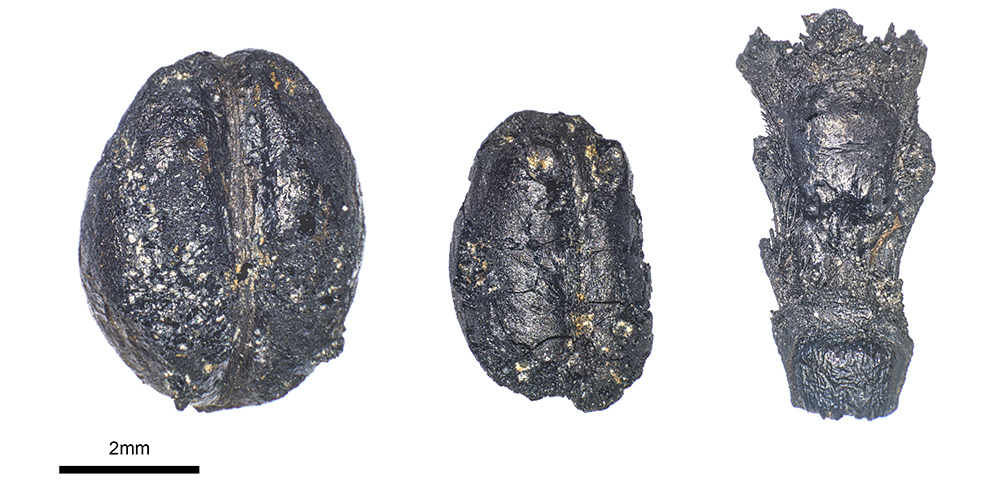
Remains of crops from the Neolithic period – here naked barley and naked wheat – indicate connections between geographically distant settlements.

When workers discovered the first pile-dwelling settlement on Lake Zurich in the mid-19th century, a whole branch of archaeological research began. 111 pile-dwelling villages in the Alps now belong to the UNESCO World Cultural Heritage. So far, however, it was unclear where this unique design came from. Until a few years ago, experts assumed that this was a local phenomenon.

Researchers around Prof. Dr However, Ferran Antolín from the Department of Integrative Prehistoric and Natural Scientific Archeology (IPNA) at the University of Basel are now providing new clues as to how the pile-dwelling culture came to the areas north of the Alps. 

Prehistoric plant remains from a settlement on Lago di Varese in northern Italy show the same composition as the useful plants from the oldest Swiss lake dwelling settlements in Zurich and in Egolzwil in Lucerne. 

The researchers report on this in the “Journal of Archaeological Science: Reports”.

Durum wheat, barley, opium poppy and flax

The team collected sediment cores around a prehistoric settlement on the Isolino Virginia and radiocarbon dated crops in the deposits. According to this, people seemed to have visited this artificial island as early as 4950 to 4700 BC. to call their home. The oldest known pile-dwelling settlements in Switzerland date back to around 4300 BC. Chr.

Through comparisons with the IPNA reference collection, the archaeobotanists were able to identify the composition of the approximately 7000-year-old plant material from this earliest settlement phase on Isolino Virginia: naked wheat (durum wheat), naked barley, opium poppy and flax. The same types of plants as those cultivated by the inhabitants of Switzerland’s oldest pile-dwelling settlements.

Connection to the western Mediterranean

However, these plant species are atypical for the northeast Italian population of the time, whose agriculture concentrated on the cultivation of spelled wheat such as emmer. 

The crops found around Lake Varese tended to be cultivated in the western Mediterranean. From this, the research team concluded that the settlement on the Isolino Virginia was probably founded by groups that came from the western Mediterranean or were closely connected with it through trade. 

“These groups probably played a major role in the spread of the pile-dwelling phenomenon north of the Alps,” says archaeobotanist Antolín.

The period between 4700 B.C. BC, when the settlement on the Isolino Virginia was temporarily abandoned, and 4300 BC, when the first pile-dwelling villages emerged north of the Alps, remains fraught with unanswered questions. 

The researchers suspect that other archaeological evidence, such as other settlements, may have remained undiscovered or lost.

In addition, ongoing research shows that there is also a wealth of evidence of prehistoric pile dwellings in other areas of Europe, such as in the central Balkans. Here, too, the team from the University of Basel is involved in research into the Neolithic pile-dwelling settlements.

However, these sites have a different agricultural tradition, so a direct connection to the pile dwellings of Switzerland seems unlikely.

According to Antolín, the origin of the pile dwellings remains a complex phenomenon that can hardly be explained from the remains of the buildings themselves. “However, the analysis of crop residues can make an important contribution here.”

Looted Artifacts Returned to France

Looted Artifacts Returned to France

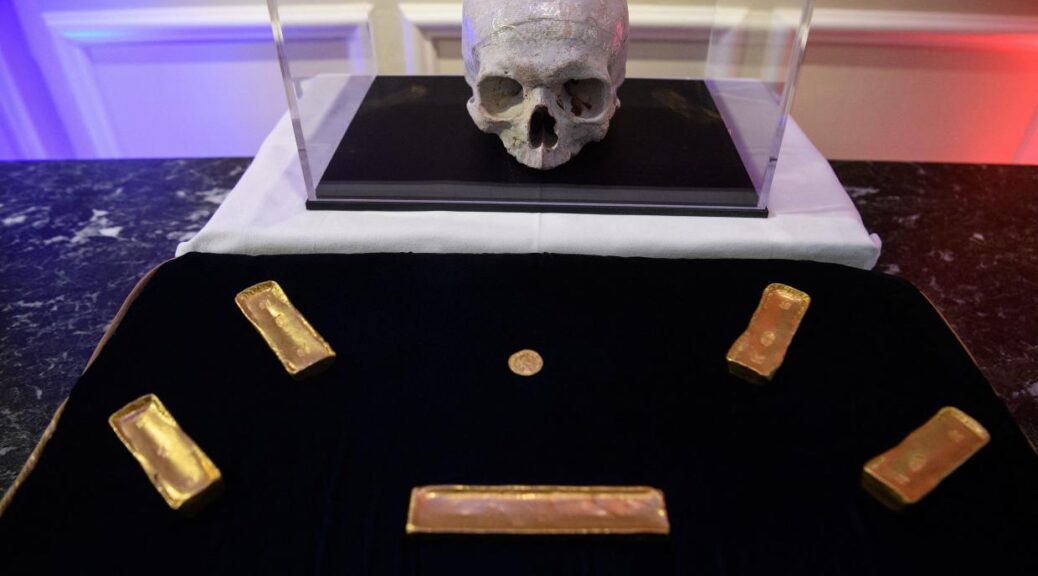
The United States has returned a set of illegally obtained artefacts, including a skull from the Parisian catacombs and golden ingots from an Atlantic shipwreck, to their rightful owner: France. 

The prized objects, which also included an ancient Roman coin, were handed over on Wednesday during an official “restitution” ceremony at the French ambassador’s residence in Washington.

Steve Francis, a high-ranking official in the U.S. Department of Homeland Security, along with French Ambassador Philippe Etienne, unveiled the pieces and detailed how American authorities had worked with their French counterparts to get them back into French hands.

Artefacts are displayed during a ceremony marking the restitution of cultural property from the U.S. to France at the ambassador’s residence in Washington, D.C., on March 2, 2022. The items include five gold ingots from the Prince de Conty, which sank near the Breton coast in 1746, a gold coin from the third century discovered in 1985 of Corsica’s Gulf of Lava, and a skull from the Paris catacombs.

“These objects tell the history of France, its commerce, and its people,” Francis said in a statement. “HSI is proud to have played a role in ensuring these artefacts continue to be part of France’s history for future generations to enjoy.”

The five golden ingots had originally been looted from the Prince de Conty, a ship that wrecked in December 1746 off the French island of Belle-Ile-en-Mer, near mainland France, according to a handout provided by the French embassy.

The vessel, which was on a return trip from China, had long been forgotten until a teacher in 1975 came across archival documents mentioning its location. He received authorization to excavate the site, but it was quickly looted, with many of the ingots disappearing before arrests were made.

However, in December 2017, five ingots matching the description of the Prince de Conty gold appeared on a list of items up for auction in California.

A French agency dedicated to underwater archaeology notified American authorities, who stepped in to seize the objects.

“The evidence that was provided by the French government was overwhelming,” said David Keller, a U.S. agent who focuses on cultural property and antiquities.

“These marks on them identify the people that actually made the ingots in the Qing dynasty,” Keller told AFP, “so there’s a lot of history just wrapped up in it.”

The golden coin is much older, dating back to the third century AD.

It is part of a larger treasure trove of ancient Roman objects, known as the Treasure of Lava, which was found in 1985 on the French island of Corsica, and was sold without official permission.

According to the French Embassy, specialists in currency “consider it one of the most important monetary treasures in the world.”

The skull originated in the Parisian catacombs, extensive caverns created in the late 18th century to house relocated remains from local cemeteries.

The site, known as an ossuary, is the largest in the world, containing the bones of more than six million Parisians.

The skull was recovered from an antiquities dealer in Houston, Texas in 2015. It will be returned to the Catacombs Museum in Paris, to join the collections of the ossuary, DHS said.

Over the years, Homeland Security Investigations has returned many artifacts to France, including a painting by Picasso stolen from France’s National Museum of Modern Art; a manuscript stolen from the French Navy Archival Depository Fund; and a painting by Edgar Degas stolen from the Musée Malraux in Le Havre, France.

“It is unacceptable that cultural property can be stolen and trafficked, and this is one of the mutual priorities between the United States and France,” Ambassador Etienne told AFP Thursday.

These Ancient Greek Helmets Tell of a Naval Battle 2,500 Years Ago

These Ancient Greek Helmets Tell of a Naval Battle 2,500 Years Ago

Archaeologists in southern Italy announced last week that they unearthed two helmets, fragments of weapons and armour, bits of pottery and the remains of a possible temple to Athena at an archaeological excavation of the ancient Greek city of Velia, reports Frances D’Emilio for the Associated Press (AP).

These Ancient Greek Helmets Tell of a Naval Battle 2,500 Years Ago
Chalcidian helmets such as this one were often worn by ancient Greek warriors.

Researchers, who have been working the site since last July, announced in a translated statement that they believe that these artefacts are linked to a major maritime battle that changed the balance of power in the Mediterranean nearly 2,500 years ago.

Ancient Greeks may have left the items behind after the Battle of Alalia. Between 541 and 535 BCE, a fleet of Phocaean ships—who had set up a colony, Alalia, on the island of Corsica—set sail on the nearby Tyrrhenian Sea to fend off attacks from neighbouring Etruscan and Carthaginian forces, per the statement.

An archaeologist works to free one of the helmets from the dig site.

Though the Greeks emerged victoriously, the costly sea battle ultimately spurred the Phocaean colonists to leave Alalia and establish a colony closer to other Greek settlements along the southern coast of Italy.

Settlers from Phocaea sailed for the mainland and purchased a plot of land that would eventually become Velia, according to the Guardian.

Initial studies of the helmets reveal that one was designed in the Greek Chalcidian style, while the other helmet resembles the Negua headpieces typically worn by Etruscan warriors, per ANSA. 

The archaeologists suggest Greek soldiers might have stolen these helmets from conquered Etruscan troops during the Battle of Alalia, per the statement.

An aerial view of the dig site at the acropolis of Velia, an ancient Greek colony in present-day southern Italy that was founded shortly after the Battle of Alalia.

In another major find, researchers also unearthed several brick walls that date to Velia’s founding in 540 B.C.E. and may have once formed a temple to the mythical Greek goddess of war and wisdom, Athena, as Angela Giuffrida reports for the Guardian.

Measuring about 60 feet long by 23 feet wide, the walls were likely constructed in the years just following the Battle of Alalia, says Massimo Osanna, the archaeological park director and head of Italian state museums, per Italian news agency ANSA.

The archaeologists say the Phocaeans may have offered the enemy armour as a tribute to the goddess.

Archaeologists unearthed two helmets including one, pictured here, that appears to be created in the Etruscan “Negua” style. Experts suggest that Greek soldiers might have stolen this piece of armour from Etruscan forces during the Battle of Alalia.

“It is, therefore, possible that the [Phocaeans] fleeing from Alalia raised [the temple] immediately after their arrival, as was their custom, after purchasing from the locals the land necessary to settle and resume the flourishing trade for which they were famous,” says Osanna in the translated statement. “And to the relics offered to their goddess to propitiate her benevolence, they added the weapons snatched from the enemies in that epic battle at sea.”

Located near the structure, the team found fragments of pottery inscribed with the Greek word for “sacred,” several pieces of bronze and metal weapons and bits of what appears to be a large, decorated shield.

Researchers plan to clean and analyze the artefacts in a laboratory for further study, where the director says they hope to find more information, particularly on the helmets.

She says in that statement that there may be inscriptions inside of them, something common in ancient armour, that could help trace the armour’s history, such as the identity of the warriors who wore them.