Who’s a Good Archaeologist? Dog Digs Up Trove of Bronze Age Relics
Is this the world’s least likely archaeologist? A dog named Monty, who was out for a walk in the Czech village of Kostelecké Horky this past March, began excitedly digging in a field when he, miraculously, discovered a buried cache of rare Bronze Age artefacts.
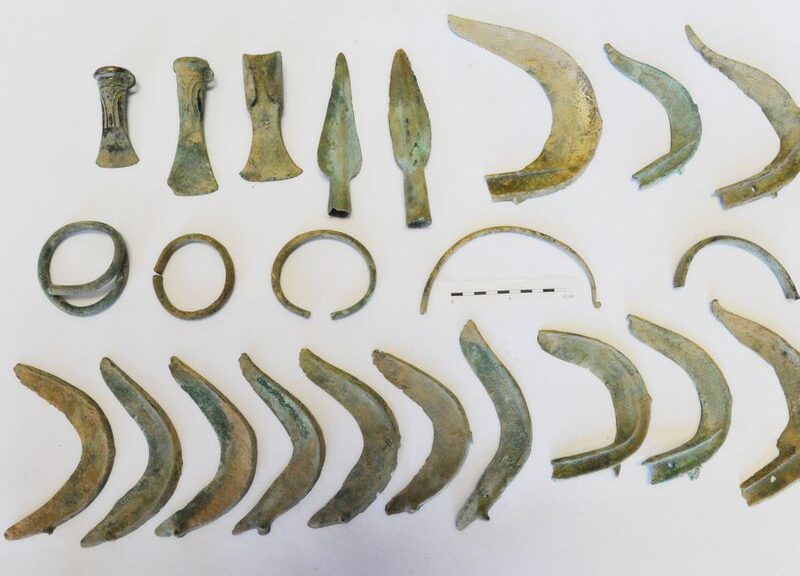
Bronze Age artefacts were discovered by a local dog named Monty. Image courtesy of Hradec Králové Region.
The dog helped uncover 13 sickles, two spear points, three axes, and a number of bracelets, all-around 3,000 years old.
Monty’s owner, identified only as “Mr Frankota,” received a 7,860 CZK ($360) reward for turning over the artefacts, Smithsonian magazine reports.
“The fact that there are so many objects in one place is almost certainly tied to an act of honorarium, most likely a sacrifice of some sorts,” archaeologist Martina Beková, of the Museum and Gallery of Orlické Mountains in Rychnov told Radio Praha.
“What particularly surprised us was that the objects were whole, because the culture that lived here at the time normally just buried fragments, often melted as well.
These objects are beautiful, but the fact that they are complete and in good condition is of much more value to us.”
Archaeologists believe the artefacts are from the Urnfield period of the late European Bronze Age, named for the communities that were increasingly cremating their dead and burying them in urns.
A flyer for the town of Kostelec nad Orlicí’s exhibition “Journey to the Beginning of Time,” featuring Bronze Age artefacts discovered by a local dog named Monty. Image courtesy of Hradec Králové Region.
The artefacts are currently on view in the town of Kostelec nad Orlicí through September 21 as part of the exhibition “Journey to the Beginning of Time.”
The ancient objects will then undergo conservation before being put on permanent display at the Kostelec palace.
Monty’s sharp nose has left the experts wondering what else might be uncovered in the area.
“Archaeologists have searched the surrounding fields with metal detectors,” Sylvie Velčovská, a spokesperson for the Hradec Králové Region, told Radio Praha.
Though nothing else has turned up yet, “there were some considerable changes to the surrounding terrain over the centuries, so it is possible that the deeper layers are still hiding some secrets.“
Ancient mass grave, WWII bunker among new finds in Istanbul’s Haydarpaşa dig
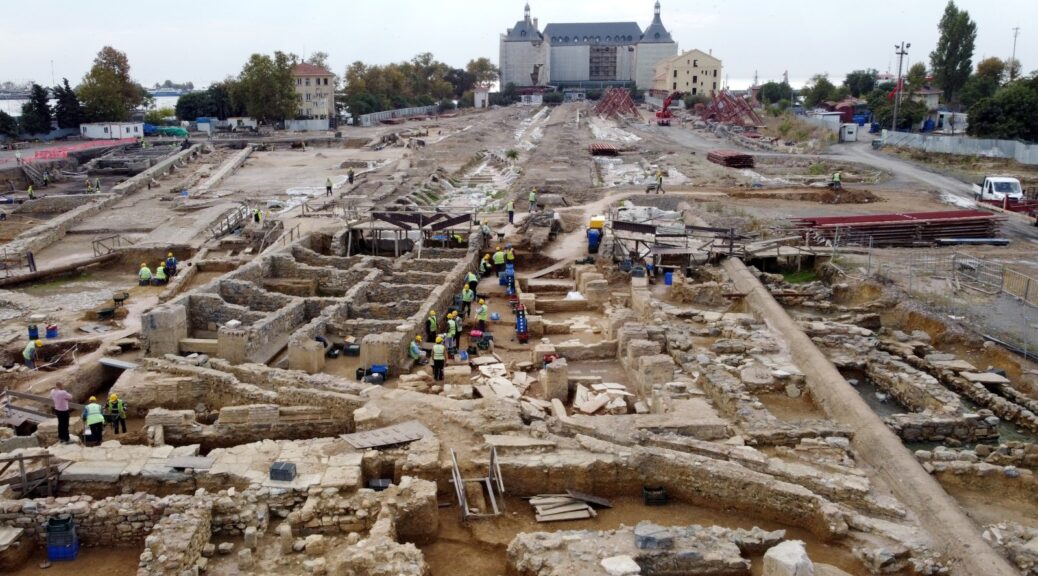
The ongoing archaeological excavation on the premises of Istanbul’s iconic Haydarpaşa Train Station entered a new phase with the recent removal of concrete platforms, with ancient mass graves, a mausoleum and a bunker used during World War II joining a long list of artefacts retrieved from the area.
Archaeologists and staff work at the Haydarpaşa excavation area in Kadıköy, Istanbul, on Oct. 12, 2021.
Precious historical artefacts dating back to the fifth century B.C. have been uncovered in the excavations that have been ongoing for the past three years in the 30-hectare (74-acre) facility housing platforms, maintenance wards, depots, parking lines and manoeuvre areas.
These artefacts shed light on the history of the 15-million megapolis and the Asian district of Kadıköy, where the ancient city of Chalcedon once stood.
Istanbul Archaeology Museum Director Rahmi Asal told reporters Sunday that the backyard of the station has indeed turned into an archaeological site. “The current area where we are working is inside the western harbour of Chalcedon. Indeed, very important ruins and artefacts were recovered. One of them is a private residence with opus sectile flooring dating back to the A.D. fifth century, along with a bathhouse,” Asal was quoted as saying by Anadolu Agency (AA).
“We also came across a section of Sainte Bassa Church, an important ruin from the Byzantine era that is narrated both in antique sources as well as modern publications. Inside the church’s apse, a mass grave was found containing approximately 28 bodies,” Asal said. Other findings include a platform dating back to the Hellenistic period, a pedestal probably belonging to a mausoleum and an adjacent sarcophagus, ruins from a holy spring (hagiasma in Greek, ayazma in Turkish) inside a palace ruin, and stone brick building dating back to the A.D. fifth to sixth centuries believed to be used as a melting workshop due to the furnaces and pots found there.
Expert work on human remains and skeletons at the Haydarpaşa excavation area in Kadıköy, Istanbul, on Oct. 12, 2021.
An Ottoman-era water fountain, erected in 1790 in connection with other fountains in nearby Halitağa Street and underwent repairs in 1836, was also uncovered at the site.
A bunker is seen at the Haydarpaşa excavation area in Kadıköy, Istanbul, on Oct. 12, 2021.
Another interesting finding covered by platforms was a 400-meter (1,312-foot) long bunker, which is 2 meters in width and 2.40 meters in height. Built-in 1942, the bunker also contains electrical panels and toilets.
Asal stated that nearly 12,000 gold, silver and bronze coins in good condition were retrieved from the excavation site, with the most important being a coin dating back to the fifth century B.C.
Explaining that the excavation went down some 2 meters in parts, Asal said that an interrupted chronological settlement from the Hellenistic, Roman, Byzantine and Ottoman periods can be traced on all layers of the earth. “If we were to talk about the history of Kadıköy in particular, our information on its archaeology and art history was unfortunately scarce apart from information in antique sources. We can say that these excavations are rewriting, reshaping the history of Kadıköy with concrete archaeological documents.”
Asal explained that the excavation is ongoing as part of the Haydarpaşa restoration project of the Ministry of Transport and Infrastructure, and it is not possible to give an exact time frame on when the excavation will end since it depends on both the project requirements and new archaeological findings shaping it.
An artefact bearing inscriptions in ancient Greek letters is seen at the Haydarpaşa excavation area in Kadıköy, Istanbul, on Oct. 12, 2021.
Pottery and other earth cases are seen among ancient artefacts at the Haydarpaşa excavation area in Kadıköy, Istanbul, on Oct. 12, 2021
“We know that currently, a new project is in the making that also utilizes recovered artefacts and adds them into the station project. Once we see that project, like the museum, we will convey our excavation results and assessment report to the local conservation board, which will shape the remaining process accordingly.”
The priority of archaeologists, art historians and citizens should be the Haydarpaşa Station itself, Asal said, underlining that the symbolic landmark should preserve its primary function as a terminus station and archaeological findings should be integrated into that function.
Yalçın Eyigün, head of the General Directorate of Infrastructure of the Transport and Infrastructure Ministry, told Demirören News Agency (DHA) that the designing process for closed areas and an open-air museum is ongoing, which the ministry seeks to complete in the next two years.
Currently, work has been completed on 49% of the 140,000 square meters area slated for excavations, Eyigün said, adding that 250 staff are working under the supervision of 15 archaeologists and the Istanbul Archaeology Museum.
Explaining that the total area of the Haydarpaşa compound is 4.75 hectares, Eyigün said the ministry aims to use only 75,000 square meters for railroad-related activities, with the rest allocated for an archaeological site, archaeological park and an industrial heritage museum.
The area, formerly known as Haydarpaşa Meadows before railway construction began in 1872, has many well-preserved or intact artefacts, due to the fact that construction began later than in the rest of Istanbul’s central neighbourhoods. The station building itself, which was constructed between 1906 and 1909, sits atop 1,100 wooden piles on reclaimed land.
Once serving as the western terminus of the Ottoman Empire’s ambitious Hejaz and Baghdad railways, the station has been closed to passengers since June 2013 when suburban rail services stretching to the Gebze district of Kocaeli province were halted for the Marmaray project. Featuring a submerged train tunnel crossing the Bosporus and revamping the old suburban rail lines to increase train and passenger capacity, the Marmaray bypasses Haydarpaşa and its European counterpart, the Sirkeci Station. Intercity trains to Anatolia were also scrapped a year earlier over the ongoing construction for a high-speed train.
The station experienced several setbacks throughout its history. On the first day of its opening in 1908, a fire broke out and it was reopened on Nov. 4, 1909, after a restoration process. The station housed an armoury and ammunition depot during World War I but was damaged on Sept. 6, 1917, when the armoury exploded. The station completely collapsed after that. On the 10th anniversary of the founding of the Turkish republic, the station was rebuilt to its original state and a comprehensive restoration was also carried out in 1976.
In 1979, certain sections of the station were damaged during the Independent tanker accident, in which a Romanian crude oil carrier exploded after colliding with a Greek freighter on the Bosporus off Haydarpaşa Port.
Following a 2010 fire that broke out during repairs, a temporary protective roof was placed to protect the building from rainfall and snow. Several projects were made public over the years to reassess the building’s use as a hotel with a larger convention centre project in the surrounding rail facilities. Following calls from the public, the Turkish State Railways (TCDD) prepared a thorough restoration project for the building so it can serve its original function in 2016, which was approved by relevant authorities. The recent archaeological excavation began during repairs to tracks and platforms leading to the main station building.
Garden statues turn out to be ancient Egyptian relics, selling for $265,000
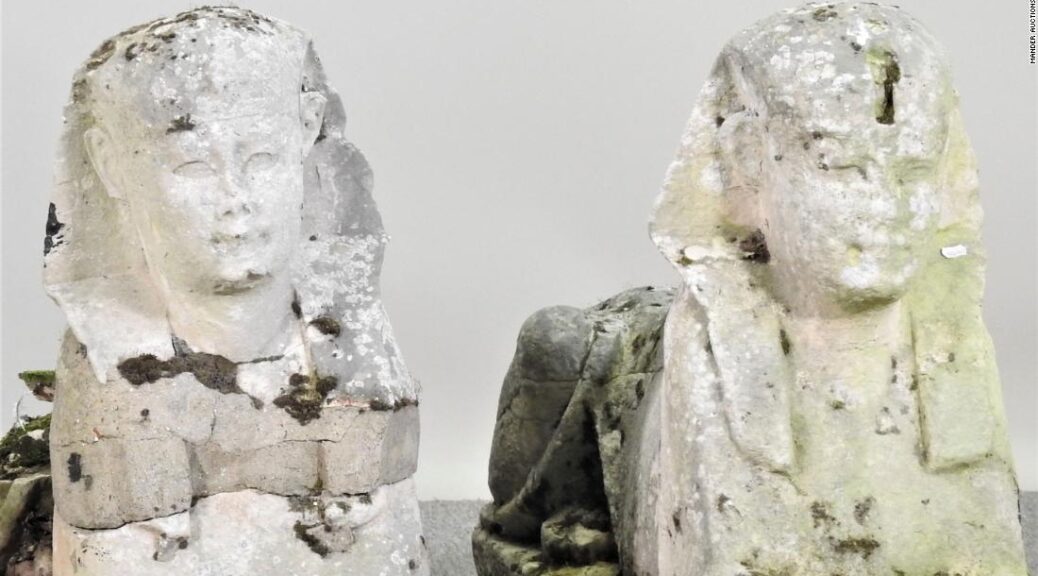
An auction company said that a pair of carved stone statues used as garden ornaments sold for more than £195,000 ($265,510) when it was discovered that they were ancient Egyptian artefacts going back thousands of years.
The artefacts were acquired from a garden in Sudbury, Suffolk, in eastern England.
Mander Auctioneers, which handled the sale, said they were contacted by a family looking to get rid of items from their old house before moving home.
The statues had been stood in the garden until last month. Credit: Mander Auctions
The “heavily weathered” statues, which had been used to decorate a garden patio until last month, had been bought for “a few hundred pounds” at another auction 15 years ago and were believed to be 18th-century replicas of ancient Egyptian relics, according to the auction house.
One statue even had its head re-attached with cement by a local builder under the instruction of the previous owners, auctioneer James Mander told CNN Tuesday.
“We didn’t really question them and put them in [at auction] at £300 to £500 ($410 to $680),” Mander told CNN. “And then the auction just went crazy,” he said.
The world’s most expensive sculptures to sell at auction, from an ancient lioness to a stainless steel rabbit
Saturday’s bidding began at £200, but within 15 minutes four telephone bidders and numerous internet buyers pushed the final price up to £195,000 plus 24% buyer’s premium, with an international art gallery making the final sale.
“Opinion was that they were genuine ancient Egyptian examples, which had somehow passed through recent history as 18th-century copies,” auctioneers said in a statement.
Auctioneers said the sellers had no idea of the true value of the statues.
Mander said that, in the 18th century, the Grand Tour saw English people travel through Europe, buying items.
“And we’ve just presumed they were 18th century Grand Tour items,” Mander told CNN.
‘Tomb raiders’: The pandemic is making it easier than ever to loot ancient Roman treasures
“As it turns out they’re thousands of years old and genuine. So it’s quite amazing really,” he said, adding that news of the final sale was “beyond comprehension” for the surprised previous owners.
Mander said that work was being done to trace the provenance of the statues, and he can’t place an exact date on the artefacts yet. “I wonder where they’ve been for the last 5,000 years. It’s quite incredible, really,” he said.
Ancient poop shows people in present-day Austria drank beer and ate blue cheese up to 2,700 years ago
According to a statement released by Cell Press, Frank Maixner of the Eurac Research Institute for Mummy Studies, Kerstin Kowarik of the Museum of Natural History Vienna, and their colleagues analyzed microbes, DNA, and proteins in 2,700-year-old coprolites recovered from an Iron Age salt mine in central Austria.
Human faeces don’t usually stick around for long—and certainly not for thousands of years. But exceptions to this general rule are found in a few places in the world, including prehistoric salt mines of the Austrian UNESCO World Heritage area Hallstatt-Dachstein/Salzkammergut.
Now, researchers who’ve studied ancient faecal samples (or paleofeces) from these mines have uncovered some surprising evidence: the presence of two fungal species used in the production of blue cheese and beer.
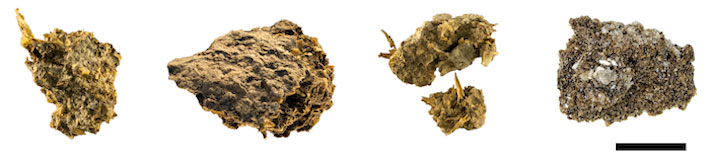
This image shows paleofeces samples from Hallstatt salt mines analyzed in this study.
The findings appear in the journal Current Biology on October 13.
“Genome-wide analysis indicates that both fungi were involved in food fermentation and provide the first molecular evidence for blue cheese and beer consumption during Iron Age Europe,” says Frank Maixner (@FrankMaixner) of the Eurac Research Institute for Mummy Studies in Bolzano, Italy.
“These results shed substantial new light on the life of the prehistoric salt mines in Hallstatt and allow an understanding of ancient culinary practices in general on a whole new level,” adds Kerstin Kowarik (@KowarikKerstin) of the Museum of Natural History Vienna.
“It is becoming increasingly clear that not only were prehistoric culinary practices sophisticated, but also that complex processed foodstuffs, as well as the technique of fermentation, have held a prominent role in our early food history.”
Earlier studies already had shown the potential for studies of prehistoric paleofeces from salt mines to offer important insights into early human diet and health.
In the new study, Maixner, Kowarik, and their colleagues added in-depth microscopic, metagenomic, and proteomic analyses—to explore the microbes, DNA, and proteins that were present in those poop samples.
These comprehensive studies allowed them to reconstruct the diet of the people who once lived there. They also could get information about the ancient microbes that inhabited their guts. Gut microbes are collectively known as the gut microbiome and are now recognized to have an important role in human health.
Their dietary survey identified bran and glumes of different cereals as one of the most prevalent plant fragments. They report that this highly fibrous, carbohydrate-rich diet was supplemented with proteins from broad beans and occasionally with fruits, nuts, or animal food products.
In keeping with their plant-heavy diet, the ancient miners up to the Baroque period also had gut microbiome structures more like those of modern non-Westernized individuals, whose diets are also mainly composed of unprocessed food, fresh fruits and vegetables.
The findings suggest a more recent shift in the Western gut microbiome as eating habits and lifestyles changed.
When the researchers extended their microbial survey to include fungi, that’s when they got their biggest surprise: an abundance in one of their Iron Age samples of Penicillium roqueforti and Saccharomyces cerevisiae DNA.
“The Hallstatt miners seem to have intentionally applied food fermentation technologies with microorganisms which are still nowadays used in the food industry,” Maixner says.
The findings offer the first evidence that people were already producing blue cheese in Iron Age Europe nearly 2,700 years ago, he adds. In ongoing and future studies of the paleofeces from Hallstatt, they hope to learn more about the early production of fermented foods and the interplay between nutrition and the gut microbiome composition in different time periods.
Archaeologists find a gold “solar bowl” in a 3,000-year-old settlement in Austria
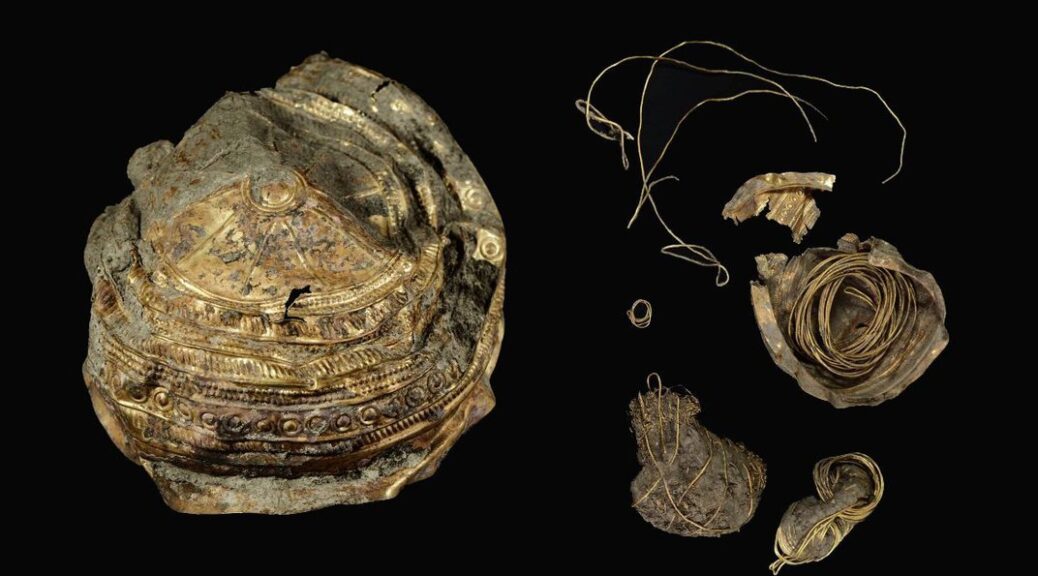
It was, in the words of archaeologist Michał Sip, the “discovery of a lifetime.” Unearthed ahead of construction of a railway station in Ebreichsdorf, just south of Vienna, the roughly 3,000-year-old golden bowl features a sun motif and is the first of its kind found in Austria, reports Szymon Zdziebijowski for the state-run Polish Press Agency (PAP).
The golden bowl may have been used in religious ceremonies honouring the sun.
Vessels of this kind have been found in other European countries, including Spain, France and Switzerland, says Sip, who is leading the excavation for Novetus, a German company that assists with archaeological digs. Only 30 similar bowls are known to exist, according to Heritage Daily.
Measuring about 8 inches long and 2 inches high, the Ebreichsdorf bowl is made of a thin metal consisting of 90 per cent gold, 5 per cent silver and 5 per cent copper.
“This is the [second] find of this type [discovered] to the east of the Alpine line,” Sip tells PAP, per Google Translate.
He adds, “Much more is known from the area of northern Germany, Scandinavia and Denmark because [this kind of pottery was] produced there.”
The vessel contained gold bracelets and golden wires wrapped around decomposed fabric.
The golden vessel is linked to the Urnfield culture, a prehistoric society that spread across Europe beginning in the 12th century B.C.E., per Encyclopedia Britannica.
The group derived its name from the funerary ritual of placing ashes in urns and burying the containers in fields.
An image of the sun with rays emanating from it adorns the newly discovered bowl. Inside the vessel, archaeologists found two gold bracelets and coiled golden wires wrapped around now-decomposed fabric or leather.
“They were probably decorative scarves,” Sip tells PAP. He posits that the accessories were used during religious ceremonies honouring the sun.
Sip and his colleagues unearthed around 500 bronze objects, clay pottery and other artefacts at the Austrian site, which appears to have been a sizable prehistoric settlement. The team found the golden bowl in the shallow ground near the wall of a house last year.
“[T]he numerous and valuable finds in the form of bronze and gold objects are unique in this part of Europe, and so is the fact that the settlement in Ebreichsdorf … was so large,” Sip tells PAP.
Soon after the find’s discovery, the Austrian government stepped in to ensure the artefacts’ safety. The golden bowl will soon go on view at the Kunsthistorisches Museum in Vienna.
“The discovery of a treasure hidden 3,000 years ago was spectacular,” Christoph Bazil, president of the Austrian Federal Monuments Office, tells Remonews. “[We] immediately placed the richly decorated gold bowl, the gold spirals and the remnants of a gold woven fabric under protection due to their importance at the European level.
The Ebreichsdorf archaeological excavation goes down in history with this golden treasure.”
Speaking with Austrian broadcaster noe.ORF.at, Franz Bauer, director of ÖBB-Infrastruktur AG, which oversees the country’s rail transport, says the bowl’s presence suggests the region had “intensive trade relations” with other European settlements. It was likely made elsewhere and brought to Ebreichsdorf.
Though archaeologists found the artefacts in 2020, authorities decided to hold off on disclosing the news until a detailed analysis could be completed. Excavations will continue at the site for the next six months.
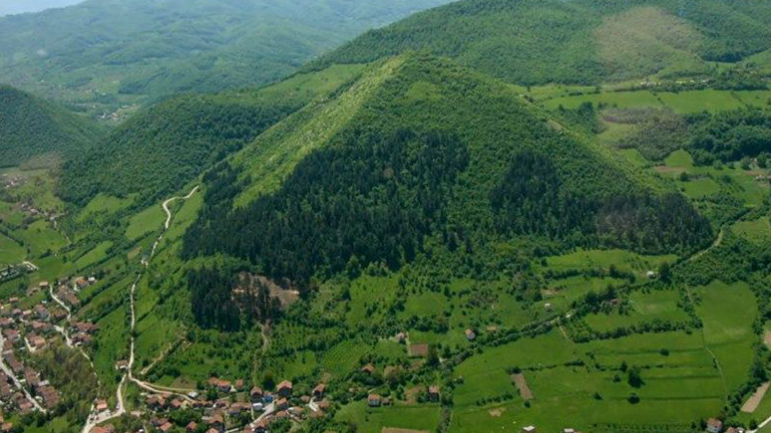
When Dr. Semir “Sam” Osmanagic discovered the first Bosnian pyramid, he suspected it was a find that could force the re-writing of history. But what he did not know how extremely old this structure really was.
The proof came in June 2012 when a team of volunteers, led by archaeologists from Italy uncovered a fossilized leaf.
They found it on the top of one of the covering blocks on the structure known as the “Mother Pyramid” or “Pyramid of the Sun.”
Under the direction of Dr. Riccardo Brett and Niccolo Bisconti, the organic material was sent to a laboratory in Kiev, Ukraine to determine its age.
The carbon 14 test showed that the age of the leaf is within plus or minus 200 years of 24,800. This puts it at least 24,600 and as much as 25,000 years old.
According to current history books, the oldest civilizations on Earth are the Babylonians and Sumerians, who lived around 5,000 years ago, so the Bosnian pyramids pre-date these ancient civilizations by ten millennia.
In 2005, when the Pyramid of the Sun was first discovered, researchers had a sample of earth from the topsoil that covered the structure dated using the radiocarbon method, and it was shown to be as old as 12,000 years.
Discoveries made seven years later continue to support the profound age of this pyramid as well as challenging the scientific establishment to re-think how long civilizations on earth have been creating monumental structures such as the pyramids of Bosnia.
For people who would like to visit the Bosnian pyramids and experience for themselves the oldest known pyramids on the planet, Body Mind Spirit Journeys is offering a group tour for spiritually-minded travellers from March 16 – 27, 2019.
The tour is led by “Ancient Aliens” expert and “Magdalene Line” bestselling author Kathleen McGowan, and features tours of the Bosnian Pyramid of the Sun by its discoverer, Dr. Semir “Sam” Osmanagic.
The video below shows highlights of the Bosnian Pyramid tour as well as views of the hotel in Visoko where we will be staying…
Marble Source for Greek Archaic Sculpture Identified
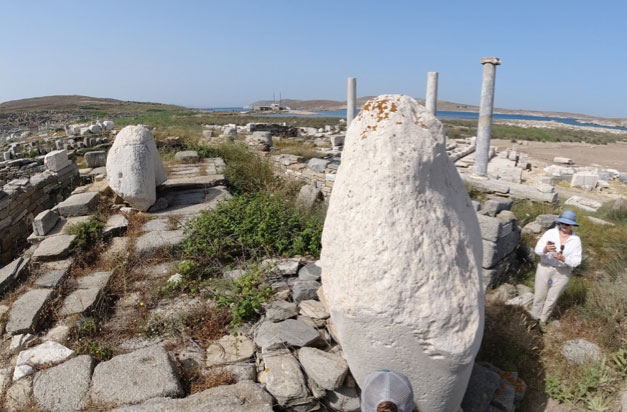
The source of marble for a statue of Apollo on the Greek island of Delos has been a mystery to art historians and archaeologists for decades. The stone’s chemistry pointed geochemists to the southern end of the nearby island of Naxos, but no one thought there were ancient marble quarries there. A geoarchaeologist believes he found the source.
“We had actually been told that we were not going to find what we were looking for,” says geoarchaeologist Scott Pike of Willamette University. But after two field seasons traipsing across Mediterranean shrublands, Pike believes he has found the source.
He is presenting his findings on Monday, 11 October 2021 at the Geological Society of America’s GSA Connects 2021 annual meeting in Portland, Ore.
The Greek Archaic period (approximately 800 to 480 B.C.E.) is known in part for its “larger-than-life” kouros statues, which depicted young men. Together, the massive Apollo kouros on Delos would stand around ten meters (33 feet) high, although today it is broken into several parts.
The massive marble chunks are white and worn; at a glance, some of the pieces hardly resemble parts of a human figure. But the statue has drawn researchers all the same. Searching for its source was sparked in part by an ambiguous inscription at its base, roughly translated as, “I am of the same stone, statue and plinth,” with a later addition stating that the kouros was “from the Naxians, to Apollo,” according to Pike.
It was not clear whether the inscription referred to the statue’s structure, being hewn from a single piece of marble, or the origin of its stone. Pike sampled various parts from the statue — a hand, the upper and lower torso, a bit of leg — and analyzed its carbon and oxygen isotopic composition. That composition can be used to trace the marble source by comparing it against other analyzed marbles, like finding a fingerprint match in a database.
“The analyses showed the marble came from Naxos, but from a region where there hasn’t been any evidence of ancient quarrying. We know that there are two quarries in the northern part of the island, where there are still large kouroi in place in the quarries. But we didn’t know of any ancient quarries in the south,” says Pike.
Pike headed to the southern side of Naxos, despite locals assuring him his efforts were in vain. He relied on local knowledge of other archaeological sites and geologic maps to guide him as he “scoured the landscape” looking for, essentially, outcrops of white marble and possible small pits. Remnants of Archaic quarries bear little resemblance to the vast open-pit mines humans create today and were difficult for Pike to find.
After a couple of weeks of searching, Pike began finding small bands of white marble that were not marked on the geologic maps. Some were close to archaeological sites, giving Pike some confidence that these small quarries could be the source.
“Finding what we were looking for was exciting because being told several times that you’re not going to find anything is discouraging, but we knew,” Pike says. “The evidence pointed to the south. I felt the most Indiana Jones I’ll ever be.”
Back in the lab, Pike analyzed his marble samples and found that two of the newly-uncovered southern white marbles were good matches for the Apollo kouros at Delos. Knowing that these early marble quarries exist in the south of the island will be helpful for tracing the source for other ancient marble artefacts, such as older Bronze Age Cycladic figurines that have puzzled geoarchaeologists. It also has implications for knowledge of commerce at the time.
“Knowing now that there is a marble source on Naxos for these Bronze Age statues and figurines will place the region more in the centre of commerce, trade and influence than had been previously understood,” Pike says.
Juan Negro crouched in the shadows just outside a cave, wearing his headlamp. For a brief moment, he wasn’t an ornithologist at the Spanish National Research Council’s Doñana Biological Station in Seville. He was a Neandertal, intent on catching dinner. As he waited in the cold, dark hours of the night, crowlike birds called choughs entered the cave.
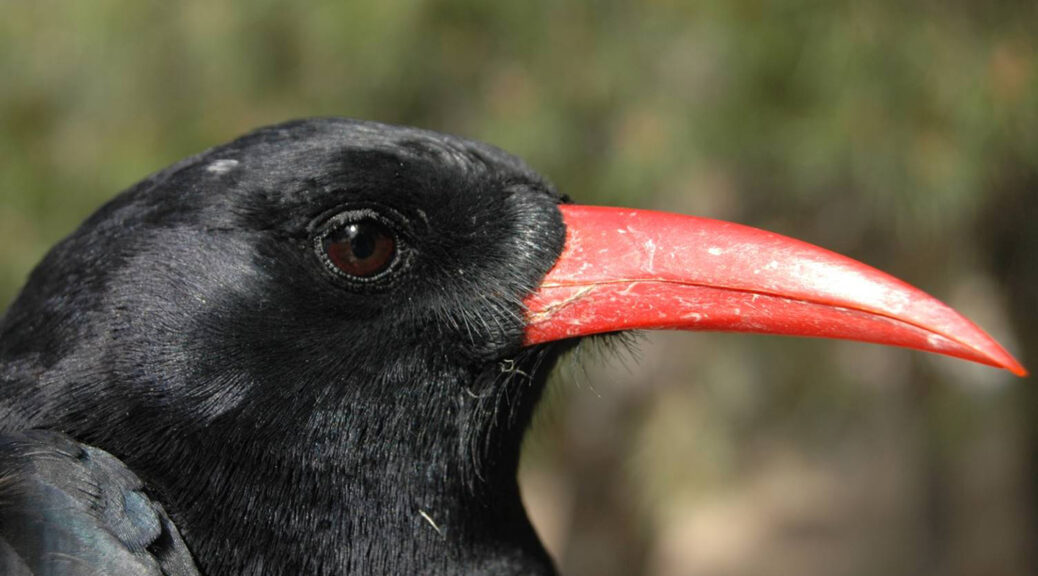
A red-billed chough (Pyrrhocorax pyrrhocorax) is an elusive species to hunt during the day. But its nighttime roosting habits could have made it easy prey for Neandertals to catch with their bare hands, a new study suggests.
The “Neandertal” then stealthily snuck in and began the hunt.
This idea to role-play started with butchered bird bones. Piles of ancient tool- and tooth-nicked choughs bones have been found in the same caves that Neandertals frequented, evidence suggesting that the ancient hominids chowed down on the birds. But catching choughs is tricky.
During the day, they fly far to feed on invertebrates, seeds and fruits. At night though, their behaviour practically turns them into sitting ducks. The birds roost in groups and often return to the same spot, even if they’ve been disturbed or preyed on there before.
So the question was, how might Neandertals have managed to catch these avian prey?
To find out, Negro and his colleagues decided to act like, well, Neandertals. Wielding bare hands along with butterfly nets and lamps — a proxy for nets and fire that Neandertals may have had at hand— teams of two to 10 researchers silently snuck into caves and other spots across Spain, where the birds roost to see how many choughs they could catch.
Researchers in Spain attempt to capture choughs with their bare hands in roosting sites such as this building. The effort was part of a study to see if Neandertals could have successfully hunted the birds.
Using flashes of light from flashlights to resemble fire, the “Neandertals” dazzled and confused the choughs. The birds typically fled into dead-end areas of the caves, where they could be easily caught, often bare-handed. Hunting expeditions at 70 sites snared more than 5,500 birds in all, the researchers report September 9 in Frontiers in Ecology and Evolution.
The birds were then released unharmed. It was “the most exciting piece of research” Negro says he’s ever done.
The results demonstrate that through teamwork, choughs can be captured without fancy tools at night and offer a likely way that Neandertals could have captured choughs. But actual Neandertal bird-catching behaviour remains unknown. If this is in fact how Neandertals hunted, it adds to claims that their behaviour and ability to think strategically is more sophisticated than they are often given credit for.
Red-billed choughs, captured as part of an experiment to see if Neandertals could have caught the birds, sit in a sack. The birds were released unharmed.
“The regular catchment of choughs by Neandertals implies a deep knowledge of the ecology of this species, a previous planning for its obtaining, including procurement techniques, and the ability to plan and anticipate dietary needs for the future,” says Ruth Blasco.
A taphonomist at the Catalan Institute of Human Paleoecology and Social Evolution in Tarragona, Spain, Blasco is an expert in the Neandertal diet.
Such role-playing, she notes, is “commonly used by scholars as valid analogies to infer processes that happened in the past.” For instance, reenactments with replicas of wooden spears have suggested that Neandertals could have hurled the weapons to hunt prey at a distance.
The researchers re-creating chough hunts used butterfly nets to catch birds fleeing sites with narrow entrances, as well as bigger nets partially covering larger openings. But “the easiest thing was to grab the birds by hand,” Negro says.
“You have to be intelligent to capture these animals, to process them, to roast and eat them,” he notes. Previous studies have shown that Neandertals may have been similarly adept at foraging for seafood. “We tend to think that [Neandertals] were brutes with no intelligence,” Negro says, “but in fact, the evidence is accumulating that they were very close to Homo sapiens.”