Category Archives: EUROPE

Fossils of two previously unknown dinosaurs were discovered off the coast of England

Fossils of two previously unknown dinosaurs discovered off the coast of England

Fossils discovered on a rocky beach on England’s Isle of Wight around 127 million years ago reveal that there was double trouble on the island, with a pair of large previously unknown dinosaur predators living perhaps side by side, both adapted to hunting along the water’s edge.

Artists impression of newly identified species (Anthony Hutchings via University of Southampton )

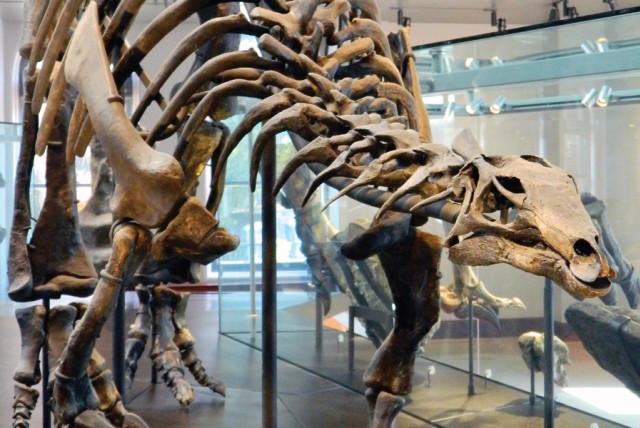
Scientists on Wednesday announced the discovery of fossils of the two Cretaceous Period meat-eaters – both measuring about 30 feet long (9 meters) and boasting elongated crocodile-like skulls – on the southwest of the island, one of Europe’s richest locales for dinosaur remains.

They are examples of a type of dinosaur called a spinosaur, known for long and narrow skulls with lots of conical teeth -perfect for grasping slippery fish – as well as strong arms and big claws.

One is named Ceratosuchops inferodios, meaning “horned crocodile-faced hell heron.” The name refers to a heron because of that bird’s shoreline-foraging lifestyle. Ceratosuchops had a series of low horns and bumps ornamenting its brow region.

The second is named Riparovenator milnerae, meaning “Milner’s riverbank hunter,” honoring British paleontologist Angela Milner, who died in August. It may have been slightly larger than Ceratosuchops.

Riparovenator milnerae is thought to have had a 1m-long skull similar to crocodiles

Each is estimated to have weighed around one to two tons, with skulls around a yard long, according to Chris Barker, a University of Southampton PhD student in palaeontology and lead author of the study published in the journal Scientific Reports.

“Both would have been heron-like shoreline hunters, wading out into the water and thrusting the head down quickly to grab things like fish, small turtles, et cetera, and on land would do something similar, grabbing baby dinosaurs or the like.

They would basically have eaten anything small they could grab,” said palaeontologist and study co-author David Hone of the Queen Mary University of London. Spinosaurus were part of the broad group of bipedal meat-eating dinosaurs called theropods that included the likes of Tyrannosaurus rex.

As semi-aquatic hunters, spinosaurus targeted different prey and lacked the massive, boxier skull and large serrated teeth of T. rex, which inhabited North America about 60 million years later.

Ceratosuchops and Riparovenator roamed a floodplain environment bathed in a subtropical Mediterranean-like climate. Forest fires occasionally ravaged the landscape, with fossils of burned wood found throughout Isle of Wight cliffs.

With a large river and other bodies of water-attracting plant-eating dinosaurs and hosting numerous bony fish, sharks and crocodiles, the habitat provided Ceratosuchops and Riparovenator plenty of hunting opportunities, Barker said.

These two cousins may have lived at the same time, perhaps differing in prey preference, or may have been separated a bit in time, the researchers said. There was a third roughly contemporaneous spinosaur named Baryonyx, whose fossils were unearthed in the 1980s, that lived nearby and was about the same size, maybe slightly smaller.

Partial remains of Ceratosuchops and Riparovenator were discovered near the town of Brighstone. Ceratosuchops is known from skull material, while Riparovenator is known from both skull and tail material. There are braincase remains for both, giving particular insight into these creatures.

The haul of bones was discovered on a beach near Brighstone, Isle of Wight, over a period of several years

The fossils helped the scientists produce a family tree of spinosaurs, indicating the lineage originated in Europe before moving into Africa, Asia and South America, according to University of Southampton paleobiologist Neil Gostling, who supervised the research project.

The largest one, Spinosaurus, reached 50 feet (15 meters) long and lived in North Africa roughly 95 million years ago. It differed from its Isle of Wight forerunners, boasting a large sail-like structure on its back and adaptations for a more aquatic lifestyle.
10-foot-tall Bronze Age geoglyph of a bull found in Siberia Is A First

10-foot-tall Bronze Age geoglyph of bull found in Siberia Is A First

A geoglyph of a bull discovered in Siberia dates back more than 4,000 years, making it twice as old as the famed Nazca lines of Peru and millennia older than Uffington’s chalk-lined White Horse.

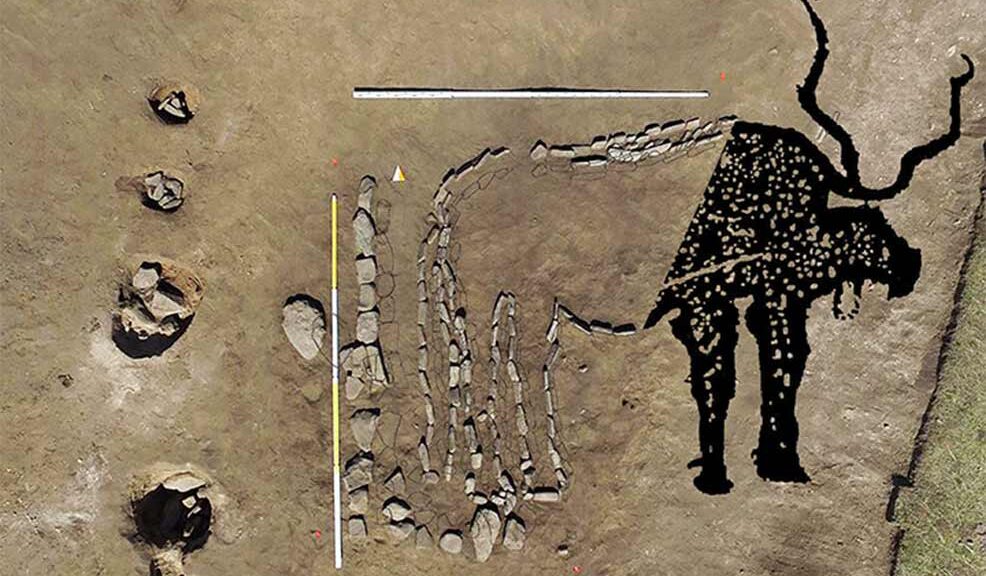
Geoglyphs, which often have spiritual or religious meaning, are large designs made in the ground that can typically only be seen from the air.  The bull, which measures 10 feet tall by 13 feet long, is formed from carefully arranged pebbles and sandstone.

It was part of a larger Early Bronze Age burial site uncovered near Khondergey, a village in southwest Tuva close to Russia’s border with Mongolia.

Archaeologists in Siberia have discovered a bull geoglyph they believe is more than 4,000 years old—a millennia older than Uffington’s White Horse and twice as old as the famed Nazca lines of Peru
The bull, which measures 10 feet tall by 13 feet long, is formed from carefully arranged pebbles and sandstone.

This is the first animal geoglyph found in this part of Central Asia, according to archaeologists at the Russian Academy of Sciences’ Institute of the History of Material Culture, who participated in the discovery.

‘The bull motif is very typical for the Central Asia cultures of the Early Bronze Era,’ Marina Kilunovskaya, head of Tuva Archaeological Expedition, told The Siberian Times. ‘Later in the Scythian era, bulls were replaced by deers.’ 

Kilunovskaya said petroglyphs, or rock carvings, of bulls, have been discovered in Tuva and the surrounding regions before but this is the first animal geoglyph.

‘We didn’t previously find such stone compositions.’ she told the Times.

Only the back half of the bovine remains—its front was destroyed by road construction in the 1940s. Members of the expedition hope the bull’s rear will be better preserved.

10-foot-tall Bronze Age geoglyph of bull found in Siberia Is A First
A graphic indicating what the bull would have looked like when it was made. Its front end was unknowingly destroyed during road construction in the 1940s

Geoglyphs have been discovered in diverse corners of the world: In addition to the Nazca Lines in Peru and Uffington’s White Horse in England, the Blythe Intaglios are a group of gigantic figures carved into the ground in the Colorado Desert near Blythe, California, that have been radiocarbon-dated to between 900 and 1200 BC.

The Cerne Abbas Giant in Dorset, England, is a 180-foot tall nude male figure with a prominent erection and large club. The phallic figure’s outline was made by digging two-foot deep trenches into the ground and filling it with crushed chalk. 

Dates for when it was carved have ranged from the Middle Ages to the 17th century, but using optically stimulated luminescence,  scientists have placed it much further back, somewhere between  700 1110 AD.

The oldest known geoglyph is also in Russia, though some 1,100 miles away from the Tuva bull: An enormous moose only clearly visible from the sky in Chelyabinsk dates to about 6,000 years ago.

The moose, sometimes labelled an elk, was incised on the Zyuratkul Mountains. It stretches for about 902 feet and depicts an animal with four legs, antlers, and a long muzzle.

Only discovered in 2011 using satellite imaging, the moose is also the largest-known figurative geoglyph, as opposed to an abstract or geometric design.

Stone tools uncovered by archaeologists at the site show indicate were made to fit the hands of children, who partook in the glyph’s creation.

The Cerne Abbas Giant in Dorset, England, is a 180-foot tall nude male figure with a prominent erection and large Club.

‘But it was not a kind of slave labour of children,’ Stanislav Grigoryev, a senior researcher from the Chelyabinsk History and Archaeology Institute, told The Siberian Times. ‘They were involved to share common values, to join something important to all the people.’

In 2014, dozens of 50 geoglyphs of various shapes and sizes, including a massive swastika, were discovered across northern Kazakhstan.

1,800-year-old rock tombs found in Turkey’s ancient city Blaundus

1,800-year-old rock tombs found in Turkey’s ancient city Blaundus

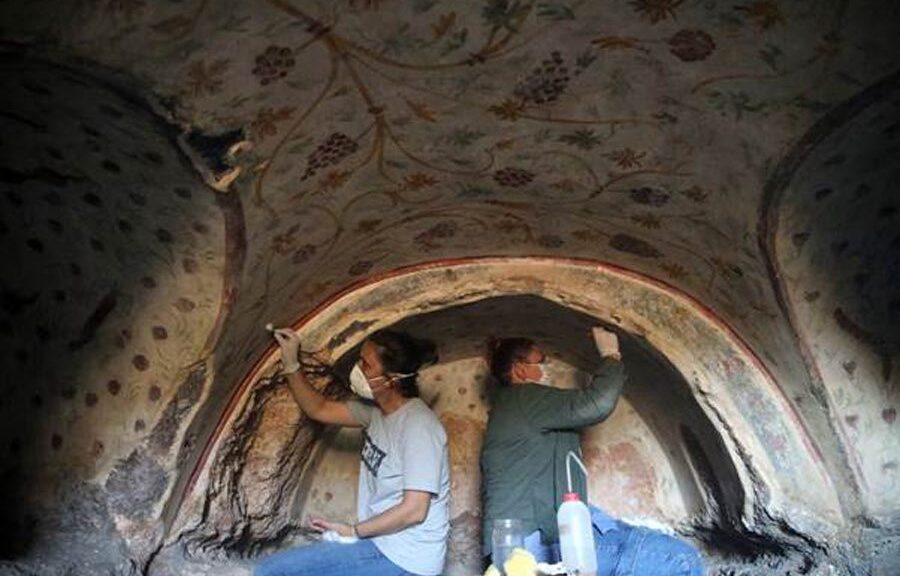
In the ancient city of Blaundus, located in the Ulubey neighbourhood of the western Anatolian city of Uşak, a total of 400 rock-cut graves dating from around 1,800 years ago and adorned with various motifs were discovered.

Excavations continue in the ancient city of Blaundus, situated on a peninsula surrounded by deep valleys, under the presidency of professor Birol Can of Uşak University’s Archaeology Department. While archaeological digs have revealed many Hellenistic, Roman and Byzantine artefacts in the ancient city to date, this year’s work was focused on the areas of the necropolis.

These excavations unveiled 400 rock tombs featuring multiple rooms, the walls of which were decorated with special motifs of vine branches, bunches of grapes and flowers.

An outside view from the rock tombs in the ancient city of Blaundus, Uşak, western Turkey, Sept. 29, 2021.

Speaking to Anadolu Agency (AA), the excavation head Can said that Blaundos was established on a safeguarded hill. “There is only one entrance to the city from the north, and the city is surrounded by a valley reaching a depth of 70 meters (300 feet) in some points. We determined rock-cut tombs in our recent works conducted in the steep sides of the valley.

From the analysis of materials and bones, we found in this area, we understand that these rock tombs were intensely used after the A.D. second century. We can say that they were used as family graves.”

Can’s team believes that there are also a large number of graves underground in the ancient city. Noting that there are different types of rooms inside the rock tombs, Can be continued: “There are arched sarcophagi carved into the bedrock in front of the walls of each room.

Apart from these, places that are thought to be used for funeral ceremonies were also found inside the rock tombs. The main door of the tombs was closed with a marble door and reopened during burial or ceremony times in the past.”

An aerial view from the rock tombs in the ancient city of Blaundus, Uşak, western Turkey, Sept. 29, 2021.

Emphasizing that their priority is the preservation of the tombs, Can said that they also prepare projects for the promotion and opening of these structures.

Stating that there will be a walking path starting from the city entrance and going around these tombs, Can said: “Within this project, plans have been made to illuminate the area of the tombs. We are planning to make the entire necropolis visitable in the future.”

The ancient city of Blaundus was established by Roman Commander Blaundus as Alexander the Great was off to a campaign in Anatolia.

Following Alexander the Great, the city was ruled by Romans and Byzantines. It was the seat of the bishopric in these periods.

Blaundus was built on the top of a hill overlooking Grand Ulubey Canyon, which has strategic importance for the Lydia-Phrygia border.

Although the city was founded in the Hellenistic era, due to earthquakes that caused widespread damage, the city was rebuilt and fashioned into one of the more significant Roman-era urban centres in the region.

There are many public and religious buildings, such as temples, a theatre, a stadium, a gymnasium and a basilica.

The structure of an 8-kilometer (5-mile) aqueduct also remains that served to bring fresh water to the city.

Prehistoric aliens in Malta? Hypogeum’s trove of elongated skulls to get cutting-edge study

Prehistoric aliens in Malta? Hypogeum’s trove of elongated skulls to get cutting-edge study

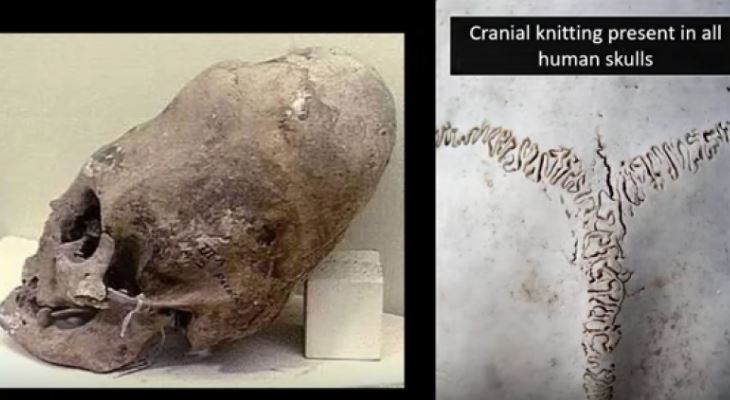
In the oldest underground temple and necropolis in the world – the Hal Saflieni Hypogeum, here in Malta – was discovered a collection of skulls that show peculiar abnormalities and/or pathologies: sometimes inexistent cranial knitting lines abnormally developed temporal partitions; evidence of drilling and swelling at the back of the head, possibly from recovered traumas; and, strangest of all, a lengthened skull lacking a fossa median, the join that runs along the top of the skull.

The reason for these abnormalities has been shrouded in mystery.

Until 1985, the unearthed skulls were on display at the National Museum of Archaeology. Strangely, Heritage Malta, the authority responsible for Malta’s prehistoric heritage, removed them from public view around 30 years ago, and, since then, they have only been available to researchers by special permission. 

Prehistoric aliens in Malta? Hypogeum’s trove of elongated skulls to get cutting-edge study

Heritage Malta outright dismisses some theories which have been floating about, related to ‘serpent priests’ or ‘alien skulls’. Fair enough, the theories – despite the curious evidence – only exist within the realm of speculation. But, in 2017, Heritage Malta set out to completely ‘bust the myth’ regarding the elongated skulls at the refurbished Visitors Centre at the Hal Saflieni Hypogeum. Why so much effort to dissuade anyone from believing that anything extraordinary had been found down there?

Photos and books by Dr Anton Mifsud and his colleague Dr Charles Savona Ventura, who first investigated the skulls, testify to their existence and abnormality. Vittorio Di Cesare and Adriano Forgione of HERA magazine, Rome, Italy were the only non-officials able to obtain permission to investigate the skulls.

They published a very thorough article regarding their findings and it would seem that they were very impressed. 

Most interesting to them was the skullcap with the lengthened posterior. Their research confirmed that the cranium was naturally long and not as a result of bandaging or boards, as was customary in ancient South American civilizations. And, they couldn’t find evidence of median knitting, technically named sagitta, which is considered ‘impossible’ by medics and anatomists. Di Cesare and Forgione also did not discount that this find was particular to the Hal Saflieni Hypogeum. They went on, in their article, to draw parallels and conclusions related to the Egyptian culture and so-called ‘serpent priests’.

Meanwhile, Ms Rodriguez Aguilera was running for office in Miami as a Republican when an interview of her alien abduction as a child resurfaced. Therein she claimed the aliens had told her that “there are 30,000 skulls – different from those of human beings – in a cave on the Mediterranean island of Malta.” Is that so?

The skulls, dating back to 3000-2500 BC, were first discovered in 1902. By the 1920s, the National Geographic magazine (January to June 1920 VOLUME XXXVII) reported that the first inhabitants of Malta were a race with elongated skulls:

“From an examination of the skeletons of the polished-stone age, it appears that the early inhabitants of Malta were a race of long-skulled people of lower medium height, akin to the early people of Egypt, who spread westward along the north coast of Africa, whence some went to Malta and Sicily and others to Sardinia and Spain.”

In fact, despite the attempts of Heritage Malta to water down the finding, the story of the elongated skulls of Malta has been reported far and wide. These include the following 4-minute Mystery History documentary.

Neanderthal, Cro-Magnon, Denisovans, Modern Man … are the ‘long heads’ a hybrid species? A different species? Aliens? What is certain is that they were real and apparently revered as gods such that modern human beings purposefully mutilated themselves to look like them. Yet, instead of capitalising on this find, Malta hides away the ‘long-headed’ skulls and dismisses any notion that they could bear any special importance. Just…odd!

So while Heritage Malta shrugs off the extraordinary find in the depths of the earth at the Hypogeum, Belgian author Philip Coppens, who focuses on fringe science and alternative history, and others around the world, continue to raise interesting questions. Such as:

  • Why were the reports of Emmanuel Magri, the first official excavator of the site, never published? Why, upon his death in 1907, had all of his notebooks on the excavation disappeared?
  • Why, when it was originally reported that the bones of 33,000 people were found, was this figure later changed to 7,000, and then reduced again to a mere 100?
  • Why were the elongated skulls removed from public view in 1985? Why are they now only available to researchers? Why are only six of the original eleven still at the museum? Where are the others?
    Why was the Hypogeum of Santa Lucia sealed off and never excavated since it was discovered in 1973? 
  • Why was the Brockdorff Circle – a hypogeum in Gozo – buried and forgotten after it was discovered in 1820, only to be rediscovered in 1964? And why did it take until 1987 and 1994 to properly excavate it? What might have gone missing since the 19th Century?
  • Could there be any truth to the tales of strange giant humanoids dwelling in hidden caverns below the Hal Saflieni Hypogeum? Is there any truth to the tales of disappearing children? What could be the reason for the cover-ups?

What do you think?

Amateur Divers Discover Trove of 53 Roman Gold Coins in Spain

Amateur Divers Discover Trove of 53 Roman Gold Coins in Spain

Two amateur divers swimming along the Spanish coast have discovered a huge hoard of 1,500-year-old gold coins, one of the largest on record dating to the Roman Empire. The divers, brothers-in-law Luis Lens Pardo and César Gimeno Alcalá, discovered the gold stash while vacationing with their families in Xàbia, a coastal Mediterranean town and tourist hotspot.

Amateur Divers Discover Trove of 53 Roman Gold Coins in Spain
Freedivers in Spain notified the authorities after finding a handful of gold coins dating to the fall of the Western Roman Empire.

The duo rented snorkelling equipment so they could go freediving with the goal of picking up trash to beautify the area, but they found something far richer when Lens Pardo noticed the glimmer of a coin at the bottom of Portitxol Bay on Aug. 23, El País reported. 

When he went to investigate, he found that the coin “was in a small hole, like a bottleneck,” Lens Pardo told El País in Spanish. After cleaning the coin, Lens Pardo saw that it had “an ancient image, like a Greek or Roman face.” Intrigued, Lens Pardo and Gimeno Alcalá returned, freediving to the hole with a Swiss Army knife and using its corkscrew to unearth a total of eight coins. 

Stunned by the find, Lens Pardo and Gimeno Alcalá reported it the next day to the authorities. “We took the eight coins we had found and put them in a glass jar with some seawater,” Lens Pardo said.

Soon, a team of archaeologists from the University of Alicante, the Soler Blasco Archaeological and Ethnological Museum and the Spanish Civil Guard Special Underwater Brigade, in collaboration with the Town Council of Xàbia, came together to excavate and examine the treasure. 

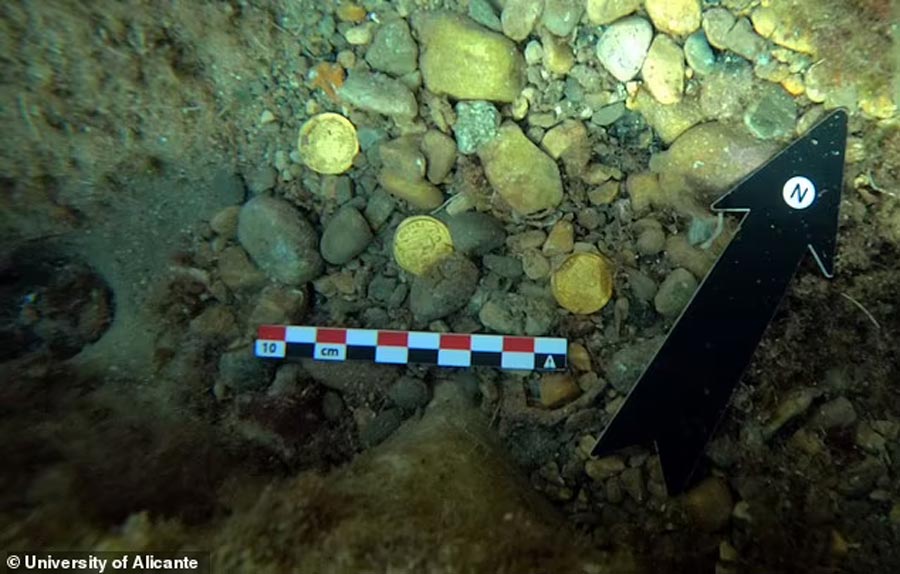
With the help of the archaeologists, they found that the hole held a hefty pile of at least 53 gold coins dating between A.D. 364 and 408 when the Western Roman Empire was in decline. Each coin weighs about 0.1 ounces (4.5 grams).

The coins were so well preserved, archaeologists could easily read their inscriptions and identify the Roman emperors depicted on them, including Valentinian I (three coins), Valentinian II (seven coins), Theodosius I (15 coins), Arcadius (17 coins), Honorius (10 coins) and an unidentified coin, according to a University of Alicante statement.

The hoard also included three nails, likely made of copper, and the deteriorated lead remains of what may have been a sea chest that held the riches.

Coins from the underwater hoard buried off the coast of Spain.

The hoard is one of the largest known collections of Roman gold coins in Europe, Jaime Molina Vidal, a professor of ancient history at the University of Alicante (UA), a researcher at the University Institute of Archaeology and Historical Heritage at UA and team leader who helped recover the buried treasure, said in the statement.

The coins are also a treasure trove of information, and may shed light on the final phase of the Western Roman Empire before it fell, Molina Vidal said. (In A.D. 395, the Roman Empire split into two pieces: the Western Roman Empire, with Rome as its capital, and the Eastern Roman, or Byzantine, Empire, with Constantinople (modern-day Istanbul) as its capital, Live Science previously reported.)

Perhaps these coins were purposefully hidden during the violent power struggles that ensued during the Western Roman Empire’s final stretch.

During that time, the barbarians — non-Roman tribes such as the Germanic Suevi and Vandals and the Iranian Alans — came to Hispania, the Roman name for the Iberian Peninsula, and took power from the Romans in about 409, according to the statement.

The hoard found off the coast of Spain is one of the largest Roman coin hoards in Europe.

“Sets of gold coins are not common,” Molina Vidal told El País, adding that Portitxol Bay is where ships leaving from Rome’s Iberian provinces stopped before sailing to the Balearic Islands, which includes modern-day Mallorca and Ibiza and then heading to Rome. Given that archaeologists haven’t found evidence of a nearby sunken ship, it’s possible that someone purposefully buried the treasure there, possibly to hide it from the barbarians, likely the Alans, he said.

“The find speaks to us of a context of fear, of a world that is ending — that of the Roman Empire,” Molina Vidal said.

So far, a study of the coins suggests that the gold hoard belonged to a wealthy landowner, because in the fourth and fifth centuries “the cities were in decline and power had shifted to the large Roman villas, to the countryside,” Molina Vidal told El País.

“Trade has been stamped out and the sources of wealth become agriculture and livestock,” he said. As the barbarians advanced, perhaps one of the landowners gathered up the gold coins — which did not circulate as regular money, but were collected by families to serve as signs of wealth — and had them buried in a chest in the bay. “And then he must have died because he did not return to retrieve them,” Molina Vidal said.

After the coins are fully studied, they will go on display at the Blasco Archaeological and Ethnographic Museum in Xàbia. Meanwhile, the Valencian government has allocated $20,800 (17,800 Euros) for underwater archaeology excavations in the area, in case any more treasures are buried in the vicinity. Previously, Portitxol Bay has yielded other discoveries, including anchors, amphorae (ceramic vessels), ceramics and metal remain, and artefacts associated with ancient navigation. 

40,000-Year-Old Chamber Of Secrets Discovered At Gorham’s Cave Complex

40,000-Year-Old Chamber Of Secrets Discovered At Gorham’s Cave Complex

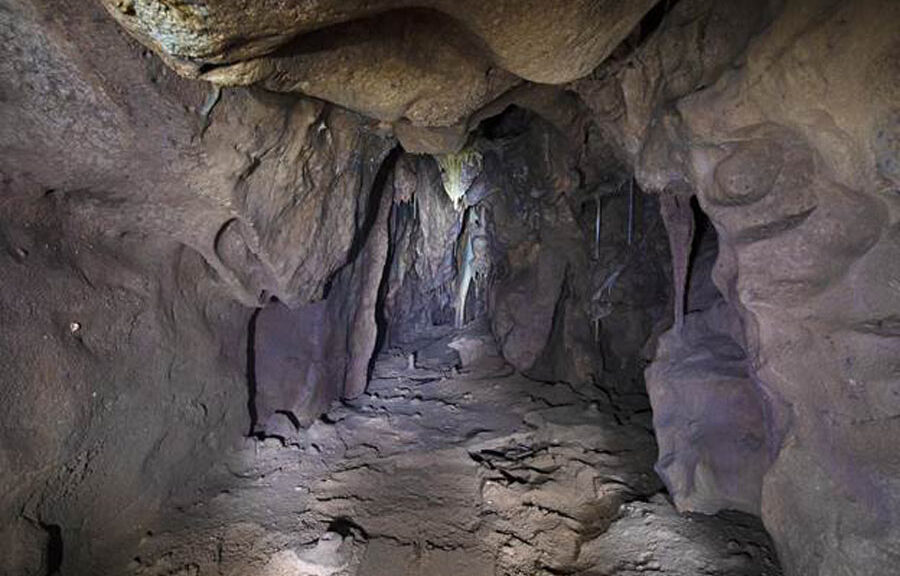
A cave chamber sealed off by sand for some 40,000 years has been discovered in Vanguard Cave in Gibraltar — a finding that could reveal more about the Neanderthals who lived in the area around that time. 

Entrance to Vanguard Cave, Rock of Gibraltar

“Given that the sand sealing the chamber was [40,000] years old, and that the chamber was, therefore, older, it must have been Neanderthals,” who lived in Eurasia from about 200,000 to 40,000 years ago and were likely using the cave,  Clive Finlayson, director of the Gibraltar National Museum, told Live Science in an email. 

While Finlayson’s team was studying the cave last month, they discovered the hollow area. After climbing through it, they found it is 43 feet (13 meters) in length, with stalactites hanging like eerie icicles from the chamber ceiling.

Along the surface of the cave chamber, the researchers found the remains of lynx, hyenas and griffon vultures, as well as a large whelk, a type of sea snail that was likely carried into the chamber by a Neanderthal, the archaeologists, said in a statement. 

The researchers are eager to see what they will find once they start excavating. One possibility is that the team will discover Neanderthal burials, Finlayson said.

“We found the milk tooth of a 4-year-old Neanderthal close to the chamber four years ago,” he said. The tooth “was associated with hyenas, and we suspect the hyenas brought the child [who was likely dead] into the cave.” 

Researchers have discovered plenty of evidence of Neanderthals’ presence in the cave system, called the Gorham’s Cave Complex, including a carving that may have been early Neanderthal artwork.

In addition, findings have suggested that, at this cave system, our closest extinct relatives butchered seals, plucked feathers off birds of prey to wear as ornaments and used tools, Live Science previously reported.

Scientists have speculated that this cave system may have been one of the last places Neanderthals lived before they went extinct around 40,000 years ago. 

‘Ancestor’ of Mediterranean mosaics discovered in Turkey

‘Ancestor’ of Mediterranean mosaics discovered in Turkey

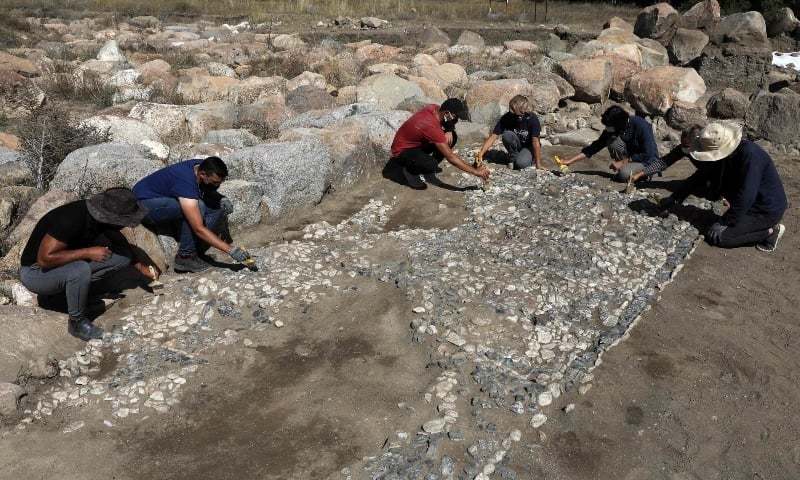
The discovery of a 3,500-year-old paving stone, described as the “ancestor” of Mediterranean mosaics, offers illuminating details into the daily lives of the mysterious Bronze Age Hittites.

Archaeologists work at the site where a 3,500-year-old paving stone was discovered in Buyuk Taslik village, Turkey

The assembly of over 3,000 stones — in natural shades of beige, red and black, and arranged in triangles and curves — was unearthed in the remains of a 15th century BC Hittite temple.

“It is the ancestor of the classical period of mosaics that are obviously more sophisticated. This is a sort of the first attempt to do it,” says Anacleto D’Agostino, excavation director of Usakli Hoyuk, near Yozgat, in central Turkey.

‘Ancestor’ of Mediterranean mosaics discovered in Turkey
ARCHAEOLOGISTS working on the 3,500-year-old paving stones discovered in Turkey’s Yozgat province.

At the site, three hours from Turkey’s capital Ankara, first located in 2018, Turkish and Italian archaeologists painstakingly use shovels and brushes to learn more about the towns of the Hittites, one of the most powerful kingdoms in ancient Anatolia.

“For the first time, people felt the necessity to produce some geometric patterns and to do something different from a simple pavement,” D’Agostino says.

“Maybe we are dealing with a genius. Maybe not. It was maybe a man who said ‘build me a floor’ and he decided to do something weird.”

The discovery was made opposite Kerkenes mountain and the temple where the mosaic is located was dedicated to Teshub, the storm god worshipped by the Hittites, equivalent to Zeus for the ancient Greeks.

“Probably here the priests were looking at the picture of Kerkenes mountain for some rituals and so on,” D’Agostino adds.

The archaeologists this week also discovered ceramics and the remains of a palace, supporting the theory that Usakli Hoyuk could indeed be the lost city of Zippalanda.

A significant place of worship of the storm god and frequently mentioned in Hittite tablets, Zippalanda’s exact location has remained a mystery.

“Researchers agree that Usakli Hoyuk is one of two most likely sites. With the discovery of the palace remains alongside the luxurious ceramics and glassware, the likelihood has increased,” D’Agostino says.

“We only need the ultimate proof: a tablet carrying the name of the city.”

The treasures of Usakli Hoyuk, for which cedar trees were brought from Lebanon to build temples and palaces, were swallowed up like the rest of the Hittite world towards the end of the Bronze Age. The reason is still not known. But some believe a change in climate accompanied by social unrest is the cause. Nearly 3,000 years after their disappearance, the Hittites continued to inhabit Turkish imagination.

A Hittite figure representing the sun is Ankara’s symbol. And in the 1930s, the founder of the modern Turkish republic, Mustafa Kemal Ataturk, presented Turks as the direct descendants of the Hittites.

“I don’t know if we can find a connection between ancient Hittites and people living here now. Centuries and millennia have passed, and people moved from one place to another,” D’Agostino says.

“But I would like to imagine that some sort of spiritual connection exists.” In an attempt to honour this connection, the excavation team recreated Hittite culinary traditions, trying ancient recipes on ceramics produced as they would have been at the time using the same technique and clay.

“We reproduced the Hittite ceramics with the clay found in the village where the site is located: we baked dates and bread with them as the Hittites used to eat,” says Valentina Orsi, co-director of the excavation.

“It was very good.”

Archaeologists Find Several Jars Full of Emeralds Connected to El Dorado, Spain

Archaeologists Find Several Jars Full of Emeralds Connected to El Dorado, Spain

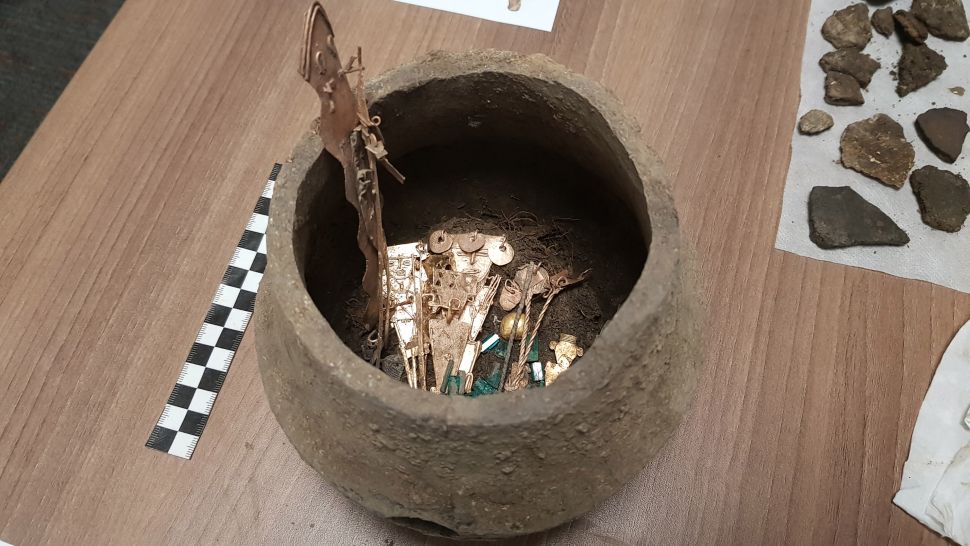
Archaeologists in Colombia have found eight ceramic jars, with metallic figurines and emeralds inside, within a temple and its adjacent graves. 

Archaeologists Find Several Jars Full of Emeralds Connected to El Dorado, spain
Here, an ofrendatario is found at the Muisca site.

The ancient Muisca (also called the Chibcha) crafted the jars called “ofrendatarios” about 600 years ago. The Muisca, a people whose civilization flourished in the region at the time, were famous for their metal-crafting skills, and their work may have inspired the legend of El Dorado — a legendary city made of gold. 

Between 1537 and 1540, the Spanish conquered the region, and many of the Muisca were killed during fighting or due to disease. Despite the destruction, the Muisca persevered and thousands of their descendants live on today. 

Archaeologists uncovered the temple and graves in the remains of an ancient Muisca town located near Bogotá, the modern-day capital of Colombia.

A team led by archaeologist Francisco Correa, an archaeologist who conducts excavations prior to construction work, found the ofrendatarios during excavations that were conducted prior to road construction in the area.

Some of the figurines look like snakes and other animals, while others look more like people with headdresses, staffs and weapons. The temple where the ofrendatarios were found may be related to ancestor worship. 

“It’s very difficult to establish, I think there was some type of cult of the ancestors,” Correa told Live Science.

Ofrendatarios like these have been found at other ancient Muisca sites and may have been offerings of sorts. They have artefacts inside that often include metallic figurines and emeralds. 

The temple and ofrendatarios may also be related to deities worshipped by the Muisca, said Correa, noting that they worshipped a variety of gods, including those associated with the moon and sun. 

Metal-crafting legend

The Muisca were regarded as experts in metal crafting. When the Spanish encountered the Muisca, they were particularly amazed at their goldwork. There were no gold mines nearby, so the ancient Muisca traded for the metal with other groups. 

As for whether the Muisca metalwork — especially their goldwork — inspired the legend of El Dorado, Correa said the group did have a tradition in which during certain ceremonies a chief would appear covered in an ointment that included gold particles.

This ceremony “was one of the motivations of this myth,” said Correa. The ceremony was witnessed by Spaniards and recorded in Spanish chronicles; the story along with the Muisca’s goldwork helped inspire the legend. 

Correa worked with the Museo Del Oro & Xavierian University’s Industrial Engineering department to conduct the excavation. He also got assistance from Artec 3D, which provided an Artec Eva scanner that he used to create 3D scans of the artefacts.