A tall story! Famous artist Michelangelo was surprisingly SHORT, measuring just 5ft 3in
As an artist, the legendary Michelangelo Buonarroti left behind some big shoes to fill. But in real life, the great painter’s shoes weren’t big at all — and neither was Michelangelo.
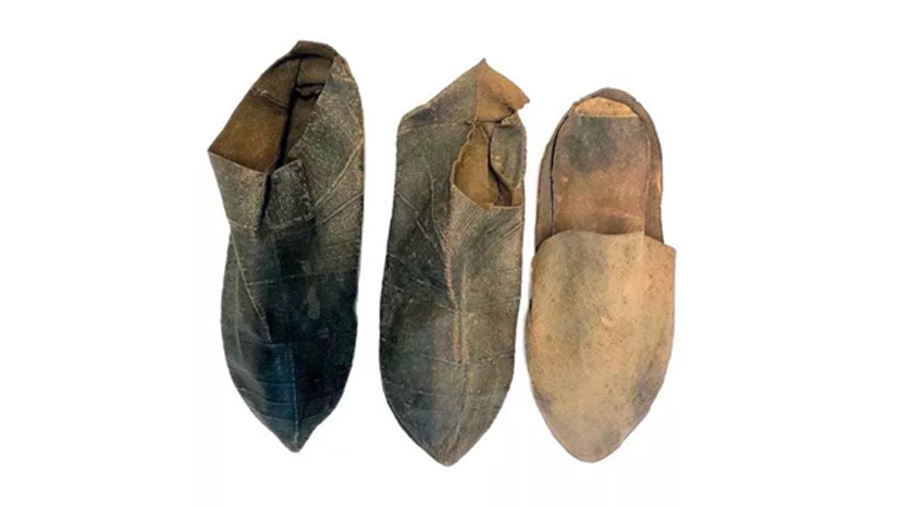
Italian researchers recently examined three shoes that were found in Michelangelo’s home after his death and are thought to have belonged to the Renaissance artist: a pair of leather shoes and a single leather slipper (the companion was stolen in 1873), in the collection of the Casa Buonarroti Museum in Florence, Italy.
The researchers’ analysis is the first to estimate the physical characteristics of the artist based on measurements of personal objects such as footwear, and they found that Michelangelo, while still an artistic giant, stood no more than 5 feet 2 inches (1.6 meters) tall.
While this is relatively short for a European adult man by today’s standards, at the time Michelangelo was alive (1475 to 1564) that height would not have been unusual, said scientists with the Forensic Anthropology, Paleopathology and Bioarchaeology Research Center (FAPAB) in Avola, Italy.
FAPAB researchers Francesco Galassi, a paleopathologist, and Elena Varotto, a forensic anthropologist, measured the shoes and then calculated the wearer’s foot dimensions and height, and their results aligned with a description of Michelangelo by the 16th-century artist and writer Giorgio Vasari.
Vasari wrote that Michelangelo was “broad in the shoulders” but the rest of his body was “somewhat slender in proportion” and his stature was average, according to the study.
The shoes were all similar in size, suggesting that both pairs (when the slipper pair was complete) were worn by the same person.
However, even though the shoes have long been attributed to Michelangelo, it’s also possible that they belonged to another man in the artist’s household, such as a family member or one of Michelangelo’s descendants, the scientists wrote.
Michelangelo may have been in poor health toward the end of his life, and likely had gout and lead poisoning as well as severe arthritis in his hands, according to clues found in Michelangelo’s own writings and in painted portraits of the artist, Live Science previously reported.
A circa 1540 portrait of Michelangelo by Italian painter Jacopino del Conte (1513–1598). Not surprisingly, the portrait doesn’t focus on Michelangelo’s height but on his face and hand instead.
As Michelangelo’s remains have never been exhumed and analyzed, it’s difficult for scientists to be certain about the artist’s condition when he died at the age of 88.
However, studies such as this can help to fill in some of the physical details about Michelangelo toward the end of his lifetime, the authors reported.
The findings were published in the September 2021 issue of the journal Anthropologie.
Huge and exquisite gold hoard from Iron Age discovered in Denmark
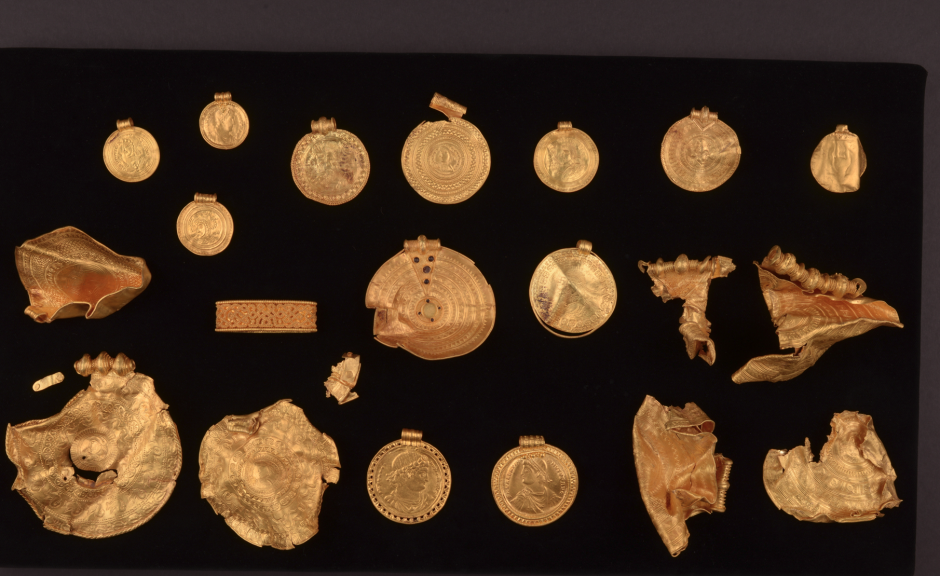
The treasure consisted of a special type of medallion called bracteate and heavy Roman gold coins that had been turned into jewellery.
A huge gold treasure of almost 1 kilogram consisting of medallions the size of small saucers and Roman coins made into jewellery, has now seen the light of day. Amateur archaeologist Ole Ginnerup Schytz had just acquired a metal detector and was allowed to walk in the field with his old classmate. After a few hours, the detector buzzed, and then Danish history was a marked gold find richer.
“It really is a unique find. It’s something you don’t see very often, maybe every 50 years, “exclaims Mads Ravn, head of research at the Vejlemuseerne. Two days before Christmas Eve, Mads Ravn received an SMS from Ole Ginnerup Schytz, who sent a picture of the unique gold find, and asked if it was anything special?
“I replied immediately that: ‘I probably think it is,’ remembers Mads Ravn. The find was made on a field 8 kilometres from Jelling. So far, the exact location of the find is kept secret so that it is not run over by amateur archaeologists looking for gold.
“There is no more gold,” emphasizes Mads Ravn.
Since it was found in the winter of 2020, the gold treasure has been studied by researchers at the Vejlemuseerne and the Nationalmuseet
Large medallions are completely unique
The treasure has since been examined and is dated to have been buried in the 500s. Especially the medallions as large as small saucers stand out in the eyes. These are some of the largest found in Denmark.
“The size is spectacular because they are usually the size of a 5 kroner,” says Mads Kähler Holst, who is an adjunct professor of archaeology at Aarhus University and who has not been involved in the gold discovery.
“But the pictorial world and the inscription on them are also really interesting,” he adds.
The medallions are decorated and are known as a special type of medallions called bracteate. It was a kind of medallion that was given away to alliance partners, explains Lisbeth Imer, museum inspector and senior researcher at the National Museum:
“It was a kind of piece of jewellery that you wore around your neck, and in that way, you could show who you were in alliance with,” explains Lisbeth Imer, who researches runes.
The so-called bracteates are some of the largest that have been found in Denmark.
Early signs of Norse mythology
The medallions are just decorated with runic inscriptions and motifs that possibly refer to the rulers and nobles of the time, which is very common. One of the finds stands out, however, as it brings to mind Nordic mythology. On the medallion is printed a man’s head with a braid and some runes. Under the head is seen a horse and in front of a bird with which the man communicates. There is a runic inscription between the horse’s muzzle and forelegs, which according to the preliminary interpretations says ‘houaʀ’; ‘the tall’.
‘The High’ may refer to the ruler who abolished the find but is also in later mythological contexts associated with the god Odin. The high is one of the names by which Odin is later known. But typically we only see it many hundreds of years later. We know it, among other things, from the Icelandic Edda poems, which perhaps in oral form date back to the 9th century, “says Lisbeth Imer.
“It may be a sign that Nordic mythology and the way of thinking in the later Viking Age was more widespread than we already thought around the year 500, which is 300 years before the Viking Age,” adds Mads Ravn from Vejlemuseerne.
The man with the beautiful braids here is believed to be an Odin. If this is true, it is one of the earliest signs of Norse mythology in Denmark.
Insanely heavy Roman coins
In addition to the medallions, the treasure also consists of a handful of Roman coins that have been turned into jewellery. The coins are insanely valuable (expression of how large a part of a metal mixture is made up of a precious metal, ed.). They are wildly heavy and have almost 24 carats. These are some that you have picked up in Rome or served in the Roman army, “says Mads Ravn.
It is not uncommon for Roman gold at that time to end up in dark northern Europe. It is popularly said that the downfall of the Roman Empire began around the year 395. Since then, the city was plundered by Germans.
“We are back at the time of the migration. The Roman Empire has fallen and they are pumping huge amounts of gold into the rest of Europe. Much of that gold ends up in Scandinavia, “says Mads Kähler Holst and continues:
‘The great change of power in Europe between Romans and Germans took place at that time. As a result of these upheavals, a new elite emerges in the 5th century. That is the story that the find is based on, “he explains. The gold treasure is so valuable that it has no doubt been dug down by a powerful great man or warlord at that time. But scientists do not yet know who the powerful Iron Age persona was.
A Roman coin transformed into a jewel. The fascinating journey of gold tells us about a European continent that was already closely connected by trade and war in the Iron Age.
The find may be connected to the Jelling Kings
This week, however, they got a little wiser. Although the treasure was found last winter, archaeologists from the Vejlemuseerne have only had the opportunity to excavate the site this summer. In this connection, they have now found out that the treasure has been buried in a longhouse, located in a village consisting of 3-4 farms, as it looks so far.
That the treasure was found in a house is interesting for several reasons. This indicates that the rich and powerful lord has been established in the area and is not only driven past the area, which is only 8 kilometres from Jelling.
Jelling is known as a centre of power in the Viking Age, which broke through in the 10th century when first Gorm the Old ruled over Jutland, and Harald Bluetooth later raised the Jelling stones and ‘made the Danes Christian’.
However, we know very little about what the area looked like before that time. Large royal seats such as Lejre and Uppsala have roots from around the 5th century. But we do not know Jelling’s history from before the 10th century very well, «says Mads Kähler Holst.
Jelling was a definite centre of power in Viking-era Northern Europe. Today it is a station town in South Jutland with 3,607 inhabitants.
Thus, there is a significant part of the story of how Denmark came to be, which we do not quite understand yet. Here, the new gold treasure may play a role. It raises a discussion about whether the gold find here has a connection to the Jelling kings from the 10th century, points out Mads Kähler Holst. He emphasizes, however, that there is still a large black hole of 400 years from the year 500 to the 900s, but it is likely that there has already been a local power foundation for centuries before Jelling really became a central part of the map of Denmark.
We have enough knowledge to conclude that there has lived an important little king or warlord who has been involved in the struggle for a united Denmark, long before we thought. The discovery of the enormous amount of gold shows that the site has been a centre of power in the late Iron Age, “emphasizes Mads Ravn. Several other small villages have also been found in the area around Jelling from that time, says the head of research.
The gold treasure will be exhibited next year
Mads Ravn and his colleagues from the Vejlemuseerne obviously want to dig further in the secret place near Jelling, so they can find out more about who was behind the burial of such a precious treasure. The initial analyzes from the area show that the tax was buried, in roughly the same period as the houses were used. However, archaeologists have planned to make carbon-14 datings at the site so they can get even more accurate knowledge of when the houses are from.
However, the excavation work is over, as there is a lack of time and funds to continue digging in the area, Mads Ravn announces. If you have become curious about the new gold find, you can be happy that the Vejlemuseerne is exhibiting the treasure in a large Viking exhibition that opens on 3 February 2022.
The exhibition tells the story of Harald Blåtand’s eastern connections and of the early state formation that created the foundation for the Jelling dynasty. The Viking exhibition is made in collaboration with the Moesgaard Museum, which also has an exhibition that tells about other aspects of the Vikings’ travels to the east.
Archaeologists in southwest Russia have unearthed a trove of medieval silver at a site where the treasure was often hidden from an invading Mongol army in the 13th century — but oddly it seems to have been buried there at least 100 years before the Mongols swept through.
Among the treasure are several “seven ray rings” that are thought to represent the rays of the sun.
The trove of silver pendants, bracelets, rings, and ingots was found during excavations earlier this year near the site of Old Ryazan, the fortified capital of a Rus principate that was besieged and sacked by Mongols in 1237.
The Mongol attack was particularly bloodthirsty; historical accounts report that the invaders left no one alive in Old Ryazan and archaeologists have discovered nearly 100 severed heads and several mass graves there from the time.
The hidden treasure was found in the forested bank of a ravine several hundred yards away from two small medieval settlements that had existed there; archaeologists also found remains of a cylindrical container probably made from birch bark that had once held the trove, according to a translated statement from the Russian Academy of Sciences.
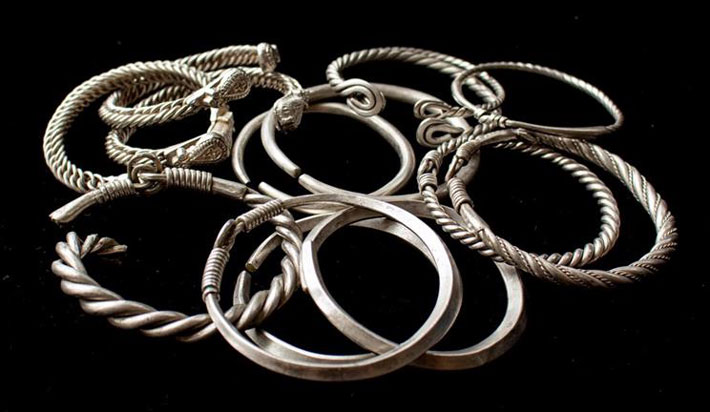
The treasure includes 14 ornate bracelets, seven rings and eight “neck hryvnias” — a type of pendant worn around the neck that gave its name to the modern Ukrainian currency — and weighs 4.6 pounds (2.1 kilograms).
The jewelry is finely made, and archaeologists think its mixed composition shows it was a trove of accumulated wealth rather than a set of jewellery for a particular costume.
Golden Horde
Ryazan was one of several medieval principalities of the Rus people in the 11th century. It was centered on the city now known as Old Ryazan — about 30 miles (50 km) southeast of the modern city of Ryazan and about 140 miles (225 km) southeast of Moscow — and grew powerful enough to occasionally go to war with its neighbours.
But Ryazan was east of the other Rus principalities, and so it was the first to fall to an invading Mongol army from the far east, led by a grandson of Genghis Khan called Batu Khan.
The Mongols first defeated the Ryazan army in battle and then besieged the capital city, using catapults to destroy its fortifications.
The inhabitants of the city repelled the besiegers for almost a week — but in the end, the Mongols plundered the city, killed its prince, his family, and its inhabitants, and burned all that remained to the ground. A Rus chronicler noted “there was none left to groan and cry.”
Batu Khan’s armies went on to conquer and subjugate other Rus principalities until the Mongol leader’s death in 1255; his successors ruled much of southern and central Russia as the Golden Horde — from the Turkic phrase “Altan Orda,” which means “golden headquarters,” possibly from the golden colour of Batu Khan’s tent.
The hidden hoard of medieval silver, including several finely-made bracelets, was found at the site of Old Ryazan which was destroyed by an invading Mongol army in the 13th century. Archaeologists say the silver bracelets and other items of jewellery in the medieval hoard are especially well-made.
Among the treasure are several “seven ray rings” that are thought to represent the rays of the sun. Seven-ray rings became a distinctive feature of early medieval Russian jewellery; it’s thought their design was introduced from the far east.
Some of the bracelets, including this one of braided silver wire, are thought by their style to date from the 10th and 11th centuries. The ends of some of the bracelets are hollow and delicately embossed with intricate ornamental designs, including stylized palm trees that suggest an eastern and southern influence. Some of the bracelets are embossed at the ends with crosses that presumably portray Christian crucifixes.
Several buried treasures found at Old Ryazan date from the siege of the city in 1237, but archaeologists think this hoard of silver was buried about 100 years before that.
Hidden treasure
The practice of hiding treasure to prevent the invading Mongols from finding it seems to have been relatively common during the siege — more than a dozen hidden troves have now been found nearby, including the famous Old Ryazan Treasure, a collection of bejewelled royal regalia which was discovered by chance in the 19th century and is now on display in a nearby cathedral.
Somewhat surprisingly, however, the newly-discovered trove seems to have been hidden away between the end of the 11 century and the beginning of the 12th century — a century before the Mongol invasion, based on analysis of the style of the jewelry and ceramics found nearby, the RAS archaeologists said.
“The… treasure is clearly older than the Old Ryazan Treasure and includes jewellery made with simpler techniques and a more archaic manner,” the statement read.
The trove includes several six-sided “grivna,” a relatively small type of standardized silver ingot that could be used as jewellery, a measure of weight, or currency during the medieval Rus period. The bracelets are especially well made. The most complex has three silver braids and are ornamented at the ends with embossed crosses and palm leaves, the archaeologists said.
“Further studies of the treasure items, the technique of their manufacture, the composition of the metal will complement our knowledge of the early history of Old Ryazan,” they wrote; “possibly it will reveal the historical context of the concealment of the treasure.”
Scientists Reconstruct First-evolved Plant Roots Using 400-million-year-old Fossil
A plant fossil from a geological formation in Scotland sheds light on the development of the earliest known form of roots. A team led by researchers at GMI – the Gregor Mendel Institute of Molecular Plant Biology of the Austrian Academy of Sciences, the University of Edinburgh, and the University of Oxford realize the first 3D reconstruction of a Devonian plant-based exclusively on fossil evidence.
Artist’s reconstruction of what Asteroxylon mackiei would have looked like in life. Each leafy shoot is roughly 1 cm in diameter.
The findings demonstrate that the appearance of different axis types at branching points resulted in the evolution complexity soon after land plants evolved sometime before 400 million years ago. The results are published in eLife.
New research demonstrates how the oldest known root axed developed more than 400 million years ago. The evolution of roots at this time was a dramatic event that impacted our planet and atmosphere and resulted in transformative ecological and climate change.
3D reconstruction of Asteroxylon mackiei made from digitally re-assembling thin slices of rock. The reconstruction shows the highly branched leafy shoot in green and the rooting system in blue and purple. 3D scale bar 1 x 0.1 x 0.1 cm
The first evidence-based 3D reconstruction of the fossil Asteroxylon mackiei, the most structurally complex plant from the Rhynie chert has shown how roots and other types of axes developed in this ancient plant. The fossil is preserved in chert (a type of flint) found near the village of Rhynie in Aberdeenshire, Scotland.
The specimens are exceptionally well-preserved in the 407-million-year-old rocks from the Early Devonian period.
The extinct genus Asteroxylon belongs to the group of plants called the lycophytes, a class that also comprises living representatives such as isoetes and selaginella.
The reconstruction has allowed researchers, for the first time, to glean both anatomical and developmental information of this mysterious fossil. This is of particular significance because previous interpretations of the structure of this fossil plant were based to a large extent on comparisons of fragmentary images with extant plants.
A thin slice of the 407 million-year-old Rhynie chert mounted on a glass slide showing the amazing preservation of fossil plants preserved within. Specimen number 4178 in the paleobotanical collection at the University of Münster, Germany. Each interval on the scale bar is 1 mm.
The reconstruction demonstrates that these plants developed roots in an entirely different way than extant plants develop roots today. The rooting axes of A. mackiei are the earliest known types of plant roots.
“These are the oldest known structures that resemble modern roots and now we know how they formed. They developed when a shoot-like axis formed a fork where one prong maintained its shoot identity and the second developed root identity,” says Dolan.
This mechanism of branching, called “dichotomous branching,” is known in living plants within tissues that share structural identity. However, as Dolan stresses: “No roots develop in this way in living plants, demonstrating that this mechanism of root formation is now extinct.” Their findings demonstrate how a now extinct rooting system developed during the evolution of the first complex land plant.
View over the village of Rhynie in Aberdeenshire, Scotland. The fossil deposit known as the Rhynie chert is named after the village of Rhynie where it was first discovered just over a century ago
“100 Years after the discovery of the fossils in Rhynie, our reconstruction demonstrates what these enigmatic plants really looked like! The reconstruction also demonstrates how the roots formed” exclaims GMI group leader Liam Dolan, co-corresponding author on the work.
Understanding the structure and evolution of these plants from the Early Devonian period provides us with an insight into events at a key time in Earth history just after plants colonized the dry surfaces of the continents as they began to spread – radiate – across the land.
“Their evolution, radiation, and spread across all continents had a dramatic impact on the Earth system. Plant roots reduced atmospheric CO2 levels, stabilized the soil and revolutionized water circulation across the surfaces of continents,” states first author and co-corresponding author Alexander (Sandy) J. Hetherington, group leader at the University of Edinburgh. At the root of the environmental and ecological impact of the plant, evolution are the plant roots themselves!
Hetherington highlighted how his research was enabled by fossils that were collected by generations of palaeontologists that are housed in many different museums and universities.
“The answers to so many of the key questions of evolution are lying in shelves in these institutions,” said the scientist who is now based at the University of Edinburgh. “Using digital 3D techniques it is possible for the first time to visualize the complex body plan of A. mackiei allowing us to discover how these enigmatic plants developed. It was brilliant to finally see details that had previously been hidden.”
Israeli-Lithuanian Team Reveals Torah Ark at the Site of Vilnius’ Great Synagogue
Imaging of the podium at the Great Synagogue of Vilnius,
In Vilnius, capital of Lithuania, an excavation of its former Great Synagogue has fully exposed the Torah ark and the podium that was destroyed by Nazi-Germany during the Holocaust.
A joint Israeli-Lithuanian excavation expedition, using a ground-penetrating radar test at the site, announced on Thursday that it had made significant discoveries at the site Thursday at the end of this season of a six-year excavation project.
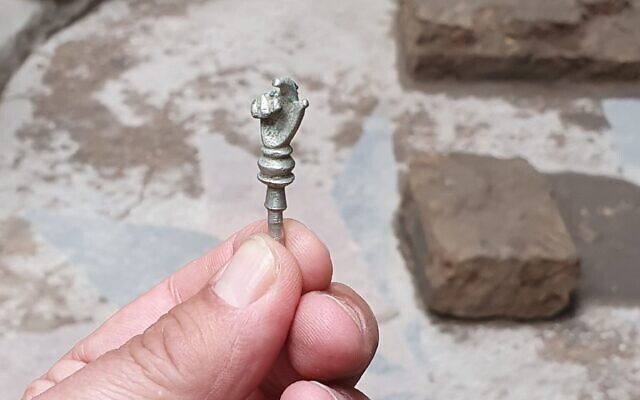
The silver Yad found this morning at the Great Synagogue of Vilna
“Just this morning, while sifting the soil in front of the Aron Kodesh (Torah ark), we found a silver Yad (hand). The Yad is a pointer used to read from the Torah scroll”, the archaeologists from Israel Antiquities Authority and the Lithuanian Cultural Heritage Preservation Institute said. The finding will be exhibited at the local Jewish museum.
Vilnius was in the past known as the “Jerusalem of Lithuania”. The Great Synagogue of Vilnius, built in the 17th century in Renaissance-Baroque style, was the major part of a large Jewish centre of religious and community studies.
The heart of the Lithuanian Jewish community, included synagogues and prayer halls, schools, ritual baths, and the community council.
Around 450 seats in the synagogue can be counted, though the number might have doubled during the high holidays.
Due to the prohibition to build synagogues higher than churches, a foundation was dug well below street level to create the interior height. Outside, the synagogue looked to be about three stories high, but inside it reached over four stories.
The synagogue is linked to Rabbi Eliyahu ben Shlomo Zalman in the 18th century, known as the Vilna Gaon (the genius of Vilna/Vilnius), a famous Talmudist and author of scientific studies.
The excavation of the Great Synagogue of Vilna in Lithuania showing the area of the Torah ark and two flights of stairs destroyed by the Nazis and the Soviets, August 2021.
Centuries of existence came to an end with the destruction of the Jewish community of Vilnius during the Holocaust.
The synagogue, which was sacred to the Jews of Lithuania, was looted and burned by the Nazis, and in 1956-7 its remains were completely destroyed by the Soviet authorities. A modern school was built on the premises.
“When we arrived to carry out the excavations of the interior of the synagogue, it became clear, unfortunately, that the core of the synagogue had been greatly damaged,” said Dr Jon Seligman from the Israel Antiquities Authority. “Still, two impressive staircases, clearly visible in the many images of the synagogue before its destruction, were discovered and are evidence of their existence.”
What distinguishes the synagogue from other synagogues from the period? “The synagogue is a typical baroque nine-bay synagogue,” Dr Seligman replied.
“Similar structures with a central podium (bimah) inside four supporting columns and nine vaulted bays existed at other places in Eastern Europe, such as Grodno, Lancut, Kalvarija, Druja, and Slonim.”
Are there plans for a memorial at the site or restoration of the building? “That is a question for Vilnius municipality, the Lithuanian Jewish community and Lithuanian society to decide.”
The remains of up to 20,000 people have been found in Ukraine’s southern city of Odessa as excavations continue at a site believed to be a mass grave of victims of Stalin’s Terror, historians said Monday.
People work on the site of mass graves site unearthed near Odessa airport in Ukraine
According to various estimates, the bones of between 5,000 and 20,000 people lie in the ground, making it one of the largest mass graves unearthed in Ukraine so far.
They were discovered this month close to Odessa airport after exploratory works started as part of expansion plans.
“As of today, 29 graves have been discovered. The bodies lie in several layers,” local historian Oleksandr Babych told journalists at the site which until recently was a garbage dump.
The bones of between 5,000 and 20,000 people lie in the ground, making it one of the largest mass graves unearthed in Ukraine
“Already we can clearly see at least five layers”, he said.
Historians believe that these people were executed in the 1930s, the time is known as Stalin’s Great Terror.
Archaeologist Tetyana Samoylova, a chief consultant at the site, highlighted the “cynicism” with which the sentences were carried out.
“They dug out pits in the garbage and threw these people in or shot them dead as they were standing there,” Samoylova said.
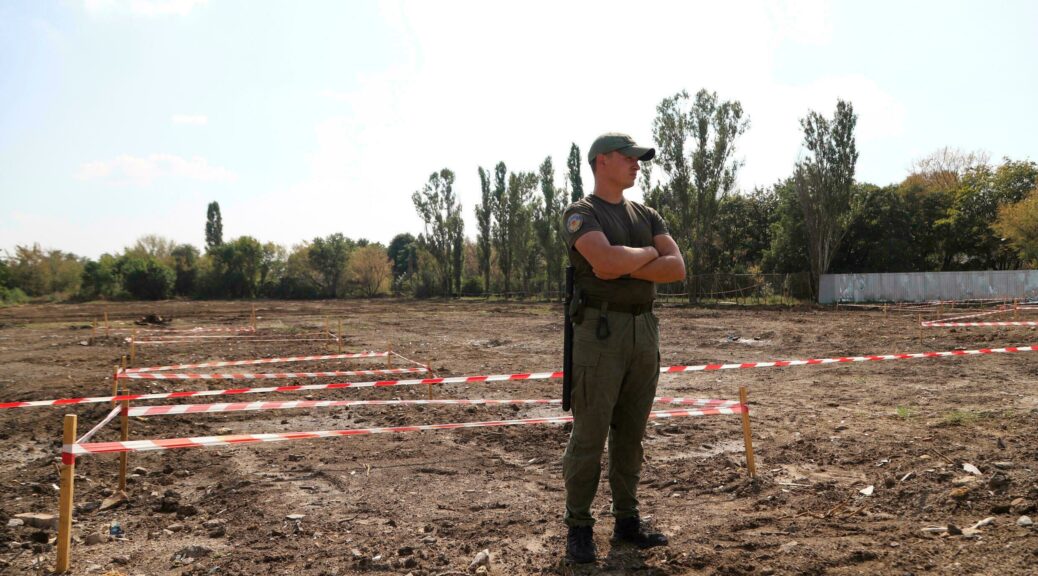
“And then they covered them with the same garbage,” she added, standing next to the dozens of graves marked by red tape.
It took 400 trucks to remove the top layer of garbage, according to a search group.
“When we carry out the exhumation, we will decide what to do here. And, of course, we plan to make a memorial,” Odessa mayor Gennady Trukhanov said.
Historians believe the people were executed in the 1930s, the time known as Stalin’s Great Terror
Some mass graves had already been unearthed in this area in previous years.
The prisoners’ nationalities and the crimes for which they were sentenced to die to remain unknown.
According to estimates made by historians, hundreds of thousands of Ukrainians were imprisoned or executed in Gulag camps during the Stalinist repressions.
One of the best-known execution sites is the forest near the village of Bykivnia on the outskirts of the capital Kiev, where tens of thousands of victims were buried in 1937-1941.
Millions of Ukrainians also died in the great famine of 1932-1933, which Kiev regards as a genocide orchestrated by Stalin.
A 400-year old ship has been found in the Baltic Sea
In June 2011, a Finnish treasure hunting company was scanning the Baltic Sea in the Gulf of Bothnia when “they claimed” their sonar captured what tabloid newspapers reported was “a sunken UFO.”
While most scientists agree that the 2011 Baltic Sea discovery is most likely a natural geological formation, another mystery craft has just been identified by a team of divers in the Baltic Sea. The divers who discovered the “mystery shipwreck” said the “near-perfect” ship they found on the Baltic Sea floor in 2020 was “miraculous.”
Now, that mysterious Baltic Sea ship that was discovered between the mainland of Finland and the Estonian island of Hiiumaa has been identified. The Badewanne dive team that found the Baltic Sea wreck consists of voluntary divers of different nationalities.
The team specializes in documenting wrecks in the Gulf of Finland. Another team of archaeologists and maritime historians solved the ship’s identity, and the answers are amazing.
A bird motif on the Baltic Sea ship, which was initially discovered on the seafloor off the coast of southern Finland in July 2020, and then intensively researched by various experts.
The Baltic Sea Ship Mystery Solved By Its Ancient Motifs
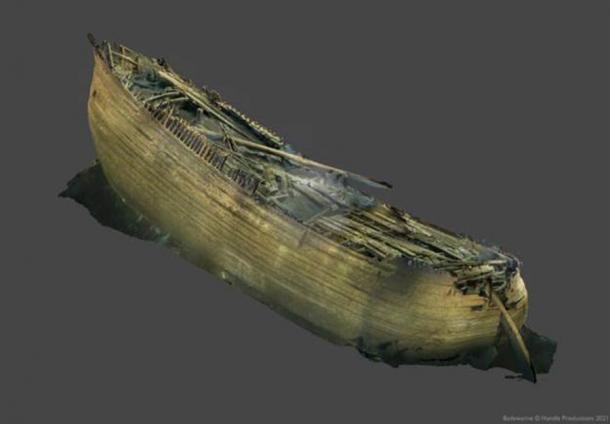
Discovered in great condition at a depth of 85 meters (279 feet) in the Baltic Sea last summer, the Dutch “fluyt” ship was engineered to “carry maximum cargo with a minimum crew,” according to a report in Dutch News. The identity of the ship remained unknown until a team of deep-sea archaeological divers discovered “carved motifs on the transom.”
Archaeologist Niklas Eriksson of Stockholm University, who led the team of divers that solved the mystery of the 400-year-old sunken ship, said the archaeologists are now celebrating a “miraculous breakthrough.”
An article on Diver Net quotes Minna Koivikko, from the Finnish Heritage Agency, who said the discovery “restores one’s faith in miracles.” Koivikko revealed to the media that the ship was named “Swan.”
Furthermore, it is known the craft was built in 1636 AD, and the archaeologists believe that closer examinations of the transom will reveal the coat of arms for the ship’s home port. Archaeologist Martijn Manders, from the Cultural Heritage Agency of the Netherlands, said the new information found on the ship might even yield the names of the crew members.
A 3D photogrammetric model of the fluyt Baltic Sea ship as it was found on the Baltic Seafloor. Orthometric projection model made with Metashape software.
A Ghost Ship Symbolic Of Dutch Pride
Professor Eriksson said that while divers have found fragments of motifs on previous dives, now archaeologists “have the entire composition.” And with the newly discovered motifs, the team of researchers can now identify the ship in the same way that people in the 17th century did, according to Dutch News, who also said this specific design of seaborne craft “helped forge the Dutch Empire.”
The “fluyt” was a three-masted vessel with a capacious hull, so designed to maximize her cargo capacity. It also had specially designed rigging so that smaller crews could hoist and maintain the sails, and this rig structure also enabled more space, and therefore cut operational costs.
Manders said the fluyt highlighted “the typical Dutch approach to shipbuilding and symbolized the flourishing seafaring trade of the time.”
A drawing of a typical three-masted Dutch fluyt ship by Wenceslaus Hollar (1607–1677).
Fluyts: Kings Among The Fleets Of Early Globalization
The discovery of this ship will add volumes to what is known about how fluyts operated. Moreover, it will almost complete archaeologists’ picture of an ancient transportation vessel that was “a simple, common ship, that created the right circumstances for early globalization,” according to Professor Niklas Eriksson.
Putting the discovery into historic context, when the ship was afloat and serving the Dutch Empire, it added to what was a global powerhouse. In the mid-17th century, Dutch ships carried around half of Europe’s produce and goods. The ship was functional in a period of European history that is known as “The Dutch Golden Age ” and that nation’s maritime power lasted until the late 17th century.
Manders told Dutch News that the team of researchers invited amateur sleuths who are interested in maritime history to join in the search for more clues.
The heritage specialist explained that new research archives have become available in digital form online and that this whole investigation “is an interesting puzzle, just the thing for a bad summer.”
The story of the divers who discovered the ship, and the archaeological team who researched and interpreted the motifs, is currently being made into a new documentary by Handle Productions of Helsinki, Finland, which Ancient Origins will no doubt discuss after it’s aired.
2,000-Year-Old Roman-Era Chandelier is One-of-a-Kind!
A Roman chandelier, which is believed to be the last one remaining, has been reconstructed by Spanish archaeologists after they discovered it among the ruins of a workshop.
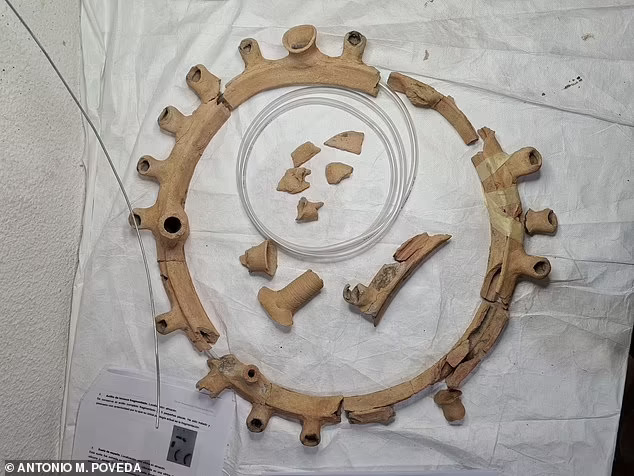
The round lamp which was used during the Roman Empire to light up large spaces has a diameter of half a metre and has spots for 32 candles or fuses.
The rare artefact, which has been lovingly restored by local art teacher Eva Maria Mendiola, is on display at the Elda Museum in Alicante, Spain.
It is believed the light, from the 1st Century AD, was made by a potter named Lucius Eros, The Times reports.
According to El Pais, Augustus and Tiberius were ruling while Eros was alive and he used to engrave his name on the moulds he made.
The round lamp which was used during the Roman Empire to light up large spaces has a diameter of half a metre and has spots for 32 candles or fuses
It is believed the light, from the 1st Century AD, was made by a potter named Lucius Eros.
His branding made it possible to identify the craftsman that had originally made the precious item which was found during an archaeological dig.
Another four lamp moulds were found at the archaeological site Elo-Monastil, which is where Eros is believed to have had his workshop and several kilns.
His workshop was first discovered in 1989 before further kilns were found in 2009 and 2010.
The rare artefact, which has been lovingly restored by local art teacher Eva Maria Mendiola, is on display at the Elda Museum in Alicante, Spain.
Speaking in 1989, professor of Ancient History at the University of Alcalá de Henares Antonio M. Poveda explained the chandeliers of this style would have taken a lot of expertise to make.
As a result, they were quite rare and were only made to order for wealthier people in other cities, including what is now known as Elche and Alicante, with large rooms to light up.
This latest discovery is the first of its kind to have been preserved.
The lights worked by poking fuse through holes in the multiple tubes and oil was piped in to keep it alight.
They were soon replaced by lamps made of metal materials.