1,800-year-old Roman Chariot with horses found buried in Croatia
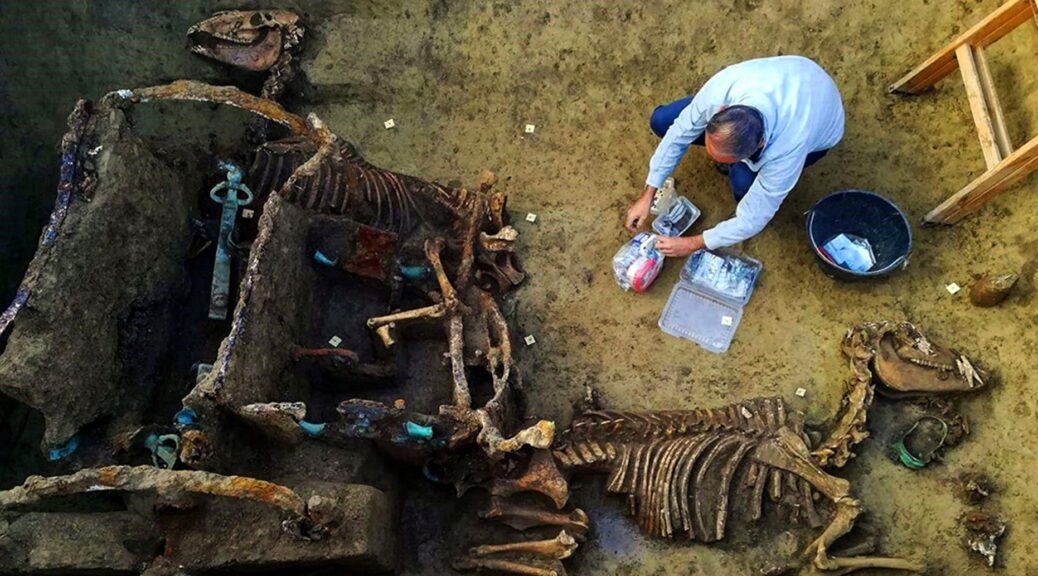
In Croatia, archaeologists discovered the fossilized remnants of a Roman chariot that had been buried with two horses as part of a burial ritual.
A large burial chamber for an ‘extremely wealthy family’ was found in which the carriage with what appears to be two horses had lain.
Archaeologists from the City Museum Vinkovci and Institute of Archaeology from Zagreb discovered the Roman carriage on two wheels (known in Latin as a cisium) with horses at the Jankovacka Dubrava site close to the village of Stari Jankovci, near the city of Vinkovci, in eastern Croatia.
The horses’ remains and the chariot were all buried together in what appears to have been a ritual reserved for very wealthy families.
The discovery is believed to be an example of how those with extreme wealth were sometimes buried along with their horses.
Curator Boris Kratofil explained to local media that the custom of burial under tumuli (an ancient burial mound) was an exceptional burial ritual during the Roman period in the south of the Pannoinan Basin.
He said: ‘The custom is associated with extremely wealthy families who have played a prominent role in the administrative, social and economic life of the province of Pannonia.’
The discovery is estimated to be from the third century AD but the team of scientists are working to confirm its age.
Archaeologists say the discovery will allow them to know a little more about the family whose members were buried in this area 1,800 years ago.
The director of the Institute of Archaeology Marko Dizdar said that it was a sensational discovery that is unique in Croatia.
He said: ‘After this comes a long process of restoration and conservation of the findings, but also a complete analysis of the findings.
‘In a few years, we will know a little more about the family whose members were buried in this area 1,800 years ago.
‘We are more interested in the horses themselves, that is, whether they were bred here or came from other parts of the empire, which will tell us more about the importance and wealth of this family.
‘We will achieve this through cooperation with domestic as well as numerous European institutions.’
British teacher finds long-lost relative: 9,000-year-old man
Adrian Targett visited the home of a close relative yesterday. He had to put on Wellington boots because the floor is muddy. The relative was not in. Hardly surprising: he died 9,000 years ago.
9,000-Year-Old Cheddar Man Has Living Descendant Still Living in The Same Area
But there is no doubt: Mr Targett, a 42-year-old history teacher in Cheddar, Somerset, has been shown by DNA tests to be a direct descendant, by his mother’s line, of “Cheddar Man“, the oldest complete skeleton ever found in Britain, and now also the world’s most distant confirmed relative.
Even the Royal Family can only trace its heritage back to King Ecgbert, who ruled from 829AD to 830AD. By contrast, Cheddar Man, a hunter-gatherer who pre-dated the arrival of farming, lived in 7150BC.
The news caught everyone by surprise. Mr Targett’s wife, Catherine, said: “This is all a bit of a surprise, but maybe this explains why he likes his steaks rare”.
The discovery came about during tests performed as part of a television series on archaeology in Somerset, Once Upon a Time in the West, to be shown later this year.
DNA found in the pulp cavity of one of Cheddar Man’s molar teeth was tested at Oxford University’s Institute of Molecular Medicine, and then compared with that of 20 people locally, whose families were known to have been living in the area for some generations.
To make up the numbers, Mr Targett, an only child who has no children, joined in. But the match was unequivocal: the two men have a common maternal ancestor. The mitochondrial DNA, which is inherited from the egg, confirmed it.
“I’m absolutely overwhelmed,” Mr Targett said on hearing of the match. “It is very strange news to receive – I’m not sure how I feel at the moment.”
His pupils were delighted (“He has never had a nickname … until now,” one 16-year-old said with relish) and so were scientists. The finding could provide a key to the debate about the process by which early humans settled down to agricultural life.
Cheddar Man was discovered in 1903, 20 metres inside Gough’s cave, which is the largest of 100 caverns in Cheddar Gorge – Britain’s prime site for Palaeolithic human remains. He had been buried alone in a chamber near the mouth of a deep cave, about 1,000 years before hunter-gathering began to give way to farming.
Visiting the site, Mr Targett said: “I’m glad I don’t live down here – it’s very dark, dank and dismal. I have been down here before but, of course, I never dreamed that I was standing in my ancestor’s home.”
Dr Larry Barham, an archaeology lecturer at Bristol University, said: “There is debate over whether farmers arrived from eastern Europe and ousted the hunter-gatherers – or whether the idea of farming spread through the population. This discovery strongly suggests an element of the second.”
In Cheddar Man’s time, the area would have been sparsely populated, with dense forests. He would have hunted deer, rabbits, waterfowl and perhaps fish, and gathered nuts, fruit and edible roots. “There were wild boar, bears and beavers.
There were packs of wild wolves, too, but apart from that life was probably pretty good. Cheddar Gorge would have looked similar then and must have been a good spot, with ready-made homes, a spring and forest nearby,” Dr Barham said.
Physically, Cheddar Man would have looked like a modern man. “You could put a suit on him and he wouldn’t look out of place in an office. In fact, he probably wore tailored clothes of leather or skins sewn together,” Dr Barham added.
“It is likely he was part of an extended group of families of 30 or so people. They lived too late to see a woolly mammoth, and too soon to see the earliest farming.”
The link between Cheddar Man and Adrian Targett easily outstrips the existing record for distant ancestors.
The oldest previously recorded relative was the great-great-great-great-grandfather of Confucius who lived in the eighth century BC. Two of Confucius’s 85th lineal male descendants today live in Taiwan.
In Italy, a giant water tank has been linked to prehistoric rituals.
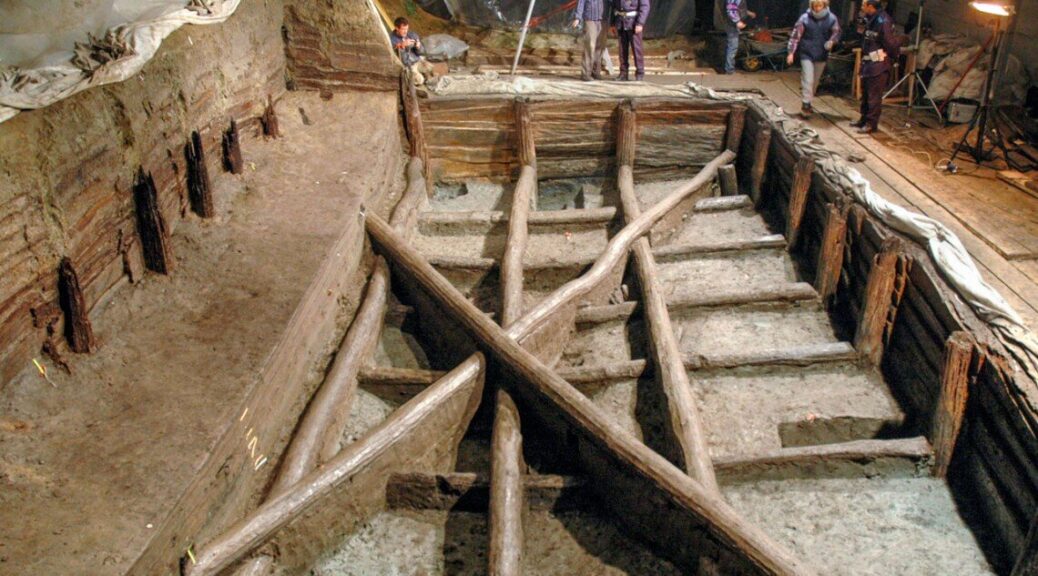
The Noceto Vasca Votiva is a unique wood structure that was unearthed on a small hill in northern Italy in 2005. Built primarily of oak and slightly larger than a backyard swimming pool, the exact purpose of the in-ground structure has remained a mystery, as has the date of its construction. Italian researchers estimated its origins go back to the late Middle Bronze Age, sometime between 1600 and 1300 BCE.
The Cornell Tree-Ring Laboratory received wood samples from the Noceto Vasca Votiva’s lower and upper tanks, then used dendrochronology and a form of radiocarbon dating called “wiggle-matching” to date their origins to 1444 and 1432 B.C., respectively.
While that gap might not seem huge, in archaeological terms it’s like comparing the culture that invented the steam engine with the one that produced the iPad.
A Cornell University team led by Sturt Manning, Distinguished Professor of Arts and Sciences in Classics and director of the Tree-Ring Laboratory, used dendrochronology and a form of radiocarbon dating called ‘wiggle matching to pinpoint, with 95% probability, the years in which the structure’s two main components were created: a lower tank in 1444 BCE, and an upper tank in 1432 BCE Each date has a margin of error of four years.
The finding confirms that the Noceto Vasca Votiva was built at a pivotal moment of societal change, and bolsters the Italian researchers’ theory that the structure was used for a supernatural water ritual.
The team’s paper, “Dating the Noceto Vasca Votiva, a Unique Wooden Structure of the 15th Century BCE, and the Timing of a Major Societal Change in the Bronze Age of Northern Italy,” published June 9 in PLOS ONE.
Manning has led the Tree-Ring Laboratory since 2006, and his team has advanced a range of tools and techniques that have successfully challenged common assumptions about historical artefacts and timelines. Among the lab’s specialities is tree-ring sequenced radiocarbon “wiggle-matching,” in which ancient wooden objects are dated by matching the patterns of radiocarbon isotopes from their annual growth increments (i.e., tree rings) with patterns from datasets found elsewhere around the world. This enables ultra-precise dating even when a continuous tree-ring sequence for a particular species and geographic area is not yet available.
“Working at an archaeological site, you’re often trying to do dendrochronology with relatively few samples, sometimes in less than ideal condition, because they’ve been falling apart for the last 3,500 years before you get to see them. It’s not like a healthy tree that is growing out in the wild right now,” Manning said. “We often measure the samples a number of times to extract as much signal as we can.”
The Noceto Vasca Votiva is about 12 meters long, 7 meters across and roughly four meters deep—although the depth was a little ambiguous at first.
When the site was fully excavated, the researchers found that the structure had a second tank beneath it, which had been built first but collapsed before it was finished. It was initially unclear how much time elapsed between the creation of the two tanks, which shared some of the same materials.
Judging by the size of the structure and the extensive labour that would have been required to excavate the earth and drag timber to the uphill location, the Italian researchers recognized that the Noceto Vasca Votiva was a major undertaking for its era and theorized its purpose. But they were unable to determine the precise date of its origins, and so turned to the Cornell Tree-Ring Laboratory.
Manning’s team made multiple attempts with different samples. While the wood from the Noceto site was well-preserved—a rarity, given its age—there was an unexpected challenge when the samples did not seem to fit the international radiocarbon calibration curve that is used for matching tree-ring sequences. This suggested the curve needed revising for certain time periods, and in 2020 a new version was published. The Noceto data finally fit.
By combining radiocarbon dating calibrated via dendrochronology from southern Germany, Ireland and North America, along with computer-intensive statistics, the Cornell team was able to establish a tree-ring record that spanned several hundred years. They pegged the construction of the lower and upper tanks at 1444 and 1432 BCE, respectively; and they determined the finished structure was in use for several decades before it was abandoned, for reasons that may never be known.
The new timeline is particularly significant because it synchs up with a period of enormous change in Italian prehistory.
“You’ve had one way of life in operation for hundreds of years, and then you seem to have a switch to fewer, larger settlements, more international trade, more specialization, such as textile manufacture, and a change in burial practices,” Manning said. “There is something of a pattern all around the world. Nearly every time there’s a major change in social organization, there tends often to be an episode of building what might be described as unnecessary monuments. So when you get the first states forming in Egypt, you get the pyramids. Stonehenge marks a major change in southern England. Noceto is not the scale of Stonehenge, but it has some similarities—an act of major place-making.”
Because the structure was located atop a hill and not in the centre of a village, it wasn’t used as a reservoir or well. The smooth layers of sediment that filled in the structure, and the absence of channels, implying it wasn’t used for irrigation. In addition, the researchers discovered a large set of objects deliberately deposited inside the tank, including numerous ceramic vessels, figurines and a range of stone, wood and organic items. All of that evidence indicates the structure was used in some kind of supernatural water ritual.
“It’s tempting to think it was about creating a reflective surface that you can see into, and where you put some offerings, but you’re also looking at the sky above and the linking of land, sky and water (rain),” Manning said.
Given the fact that nearby settlements in this southern edge of the Po Plain were built with dikes and terraces, and the region was agriculturally productive with much water management, water was clearly important for all aspects of the builders’ lives. At least for a time.
“The collapse of the whole social and economic system in the area around 1200 BCE seems to occur because it becomes much drier,” Manning said.
1.8-million-year-old skull shakes mankind’s family tree
According to experts, the discovery eight years ago of a 1.8-million-year-old human ancestor’s skull found underneath a medieval Georgian village suggests our family tree may have fewer branches than some believe, scientists say.
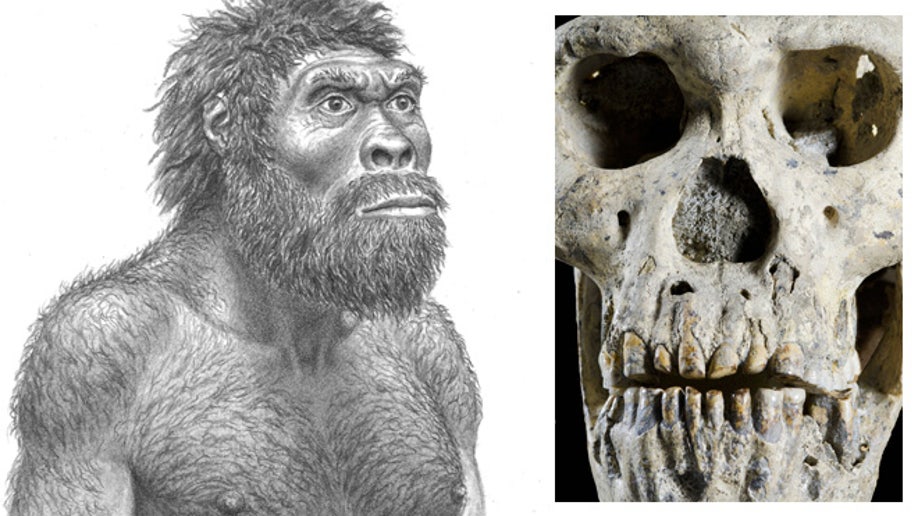
This 2005 photo provided by the journal Science shows a pre-human skull found in the ground at the medieval village Dmanisi, Georgia. The discovery of the estimated 1.8-million-year-old skull of a human ancestor captures early human evolution on the move in a vivid snapshot and indicates our family tree may have fewer branches than originally thought, scientists say.
The skull, along with other partial remains previously found at the rural site, offers a glimpse of a population of pre-humans of various sizes living at the same time — something that scientists had not seen before in such an ancient era.
This diversity bolsters one of two competing theories about the way our early ancestors evolved, spreading out more like a tree than a bush, according to a study published in the journal Science.
When examined with the earlier Georgian finds, the skull “shows that this special immigration out of Africa happened much earlier than we thought, and a much more primitive group did it,” said David Lordkipanidze, director of the Georgia National Museum and the study’s lead author.
“This is important to understanding human evolution,” he said.
For years, some scientists have said humans evolved from only one or two species, much like tree branches out from a trunk. Others say the process was more like a bush, with several offshoots that went nowhere.
Even bush-favouring scientists say these findings show a single species nearly 2 million years ago at the site in the former Soviet republic. But they disagree that the same conclusion can be made about bones found elsewhere, such as in Africa.
Lordkipanidze and colleagues point out that the skulls found in Georgia are different sizes but are considered to be the same species. So, they reason, it’s probable that various skulls found in different places and from different periods in Africa may not be different species but variations in one species.
To see how a species can vary, just look in the mirror, they say.
“Danny DeVito, Michael Jordan and Shaquille O’Neal are the same species,” Lordkipanidze said.
The adult male skull found in Georgia wasn’t from our species, Homo sapiens; it was from an ancestral species in the genus Homo. Scientists say the Dmanisi population is probably an early part of our long-lived primary ancestral species, Homo erectus.
Tim White of the University of California at Berkeley wasn’t part of the study but praised it as “the first good evidence of what these expanding hominids looked like and what they were doing.”
Fred Spoor of the Max Planck Institute in Germany, a proponent of a bushy family tree with many species, disagreed with the study’s overall conclusion, but he lauded the Georgia discovery as critical and even beautiful.
“It really shows the process of evolution in action,” he said.
Spoor said it seems to have captured a crucial point in the evolutionary process where our ancestors transitioned from Homo habilis to Homo erectus — although the study authors said that depiction is going a bit too far.
The researchers found the first part of the fossil, a large jaw, below a medieval fortress in 2000. Five years later — on Lordkipanidze’s 42nd birthday — they unearthed the well-preserved skull, gingerly extracted it, put it into a cloth-lined case and popped champagne. It matched the jaw perfectly.
They were probably separated when the individual lost a fight with a hungry carnivore, which pulled apart his skull and jaw, Lordkipanidze said.
The skull was from an adult male just shy of 5 feet with a massive jaw and big teeth but a small brain, implying limited thinking capability, study co-author Marcia Ponce de Leon, of the University of Zurich, said. It also seems to be from the evolutionary point where legs were getting longer, for walking upright, and hips smaller, she said.
Pornographic Pompeii wall paintings reveal the raunchy services offered in ancient Roman brothels 2,000 years ago
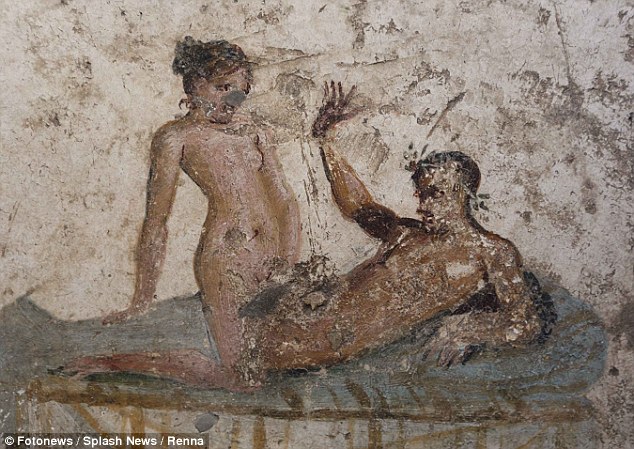
The sexual behaviours of ancient Italians have been exposed in wall paintings found in a renowned Pompeii brothel. The ‘Lupanar of Pompeii‘ is adorned with wall murals showing vivid sex scenes that date back centuries.
The sex house was once a hangout for wealthy businessmen and politicians before the Roman city was famously wiped out by a volcanic eruption in 79 AD.
Researchers believe the erotic paintings depicting group sex and other acts may have indicated the services offered by prostitutes.
The Lupanar of Pompeii was the centre point for the doomed city’s thriving red-light district.
The ancient Roman brothel was originally discovered in the nineteenth century. It was closed but was recently re-opened to the public in October 2006.
Wall paintings in a historic Pompeii brothel have revealed the amorous activities of ancient Italians. The ‘Lupanar of Pompeii’ is decorated with centuries-old wall paintings depicting explicit sex scenes
While the brothel is neither the most luxurious nor the most important historic building in what remains of Pompeii, it is the most frequently visited by tourists from across the world.
The ancient Roman brothel was originally discovered in the nineteenth century. It was closed but was recently re-opened to the public in October 2006
Prostitutes at the brothel were not exclusively women.
Men, especially young former slaves, sold themselves there too – to both men and women. The erotic lives of Pompeii’s prostitutes were recently illustrated by Western University professor, Kelly Olson. Professor Olson focuses her work on the role of women in Roman society, and the apparent open sexuality visible in the many frescos and sculptures.
The Classical Studies professor travelled to the ancient city as a featured expert on Canadian broadcaster CBC’s programme ‘The Nature of Things. Speaking of life in ancient Pompeii brothels, she said: ‘It’s not a very nice place to work.’
The Lupanar of Pompeii – a Unesco World Heritage Site – was once a hangout for wealthy businessmen and politicians before the Roman city was famously wiped out by a volcanic eruption in 79 AD
‘It’s very small, dank and the rooms are rather dark and uncomfortable,’ she told CBC.
‘Married men could sleep with anyone as long as they kept their hands off other men’s wives,’ she said.
‘Married women were not supposed to have sex with anyone else.’
The building is located in Pompeii’s oldest district.
The two side streets that line the brothel were once dotted with taverns and inns. Upon entering the building, visitors are met by striking murals of erotic scenes painted on the walls and ceilings.
In each of the paintings, couples engage in different sexual acts.
According to historians, the paintings weren’t merely for decoration – they were catalogues detailing the speciality of the prostitute in each room. Two thousand years ago, before the devastating volcanic eruption, prostitution was legal in the Roman city.
Slaves of both sexes, many imported from Greece and other countries under Roman rule, were the primary workforce. The Unesco World Heritage Site is of special importance because, unlike other Pompeii brothels at the time, the Lupanar of Pompeii was built exclusively for prostitution appointments, serving no alternative function.
Researchers believe the erotic paintings depicting group sex and other naughty acts may have indicated the services offered by prostitutes
Its walls remain scarred by inscriptions left by past customers and working girls. Researchers have managed to identify 120 carved phrases, including the names of customers and employees who died almost two thousand years ago.
Many of these inscriptions include similar phrases to that one would find in a modern-day bathroom, including men boasting of their sexual prowess.
On the top floor of the building sit five rooms, each with a balcony from which the working girls would call to potential customers on the street.
2,000 years ago, before the devastating volcanic eruption, prostitution was legal in the Roman city. Slaves of both sexes, many imported from Greece and other countries under Roman rule, were the primary workforce
Much like in ancient Rome, researchers speculate that Pompeii prostitutes were required to legally register for a licence, pay taxes, and follow separate rules to regular Pompeii women.
For example: When out on the street, Pompeii’s working girls wore strict attire – they wore a reddish-brown coat at all times, and dyed their hair blonde. Prostitutes were separated into different classes depending on where they worked and the customers they served.
The Unesco World Heritage Site is of special importance because, unlike other Pompeii brothels, the Lupanar of Pompeii was built exclusively for prostitution appointments, and served no alternative function
Though the historic sex site has been ‘closed for business for some time, that hasn’t stopped some raunchy holidaymakers attempting to re-christen the building. In 2014, three French holidaymakers were arrested for trespassing after breaking into the brothel ruins for a late-night sex romp.
A Frenchman and two Italian women, all aged 23 to 27, allegedly broke into the Suburban Baths to fulfil their fantasies inside a former brothel that is still decorated with centuries-old wall paintings depicting explicit sex scenes.
But authorities brought the group’s middle-of-the-night threesome to a premature end.
In 2014, three French holidaymakers were arrested for trespassing after breaking into the brothel ruins for a late-night sex romp
Hoard of silver coins may have been part of the historic ransom to save Paris
A hoard of silver coins minted in the Carolingian Empire about 1,200 years ago has been unearthed in northeastern Poland and may have been part of a historic ransom to save Paris from a Viking invasion.
Only three coins of this type have ever been found before in Poland, which was well beyond the Carolingian realms. Archaeologists suspect they are linked to the Scandinavian trading emporium at Truso.
It’s the first time anyone has found so many Carolingian coins in Poland. Only three such coins — of a distinctive style with Latin inscriptions and a central crucifix — have been found in the country before now.
The Carolingian Empire was founded by the Frankish king Charlemagne — Charles the Great — and spanned much of modern France, Germany, Switzerland and northern Italy in the eighth and ninth centuries.
Archaeologists think the newfound coins may have come from the Viking trading town of Truso, which was then located near the Baltic coast about 60 miles (100 kilometres) west of the farmer’s field where they were found.
And if the coins did come from Truso, it’s possible that they were part of an immense ransom of gold and silver paid by a Carolingian king to prevent invading Vikings from sacking the city of Paris.
“If a larger number of the coins can be attributed to Paris, then yes, it is possible — and some have already been attributed to Paris,” said Mateusz Bogucki, an archaeologist and coin expert at the University of Warsaw in Poland. But “it is way too early to give such an interpretation,” he told Live Science.
Regardless, the distinctiveness of the coins raises interesting questions about their origins, Bogucki said. At the time the hoard was hidden or lost, the first medieval Polish kingdom had yet to be established, and the Slavic tribes in the region used mainly Arabian silver dirhams paid in exchange for slaves by traders from the Muslim caliphate, based in Baghdad far to the south.
A total of 118 of the Carolingian silver coins, about 1,200 years old, were unearthed in a farmer’s field near the town of Biskupiec in north-east Poland.
Carolingian coins
Metal detectorists discovered the first handful of the coin hoard in November 2020, in a field near the town of Biskupiec.
The finders, who had permission from the provincial government for their activities, stopped any further searching and kept the location secret until experts from the nearby Museum of Ostróda could investigate the find.
By March 2021, archaeologist Luke Szczepanski and his team had unearthed a total of 118 coins from the field — 117 of them minted during the reign of the Carolingian emperor Louis the Pious, who ruled from A.D. 814 until 840, and one coin minted during the reign of his son Charles the Bald, who ruled until A.D. 877.
Such coins are extremely rare in Poland, which was well beyond the lands ruled by the Carolingian dynasty. The only three Carolingian coins previously unearthed were found at the archaeological site at Truso, which had been established by Norse traders by the eighth century and was famous for its trade in amber, furs and slaves.
It seems likely that the owner of the hoard of coins found near Biskupiec had obtained them in Truso, Bogucki said, but there is a possibility that they had come from somewhere else and were being taken to Truso for trading. The coins have no marks that show exactly where and when they were minted, but researchers can learn more about their origins by studying characteristics like the shapes of the letters in their Latin inscriptions, he said.
Only three coins of this type have ever been found before in Poland, which was well beyond the Carolingian realms. Archaeologists suspect they are linked to the Scandinavian trading emporium at Truso.
Viking shakedown
The archaeologists aren’t sure how the hoard of silver coins came to be hidden or lost near Biskupiec. The region was probably an uninhabited wilderness at the time, and archaeologists have not found any traces of a nearby settlement, Szczepanski told Science in Poland.
One intriguing possibility, however, is that the coins came from Truso and that they were originally part of a ransom paid by the Carolingian king Charles the Bald to Vikings threatening Paris, his capital city.
Norse raiders frequently attacked the Frankish heartlands of the Carolingian Empire — today’s northern France and western Germany — after the late eighth century. Historical records compiled by monks suggest that in A.D. 845 a large fleet of Viking ships sailed up the Seine and laid siege to Paris, then located on an island in the river.
Charles the Bald reportedly paid the invaders 7,000 livres, or more than 5 tons of silver and gold, to prevent them from sacking the city, Bogucki said, and it’s possible that some of the coins found near Biskupiec were part of that ransom.
Charlemagne was King of the Franks in the late eighth century when his armies conquered most of western Europe. He was crowned Emperor of the Romans by the pope in Rome in A.D. 800; his rule and those of his dynasty are known as the Carolingian Empire, which later became Europe’s Holy Roman Empire. Charlemagne’s son Louis the Pious succeeded him as emperor in 814, and the empire was divided among Louis’ sons in 840.
Charles the Bald, one of Louis’ sons, ruled the western kingdoms and became the Carolingian emperor in 875. Portrayals from the time show him with a full head of hair; historians speculate that he may, in fact, have been very hairy and that the nickname was used ironically, or that his “baldness” referred to his initial lack of lands compared with those of his brothers.
DNA Analysis Reunites Viking Relatives 1,000 Years Later
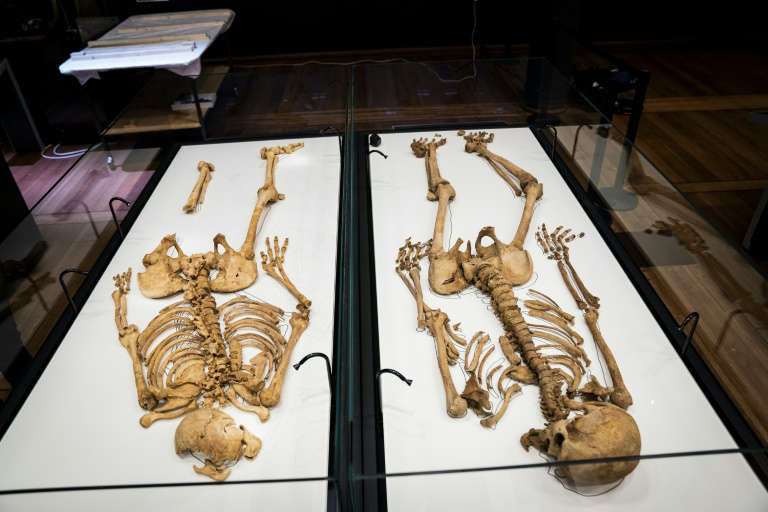
The AFP reports that DNA analysis has linked the remains of two men who died some 1,000 years ago.
Separated for 1,000 years, two Viking warriors from the same family were reunited on Wednesday at Denmark’s National Museum, as DNA analysis helps shed light on the Vikings’ movements across Europe.
One of the Vikings died in England in his 20s in the 11th century, from injuries to the head. He was buried in a mass grave in Oxford.
The two related Viking skeletons in Denmark’s National Museum
The other died in Denmark in his 50s, his skeleton bearing traces of blows that suggest he took part in battles.
DNA mapping of skeletons from the Viking era — from the eighth to the 12th century — enabled archaeologists to determine by chance that the two were related.
“This is a big discovery because now you can trace movements across space and time through a family,” museum archaeologist Jeanette Varberg told AFP.
Two of her colleagues spent more than two hours on Wednesday piecing together the skeleton of the man in his 20s, from the remains freshly arrived from Oxford.
The 150 bones have been lent to the Danish museum by the Oxfordshire Museum in Britain for three years.
The historical consensus is that Danish Vikings invaded Scotland and England from the late eighth century.
The younger of the two men “may have been cut down in a Viking raid, but there is also a theory that they (the skeletons in the mass grave) were victims of a royal decree by English King Ethelred the Second, who commanded in 1002 that all Danes in England should be killed,” Varberg said.
It is very rare to find skeletons that are related, though it is easier to determine the relationships for royals, according to Varberg.
While the two were confirmed to be relatives, it is impossible to determine their exact link.
They may have been half-brothers, or a grandfather and grandson, or an uncle and nephew.
“It’s very difficult to tell if they lived in the same age or they differ maybe by a generation because you have no material in the grave that can give a precise dating. So you have a margin of 50 years plus or minus,” Varberg said.
Is This 400,000-Year-Old Hominin the Great Grandpa of Neanderthals?
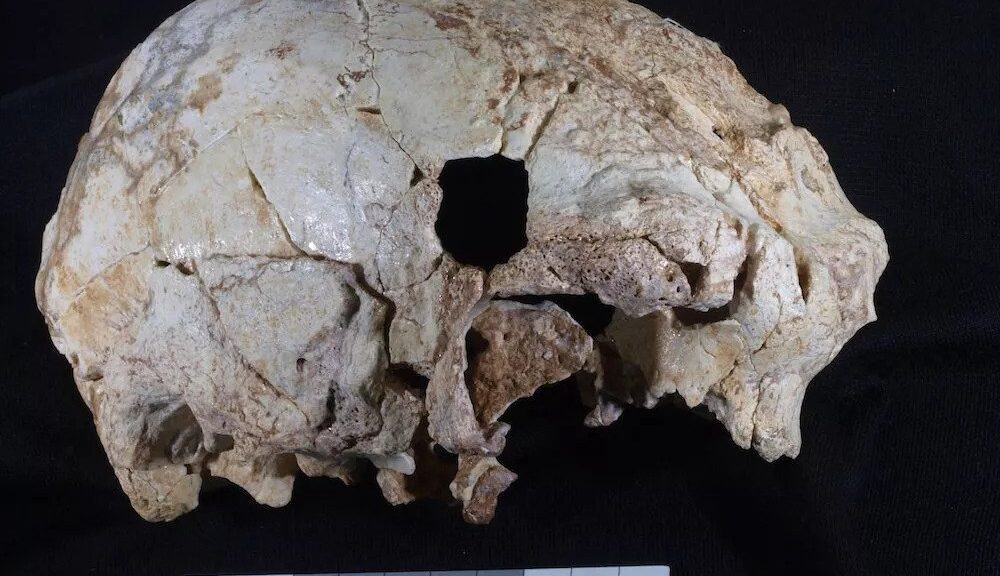
According to new research, a 400,000-year-old hominid skull contains a few telltale features that imply it’s more of a Neanderthal than a Homo sapiens relation, a new study finds.
The hominin cranium, nicknamed “Aroeira 3,” that researchers found in a Portuguese cave.
The cranium, discovered in a Portuguese cave, is helping anthropologists understand how hominins, particularly Neanderthals, evolved during the middle Pleistocene epoch in Europe, the researchers said.
The team isn’t sure whether the skull belongs to a newfound species of hominin, but noted that the skull appeared “broadly ancestral” to the Neanderthals, said study co-researcher Rolf Quam, an associate professor of biological anthropology at Binghamton University in New York.
In addition, the scientists unearthed hand axes in the cave, a stone-crafted technology that was likely developed in the Middle East about 500,000 years ago.
Thanks to the excavations, researchers now have proof that this technology spread as far west as Portugal within 100,000 years of being developed in the Middle East, Quam said.
Acheulean hand axes discovered at the Aroeira site in Portugal
Prize find
Researchers found the skull on the last day of their field season in 2014. During previous fieldwork at the Gruta da Aroeira cave from 1998 to 2002, researchers found human teeth, animal remains and stone-made hand axes. But the latest discovery, the skull, was the excavation’s prize find, Quam said.
The team discovered the cranium in the back of the cave, buried in petrified sediment.
“The archaeologists, when they found it, weren’t sure how to get it out,” Quam told Live Science. “They basically had to use a circular saw to cut out a huge block chunk that included the skull.”
The researchers brought the block to a restoration laboratory in Madrid, and a fossil preparator spent 2.5 years extracting the skull.
“That is an incredible amount of labor to get this thing out,” Quam said.
Once they freed the skull, the researchers put it in computed tomography (CT) scanner, which allowed them to create a 3D virtual reconstruction of the bone.
“The skull is only half a skull,” Quam said. “With the CT scans, we were able to mirror-image it and make the other half, so it’s more complete now.”
A virtual reconstruction of the 400,000-year-old hominin skull
Neanderthal-like features
The skull, nicknamed the “Aroeira cranium” after the Portuguese cave in which the item was found, is the oldest hominin fossil ever discovered in Portugal, Quam said. (A hominin is a group that includes modern humans and their recent ancestors, including Neanderthals, Homo erectus, Homo habilis and several species of Australopithecus.)
With a cranial capacity of more than 67 cubic inches (1,100 cubic centimeters), the Aroeira skull is about the same size as other hominin skulls found from that time period.
Modern humans have larger cranial capacities, of about 79 cubic inches (1,300 cubic cm), according to the Institute of Human Origins at Arizona State University, which was not involved with the new study.
Interestingly, the Aroeira cranium has Neanderthal-like features, Quam said. Those include a Neanderthal-shaped brow and a bony projection behind the ear, known as a mastoid process, which is small like a Neanderthal’s, Quam said.
However, the Aroeira individual lived long before the Neanderthals, which existed from about 200,000 years ago to 40,000 years ago, when they went extinct. Still, the skull “can help us understand the origin and evolution of Neanderthals better,” Quam said. “The fact that it is so well-dated is critical because that’s going to help us think about the evolutionary process — what changed first” as Neanderthals emerged on Earth.