The mysterious Egyptian tablet that is similar to an aircraft control panel
Some Egyptologists and theorists believe that this is a replica of a much earlier but far more advanced object used by Gods and Demi-Gods of Egypt.
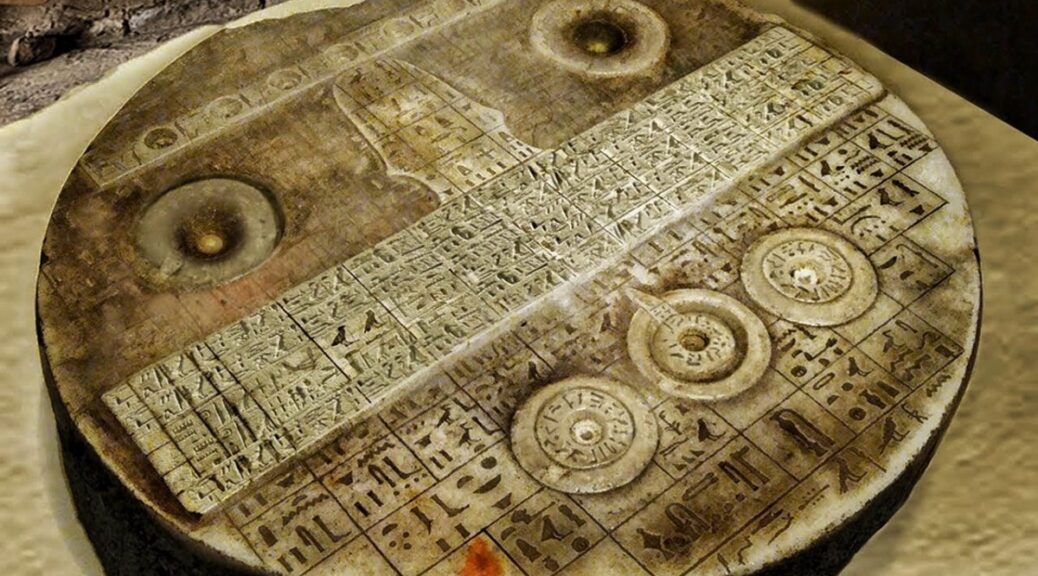
The Mysterious Egyptian Tablet That Is somewhat resemble an aircraft control panel.
After just a few seconds of staring at this mysterious object, we get the unmistakable feeling that it was an OOPArt artefact, which is when something literally does not belong to the time it is dated.
The enigmatic table from Ancient Egypt is about 49 cm in diameter and 13 cm in height, weighing as much as 75 kg and was meticulously moulded in alabaster, a material that only exists in this region and was frequently used for decorating of various sites, including sarcophagi.
But this incredible artefact is absolutely unlike anything that was produced in this ancient time (nothing similar has been found to this day), as it features circular openings and basically undecipherable reliefs that specialists and scholars cannot interpret even after years of study.
These characteristics that we can observe, make the object resemble a control table of a modern aeroplane.
Some Egyptologists and theorists assume that this is a copy of a much older object, made of different, less weather-resistant, but considerably more advanced materials used by Gods and Demigods – perhaps a reproduction of the extraterrestrial technology observed in the past by the ancients.
This artefact was acquired by the Dutch museum in 1828, which is very interesting information about it. However, it is unknown which temple, tomb, or even where it was discovered.
As with many ancient Egyptian items, its provenance (from where it was recovered) is frequently forgotten, but its authenticity can still be confirmed. At the moment, the artefact is in the Leiden Museum of Antiquities.
Its authenticity was validated by specialists in the area after many investigations and assessments.
The strange contraption was discovered over 4,500 years ago and instantly connected with Egypt’s fifth dynasty of pharaohs.
The artifact comes from ancient Egypt, the purpose of which has not yet been determined. On this artifact, an image was applied that somewhat resembled a map or some kind of schematic board.
Only a small portion of its possible history can be deduced from the hieroglyphics found on its surface.
This tablet, according to one interpretation (there are others, all quite different), was used for the libation of deceased members of the highest Egyptian hierarchy in order for them to successfully enter the underworld.
Regardless of what the object is, its resemblance to modern equipment continues to perplex even the most sceptics and experts who have been unable to come up with a solid explanation for the find.
Amazing 1,600-year-old biblical mosaics reveal a new perspective on Galilean life
In its eighth dig season, the vibrant mosaic flooring of a fifth-century synagogue excavated in the small ancient Galilee village of Huqoq continues to surprise. The 2018 Huqoq dig has uncovered unprecedented depictions of biblical stories, including the Israelite spies in Canaan. With its rich finds, the Byzantine-period synagogue busts scholars’ preconceived notions of a Jewish settlement in decline.
“What we found this year is extremely exciting,” the University of North Carolina at Chapel Hill Prof. Jodi Magness told The Times of Israel, saying the biblically-based depictions are “unparalleled” and not found in any other ancient synagogue.
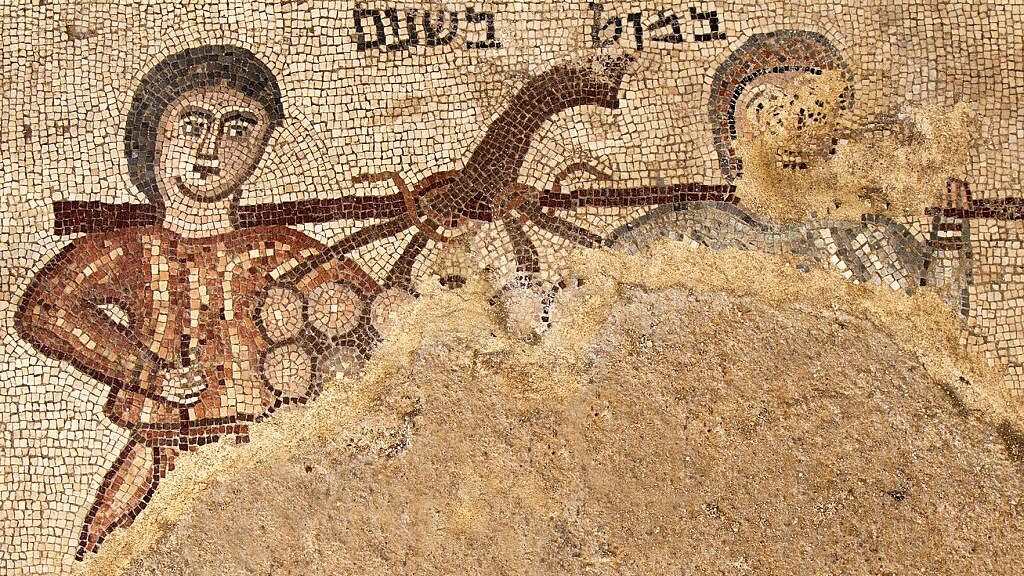
“The synagogue just keeps producing mosaics that there’s just nothing like and is enriching our understanding of the Judaism of the period,” said Magness. A recently unearthed mosaic shows two men carrying between them a pole on their shoulders from which is hung a massive cluster of grapes (the same as the easily recognizable symbol of Israel’s Ministry of Tourism). With a clear Hebrew inscription stating, “a pole between two,” it illustrates Numbers 13:23, in which Moses sends two scouts to explore Canaan.
A mosaic found in the 2018 Huqoq excavation is labelled ‘a pole between two,’ depicting a biblical scene from Numbers 13:23. The images show two spies sent by Moses to explore Canaan carrying a pole with a cluster of grapes.
Before wrapping up the dig season last week, the team of 20 excavators uncovered a further biblical mosaic panel, which shows a youth leading an animal on a rope and includes the inscription, “a small child shall lead them.” It is a reference to Isaiah 11:6, “The wolf also shall dwell with the lamb, and the leopard shall lie down with the kid; and the calf and the young lion and the fatling together; and a little child shall lead them.”
According to a 2013 Biblical Archaeology Review article by Magness, “Huqoq was a prosperous village about 3 miles west of Magdala (home of Mary Magdalene) and Capernaum (where Jesus taught in the synagogue),” located next to a fresh spring. It appears twice in the Hebrew Bible, in Joshua 19:32–34 and 1 Chronicles 6:74–75. “Our excavations have not reached these early occupation levels, however,” she writes.
These two newly published mosaics join a pantheon of others — from 2012 and 2013, two Samson depictions, to fantastical elephants and mythical creatures from 2013-2015, Noah’s Ark in 2016, and colourful and as yet unpublished Jonah and the whale in 2017. During this year’s dig, the team also continued to expose and study rare 1,600-year-old columns, first uncovered in previous seasons, which are covered in painted plaster with red, orange, and yellow vegetal motifs. Other discovered columns, said Magness, were painted to imitate marble.
However, despite these “imitation marble” columns, this was no poor man’s synagogue. Much in the manner of King Herod decorating his palaces with painted faux-marble frescos, the columns and gorgeous mosaics point to a wealthy, flourishing fifth-century Jewish settlement, said, Magness.
“In general, unless you’re in a really important church in the Byzantine period, you won’t find marble, rather this common local alternative,” she said. She laughed, saying there is a feeling of “one-ups-manship” in the construction of the Huqoq synagogue.
A fish swallows an Egyptian soldier in a mosaic scene depicting the splitting of the Red Sea from the Exodus story, from the fifth-century synagogue at Huqoq, in northern Israel.
“Every village has its own synagogue,” Magness said. “In Huqoq there’s a feeling that the villagers said, ‘We’re going to build the biggest and best.’ It’s as if they decided to throw everything into it.”
The obvious wealth and disposable income displayed in the synagogue is “contradicting a widespread view — not my view — that the Jewish community was in decline,” she said.
However, not only the synagogue was rich and diverse, but also the Judaism it housed.
“The mosaics decorating the floor of the Huqoq synagogue revolutionizes our understanding of Judaism in this period,” said Magness in a press release. “Ancient Jewish art is often thought to be aniconic, or lacking images. But these mosaics, colourful and filled with figured scenes, attest to a rich visual culture as well as to the dynamism and diversity of Judaism in the Late Roman and Byzantine periods.”
The Huqoq synagogue’s fifth-century mosaic, with the upper register showing a war elephant.
According to Magness, “Rabbinic sources indicate that Huqoq flourished during the Late Roman and Byzantine periods (fourth–sixth centuries CE). The village is mentioned in the Jerusalem Talmud in connection with the cultivation of the mustard plant.”
Aside from the outstanding mosaics and colourfully painted columns, there are other features of note in this synagogue: Discovered in 2012, an inscription flanked by the faces of two women and a man (a fourth face, presumably of a man, is not preserved) might be the first donor portraits found in a Jewish house of prayer. The practice, said Magness, was “not uncommon in Byzantine churches,” but has no parallel example found in a synagogue of the era. Although there are aspects of the synagogue that may point to a Christian influence, for example, the possible donor portraits, Magness does not believe the Huqoq community was more impacted than other neighbouring congregations.
Detail from the Huqoq synagogue’s 5th-century mosaic showing Samson carrying the gate of Gaza, from Judges 16.
“In general there was some interaction between Jews and Christians, as well as Judaism and Christianity, in the sense that both religions laid claim to the same tradition and called themselves the ‘true Israel,’” said Magness. It is not coincidental that the same biblical themes appear in both forums.
“They are clearly some sort of dialogue, broadly speaking… A lot of what we see at Huqoq can be understood on the background of the rise of Christianity,” she said.
“There is evidence of occupation at the site during the Persian, Hellenistic, Early Roman, Abbasid, Fatimid and Crusader-Mamluke periods. The modern village was abandoned in 1948 during the fighting in Israel’s War of Independence. In the 1960s, the site was bulldozed,” writes Magness in BAR. It appears that the Huqoq synagogue is the ancestor of what seems to be a later, 12-13th century Jewish house of prayer. Faint, broken remnants of that incarnation’s mosaic flooring have also been discovered a meter above the dynamic mosaics of the Byzantine era.
2018 Huqoq excavation with students from University of North Carolina-Chapel Hill, surrounding dig director Dr Jodi Magness.
It is possible, said Magness, that this is a synagogue mentioned by French 14th century Jewish physician-turned-traveller Isaac HaKohen Ben Moses, aka Ishtori Haparchi, mentioned in his 1322 geography of the Holy Land, “Sefer Kaftor Vaferach.”
Regardless, there are no extant medieval synagogues in Israel today, making this find potentially no less important than the more attention-grabbing images in the fifth-century mosaic floors, said Magness.
Pair of donkeys in Noah’s Ark scene at the Huqoq excavation.
Both of these finds — the medieval synagogue and beautiful Byzantine mosaics — are all the more remarkable in that they are a by-product of a different scholarly quest: Magness decided to excavate at Huqoq to test a wide-spread Galilean synagogue dating system, which dated the buildings based on their architectural structures.
“Since the early 20th century, when these synagogues began coming to light, scholars developed a tripartite chronology: The earliest, these so-called ‘Galilean-type synagogues,’ were dated to the second and third centuries CE, followed by ‘transitional synagogues’ in the fourth century, and then by ‘Byzantine synagogues’ in the fifth and sixth centuries,” writes Magness in the BAR article. Although housed in a fifth-century village, based on its architectural features, according to previous scholarly consensus, the Huqoq synagogue should have been classified a “Galilean-type synagogue” and dated to the second or third centuries. This is, Magness has proven, clearly not the case.
Pictured is the Huqoq synagogue mosaic depicting the month of Teveth (December-January) with the sign of Capricorn.
What was originally to have been a brief excavation has turned into eight seasons. And although Magness is assisted by Shua Kisilevitz of the Israel Antiquities Authority (IAA) and Tel Aviv University, the excavation is funded independently of the IAA, by sponsors including UNC-Chapel Hill, Baylor University, Brigham Young University and the University of Toronto, the Friends of Heritage Preservation, the National Geographic Society, the William R. Kenan Jr. Charitable Trust, and the Carolina Center for Jewish Studies. There will be a 2019 dig season, said Magness, who estimated she needs at least another four years to complete the ever-evolving project.
“Every year, there is another mind-blowing, weird discovery,” said Magness.
Amazing 1,300-Year-Old Technology Found Hidden in Comox Harbour
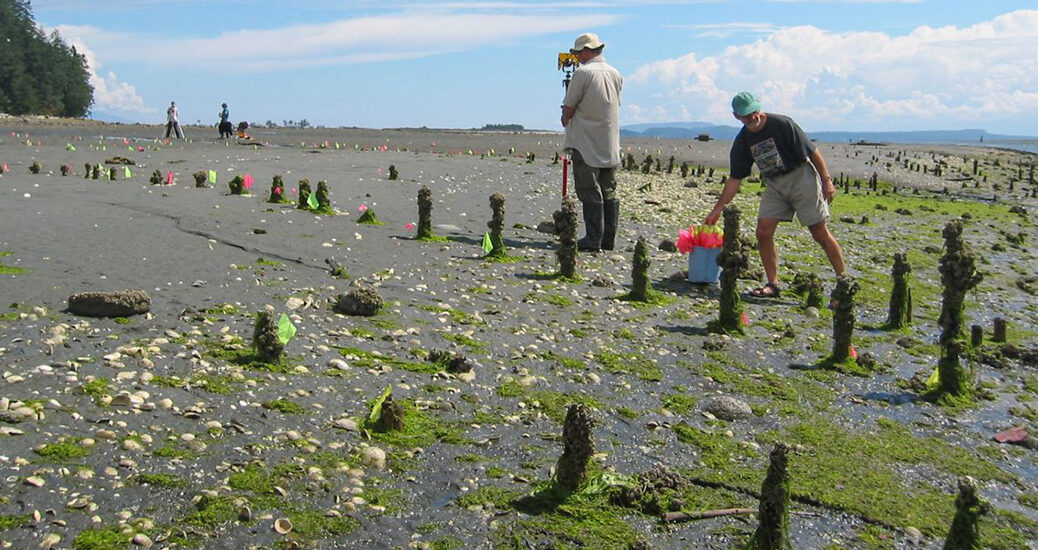
There had always been stakes poking up from the shore at low tide in the Comox Harbour. But nobody really knew what they were.
What were they doing there?
Who had put them there?
And when?
Maybe they were leftover from a failed industry. Maybe they were made by Japanese immigrants and then abandoned when the Japanese moved on. They were a mystery.
A mystery no one was really trying to solve.
That is until a mature student from Malaspina College named Nancy Greene started poking around. Between 2002 and 2015, she and her husband and other local folks spent years mapping all the stakes they could find. There were a lot of stakes. Ultimately, Greene and her team found and mapped 13,602. The stakes clearly formed patterns, but it took Greene years to figure out just what those patterns meant.
Greene assembled archaeological records and tapped into local indigenous oral history. One K’ómoks elder gave Greene a clue: her grandmother said the stakes were weirs that helped catch salmon, and each family was responsible for specific weirs.
After putting it all together, Greene concluded this was the largest ancient fish trap system of its kind in North America, or maybe even the world. Greene guesses there are 150,000 to 200,000 cedar and fir stakes from the remains of more than 300 fish traps.
Illustration by David McGee and Mercedes Minck / Hakai Magazine
How many fish traps used to exist on west, north and central Vancouver Island?
How had the knowledge of such a huge, ingenious system vanished from history?
Deidre Cullon, an archaeologist and adjunct professor in the geography department at Vancouver Island University (formerly Malaspina College), told Brian Payton of Hakai Magazine it was a “perfect storm” of man-made and natural events.
“The smallpox epidemic of 1862 claimed the lives of half the Indigenous people on the coast of British Columbia. In that catastrophe, not only were keepers of knowledge lost; entire communities were abandoned. Lost, too, was the need for a high-production fishery—there were far fewer mouths to feed.”
“And then, right on the heels of that, the Canadian government chose to support commercial fishing for canneries,” Cullon told Hakai Magazine. The government made the traps illegal and sent their fisheries officers to destroy them.
This was followed by the invention of residential schools, which took Indigenous children from their families and put them in far-off boarding schools. The children were separated from their communities, language, and culture. Parents could no longer teach their children their traditional knowledge. Eventually, the fish traps were forgotten.
So for almost a century, knowledge of this brilliant, ancient technology disappeared. But then the big earthquake of 1946 loosened the sand in the harbour and swept some out to sea. Thousands of stakes started popping up.
Testing showed some of the fish traps in the Comox Harbour are more than 1,300 years old. That means people who spoke Pentlach, a language that is now extinct, started building fish traps in Comox Harbour around the year 700.
Image from Hakai Magazine
The ancient technology was amazingly complex but simple.
The fish traps used wooden stakes and woven panels to make fences along the shore. When the tide came in, the fish would swim up and into the fish trap, but they wouldn’t be able to find their way out.
Then when the tide went back out, the fish would be caught in the pool of water inside the trap. The traps were a Hotel California for salmon — they could check in, but they could never leave. The old techniques have a lot to teach us about sustainable fishing. The way the fish traps were set up allowed people to adapt them to fit each local creek.
They also let people take the fish they needed and then release all the ones they didn’t need. They could let enough fish go to make sure the salmon population stayed healthy. A healthy salmon population would come back every year and keep the community fed.
Some First Nations in the Great Bear Rainforest are trying to bring back the ancient techniques to save the collapsing salmon population. For example, in 2013, the Heiltsuk Nation built a fish trap on the Koeye River.
William Housty, conservation manager for the Heiltsuk Integrated Resource Management Department, told Hakai Magazine, “I think it’s genius.”
The fish trap has allowed the Heiltsuk to assess the health of salmon and the whole ecological system. They can now tag and release salmon, check up on how well they are spawning and surviving and — perhaps most importantly in a changing climate — monitor how stream temperature affects the salmon.
Maybe part of the solution to the salmon crisis facing Island communities was hidden in the Comox Harbour for over a century. Luckily a mature undergraduate was curious and determined enough to decode the hidden secret.
Pompeii’s 2,000-Year-Old Fast Food Outlet Is Now Open To Visitors
The Italian archaeologists have unearthed a 2,000 years old fast-food stall from the ashes in Pompeii, Italy. The researchers have dug out an ancient restaurant from the vast archaeological site in the city of Southern Italy, that could now give new clues about the snacking habits of the ancient Romans.
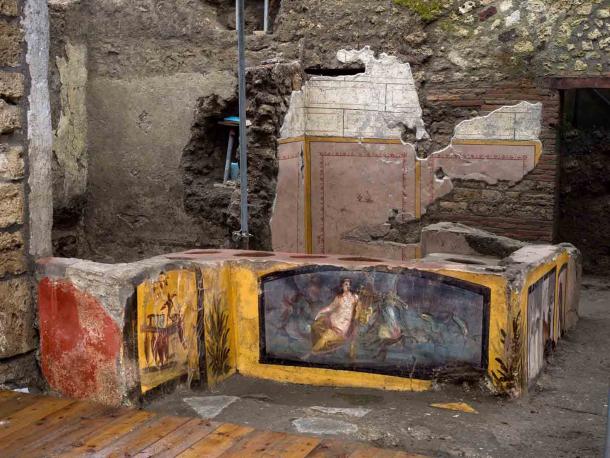
Frescoes on an ancient counter discovered during excavations in Pompeii, Italy
According to the reports, the Italian archaeologists who have been carrying out excavations at the ancient lost city of Pompeii on Saturday said that they had discovered a frescoed ‘thermopolium’ or fast-food counter in an exceptional state of preservation.
The ornate snack bar counter, decorated with polychrome patterns and frozen by volcanic ash, was partially taken off from the ground last year but archaeologists had continued their work on the site to reveal it in its full glory.
Pompeii was buried in a sea of boiling lava when the volcano on nearby Mount Vesuvius erupted in 79 AD, killing between 2,000 and 15,000 people.
The massive site that spreads over 44 hectares (110 acres) is what remains of one of the richest cities in the Roman empire.
The Thermopolium of Regio V, which is believed to have been present at a busy intersection of Silver Wedding Street and Alley of Balconies, was the Roman-era equivalent of a fast-food snack stall.
The Thermopolium was very popular in the Roman world. Pompeii alone had around 80 such stalls.
A fresco bearing an image of a Nereid nymph riding a seahorse and gladiators in combat has also been unearthed at the spot.
The team has discovered duck bone fragments as well as the remains of pigs, goats, fish and snails in earthenware pots. Some of the ingredients had been cooked together like a Roman era paella.
The excavators have found crushed fava beans, used to modify the taste of wine at a bottom of one jar.
Reportedly, the food stall appears to have been closed in a hurry and abandoned by its owners, believed to be after the first rumblings of the eruption were felt, said Massimo Osanna, director general at the Archaeological Park of Pompeii.
The remains of one of the individuals at the top of this image, who was discovered on a bed in the back of a room at the amazing Pompeii food stall found in March 2019 AD at the Regio V site.
Alongside human remains, amphorae, a water tower and a fountain were found. The remains of a man believed to have been aged around 50 has also been discovered near a child’s bed.
“It is possible that someone, perhaps the oldest man, stayed behind and perished during the first phase of the eruption,” Osanna said.
The remains of another person were also found and could be an opportunist thief or someone fleeing the eruption who was “surprised by the burning vapours just as he had his hand on the lid of the pot that he had just opened”, he added.
The archaeologists, in the latest stage of their work, have excavated a number of still life scenes, including depictions of animals believed to have been on the menu, notably mallard ducks and a rooster, for serving up with wine or hot beverages.
An image of a dog with homophobic graffiti written in white across the top border found at the soon to reopen Pompeii food stall.
A highly realistic painting of a rooster decorates the soon to reopen Pompeii food stall, located in the Regio V site area.
Pompeii is Italy’s second most visited site after the Colisseum in Rome and last year attracted around four million tourists.
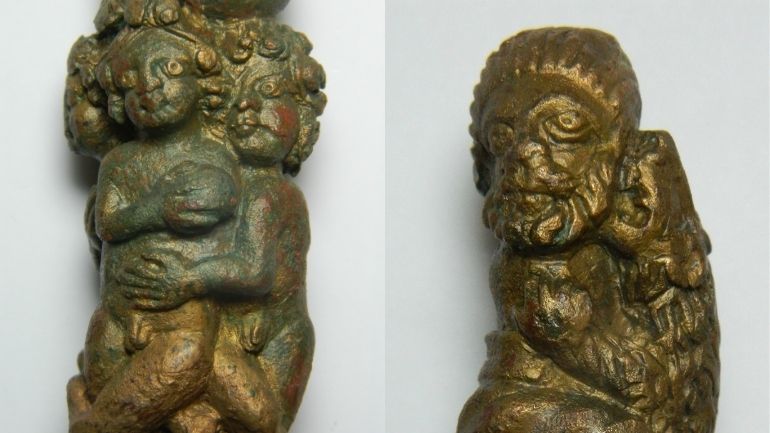
Archaeologists have discovered a bronze key handle that shows lions were used in executions in Roman Britain. The handle, which depicts a “Barbarian” wrestling with a lion, was discovered beneath a Roman townhouse in Leicester’s Great Central Street.
It also shows figures of four boys cowering in terror.
Excavation leader Dr Gavin Speed, from the University of Leicester, said nothing quite like it had been found “anywhere in the Roman Empire before”.
Archaeologists said the bronze handle gave an insight into executions in Roman Leicester
“When first found, it appeared as an indistinguishable bronze object, but after we carefully cleaned off the soil remarkably we revealed several small faces looking back at us, it was absolutely astounding,” Dr Speed said.
The object was found by the University of Leicester Archaeological Services (ULAS) in 2017, then studied at King’s College London and the findings have now been published in the journal Britannia.
The Friars Causeway key handle before cleaning and conservation.
The key handle was found buried under a townhouse in the city
Co-author Dr John Pearce, from King’s College, said: “This unique object gives us our most detailed representation of this form of execution found in Roman Britain.
“As the first discovery of this kind, it illuminates the brutal character of Roman authority in this province.”
Roman law sanctioned the execution of criminals and prisoners of war through the public spectacle of throwing them to the beasts, defined by the Latin term damnatio ad bestias.
This form of execution was often used to symbolise the destruction of Rome’s enemies – members of tribes who lived outside the Roman Empire and were collectively known as “Barbarians“.
This new evidence of Leicester’s Roman past was found along with Roman streets, mosaics floors and a Roman theatre. Nick Cooper from the ULAS said the handle would have been purpose-made in Leicester for a very important house.
The townhouse where it was found stands next to the newly-discovered Roman theatre.
On the same site where the key handle was found experts uncovered a theatre and several mosaic floors
“It’s one of the most exciting finds we’ve had in Roman Leicester and it’s got a great story to tell about life in Roman Leicester and the potential evidence it gives for activities that might have taken place in the theatre, or possibly an amphitheatre that we haven’t discovered yet,” Mr Cooper added.
“Within a small handle, about 10cm long, you have a story evolving there of the practice in Roman law where criminals and prisoners of war are condemned to be killed by beasts.
“That was slightly worse than being condemned to the mines, which is the other way that prisoners often met their end.”
The bronze handle will go on public display at Leicester’s Jewry Wall Museum which is currently being redeveloped and will reopen in 2023.
Archaeologists make ‘astonishing’ discovery of 5,000-year-old piece of wood in Orkney
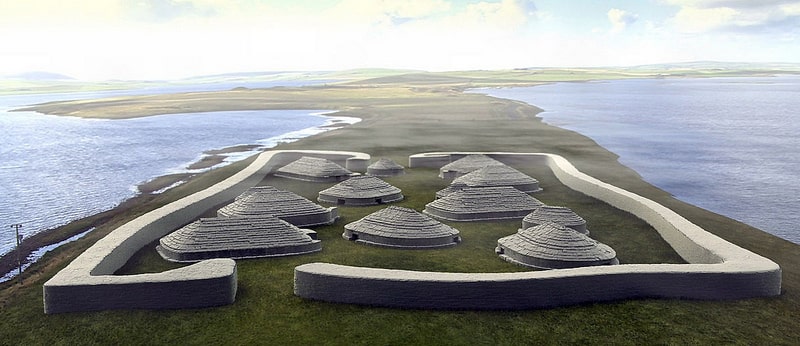
Archaeologists found the wood while excavating the Ness of Brodgar, home to a vast network of buildings, including a temple-style complex, that thrummed with activity during the Neolithic period.
Sigurd Towrie, of the University of Highlands and Islands Archaeology Institute, said it was the first time wood had been found on the site.
Mr Towrie said: “Over the years of excavation the Ness has produced so many surprises that some archaeologists thought we had exhausted all the possibilities. Not so.”
He said the “astonishing new discovery” of the wood was made at ‘structure 12’ on the site, a large rectangular building that is some 17-metres long.
The building was divided up inside by pillars to create a series of bays, alcoves and recesses which surrounded two large hearths.
Access to this was by three entrances, one that was flanked by a pair of standing stones that faced the burial chamber at Maeshowe, with the building likely a “stunning sight” in the immense Neolithic landscape of mainland Orkney.
The vast Ness of Brodgar site in Orkney.
Mr Towrie said the wood was found in a post hole and had survived probably due to its preservation under a tiny amount of water.
“Preservation of organic material is very rare,” he said.
“The post hole sat in a depression and we think some water had gathered. It creates anaerobic conditions, which slows down decay.”
While few trees stand on Orkney today, the islands were once rich in the woodland that disappeared over time due to rising sea levels.
Recent studies of the “woodlands under the waves” included analysis of remains of a forest, which had been pushed under the water at Bay of Ireland near Stromness, which has been dated to around 6,000-years-old.
“The earliest Neolithic settlements were made of wood and then they later switched to stone,” Mr Towrie said.
“The wood that we found is in very poor condition, but hopefully we will be able to tell what kind of wood it is and whether it was grown locally or imported.”
The Ness of Brodgar site covers around six acres between the Ring of Brodgar and the Stones of Stenness in the Heart of Neolithic Orkney World Heritage Site.
The earliest structures on the site were built around 3300 BC, with the site closed down and abandoned after around 1,000 years. The site was first excavated in 2003 with the summer excavations ending with Ness of Brodgar being covered up again for the winter.
Decorated stone slabs, thousands of sherds of pottery and a temple-style building are among key finds at Ness of Brodgar, an incredible site given its scale and central function to Neolithic life in Orkney.
Earlier this year, a potter’s fingerprint was discovered on a vessel made some 5,000 years ago, creating a “poignant connection” to the people who lived and visited here. Around 30 archaeologists are on the site this summer, with hundreds of visitors dropping by the site as work progresses.
Mr Towrie said: “On one day, we had 450 people here. It’s been great to be back on site again and to see so many people, and to still know that people really care about this place.”
FEFU archaeologists have found the oldest burials in Ecuador
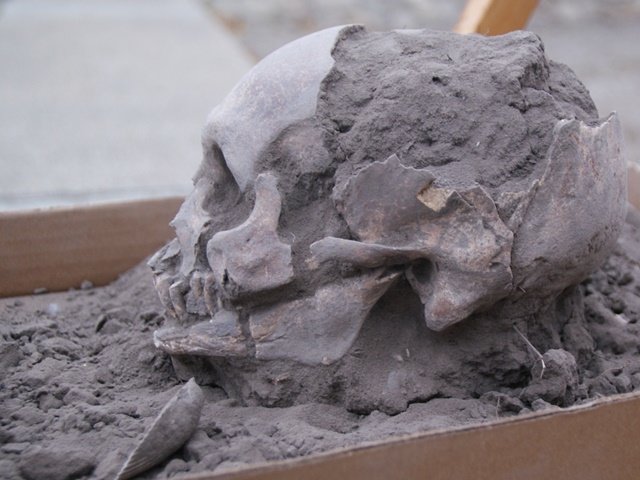
Archaeologists of the Far Eastern Federal University (FEFU) found three burials of the ancient inhabitants of South America dated from 6 to 10 thousand years ago.
The ancient skull excavated in Loma Atahualpa, Ecuador, 2018, by archaeologists of the Far Eastern Federal University (FEFU)
The excavations were carried out in Atahualpa Anton, Ecuador. The findings belong to the Las Vegas archaeological culture of the Stone Age.
Analysis of artefacts will help scientists understand the development of ancient cultures on the shores of the Pacific Ocean and clarify the origin and development of ancient American civilizations.
Research is being jointly conducted by FEFU and Primorsky Polytechnic University in Guayaquil (ESPOL, Ecuador).
Previously, FEFU scientists investigated the famous Neolithic settlement in Real Alto. In 2018, they decided to study an earlier site in order to trace the development of ancient cultures on the Pacific Coast opposite to the Pacific Coast of Russia (Russian Far East).
“The archaeological site of Loma Atahualpa is more archaic than Real Alto, its materials are transitional from the Mesolithic to the Neolithic.
We excavated three burials that were probably made at different times. This will make it possible to compare their materials and retrieve the new information on the development of ancient cultures in the period from 10 to 6 thousand years ago,” said Alexander Popov, director of the Educational and Scientific Museum of The School of Humanities of FEFU.
Expedition materials are processed by experts from several countries. The stone tools found were examined at Tohoku University (Japan) for traces of mechanical activity in order to understand how they were used. There were also sent samples for radiocarbon dating.
Simultaneously, anthropologists from The Kunstkamera (Peter the Great Museum of Anthropology and Ethnography, St. Petersburg) and the Institute of the Problems of Northern development, Siberian Branch of the Russian Academy of Sciences (Tyumen, Russia) began to study the morphological features of the human remains found.
“In the course of working with Ecuadorian colleagues, we have learned that our research attracted the obvious attention of scientists.
Last year’s symposium, which was organized at the Real Alto Museum, was attended by colleagues from the United States, Canada, Brazil, Japan, Poland and other countries.
We also cooperate with partners from several European countries and the Russian Academy of Sciences,” said Alexander Popov.
5700-year-old child skeleton unearthed in the Turkish city of Malatya
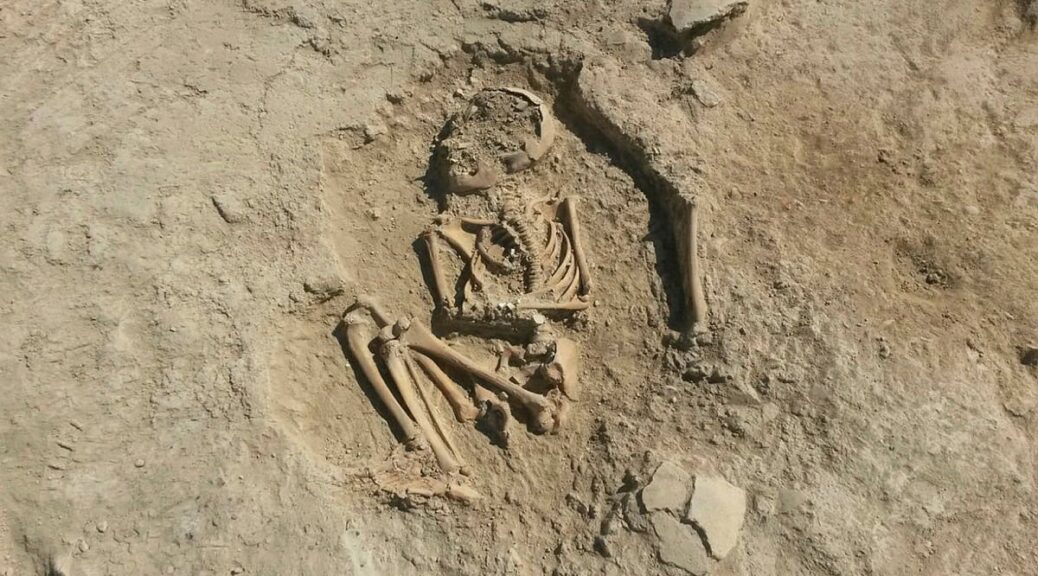
A 5,700-year-old skeleton of a noble-born child has been found buried in the ruins of a Copper Age Turkish house. Anthropologists believe the bones belonged to a six-year-old who most likely died of trauma in the fourth millennium BC.
The skeleton was found in the foetal position and the skull has been smashed, although it’s not immediately clear whether this happened before or after death.
The remains were found in what is believed to be an ancient house during an excavation of the Arslantepe Mound outside Malatya, eastern Turkey.
With its prime position near the west bank of the Euphrates River, this UNESCO World Heritage site boasted a thriving population through the Roman and Byzantine periods owing to its wetlands and agricultural resources.
Yet now it is flocked to by archaeologists who comb through the ruins hoping to learn more about Arslantepe’s rich history.
Anthropologists believe the bones belonged to a six-year-old who most likely died of trauma in the 4th millennium BC
Dr Marcelle Frangipane, of the University of Rome who led the dig, said the bones would be sent for analysis but early estimates suggested the child was very young and died of shock.
She said: ‘We found beads on the arms and neck of the child, which we have not seen before. These beads indicate that the child belonged to a noble family.’
Hailing the skeleton an ‘important find’, she added: ‘The delegation stated that the child is six or seven years old, but they need to work on it further.
‘The child may have died as a result of trauma. Such results will be determined as a result of the analysis.
‘This is a very important find. As a result of the analysis of the skeleton, we will reach more detailed information.’
The remains were found in what is believed to be an ancient house during an excavation of the Arslantepe Mound outside Malatya, eastern Turkey
Dr Frangipane also said that they are waiting for the results of the examination to discover the gender, genetic structure, age and cause of death of the child as well as the diet of the era.
The position of the skeleton suggests the child was frightened and had curled itself into the foetal position, wrapping its arms around its body.
Remarkably, the position which this infant died in has been almost perfectly preserved in the ground, although its skull has been caved in.
Over the past 50 years, since serious excavations of the Arslantepe Mound began, archaeologists are slowly unearthing what they believe to be a fourth millennium BC palace.
Interconnected mud-brick architecture sprawling over 2,000 square metres is suggestive of the first ‘public palace’, according to UNESCO.
The organisation says this ancient structure was ‘composed by two temples, a storeroom complex, administrative areas with thousands of clay-ceilings bearing the impressions of more than 220 beautiful seals, entertainment halls, a monumental gate, corridors and courtyards.