New technique reveals hidden detail in an ancient Etruscan painting
Multi-illumination hyperspectral extraction (MHX) has been used to reveal previously unseen details in 2,500-year-old Etruscan tomb paintings, according to a Live Science report.
For instance, they found new details in a painting from the “Tomb of the Monkey” and scenes of an underworld in another work of art.
The Etruscans created detailed paintings, but the passage of time has meant that many of them are now only partly visible and that much of their colour has been lost.
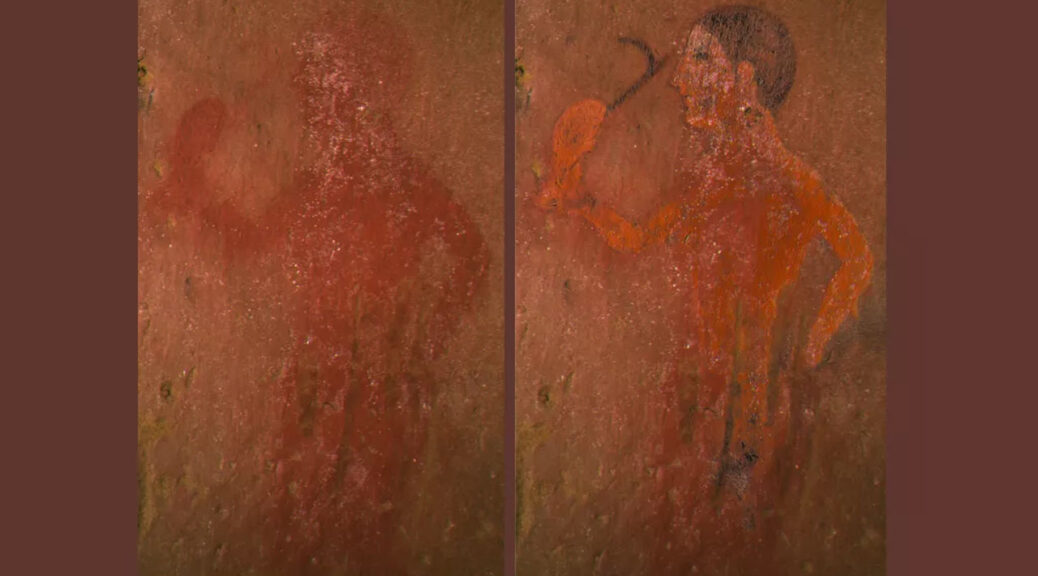
Using a new technique to restore this Etruscan painting (left) from the 2,500-year-old “Tomb of the Monkey,” researchers revealed what it really looked like so long ago (right).
“A major issue is the significant loss of information on the polychromy [colours] of the preserved paintings, with special regard to some specific colours owing to their physical-chemical composition,” Gloria Adinolfi, a researcher at Pegaso Srl Archeologia Arte Archeometria (a research institute), said in a presentation given Jan. 8 at the virtual joint annual meeting of the Archaeological Institute of America and the Society for Classical Studies.
The fact that some colours survive the passage of time better than others can give a distorted view of what ancient paintings looked like at the time they were painted, Adinolfi said. For example, some shades of green tend not to survive well, whereas red often does, she said.
“Red oaks usually seem to be more resistant so that sometimes reds are dominant and alter the correct perception of the original polychromy of the pictorial decoration,” Adinolfi said.
Revealing ancient paintings
To reveal the paintings, the scientists used a technique called multi-illumination hyperspectral extraction (MHX), which involves taking dozens of images in the visible, infrared and ultraviolet bands of light and processing them using statistical algorithms developed at the National Research Council of Italy in Pisa, said team member Vincenzo Palleschi, a senior researcher at the research council.
The technique can detect Egyptian blue, a colour developed in ancient Egypt that “has a very specific response in a single spectral band,” Palleschi said. The team also analyzed the residual remains of other remaining colours to help determine what colours were in the painting.
By combining the MHX and colour analyses, the team revealed vanished scenes from ancient Etruscan paintings.
The researchers unveiled several examples during the presentation, including details of paintings depicting the Etruscan underworld showing rocks, trees and water.
In the Tomb of the Monkey, so named because a painting in the tomb shows a monkey on a tree, the researchers uncovered details of a painting depicting a person.
To the naked eye, the painting looks like a red blur, but after the MHX and colour analyses were complete, the painting clearly showed a person carrying an object and details of their hair and face.
The tomb was discovered in the 19th century but now, with the new technology, the painting has become much more visible.
The team’s research is ongoing, and more paintings may be revealed in the future.
Hiker Accidentally Discovers 1,200-Year-Old Viking Sword in Norway
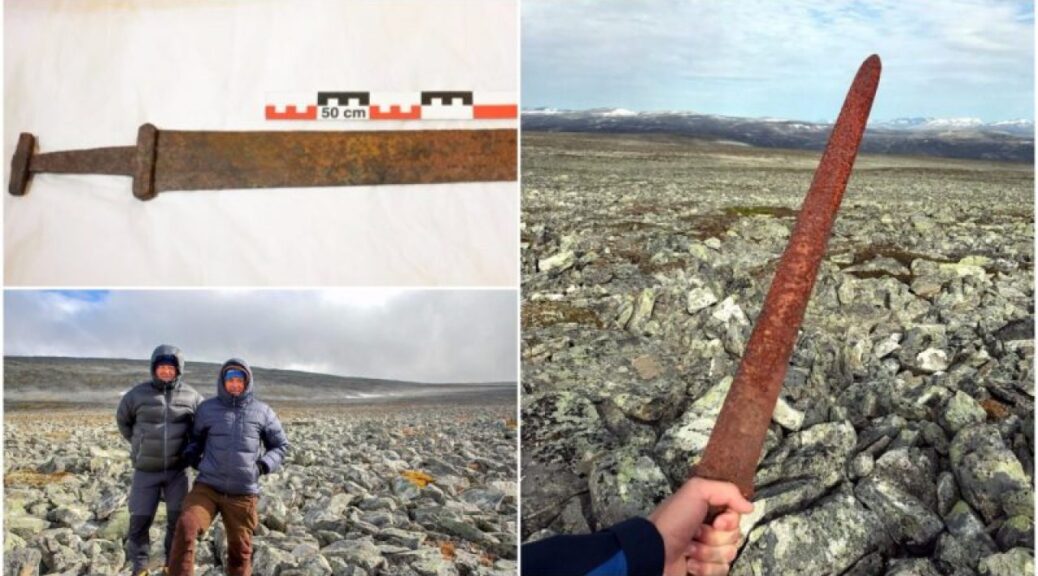
After hiking across the plateau that covers the region between the west and east sides of Norway, Goran Olsen sat down to take a break. That’s when he spotted a rusty sword blade lying under some rocks on the well-travelled mountain path.
While hiking on a mountain path in south-central Norway, a man recently stumbled on a well-preserved Viking sword that archaeologists say dates back to A.D. 750.
Archaeologists have identified Olsen’s find as a type of Viking sword made circa A.D. 750. That makes it some 1,265 years old, though the scientists have warned this is not an exact date.
Double-edged and made of wrought iron, the sword measures just over 30 inches long (77 centimetres). Though covered in rust, and lacking a handle, it is otherwise in excellent condition.
A hiker is dwarfed by the landscape of the mountain plateau where the Viking sword was found
The Haukeli mountains are covered in snow and frost at least six months out of the year and experience little humidity in summer, conditions that may explain why the sword is so well preserved. As County Conservator Per Morten Ekerhovd told CNN: “It’s quite unusual to find remnants from the Viking Age that are so well-preserved…[the sword] might be used today if you sharpened the edge.”
Beginning in the 8th century, many Vikings left their native homes in Denmark, Norway and Sweden, using advanced navigational technology to spread out across Europe and beyond. Famous—and feared—for their violent attacks on coastal cities and towns, they were also skilled traders and daring explorers who founded the first colony in Greenland and reached North America some 500 years before Christopher Columbus.
The Viking Age endured until the late 11th century, leaving a lasting impact on Western society and the world.
Viking law mandated that all free men were required to carry weapons and be prepared to wage war at all times. Of the most common weapons—swords, spears and battle-axes—swords were the most expensive to make. With their decorated hilts of silver, bronze or copper, Viking swords functioned as status symbols.
According to the pagan beliefs of many Vikings, a sword was a sacred object that could help its bearer enter heaven. After attaining the highest honour of dying in battle, the heroic Viking warrior, with his sword in hand, would feast with the gods in a special place known as Valhalla.
Many later Viking sword blades were emblazoned with specific markings, believed to be the names of their creators. Of the thousands of Viking swords that have been discovered across Scandinavia and northern Europe—most excavated from burial sites or found in rivers—some 170 have been marked with the name Ulfberht.
Their superior quality shocked archaeologists, as the technology needed to produce such pure metal would not be invented for another 800 years. In order to liquefy iron ore and remove impurities (known as “slag”), modern metalworkers heat it to 3,000°F (1,650°C); carbon is then added in order to strengthen the brittle iron.
In medieval times, when ovens could not achieve high-enough temperatures to liquefy the iron, metal workers would have to remove slag by pounding it out, a much less effective process.
With very little slag, and high carbon content, the Ulfberht blades are made of what’s known as “crucible steel,” a state-of-the-art metal that would not be seen in Europe again until the Industrial Revolution.
Experts believe the crucible steel used by the Vikings may have come from the Islamic world. Warriors in Central Asia had been using swords of material similar to that of the Ulfberht for centuries before the Viking Age, and a robust trade route known as the Volga connected Scandinavia with northern Iran from the early 9th to the mid-11th century.
Last March, researchers announced that a ring recovered from a 9th century Viking grave a century ago bears an Islamic inscription meaning “for/to Allah,” providing a rare physical link between the two worlds.
The sword Olsen discovered in Haukeli is not branded, and is missing its handle, but is still a strong blade. Experts believe it could be from a Viking burial site, or it could have belonged to a traveller who died in an accident or succumbed to frostbite. Either way, they say, its owner would likely have been a high-status member of Viking society.
The sword is now at the University of Bergen, for preservation and research purposes. Archaeologists are planning an expedition to the site of Olsen’s discovery for next spring, once the snow melts, in order to see if they can uncover any more artefacts.
Six thousand-year-old tombs found in northwest Argentina
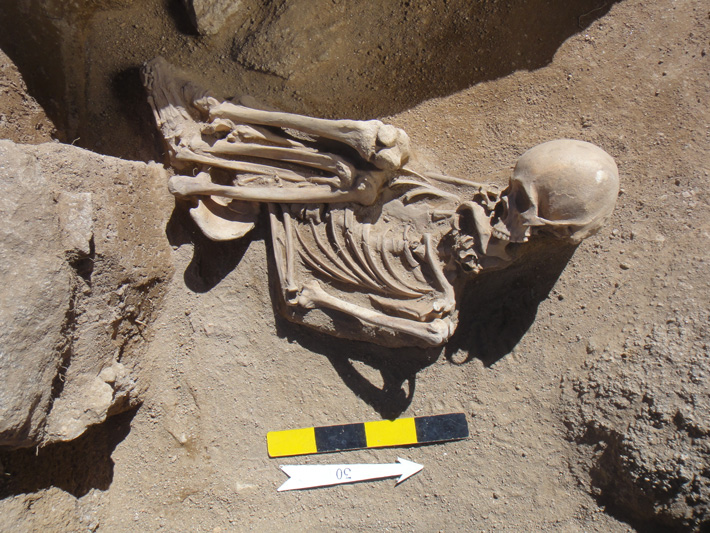
Radio Cadena Agramonte reports that 12 graves dated between 6,000 and 1,300 years ago were unearthed in northwestern Argentina by a team of researchers from the University of Buenos Aires–National Scientific and Technical Research Council (CONICET), during investigations over the past 15 years.
A group of Argentine researchers found in the province of Catamarca 12 graves with more than six thousand years old, reported the scientific outreach agency CTyS, of the University of La Matanza.
According to the source, most were found fortuitously by residents of the area who, upon finding the remains, alerted the archaeological team that has been studying pre-Hispanic burial practices in northwestern Argentina for years.
The doctor in Archeology, Leticia Cortés, a specialist in burial methodologies in pre-Hispanic populations that inhabited the Valle del Cajón area, explained that when these practices are compared with current ones, they may seem strange.
“Knowing these customs, we can reconstruct the cultural practices of the past and put into perspective our own traditions, which are part of a cultural construction,” said Cortés, a researcher at the Institute of Cultures.
The search of this type began more than 15 years ago, with a research team dependent on the National Council for Scientific and Technical Research, led by María Cristina Scattolin and dedicated to excavation and analysis tasks in the town of Valle del Cajón.
This practice of burials before the arrival of the Spanish was far from what is customary today on the basis of the Judeo-Christian model.
Cortés pointed out that this type of find usually occurs after the rainy season, in summer, which is uncovered and the bones are exposed.
“There was a great variability of burial methods, in individual or collective graves, and also in the posture of the bodies.
Some are hyperflexed, like squatting, with the shoulders touching the knees, others extended and disjointed and mixed, ”explained the specialist.
Cortés pointed out that many times people lived with their dead on a daily basis, buried them in the same patio where they cooked, made pots or carved stones. It is an interesting thing to see the different conceptions that were had about life and death, he said.
According to archaeology, they continue working and have found necklaces and pendants that would be associated with the deceased, as non-transferable objects that are buried next to the body and remain there.
Bronze Age Spear Discovered on the Island of Jersey
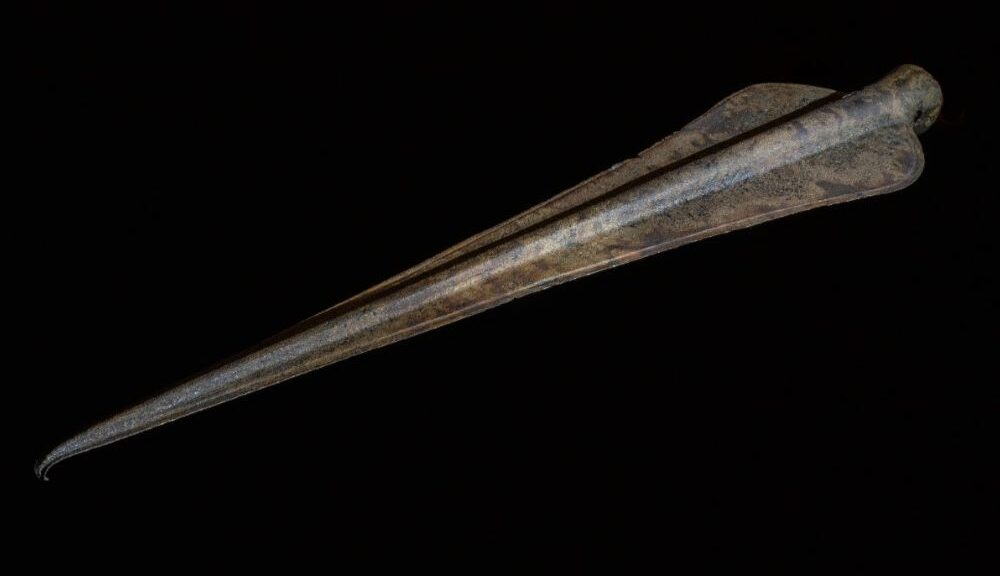
A metal detector on a Jersey beach reportedly discovered a 13-inch-long copper spearhead, which is about 3,000 years old, experts claim. According to recent studies, The ‘rare and complete’ spearhead, which still has remnants of the wooden shaft still attached, dates back to the Late Bronze Age, somewhere between 1207 and 1004 BC.
The rare copper alloy spearhead (pictured) dating back thousands of years to the Late Bronze Age has been discovered in Jersey.
However, it was discovered in the August of last year near Gorey Harbour in Jersey, but archaeologists have only now confirmed its age with the results of radiocarbon dating. It is completely different due to its size and the fact that it’s so well preserved – likely due to protection from the air by the black sand from which it was pulled.
It was found on the beach at Gorey by Jay Cornick, a Jersey-based metal detectorist and electrical engineer. Cornick brought it to independent trust Jersey Heritage to be recorded, in line with recommended best practice for non-treasure finds there.
It’s thought to be unique to the Channel Islands and a rare find in Britain. This spearhead is completely different from everything else we have,’ said Olga Finch, curator of archaeology at Jersey Heritage.
‘The spearhead is a really exciting find for Jersey – it is unique and very rare in terms of its large size and the fact that it is intact. The Bronze Age items we already have in our collection are mainly from hoards, which are usually great deposits of metal tools and weapons but mostly broken up and used.
‘It also doesn’t fit with what we already know about this period of time so we’re wondering if it was deposited as part of a ritual or an offering.
‘Our next step is to work with experts elsewhere and look at the location of the find to discover what new stories we can find out about the Bronze Age in Jersey.’
Paul Driscoll, Archaeology and Historic Environment Record Officer at South Gloucestershire Council, has studied and researched the Bronze Age collections at Jersey Heritage and more widely in the Channel Islands.
‘The spearhead is in such good condition,’ Driscoll said.
‘Many of the spears in the Jersey Heritage collection are broken – I think deliberately in prehistory as they are uniform in their breakage and thus unlikely to be random.
‘There are, however, a few intact examples but none that parallel this one.’ Conservation work on the spearhead was carried out by Jersey Heritage’s Museum Conservator Neil Mahrer, who said he had never seen anything like it in his career.
‘To see this spearhead in one piece was incredible and the wood inside the spear shaft was so well preserved that we were able to use it to discover that it dated back to over 3,000 years ago,’ he said.
Mahrer sent the wood to York Archaeological Trust, which used carbon dating to approximate the date of the wood and therefore the artefact as a whole. York Archaeological Trust also discovered the wood used as field maple, commonly used in the Bronze Age.
When Cornick found the artefact last summer it was buried point-down one of the lowest tides of the year when his metal detector went over it.
“It was a good 15 inches to 18 inches deep,’ he told the Telegraph.
‘It was at a 45-degree angle and when I dug it I saw the end of it and just pulled it out.
Neil Mahrer, Jersey Museum conservator, with the spear. He said: ‘To see this spearhead in one piece was incredible’
‘It came out with a sucking sound. It was deep enough into the black, clayey sand that doesn’t move with the tide that it may have been there since it went in.
‘When I found the spear I didn’t think it was that important or that old.
‘My initial thought when I dug it out was that it was a modern fishing spear and probably less than 100 years old so it was just thrown in my bag until I got back to the car.
‘Then I looked again and thought it might have a little bit of age to it.’
The Bronze Age spearhead is now on display in the case of a new find at Jersey Museum & Art Gallery, which is in Saint Helier in the island’s south.
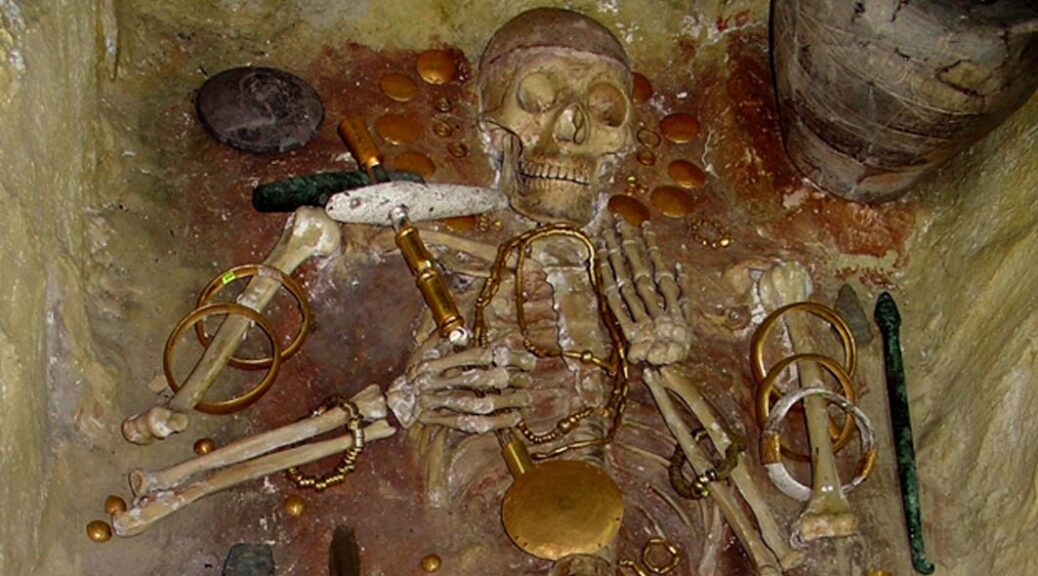
The Varna Man, who lived around the 5th Millennium BC, is the wealthiest burial at that time
The site, located on the outskirts of the Black Sea resort of Varna, was discovered accidentally when tractor operator Raicho Marinov was cutting a trench to lay an electric cable for a local factory.
He suddenly noticed small squares of shiny yellow metal, bracelets of the same material, green-coloured artefacts, and flakes of flint.
Rushed to the local museum, the objects were soon identified as prehistoric stone tools, corroded copper axes, and, clearly associated with them, golden ornaments. The association was what mattered: the implication was that the gold artefacts were older than any others ever discovered anywhere.
The Varna man burial has some of the world’s oldest gold jewelry.
Museum curator Michail Lazarov and Sofia University professor Georgi Georgiev immediately set about organising a rescue excavation, and the museum’s young archaeologist, Ivan Ivanov, was appointed to lead it.
Ivanov’s team eventually uncovered 281 graves, more than half with grave goods, 18 of them exceptionally rich, and one of them among the richest graves ever excavated.
The date of the cemetery has recently been pushed back to the 5th millennium BC. A radiocarbon determination now gives it as c.4500 BC.
The discoveries
About 200 crouched or, far more commonly, extended inhumations have been uncovered in the two-thirds of the cemetery so far excavated. Both males and females are represented.
The bodies were placed in flat graves formed of shallow pits without mounds. The remaining graves are ‘cenotaph graves’ – where nobody is present but where grave goods have been laid out – or ‘mask graves’, where a life-size ceramic mask has been substituted for an actual body.
Three cenotaph graves, three mask graves, and a number of the inhumations are extremely rich. The total assemblage includes 3,000 gold artefacts weighing over 6kg.
The richest burial is of a man in his mid-40s buried with no less than 990 separate gold objects, including beads, rings, and a variety of decorations for body, clothing, and hair, among them a penis sheath. This man was also buried with copper axes, other copper tools, and a sceptre in the form of a perforated stone axe or mace.
In addition to gold and copper, the exotic materials represented among the grave goods include graphite, spondylus shell, dentalium shell, carnelian, and marble. Ceramic containers were also present in many graves.
The deductions
Varna implies three major developments in the mid-5th millennium BC. First, given the range of exotic material, Varna must have been part of an extensive trading network, allowing some members of this Early Chalcolithic community to become rich and powerful.
Second – presumably because of its role in trade – the Varna community appears to have developed extreme social differentiation at a very early date, judging by the fact that most graves contain no or few grave goods, while a minority are exceptionally rich. The social gap between the many unfurnished inhumations and the Grave 43 man seems huge.
A reconstruction of Grave 43 at Varna.
Third, on the evidence of Grave 43 – by implication that of a warrior, a ruler, and perhaps, given the common character of early chieftainship, some sort of priest-king – the transition from a more matriarchal Neolithic to a more patriarchal Chalcolithic/Bronze Age form of social organisation was well advanced at Varna.
The presence of bull-shaped objects among the goldwork – most of which is otherwise non-representative – coupled with the penis sheath certainly implies a cultural preoccupation with virility and male power.
20-million-year-old fossilised tree discovered by scientists in Greece
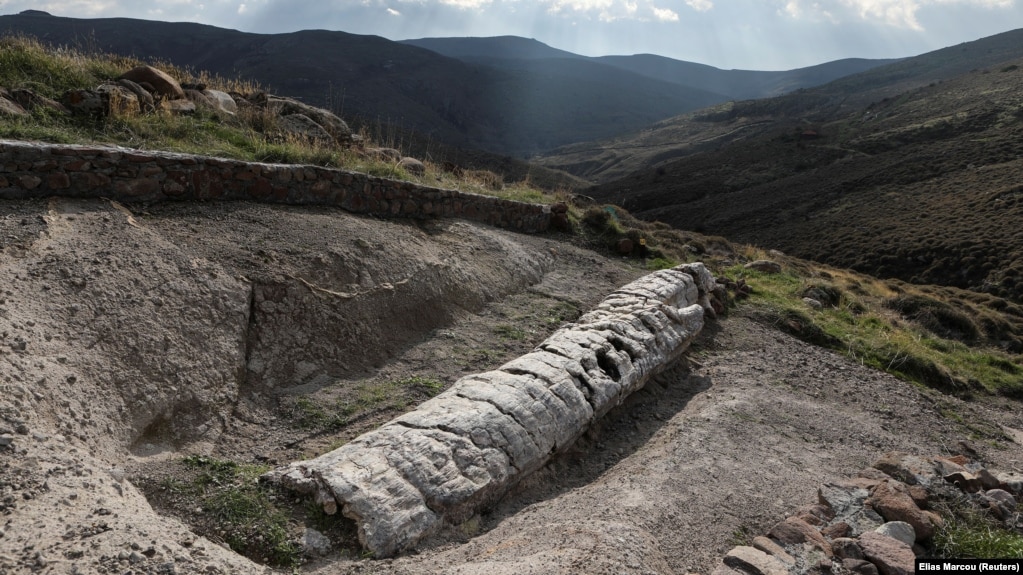
Two Greek scientists on the volcanic island of Lesbos claim they have uncovered a fossilized tree that is about 20 million years old. In the middle of road-work near an ancient forest on the eastern Mediterranean island, a particularly unusual discovery was found. The area was petrified millions of years ago.
In 1995, the site started to be dug up or excavated. Professor Nikos Zouros claimed that it is the first tree in the region to be discovered in such good condition, complete with branches and roots. He is with the Museum of Natural History of the Petrified Forest of Lesbos.
After 20 million years, the tree’s roots and leaves were still intact. It was a rare discovery, according to Zouros, one he had never seen before.
A fossilized tree is seen at the Petrified Forest National Park on the island of Lesbos, Greece.
“It is a unique find,” he said. “[It] is preserved in excellent condition. And from studying the fossilized wood we will be able to identify the type of plant it comes from.”
The 15,000-hectare petrified forest of Lesbos is a protected site of the United Nations Educational, Scientific and Cultural Organization, or UNESCO.
The forest is the result of a volcanic eruption 20 million years ago. Lava from the volcano covered the island’s ecosystem, which at that time was a subtropical forest.
The fossilized tree is about 19 meters long. It was preserved by heavy amounts of volcanic ash after it fell. A large number of fruit tree leaves also were found nearby.
The trees and animal bones found in the same general area add to the history and understanding of life that once existed there.
“During the excavations, the various forests that existed between 17 and 20 million years ago on Lesbos are being uncovered,” said Zouros. He and his team plan to rebuild the “ecosystem that existed during that period.”
For further study, he and his team transported the tree from the site using a special support system and metal structure.
A ‘Lamborghini’ Of Chariots Is Discovered At Pompeii. Archaeologists Are Wowed
Researchers at Pompeii have confirmed the discovery of an intact ceremonial chariot from a villa near the famed Italian archaeological site, calling it an “exceptional discovery.” The chariot was identified as “an exceptional discovery” that “has no parallel in Italy thus far,” according to the announcement made on Saturday.
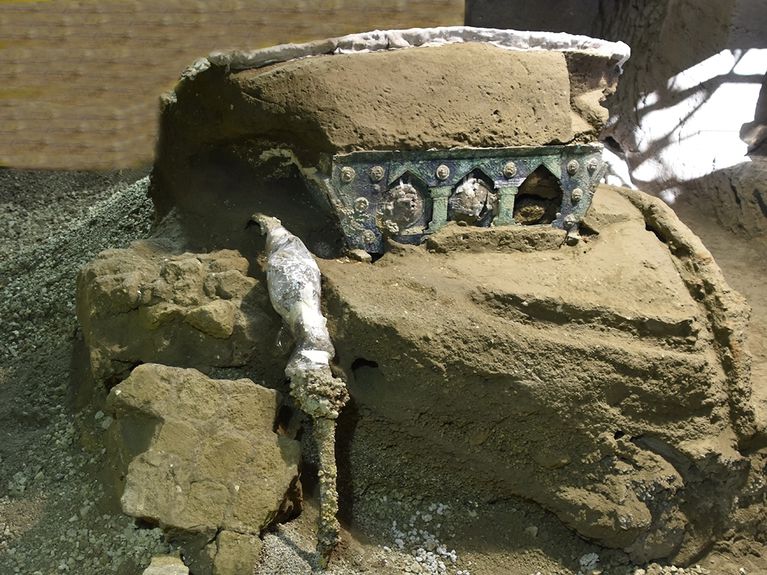
A well-preserved chariot discovered in Pompeii has been described as an “extraordinary find” and has iron wheels, bronze and tin decorations and mineralized wood.
Officials also stated that the chariot is kept in remarkable detail, including the four iron wheels, metal armrests and backrests, and a bench mounted on top of the frame that could seat one or two people.
Notably, the chariot is adorned with metal medallions depicting satyrs, nymphs and cupids, suggesting the possibility that it may have been used in marriage ceremonies.
“I was astounded,” said Eric Poehler, a professor at the University of Massachusetts Amherst who has a speciality in traffic in ancient Pompeii. “Many of the vehicles I’d written about before … are your standard station wagon or vehicle for taking the kids to soccer. This is a Lamborghini. This is an outright fancy, fancy car.”
Archaeologists worldwide expressed similar excitement Saturday over the announcement. “Still wrapping my head around the latest incredible discovery,” wrote Sophie Hay of the University of Cambridge. “My jaw is on the floor just now!” wrote Jane Draycott of the University of Glasgow.
A single exclamation point did not suffice for historian and writer Rubén Montoya, who wrote in Spanish that Pompeii “does not stop giving us surprises!!!”
The ancient city of Pompeii has been the subject of fascination and archaeological digs for hundreds of years. It was buried in volcanic ash from Mount Vesuvius nearly 2,000 years ago, a disaster that preserved in incredible detail the buildings and ephemera of the city and even the shapes of the bodies of the Romans who once walked the city’s streets.
According to Italian authorities, the chariot survived the eruption and the intervening years because it was stored inside a portico.
The eruption caused the walls and ceiling around it to collapse under the weight of volcanic ash. In recent years, looters had dug tunnels on either side. But “miraculously,” officials say, the chariot was spared.
While previous excavations had yielded everyday vehicles used for travel and work, this ceremonial chariot is the first find of its kind to be discovered, explained Massimo Osanna, the outgoing director of the site.
“It is an extraordinary discovery for the advancement of our knowledge of the ancient world,” Osanna said in a statement.
One of the chariot’s bronze and tin medallions, which depict various erotic scenes featuring satyrs, nymphs and cupids.
Every so often, some new discovery from Pompeii prompts excitement from historians about the glimmer of understanding it reveals about the residents of the ancient world: their fast-food preferences, how their taverns were decorated, their unlucky deaths.
Even among those semi-frequent discoveries, Poehler says, this chariot stands out.
“This is precisely the kind of find that one wants to find at Pompeii, the really well-articulated, very well-preserved moments in time,” he said. “And it happens to be in this case an object that is relatively rare despite its ubiquity in the past.”
Broken toilet leads to the discovery of 2,000 years of history beneath the Italian restaurant
A blocked toilet in an Italian building has changed the life of its owner who was planning to open a trattoria on the site. Lucian Faggiano was trying to find the offending sewage pipe at the property in Puglia, Italy when he made a fascinating discovery.
Lucian Faggiano’s dream of opening a restaurant was scuppered when a dig to find a blocked sewage point yielded some 2,000 years of hidden history, including vast rooms and pottery (shown in this image that features Mr Faggiano left and his son)
After digging a trench beneath the building he found a network of underground rooms and corridors that housed Roman devotional bottles, ancient vases, hidden frescoes and what are thought to be etchings from the Knights Templar.
Lucian Faggiano bought the building in Lecce, Puglia in the south of Italy and had planned to turn it into a trattoria – but renovations were put on hold when he discovered a toilet on the site was blocked.
And while attempting to fix the toilet he dug into a Messapian tomb built 2,000 years ago, a Roman granary, a Franciscan chapel, and even etchings thought to be made by the Knights Templar.
In a bid to stop the sewage backing up, Mr Faggiano, 60, and his two sons dug a trench and instead of isolating the offending pipe found underground corridors and rooms beneath the property on 56 Via Ascanio Grandi.
The search for the pipe began at the turn of the millennium.
Lecce, at the heel of Italy’s boot’, was once a crossroads in the Mediterranean and an important trading post for the Romans. But the first layers of the city date to the time of Homer, according to local historian Mario De Marco. It is not unusual for religious relics to turn up in fields or in the middle of the city itself, which has a mixture of old architecture
Eight years after it was meant to open as a restaurant, the building has been turned into Museum Faggiano (pictured) and a number of staircases allow visitors to travel down through time to visit the ancient underground chambers discovered by the family
He imagined it would take a week to dig down and fix the plumbing beneath the building, but instead, the DIY mission led to the discovery of a Messapian tomb, a Roman granary (pictured left), a Franciscan chapel – and even etchings from the Knights Templar. An ancient room beneath the modern building is shown right
The search for the pipe (shown in this image of Mr Faggiano and his son) began at the turn of the millennium when no-one could have predicted the treasures hidden beneath the floorboards, which revealed a subterranean world dating back to before the birth of Jesus
For example, a century ago, a Roman amphitheatre was recently found beneath a marble column bearing the statue of Lecce’s patron saint, Orontius in the main square and recently a Roman temple was found under a car park.
‘Whenever you dig a hole, centuries of history come out,’ said Severo Martini, a member of the City Council. Mr Faggiano asked his sons to help fix the problem with the plumbing so he could accelerate the opening of his restaurant, in a building that looked like it was modernised.
Years of excavations have seen the emergence of Roman devotional bottles, ancient vases and a ring with Christian symbols as well as hidden frescoes and medieval pieces. Here, Mr Faggiano carries a piece of Roman pottery from an underground room
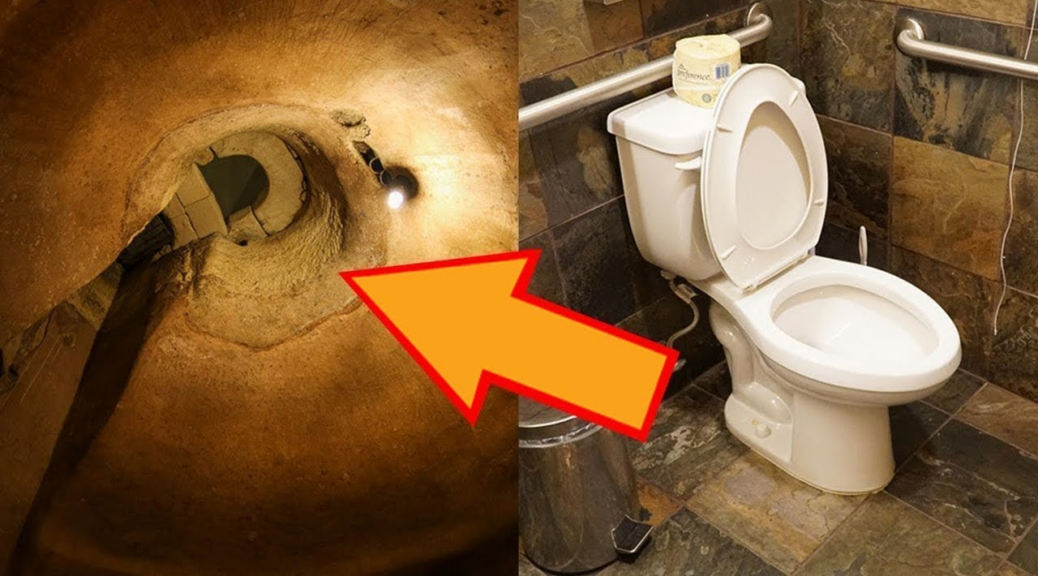
The building yielded plenty of nooks and crannies including mysterious shafts (pictured left and right) which lead to older parts of the building deeper and deeper underground
But when they dug down they hit a floor of medieval stone, beneath which was a Messapian tomb, built by people who lived in the area before the birth of Jesus. Legend has it the city was founded by the Messapii, who are said to have been Cretans in Greek records, but then the settlement was called Sybar.
Upon further investigation, the family team also discovered a Roman room that was used to store grain and a basement of a Franciscan convent where nuns were thought to have once prepared the bodies of the dead.
Afraid of costs and the delay in opening the restaurant, Mr Faggiano initially kept his amateur archaeology a secret from his wife, in part perhaps because he was lowering his youngest son, Davide, 12 though small gaps in the floor to aid his work.
But his wife, Anna Maria Sanò suspected the work was more complex than it appeared thanks to the number of dirty clothes she was washing, and because of dirt and debris is taken away.
Investigators shut down the site, warning Mr Faggiano he was conducting an unofficial archaeological dig. After a year, work continued but had to be overseen by heritage officials who witnessed the emergence of Roman devotional bottles, ancient vases and a ring with Christian symbols as well as hidden frescoes and medieval pieces.
Retired cultural heritage official, Giovanni Giangreco, who was involved with the excavation, said: ‘The Faggiano house has layers that are representative of almost all of the city’s history, from the Messapians to the Romans, from the medieval to the Byzantine time.’
Afraid of costs and the delay in opening the restaurant, Mr Faggiano initially kept his amateur archaeology a secret from his wife. Here, he sorts through pieces of glass and pottery found in one of the rooms. There are even pieces embedded in the wall
Despite bearing the financial load of the dig, the family became fascinated about the history beneath their building and made ends meet by renting rooms in it. Mr Faggiano admits to becoming obsessed with the project but still wanted to open his restaurant.
He said: ‘At one point, I couldn’t take it anymore I bought cinder blocks and was going to cover it up and pretend it had never happened.’
Eight years after it was meant to open as a restaurant, the incredible building has been turned into Museum Faggiano and a number of staircases allow visitors to travel down through time to visit the ancient underground chambers.
However, Mr Faggiano hasn’t given up on his culinary dream and is planning on opening a restaurant at a less complex location – even though he finally found the troublesome sewage pipe.