20-million-year-old fossilised tree discovered by scientists in Greece
Two Greek scientists on the volcanic island of Lesbos claim they have uncovered a fossilized tree that is about 20 million years old. In the middle of road-work near an ancient forest on the eastern Mediterranean island, a particularly unusual discovery was found. The area was petrified millions of years ago.
In 1995, the site started to be dug up or excavated. Professor Nikos Zouros claimed that it is the first tree in the region to be discovered in such good condition, complete with branches and roots. He is with the Museum of Natural History of the Petrified Forest of Lesbos.
After 20 million years, the tree’s roots and leaves were still intact. It was a rare discovery, according to Zouros, one he had never seen before.
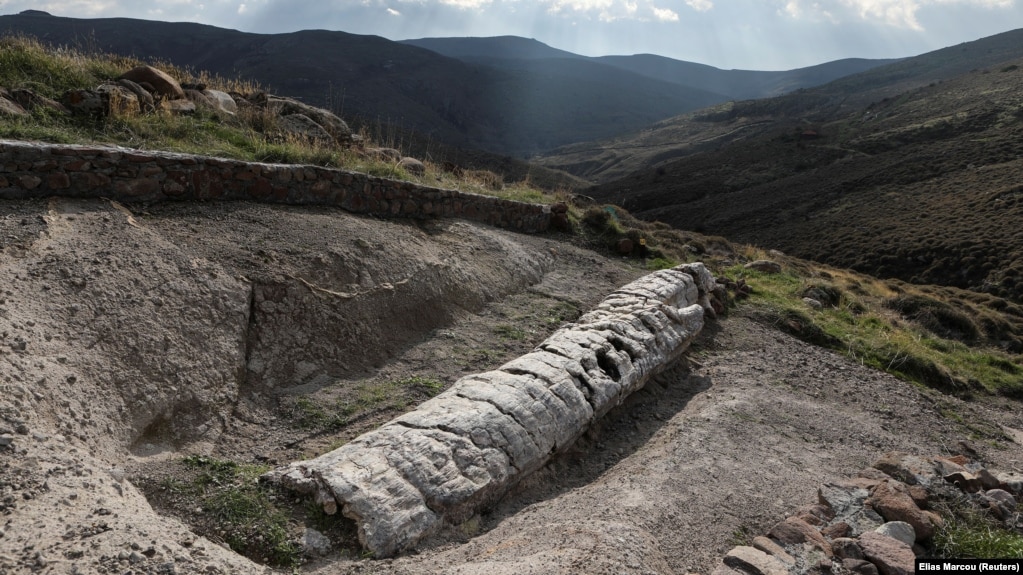
A fossilized tree is seen at the Petrified Forest National Park on the island of Lesbos, Greece.
“It is a unique find,” he said. “[It] is preserved in excellent condition. And from studying the fossilized wood we will be able to identify the type of plant it comes from.”
The 15,000-hectare petrified forest of Lesbos is a protected site of the United Nations Educational, Scientific and Cultural Organization, or UNESCO.
The forest is the result of a volcanic eruption 20 million years ago. Lava from the volcano covered the island’s ecosystem, which at that time was a subtropical forest.
The fossilized tree is about 19 meters long. It was preserved by heavy amounts of volcanic ash after it fell. A large number of fruit tree leaves also were found nearby.
The trees and animal bones found in the same general area add to the history and understanding of life that once existed there.
“During the excavations, the various forests that existed between 17 and 20 million years ago on Lesbos are being uncovered,” said Zouros. He and his team plan to rebuild the “ecosystem that existed during that period.”
For further study, he and his team transported the tree from the site using a special support system and metal structure.
A ‘Lamborghini’ Of Chariots Is Discovered At Pompeii. Archaeologists Are Wowed
Researchers at Pompeii have confirmed the discovery of an intact ceremonial chariot from a villa near the famed Italian archaeological site, calling it an “exceptional discovery.” The chariot was identified as “an exceptional discovery” that “has no parallel in Italy thus far,” according to the announcement made on Saturday.
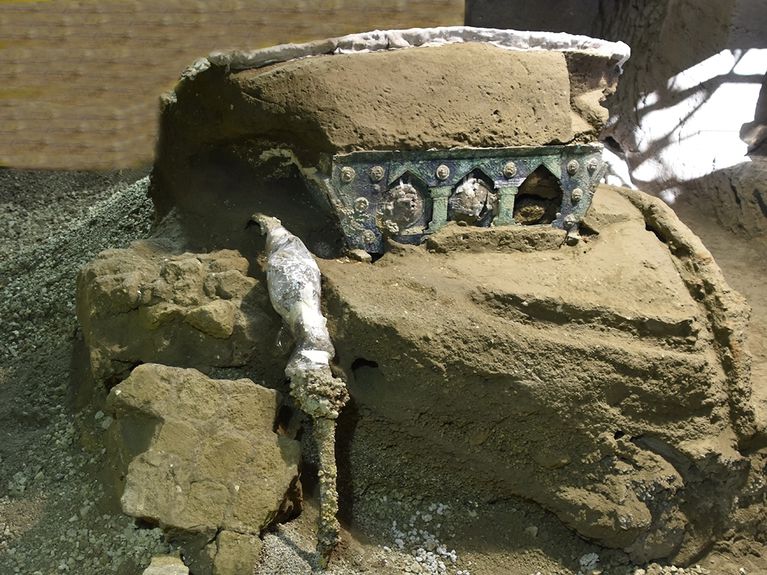
A well-preserved chariot discovered in Pompeii has been described as an “extraordinary find” and has iron wheels, bronze and tin decorations and mineralized wood.
Officials also stated that the chariot is kept in remarkable detail, including the four iron wheels, metal armrests and backrests, and a bench mounted on top of the frame that could seat one or two people.
Notably, the chariot is adorned with metal medallions depicting satyrs, nymphs and cupids, suggesting the possibility that it may have been used in marriage ceremonies.
“I was astounded,” said Eric Poehler, a professor at the University of Massachusetts Amherst who has a speciality in traffic in ancient Pompeii. “Many of the vehicles I’d written about before … are your standard station wagon or vehicle for taking the kids to soccer. This is a Lamborghini. This is an outright fancy, fancy car.”
Archaeologists worldwide expressed similar excitement Saturday over the announcement. “Still wrapping my head around the latest incredible discovery,” wrote Sophie Hay of the University of Cambridge. “My jaw is on the floor just now!” wrote Jane Draycott of the University of Glasgow.
A single exclamation point did not suffice for historian and writer Rubén Montoya, who wrote in Spanish that Pompeii “does not stop giving us surprises!!!”
The ancient city of Pompeii has been the subject of fascination and archaeological digs for hundreds of years. It was buried in volcanic ash from Mount Vesuvius nearly 2,000 years ago, a disaster that preserved in incredible detail the buildings and ephemera of the city and even the shapes of the bodies of the Romans who once walked the city’s streets.
According to Italian authorities, the chariot survived the eruption and the intervening years because it was stored inside a portico.
The eruption caused the walls and ceiling around it to collapse under the weight of volcanic ash. In recent years, looters had dug tunnels on either side. But “miraculously,” officials say, the chariot was spared.
While previous excavations had yielded everyday vehicles used for travel and work, this ceremonial chariot is the first find of its kind to be discovered, explained Massimo Osanna, the outgoing director of the site.
“It is an extraordinary discovery for the advancement of our knowledge of the ancient world,” Osanna said in a statement.
One of the chariot’s bronze and tin medallions, which depict various erotic scenes featuring satyrs, nymphs and cupids.
Every so often, some new discovery from Pompeii prompts excitement from historians about the glimmer of understanding it reveals about the residents of the ancient world: their fast-food preferences, how their taverns were decorated, their unlucky deaths.
Even among those semi-frequent discoveries, Poehler says, this chariot stands out.
“This is precisely the kind of find that one wants to find at Pompeii, the really well-articulated, very well-preserved moments in time,” he said. “And it happens to be in this case an object that is relatively rare despite its ubiquity in the past.”
Broken toilet leads to the discovery of 2,000 years of history beneath the Italian restaurant
A blocked toilet in an Italian building has changed the life of its owner who was planning to open a trattoria on the site. Lucian Faggiano was trying to find the offending sewage pipe at the property in Puglia, Italy when he made a fascinating discovery.
Lucian Faggiano’s dream of opening a restaurant was scuppered when a dig to find a blocked sewage point yielded some 2,000 years of hidden history, including vast rooms and pottery (shown in this image that features Mr Faggiano left and his son)
After digging a trench beneath the building he found a network of underground rooms and corridors that housed Roman devotional bottles, ancient vases, hidden frescoes and what are thought to be etchings from the Knights Templar.
Lucian Faggiano bought the building in Lecce, Puglia in the south of Italy and had planned to turn it into a trattoria – but renovations were put on hold when he discovered a toilet on the site was blocked.
And while attempting to fix the toilet he dug into a Messapian tomb built 2,000 years ago, a Roman granary, a Franciscan chapel, and even etchings thought to be made by the Knights Templar.
In a bid to stop the sewage backing up, Mr Faggiano, 60, and his two sons dug a trench and instead of isolating the offending pipe found underground corridors and rooms beneath the property on 56 Via Ascanio Grandi.
The search for the pipe began at the turn of the millennium.
Lecce, at the heel of Italy’s boot’, was once a crossroads in the Mediterranean and an important trading post for the Romans. But the first layers of the city date to the time of Homer, according to local historian Mario De Marco. It is not unusual for religious relics to turn up in fields or in the middle of the city itself, which has a mixture of old architecture
Eight years after it was meant to open as a restaurant, the building has been turned into Museum Faggiano (pictured) and a number of staircases allow visitors to travel down through time to visit the ancient underground chambers discovered by the family
He imagined it would take a week to dig down and fix the plumbing beneath the building, but instead, the DIY mission led to the discovery of a Messapian tomb, a Roman granary (pictured left), a Franciscan chapel – and even etchings from the Knights Templar. An ancient room beneath the modern building is shown right
The search for the pipe (shown in this image of Mr Faggiano and his son) began at the turn of the millennium when no-one could have predicted the treasures hidden beneath the floorboards, which revealed a subterranean world dating back to before the birth of Jesus
For example, a century ago, a Roman amphitheatre was recently found beneath a marble column bearing the statue of Lecce’s patron saint, Orontius in the main square and recently a Roman temple was found under a car park.
‘Whenever you dig a hole, centuries of history come out,’ said Severo Martini, a member of the City Council. Mr Faggiano asked his sons to help fix the problem with the plumbing so he could accelerate the opening of his restaurant, in a building that looked like it was modernised.
Years of excavations have seen the emergence of Roman devotional bottles, ancient vases and a ring with Christian symbols as well as hidden frescoes and medieval pieces. Here, Mr Faggiano carries a piece of Roman pottery from an underground room
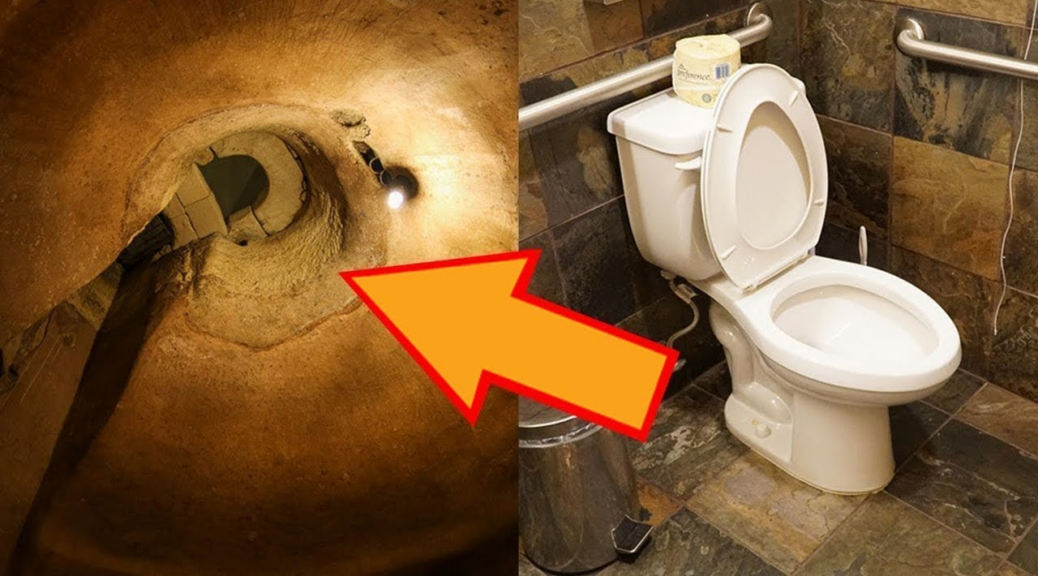
The building yielded plenty of nooks and crannies including mysterious shafts (pictured left and right) which lead to older parts of the building deeper and deeper underground
But when they dug down they hit a floor of medieval stone, beneath which was a Messapian tomb, built by people who lived in the area before the birth of Jesus. Legend has it the city was founded by the Messapii, who are said to have been Cretans in Greek records, but then the settlement was called Sybar.
Upon further investigation, the family team also discovered a Roman room that was used to store grain and a basement of a Franciscan convent where nuns were thought to have once prepared the bodies of the dead.
Afraid of costs and the delay in opening the restaurant, Mr Faggiano initially kept his amateur archaeology a secret from his wife, in part perhaps because he was lowering his youngest son, Davide, 12 though small gaps in the floor to aid his work.
But his wife, Anna Maria Sanò suspected the work was more complex than it appeared thanks to the number of dirty clothes she was washing, and because of dirt and debris is taken away.
Investigators shut down the site, warning Mr Faggiano he was conducting an unofficial archaeological dig. After a year, work continued but had to be overseen by heritage officials who witnessed the emergence of Roman devotional bottles, ancient vases and a ring with Christian symbols as well as hidden frescoes and medieval pieces.
Retired cultural heritage official, Giovanni Giangreco, who was involved with the excavation, said: ‘The Faggiano house has layers that are representative of almost all of the city’s history, from the Messapians to the Romans, from the medieval to the Byzantine time.’
Afraid of costs and the delay in opening the restaurant, Mr Faggiano initially kept his amateur archaeology a secret from his wife. Here, he sorts through pieces of glass and pottery found in one of the rooms. There are even pieces embedded in the wall
Despite bearing the financial load of the dig, the family became fascinated about the history beneath their building and made ends meet by renting rooms in it. Mr Faggiano admits to becoming obsessed with the project but still wanted to open his restaurant.
He said: ‘At one point, I couldn’t take it anymore I bought cinder blocks and was going to cover it up and pretend it had never happened.’
Eight years after it was meant to open as a restaurant, the incredible building has been turned into Museum Faggiano and a number of staircases allow visitors to travel down through time to visit the ancient underground chambers.
However, Mr Faggiano hasn’t given up on his culinary dream and is planning on opening a restaurant at a less complex location – even though he finally found the troublesome sewage pipe.
Lasers removed stains on a fresco in Pompeii’s House of the Ceii
One of Pompeii’s most action-packed frescoes has regained some of its colours after lasers removed centuries-old stains and restorers touched up worn paint.
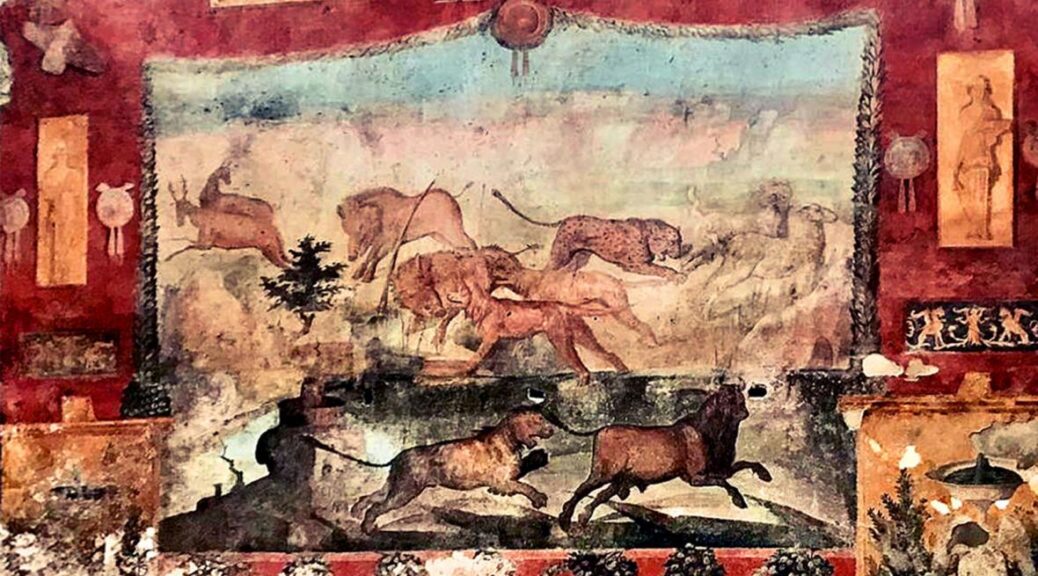
Featuring a lion chasing a bull, wild boar bearing down on deer and a leopard pouncing on sheep, the large fresco adorned the garden wall of the Pompeiian magistrate Lucius Ceius Secundus. Vegetation runs along the foot of the fresco, while the owner’s passion for Egypt is revealed by images on a sidewall of sacred Egyptian buildings and African pygmies hunting hippopotamuses and crocodiles.
The artwork — of hunting scenes — was painted in the so-called ‘Third’ or ‘Ornate’ Pompeii style, which was popular around 20–10 BC and featured vibrant colours.
In 79 AD, however, the house and the rest of the Pompeii was submerged beneath pyroclastic flows of searing gas and volcanic matter from the eruption of Vesuvius. Poor maintenance since the house was dug up in 1913–14 saw the hunting fresco and others deteriorate, particularly at the bottom, which is more vulnerable to humidity.
The main section of the fresco depicts a lion pursuing a bull, a leopard pouncing on sheep and a wild boar charging towards some deer. Frescos commonly adorned the perimeter walls of Pompeiian gardens and were intended to evoke an atmosphere — often one of tranquillity — while also creating the illusion that the area was larger than in reality, much as we use mirrors today.
A stunning fresco in the garden of Pompeii’s Casa dei Ceii (House of the Ceii) has been painstakingly laser-cleaned and touched up with fresh paint by expert restorers
‘What makes this fresco so special is that it is complete — something which is rare for such a large fresco at Pompeii,’ site director Massimo Osanna told The Times.
Alongside the haunting imagery of the now restored fresco, with its wild animals, the sidewalls of the garden featured Egyptian-themed landscapes, with beasts of the Nile delta-like crocodiles and hippopotamuses hunted by African pygmies and a ship shown transporting amphorae.
Experts believe the owner of the townhouse, or ‘domus’, had a connection or fascination with Egypt and potentially also the cult of Isis, that of the wife of the Egyptian god of the afterlife, which was popular in Pompeii in its final years.
In fact, the residence has been associated with one Lucius Ceius Secundus, a magistrate — based on an electoral inscription found on the building’s exterior — and it is after him that it takes its name, ‘Casa dei Ceii’.
The property, which stood for some two centuries before the eruption, is one of the rare examples of a Domus in the somewhat severe style of the late Samnite period of the second century BC.
The house’s front façade sports an imitation ‘opus quadratum’ (cut stone block) design in white stucco and a high entranceway set between two rectangular pilasters capped with cube-shaped capitals.
Casa dei Ceii’s footprint covered some 3,100 square feet (288 sq. m) and contained an unusual tetrastyle (four-pillared) atrium and a rainwater-collecting impluvium basin in a Grecian style, one rare for Pompeii, lined with cut amphora fragments.
The artwork — of hunting scenes — was painted in the so-called ‘Third’ or ‘Ornate’ Pompeii style, which was popular around 20–10 BC and featured vibrant colours, as pictured
The property, which stood for some two centuries before the eruption, is one of the rare examples of a domus in the somewhat severe style of the late Samnite period of the second century BC. The house’s front façade sports an imitation ‘opus quadratum’ (cut stone block) design in white stucco and a high entranceway set between two rectangular pilasters capped with cube-shaped capitals, as pictured
Other rooms found inside the property included a triclinium, where lunch would have been taken, two storage rooms, a tablinum which the master of the house would have used as an office and reception room and a kitchen with a latrine.
An upper floor, which partially collapsed during the eruption, would have been used by the household servants and appeared to be in the process of being renovated or constructed at the time of the catastrophe.
The garden on whose back wall was adorned by the hunting fresco, meanwhile, featured a canal and two fountains, one of a nymph and the other a sphynx.
During the excavation of the townhouse, archaeologists found the skeleton of a turtle preserved in the garden. The recent restoration work saw the paint film of much of the fresco — particularly a section featuring botanical decoration — carefully cleaned with a special laser.
The recent restoration work saw the paint film of much of the fresco — particularly a section featuring botanical decoration — carefully cleaned with a special laser. Experts also carefully retouched the paint in areas of the fresco that had been abraded over time, as well as instigating protective measures to help prevent the future infiltration of rainwater
‘What makes this fresco so special is that it is complete — something which is rare for such a large fresco at Pompeii,’ site director Massimo Osanna told The Times
Experts also carefully retouched the paint in areas of the fresco that had been abraded over time, protective measures have also been taken to help prevent the future infiltration of rainwater that could damage the artwork.
Experts believe the owner of the town house, or ‘domus’, had a connection or fascination with Egypt and perhaps the cult of Isis, that of the wife of the Egyptian god of the afterlife, which was popular in Pompeii in its final years. Pictured: the bull on the bottom right of the fresco.
Casa dei Ceii’s footprint covered some 3,100 square feet (288 sq. m) and contained an unusual tetrastyle (four-pillared) atrium and a rainwater-collecting impluvium basin in a Grecian style, one rare for Pompeii, lined with cut amphora fragments
Venetian Blue Beads Found in Alaska Predate Arrival of Columbus
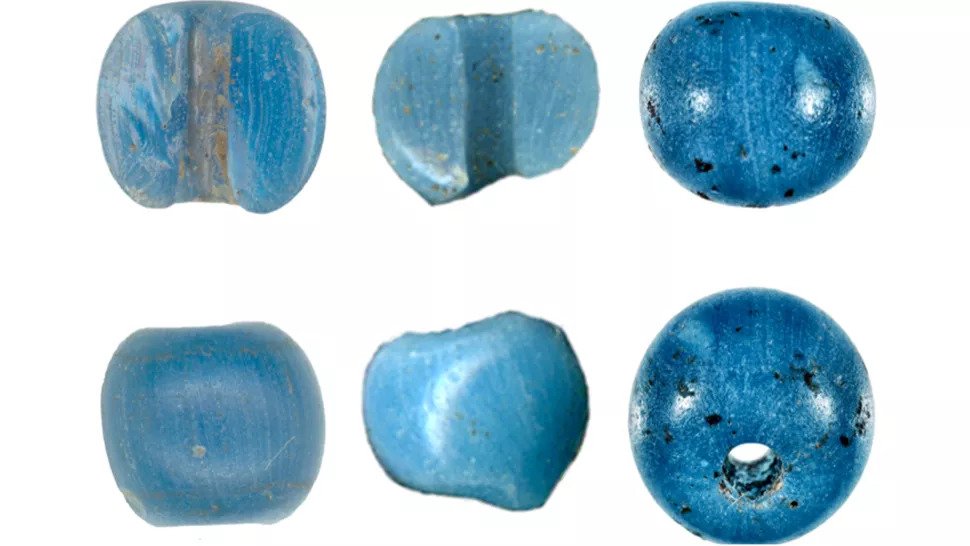
Tiny glass beads from Venice made their way to Alaska decades before Christopher Columbus‘ arrival in the New World. The beads, the colour and size of blueberries, were uncovered in a house pit in Punyik Point, a seasonal Inuit camp near the Continental Divide in Alaska’s Brooks Range.
Archaeologists determined the objects were created between 1440 and 1480 following a radiocarbon-dating of twine that held the jewellery.
Researchers from the University of Alaska suggest the beads were among trinkets that passed hands through various trade routes — starting in Europe, then along the Silk Road to China, through Siberia and finally to the Bering Strait. According to the study, the new discovery resets the clock on when traded began between Europe and North America.
Glass beads made in Venice and found in Alaska by archaeologists. The findings were published in a January 2021 paper called “A Precolumbian Presence of Venetian Glass Trade Beads in Arctic Alaska,” by Michael Kunz and Robin Mills.
Mike Kunz, an archaeologist with the university’s Museum of the North in Fairbanks, discovered a total of 10 beads in three locations in the Brooks Range: Punyik Point, Kinyiksugvik and Lake Kaiyak House.
Kunz theorizes the baubles were just small piece of a number of trinkets that made their way various trade routes that began in Europe, then along the Silk Road to China, through Siberia and finally across the Bering Strait.
They were then presumably brought across the frigid Arctic Ocean to Alaska by kayak. Punyik Point was a popular stopping point for traders, Kunz says, because of the many caribou in the area.
Archaeologists in Arctic Alaska have found blue beads (top left) from Europe, possibly Venice, that might predate Christopher Columbus’ voyage to the New World.
‘And, if for some reason the caribou didn’t migrate through where you were, [it also] had excellent lake trout and large shrub-willow patches,’ he added. University of Wisconsin archaeologist William Irving found several turquoise beads at Punyik Point in the 1950s and 1960s.
But Irving had no way to know when they were deposited.
Flash forward to 2004, when Kunz and Bureau of Land Management archaeologist Robin Mills returned to the ancient campsite. They found three more beads there, along with copper bangles, metal loops that could have been earrings and other metal pieces that could have been part of a necklace or bracelet.
Artefacts found at Indigenous Alaskan sites include glass blue beads, copper bracelets and bangles, and iron pendants.
Wrapped around one of the bangles was a twine that had survived centuries of burial just a few inches below the surface. Because the twine is made of plant fibres — probably the inner bark of shrub willow, the scientists surmised— it meant they finally had an organic matter to conduct radiocarbon dating on using Accelerator mass spectrometry.
‘We almost fell over backwards,’ Kunz said in a release. ‘It came back saying [the plant was alive at] some time during the 1400s. It was like, Wow!’
With that information, along with radiocarbon dating of charcoal found nearby, they surmised the glass beads at all three locales arrived at some point between 1440 and 1480.
‘The beads challenge the currently accepted chronology for the development of their production methodology, availability, and presence in the Americas,’ the researchers wrote in a new paper in the journal American Antiquity.
‘This is the first documented instance of the presence of indubitable European materials in prehistoric sites in the Western Hemisphere as the result of overland transport across the Eurasian continent.’
According to Kunz and Mills, the beads probably made landfall at Shashalik, an ancient trading post north of modern-day Kotzebue, and then were transported further inland.
The archaeologists theorize they were part of a necklace or other piece of jewellery. The item’s location, at the entrance to an underground house, suggests it was dropped or discarded rather than intentionally buried.
Venice has been known as a glassmaking mecca for over 1,500 years, with the island of Murano the centre of production since at least the 13th century.
Columbus’ ships landed in the Bahamas in October 1492, before venturing on to Cuba and Haiti, where he started the first European settlement in the Americas since the Norse some 500 years earlier.
After briefly returning to Spain, Columbus made three more voyages to the New World between 1493 and 1502, exploring the Lesser Antilles, Trinidad, Puerto Rico and the northern coast of South America.
The bead variety, commonly known as ‘Early Blue’ and ‘Ichtucknee Plain,’ has been found throughout the Caribbean, the east coasts of Central and North America, and the eastern Great Lakes region, but only after Columbus’ arrival, generally between 1550 and 1750.
World Oldest DNA Discovered in 1.2 Million Year Old Mammoth Teeth
As part of a study that uncovers new information about extinct animals, scientists have discovered the oldest DNA on record, extracting it from the molars of mammoths that roamed northeastern Siberia up to 1.2 million years ago
Scientists announced on Wednesday that they have successfully retrieved and sequenced DNA from three different mammoths— elephant cousins that were among the large mammals that dominated Ice Age landscapes — entombed in permafrost conditions conducive to the preservation of ancient genetic material.
While the remains were discovered starting in the 1970s, new scientific methods were needed to extract the DNA.
An artist’s reconstruction shows the extinct steppe mammoth, an evolutionary predecessor to the woolly mammoth that flourished during the last Ice Age.
The oldest of the three, discovered near the Krestovka river, was approximately 1.2 million years old. Another, from near the Adycha river, was approximately 1 to 1.2 million years old. The third, from near the Chukochya river, was roughly700,000 years old.
“This is by a wide margin the oldest DNA ever recovered,” said evolutionary geneticist Love Dalén of the Centre for Palaeogenetics in Sweden, who led the research published in the journal Nature.
Until now, the oldest DNA came from a horse that lived in Canada’s Yukon territory about 700,000 years ago. By way of comparison, our species, Homo sapiens, first appeared roughly 300,000 years ago.
DNA is the self-replicating material that carries genetic information in living organisms — sort of a blueprint of life. “This DNA was extremely degraded into very small pieces, and so we had to sequence many billions of ultra-short DNA sequences in order to puzzle these genomes together,” Dalén said.
Most knowledge about prehistoric creatures comes from studying skeletal fossils, but there is a limit to what these can tell about an organism, particularly relating to genetic relationships and traits.
Ancient DNA can help fill in the blanks but is highly perishable. Sophisticated new research techniques are enabling scientists to recover ever-older DNA.
“It would be a wild guess, but a maximum of two to three million years should be doable,” Dalén said.
That could shed light on some bygone species but would leave many others unattainable — including the dinosaurs, who went extinct 66 million years ago.
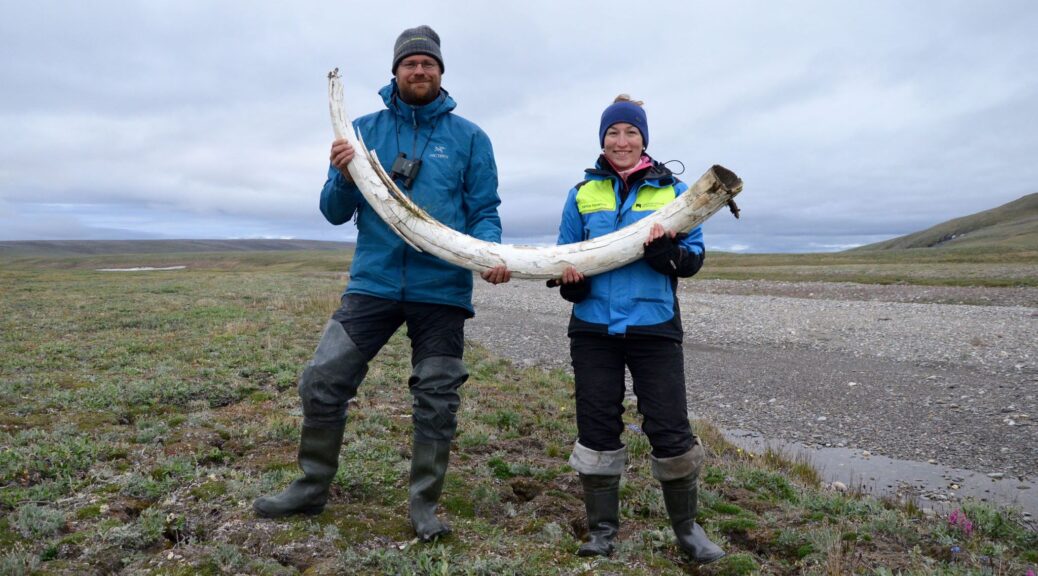
Palaeontologists Love Dalén and Patricia Pecnerova with a mammoth tusk on Wrangel Island, Arctic Ocean.
“When we can get DNA on a million-year time scale, we can study the process of speciation (formation of new species) in a much more detailed way. Morphological analyses on bones and teeth usually only allow researchers to study a handful of characteristics in the fossils, whereas with genomics we are analysing many tens of thousands of characteristics,” Dalén said.
The researchers gained insights into mammoth evolution and migration by comparing the DNA to that of mammoths that lived more recently. The last mammoths disappeared roughly 4,000 years ago.
The oldest of the three specimens, the Krestovka mammoth, belonged to a previously unknown genetic lineage that more than 2 million years ago diverged from the lineage that led to the well-known woolly mammoth.
Geneticist Tom van der Valk of SciLife Lab in Sweden, the study’s first author, said it appears that members of the Krestovka lineage were the first mammoths to migrate from Siberia into North America over a now-disappeared land bridge about 1.5 million years ago, with woolly mammoths later migrating about 400,000 to 500,000 years ago.
The Adycha mammoth’s lineage apparently was ancestral to the woolly mammoth, they found, and the Chukochya individual is one of the oldest-known woolly mammoth specimens.
DNA analyses showed that genetic variants associated with enduring frigid climes such as hair growth, thermoregulation, fat deposits, cold tolerance and circadian rhythms were present long before the origin of the woolly mammoth.
Scientists may have found one of the oldest Christian churches in the world
Using a celestial phenomenon, archaeologists are probing a mysterious structure buried deep underground in Russia. The structure could be one of the world’s oldest Christian churches, according to a new study.
The unknown structure sits in the northwestern part of the fortress of Naryn-Kala, a fortification in Derbent that dates to around A.D. 300.
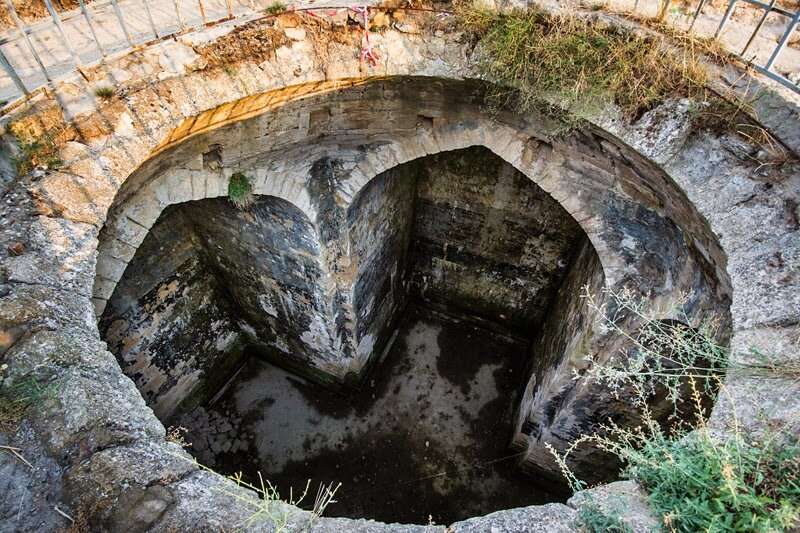
The 36-foot-deep (11 meters) cross-shaped structure is almost completely hidden underground, save for a bit of a half-destroyed dome on top. But because it’s a UNESCO cultural heritage site, the structure is protected and can’t be excavated — and its function remains largely debated.
An unknown structure in the northwestern part of the fortress of Naryn-Kala could be one of the world’s oldest churches.
The structure may have served as a reservoir, a Christian church or a Zoroastrian fire temple, according to a statement from the MISIS National University of Science and Technology in Russia.
So, a group of researchers decided to harness a celestial phenomenon called cosmic rays to help them paint a picture of the structure, similar to how a group discovered a possible void in the Great Pyramid of Giza back in 2017. They call this method “muon radiography.”
Cosmic rays are a form of high-energy radiation that comes from an unknown source outside our solar system; they constantly rain down on Earth.
Though most of the rays crash into atoms in our planet’s upper atmosphere and don’t make it to the ground, some, called muon particles, are ejected from this collision and do hit Earth’s surface.
Muons travel through matter at nearly the speed of light. But as they travel through denser objects, they lose energy and decay. So, by calculating the number of muons travelling through various parts underground, researchers can paint a picture of an object’s density.
But for this method to work, the structure and the surrounding soil need to have at least a 5% difference in density, according to the study.
The researchers placed muon detectors about 33 feet (10 m) inside the mysterious structure and took measurements for two months. They found that the structure and surrounding soil do have enough of a density difference such that they could use this method to figure out the structure’s 3D shape.
3D-model of the underground room, obtained from the results of muon detection.
The fortress of Naryn-Kala in Derbent, Russia, dates back to around A.D. 300
The researchers don’t think the structure is an underground water tank, even though many historical sources refer to it as such. Rather, it might have been used for water storage in the 17th and 18th centuries, according to the statement.
“It seems very strange to me to interpret this building as a water tank,” co-author Natalia Polukhina, a physicist at the MISIS National University of Science and Technology, said in the statement. In the same fortress, scientists have identified another underground structure that really is a tank and is rectangular, she said. What’s more, during construction, the structure wasn’t buried but on the surface and was erected on the highest point of the fortress.
“What is the sense to put the tank on the surface, and even on the highest mountain?” she asked. “Currently, there are more questions than answers.”
This study wasn’t about making a new discovery but rather confirming that the method would reveal what the structure looked like. Next, the researchers hope to conduct an even more detailed analysis to create a full 3D image of the building, ultimately helping them to understand its purpose.
“The technique is very nice,” said Christopher Morris, a fellow of the Los Alamos National Laboratory who was not a part of the study. But “the only access [to the structure] seems to be from the void in the centre.” So they can only reconstruct it using data taken from a limited point of view, he added.
“I believe it is possible to reconstruct the buried structure,” if the group implements more detectors and gathers better data, Morris told Live Science. But “I do not know if this can reveal whether the structure is a church.”
Well-Preserved Burial Cist Discovered on Scottish Island
The Scotsman reports that a well-preserved skeleton has been discovered in a tightly constructed stone burial cist about a half-mile from the Neolithic site of Skara Brae on the island of Orkney.
This researcher, a member of the archaeological team, is digging here in an effort to discover more about the skeleton, which is lying in a crouched position on its right-hand side, with the cist some three-metres wide and covered with a heavy stone slab.
It is too early to determine whether the bones are those of a man or a woman or if anything else was buried with them. But the robustness of the cist has left the skeleton virtually intact, with small bones – such as toes – surviving thousands of years.
The skeleton was discovered on a farm close to the Neolithic settlement of Skara Brae on Orkney but it is not clear if there is a link between the two, with the remains possibly from the later Bronze Age.
Martin Cook, director of AOC Archaeology, said: “The size and scale of the cist would suggest it is a late Neolithic or early Bronze Age burial.
“We think the skeleton is buried by itself and not part of a cemetery. It is obviously very close to Skara Brae.”
Mr Cook said it was too soon to say whether the burial was linked to Skara Brae, the Neolithic settlement that was occupied from around 3180 BC to 2500 BC.
“This could be a later grave,” Mr Cook added.
Evidence of other unexcavated settlements has recently been found on the coast at the Bay of Skaill.
Mr Cook added: “We are currently removing the skeleton and what we are looking for is material goods, things like pottery or animal bones or whether a joint of meat were buried with it.
“The skeleton was laid down in a crouched position and we can see the leg bones, the arms and the toes. Sometimes animals like voles will get in and take the smaller bones but this cist was really well, tightly built. It looks like all the bone is there and well.”
The find was reported to archaeologists after it was discovered during work on the Davidson cattle farm at Skaill. The excavation was carried out by AOC Archaeology on behalf of Historic Environment Scotland.
A spokesperson for Historic Environment Scotland (HES) said “We were approached by the local authority archaeologist in Orkney for assistance after the discovery of a cist burial in the buffer zone of the Heart of Neolithic Orkney World Heritage Site. AOC Archaeology, current holders of our excavation call-off contract, is attending the site and will be carrying out an archaeological excavation.”
The find comes shortly after evidence of a possible Neolithic or Bronze Age settlement in the Bay of Skaill area was discovered around half a mile from Skara Brae.
The finds of a badly damaged wall, which had been exposed due to the pounding tides on this stretch of coast, along with deer antlers, a boar tooth, a cattle jawbone and a large decorated stone have led archaeologists to consider whether “another Skara Brae” is waiting to be discovered.
Eroding wall running out from an eroding section on to the beach. The dark material in the foreground is a layer of peat. Sigurd Towrie from the University of the Highlands and Islands discovered a badly damaged wall that had been exposed by pounding tides and pouring rain
Deer antlers, a boar tooth (pictured), a cattle jawbone and a large decorated stone have also been discovered at the site – said to date back nearly 5,000 years
Sigurd Towrie, the spokesman for the Archaeology Institute at the University of Highlands and Islands, said earlier this month that the finds “suggest there is another settlement at the Bay of Skaill – one that, from previous environmental sampling, is likely to be 4,000 to 5,000 years old”.