Archaeologists find unexpected iron age settlement in Oxfordshire
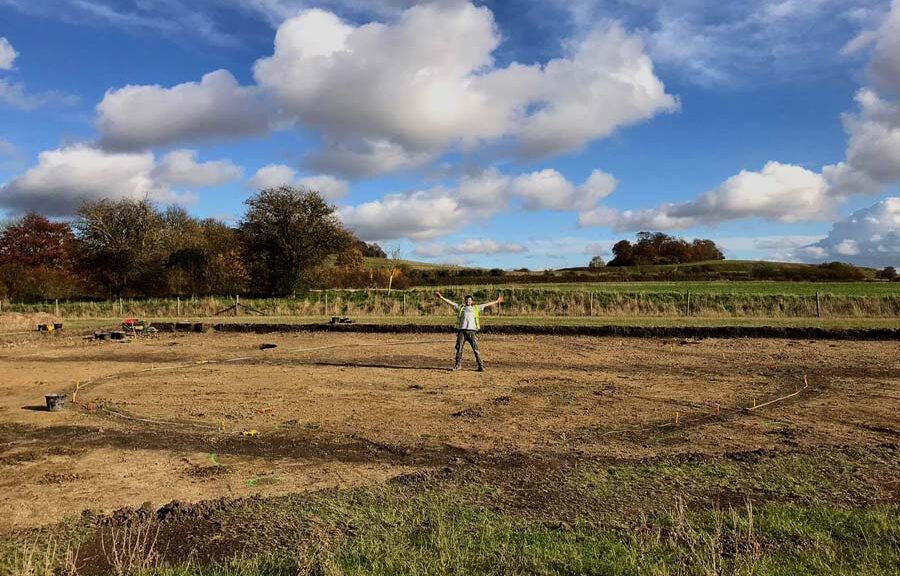
The findings of a team of archaeologists from DigVentures revealed the ruins of at least 15 roundhouses from the 4th-century B.c. to the early first century CE, along with the remains of a massive Roman villa built over the abandoned homes in the late 3rd to early 4th century CE.
Unexpected Iron Age Settlement and Roman Villa Found in Oxfordshire
In the protective shadow of Wittenham Clumps, some 50 miles west of London, the Iron Age settlement and the Roman villa are the site of an Iron Age hillfort on the banks of the River Thames.
Exactly where the people who used the hillfort actually lived had remained uncertain, but the DigVentures archaeologists believe they now have an answer.
Aerial view of the hillfort, with a portion of the River Thames visible on the left.
“Given how close we are to the hillfort, it’s not surprising that there’s a settlement here — it’s the sheer scale of it that’s impressive,” said Chris Casswell, head of fieldwork at DigVentures.
“We weren’t expecting to find so many houses within such a small space — the area we’ve excavated is just over a hectare and the settlement itself is clearly much larger.”
“We’ve still only uncovered one corner of it. What’s surprising is that hardly any of it showed up on the initial geophysics survey, probably due to a quirk in the local geology. It was only when we started digging that we were able to reveal the true extent of what is her.”
The Iron Age houses range in size from 8 to 15 m (26-49 feet) in diameter, but the majority are around 10 m (33 feet) in diameter and provide a living area of at least 78 m2.
Among the remains, the researchers unearthed an Iron Age ‘fridge’ or pantry — a collection of ceramic food storage vessels that would have been kept cool and safe within a pit dug into the ground.
A fragment of daub that appears to have been painted was also found, which suggests that rather than simply being mud-coloured, the walls of the roundhouses may have been decorated.
Footprint of the Roman villa outlined in recent snowfall.
Archaeologist India Jago at the excavated corn dryer which would have been used after the harvest.
The team also revealed the footprint of a Roman villa, built on the site of the abandoned roundhouses.
Measuring 30 m (98 feet) long, and with at least 7 column bases, it appears to be a ‘winged corridor villa’ and would have been home to a wealthy family with a working farmstead.
Among the Roman remains, the scientists found cooking utensils like strainers, spoons, knives, a ladle, cooking pots, and tableware, a surgical spatula probe that would have been used for applying ointments and oils to wounds, and well-preserved bone combs. There’s also a corn dryer, used for drying corn after harvest.
“It’s everything you’d expect to find at a busy settlement, but that’s what’s so exciting about it — these are the foods, homes, and artefacts that made up the everyday reality of these people’s lives,” Casswell said.
Viking treasure including gold bangle buried over 1,000 years ago is found on the Isle of Man
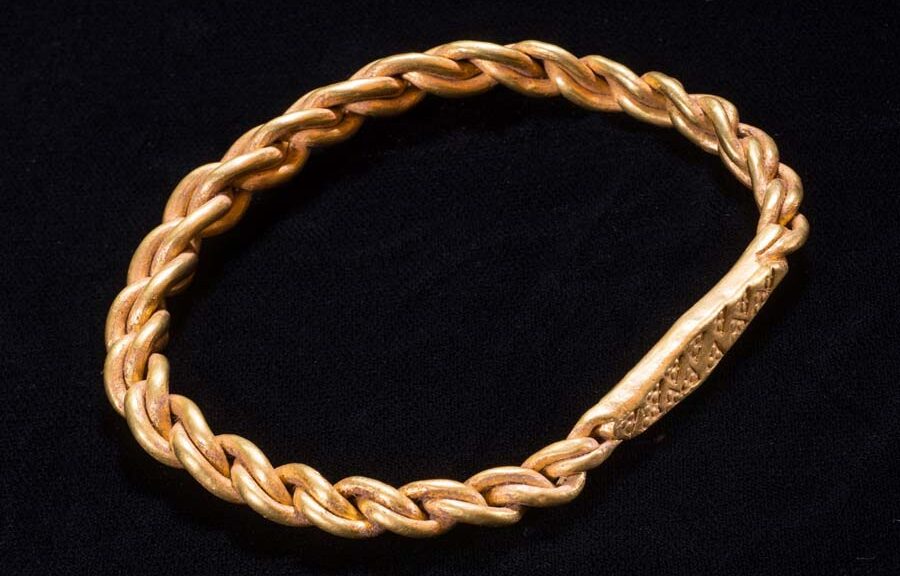
An exceptionally rare Viking artefact is presently being examined on the Isle of Man by Manx Museum authorities and has been declared treasure by the island’s coroner of inquests. The find, which is considered to be internationally significant and believed to be more than 1,000 years old, consists of a gold arm ring, a large silver brooch, at least one silver armband and other associated finds.
Some of the items discovered on the Isle of Man by Kath Giles late last year.
This has prompted some people to suspect that they have been hidden somewhere between AD950 and the present day, and were found by an amateur metal detectorist on private land last year.
Under the terms of the Declaration of Treasure, Manx National Heritage, on behalf of the Isle of Man government will be custodians of the finds.
Kath Giles, left, who found the hoard, and Allison Fox, curator for archaeology at Manx National Heritage, with the Viking age items.
The findings will eventually be part of the permanent collections on display at the Manx National Heritage Museum. Kath Giles, the metal detectorist who discovered the artefacts, said she knew straight away that what she had uncovered was significant.
“I knew I had found something very special when I moved the soil away from one of the terminals of the brooch, but then I found parts of the pin, the hoop and underneath, the gorgeous gold arm ring,” she said. “I’m so thrilled to have found artefacts that are not only so important but so beautiful.”
Allison Fox, curator for archaeology at Manx National Heritage, said the museum received a phone call from Giles late last year, and with her help was able to document the site to ensure there were no further objects remaining in the ground.
“The arm ring is a rare find. Gold items were not very common during the Viking age. Silver was by far the more common metal for trading and displaying wealth. It has been estimated that gold was worth 10 times the value of silver and that this arm ring could have been the equivalent of 900 silver coins,” she said.
The gold arm ring found by the amateur metal detectorist Kath Giles.
“Kath’s hoard can be dated on stylistic and comparative grounds to about AD950, a time when the Isle of Man was right in the middle of an important trading and economic zone. The Viking and Norse influence remained strong on the island for a further 300 years, long after much of the rest of the British Isles.”
Under the Isle of Man Treasure Act 2017, when archaeological artefacts are found there is a legal obligation for the findings to be reported to Manx National Heritage.
If the artefacts fall under the categories of the act, they must also be reported to the coroner of inquests. The coroner decides whether an artefact is a treasure and if it is found to be so, a financial reward is usually paid to the finder and landowner.
The exact value of the findings, as well as the value of the rewards, are yet to be determined. Fox said the reward would be based on a market value for all the artefacts. This will be assessed independently, usually by the treasury valuation committee.
Fox added: “At the moment, we know its historic and cultural value to the history of the Isle of Man, but its financial value will be assessed in the future.”
This month, the Department for Digital, Culture, Media and Sport revealed that more than 1,300 pieces of treasure were found in the UK throughout 2019, the largest haul since records began.
That year, two metal detectorists who discovered a Viking hoard estimated to be worth as much as £12m were given lengthy jail terms after failing to report their findings.
2,000-year-old Roman millstone found with massive penis engraved on it
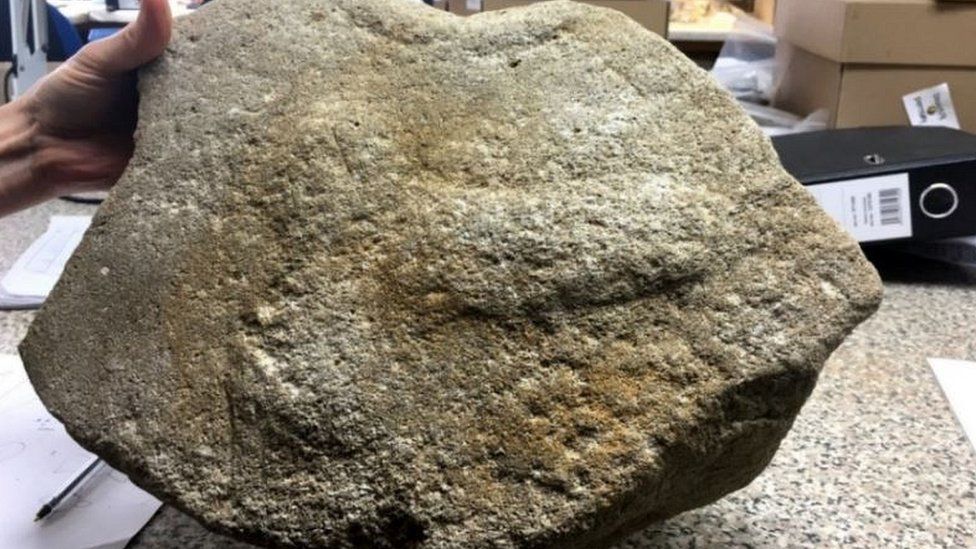
Archaeologists found a Roman millstone unearthed in Cambridgeshire with an engraving of a penis. The inscription, which was a symbol for strength and virility, was thus deciphered.
Over the course of several months, as part of roadwork for an extensive 21-mile section of the A14 between Cambridge and Huntingdon, a millstone and others were discovered.
The finds came from the remains of a Roman villa located near the town of Godmanchester, a Highways England spokesperson told MailOnline.
However, the phallographic carving — which was made to give the millstone and its flour good luck and protection — was only recently identified by experts.
The upgraded stretch of road was opened to traffic in the May of last year — but the millstone was not the only archaeological find revealed before the works finished.
Other finds included the tusk of a woolly mammoth, the skull of a woolly rhinoceros, an abandoned medieval village, and three dismembered men from 1,500 years ago.
Woolly mammoth and rhino remains also found along the road are thought to date back to the last Ice Age
Archaeologists also found the earliest known evidence for beer brewing in Britain, which dated back to as early as 400 BC.
A Roman millstone found near Cambridge was decorated with an engraving of a penis — an ‘image of strength and virility’ — archaeologists have revealed. Pictured, the millstone
According to Highways England’s Archaeology lead for the A14, Steve Sherlock, the penis-decorated millstone is important as it ‘adds to the evidence for such images from Roman Britain.’
‘There were known associations between images of the phallus and milling, such as those found above the bakeries of Pompeii, one inscribed with Hic Habitat Felicitas — “You Will Find Happiness Here”,’ he explained.
‘The phallus was seen as an important image of strength and virility in the Roman world, with it being common practice for legionaries to wear a phallus amulet, which would give them good luck before the battle.’
The millstone was examined by experts from the Museum of London Archaeology Headland Infrastructure and Oxford Archaeology.
Alongside the carving of the phallus on the millstone’s upper face, the team discovered two crosses that had been inscribed on its circumference.
The quern itself would have been a simple hand mill, such as typically consists of two circular stones between which corn is ground.
According to the archaeologists, the millstone appeared to have been broken during use and subsequently adapted to be used as a saddle quern — a base stone in the grinding process — which would have hidden the genital image from sight.
The millstone was examined by experts from the Museum of London Archaeology Headland Infrastructure and Oxford Archaeology. Alongside the carving of the phallus on the millstone’s upper face, the team discovered two crosses that had been inscribed on its circumference. Pictured, Oxford Archaeology expert Ruth Shaffrey, poses with the phallus-bearing millstone.
The researchers reported that more than 300 querns millstones were recovered during archaeological work on the A14 upgrade project.
Decorated querns and millstones of any date are rare — and only four Roman millstones have ever been discovered from around a total of 20,000 nationwide. While crosses on such stones are more prevalent, these tend to be found only at military sites, the team explained.
‘As one of only four known examples of Romano-British millstones decorated this way, the A14 millstone is a highly significant find,’ said Oxford Archaeology’s worked stone specialist, Ruth Shaffrey.
‘It offers insights into the importance of the mill to the local community and to the protective properties bestowed upon the millstone and its produce (the flour) by the depiction of a phallus on its upper surface.’
6,500 Medieval Coins And Gold Rings Found In A Field
A newly uncovered medieval silver cache that contains thousands of silver coins and this trove of precious metal was found in a Polish cornfield by archaeologists working with the help of a priest and local firefighters.
It is a rare treasure that was discovered in Słuszków, a village in west-central Poland, it was a nearly 900-year-old hoard, It is said to contain one of a kind treasure; a gold ring etched with a Cyrillic inscription that translates to: “Lord, may you help your servant Maria.”
That ring may have belonged to a princess; the coin stash was certainly fit for one. “The newfound hoard consists of over 6,600 items — silver coins and silver clumbs (tiny ingots) … wrapped in three linen pouches, packed in a basket and then put in the ceramic vessel,” Adam Kędzierski, an archaeologist at the Institute of Archaeology and Ethnology at the Polish Academy of Sciences, told Live Science in an email.
Kędzierski said he wouldn’t have found the medieval hoard without the help of a local priest. In November 2020, Kędzierski visited Słuszków to learn more about another medieval treasure — one of the largest coin hoards ever found in Poland, which had been unearthed in 1935.
The exact location of the 1935 hoard had never been recorded, and Kędzierski hoped to locate and photograph it for an upcoming book. However, during his stay, Kędzierski happened to talk with a priest, Rev. Jan Stachowiak, who shared a little bit of gossip about the possible location of another hoard.
The excavation site of the medieval hoard
After using a metal detector to locate the general area where the hoard was buried, Kędzierski and his colleagues dug up a small trench in a cornfield in the village. There, he found a ceramic vessel that held the medieval riches.
“The vessel itself, buried only 30 centimetres [nearly 12 inches] under the ground, was completely preserved — only the lid/the upper part was missing,” he said.
After realizing the hoard’s incredible value, Kędzierski and his team called in local volunteer firefighters to guard the treasure until the excavation was complete, according to The First News, a Polish news outlet.
Most of the coins were silver coins known as cross denarii, minted with the image of a large cross and dating to the end of the 11th century or the beginning of the 12th century, he said. The hoard also held Czech, Danish, Hungarian and German coins, including a denarius coin of Germany’s King Henry III.
A denarius (silver coin) of Henry III, king of Germany
The “rarest coins” are denarii featuring Sieciech, a high-ranking Polish statesman who served Władysław I Herman, the Duke of Poland from 1079 to 1102, Kędzierski said. The hoard’s “biggest sensation,” are four golden rings, including the ring with the Cyrillic inscription about the woman named Maria, he said.
The four gold rings found in the medieval hoard
Unlike silver trinkets, gold jewellery was extremely rare in Poland during the early Medieval period, Kędzierski said. Perhaps, the newfound gold rings belonged to the first ruling dynasty of Poland, known as the Piast dynasty.
“The treasure (dated back to 1105) might have belonged to Zbigniew, Duke of Poland and the wedding band wearing the Cyrillic inscription could have been a gift of his grandmother — Dobroniega Maria, a daughter of Vladimir the Great, Prince of Kiev, and a wife of a Polish price, Casimir the Restorer,” Kędzierski said in the email.
Now that the hoard has been excavated, researchers will analyze and date the gold and silver pieces as well as the linen pouches and the basket that held these treasures. “Particularly interesting will be establishing the provenance of the gold decoration items,” such as the rings, Kędzierski said.
The discovery of this second hoard at Słuszków suggests that the village may have played a more important role in history than previously realized. Perhaps a high ranking official tied to the duke lived in Słuszków, or maybe it was even a temporary residence for Duke Zbigniew, Kędzierski said.
Słuszków is known for other early medieval artefacts; over the years, local farmers have told archaeologists about early medieval vessels and dishes found in their fields, “which may be a sign of [the] remains of stone buildings in the area of Słuszków,” Kędzierski said.
Ancient Roman Library Discovered Beneath German City
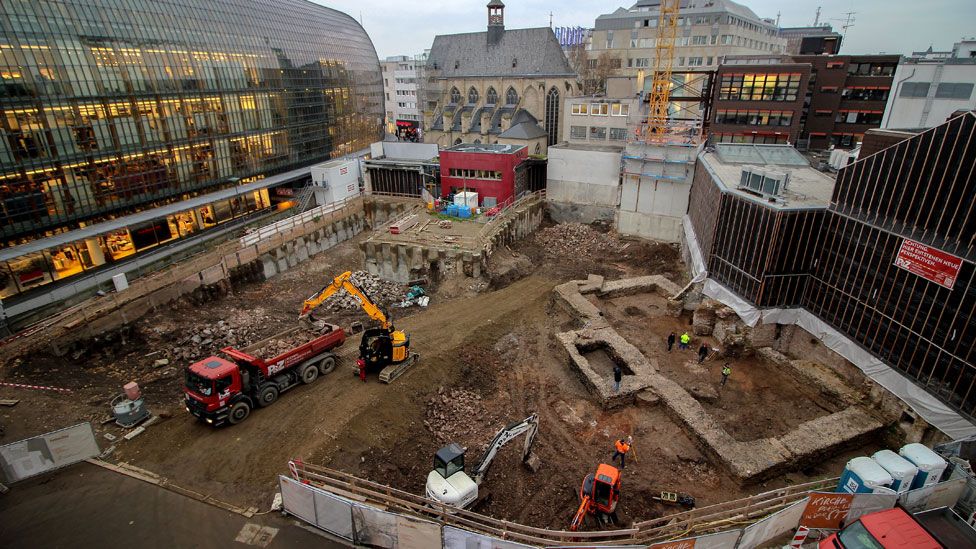
The first thing the archaeologists realised when they discovered the foundations of a Roman-era building situated in the heart of Cologne, Germany, they initially thought they had found the ruins of a public assembly hall.
Archaeologists identified the library based on a series of wall niches that once housed ancient scrolls
The discovery of tiny wall niches, however—at roughly 31 by 20 inches, the spaces were too small to hold statues—soon led them to conclude otherwise: Here, in the former Roman city of Colonia, stood the country’s oldest known library.
According to the Guardian’s Alison Flood, the wall niches mirror those seen in the Library of Celsus, a 2nd-century Roman building located in modern-day Ephesus, Turkey. (Although that structure’s interior was destroyed by an earthquake in the 3rd century, with the facade following in the 10th or 11th century, Celsus was re-erected by archaeologists during the 1970s.)
Based on this connection, researchers were able to identify the niches as all that remained of cupboards built to house an ancient library’s roughly 20,000 scrolls.
The Cologne structure was built in the southwest corner of the city’s forum, or marketplace, sometime between 150 and 200 C.E., according to Martin Oehlen of German news outlet Kölner Stadt-Anzeiger.
The Romans had founded Cologne, then known as Colonia, on the banks of the Rhine River about a century earlier in 50 C.E.
The city, which served as the capital of the Germania Inferior province and housed some of Rome’s influential imperial governors, soon emerged as a vibrant trade and manufacturing centre.
Given the library’s central location, Schmitz believes it was open to the entire city rather than a single private citizen or municipal leader. He suggests that locals were free to peruse the building’s expansive collection, perhaps using ladders to reach higher shelves or checking parchment labels to find relevant writings.
Dagmar Breitenbach of German broadcast station Deutsche Welle writes that Marcus Trier, director of the Cologne Bodensekmalpflege (Cologne’s office of historic preservation), estimates the library measured around 66 by 30 feet and stood at two stories tall.
Quite huge’ … detail of the library’s walls.
An annex housing a statue of Minerva, Roman goddess of wisdom and warfare, was likely added after initial construction, The Art Newspaper’s Catherine Hickley reports.
“[The structure] is at a minimum the earliest library in Germany, and perhaps in the north-west Roman provinces,” Dirk Schmitz, an archaeologist at the Roman-Germanic Museum of Cologne, tells Flood. But he speculates that there could be more Roman libraries discovered in the future.
“Perhaps there are a lot of Roman towns that have libraries, but they haven’t been excavated,” he adds. “If we had just found the foundations, we wouldn’t have known it was a library. It was because it had walls, with the niches, that we could tell.”
Archaeologists discovered the site while conducting construction work on a Protestant church in Cologne’s city centre, Oehlen notes.
The library will be integrated into the new building’s underground garage, with two would-be parking spaces instead displaying the ancient structure’s walls and three parchment niches.
The western German city on the Rhine River is over 2,000 years old – so stumbling upon ancient ruins is not unusual.
Renovations Reveal Twelfth-Century Bath House in Spain
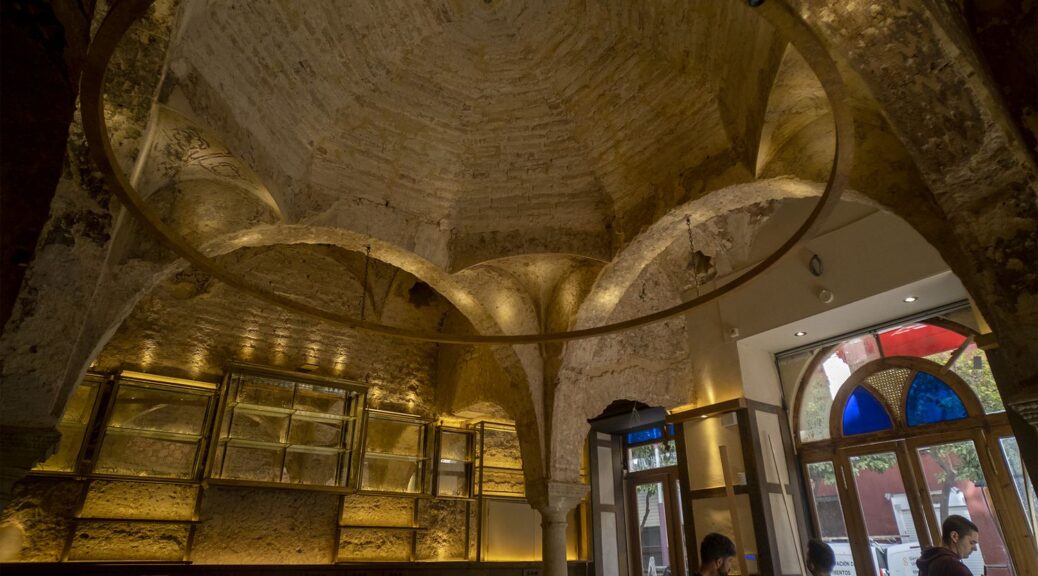
According to an El País report, renovation of a popular tapas bar on Seville’s Mateos Gago Street revealed the walls and skylights of a twelfth-century hammam, or bathhouse, built during the rule of the Almohad Caliphate.
The 12th-century bathhouse discovered in the popular bar Cervecería Giralda, in Seville.
On Mateos Gago Street, in the southern Spanish city of Seville, the hammam is situated only a few meters from the Roman Catholic cathedral of the city, and for a century it has been one of the most crowded Arab baths in the city. The thing is, customers were not going there to immerse themselves in water, but rather to pour the liquid down their throats: the baths were concealed under a popular bar named Cervecería Giralda.
In the early 1900s, the architect Vicente Traver converted the building into a hotel, thus concealing (and preserving) a bathhouse dating back to the 12th century, during the days of the Almohad Caliphate that ruled Al-Andalus.
The ancient structure emerged again last summer when the bar underwent some renovation work. The work exposed high-quality murals that are unique to Spain and Portugal.
The find came as a big surprise as everyone had previously thought the structure was nothing more than “a Neo-Mudejar pastiche,” in the words of Fran Díaz, the architect in charge of the refurbishment.
Paintings in one of the vaults of the hammam discovered in Seville.
“The most important thing is that we realized the bath was completely painted, from top to bottom, with high-quality geometric decoration,” says Álvaro Jiménez, an archeologist who has supervised the work. “The drawings were made in red ochre on white, and large fragments were preserved on the walls and vaulted ceilings. This is the only surviving Arab bath with an integral decoration; until now, the only known examples had painted just on the baseboards.”
“It’s been a complete surprise. This is an important discovery that gives us an idea of what other baths might have looked like during the Almohad period, especially in Seville, which was one of the two capitals of the empire together with Marrakech,” adds the archeologist Fernando Amores, who collaborated on the project. “The hammam is very near the site of the main mosque, which was also built in the 12th century, and which also explains its much richer decorative elements.”
The first probes under the false ceilings at Giralda – one of the most popular venues in Seville’s historic center – soon unearthed several different kinds of skylights known as luceras. This discovery triggered a completely different approach to the reform work, which began focusing on the complete recovery of the Arab baths.
“Given the relevance of the finds, architecture took a step back and made way for archeology. The solution we found to preserve the baths while allowing the space to keep functioning as a bar was to use a metal cornice to crown the traditional wall tiles put there by Vicente Traver and which are now a part of the establishment’s personality; the original wooden bar counter has also been preserved,” notes Fran Díaz.
The cold room of the hammam at Cervecería Giralda
The 202-square-meter tapas bar, which opened in 1923, will continue in operation when the work ends next month.
The venue’s main space, where the bar counter is located, was once the warm room of the hammam, a space covering 6.70 square meters with an eight-sided vaulted ceiling resting on four columns. One side opens into a rectangular room with a barrel vault that is 4.10 meters wide and 13 meters long, once serving as the bath’s cold room. The kitchen area is where the hot room must have been, although the only remaining vestige is a portion of an arch.
The baths were accessed from Don Remondo street, where the dry area used to be, notes Álvaro Jiménez, who wrote his Ph.D. dissertation on the remains of the Almohad mosque, now the site of Seville’s Roman Catholic cathedral.
The restoration work unveiled 88 skylights in different shapes and sizes, such as stars, lobulated designs, and octagons, that together are much more elaborate than decorations found in other Arab baths from the same period.
Amores also highlights the paintings in the arches of the warm room, made in a zigzagging style meant to represent water. “Nearly all the representations in the Islamic world allude to paradise,” he notes.
The uniqueness of this bath does not rest solely on its latticed paintings, but also on the five rows of skylights in the cold room – other baths have three, and sometimes just one. The cold room, which for the last century has served as the bar’s eating area, lost two meters in 1928 when Mateos Gago street was widened.
A geometric design above the door leading to the cold room of the baths.
In order to understand the structure of the baths, which were typically built by the state and handed over to third parties for management, an expert named Margarita de Alba used photogrammetry techniques to recreate what these spaces must have looked like in the 12th century when Seville was known as Isbilia.
“There is documentary evidence in Christian texts from 1281 about the so-called baths of García Jofre, described as adjoining a property given by King Alfonso X to the Church of Seville. The next testimony is from the 17th-century historian Rodrigo Caro, who said that the vault you see when you enter from Borceguinería [the earlier name for Mateos Gago street] is not a bath, writing: ‘I’d sooner believe these are relics from some circus or amphitheater.’
Even the art historian José Gestoso said the vault is ‘of Mauritanian tradition, a construction that is frequently seen in Seville monuments from the 15th and 16th centuries,” says Jiménez, illustrating how popular belief held that the García Jofre bath had disappeared due to the passage of time.
But it was there the whole time. In the 17th century, there was a major reform that took down the vault in the warm room and rebuilt a much lower one to make room for an extra floor above it. “The building was ‘Italianized’ and the original columns, probably made from reused Roman columns, were replaced with others made with Genoese marble. All the skylights were shut. Our theory is that it became the premises for a merchant who built his home over the shop,” adds Jiménez.
The 20th-century architect Vicente Traver could have torn down the remains of the bathhouse, but he chose to protect and preserve them. And now, customers of Cervecería Giralda know that they are having their beers inside an Almohad hammam.
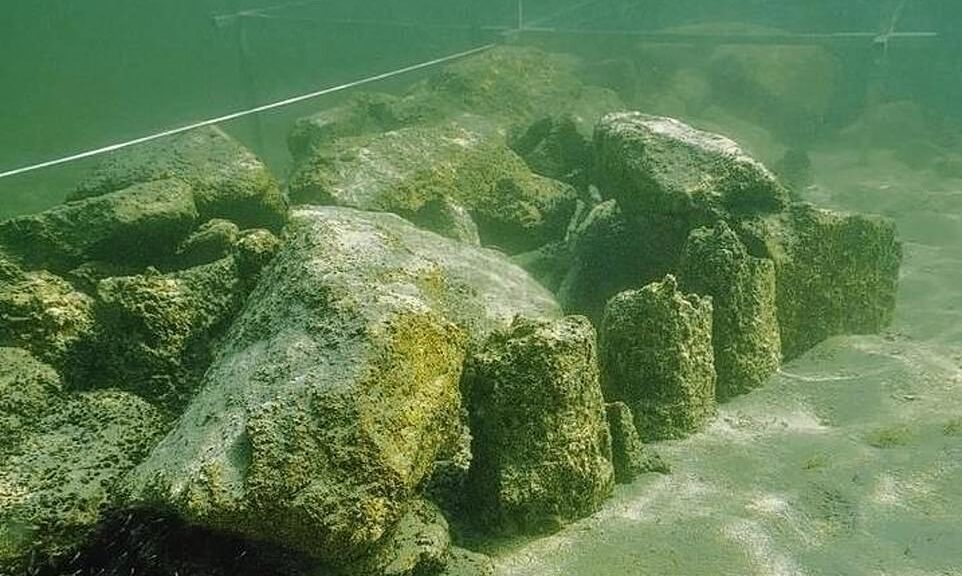
Archaeologists claim that a range of mysterious man-made stones submerged beneath the surface of a European lake is 5,000 years old. Local media reports that the so-called ‘Swiss Stonehenge’ sits 15feet down at the bottom of Lake Constance and is a Neolithic relic, with stones ranging in size up to around 100 inches wide.
The man-made piles of stones were found on the Swiss side of the lake, a 207-square-mile body of water on the borders of Switzerland, Germany and Austria.
Each stone was located at regular intervals running completely parallel to the Swiss shoreline. A spokesman at the Archaeology Office of the Swiss Canton of Thurgau described the findings as ‘sensational’ after carrying out excavations of the lake bed.
Archaeologists claim that a range of mysterious man-made stones submerged beneath the surface of an European lake are 5,000 years old (pictured)
A ship equipped with a digger with a 15-metre-long arm removed material alongside the stones to reveal them for study. Analysis of how they were placed shows they were put down by humans and not by nature, archaeologists claim.
Using underwater georadar developed by the Technical University of Darmstadt in Germany, the team of scientists managed to study the lake’s sediment and stone deposits in search of the origin and purpose of the formations.
The Archaeology Office wrote: ‘With high-frequency electromagnetic pulses, the hidden layer of the lake bed in the vicinity of the stone structures was recorded.’
‘It is obvious that the stones of up to 40 centimetres in size rest on the post-glacial, banded lake deposits and clearly above the underlying upper edge of the moraine [a glacially formed accumulation of unconsolidated glacial debris].
‘Thus, it is now scientifically proven that the cairns did not originate naturally from the glacier, but were piled up by human hands.’
The man-made piles of stones were found on the Swiss side of Lake Constance, a 207-square-mile lake on the borders of Switzerland, Germany and Austria and work is ongoing to learn more about them
The spokesman added: ‘The first results produced using carbon dating show that the stones in area 5 were placed there around 5,500 years ago in the Neolithic period.’
In the following months, further investigations will be carried out with the hope of discovering more about the artefacts, which will be analysed by an international team of researchers.
Initially, it was unclear whether the stones were natural formations from the remnants of a glacier which was located in the area 18,000 years ago. The researchers had originally suspected that the formations were from the Bronze Age dating back to around 1000 BC.
A piece of Poplar wood retrieved by the divers which may have been used as part of the construction or excavation of the rocks. Experts have confirmed these mysterious piles of stones – compared to an underwater Stonehenge – found at the bottom of Lake Constance are much older than previously thought
Currently, there are various theories about the purpose of the stones, such as that they served as weirs, burial mounds or signposted transportation routes.
Urs Leuzinger, a researcher on the project, estimates that at the time of construction, the cairns were located along the shoreline or even in shallow water.
He said: ‘I’ve never really experienced anything like this. Whenever we dig something up, we usually know what it’s all about.’
He said that his team ‘has no intention to compete with the original Stonehenge’, saying that the moniker had been ‘chosen by German media’ and not by archaeologists.
However, he said that there are some similarities with the Wiltshire monument as it required an equally impressive feat by prehistoric humans to transport such stones.
Dr Leuzinger said: ‘After all, our 170 cairns of 500 cubic metres of stones each does bring quite a decent amount to the shores of Lake Constance.’
The cairns were first discovered in 2015 by the Institute for Lake Research in the town of Langenargen in the south-western German state of Baden-Wuerttemberg.
It is thought they would have been near to a settlement of lake dwellings which are much deeper underwater perhaps close to what was once a prehistoric shoreline and are yet to be discovered, according to the Thurgau Office for Archaeology.
But they added: ‘It may also be the case that the lake dwellings have already eroded away due to the erosion over the years.’
Medieval tunnel discovered under the castle in Szczecin in Poland
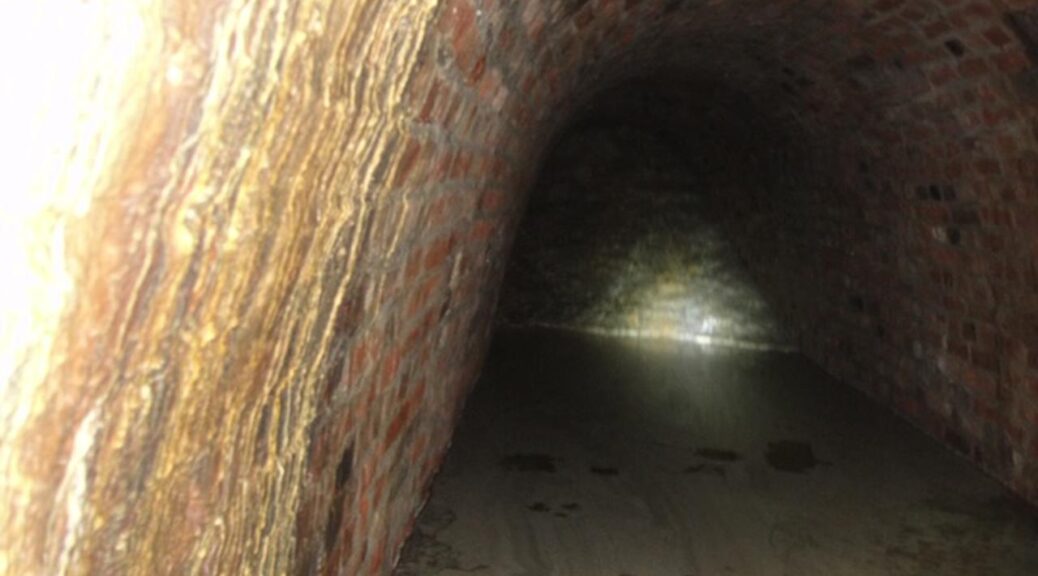
Archaeologists have uncovered over 270 meters of previously hidden tunnels beneath the Pomeranian Dukes’ Castle in Szczecin. They also warned that more detailed research was needed because they could collapse. Some of them come from the Middle Ages.
The management of the Pomeranian Dukes’ Castle informed about the discovery of tunnels that had not been known so far.
We have heard legends about the labyrinth of corridors under the castle, but there has never been evidence that they actually exist – informs Monika Adamowska, press spokeswoman for the Pomeranian Dukes’ Castle in Szczecin.
Pomeranian Dukes’ Castle
However, first, there was a construction disaster – one of the pillars collapsed in May 2017 and with it part of the vault of the northern wing of the Castle. The prosecution decided that soil erosion was probably to blame and the investigation was discontinued.
There was supposed to be a renovation, it was a disaster
The management of the castle, which for years has been wanting to renovate the northern terraces, on the occasion of this investment and taking into account the disaster, commissioned a series of construction and soil tests.
During this research, specialists from the Building Research Institute in Warsaw discovered a labyrinth of tunnels about 16 meters underground.
Under the escarpment and the northern wing, there is a branched network of corridors over 270 meters long – tells us, Adamowska. However, unfortunately, ITB employees also determined that the tunnels are not in good condition.
– This is a very serious situation. The tunnels are covered with rubble, which was used to strengthen the escarpment and created empty spaces, caverns, and rubble above them – continues Adamowska. Additionally, there is groundwater in this place.
This requires swift actions to reinforce the escarpment and a careful examination of the corridors and sheds new light on the recent disaster to which the underground structures may have contributed.
They did not expect tunnels from the Middle Ages
There are entrances to the tunnels probably from the north, which you have to dig. Unfortunately, specialists do not want to do it yet, because then the trees that grow on the part of the slope on which the castle stands could collapse on them.
On February 8, the municipal conservator of monuments gave permission to cut down the trees.
For now, cavers descended into the tunnels through a drilled vertical shaft. They took samples for testing and made photographic documentation. Then it turned out that the post-German corridors from World War II are connected with brick tunnels from the Middle Ages. This was a surprise for the scientists and management.
The findings were confirmed by tests of mortar and bricks samples carried out both in the castle’s Art Conservation Studio and in the Laboratory and Conservation Research Studio in Kraków.
The management of the castle emphasizes that it acts in accordance with the guidelines of specialists and is taking appropriate steps to secure the monument and at the same time investigate the new discovery. He also admits that it will extend the modernization of the terraces.
The Pomeranian Dukes’ Castle is one of the most important monuments in the region – the historic seat of the Griffin family, rulers of the Pomeranian Duchy. The first Slavic stronghold was built on the castle hill in the 12th century, but the modern building was built from the mid-14th century.
– The castle has revealed another secret to us, which may give us more information about the Griffin dynasty. I do not rule out that it may become an attraction for visitors in the distant future – comments Barbara Igielska, director of the Pomeranian Dukes’ Castle in Szczecin, on the discovery.