Category Archives: IRELAND

The Search for “Lost” Royal Graves in Britain and Ireland

The Search for “Lost” Royal Graves in Britain and Ireland

The graves of dozens of what may have been early British kings, queens, princes and princesses from the era of the mythical King Arthur have been revealed by a new study. It suggests that British royal graves dating from between the fifth and the seventh centuries A.D. have been overlooked until now, possibly because they weren’t elaborate and contained no valuable grave goods. 

The Search for “Lost” Royal Graves in Britain and Ireland
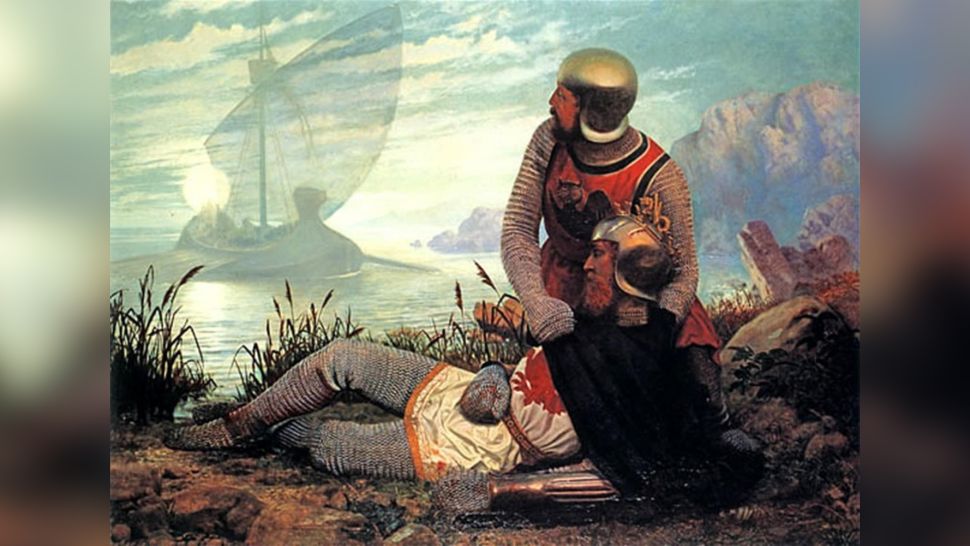
The new study identifies British Royal graves from the era of the mythical King Arthur. Several places in Britain are claimed to be the location of his burial, but according to some legends, Arthur was taken by a magical boat to the mystical Isle of Avalon after being mortally wounded in battle.

The research reconsiders archaeological evidence from a little-understood period of British history, between the end of Roman rule and the late Anglo-Saxon kingdoms — a time traditionally described by the legends of King Arthur.

The new study by Ken Dark, an emeritus professor of archaeology and history at the University of Reading in the United Kingdom, identifies what may be up to 65 graves of post-Roman British kings and their families at about 20 burial sites across the west of England and Wales, including the modern English counties of Somerset and Cornwall.

The British continued to rule in what is now the west of England, Wales, and parts of Scotland in the centuries after the end of Roman rule in Britain in the early fifth century, while the invading Anglo-Saxons settled in the east. 

But while Anglo-Saxon rulers of the time were given elaborate burials with valuable and ornate grave gifts, the Christian British may have viewed this as a pagan practice, Dark said. 

The study suggests the “lost” graves of the post-Roman British royalty are the enclosure graves found at several early Christian burial sites throughout the west of England and Wales.

Instead, the British seemed to have buried their royalty without grave goods in simple graves without stone inscriptions alongside the graves of common Christians – although many of the royal graves were enclosed by a rectangular ditch and probably surrounded by a fence that has since rotted away, he said.

Dark, who is now at the University of Navarra in Spain, is the author of the study published this month in the Journal of the Royal Society of Antiquaries of Ireland.

“The royal graves are very standardized,” he told Live Science. “They have some variation, just like the ordinary graves do — some are bigger, some are smaller, some have only one grave in the centre while others have two or three.”

Post-Roman Britain

Roman rule in Britain lasted from A.D. 43, following a Roman invasion under the emperor Claudius, until about A.D. 410, when the last Roman troops were recalled to Gaul (modern France) amid internal rebellions in the Roman Empire and invasions by Germanic tribes. (The Roman general Julius Caesar invaded southern Britain in 55 B.C. and 54 B.C., but he didn’t establish a permanent Roman rule.)

Between the fifth and seventh centuries, the Christian British ruled what are now western England and Wales as a patchwork of small kingdoms that tried to continue Christian Roman traditions. In the same period, pagan Germanic tribes — the Angles, Saxons and Jutes, who originated in the north of Europe — invaded and settled in the eastern parts of the country.

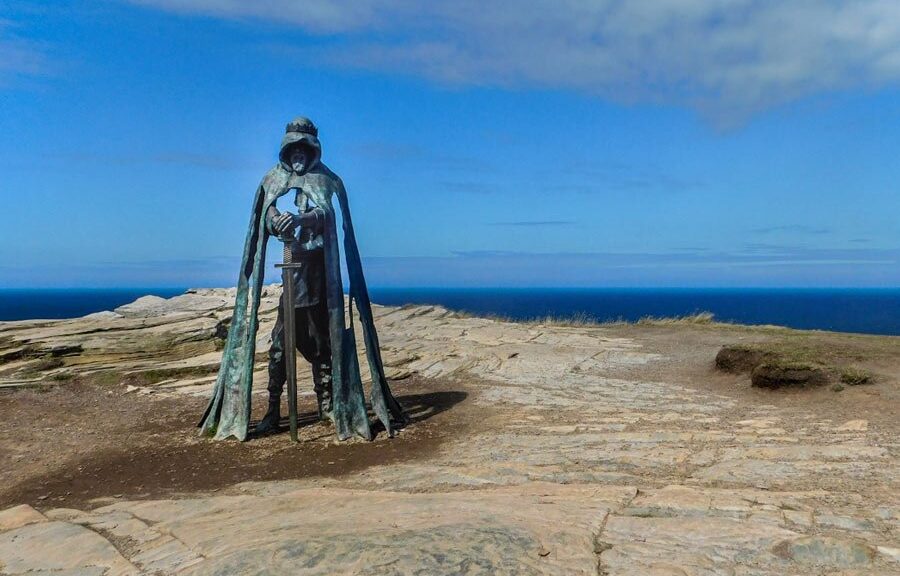
Graves thought to be of British kings, covered with mounds of earth, were also found at Tintagel on the coast of Cornwall – a site long associated with British royalty, and especially some legends of King Arthur.

The legends of King Arthur, who was supposedly British and Christian, are set in this period, although most historians think Arthur didn’t actually exist. (Dark, however, suggests that a real person or a fictional hero of that name was famous as early as the sixth century because Dark’s previous studies have suggested there was a sudden spike in the use of the name “Arthur” among British and Irish royal families at the time.)

Dark began his investigation to address a long-standing archaeological mystery: while many British kings were known to have lived during this time period, almost none of their graves had ever been found.

Until this study, the burial of only one British king from this era was known after being discovered in the northwest of Wales; an inscription on a gravestone name the person buried there as Catamanus (Cadfan in Welsh) and declares that he was a king (rex in Latin.) 

But Cadfan may have retired from the kingship to become a monk before his death, and the phrasing of the inscription implies his grave was being commemorated because of his status as a monk, Dark said. 

Meanwhile, the graves of at least nine Anglo-Saxon rulers from the period have been found, including one at the famous ship-burial at Sutton Hoo near the east coast of England.

Royal graves

To get to the bottom of the mystery, Dark reviewed the archaeological work previously done at thousands of burial sites from this period in the west of Britain and Ireland. His study suggests that the British royal graves were placed within early Christian cemeteries; and while they were marked out as those of high-status people, they seem very humble compared to ornate pagan graves and none have stones with inscriptions stating who was buried there. 

The outer enclosures vary in size and some contain up to four graves, but they are typically about 15 to 30 feet (4 to 9 meters) across and up to 30 feet (9 m) long.

“We’ve got a load of burials that are all the same, and a tiny minority of those burials are marked out as being of higher status than the others,” Dark said. “When there are no other possible candidates, that seems to me to be a pretty good argument for these being the ‘lost’ royal burials.”

At one site at Tintagel, a fortified peninsula on the coast of Cornwall that’s long been associated with post-Roman British royalty and legends of King Arthur, what are thought to be five British royal graves in an early Christian cemetery take another form. Each was covered by a mound of earth, possibly because Irish royal graves are also covered with mounds called “ferta,” he said. (The post-Roman British had strong links to Celtic Ireland; the ancient Irish and British were both of Celtic origin and had similar languages.)

But the pattern of placing the royal graves at the centre of an enclosure – usually rectangular, but sometimes circular – appears to be a burial style developed by Christians in late Roman Britain, he said. 

“The enclosed grave tradition comes straight out of late Roman burial practices,” he said. “And that’s a good reason why we have them in Britain, but not in Ireland — because Britain was part of the Roman empire, and Ireland wasn’t,” he said. 

Although previous studies had noted the enclosed graves were thought to hold people of high social status, rather than royals; and archaeologists were expecting royal burials to be covered by mounds of earth or marked with inscriptions on stone, he said. “But I’m suggesting that this burial practice was specifically royal.”
The Royal Burials of 65 Celtic Kings Identified in England and Wales

The Royal Burials of 65 Celtic Kings Identified in England and Wales

Roughly 60 newly-discovered royal graves in the north and west were of British or Irish Celtic origin, according to a new study. A number of English kings in the post-Roman era were of Irish origin, with several Celtic tombs uncovered in the west and north of Britain.

Artist’s depiction of the Celts.

Professor Ken Dark of the University of Reading and Spain’s University of Navarra, a leading expert on the period immediately after the collapse of Roman rule in Britain, has published a new report revealing the locations of between 55 and 65 Celtic-British royal graves from the dark ages. 

The newly-discovered graves are located in Wales, Cornwall, Devon, and Somerset and share several similarities with Irish royal tombs, according to Dark’s research. 

England consisted of a series of tiny states following the collapse of the Roman Empire in the 5th century, with Anglo-Saxons of Germanic origin dominating in the south and celts of British and Irish origin ruling in the north and west. 

The names of the kings buried in the newly-discovered graves are currently unknown, but Dark says that they are likely to have been kings, sub-kings, or other royals in the British kingdoms of Gwynedd (northwest Wales), Dyfed (southwest Wales), Powys (central east Wales), Brycheiniog (modern Breckonshire) and Dumnonia (now southwest England). 

The study of early Celtic graves in Britain remains in its infancy. Archaeologists only ever identified one definite indigenous British royal burial site, while the graves discovered by Dark represent just 0.1% of British-Celtic dark age burials.

The graves have square or rectangular ditched enclosures around them, while many appear to have entry gates or access causeways.

The enclosures, which measure up to 10 meters squared, often feature timber posts or a stone-lined pit. 

The graves had been gradually discovered over the years, but Dark is the first scholar to realize their probably royal status. 

Dark has also identified a further 43 sites as likely royal burial sites in Ireland. 

4,500-year-old Neolithic tomb collapses in South Dublin

4,500-year-old Neolithic tomb collapses in South Dublin

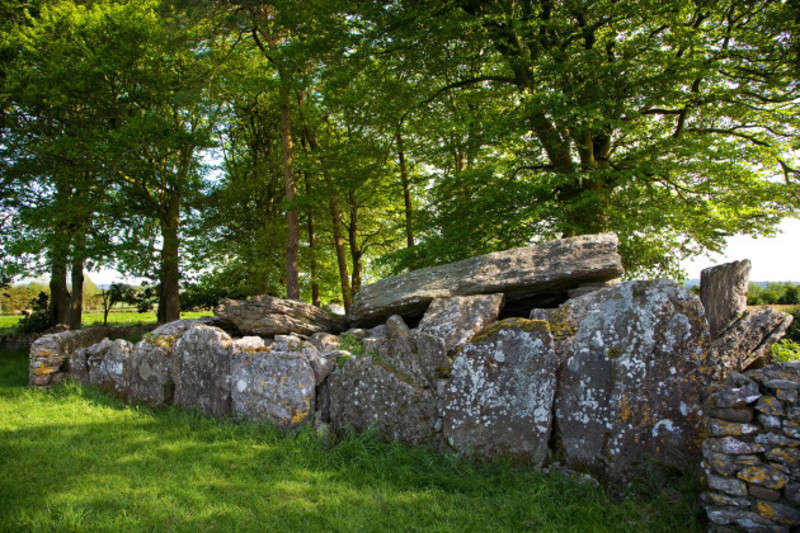
The tomb, which dates back to the Neolithic period before the start of the Bronze Age, appears to have collapsed in late 2021, with photos showing the capstone having fallen in. The tomb itself is located on farmland in Shankill and is known as the Carrickgollogan wedge tomb.

The Carrickgollogan Dolmen in Shankill Co Dublin

Andrew Bambrick, who runs a heritage conservation community, says that the capstone appears had fallen in between the two supporting stones and that it was sad to see it like this. 

“It’s sad, it’s been in the country for over 4,500 years and it’s collapsed,” said Bambrick.

Photos taken of the monument in early 2021 show it surrounded by fencing and overgrown with brambles. In more recent photos, there are fewer brambles surrounding the tomb, but the capstone has collapsed inwards.

Bambrick says that while wedge tombs have collapsed in the past, it is usually due to factors like tree roots displacing the tomb and over long periods of time, erosion.

Bambrick says that he has reported the collapse to the National Monument Service, but had yet to receive a response.

The tomb appears to have collapsed in late 2021

However, the Department of Heritage said that the National Monuments Service was made aware of the collapse and that they plan on investigating further.

“The National Monuments Service was recently made aware of an apparent collapse of a capstone at the monument and will be investigating the matter,” said a spokesperson for the Department.

The wedge tomb is included within the most recent Record of Protected Structures (RPS) published by Dun Laoghaire – Rathdown County Council. 

While there is awareness of large scale monuments, like Newgrange, Bambrick says that there needs to be more done to raise awareness of smaller, local heritage sites like the Carrickgollogan Dolmen.

He says greater awareness of these historical sites will lead to greater preservation efforts and called for local community groups to be set up to look after dolmens.

Bambrick said that while there were laws in place to protect historical sites like dolmens, there needed to be further efforts to investigate and enforce these protection laws.

He says that a separate organisation specifically to tackle monument vandalism needed to be set up by the Government.

The National Monuments Service is responsible for archaeological matters arising at larger monuments in the care of the State, as well as carrying out surveys on areas that may have historical monuments.

The body also provides advice to planning authorities on development proposals, like development plans, around the impacts they may have on historical sites.

Wedge tombs were the last tombs to be built during the Neolithic period, acting as burial grounds. All wedge tombs in the country are protected under the National Monument Service.

Similar tombs constructed during the Neolithic era include passage tombs, portal tombs and court tombs. These were constructed earlier in the Neolithic era, before wedge tombs became more common.

Well-known wedge tombs include the Labbacallee wedge tomb near Glanworth in Co Cork. It is noted as the largest in Ireland and dates back to 2300 BC.

4,500-year-old Neolithic tomb collapses in South Dublin
The Labbacallee wedge tomb near Glanworth in Cork

Neolithic cattle sites could change the understanding of what beef meant to the people of Ireland

Neolithic cattle sites could change the understanding of what beef meant to the people of Ireland

Neolithic cattle sites could change the understanding of what beef meant to the people of Ireland

An archaeological site in Dublin with an unusually large collection of cattle remains could potentially change the understanding of beef and cattle herding in Middle Neolithic Ireland and Europe.

Data collected from the N2 Kilshane excavation in north county Dublin near Finglas by researchers from the UCD School of Archaeology and Queen’s University Belfast suggests that the multipurpose use of cattle for milk, meat and as draft animals were far more complex in the later 4th millennium BC Atlantic Europe than previously thought.

The remains of at least 58 individual cattle were recovered from the ditches of an enclosure excavated at Kilshane dating back some 5,500 years, and the site is one of the few with large faunal assemblages to be unearthed in Ireland.

Cattle are widely recognised as having important economic, social, symbolic and religious roles in Neolithic communities in Europe, and it has long been assumed that cattle in Neolithic Ireland had similar important roles.

However the absence of large faunal assemblages like the one found at Kilshane has, to date, precluded direct comparison with the rest of Europe, where the special status of cattle was strongly expressed by feasting and commensality.

Dr Fabienne Pigiere, zooarchaeologist in the UCD School of Archaeology, who led the study stressed the unusual character of this osteological assemblage compared to feasting remains from other sites: “Unlike contemporary British or continental sites, the Kilshane assemblage is nearly fully composed of cattle remains.

Its analysis shows the importance of sharing meat during this special gathering event and also allows us to investigate the husbandry economy of the Neolithic communities who exploited cattle for milk and as working beasts for traction”.

The kill-off pattern found on the bones at Kilshane indicates that the bulk of the cattle killed was of an optimum age for meat production, at around two and a half years.

Another small group of individuals aged over three years were also slaughtered; likely having been kept for milk production or breeding stock, and to be used as draft animals.

The numerous females identified in the Kilshane assemblage also confirms the importance of milk production in the husbandry economy of Middle Neolithic Ireland.

Similar kill-off patterns, indicating a focus on milk and meat production, have been recorded at Neolithic and Bronze Age sites in the UK and North-Western Europe.

The unusual predominance of cattle, the lack of bones broken to collect marrow, and the high number of cattle killed at the optimum age for meat production suggest feasting practices, according to the paper’s findings published in the Journal of Archaeological Science: Reports.

“This cattle assemblage is providing key insights into prehistoric farming in Ireland, and Europe, right at the time that passage tombs are starting to be constructed. It’s giving us a real sense of the communities behind these monuments and how they supported themselves”, said Dr Jessica Smyth, Lecturer in the UCD School of Archaeology.

The discovery at Kilshane not only has implications for understanding how the economy of the communities of Neolithic Ireland functioned but the larger role that cattle husbandry played in their social, symbolic and religious activities.

This recent research carried out at Kilshane was undertaken as part of the IRC Laureate ‘Passage Tomb People’ project, building on earlier post-excavation analysis funded by Transport Infrastructure Ireland.

“We are delighted to see further research emanating from the exceptional faunal assemblage discovered on the N2 Kilshane excavation,” said Mary Deevy, Senior Archaeologist with Transport Infrastructure Ireland.

Incredible 5,500-year-old tomb discovery is ‘find of a lifetime

Incredible 5,500-year-old tomb discovery is ‘find of a lifetime’

It appears as if Meath is in the midst of a golden age of archaeological discovery after the unearthing of a 5,500-year-old megalithic passage tomb at Dowth Hall.

After last week’s incredible discovery of a previously uncharted henge site near Newgrange in Co Meath, another fascinating find nearby is shedding even more insight into ancient Ireland.

According to RTÉ News, a 5,500-year-old megalithic passage tomb has been revealed on the grounds of Dowth Hall, just down the road from the Newgrange monument. It is the most significant find of its type in Ireland in the past 50 years.

So far, two burial chambers have been discovered in what is the western section of the main passage tomb, buried by a massive stone cairn measuring 40 metres in diameter.

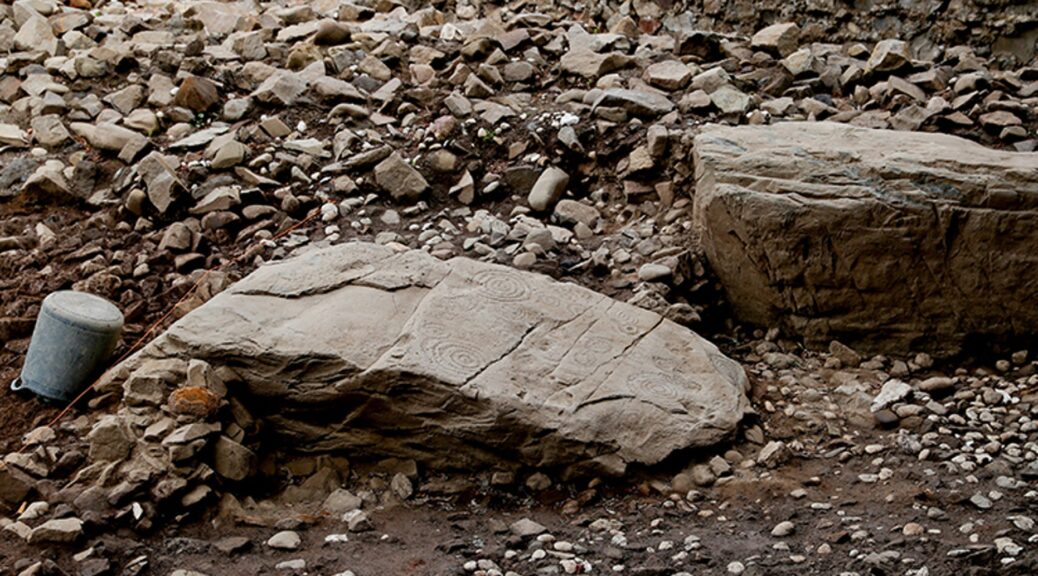
A series of six kerbstones have been found around the perimeter of the cairn, one of which is adorned with a number of well-preserved Neolithic carvings and drawings.

Incredible 5,500-year-old tomb discovery is 'find of a lifetime'
A kerbstone with elaborate carvings.

The discovery was made as part of a collaboration between the agritech firm Devenish and the University College Dublin School of Archaeology.

Speaking of its importance, Dr Clíodhna Ní Lionáin, who led the Devenish part of the dig, said: “For the archaeologists involved in this discovery, it is truly the find of a lifetime.”

Adding to this, Devenish’s executive chair Owen Brennan compared its decision to choose the site with those made by the tomb’s constructors thousands of years ago.

“From our archaeological research, it seems we made the same decision for the same reasons as a long line of our farming colleagues from the Neolithic, the Bronze Age, medieval and more recent times,” he said.

“The monuments here, created by some of Ireland’s first farmers, capture our imaginations and those of our visitors to the Devenish Lands of Dowth.”

The Brú na Bóinne World Heritage Site at the tomb’s location is now a real hotbed of archaeological activity, and with the recent henge discovery made after an intense heatwave, more major digs could be in the works in the region in the years ahead.

1,000-Year-Old Ink Pen Found in Ringfort is Ireland’s Oldest

1,000-Year-Old lnk Pen Found in Ringfort is Ireland’s Oldest

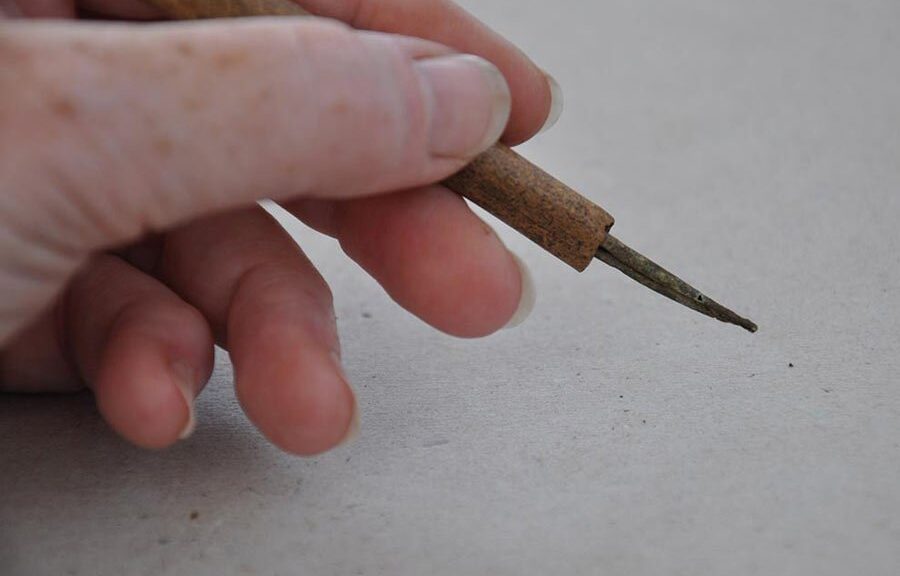
The British Isles’ oldest-known ink pen has been found during excavations of a Cashel, or stone fort, in County Clare. Archaeologist Michelle Comber of the National University of Ireland, Galway unearthed the 1,000-year-old writing implement from the Caherconnell Cashel.

Ireland’s oldest ink pen was discovered at the Caherconnell Cashel ringfort among many fine craftworking and metalwork tools.

This 140-foot-wide ringfort was built in the late 10th century and would have been home to wealthy — and, it seems, literate — local rulers until the early 1600s. Other artefacts from the site have shown that the occupants engaged in varied pursuits, from fine craftworking and metalwork to trade, games and music.

Most examples of early literacy in Ireland come from the Church, whose hardworking scribes painstakingly copied all manner of ecclesiastical texts. 

Most famous, perhaps, is the Book of Kells — a manuscript created in honour of Christ in 800 AD that is resplendent with elaborate calligraphy and illustrations. However, Dr Comber believes that the individual who used the Caherconnell pen likely did so in order to record more mundane things like family lineages and trades.

Dr Comber told MailOnline that the bone-and-metal Caherconnell pen is the earliest complete example of a composite pen from anywhere within the British Isles.

1,000-Year-Old lnk Pen Found in Ringfort is Ireland’s Oldest
Ireland’s oldest-known ink pen (pictured) — which sports a hollow bone barrel and copper-alloy nib — has been found during excavations of a Cashel, or stone fort, in County Clare

Earlier in British history, however, the Romans were known to use pens that were made entirely of a copper-alloy, rather than sporting a separate barrel and nib.

In England, several copper-alloy nibs have been found, albeit without the necessary barrel, dating from between the 13th and 16th centuries. On the flip side, a couple of hollow bone pen shafts have been recovered from the London area that data to the 13th–15th centuries. 

If, as suspected given their lack of splint point, these were originally used with attached nibs — much like the Caherconnell pen — such have been long lost.

According to Dr Comber, perhaps the most curious part of the discovery is the context from which it appears to have originated, namely in a secular, rather than religious, setting.

Perhaps the most curious part of the discovery of the pen (pictured) is the context from which it appears to have originated — namely in a secular, rather than religious, setting

‘The Caherconnell Archaeology project has been a hugely rewarding one, with many unexpected and exciting discoveries along the way,’ the archaeologist explained.

‘This find has, however, exceeded all expectations, revealing the tantalising prospect of an advanced secular literacy in 11th-century Ireland.’

The fact that most known evidence of early literacy in Ireland is associated instead with the Church — and no pen of this age or type had previously been found — led Dr Comber to seek confirmation that the artefact could, indeed, have functioned as a writing tool.

Accordingly, she teamed up with experimental archaeologist Adam Parsons of Blueaxe Reproductions to fabricate a replica of the historical implement. 

Dr Comber teamed up with experimental archaeologist Adam Parsons of Blueaxe Reproductions to fabricate a replica (pictured) of the historical implement — enabling the duo to demonstrate that the artefact would have worked perfectly as a dip pen

When put through its paces, the duo found that the modern duplicate does work — and its original counterpart would have worked — just perfectly as a dip pen.

Dip pens are those that have no ink reservoir as is characteristic of modern fountain pens and need to be returned to a well frequently to replenish their supply. This in itself set the Caherconnell pen apart, as the more common writing implement in the 11th century would have been the feather quill.

According to expert calligrapher and historian Tim O’Neill, the design of the Caherconnell pen would have lent it well for use on fine work — perhaps even the drawing of fine lines.

‘A metal pen from such an early date is still hard to credit,’ Mr O’Neill said.

‘But the fact that it functions with ink is there to see. It would have worked well for ruling straight lines — to form, for instance, a frame for a page.’ 

Human Remains Discovered Under 19th-Century Pub in Ireland

Human Remains Discovered Under 19th-Century Pub in Ireland

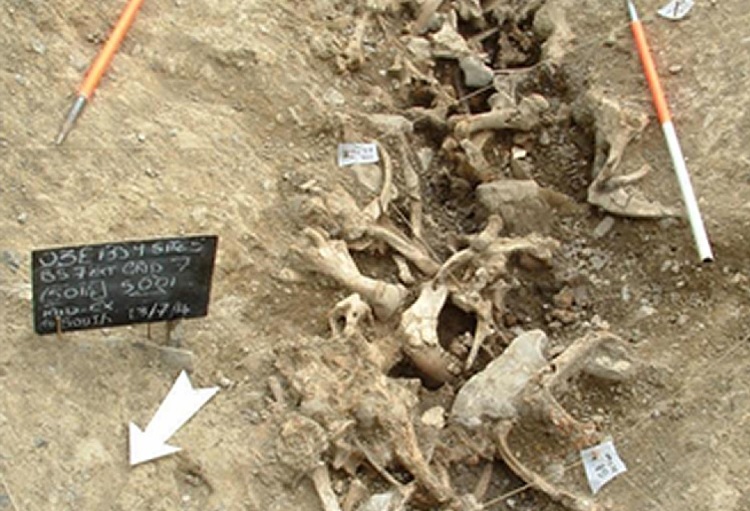
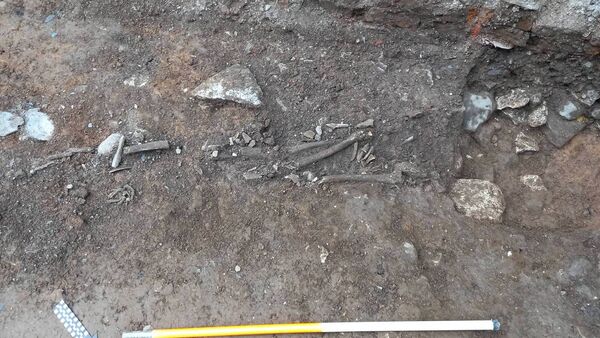
The first skeleton was unearthed almost two weeks ago and works have now uncovered the remains of six people, believed to predate the 19th-century building on the site. The skeletal remains of six people have now been found under a partially demolished pub near the medieval heart of Cork city.

Human Remains Discovered Under 19th-Century Pub in Ireland
The fragmentary remains of the first skeleton were discovered on the site.

Confirmation of the new discoveries on the site of the former Nancy Spain’s pub on Barrack St comes almost two weeks after the discovery of a partial human skeleton during groundworks on the site, which is being cleared for a Cork City Council social housing project.

City archaeologist Ciara Bret, confirmed an archaeological excavation, which has been ongoing since by a licensed archaeological consultant and an osteoarchaeologist, a human bones specialist, in consultation with her and the National Monument Service, has uncovered the remains of six individuals.

“The remains are fragmentary and predate the current 19th-century building on the site,” she said.

“Given that the site is still being archaeologically investigated, it is not possible at this time to definitively date the remains but they are likely to be 18th century or earlier.

“It is important to note that it is only through post-excavation analysis, which will include examination by the osteoarchaeologist and radiocarbon dating of the bones, that a complete understanding of the remains will be achieved.” 

The human remains are being fully recorded and will be removed by experts under an archaeological license issued under Section 26 of the National Monuments Act 2004.

Gardaí is on duty on the site of the former Nancy Spain’s pub on Barrack Street, Cork, where suspected human remains have been discovered.

Following the completion of the post-excavation analysis, the skeletal remains will be prepared for acquisition by the National Museum of Ireland or will be re-interred at “an appropriate location”.

Ms Brett said because the Barrack Street area forms part of the former suburbs of the medieval city, it is of important historical and archaeological significance, and all groundworks at the site were being archaeologically monitored.

The main contractor, MMD Construction, appointed archaeologist John Cronin and Associates to oversee the groundworks.

An archaeologist was present for the excavation of the ground floor slab but during the final stages of the excavation, there was what Ms Brett described as “a notable change in ground conditions” and it was decided that a hand exploration of the area would be required.

It was during this process that the first skeleton was uncovered.

Following a preliminary visual inspection of the remains in situ by the archaeologist and Garda scenes of crime experts, the bones were deemed a historic find and the Garda investigation was stood down.

The site was then handed back to the builders and the hand exploration continued, leading to the discovery of the other remains nearby.

Nancy Spain’s was once one of Cork’s best-known music venues. Singer-songwriter David Gray played his first Cork gig there in 1992.

The city council plans to build 32 apartments on the site.

‘Extraordinary’ 800-year-old chain mail found in Co Longford

‘Extraordinary’ 800-year-old chain mail found in Co Longford

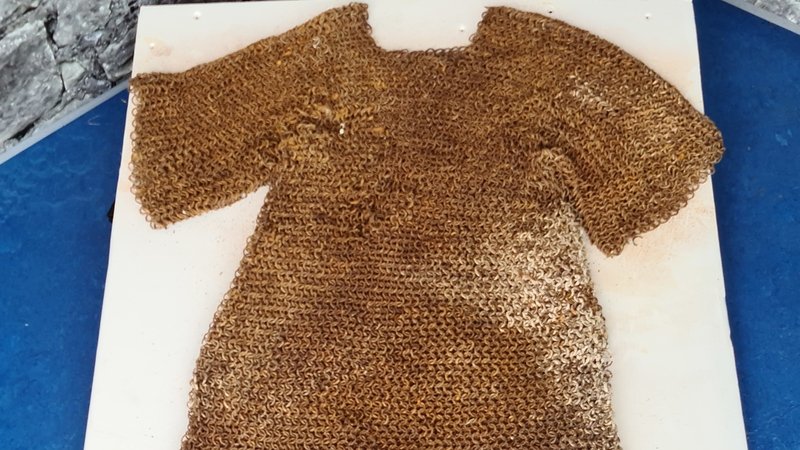
In 1169 AD, Norman invaders arrived in County Wexford, Ireland. Now, a rare and complete, 800-year-old Norman “hauberk” (chainmail vest) has been discovered in County Longford thought to date to when the Normans arrived there in 1172.

The “hauberk” was a coat of upper body armour that was often referred to as a “byrnie.” Made of chain mail, the wearable metal material was much more flexible and lightweight compared with the stiffer and heavier plate armour.

It was an almost perfectly preserved hauberk that was recently discovered in a shed at an undisclosed location in Ireland. According to a report in RTE the ancient armour is currently being held by the local tourist attraction, “ Granard Knights & Conquests,” prior to being exhibited to the public at the National Museum of Ireland.

‘Extraordinary’ 800-year-old chain mail found in Co Longford
The chainmail vest or hauberk at the Granard Knights & Conquests Heritage Center, Longford.

A Real Ancient Treasure For Heritage Week

The piece of rare, and almost complete, ancient Norman armour, that is soaked with the history of 800 years, was recently found rusting in a garden shed.

The discoverer only realized what he had in his shed after attending a ‘Norman People’ event at Granard Knights & Conquests, as part of National Heritage Week. When the finder went home and recognized the item in his shed was virtually the same as those worn by the actors earlier they came forward and informed Irish antiquary authorities.

Tourism and Education Officer for Granard Knights & Conquests, Deirdre Orme, told RTE that the hauberk is an “absolutely amazing discovery.” Furthermore, General Manager of Granard Knights & Conquests, Mr Bartle D’Arcy, explained that while the artefact was not discovered in Granard, or at Granard Motte, it was dug up from a drain nearby. Now, the National Museum of Ireland has announced that their restorers will preserve the rare piece of Norman armour.

A modern replica of Norman chainmail armour.

An Origin Story As Grand As The Discovery, Perhaps?

Deirdre Orme of Granard Knights & Conquests said the team were “completely blown away” when the finder presented their team of history lovers with the 800-year-old hauberk. The reason for her excitement was because the whole scenario “completely links into what we’re doing here at the centre – tapping into our Norman history and heritage.”

The hauberk dates back to approximately 1172 AD when the Normans first arrived in Ireland. This is why the archaeologists at the National Museum of Ireland are associating the discovery with the story of Richard De Tuite, Lord Chief Justice of Ireland, who in 1199 AD built a timber-frame castle and motte.

Whether or not the armour was indeed linked with the story of Richard De Tuite, or not, Mr D’Arcy said that for the finder to have discovered the almost whole, original Norman hauberk. “is just beyond belief.” And the Norman culture specialist added that the whole discovery was amplified because it coincides with Heritage Week.

Apart from rust, the armour is almost flawless.

Changing The Face Of Ireland Forever

The history of Ireland is greatly composed of stories of ancient invasions. The native Fir Bolg were defeated by the Tuatha De Dannan and they themselves were banished to the mounds to exist only as faeries.

However, none of the mythological invasions was so near-genocidal as were the real-life Norman invasions. For while several waves of giants and semi-divine armies have attacked Ireland in ancient legends, none of them aimed to eradicate Irish culture so much as did the Normans, backed by forces of Rome. 

According to the New World Encyclopedia, the Norman invasion of Ireland led to “the eventual entry of the Lordship of Ireland into the Angevin Empire.” This meant the Normans had the blessing of the Pope, which was a way to punish the island’s Christianity that had failed to conform to Rome’s strict rules of worship.

The immediate consequences were the end of the ancient linage of Irish High Kings and all of the timeworn ways of living and dying, and the onset of English rule in Ireland, which continued until 1922.

The Norman hauberk is an artefact from the first days of these cataclysmic changes that would entirely change the destiny of the Emerald Isle.