Category Archives: WORLD

Eroding World War II-Era Graffiti in England Recorded

Eroding World War II-Era Graffiti in England Recorded

Researchers have discovered the identities of over 30 United States soldiers graffitiing a wall 75 years ago during World War Two.

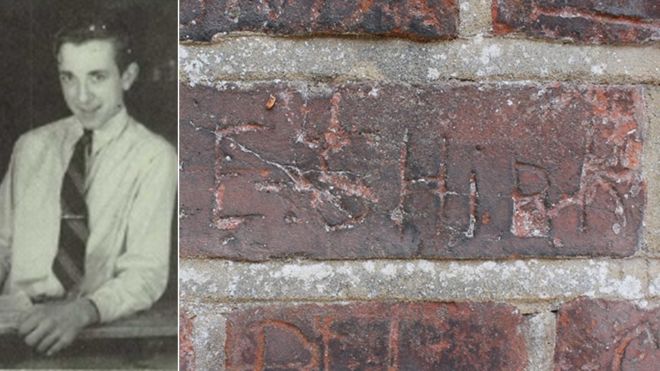
On the Western Esplanade in Southampton the 62 ft (19 m) ‘ D-Day Wall ‘ has more than 70 names grafted by soldiers who are waiting for the day D to embark on Normandy.

The naval archeology Trust has documented their war records and lives back in the US. Many took part in the Battle of the Bulge from the end of 1944.

The trust began a project to digitally record the wall after historians warned the names were in danger of wearing away.

The wall enclosed the old town mortuary and soldiers queued alongside it as they waited to board ships at what is the current-day Red Funnel ferry dock.

Volunteers used specialist photography to decipher the names before using online genealogy sources and US military records to identify the soldiers and learn more about their stories.

The soldiers are believed to have belonged to the 99th and 106th Infantry Divisions and were among the two million Americans who transited through Southampton to mainland Europe.

One of the soldiers identified, Glenn Bunker, served with the 88th Engineers Heavy Pontoon Battalion

Many fought in the Battle of the Bulge from December 1944 – the last major German offensive faced by the allies as they fought their way towards Berlin.

Helen Wallbridge from the trust said finding the military record of Curt Hodges from Chicago proved a “breakthrough”, as it allowed the names of fellow members of his unit to be confirmed.

“Looking at the spacing of the inscriptions, it seems plausible that the men stood in a line and carved their names together.”

“It’s detective work and a jigsaw so it’s great when you get the pieces to fit and you get a name,” she added.

The researchers traced the name William Paul Urban and found he came from Chicago and reached the rank of sergeant before he was killed in action aged 29 in March 1945.

Two of the men named – Robert Golden and William Knight – were found to have been captured and spent the remainder of the war as POWs.

An aerial view of Southampton taken in 1948 shows the wall close to the town’s docks
The name “WM Mueller New York” is among 100 etched on the wall by US servicemen

Among others who survived the war, William Mueller from New York went on to become an aeronautical engineer. Twenty-two-year-old Ralph Odom went to work in construction before his death in 2008.

The trust has attempted to contact family members of the veterans, providing them with an unexpected memorial to their departed loved ones.

The daughter of one said: “My gratitude and appreciation are emotions words can’t reach.”

The 19m (62ft) long wall is already a listed war memorial although the names are expected to erode further in the coming years.
Anglo-Saxon gold pendant found in Norfolk declared treasure

Student’s Lucky Find Worth £145,000 Is Rewriting Anglo-Saxon History

A student in Norfolk certainly never dreamed that he could rewrite Anglo Saxon history with a finding of a female skeleton wearing a pendant – but experts say that the “exquisite” gold piece is doing just that.

“A discovery of a female skeleton bearing a gold pendant imported from Sri Lanka with coins bearing the marks of a continental king is prompting a fundamental reassessment of the seats of power in Anglo Saxon England.”  Stated by the Telegraph.

The items are known as the Winfarthing Woman’s treasure An examination of grave objects, i.e. two inscribed coins, suggests that the grave’s owner was buried between 650 to 675 AD and was an elite member of society, possibly even royalty.

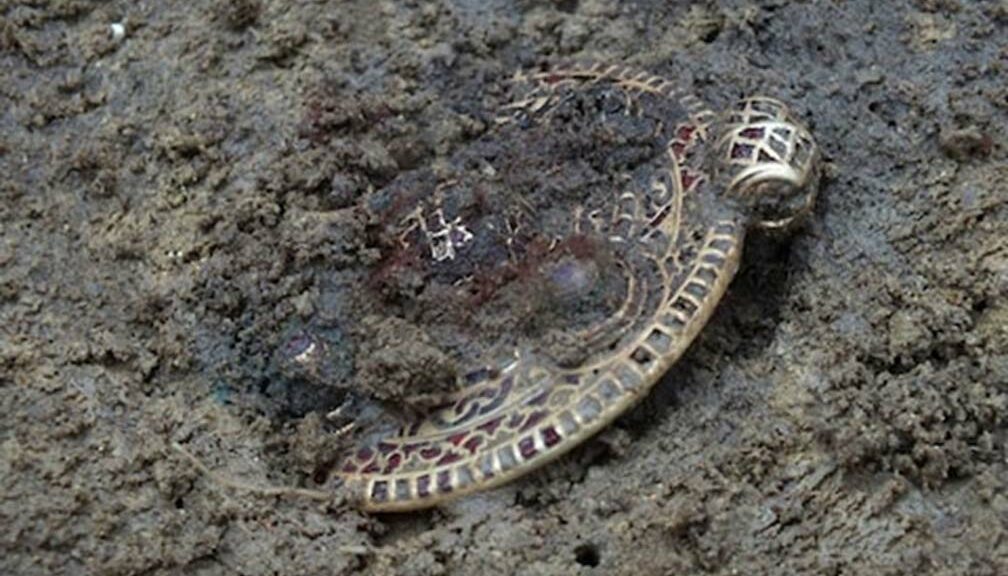
One of the large gold pendants found on the skeleton is inlaid with hundreds of tiny garnets. That artifact alone has been valued at £145,000 (almost $190,000).

A delicate gold filigree cross found in the burial suggests that the woman may have been one of the earliest Anglo Saxon converts to Christianity. Other items found in the grave included two identical Merovingian gold coins which had been made into pendants and two gold beads.

Senior Curator of the Norwich Castle Museum Dr. Tim Pestell said the craftsmanship of these objects is “equal” to the famous Staffordshire Hoard.

The Anglo-Saxon pendant found at the rich grave in Winfarthing, Norfolk.

In an amusing turn of events, the discovery was made at a site that has been overlooked by archaeologists over the years due to the poor soil.

But Thomas Lucking, who found the site in 2015 decided that the location was worth an examination. “We could hear this large signal.

We knew there was something large but couldn’t predict it would be like that,” he said, “When it came out the atmosphere changed.”

The Guardian reports the first artifact unearthed was a bronze bowl placed at the feet of the skeleton when the human remains were noted Lucking paused the dig to call the county archaeology unit in.

Excavating the Anglo-Saxon grave in Winfarthing, Norfolk.

Work continues at the site first identified by Lucking as it has been identified as a cemetery, possibly with a settlement located nearby as well. Mr. Lucking now works as a full-time archaeologist.

Two other interesting discoveries described at the launch of the Portable Antiquities Scheme and Treasure annual reports at the British Museum include two Bronze Age hoards and a Roman coin collection.

One of the Bronze Age hoards consisted of 158 axes and ingots while the other consisted of 27 axes and ingots. Both were found in Driffield, East Yorkshire, and date to around 950-850 BC.

The Roman coins numbered more than 2,000 and were discovered inside a pottery vessel in Piddletrenthide, Dorset.

Some of the artifacts found in the Driffield hoard.

Unusual Greek Baby Burial Unearthed in Sicily

Unusual Greek Baby Burial Unearthed in Sicily

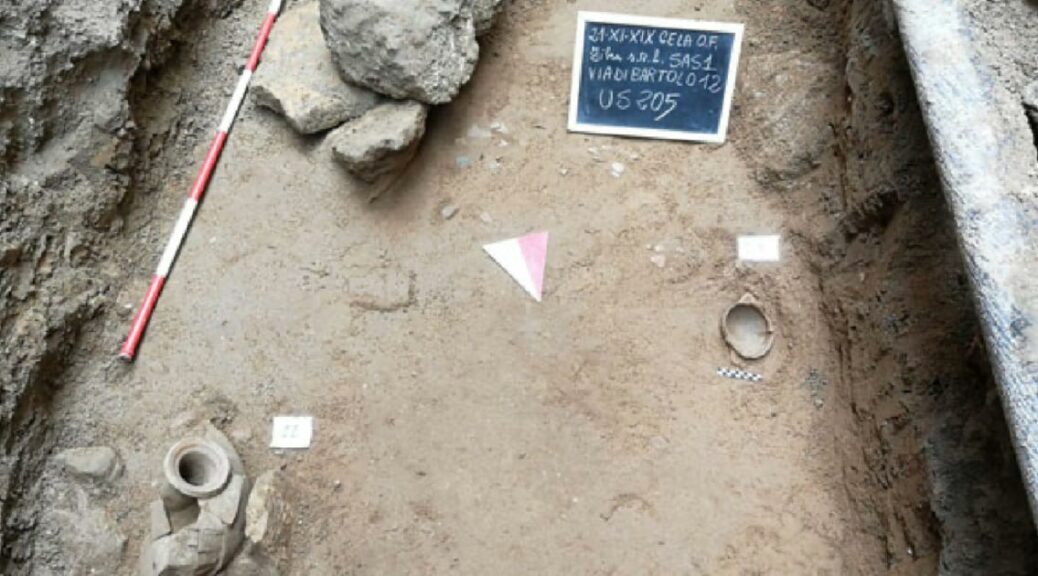
In the Sicilian town of Gela, workers who installed cables under a road have uncovered part of the ancient Greek burial.

This month’s people in Gela, Sicily, in Via Di Bartolo, expected road work disruption because of workers installing street-side fiber optic cables.

But instead, they ended up getting an archeological dig outside their front gate after an old necropolis dating back to the 7th century BC was found by the Open Fiber cabling company

Example of an (ornate) 4 th century BC Greek hydria.

The ceramic water jug containing bones of a newborn child and parts of a large animal skeleton according to local authorities has so far been found along the small  strip of the road.

The finds were reportedly made by Open Fiber’s in-house archaeologist, Gianluca Calà, who had been on call during the installation work in case of such discoveries, which are not that unusual in Sicily.

Screenshot: Google Maps

A sarcophagus containing an intact skeleton thought to be from the same period was discovered earlier this month in Gela.”

Two weeks after the last important discovery, in what is certainly a Greek necropolis, Gela gives us other extraordinary testimonies of the past” the Sicilian regional government stated in a press release.

The area where the discoveries were made is believed to be part of a necropolis first excavated at the beginning of the twentieth century by Paolo Orsi, according to the La Sicilia newspaper.

“Once again Gela is confirmed to be a part of Sicily that can tell us an important part of our ancient history.

Two important archaeological finds, a short distance from each other, show that great attention is paid to the Gela area, which I believe to be a precious treasure chest,” said local

Open Fiber said it would be willing to enlarge the excavation area to help historians and archaeologists uncover more ancient finds in Gela, La Sicilia wrote.

Gela is believed to be the site of one of the earliest settlements of Greeks, from Rhodes and Crete.

“The newly-uncovered graves are seen as particularly important by historians,” the Sicilian regional government stated, “as they’re thought to hold the remains of the first settlers along with examples of the fine ceramics they brought with them.”

Over 130 Roman Inscriptions Uncovered At Ancient Site Of Mustis In Northern Tunisia

Over 130 Roman Inscriptions Uncovered At Ancient Site Of Mustis In Northern Tunisia

Inscriptions have played a very important role in deciphering the secrets of the past. Archaeologists have uncovered over 130 inscriptions at an important ancient site in Tunisia.

Experts discovered a series of inscriptions at the abandoned city of Mustis. They are expected to provide numerous insights into the history and development of this important ancient metropolis.

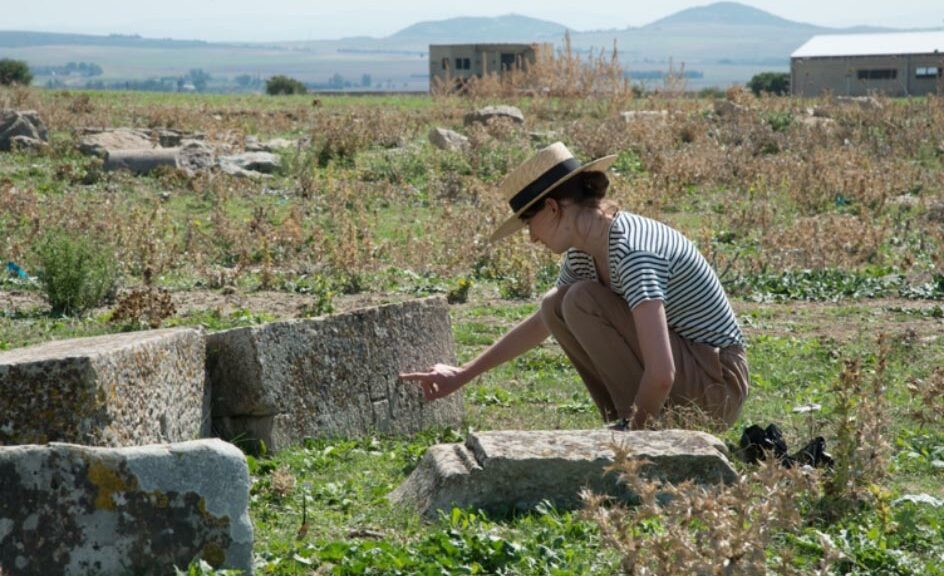
A team from the Warsaw University’s Centre of Mediterranean Archaeology, in cooperation with Tunisian National Heritage Institute, was surveying the ancient city of Mustis, near Thugga, Tunisia. A number of epigraphic experts were involved in the project.

The mission was led by Professor Tomasz Waliszewski and it finished its work, only recently. During the survey, they found a large number of inscriptions.

During their investigations of the ancient ruins, the team found over 100 inscriptions. They all date to the era when this area was part of the Roman province of Africa. Waliszewski stated that “Our epigraphic team has already inventoried over 130 Latin inscriptions from Roman times” reported The BBC.

The epigraphers found a large number of texts that had been engraved onto buildings and tombstones. Those found on buildings tell the story of Mustis’ development, including the construction of public buildings and temples.

The headstones provide the names of citizens and “other everyday matters of the bustling city’s inhabitants” according to The BBC . The inscriptions are important because they tell us what was important to the citizens and they are a treasure trove for historians.

Roman inscriptions found on headstones.

Moreover, the inscriptions are providing evidence with regard to the political history of the city. Mustis was “a municipium (a town with self-government bodies) at the time of Emperor Augustus” according to the Roman Art Lover. The inscriptions can tell researchers a great deal about the government and institutions of the metropolis. Roman Africa was renowned for its many cities and the texts can also tell us much about the process of urbanization in this part of the empire.

This is not the first time that inscriptions have been found in the area. Waliszewski, estimates “that there are over 500 Latin inscriptions in the Mustis area and nearby” reports The BBC. Some of these celebrate the achievements of emperors such as the North African Septimius Severus.

Mission leader Professor Tomasz Waliszewski points out one of the Roman inscriptions.

‘Mustis, or Musti, was first established by Numidians who had created a strong kingdom in the area. This realm was conquered by the Romans in the 2nd century BC after they defeated its king Jugurtha, and it was turned into a proconsular province.

Mustis was turned into a colony, by the conquerors. The famed general Marius “settled some of his veterans at Mustis which was redesigned according to usual Roman patterns” according to the Roman Art Lover.

The colony soon thrived because of its location on key trade routes and was probably a cosmopolitan society. Its economy was mainly dependent on agriculture.

Mustis, where the inscriptions were found, was an ancient Roman metropolis with rural suburbs.

Archaeologists have unearthed several temples, dedicated to Roman gods , such as Ceres, the Roman goddess of farming and cereals. Many villas have also been unearthed in the city that once belonged to the elite. An arch dedicated to the Roman emperor Gordian I was also built in the eastern entrance to Mustis and it can still be seen. Mustis went into decline in the 5th century as the Vandals, first raided and then conquered North Africa.

The Byzantines reconquered the city in the mid-6th century, but it never recovered its former glory. They turned the city into a small fortress, although the remains of a Christian basilica have been found in the ruins of the city.

It also appears that Mustis was a bishopric. The city declined after the Arab conquests and the “last excavated objects found in the city come from 12th century” suggesting that it was abandoned, sometime after that date, according to the BBC.

The ruined city was largely left intact down the centuries and it was re-discovered in the 19th century. In the 1960s many of the remains were restored, such as the Eastern Arch.

It is now part of an archaeological park but the remains in the area have been neglected for years. It is hoped that further research will be undertaken on the site and it is expected that more inscriptions will be found, revealing more about life in ancient Roman Africa.

Apart from the numerous Latin inscriptions, the excavations shed new life on the Roman urbanization of the region.

Roman-Era Sarcophagus With Skeleton Found In Turkey

Roman-Era Sarcophagus With Skeleton Found In Turkey

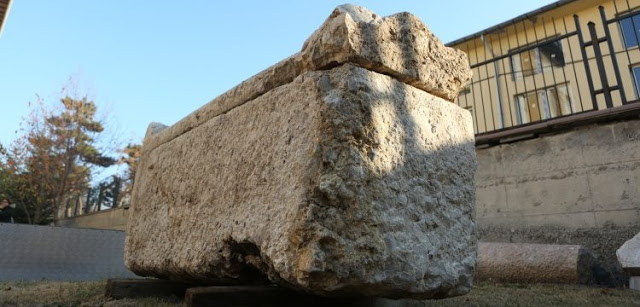
During road construction work in central Turkey a 2000-year-old sarcophagus containing a woman’s skeleton was discovered by a provincial official.

Municipality workers in Corum province found the sarcophagus located around 70 centimeters (27 inches) deep from the surface and informed the Corum Museum about the finding.

The sarcophagus placed some 70.0 centimeters deeper from the ground, was discovered by municipal workers in the central Anatolian province of Çorum, and informed the Çorum Museum about the find.

Together with the police, museum experts toured the scene and after a recovery search, the sarcophagus was moved to the museum.

The sarcophagus also included pieces of glass and a perfume bottle made of terracotta, along with the skeleton, which was sent to the Anthropology Department of Hitit University in Çorum for examination.

Sümeyra Şengül, the provincial head of the Culture and Tourism Office, told reporters that the 2.72-meter long sarcophagus belongs to the Roman era.

“When we opened the cover of the sarcophagus, we saw a female skeleton. It is estimated that it belonged to an old woman,” Sengul said, adding that there were also pieces of glass and a scent bottle.

“These remind us of burial gifts of the Roman era,” she said. Such a sarcophagus is rare in the region as it is made of local materials and possibly was made by “local stone masters,” she noted.

Stating that they earlier came across a soil grave in the region, Şengül added: “All these make us think that the region should be examined thoroughly, and we might come across some irregular burials from the Roman period.”

The Museum Directorate initiated efforts with the Culture and Tourism Ministry to preserve and examine the region in detail as a protected area.

Farmer accidentally discovers giant Byzantine-era pithos in central Turkey

Farmer accidentally discovers giant Byzantine-era pithos in central Turkey

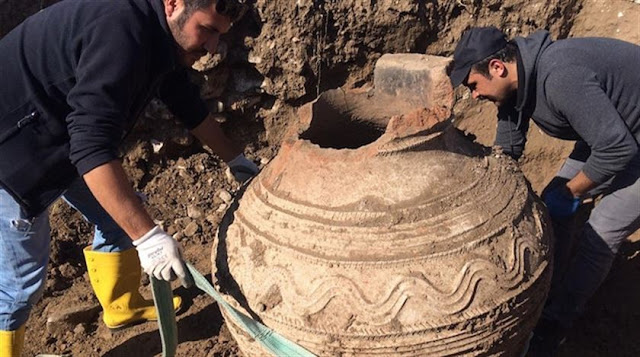
A giant ceramic jar from Byzantine times was found by the farmer who plowed his field in central Kırıkkale in Turkey.

After his tractor locked up in a pot, the farmer living in the village of Koçubaba in Balışeyh district found the jar.

He called the gendarmerie immediately to inform officials of the find.

After archeologists have been extracted, the jar, which was reportedly used to store food supplies, was brought to the Kırıkkale Culture and Tourism Directorate.

“It was used as a cellar in the Byzantine era,” Kırıkkale Culture and Tourism Director Aydın Demiröz told Anadolu Agency, adding that it will be exhibited in the directorate headquarters.

Archaeologists in Turkey, which has historically been home to many civilizations, are not the only ones to frequently find significant historical artifacts throughout the country.

Construction workers, farmers, and ordinary citizens come across invaluable ancient artifacts in all parts of the country.

Ancient Roman-era oil lamps found in southeast Turkey

Ancient Roman-era oil lamps found in southeast Turkey

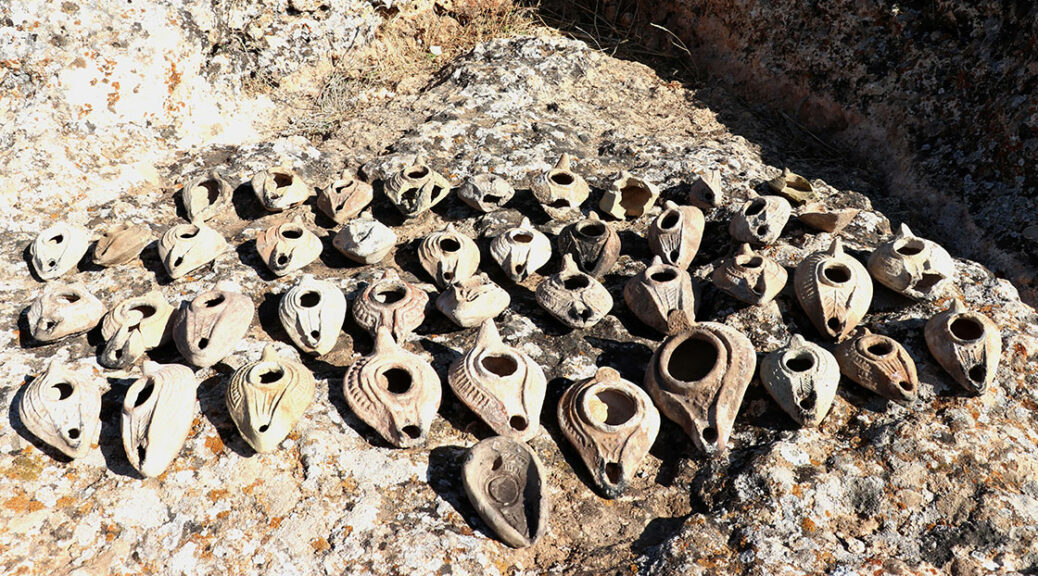
In southeastern Diyarbakir in Turkey, archeologists have discovered 48 old lamps from around 1,500 years ago.

During excavations at Castle Zerzevan in the district of Cinar, the lamps were uncovered.

Excavations are being performed by Aytac Coskun, Assistant Professor of Archaeology at Dicle University.

It was said that the lamps that would date from Late Roman. Early Byzantine period, would provide more information about the castle’s history.

Coskun said the place where the lamps were discovered could have been an ancient shop. “Each lamp has a different sign on it, including sun, stars or letters sometimes. They all have a different meaning,” Coskun said.

The lamps were unearthed near a 1,700-year-old Roman-era underground Mithras temple, which was discovered in 2017.

The castle is situated on a 55,200-square-meter area surrounded with walls stretching 12 to 15 meters high and 1,200 meters long, along with a 21-meter high watchtower and guard castle.

Excavations near the Demirolcek neighborhood, located 13 kilometers from the Cinar district, have been ongoing since 2014 with the help of Turkey’s Ministry of Culture and Tourism, the Diyarbakir Museum, the Diyarbakir governorship, the Cinar district governorship, and Dicle University.

The vast space also includes a church, administrative buildings, ruins of ancient homes, grain and weapon storage facilities, an underground temple, underground shelters, rock tombs, and water channels.

Previously, an underground church and shelter with a capacity to hold 400 people, houses and hidden passages were unearthed.

The Zerzevan Castle is situated along the ancient route of military premises and located on a 124-meter-high rocky hill in a strategic location between Amida and Dara.

The settlement overlooks the entire valley and once controlled a large area on a key, ancient trade path. Once a strategic Roman border garrison town, the castle also witnessed the clashes between Romans and Sassanians.

The first settlement was named “Samachi” and while it is not certain when it was built, the excavations are close to revealing its age.

The castle walls were repaired at the time of Byzantine Emperor Anastasios (AD 491-518) and Justinian (AD 527-565) while some parts were completely rebuilt.

The Ancient Remains of 5,000-Year-Old ‘Giants’ Discovered in China

The Ancient Remains of 5,000-Year-Old ‘Giants’ Discovered in China

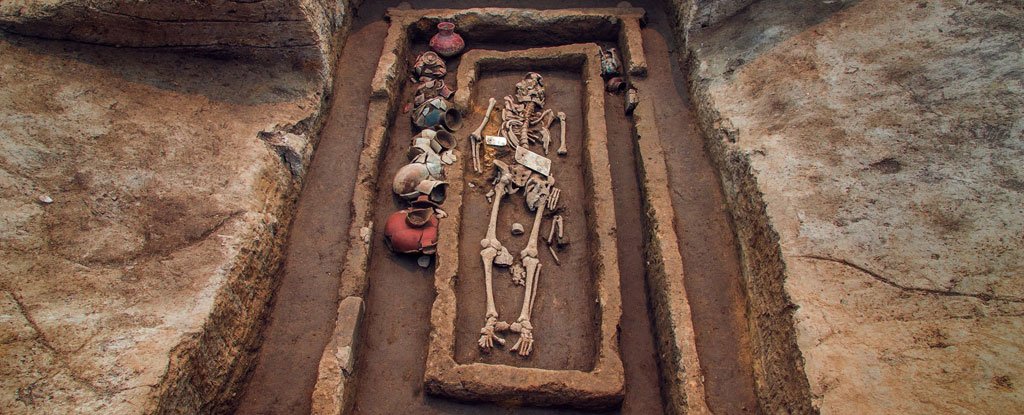
In China, archeologists discovered a 5,000-year-old graveyard where ‘ Giants ‘ were buried. Skeletal remains suggest that they were almost a foot taller than anybody else who lived at the time.

Mystery surrounds a recent excavation performed by Chinese archaeologists in eastern parts of the country as they have uncovered the remains of ‘Giants’ that lived in the area some 5000 years ago. Their bone structure shows they were unusually tall and strong report experts.

Archeologists found the remains of unusually ‘ tall ‘ and strong people in Eastern China according to the latest reports from the Chinese news agencies…

According to reports from the People’s Daily Online, the men discovered in the graves measured from around five foot 11 inches to six foot three inches which would have been considered extremely tall 5,000 years ago.

“This is just based on the bone structure. If he was a living person, his height would certainly exceed 1.9 meters,” said Fang Hui, head of Shandong University’s school of history and culture.

For twelve months have Chinese experts been excavating the remains of more than 100 houses, 200 graves and around 20 sacrificial pits located in the Jiaojia village in Zhangqiu District, Jinan City, the capital of Shandong? The ancient relics excavated by archaeologists belong to a late Neolithic Civilization located near the lower reaches of the Yellow River.

“Already agricultural at that time, people had diverse and rich food resources and thus their physique changed,” added Hui.

People in the area most likely lived off agriculture and raising pigs as remains of pig bones were found in some of the tombs.

Archaeologists believe that the skeletons of larger height belong to men of a higher status in the village. Their height is believed to have been related to their status since taller and stronger men could acquire better food, report the People’s Daily Online.

Furthermore, it is believed that people who inhabited the region around Shandong were among the tallest in China, something backed up by official statistics.

According to reports, in 2015, the average height of men 18 years old in Shandong averaged 5.75 feet compared to the national average of 5.64.

Curiously, Confucius, a native to the region was said to be about 1.9 meters tall, or 6.2 feet.

In addition to the unusually tall skeletons, experts also discovered that people in the region lived incredibly comfortable lives and their houses were exceptionally well built, with separate kitchens and bedrooms according to archaeologists. One of the archaeologists—Wang Fen, head of the Jiaojia excavation team—said that they also discovered remains of colorful pottery and jade artifacts as well as ruins of ditches and clay embankments.

Furthermore, experts believe the region was a political, economic and cultural center 5,000 years ago.

Archaeologists believe that people who inhabited the region around Shandong were among the tallest in China.

Wang Yongbo of the Shandong Provincial Institute of Archeology believes the Jiaojia ruins fill a cultural blank 4,500 to 5,000 years ago in the lower reaches of the Yellow River.

Among the graves, archaeologists found that some of the skeletons show clear signs of damage to the head and leg bones. The damage is believed to have been caused due to struggles related to power among high-ranking individuals.

Li Boqian, an archaeologist with Peking University said: “Excavations showed Jiaojia in a transition phase, but proved the existence of ancient states 5,000 years ago in the basin of lower Yellow River.”

Currently, experts are looking to expand the excavation site and more interesting discoveries are expected to be made. The archaeological area of the Jiaojia site has been enlarged from an initial 240,000 square meters to 1 sq km. currently, only 2,000 square meters have been excavated reports the People’s Daily Online.

“Further study and excavation of the site are of great value to our understanding of the origin of culture in east China,” said Zhou Xiaobo, deputy head of the Shandong provincial bureau of cultural heritage.