All posts by Archaeology World Team

Archaeologists Discovered An Ancient City Buried 30 Miles Outside Rome Without Ever Digging It Up

Archaeologists Discovered An Ancient City Buried 30 Miles Outside Rome Without Ever Digging It Up

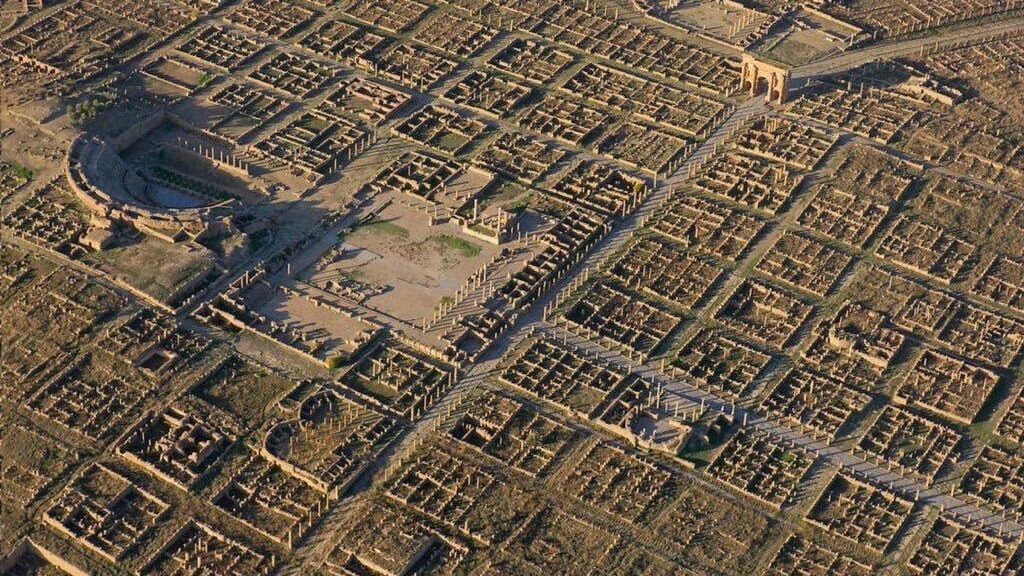
To figure out what they look like, archaeologists no longer have to excavate submerged villages. The entire ancient city of Falerii Novi, some 30 miles outside Rome, has recently been mapped by a group of Belgian and UK researchers, using radar technology that scans beneath the soil.

As the electromagnetic waves of a radar enter an underground structure, they bounce back as a measurement that can be used to produce a 3D image.

The researchers were able to recognise new buildings for the first time, such as an elegant bathhouse and a large public monument that had never been seen before. They were also able to determine how the city was organized compared to other Roman towns.

Though Falerii Novi wasn’t nearly as grand as Pompeii — a wealthy city buried under volcanic ash in 79 AD — the town had its own unique features. Its aqueduct, for instance, ran underneath its city blocks, as well as along the streets (the more common design for that time period). The researchers also found temples at the edge of the city, suggesting a sacred use of the land.

“Although we are yet to understand how this sacred landscape functioned, the survey provides new insights into the variety of planning concepts underlying what are sometimes incorrectly considered to be ‘standardized’ Roman town plans,” the researchers wrote. “By providing a contrast with more familiar towns such as Pompeii, this work also raises important questions about the planning of Roman towns more generally.”

Falerii Novi contained hidden shops, baths, and temples

Falerii Novi was built around 241 BCE. By the first century AD, it was one of around 2,000 cities in ancient Rome. Many of these towns were buried over time as the ground level steadily began to rise, or intentionally buried so Romans could build new settlements on top.

The city’s last human inhabitants left during the early medieval period in around 700 CE. The discoveries from the Belgian and UK researchers, published Tuesday in the scientific journal Antiquity, represent the first use of ground-penetrating radar to map an entire city below ground.

The researchers determined that Falerii Novi is about half the size of Pompeii: around 75 acres. Documenting each one of these acres took around eight hours, leaving them with more than 28 billion data points by the end of the survey.

While the team wasn’t able to analyze every single data point, they did outline the site’s major landmarks — shown on the map below. The map paints a picture of life more than 1,300 years ago, filled with theatre performances, shopping, worshipping, exercising, and bathing.

A massive public monument sits near the north gate, surrounded on three sides by a covered passageway with a central row of columns. The researchers estimated that the passageway is more than 550 feet long and opens out to the street. On the inside of the monument, a pair of structures (each with their own alcove) face toward one another.

“We know of no direct parallel to this structure,” the researchers wrote.

To the south-east are a market building and a public bathhouse. Both of these are new discoveries.

“While these buildings fall within the expected repertoire of a Roman city, some are architecturally sophisticated — more elaborate than would usually be expected in a small town,” the researchers wrote.

A temple directly south of the bathhouse straddles the edge of the city. To its west is a housing complex, consisting of two or three homes with atria. The researchers found evidence that the homes had been remodelled over time.

Some of the walls had been removed by stone robbers. The complex also includes a plunge bath, vaulted rooms with central heating, and a U-shaped area that likely served as an exercise room.

A second housing complex, located to the south at the foot of a slope, is lined with decorative passageways. Water pipes below this building connected to the town’s aqueduct.

These detailed discoveries, often obscured by rubble, were “previously only possible through excavation,” the researchers wrote. Their new survey method, they added, “has the potential to revolutionize archaeological studies of urban sites.”
A medieval victim still in his chainmail discovered in Sweden

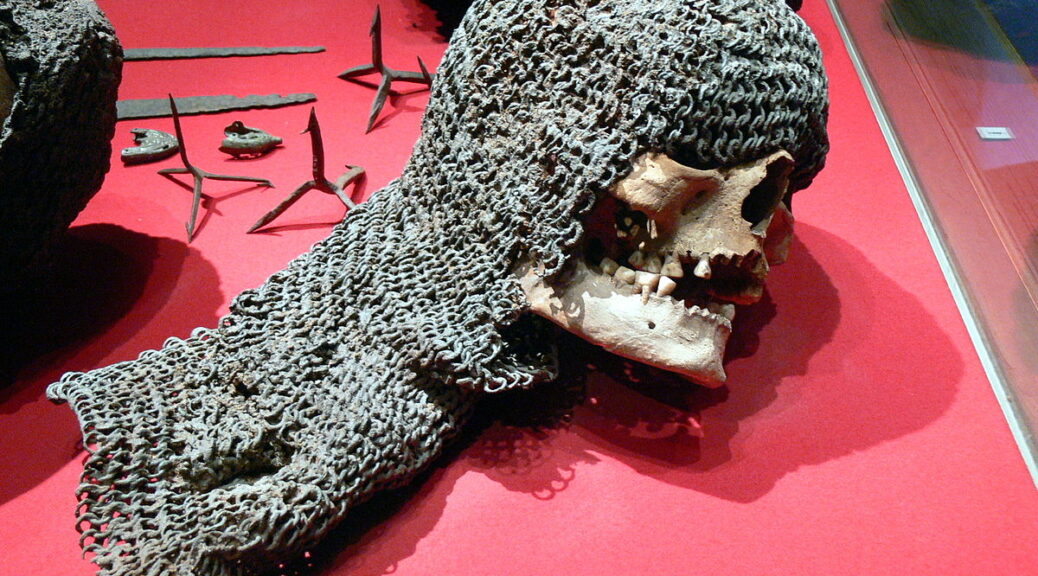
A medieval victim still in his chainmail discovered in Sweden

The Battle of Visby was a violent Medieval battle near the town of Visby on the Swedish island of Gotland, fought between the inhabitants of Gotland and the Danes, with the latter emerging victorious.

The battle left a lasting archaeological legacy; masses of slaughtered soldiers and citizens lay scattered across what was once a bloody battlefield.

Slashed and broken bones, skeletons still in their chain mail and armour, and smashed skulls, some still with spears and knives protruding out of them. One can only imagine what they endured before they breathed their last breaths.

Visby, A Merchant’s Dream

During the Middle Ages, the island of Gotland, which lies off the coast of Sweden in the Baltic Sea, played an important role in the trade between Europe and Russia. As a result of this, the city of Visby flourished.

Since the late 13th century, Visby was a member of a confederation of North-western and Central European merchant towns later known as the Hanseatic League. This league protected the commercial interests of its members and was also a defensive pact.

Greedy King Sets His Sight on Visby

As the Hanseatic League grew in influence, it was seen as a threat by some rulers. One of these was Valdemar IV, the King of Denmark. The Danish ruler is said to have not been satisfied with the fact that the Hanseatic League was a rival to his kingdom’s trade interests.

In addition, Valdemar desired to get his hands on the wealth of the League’s towns. By the middle of the 14th century, Visby, although still a member of the Hanseatic League, is said to have decreased in importance, causing Valdemar to set his eyes on it.

Additionally, it is rumoured that the inhabitants of the town sang drinking songs mocking the king, thus causing him to hold a personal vendetta against them.

Valdemar Atterdag holding Visby to ransom, 1361 by Karl Gustaf Hellqvist

The Danes Invade

In the summer of 1361, a Danish army set sail for Gotland. The inhabitants of Visby had been warned about the invading Danish force and prepared themselves for the battle. In late July 1361, Valdermar’s army landed on the west coast of Gotland.

The Danish army numbered between 2000 and 2500 men and consisted mainly of experienced Danish and German mercenaries. The defending Gotlanders, on the other hand, numbered around 2000 and were militiamen with little or no experience of battle.   

The Battle of Visby  

The Gotlanders first tried to halt the advance of the Danish army at Mästerby, in the central part of the island. The defenders were crushed, and the Danes continued their march towards Visby. The Battle of Visby was fought before the walls of the town.

Although the militiamen were fighting for their lives and fought as best as they could, they were simply no match for the professional Danish army. As a result, the majority of the defenders were killed, and the town surrendered to Valdemar.

Mass Graves and Fallen Soldiers

Those who fell during the battle were buried in several mass graves and were left in peace until the 20 th century. Between 1905 and 1928, the mass graves were discovered and subsequently excavated.

More than 1100 human remains were unearthed, and these provide us with much detail about the battle. As an example, the types of weapons used during the Battle of Visby could be determined based on the injuries left on these remains.

About 450 of these wounds, for instance, were inflicted by cutting weapons, such as swords and axes, whilst wounds inflicted by piercing weapons, such as spears, and arrows, numbered around 120.

By studying the bones, it was also found that at least a third of the defenders of Visby were the elderly, children, or the crippled, an indication that the situation was very dire indeed for townsfolk.

Victim of invasion of Visby in 1361.

It is assumed that the dead were buried quickly after the battle, and therefore were interred with the equipment they had during the battle, which included their armour and weapons.

Thanks to their excellent state of preservation, these remains are a unique archaeological find. Although not many of the defenders were well-equipped for the battle, there are several examples of chainmail shirts, coifs, gauntlets, and a variety of weapons.

These incredible remains, along with the human remains, are today displayed in the Gotland Museum and remain as a lasting legacy to the defenders of Visby.

Armored glove found at Visby. 

1,300-Year-old Hindu temple discovered in Northwest Pakistan

1,300-Year-old Hindu temple discovered in Northwest Pakistan

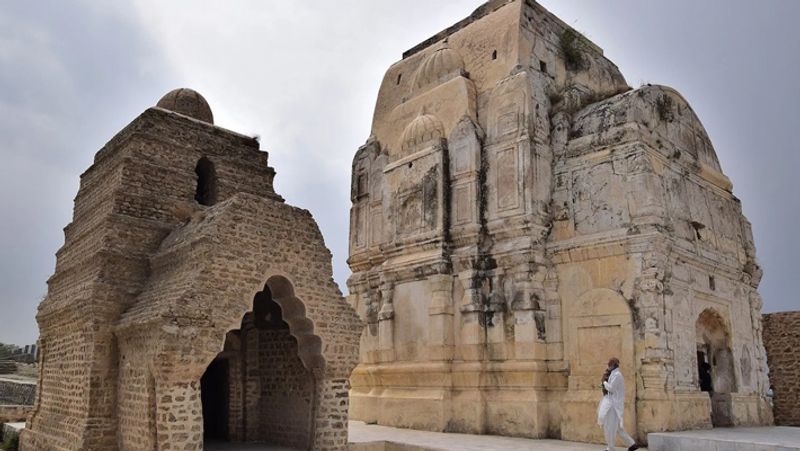
1300-year-old Hindu Temple of Lord Vishnu was discovered in Swat district of Pakistan. It is the first temple of Gandhara civilisation discovered in Swat district.

It has been discovered by Pakistani and Italian archaeological experts at a mountain in northwest Pakistan’s Swat district.

According to the reports, the archaeologist excavated a Hindu temple at Barikot Ghundai in Northwest Pakistan. Fazle Khaliq of Khyber Pakhtunkhwa Department of Archaeology said that the temple discovered is of God Vishnu.

The discovery was made during an excavation at Barikot Ghundai.(Italian Archaeological Mission to Pakistan )
Vishnu is one of the principal deities of Hinduism. He is the supreme being within Vaishnavism, one of the major traditions within contemporary Hinduism.

The temple is estimated to have been built the Hindus 1,300 years ago during the Hindu Shahi period, the archaeologist said.

The Hindu Shahis of Kabul Shahis, a Hindu dynasty which ruled the Kabul Valley (eastern Afghanistan), Gandhara (modern-day Pakistan), and present-day northwestern India from 850-1026 CE may have built the Hindu temple in the region.

During their excavation, the archaeologists also found traces of cantonment and watchtowers near the temple site.

The archaeologists have also found a water tank near the excavated site, which is believed to be used by the Hindus for bathing before offering their prayers at the temple.

Khaliq further added that Swat district is home to thousand-year-old archaeology sites and the traces of the Hindu Shahi period have been found for the first time in the area. Several Buddhist temples and worship places are also present in the Swat district.

Dr Luka, the head of the Italian archaeological mission, said this was the first temple of the Gandhara civilisation discovered in Swat district.

Only recently, newly discovered Buddha statue in Pakistan was ruined by Islamists

In July 2020, a newly discovered Buddha statue was smashed into pieces by local construction workers and a Muslim cleric on Saturday in Pakistan.

The relic was discovered while digging the foundation for a house in the Pashtun-dominated Khyber Pakhtunkhwa province’s Mardan district in Pakistan.

A video of the act showed the construction workers, along with a Muslim cleric, smashing the Buddha statue using a sledgehammer. They were seen walking over and destroying the life-sized Buddha status while expressing their acrimony against Buddhism, which they consider anti-Islam.

According to reports, the statue was destroyed on the order of a local Muslim cleric, who ruled that it is against Islam. ‘Your nikah would cease to exist and you will no more be a believer if the statue isn’t disposed of’, the cleric told the people at the site, who then followed his orders to destroy the priceless relic, which was accidentally discovered in a good condition.

In July 2020, in a similar incident, the ancient Buddhist rock carvings in the Chilas area of Pakistan-occupied-Kashmir (PoK)’s Gilgit-Baltistan was desecrated by Islamists, who painted Pakistani flag and slogans on the rock-cut art.

According to reports, the incident came to light when the locals of Gilgit-Baltistan posted images on social media platforms. The Islamists had vandalised the rock carvings by writing Islamic slogans on the rock-art that belonged to 800 AD.

Archaeologists uncover prehistoric graves and human remains in the East of England

Archaeologists uncover prehistoric graves and human remains in the East of England

The Ely Standard reports that two Bronze Age graves were found in the East of England during the archaeological investigation of land slated for construction. One of the graves held the remains of an elderly woman whose shoulder showed signs of arthritis and had lost most of her teeth. 

Orbit Homes secured planning authority to build 149 homes on land between Regal Lane/Blackberry Lane and the A142 in Soham in February 2019.

Before construction began, Orbit homes wanted to carry out expert archaeological work as part of the pre-development scheme, and an exploration of the area uncovered some interesting discoveries.

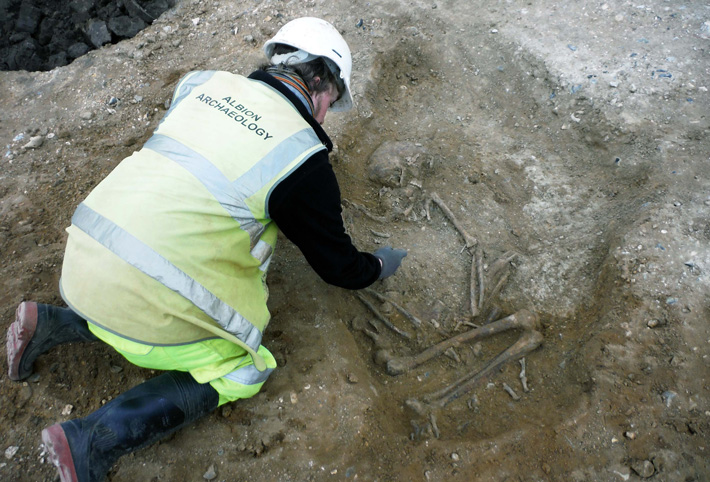
The excavation, undertaken by Albion Archaeology, included two human graves which contained the skeleton of an elderly woman who had arthritis in her shoulder and lost most of her teeth, while the other was a middle-aged man with a bad back.

David Ingham, project manager at Albion Archaeology, said: “Two human burials were found in graves and these are currently thought to be Bronze Age, but radiocarbon testing will confirm this.

Archaeologists uncover prehistoric graves and human remains at East Cambs building site
Prehistoric graves and human remains were uncovered by archaeologists on the Regal Lane/Blackberry Lane building site in Soham next to the A142 before construction work can take place. Here, the grave of a man from the Bronze Age is unearthed.

“No trace was found of an Iron Age houses, though the remains of two timber structures were identified, which could have been small granaries.”

The dig also uncovered pottery, animal and plant remain, as well as evidence of Roman ditches, with most Anglo-Saxon activity on the site was largely represented by a concentration of pits in the western half of the area.

However, Mr Ingham said there was no evidence of a Roman settlement within the site.

He said: “The identified remains may have formed part of a much wider landscape in which people and animals moved from pasture to pasture over relatively large distances.”

The first settlement on the field dates back to the Iron Age, but earlier signs of activity have been discovered which are thought to go back to as far as 2,500 BC.

Ian Fieldhouse, land and new business director for Orbit Homes in the East, added: “Around half of the six-hectare site has been excavated with further investigations taking place in December.

“Once all the data has been collated, we can continue with construction in March 2021.

“It has been a really interesting exercise; it was fascinating to learn that the findings date back to prehistoric times.”

Once building construction work begins on the homes, where 41 will be made affordable, show homes are then due to open in Autumn 2021.

Hoard of Jacobite Ammunition Unearthed in Scotland

Hoard of Jacobite Ammunition Unearthed in Scotland

The Oban Times reports that metal detectorists discovered a cache of more than 200 musket balls, coins, and gold and gilt buttons in southern Scotland on property near the shore of Loch nan Uamh that was owned by Alasdair MacMhaighstir Alasdair, Gaelic tutor to Charles Edward Stuart, also known as Bonnie Prince Charlie.

Hoard of Jacobite Ammunition Unearthed in Scotland
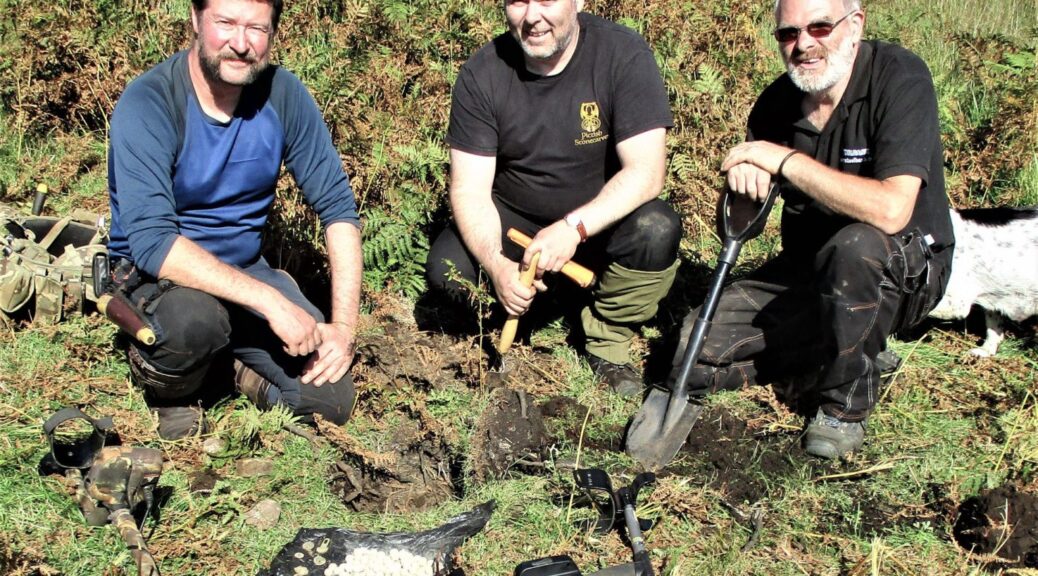
Paul Macdonald, Gary Burton and David McGovern made the discovery near Lochailort in September.

The items are thought to be part of a shipment landed just a fortnight after the Battle of Culloden in April 1746.

Paul Macdonald, David McGovern and Gary Burton were using metal detecting equipment – with the landowner’s permission – when they made the find recently on the shore of Loch nan Uamh, near Lochailort.

The historical items were uncovered near a ruined croft house that once belongs to the prince’s Gaelic tutor, and has now been reported to Treasure Trove in Scotland.

This is an official organisation which ensures objects of cultural significance from Scotland’s past are protected for the benefit of the nation and preserved in museums across the country.

Over 200 musket balls were among the finds.

Originally from Glenuig, Mr Macdonald, of the Conflicts of Interest battlefield archaeology group, said the find had been made in early September on the Rhu peninsula.

‘For around 250 years there, a hoard had lain undisturbed by one particular croft. The complete hoard included 215 musket balls and a number of gold and silver-gilt buttons, coins and some other non-ferrous items on the northern coast of Loch nan Uamh,’ said Mr Macdonald.

‘It was really just a case of joining the dots so to speak, from what history records. It is known that arms had been landed in 1746 in this area.

‘From what the finds tell us to date, the musket balls were cast for use, yet never fired and correspond with the same calibre of musket balls landed nearby with French arms for the Jacobite Rising by the ships Mars and Bellone on the 30th April 1746.

‘The arms were, of course, landed a couple of weeks after the Battle of Culloden and never saw service, but were rapidly distributed and hidden locally.

‘What we also know about the find-spot is that the now-ruined croft was once inhabited by the famous Clanranald bard, Alasdair MacMhaighstir Alasdair, who was an officer in the ’45 Rising and served as Gaelic tutor to Prince Charles Edward Stuart. He lived out his later years here at this croft until his death in 1770.

‘The find has been reported to Treasure Trove where it may through the process from there hopefully find its way to a Scottish museum.’

As to the value of the artefacts, Mr Macdonald said the find is significant but more in terms of historical worth than financial.

‘It is a very nice find and we were delighted with locating another part of the story of the prince and the Jacobite Rising.’

A 12-Year-Old Boy Found an Ancient Woolly Mammoth Tooth During a Vacation in Ohio

A 12-Year-Old Boy Found an Ancient Woolly Mammoth Tooth During a Vacation in Ohio

A 12-year-old boy visiting Ohio’s Amish Country may be one of the youngest archaeologists in history.

Last month, Jackson Hepner was living with his family at The Inn at Honey Run in Millersburg, Ohio, when he came across a rare relic of the ice age, a woolly mammoth tooth, Fox 8 reported.

“Hepner wrote on the hotel’s blog, where a relative is the hotel manager, “I noticed the tooth about ten yards upstream from the bridge that we had our family photographs on. “On the left side of the creek, it was partly buried. It was on the creek bed, entirely out of the water.

The discovery was verified by experts Nick Kardulias from the Archaeology Department of Wooster College, Dale Gnidovec from the Orton Geological Museum of the Ohio State University, and Nigel Ashland from the Geology Department of Ashland University.

They noted the tooth, an upper third molar, had parallel ridges, which are indicative of mammoths, whose diet required specialized teeth to grind their food, such as grass and seeds.

Between 110,000 and 12,000 years ago, woolly mammoths inhabited the area now called Ohio (though they ultimately died out in Siberia about 4,000 years ago).

According to Gnidovec, mammoths came over from Asia two million years ago, but skeletons older than 13,000 years are difficult to find due to “glacial advances” over the state.

A closeup view of the woolly mammoth tooth.

“During the Ice Age there were two kinds of ‘elephants’ living in Ohio — mammoths and mastodons,” Gnidovec told Newsweek.

Mastodons are much more common … [and] mammoths much rarer. That is because Ice Age Ohio had much more forested areas, which the mastodons lived in, that it did open grasslands preferred by the mammoths.”

The Inn seems to be thrilled with their involvement in this discovery and Ohio’s ancient history.

“What is now lush greenery, flowing waters, and hundreds of beautiful species was once an enormous glacial sheet that would slowly (and literally) shape Ohio’s future,” they wrote on their blog.

“The unearthing of the Mammoth tooth shows that there are definite pieces of ancient history hidden around us, connecting us to an interesting past.”

Now that his discovery has been legitimized, Hepner is eager to get his hand on his buried treasure once again.

“I would like to have my tooth back in my hands as soon as possible,” he wrote. “I want to show my friends.”

Jesus Painting Recently Discovered is a real Leonardo da Vinci drawing, Expert Says

Jesus Painting Recently Discovered is a real Leonardo da Vinci drawing, Expert Says

Italian scholars credit a recently found drawing of Jesus Christ to Leonardo da Vinci. Biblical figure’s red chalk drawing has been locked in a private collection for decades.

Art historians may have come upon the art world’s Holy Grail after discovering a new master’s work, by the Renaissance master, reports The Telegraph

Da Vinci, who died in 1519, is one of the world’s most influential artists, behind such works as the Mona Lisa and the painting of the Last Supper.

A newly discovered drawing is being attributed to Leonardo da Vinci by an Italian expert.

The newly discovered drawing depicts a calm Christ with a Mona Lisa-Esque gaze and bears a striking resemblance to other works by Leonardo.

It is now set to undergo rigorous scrutiny as the art world attempts to authenticate whether it is the real deal. The sketch had been hidden in a private collection locked away in a bank in Lombardy.

Lab tests have already found the paper dates back to the early 16th century and it bears a striking resemblance to other works by Leonardo.

Annalisa Di Maria, an Italian art historian who has studied the picture, said the pose, perspective, and style all appear to be that of the master.

She said: “It has that dynamism and sense of movement that is typical of Leonardo.

“The rendering of the beard is practically identical to Leonardo’s self-portraits, as are the eyes.

“And the painting is in red chalk, which the artist used a lot, including in the sketches for The Last Supper.”

Experts are due to present a 60-page study of the artwork at a press conference in Florence once Italy comes through its second wave of the coronavirus.

Ms. Di Maria added: “It is a remarkably beautiful and refined work and I’m absolutely convinced it is a sketch by Leonardo.”

The sketch is currently in the hands of a pair of collectors in the town of Lecco, northern Italy.

It is not clear where the artwork had been hiding over the centuries after it was discovered in the vault of the bank. Martin Kemp, a professor in the history of art at Oxford University, was cautious about the Italians’ attribution.

He has often had to bat away claims about Leonardo due to the intense popularity of Dan Brown’s book and movie The Da Vinci Code. The story claims the hidden secrets of Christianity – such as Jesus’s descendants and the Holy Grail – can be deciphered from Da Vinci’s work.

Mr. Kemp told The Telegraph: “I wouldn’t dismiss it out of hand but I simply can’t tell without seeing the drawing and the scientific evidence.

“I would need to see if it is drawn left-handed. Leonardo drew everything with his left hand.”

The dating of the paper needs to be independently verified. He also suggested it’s possible the sketch could have been produced by a pupil of Leonardo.

Prof Kemp said: “There is quite a crop of paintings of Christ and Salvator Mundi that were produced by followers of Leonardo,”

The painting of Jesus – the Salvator Mundi – was rediscovered in 2005 and became the most expensive painting ever sold, going for £340million.

However, it remains unclear exactly how much involvement he had in the work.

The expert said: “‘m not dismissing it but it has got a long way to go. It would be dangerous to write it off but even more dangerous to accept it at this point.”

Emerald Tablets Of Thoth, 50,000-Year-Old Tablets Reportedly From Atlantis

Emerald Tablets Of Thoth, 50,000-Year-Old Tablets Reportedly From Atlantis

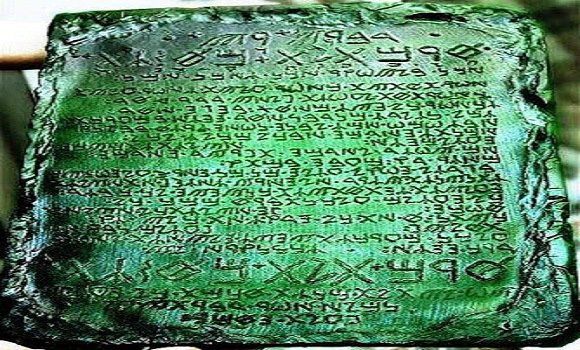
The Thoth Tablets are imperishable, resistant to all elements, acids, and corrosion. According to Bibliotecapleyades, in truth, the atomic and cellular structure is set and no change can take place, thus violating the material law of ionization.

Upon them are engraved characters in the Ancient Atlantean language;
characters who respond to the attuned thought waves of the reader and which release much more wisdom and information than the characters do when merely deciphered.

The Tablets are fastened together with hoops of a golden-colored alloy suspended from a rod of the same material. Dr. M. Doreal has translated this Work and has published through the Brotherhood of the White Temple, a translation of ten of these twelve Tablets.

He has divided the ten into thirteen parts for the sake of convenience. The last two Tablets are found in the “Interpretation of The Emerald Tablets”, also by Dr. Doreal.

THOTH, THE ATLANTEAN

When Thoth, the Atlantean and Master raised the people of Khem (Egypt) to a great civilization, and when the time came for him to leave Egypt, he erected The Great Pyramid over the entrance of the Great Halls of Amenti.

In the Pyramid, he posited his records and appointed Guards for his secrets from among the highest of his people. In later times, the descendants of these guards became the Pyramid Priests, while Thoth was deified as the God of Wisdom, the Recorder, by those in the age of darkness which followed his passing.

In legend, the Halls of Amenti became the underworld, the Halls of the Gods, where the soul passed after death for judgment.

During later ages, the ego of Thoth passed into the bodies of men
in the manner described in The Emerald Tablets, a Book of Record and Occult Wisdom, which he wrote and left in the Pyramid for those of a future Age of Light.

This is the first episode on the Emerald Tablets and its engravings by Lou Benedetto, written by Thoth, the Atlantean from the Lost city in Time of Atlantis. Thoth is an immortal who was once a very long time ago a regular human being who lived in a time over 50,000 years ago.

Second Video release of the Emerald Tablets by Lou Benedetto. Like all the Tablets they are written by an Atlantean King-Priest who ruled and lived in the Great Lost City in Time of Atlantis, over 50,000 years ago.

Thoth is a Human being that lived in a time long ago during an age now lost to us at present. Atlantis was a great civilization that thrived & flourished for many Tens of Thousands of Years.

Not only were they rulers of the sky and the land around them. But they were beings of peace, wisdom, and most importantly, a people with Great Soul Force.

Originally published in mimeographed form in the 1930s by a mysterious “Dr. M. Doreal,” these writings quickly became an underground sensation among esotericists of the time.

Tablets 1-13 are part of the original work; tablets 14 and 15 are supplemental. No one has ever seen the original tablets mentioned here, and in all likelihood, these writings would be considered channeled material today.

Dr. M. Doreal is a spiritual teacher of a multitude of seekers of light, having founded the metaphysical church and college. Doreal is the author of all of the organization’s writings and teachings and was granted permission for the esoteric wisdom to be remitted in the public forum, by the Great White Lodge and the Elder Brothers of mankind who shape and form the spiritual evolution for mankind.

Dr. M. Dorea

Doreal writes of the secrets of the symbolism of all mystery schools and gives a precisely and beautifully written step by step progression all seekers have searched for in their quest for oneness with God and attainment of the cosmic consciousness.

After traveling the world for knowledge of the light and truth, Doreal began publishing his findings in a spiritual retreat in Colorado named Shamballa.

Doreal studied the ancient teachings of the emerald tablets, the wisdom of the Kabbalah, and the light Jesus brought to mankind.

He has translated many ancient texts into English and other languages for the masses to read in order for all of us to reach atonement within ourselves and the cosmic universe. All his publications are available through the brotherhood of the white temple publication office.

However, the Emerald Tablets of Thoth the Atlantean are still part of the modern Corpus Hermeticum, for they elaborate and deepen the meaning of the historical Emerald Tablet and writings of Thoth/Hermes.