All posts by Archaeology World Team

Human Skulls Mounted on Stakes Found at 8,000-Year-Old Burial Archaeological Site in Sweden

Human Skulls Mounted on Stakes Found at 8,000-Year-Old Burial Archaeological Site in Sweden

In a mysterious underwater grave that has baffled archeologists, a group of 8,000 years old human skulls has been discovered, some of them embedded in stakes. One of the pierced skulls, found preserved in what was once a prehistoric lake in Sweden, was discovered with some of its brain tissue still intact.

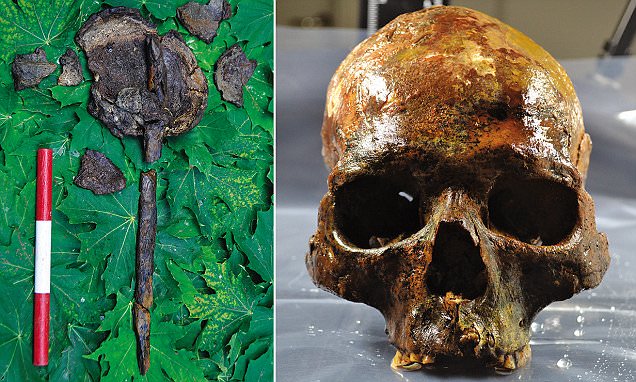
Two 8,000-year-old human skulls have been found embedded on stakes in a mysterious underwater grave that has baffled archaeologists. One of the pierced skulls(pictured) was discovered with some of its brain tissue still intact

This terrible discovery challenges our understanding of the culture of the European Stone Age, said, researchers. The reports from researchers in the University of Stockholm and the Swedish Foundation for Cultural Heritage (CHF) are the first evidence that hunter-gatherers from the Stone Age displayed heads on wooden spikes.

‘ We have here a very nuanced example of a very organized ritual ‘ CHF lead researcher Dr. Fredrik Hallgren told Live Science. Even though we can’t decipher the meaning of the ritual, we can still appreciate the complexity of it, of these prehistoric hunter-gatherers.

Uncovered at the Kanaljorden excavation site near Sweden’s Motala Ström river, the skulls were found alongside the remains of at least 12 individuals, including an infant.

Of the adults found, four were identified as male, and two as female. One of the men was in his fifties when he died, while two were younger, aged between 20 to 35. The infant skeleton is nearly complete, suggesting the child was either stillborn or died shortly after birth.

The finding is the first evidence that Stone Age hunter-gatherers displayed heads on wooden spikes. The gruesome discovery challenges our understanding of European Stone Age culture and how these early humans handled their dead, experts said

Seven of the adults likely died in agony and had suffered serious trauma to their head before they died, which researchers suggest were the result of non-lethal, violent blows. These may have been the result of interpersonal violence, forced abduction, warfare and aids of socially-sanctioned violence between group members.

The bodies were placed atop a densely packed layer of large stones in what would have been an elaborate underwater burial between 7,500 and 8,500 years ago.  Only one of the bodies still had a jawbone when it was buried, which experts suggest were removed as part of the burial ritual.

Interestingly, the group’s head injuries were gender-specific, with males found with marks near the top of the head, above the so-called hat brim line, while the females had cracks near the back and right side of their skulls.  Scientists said they don’t know what sort of weapon was used to inflict the damage, and that the wounds were serious but could not be tied to the cause of death.

Examples of blunt force trauma from analyzed individuals.

‘Though the lesions were not lethal, they must have affected the individuals – induced pain, bleeding, and a risk of secondary infections,’ study coauthor and Stockholm University archaeologist Dr. Anna Kjellström told Gizmodo.

‘Furthermore, even less severe head trauma may cause loss of consciousness, internal bleeding, or even permanent mental impairment.’

Three of the skulls, including two with stakes driven through them, showed evidence of sharp force trauma after death. The stakes were forced upwards through the foramen magnum, the large oval opening at the bottom of the skull and reached through the top of the head. They were likely used to mount the skulls before they were buried in the lake.

‘The fact that two crania were mounted suggests that they have been on display, in the lake or elsewhere,’ Dr. Kjellström said. Skulls whose jaws had been removed were chosen for the display.

‘Since we did not find any sharp trauma showing active attempts to separate the lower jaw from the skulls, this indicates that the individuals much likely were buried in another place before the depositions… One interpretation could be that this is an alternative funeral act.’

Experts uncovered 400 intact and fragmentary pieces of wooden stakes at the site, a number of which may have been used to mount objects that have since decayed.

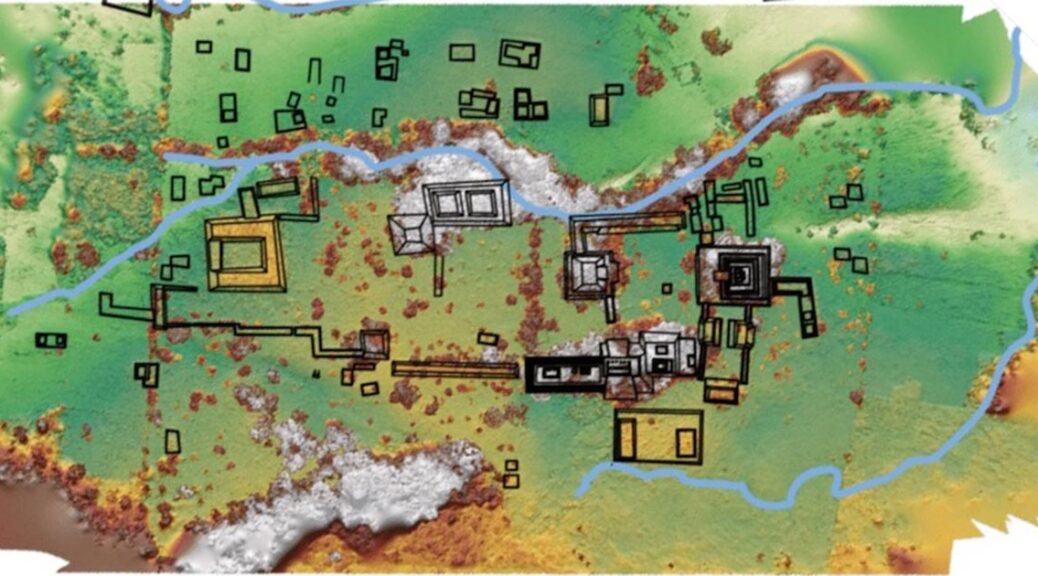
A map of the Kanaljorden site. The black outline shows the excavated area.

As well as human remains, the Stone Age site was littered with butchered animal bones, including several severed jaws, and tools carved from antler horns. Researchers say further research is needed to understand why the ancient group buried their dead in such an unusual fashion.

Stone Age hunter-gatherers are not known to remove body parts as part of burials, with many gravesites showing evidence of a respect for bodily integrity after death.

Only until later in history did groups begin to display heads on stakes, such as European colonists mounting skulls of murdered indigenous peoples. The Stone Age burial was likely a group of key tribe members that were removed from where they were initially displayed and placed in the lake, researchers said.

‘The people who were deposited like this in the lake, they weren’t average people, but probably people who, after they died, had been selected to be included in this ritual because of who they were, because of things they experienced in life,’ Dr. Hallgren said.

Dr. Mark Golitko, an archaeologist at the University of Notre Dame, who was not involved in the study, told Live Science: ‘There’s clearly something ritual going on here. What all that means, I don’t think we’ll ever know.’
A farmer in India stumble upon something, that turns out to be a 5,000-year-old chariot

A Farmer in India stumble upon something, that turns out to be a 5,000-year-old chariot

Farmers discovered fragments of pottery beside an ancient human skeleton in the village of Sinauli in Uttar Pradesh, India. The farmers didn’t know that it was an ancient burial ground dating back to the late Harappan period, about 5000 years ago. The Archeological Survey of India was quick to take up the sites for examination.

The excavations yielded findings that included 126 skeletons, bead necklaces, copper spearheads, gold ornaments, and a few anthropomorphic figures which were typical of Harappan settlements.

And since then Sinauli has been an intriguing site, as the findings can connect the dots and solve, at least, one possible shroud of the mystery of the past.

ASI has unearthed eight burial sites, the remains of two chariots and several artifacts, including three coffins, antenna swords, daggers, combs, and ornaments, among others. But what makes it so special

ASI has unearthed eight burial sites, the remains of two chariots and several artifacts, including three coffins, antenna swords, daggers, combs, and ornaments, among others.

Officials told The Times of India that the three chariots found in burial pits indicate the possibility of “royal burials” while other findings confirm the population of a warrior class here.

SK Manjul, Co-Director of Excavations and ASI’s Institute of Archaeology, Delhi told the publication, “The discovery of a chariot puts us on a par with other ancient civilizations, like Mesopotamia, Greece, etc. where chariots were extensively used. It seems a warrior class thrived in this region in the past.”

The findings of the Copper-Bronze age dating back to 2000-1800 BC, have opened up further research opportunities into the area’s history and culture.

The chariots and the coffins particularly intriguing as there have never been findings that dated this long ago. Further, the discovered coffins were found to be decorated with copper motifs, which has never been seen before.

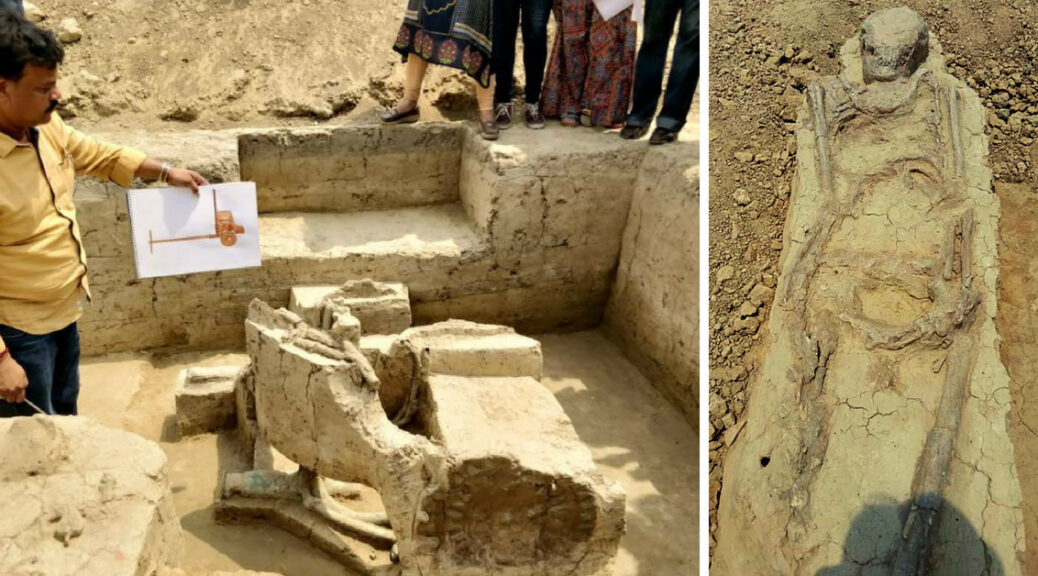
The remains of the ancient chariot (Left) and the buried corpse (Right).

“For the first time in the entire subcontinent, we have found this kind of a coffin. The cover is highly decorated with eight anthropomorphic figures. The sides of the coffins are also decorated with floral motifs,” Manjul said.

Combined with this, the swords, daggers, shields, and helmet seem to suggest the existence of a warrior class with expertise in sophisticated craftsmanship.

The Copper weapons (left) and artifacts (right) unearthed in the site. 

While it is difficult to ascertain the new findings unlike the 2005 ones, Manjul asserted that the chariots and coffins did not belong to the Harappan civilization.

He said the similarities could have been an outcome of the migration of the Harappans to the Yamuna and the upper planes during the late mature Harappan era.

In conclusion, Manjul told The Print, “The new discoveries, especially those of the chariots are a landmark moment since no such physical evidence has been found at a contemporary Harappan site.”

Well-Preserved 3,000-Year-Old Pre-Viking Sword Unearthed in Denmark is Still Sharp

Well-Preserved 3,000-Year-Old Pre-Viking Sword Unearthed in Denmark is Still Sharp

Two locals from Zealand, Denmark’s largest island, decided to walk around the field in the remote west city of Svebolle in the evening.

The decision was fortuitous to take their metal detector with them because it would allow them to uncover a major find

The two amateur archeologists began digging after the device alerted Ernst Christiansen and Lis Therkelsen to something beneath the ground.

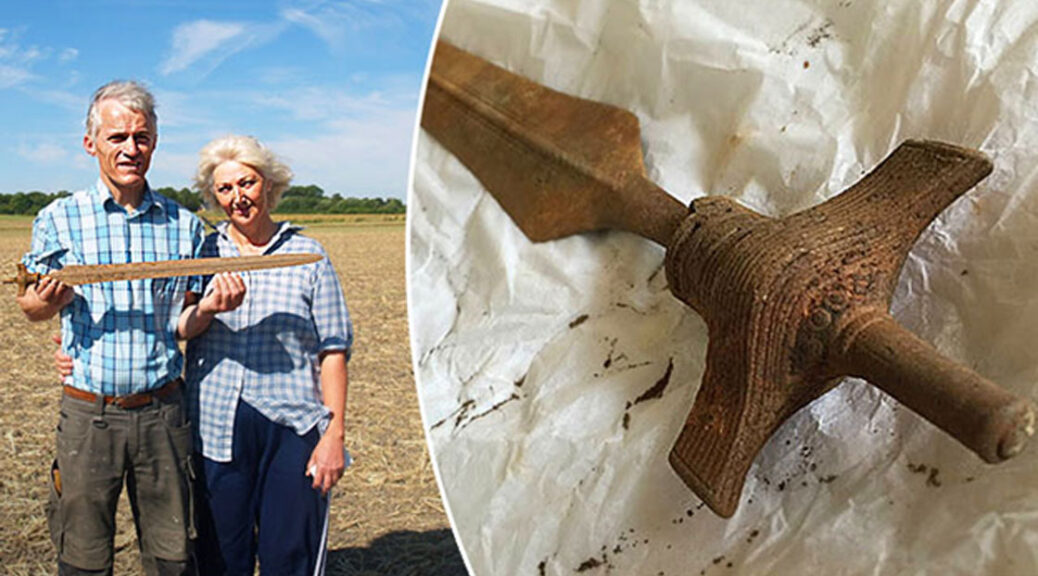
Around 30 cm down, they spotted what looked like the tip of a spear. Christiansen and Therkelsen contacted Museum Vestsjælland — a group of 11 local museums that cover the archaeological excavation and conservation of regions in the area — who revealed that the discovery was a 3,000-year-old sword from the Nordic Bronze age. 

It was also a testament to the craftsmanship of the people in Scandinavia at the time.

The visible decorations on the hilt of the sword.

“The sword is so well-preserved that you can clearly see the fine details. And it is even sharp,” the museum wrote in a press release.

Museum inspector Arne Hedegaard Andersen, who joined Christiansen and Therkelsen on the day following the discovery, reaffirmed how incredibly maintained the sword was.

Museum inspector Arne Hedegaard Andersen holds the discovery.

The Nordic Bronze Age, circa 1700-500 BC, was sandwiched between the Nordic Stone Age and the pre-Roman Iron Age. During this time period, bronze imported from Central Europe replaced previously popular materials like flint and stone.

The impressively preserved bronze sword, which predates the Vikings by around 1,000 years, remained untouched since the Bronze Age. About 32 inches long and still fairly sharp, the museum believes that it dates to phase IV of the Bronze Age, or between 1100 and 900 BC.

Though the leather that made up the sword’s grip had long rotted, the pommel and hilt show intricate bronze work, clearly decorated by skilled workers.

The details suggest that it was an expensive piece of weaponry, likely used to indicate status rather than in actual battle. Additionally, warriors during this time tended to use clubs, spears, or axes for fighting purposes.

Though the Scandinavian people joined the Bronze age through trade relatively late compared to other European nations, the local workmanship was of a higher standard. So although the religion, ethnicity, and language characteristics of the people during this time period are largely unknown, they left behind a rich archaeological legacy.

Ernst Christiansen and Lise Therkildsen with the Bronze Age sword.

One of the main ways we know about life in Scandinavia during the Bronze Age is through rock carvings called petroglyphs, which depict images of daily life, great events, and supernatural beliefs of the time.

There have been several exciting archaeological discoveries in Denmark in recent years.

In June 2016, team of three archaeologists who call themselves Team Rainbow Power uncovered the largest-ever find of Viking gold.

In October 2016, the discovery of a 5,000-year-old stone map shed light on ancient farming and topography. And in 2015, a trove of 2,000 mysterious-looking gold spirals also from the Bronze Age was discovered on Zealand

‘Incredibly rare’ grave of 2,000-year-old Iron Age warrior armed with a sword found

‘Incredibly rare’ grave of 2,000-year-old Iron Age warrior armed with a sword found

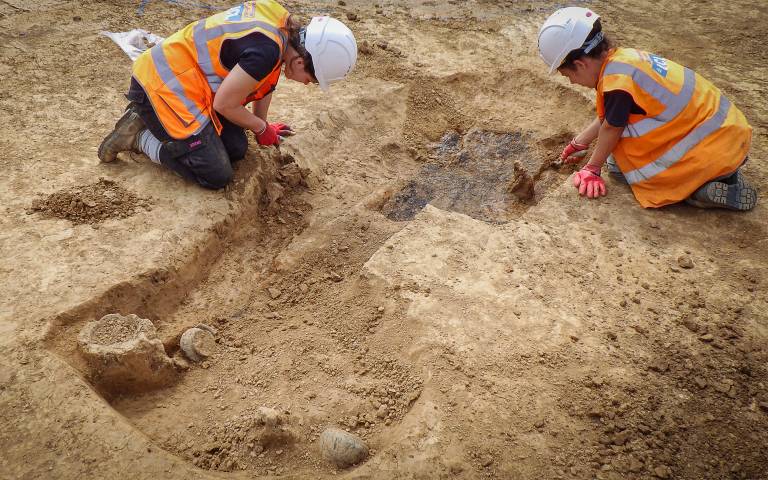
In West Sussex UCL archeologists unearthed a richly furnished tomb belonging to an Iron Age warrior buried 2000 years ago.

Iron weapons including a sword in a very decorated scabbard and a spear were placed inside the cemetery.

During an excavation undertaken by Linden Homes to build 175 new houses on the outskirts of Walberton, near Chichester, the grave was uncovered.

The team that made the discovery was from Archaeology South-East (ASE), the commercial branch of UCL’s Institute of Archaeology.

ASE archaeologist Jim Stevenson, who is managing the post-excavation investigations into the burial, said: “There has been much discussion generally as to who the people buried in the ‘warrior’ tradition may have been in life. Were they really warriors, or just buried with the trappings of one?

“Although the soil conditions destroyed the skeleton, the items discovered within the grave suggest that the occupant had been an important individual.”

The grave is dated to the Late Iron Age/ early Roman period (1st century BC-AD 50). It is incredibly rare, as only a handful are known to exist in the South of England.

X-rays and initial conservation of the sword and scabbard reveal beautiful copper-alloy decoration at the scabbard mouth, which would have been highly visible when the sword was worn in life.

Dotted lines on the X-ray may be the remains of a studded garment worn by the occupant when buried. This is particularly exciting for archaeologists as evidence of clothing rarely survives.

The grave also held the remains of a wooden container, preserved as a dark stain, likely used to lower the individual into the grave.

Four ceramic vessels were placed outside of this container, but still within the grave.

The vessels are jars made from local clays and would usually have been used for food preparation, cooking, and storage. It is likely that they were placed in the grave as containers for funerary offerings, perhaps intended to provide sustenance for the deceased in the afterlife.

Using photogrammetry a 3D model of the grave has been created, which can be viewed online: https://skfb.ly/6PLLN

Archaeologists are continuing to investigate this new discovery. By looking at other burials with weapons from the same time, they hope to find out more about the identity and social status of this individual, and the local area and landscape around that time.

Are Egyptologists Close to Finding a Pharaoh’s Intact Tomb?

Are Egyptologists Close to Finding a Pharaoh’s Intact Tomb?

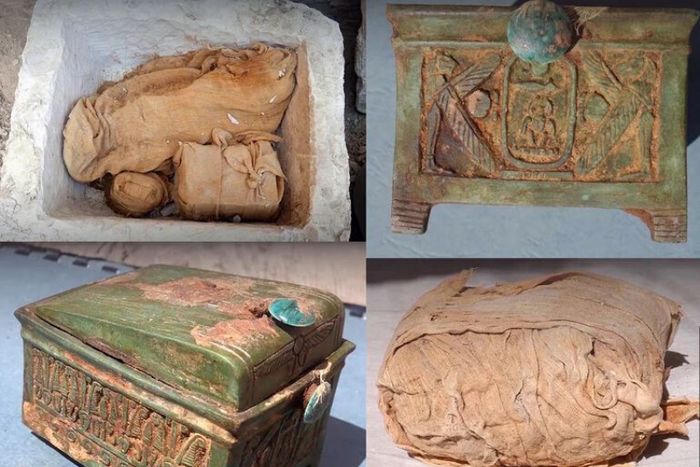
Archeologists discovered a 3,500-year-old stone chest in the ruins above the Deir el-Bahari Egyptian site.

The remarkable discovery, concealed near Hatshepsut’s famous Mortuary Temple, suggests a nearby intact royal tomb.

There were different items wrapped in linens in the box. One held a sacrificial goose skeleton the other an egg and the third set contained a wooden box holding what was presumably the ibis egg.

The extraordinary find, which was hidden near the renowned Mortuary Temple of Hatshepsut, indicates an untouched royal tomb could be nearby.
Archaeologists made the extraordinary find in the rubble above the Egyptian site of Deir el-Bahari.

The Warsaw University Institute of Archeology Professor Andrzej Niwiński said to the PAP, “The chest itself is about 40 cm long with a slightly smaller height, It was perfectly camouflaged, looked like an ordinary stone block.

“This turned out to be a chest only after a closer look.” Next to it, the archaeologists found a folded bundle.

In the case of the bundle, the four layers of linen canvas-covered a wooden box, in which there was a faience box in the shape of a chapel. It contained one of the names of Pharaoh Thutmose II.

Prof. Niwiński is optimistic that his team is close to uncovering the untouched burial place of pharaoh Thutmose II.

Prof. Niwiński, who is leading the excavation team, said: “The royal deposit proves the fact that either a temple was established in the king’s name or the king’s tomb.

“Since we are in the centre of the royal cemetery, it is definitely a tomb. Finding this deposit indicates that we are in the process of discovering the tomb.”

The chest is about 40 cm long, with a slight smaller height, which Prof. Niwiński said “was perfectly camouflaged, looked like an ordinary stone block.”

Apart from the pharaoh’s name, the symbolism of the other objects they found also points to the fact, that the deposit was made in his name.

Thutmose II was the husband of the famous queen and his half-sister, Hatshepsut, though their marriage was most probably dictated by dynastic interest.

Thutmose was only 13 when they wed and died three years later in 1479 BC.

Deir el-Bahari has been the site of work for Polish archaeologists for almost 60 years since the father of Polish archaeology, Professor Kazimierz Michałowski, led a mission in 1961 to document and preserve the Mortuary Temple of Hatshepsut.

During his reign, he was overshadowed by his wife, who would later crown herself pharaoh and become one of the best-known rulers of ancient Egypt.

The stone chest’s discovery, now made public, took place in March last year. The archaeologist continued their work in October 2019, but so far they haven’t found the entrance to the royal tomb.

A faience box in the shape of a chapel contained the name of Pharaoh Thutmose II who was the husband of the famous queen and his half-sister Hatshepsut.

Still, Prof. Niwiński is optimistic that they are close to uncovering an untouched Royal tomb.

Deir el-Bahari has been the site of work for Polish archaeologists for almost 60 years. It started in 1961, when the father of Polish archaeology, Professor Kazimierz Michałowski, led a mission to document and preserve the Mortuary Temple of Hatshepsut.

Medieval Town Walls Uncovered in Wales

Medieval Town Walls Uncovered in Wales

In a survey undertaken by Conwy Valley-based CR Archaeology, several other valuable items, which date back to the 13th century, were also found.

The discoveries made at Antur Waunfawr’s Porth yr Aur site have come as a result of building work taking place for their new Beics Antur project.

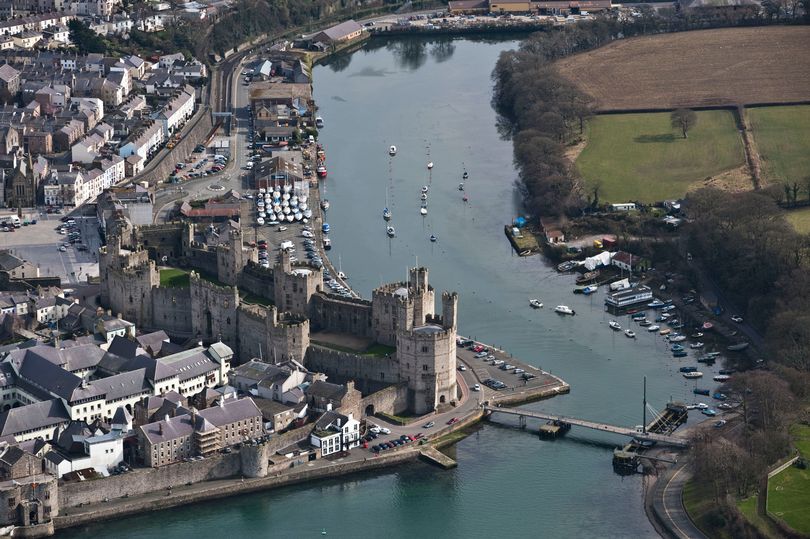
The yard was formerly owned by the local transportation company, Pritchard Bros, and it is adjacent to the medieval town walls, which are designated as a Scheduled Monument by CADW.

Historical objects dating back to the 13th century have been unearthed at Antur Waunfawr’s site in Porth yr Aur during the building works for their health and wellbeing project, Beics Antur.

Built-in 1283 by King Edward I, the town walls surround Caernarfon Castle and were built to protect the new town borough. Porth yr Aur, or ‘Golden Gate’, was the main seaward entrance to the medieval borough and it was an integral component of Caernarfon Town Wall.

So far, discoveries at the site include a flight of steps, fragments of rare medieval pottery and what seems like a fireplace or doorway.

Fragments of rare medieval pottery and wine glass.

Matthew Jones, of CR Archaeology, said: “We have unearthed a green wine jug handle, which is Saintonge ware and is connected with the wine trade from Gascony, France. Their use is in Wales dates from 1280-1310 and is mainly associated with Edwardian towns and Castle sites.

“The steps are very exciting as they could represent the remains of the original town wall with was later built over in the 14th century when the gate had to be strengthened due to increased attacks by Welsh rebels in 1297, or after a fire in 1326.

“The doorway, or it may be a fireplace, is really interesting as it could represent an unknown entrance into the gatehouse. If it is a fireplace, it would also be very interesting as it could indicate what activities were going on at the site. We have maps that show buildings and some records of names of people who lived there but very little evidence of their day to day lives.”

The construction work continues on the site, owned by Antur Waunfawr, a local social enterprise that provides work and training opportunities for adults with learning disabilities.

Antur Waunfawr’s site in Porth yr Aur

The site will be developed into a Health and Well-being center for the local community, with a dedicated activity room available for hire on the first floor, accessible facilities, as well as a sensory room suitable for individuals with learning disabilities or sensory impairment.

The project has been supported by the European Regional Development Fund through the Welsh Government; the Architectural Heritage Fund; the Welsh Government’s Intermediate Care Fund; the Welsh Government’s Community Facilities Programme; and a pledge from the Garfield Weston Foundation.

Menna Jones, chief executive at Antur Waunfawr, said: “We are proud to have a presence in the town centre and aim to combine the ancient history of Caernarfon and its heritage with new activities and businesses, to promote the wellbeing and health of local people, individuals with learning disabilities and disadvantaged people.

We are working with CADW to plan how to display these historical items, and bring the history and heritage of the area to life for locals and visitors.”

Ancient Maya kingdom unearthed in a backyard in Mexico

Ancient Maya kingdom unearthed in a backyard in Mexico

A team of archeologists from the backyard of a rancher in Mexico have discovered the site of a long-lost ancient Mayan empire. The town was discovered with the help of a food vendor.

Since 1994, when references to it were discovered at inscriptions on other Mayan excavation sites, scientists have been searching for signs of the ancient Mayan kingdom of Sak Tz’i ‘. Apart from the reference, the kingdom is also mentioned in other sculptures.

It so happens that, in 2014, the University of Pennsylvania graduate student Whittaker Schroder was driving around Chiapas in southeastern Mexico when a man selling carnitas on the side of the highway informed him that a friend, a cattle rancher, had found an ancient stone tablet.

Upon confirming the authenticity of the tablet, Schroder and another graduate student from Harvard, Jeffrey Dobereiner, informed anthropology professor Charles Golden and Brown University bioarchaeologist Andrew Scherer of the find.

From that time, it took years before the team received permission to excavate on the property, with the team making sure that the government would not confiscate the rancher’s land.

This is because, in Mexico, cultural heritage such as Maya sites are considered the property of the state. So, the team worked with government officials to make sure that the rancher would get to keep his land.

The research team believes that the archaeological site unearthed in the rancher’s backyard, Lacanja Tzeltal, is actually the capital of the Sak Tz’i’ kingdom that was first settled in by 750 B.C.

At the site, the team found evidence of a marketplace where goods were sold, a 45-foot pyramid, as well as the ruins of several structures that likely served as the residence of the elites.

The team also found evidence of a ball court and a royal palace, as well as Maya monuments with important inscriptions. Dozens of sculptures were also recovered from the site, although most of them were already degraded. Ultimately, the best-preserved artifact from the site remains to be the tablet from the rancher.

Being a relatively modest kingdom compared to the others, Sak Tz’i’ was surrounded on all sides by more powerful states. This is evidenced by the walls that were possibly built to keep invaders out.

According to Golden, it is possible that mid-sized Sak Tz’i’ kingdom’s survival among the more powerful kingdoms depended not just on its military strength but also on making peace with its neighbors.

That said, little is still known about how the kingdom survived amid the hostilities they likely faced from other, more powerful kingdoms.

For now, the team is planning to go back to the site in June to stabilize the buildings that are in danger of collapsing well as to map the ancient city with modern tools and to look for more artifacts.

Left, drawing of a tablet found at the site. Right, a digital 3D model.

The study describing the find is published in the Journal of Field Archaeology. 

Mao of the Sak Tz’i’ kingdom excavation site in Mexico. The horseshoe-shaped building on the left is the palace area.

Archaeologist hails ‘extraordinary’ Viking village find in Dublin

Archaeologist hails ‘extraordinary’ Viking village find in Dublin

Researcher excavations have modified our understanding of the oldest Viking settlement in Dublin with a black pool or Dubh Linn which was considered to be much larger than originally expected.

The excavation alongside Dublin Castle has also revealed the oldest police cells in the city and a grave of punishment.

The excavation is taking place on Ship St near where the remains of one of Dublin’s oldest churches – St Michael le Pole that was founded in the 6th century – are known to be.

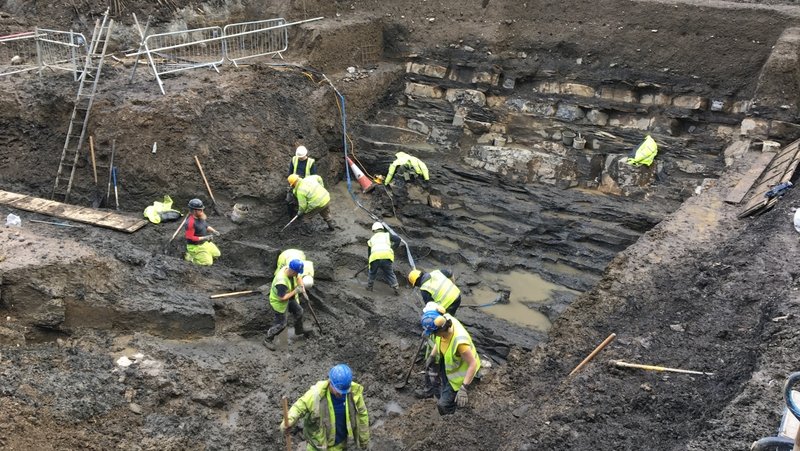
The dig is taking place beside Dublin Castle

Archaeologist Alan Hayden from University College Dublin said the work has uncovered the cells from a police station on Chancery Lane built-in 1830, and beside it are walls from a medieval farm.

There are 12th Century quarries that provided the stone to build Dublin Castle and its walls.

The most important discovery yet is that Dubh Linn – the pool on the River Poddle where the Vikings first settled – was much bigger than originally thought.

At present, a garden inside Dublin Castle marks what was thought to make up most of the original Dubh Linn.

However, this excavation has established it was nearly 400 meters wider extending to the present dig site and where St Michael le Pole church stood.

Mr. Hayden says this solves two questions that have puzzled historians – why St Michael’s Church referred to ‘le pole’ or the pool and how reports that the Vikings had up to 200 ships on the Dubh Linn.

Evidence of the settlement in the 12th Century

Niamh Donlon of the One Le Pole Square project says a development planned for the site will consist of a two-story convention center below six floors of office space.

It will incorporate the history of the site in its name.

The remains of the original St Michael le Pol church will be visible below a screen in a new public square and a tile from the church will be used in a new spa area.

A map of the site in the 14th Century

Tom Wilson, the senior civil engineer with builders JJ Rhattigan, said the archaeological dig was already factored into the development and has not caused delays.

Meanwhile, Mr. Hayden says there was one unusual find – a burial of a man found outside the church cemetery with his hand and feet cut off. He said this was a medieval punishment for insulting a lord or king.