Ancient ‘power centre’ uncovered in Perthshire, Scotland
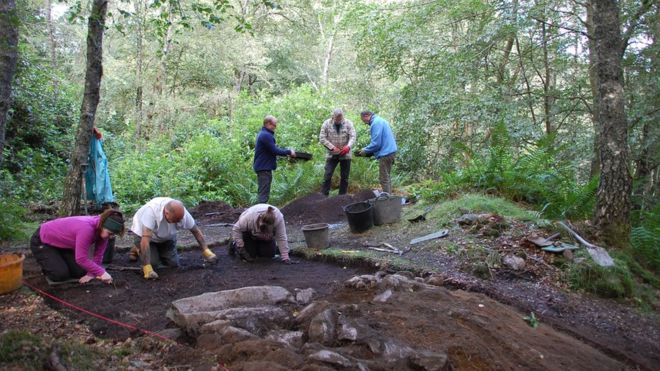
A hilltop fort near Dunkeld was an important Pictish power centre, say archaeologists who excavated the site. Evidence of metal and textile production were revealed at King’s Seat Hillfort, a legally protected site.
Finds such as glass beads and pottery suggested the Picts who occupied the site in the 7th to 9th centuries had trade links with continental Europe.
Other finds included pieces of Roman glass that were recycled and reused as gaming pieces.
In a new report on last year’s excavations, archaeologists said the wealth of finds suggested the site had been a stronghold of the elite in the local population, with “influence over the trade and production of high-status goods”.
Fragments of pottery – of the kind made in continental Europe – and Anglo-Saxon glass beads suggested the Picts were trading far afield. As well as evidence of metal-working, spindle whorls used in textile production were found.
Roman glass recycled and reused as a gaming piece was among the finds at the site
Archaeologists said the artefacts uncovered were in keeping with other high-status, royal sites of early historic Scotland, including the early Dalriadic capital of Dunadd in Argyll and the Pictish royal centre of Dundurn near St Fillan’s by Loch Earn.
Perth and Kinross Heritage Trust (PKHT) worked with Dunkeld and Birnam Historical Society, archaeological contractors AOC Archaeology Ltd on the digs.
Thirty community volunteers and Pitlochry High School students assisted with the excavations.
Last year’s work marked the third and final season of excavations as part of the King’s Seat Hillfort Community Archaeology Project. The site is a scheduled ancient monument and digs can only be done with prior permission.
A fragment of Anglo-Saxon drinking vessel
David Strachan, director of PKHT, said: “We have uncovered lots of evidence of how people were living and working, and the remains of a building with a large hearth on the summit, with fragments of glass drinking vessels, gaming pieces, animal bone and horn.
“They paint a vivid picture of high-status people gathering and feasting, decorated in the latest high-status jewellery and ornamentation.”
Cath MacIver, of AOC Archaeology, said crucibles, whetstones, stone and clay moulds found indicated that craft production took place at the hillfort.
“What’s particularly interesting is that evidence of this activity has been found in all of the trenches [excavated areas],” she said.
“There must have been a lot of iron and other metalworking going on here making the site an important centre for production – not just the home of a small group of people making items for their own use.”
In an astonishing Bronze Age discovery, a 3000-year-old community has been unearthed
Rare archaeological evidence from a prehistoric site of the Eastern England village suggests that Bronze Age Britons liked high-end fashion
The earliest samples of superfine textiles ever identified in England, Excavations, 30 miles northwest of the Cambridge area It is also one of the finest bronze ages ever found in Europe as a whole – and it is extremely important globally.
Archaeologists from the University of Cambridge’s archaeological unit have so far unearthed more than 100 fragments of textile, unspun processed fibre and textile yarn at the site. Some of the yarn is of superfine quality – with some threads being just 100 microns (1/10 of a millimetre) in diameter, while some of the fabrics themselves are so finely woven that they have 28 threads per centimetre, fine even by modern standards. It’s likely that some of the fragments of textile are from items of clothing.
Detail of preserved Bronze Age textile made from plant fibres
Originally, some of the textiles must have been of very substantial size – because they had been folded, in some cases in up to 10 layers. If made to be worn, these folded fabrics may well have been large garments, potentially, capes, cloaks – or even large drapes, perhaps similar to those known from elsewhere in the ancient (and sometimes modern) worlds – the ancient Greek chiton, the Roman toga and the Indian sari. A drape folded into 10 layers for temporary storage would have served as a substantial garment – potentially up to 3 metres square (i.e. 9 square metres).
Most of the superfine fabrics from the site – Must Farm near Whittlesea, Cambridgeshire – were made of linen. When the village was flourishing around 3000 years ago, textile manufacture seems to have been a key craft practised there. Hundreds – possibly thousands – of flax seeds have so far been found on the site (some of which had been stored in containers). Flax is the crop which produces the fibres used in linen production.
Amber bead and others found in situ
What’s more, the presence on the site of unspun processed fibre, yarn and finished textiles all strongly suggests that the village was involved not only in using textiles but also in manufacturing them. Timber fragments with delicate carpentry, found during the Historic-England-funded excavation may well be the remains of looms. Indeed fired clay loom weights have been unearthed there.
The archaeologists have also discovered that Bronze Age Britons also had a penchant for a different type of fabric – made of processed nettle stems (from a locally available non-stinging subspecies of nettle – today known as fen nettles). Unlike flax, nettles grew wild and therefore did not need to be cultivated. What’s more, well-made nettle textile was often particularly fine and silky.
But nettles may well have had additional benefits – at least in the eyes of the users of the fabrics.
In traditional ancient folklore, nettles of various types were often regarded as having magical powers. They were seen as being able to protect both humans and animals from sorcery and witchcraft. What’s more, garments made of nettles were therefore sometimes seen as protecting their wearers from evil. Indeed one of Europe’s most famous folktales – the Wild Swans (written by Hans Christian Andersen, but thought to be based on traditional folk stories) – reveals how shirts, made of nettle yarn, enabled their wearers to break a witch’s spell.
So far no evidence of any extensive patterns or coloured dyes have been found on any of the linen and nettle yarn textile fragments – although the edge of one piece of fabric (perhaps part of a shawl or cape) seems to have been decorated with fringes, rows of knots, and strips featuring different styles of weave. Certainly, dying the linen would have presented substantial technical difficulties – but bleaching it would have been much less challenging. It is therefore very likely that the natural light brown linen was bleached to achieve a creamy white or possibly even dazzlingly pure white appearance. Basic bleaching of the fabric might well have been achieved with the use of a mixture of urine and milk or by simply laying out the fabrics on wet grass on a succession of sunny days.
The village appears to have been very prosperous, yet tragically short-lived.
The village appears to have been very prosperous, yet tragically short-lived. As well as making (and presumably using) ultra-fine fabrics, at least some of the inhabitants wore exotic jewellery made of blue, black, yellow and green glass manufactured in the eastern Mediterranean region – probably in what is now the Syria or Turkey.
They lived in large well-built houses and had a wide range of tools and other possessions. So far, around 50 bronze axes, sickles, spears, swords, razors, hammers, tweezers and awls have been found along with some 60 wooden buckets, platters and troughs as well as around 60 well preserved ceramic bowls, mugs and storage jars. Dug-out canoes and two wooden wheels have also been unearthed.
But the archaeological evidence suggests that this thriving and prosperous settlement was probably attacked, burnt and destroyed by its enemies less than a year after it was built.
In the five houses excavated so far, the population seems to have fled or been captured or killed, leaving all their possessions behind – meals half-eaten, salted or dried meat still hanging in the rafters, garments neatly folded on or around well-made wooden furniture.
“It’s a bit like discovering the Marie Celeste. Everything is exactly as it was left. Only the inhabitants are missing,” said the director of the excavation, Mark Knight of the Cambridge Archaeological Unit.
“This site is providing the modern world with an image of daily life in the British Bronze Age that was until now beyond our dreams. It is only the very specific and unusual circumstances of the destruction of the settlement that has, paradoxically, allowed so much of it to be preserved intact,” he said.
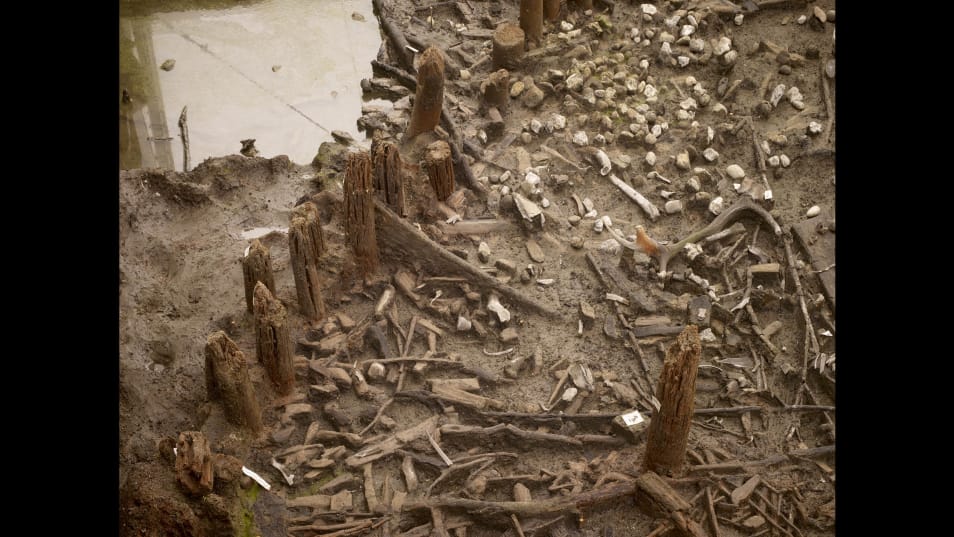
Because the village had been set alight, large numbers of wooden, textile and other artefacts were charred – and because the houses were built on wooden stilts in a river (flanked by marchland), everything ultimately ended up underwater, where it was subsequently covered with silt and mud.
This rare combination of charring and waterlogging and natural burial under sediment has been responsible for the extraordinarily high levels of preservation.
Most of the artefacts have been found inside the settlement’s houses. So far, five of these large 6-8 metre diameter structures have been found at the site. Again, because of charring and subsequent waterlogging, around half of all the wall, roof and other timbers from these buildings have been preserved.
The excavation is being directed by archaeologist Mark Knight of the Cambridge Archaeological Unit, with textile research being carried out by a textile specialist, Dr Susanna Harris of the University of Glasgow. Because of its national and international importance, the entire project is being funded to the tune of £1.4 million by Historic England and the owner of the site, one of the UK’s major brick-making companies – Forterra.
The finds include the largest group of prehistoric textiles ever discovered in Britain – and the largest collection of complete bronze, wooden and ceramic artefacts ever found in a British Bronze Age settlement.
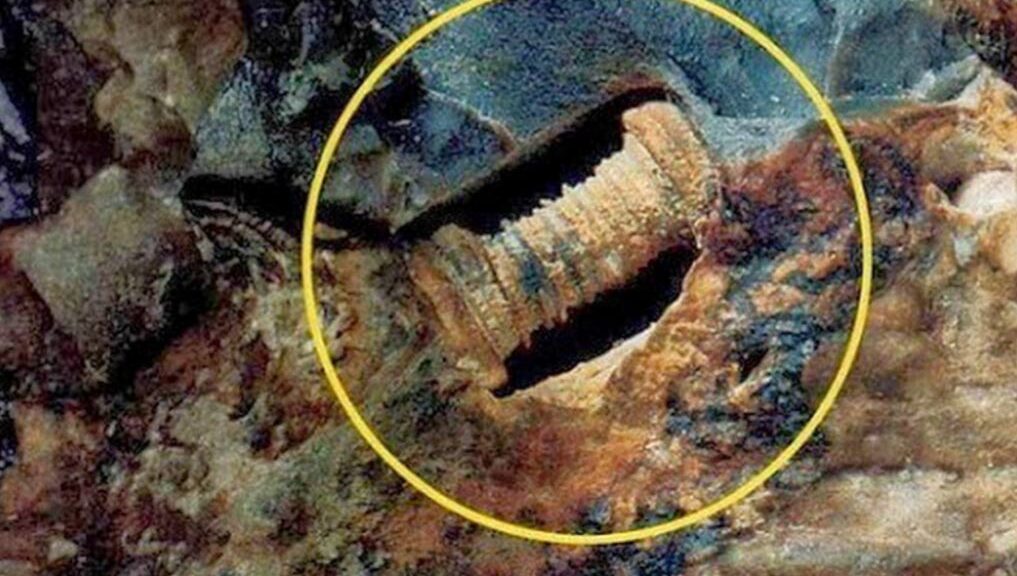
Could this 300 million-year-old ‘screw’ be proof of aliens?
Russian scientists have been pondering its existence since it was found in the 1990s – with many people believing it to be proof of highly advanced lost human civilization, aliens or a fossilized sea creature.
They say the screw is the remains of an ancient form of technology that proves extra-terrestrials visited Earth millions of years ago. However, scientists say the ‘screw’ is nothing more than a fossilized sea creature called a Crinoid.
A paleontological analysis was carried out, which revealed the stone was formed between 300 and 320 million years ago.
The team also claims that an x-ray of the stone shows that another screw is present inside it. However, they have not allowed international experts to examine the object, nor have they revealed what the screw is made of.
Since the initial finding, much debate has surrounded the discovery, with scientists scoffing at the suggestion that it reflects an ancient screw and suggesting there is a much less exciting explanation.
Location of Kaluga Oblast in Russia, where researchers claim to have found a 300-million-year-old screw
The Mail Online reports that scientists who have examined photographic evidence of the object say that there is a more earthly answer to the phenomenon – the ‘screw’ is actually the fossilized remains of an ancient sea creature known as a crinoid.
Crinoids are a species of marine animals that are believed to have evolved around 350 million years ago. They are characterized by a mouth on the top surface that is surrounded by feeding arms. Today, there are around 600 crinoid species, but they were much more abundant and diverse in the past.
A stalked crinoid has drawn by Ernst Haeckel.
Over the years, geologists have found countless fossils representing whole crinoids or their segments, some of which do resemble screws.
Scientists have suggested that the screw-like shape seen in fossil samples may be the reversed-shape of the creature, which dissolved while the rock was shaped around it.
Left: The fossilized remains of a whole crinoid. Right: Fossilized segments of crinoids
“It is thought that the fossilized creature in the mysterious rock is a form of ‘sea lily’ – a type of crinoid that grew a stalk when it became an adult, to tether itself to the seabed,” write the Mail Online.
“However, some say that the stalks of crinoids were typically much smaller than the ‘screw’, with slightly different markings, and have discarded the theory.”
Nigel Watson, author of the UFO Investigations Manual told Mail Online: “Lots of out-of-place artifacts have been reported, such as nails or even tools embedded in ancient stone. Some of these reports are…misinterpretations of natural formations.”
“It would be great to think we could find such ancient evidence of a spaceship visiting us so long ago, but we have to consider whether extra-terrestrial spacecraft builders would use screws in the construction of their craft,” he added. “It also seems that this story is probably a hoax that is being spread by the internet, and reflects our desire to believe that extra-terrestrials have visited us in the past and are still visiting us today in what we now call UFOs.”
For now, the controversy surrounding the object remains very much alive, and unless the Kosmopoisk Group releases detailed information regarding the material of the ‘screw’, it is unlikely that consensus will be reached any time soon.
83 ancient graves discovered in Egypt’s Nile Delta
According to a statement by the Ministry of Tourism and Antiquities, the Egyptian Archeological Mission, which is accredited by the Supreme Council of Antiquity, has confirmed that 83 graves had been found during archaeological excavations in the Koam Al-khiljan area of the Governorate of Daqahliya in Egypt.
According to Secretary-General of the Supreme Council of Antiquities Mostafa al-Waziri, 80 of these graves are dated back to the first half of the 4th Millennium BC, in Egypt called the Buto culture, a former city southeast of Alexandria in the Nile Delta (today Lower Egypt).
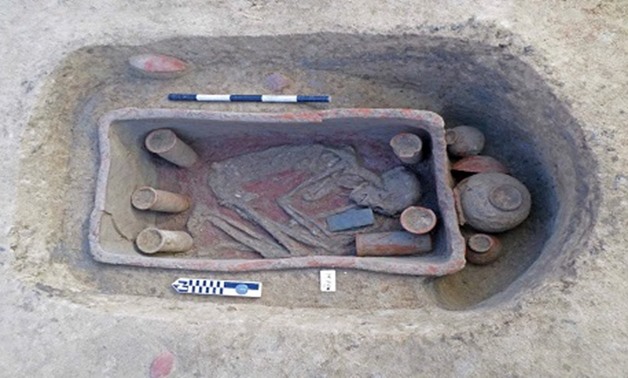
The graves are in the form of oval-shaped pits, inside which are burials designed in a squatting position rather than a sleeping position. Traditional funerary items were found buried as well, he added.
The other three graves discovered date back to Naqada III, an era from approximately 3200 BC to 3000 BC that is sometimes referred to as the protodynastic period and which saw major strides in state formation in ancient Egypt.
The Kingdoms of Lower and Upper Egypt were eventually united under the rule of a single Pharaoh around 2686 BC.
Two clay coffins were discovered as well inside the second groups of graves, which, like the others, contained burials designed in the squatting position surrounded by various funerary items, according to Ayman Ashmawy, head of the Egyptian Antiquities Sector.
The mission also found in the three tombs dating back to Naqada III two bowls used for kohl (eyeliner).
This is the first time coffins made of clay have been uncovered in the Daqahliya Governorate, Waziry noted, adding that the site must have witnessed heavy human activity during the eras of Naqada III and Buto. He said he expects more coffins of this type to be discovered at the archaeological site in the future.
The funerary artifacts discovered at the site included a collection of small, hand-made pottery, in addition to oyster shells, Ashmawy said.
Some of the discovered artifacts dated back to the second transitional period (the Hyksos period), including ovens and stoves, the remains of foundations of mud-brick buildings, four mud-brick burials, some pottery and stone utensils, and amulets and other ornaments made of semi-precious stones, according to Head of the archaeological mission and Director General of the Daqahliya Antiquities Fatehy al-Talhawy.
The Unique Ancient Tree that Produces Pearly-White Olives
A unique variety of olive trees is known as leucolea, found mostly in southern Italy. It is found in the area known historically as “Magna Graecia” or Greater Greece.
The name of the leukocarpa or leukolea olive is primarily derived from the Greek words for white (Leucos), olive (elaea) and seed (carpos), though developing in its small form. But its fruit is delicate in ivory or pearly-white during the process of maturation.
Experts claim that this particular seed was most probably first introduced to the south of Italy during the years of the Greek colonization of the Italian peninsula and Sicily.
This unique white olive tree is part of the broader family of olives, known to the scientific world as ”Olea Europea”, which means European olive.
The south of Italy is not the only place where this ancient olive is produced, but this region is the main area of production for Leucocarpa olives in modern times.
The Greek colonies of Southern Italy and their dialects
Similar white olives are found in Greece today but they are quite rare. They can also be spotted in some areas along the Mediterranean coasts of northern Africa and all the way west to the Atlantic shores of Portugal.
However, the Leucocarpa olive is mostly known by different local names, and its products are not exported in an organized and systematic way.
The Leucocarpa was traditionally used in past centuries by the communities of the Mediterranean, mainly for religious purposes, since its white color became synonymous with purity.
There is evidence that even the Christian churches of the region were known to use the special olive oil produced from this variety to anoint emperors and kings, for example.
Unfortunately, for unknown reasons, the Leucocarpa was propagated less and less over the years, and its olives and oils are now rare products, but its delicate beauty is truly quite arresting.
Anyone who is interested in seeing how this ancient olive or olive oil tastes will have to be extremely persistent since it is not very easy to find them in regular supermarkets!
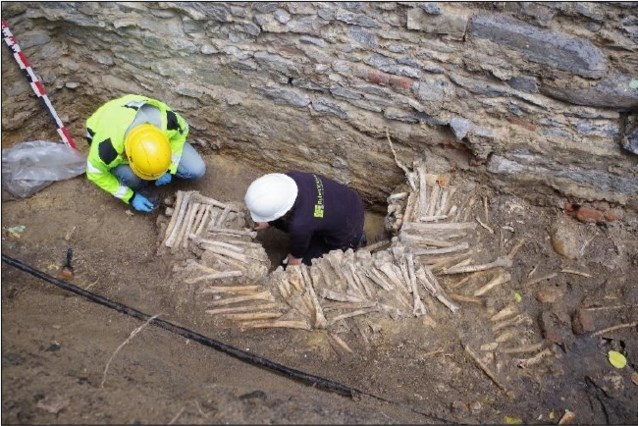
Walls made of human bones discovered under Ghent cathedral
At a cathedral in Belgium, Gruesome walls made entirely of human bones were uncovered.
Specialists believe that in the 17th century, grisly structures were constructed using bones 200 years old at the time.
The legs and shiny bones of various people were entirely made from various adults. Spaces were filled with skulls between the wall, many of which were shattered
The grisly structures were built in the 17th Century using remains that were 200 years old at the time
Archaeologists from Ruben Willaert bvba in Bruges said the find was unique to Belgium, the Brussels Times reported.
“This is a phenomenon we’ve not yet come across here,” said project leader Janiek De Gryse.
The discovery was made at Saint-Bavo’s cathedral in the city of Ghent. The building has been in use for more than a thousand years. Similar structures made using human remains have been found at ancient sites across Europe, including the catacombs of Paris.
Researchers said the Saint-Bravo bones appeared to date to the late 15th Century.
“For the moment we would place the actual construction in the 17th and 18th century,” De Gryse said, “although there’s a great deal of research still to be done.”
The walls of bones appear to have been built during a time when the graveyard was being cleared. It’s possible that the structures were pieced together while workers dug up old graves to make way for new ones.
“When clearing a churchyard, the skeletons cannot just be thrown away,” De Gryse explained.
“Given that the faithful believed in a resurrection of the body, the bones were considered the most important part.
“That is why stone houses were sometimes built against the walls of city graveyards: to house skulls and the long bones in what is called an ossuary.”
The discovery was made at Saint-Bavo’s cathedral in the city of Ghent
In other archaeology news, a fossil hunter has found pieces of Jurassic history encased in golden-snitch-like spheres. Hitler’s secret vegetable garden has been uncovered at a bunker in Poland.
And, the face of a 1,000-year-old Viking warrior woman with a gruesome battle wound across her skull has been revealed.
Humans Present at Brazil’s Santa Elina Rock Shelter 23,120 Years Ago, Confirms National Museum of Natural History in Paris
Exact Bone Dating by researchers in the Paris National Museum of Natural History. Details of the new date have been published in a paper in the scientific journal Antiquity of Cambridge University, where the research team places modern people far before the 20,000 years ago in the rock shelter of Santa Elina in Brazil.
Santa Elina rock shelter excavation site above left and sloth bone ornaments with drilled holes above right.
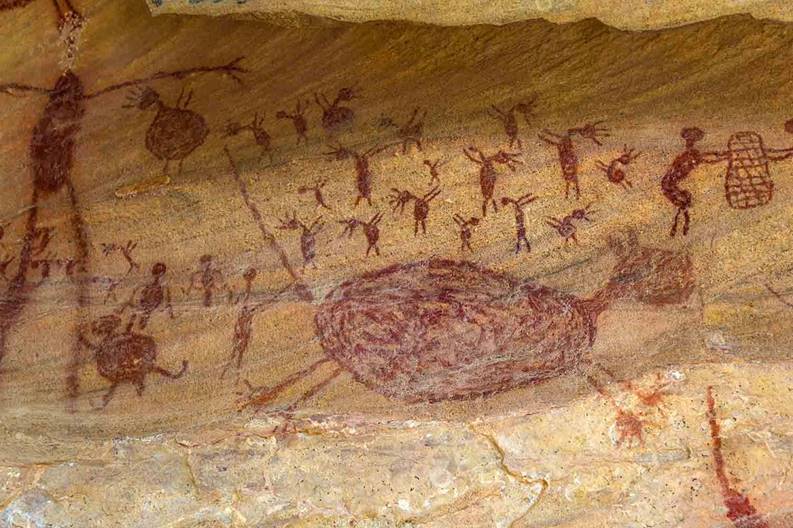
The rock shelter of Santa Elina in central Brazil contains remarkable rock art and confirmation of the first Americans ‘ lengthy occupation.
Humans Present at Brazil’s Santa Elina Rock Shelter 23,120 Years Ago, Confirms National Museum of Natural History in Paris
Occupation of the site is dated to several different periods, suggesting that groups of hunter-gatherers only dwelt at the site when climate favoured hunting in the region. The irregular periods of occupation spread across the Late Pleistocene and Late Holocene.
For many years now teams of archaeologists investigating ancient human occupations sites across Brazil have produced evidence of extremely early colonisation of this part of South America.
The earliest dates associated with Brazilian archaeological research are close to 60,000 years ago. However such extreme figures for colonisation remain highly controversial.
Excavations carried out at the Santa Elina rock shelter between 1984 and 2004 explored three sediment layers containing the remains of hearths, stone artefacts and bones associated with the extinct giant sloth species Glossotherium.
Several of the bony plates from the sloth skin had been converted into ornaments of some kind by the resident humans, the added notches and holes may have allowed these plates to be worn on the body.
Glossotherium, like other giant ground sloths, was a herbivore. It was 13 ft (4m) and weighed 2210 lbs. It would have been one of the largest herbivores in South America. This species became extinct around 12,000 years ago.
Scientists utilised three separate dating methods to investigate samples of charcoal, sediment and the sloth bones. The revealed dates securely place people at the Santa Elina site well over 23,120 years ago. Humans groups abandoned the site after a short period, but later groups utilised the rock shelter again between 10,120 to 2,000 years ago.
The new dates from Santa Elina further erode the consensus understanding that the first modern humans, known as the Clovis people, reached the Americas by walking across a land bridge between Northeast Asia and North America just 13,000 years ago.
In recent years a steady series of archaeological finds have caused a growing number of archaeologists to abandon the ‘Clovis first’ colonisation model.
The evidence of hunter-gatherers living in the Santa Elina rock shelter 23,120 years ago is highly problematic for scientists that still believe humans reached the Americas by walking into North America – the rock shelter is over 12,000 kilometres from the proposed entry site.
Not only is Santa Elina far from the earliest Clovis sites, but it is also over 2000km from the coast in a heavily forested region.
These facts call into question the way in which the American continent was colonised as it is logical to suspect that humans lived along the coastline long before making the arduous journey into the Brazilian interior 23,120 years ago.
A growing number of researchers suspect that the first settlers used canoes to colonise the Americas and perhaps drifted down the Pacific Coast in simple watercraft before heading inland.
Some South American sites once occupied by Stone Age people are closer to the Atlantic coast, raising the possibility of the first colonisation involving a movement of people from Africa.
Paleolithic ‘Sanctuary’ Containing Rock Art From 15,000 Years Ago Discovered in Spain
Archeologists have discovered a treasure trove of fossil rock art that is 15,000 years old in the autonomous region of Catalonia, Spain. In an investigation, the engravings were found on cave walls. The art is believed to prove that the site once was a religious sanctuary or shrine.
Some of the caves, in October 2019 were investigated by a team of scientists headed by Assistant Professor Joseph María Vergès of the University of Rovira I Virgili.
They had just resumed their work after some serious flooding in the area and were working on a cave known as the Font Major, which is not far from the hamlet of L’Espluga de Francolí. In particular, they were investigating the cave to establish its archaeological potential, and what they found was breathtaking.
The team stumbled across the carvings on October 30, 2019, after resuming investigations following a bout of flooding. They decided not to make the find public until it was secured, to ensure it was not destroyed
They found around 100 examples of rock art, which are mostly examples of abstract art. Also found were some 40 images that represented animals including deer, horses, and oxen, which once inhabited this part of Europe. Catalan News quotes Prof. Vergès as stating that “we made a fortuitous, extraordinary and unexpected discovery.”
The sheer number and the quality of the art mean that they are an important discovery and are invaluable for researchers. Newsweek reports that “the team says the engravings were produced on a layer of soft, sandy silt.” The art was found in a difficult to access part of the Font Major cave. The team did not immediately announce the discovery to the public as they wanted to secure and study the site first.
Paleolithic rock art of horse found in Font Major Cave near L’Espluga de Francolí.
The ancient art is the oldest that has been found in Catalonia, and there is nothing else like them in the region. The team relied on a study of their style, which revealed the majority of the images date to around 13,000 BC and comes from the “Upper Paleolithic, and more specifically to the Magdalenian period,” according to El Periodico.
It is believed based on an analysis of their style that some could be even older, while others come from the later Neolithic period. The Catalan Institute of Archaeology (IPHES), stated that the discovery was “a milestone in the history of Catalan archaeology,” reports Newsweek.
More rock art found in Font Major Cave near L’Espluga de Francolí.
The archaeologists believe that the cave was once a shrine or a religious sanctuary. It is likely that religious and other ceremonies were held at the site.
The artworks may have had some magical or spiritual significance for the Stone Age people who created them. Given the various styles of the images, it would appear that the site was considered sacred for a considerable time.
Catalan News reports Prof. Vergès as saying that “the sanctuary may have even been bigger but that some of the engravings had in fact been erased by human activity.” In the past, the cave was part of an adventure trail. Many visitors had touched and drew graffiti on the walls with the engravings and had unwittingly destroyed the Stone Age art.
The shrine or sanctuary cannot be visited because of the small size of the cave and especially because of the delicateness of the rock art. Newsweek states that “the archaeologists say that the engravings can be easily damaged or destroyed with even minimal contact.” Therefore, it is highly unlikely that the shrine will ever be open to the public.
However, experts from IPHES and the regional Catalan Culture Ministry are working to record the ancient images. They are using 3D scanning equipment to record the prehistoric art, and this will enable them to be studied without them being put at risk. It is hoped that the 3D scans, which will be in high resolution, will one day be made available to the public and allow for the sanctuary to be digitally recreated. Visitors will hopefully have an opportunity “to view a projection of the sanctuary in 3D,” according to the Catalan News.
The Catalan government has announced that the cave will be declared a cultural asset, which means that it will be protected by law.
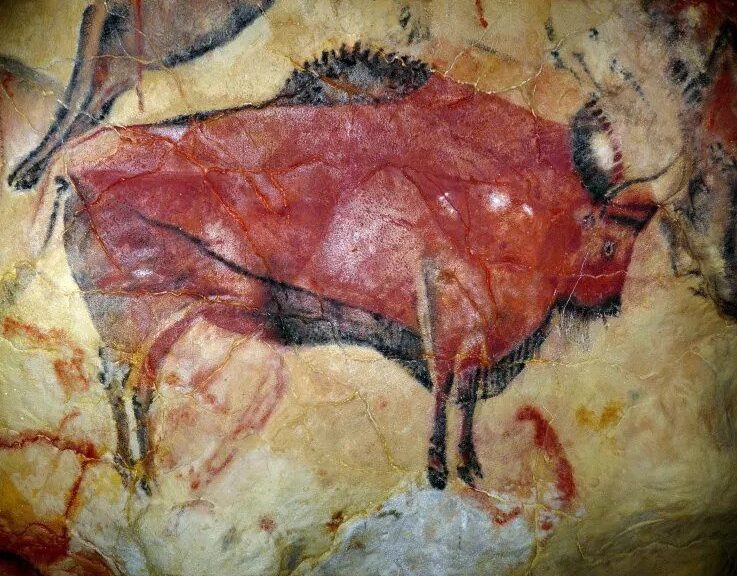
Spain is home to some of the world’s most important examples of prehistoric rock art and engravings, such as those at Altamira and El Castillo, which have some of the earliest known. Indeed, the country is home to the greatest number of documented rock art sites in the world.