Oldest Circular Structure Discovered – and It’s Made of MammothBones
Huts built from mammoth bones found along the Dniepr river valley of Ukraine (and also at locations in Moravia, Czech Republic, and in southern Poland) may be the earliest structures built by prehistoric man, and thus the earliest examples of architecture.
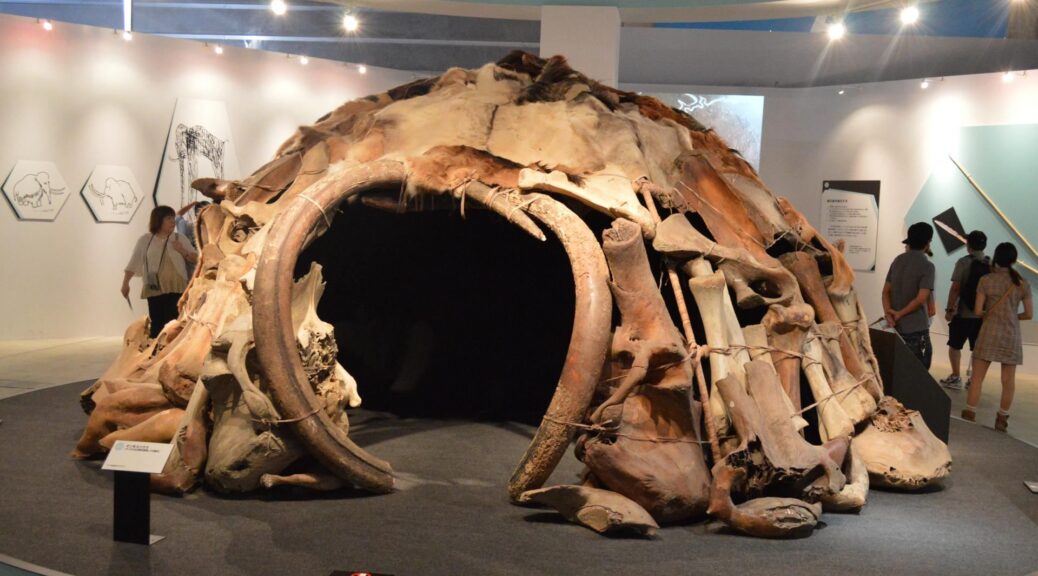
Perhaps the earliest example of domed architecture, the mammoth huts found in Mezhyrich, Ukraine, could be up to 25,000 years old. “Mammoth House” is shown at the “Frozen Woolly Mammoth Yuka Exhibit” in Yokoyama, Japan in Summer 2013.
Some of the most notable of these mammoth bone huts were found in Mezhyrich, a village in central Ukraine, where in 1965, a farmer dug up the lower jawbone of a mammoth while in the process of expanding his cellar.
Further excavations revealed the presence of 4 prehistoric huts, made up of a total of 149 mammoth bones.
These shelters date between 23,000 BCE and 12,000 BCE, and are thought to be some of the oldest dwellings known to have been constructed by prehistoric man, usually attributed to Cro-Magnons.
“They are composed of several hundred bones and tusks arranged in a rough circle, between 6 and 10 m (20 and 33 ft) in diameter.
A hearth typically lies near the centre of the former dwelling, and stone tools and other debris are scattered within and outside the structure. Large pits filled with stone tools, bone fragments and ash have been found near the houses.
Artist rendition of dwelling in Mezhirich, Ukraine, made of mammoth bones. Source: Dolní Věstonice Museum
“Considerable effort must have been required to assemble these structures. Even in a dry state, large mammoth bones weigh hundreds of pounds. It has been suggested that the bones and tusks were recovered from hunting episodes in which entire herds of adult mammoths and their young were slaughtered.
A more likely explanation is that they were gathered from natural accumulations of bones perhaps at the mouths of streams and gullies near the sites.
The primary purpose of the mammoth-bone dwellings which were presumably covered with animal skins was probably sheltered from extreme cold and high winds.
Some archaeologists, impressed with the size and appearance of the structures, have argued that they also possess religious or social significance.
They have been described as the earliest examples of ‘monumental architecture as evidence of increased social complexity and status differentiation during the final phase of the Ice Age.” (Paul G. Bahn (ed) 100 Great Archaeological Discoveries [1995] 54-55)
Mammoth bone dwelling. Reconstruction is based on the example of Mezhirich. Exhibit in the National Museum of Nature and Science, Tokyo, Japan.
Other interesting objects have also been found on the site, including a map inscribed onto a bone, presumably showing the area around the settlement.
The remains of a “drum”, made of a mammoth skull painted with a pattern of red ochre dots and lines, were also discovered, along with amber ornaments and fossil shells.
Ancient stone tomb linked to King Arthur legend is older than Stonehenge, scientists say
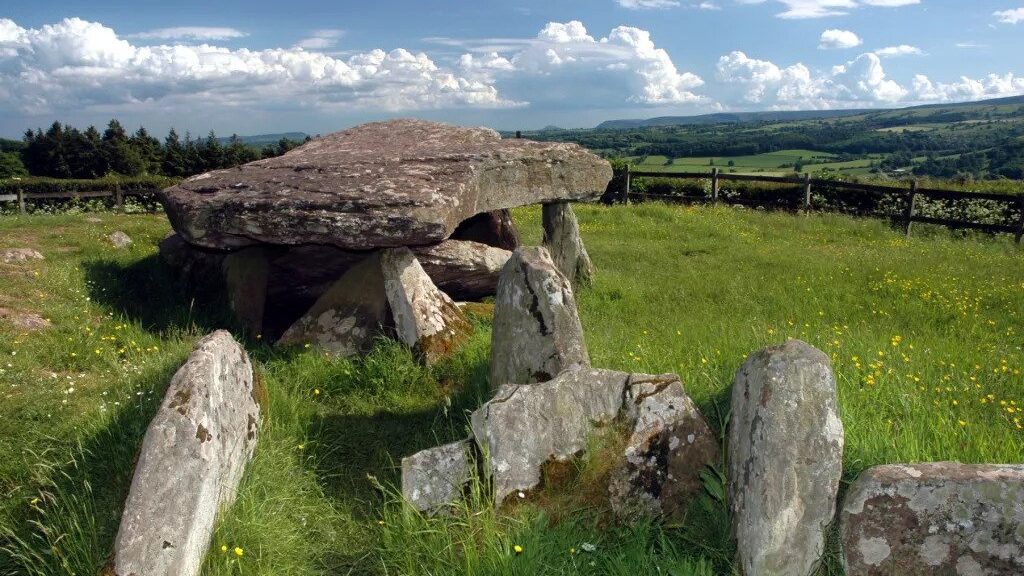
According to researchers, a mystery stone tomb in western England known as Arthur’s Stone — named after the mythical King Arthur — originated almost 6,000 years ago as part of an elaborate “ceremonial landscape” across the whole area.
The ancient monument is linked by legends to the mythical King Arthur, but archaeologists say it was built in the Neolithic period almost 6,000 years ago.
Excavations this year near the ancient stone structure in rural Herefordshire, just east of the River Wye between England and Wales, show that the site was first occupied by an earthen mound pointing to another ancient structure nearby; but that a few hundred years later, it was rebuilt and realigned to point to hills much farther south, project leader Julian Thomas, a professor of archaeology at the University of Manchester in the U.K., told Live Science in an email.
“This is a ceremonial landscape like those around Stonehenge or Avebury, but rather earlier,” Thomas said. “It certainly implies that this is a location that was politically or spiritually important at the start of the Neolithic.”
Recent excavations near Arthur’s Stone have revealed it was the site of two different Neolithic tombs aligned in different directions.
Arthur’s Stone consists of nine upright, or “standing,” stones that support an immense “capstone” weighing more than 25 tons (23 metric tons). The passage underneath leads to what’s thought to be a burial chamber, although no human remains have been found there.
The structure gets its name from legends of King Arthur, who is said to have resisted the Saxon invasion of Britain about 1,500 years ago.
Several historical events have also taken place there, including a duel between knights during the Wars of the Roses in the 15th century.
In 1645, during the English Civil War, King Charles dined with his army there. And according to the website Mysterious Britain, Arthur’s Stone was C.S. Lewis’s inspiration for the “stone table” where Aslan the Lion was sacrificed in his “Narnia” stories.
The surviving stones are thought to be part of a tomb built about 5,500 years ago that was aligned to a prominent gap between hills on the horizon.
Stone table
The excavations revealed that the first earthen mound at the Arthur’s Stone site pointed to the so-called Halls of the Dead, which teams led by Thomas discovered on a ridge a little over 1,000 yards (910 meters) away in 2013.
The Halls of the Dead were originally large timber buildings that were deliberately burned down and replaced by three earthen burial mounds, possibly after a local leader had died. The remains of similar wooden buildings have been found at Neolithic cemeteries in Europe.
The original mound site was retained by a palisade of upright wooden posts and was very similar to the central mound at the Halls of the Dead site, Thomas said. But the posts soon rotted away and the mound collapsed, so a second monument was built at the site up to 200 years later.
The rebuilt monument, probably consisting of the stones that remain today within a second earthen mound, also had an “avenue” of wooden posts that pointed toward a prominent gap between two hills on the horizon about 12 miles (20 kilometres) away, he said.
“Significantly, the stone elements are on the later alignment, along with the post avenue, and that is one of the reasons why I think they form part of the later version of the monument,” Thomas said. “I think the initial emphasis is on the internal relationships between the monuments that make up the complex but that later, the focus shifts outwards.”
Archaeologists think the first tomb at the site was built about 5700 years ago and aligned with nearby tombs called the “Halls of the Dead.”
King Arthur
Arthur’s Stone is now one of the most distinctive and best-known Neolithic monuments in England. Several local legends link it to King Arthur. However, it must have stood for several thousand years by his time, and most historians think Arthur probably didn’t exist.
According to one tale, marks on one of the stones were made by Arthur when he knelt there to pray; another story is that those marks are the indentations of the elbows of a giant he killed. The monument also supposedly marks where Arthur was buried.
Mysterious ‘Super-Henge‘ Found Near Stonehenge High-resolution ground-penetrating radar and other archaeological technologies have revealed up to 9 large intentionally placed stones outlining a crescent-shaped arena less than 2 miles away from the well-known Stonehenge in the UK Durrington Walls area. The site was home to a large Neolithic prehistoric settlement built about 4,500 years ago.
Arthur’s Stone seems to have been part of a ceremonial landscape during the early Neolithic period beginning about 5,700 years ago. The realignment of the stones about 5,500 years ago seems to have been part of an expansion of that landscape.
For example, the later alignment may have indicated that that the gap in the hills it pointed to was an important route for travellers or “a source of some important resource, or a place where allied communities lived, or another place of spiritual significance,” Thomas said.
Other features of the landscape, including several other earthen mounds and a Neolithic “causeway” and enclosure, were “an indication that this was a place that people came to for gatherings, meetings, [and] feasting … and a place that retained its significance for centuries,” he said.
In Madrid, a 76,000-year-old Neanderthal hunting camp was discovered
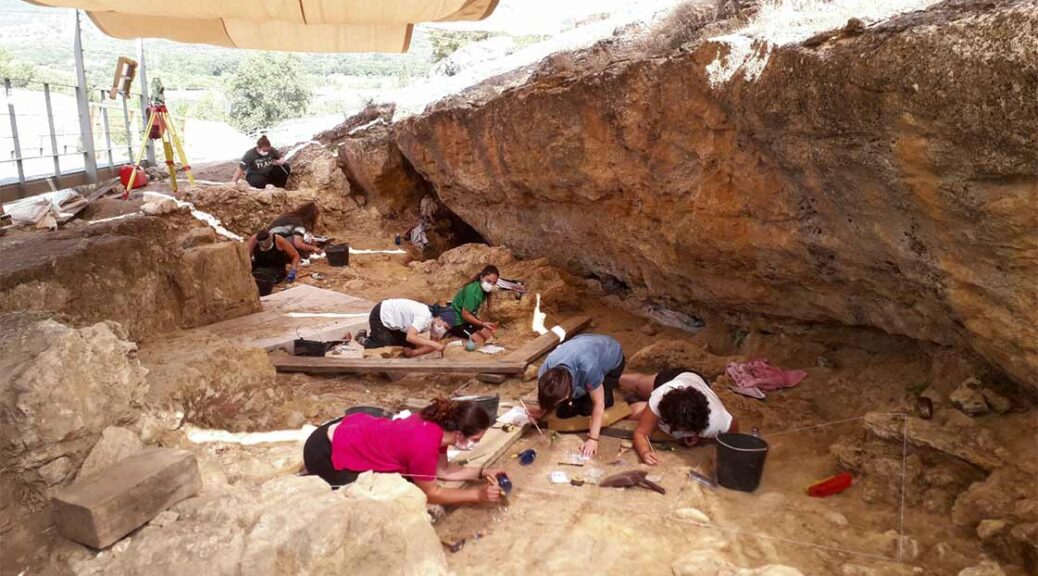
In Madrid, archaeologists have uncovered an ancient camp where Neanderthals conducted ‘hunting parties’ 76,000 years ago to chase down big bovids and deer. Archaeologists think it is the largest such camp in the Iberian Peninsula region, with a total area of 3,200 square feet (300 square meters).
They think it may have acted as an intermediary between Neanderthals hunting their prey and the place of final consumption, where the whole group would take advantage of the resources that the hunting parties had gathered.
An analysis of fauna at the Abrigo de Navalmaíllo site in Pinilla del Valle, Madrid helped researchers make the discovery.
Findings: An ancient camp where Neanderthals hosted ‘hunting parties’ to track down large bovids and deer 76,000 years ago has been found in Madrid. Animal remains (pictured) recovered from the site helped archaeologists identify the camp
Covering a space of 3,200 sq ft (300m2), archaeologists believe the Abrigo de Navalmaíllo site in Pinilla del Valle, Madrid (pictured) could be the largest such camp in the Iberian Peninsula region
Faunal remains from the Navalmaíllo site include a) jaw of a large bovid; b) rhinoceros molar; c) horse molar; d) molar hyena; e) stone tool cutting marks, and f) percussion mark to access the medulla of a long bone
A taphonomic study of fauna at the Abrigo de Navalmaíllo site showed that it matched remains found at similar hunting camps but not those at previously identified Neanderthal residential camps (pictured above)
This looks at the entire process of what happens after an organism dies and eventually becomes a fossil.
‘We have been able to demonstrate with great certainty that the Neanderthals of Navalmaíllo hunted mainly large bovids and deer that they processed at the site and that they would later move to a second referential place,’ said Abel Moclán, the study’s lead author and a researcher at the National Center for Research on Human Evolution.
‘This aspect is very interesting since there are very few deposits in the Iberian Peninsula where this type of behaviour has been identified.
‘For all this, we have used very powerful statistical tools, such as Artificial Intelligence.’
Archaeologists have previously found evidence of other Neanderthal activity in the region, including the making of stone tools or the use of fire.
With this latest discovery, researchers think it was used as a short-term base by Neanderthal groups.
Animals were captured locally, transported to the camp, and following their processing, parts of them would have been transported elsewhere.
All phases of butchery were identified, along with the extraction of marrow from long bones, revealing an interest in obtaining this nutritious food.
Human use of animal resources at the site reflects a focus on hunting large bovids and cervids, or deer, while horses, rhinoceroses and small-sized animals were much less frequent, the researchers said.
The activity of carnivores was also identified, but these animals, including hyenas, mostly left behind the remains of small prey or fed upon carcasses abandoned at the camp by human hunters.
‘Navalmaíllo is one of the few archaeological sites in Iberia that can be interpreted as a hunting camp,’ the study’s authors said, but added that ‘it is probable that more hunting camps are present in the Iberian Peninsula but are yet to be found.’
This map of the Iberian Peninsula shows the location of the Abrigo de Navalmaíllo excavation sites as well as those sites dated in the Upper Pleistocene
These graphs show the types of very large, large, medium and small-sized animals found at the site. Human use of animal resources at the site reflects a focus on primary access to large bovids and cervids. Access to horses, rhinoceroses and small-sized animals was much less frequent, the researchers said
Earlier this month separate research claimed that cave paintings drawn by Neanderthals of swirling dots, ladders, animals and hands show our distant cousins were more artistic than first thought.
A flowstone formation at the Cueva de Ardales, Málaga in Spain is stained red, originally thought to be a natural coating of iron oxide deposited by flowing water.
However, samples of the red residue allowed a team from Barcelona University to re-examine its origins and confirm it was created by Neanderthals 65,000 years ago.
They found the ochre-based pigment was intentionally applied by Neanderthals, as modern humans had yet to make their appearance on the European continent.
‘Extraordinary’ 800-year-old chain mail found in Co Longford
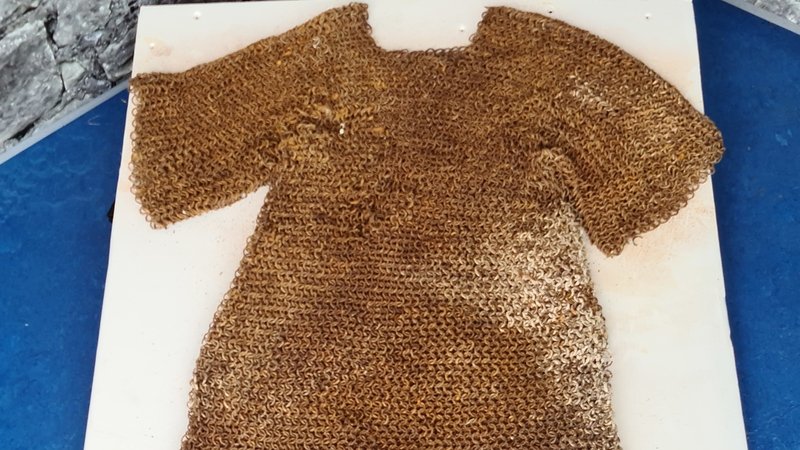
In 1169 AD, Norman invaders arrived in County Wexford, Ireland. Now, a rare and complete, 800-year-old Norman “hauberk” (chainmail vest) has been discovered in County Longford thought to date to when the Normans arrived there in 1172.
The “hauberk” was a coat of upper body armour that was often referred to as a “byrnie.” Made of chain mail, the wearable metal material was much more flexible and lightweight compared with the stiffer and heavier plate armour.
It was an almost perfectly preserved hauberk that was recently discovered in a shed at an undisclosed location in Ireland. According to a report in RTE the ancient armour is currently being held by the local tourist attraction, “ Granard Knights & Conquests,” prior to being exhibited to the public at the National Museum of Ireland.
The chainmail vest or hauberk at the Granard Knights & Conquests Heritage Center, Longford.
A Real Ancient Treasure For Heritage Week
The piece of rare, and almost complete, ancient Norman armour, that is soaked with the history of 800 years, was recently found rusting in a garden shed.
The discoverer only realized what he had in his shed after attending a ‘Norman People’ event at Granard Knights & Conquests, as part of National Heritage Week. When the finder went home and recognized the item in his shed was virtually the same as those worn by the actors earlier they came forward and informed Irish antiquary authorities.
Tourism and Education Officer for Granard Knights & Conquests, Deirdre Orme, told RTE that the hauberk is an “absolutely amazing discovery.” Furthermore, General Manager of Granard Knights & Conquests, Mr Bartle D’Arcy, explained that while the artefact was not discovered in Granard, or at Granard Motte, it was dug up from a drain nearby. Now, the National Museum of Ireland has announced that their restorers will preserve the rare piece of Norman armour.
A modern replica of Norman chainmail armour.
An Origin Story As Grand As The Discovery, Perhaps?
Deirdre Orme of Granard Knights & Conquests said the team were “completely blown away” when the finder presented their team of history lovers with the 800-year-old hauberk. The reason for her excitement was because the whole scenario “completely links into what we’re doing here at the centre – tapping into our Norman history and heritage.”
The hauberk dates back to approximately 1172 AD when the Normans first arrived in Ireland. This is why the archaeologists at the National Museum of Ireland are associating the discovery with the story of Richard De Tuite, Lord Chief Justice of Ireland, who in 1199 AD built a timber-frame castle and motte.
Whether or not the armour was indeed linked with the story of Richard De Tuite, or not, Mr D’Arcy said that for the finder to have discovered the almost whole, original Norman hauberk. “is just beyond belief.” And the Norman culture specialist added that the whole discovery was amplified because it coincides with Heritage Week.
Apart from rust, the armour is almost flawless.
Changing The Face Of Ireland Forever
The history of Ireland is greatly composed of stories of ancient invasions. The native Fir Bolg were defeated by the Tuatha De Dannan and they themselves were banished to the mounds to exist only as faeries.
However, none of the mythological invasions was so near-genocidal as were the real-life Norman invasions. For while several waves of giants and semi-divine armies have attacked Ireland in ancient legends, none of them aimed to eradicate Irish culture so much as did the Normans, backed by forces of Rome.
According to the New World Encyclopedia, the Norman invasion of Ireland led to “the eventual entry of the Lordship of Ireland into the Angevin Empire.” This meant the Normans had the blessing of the Pope, which was a way to punish the island’s Christianity that had failed to conform to Rome’s strict rules of worship.
The immediate consequences were the end of the ancient linage of Irish High Kings and all of the timeworn ways of living and dying, and the onset of English rule in Ireland, which continued until 1922.
The Norman hauberk is an artefact from the first days of these cataclysmic changes that would entirely change the destiny of the Emerald Isle.
Tourists dive into underwater archaeological Roman party town
Fish dart across mosaic floors and into the ruined villas, where holidaying Romans once drank, plotted and flirted in the party town of Baiae, now an underwater archaeological park near Naples.
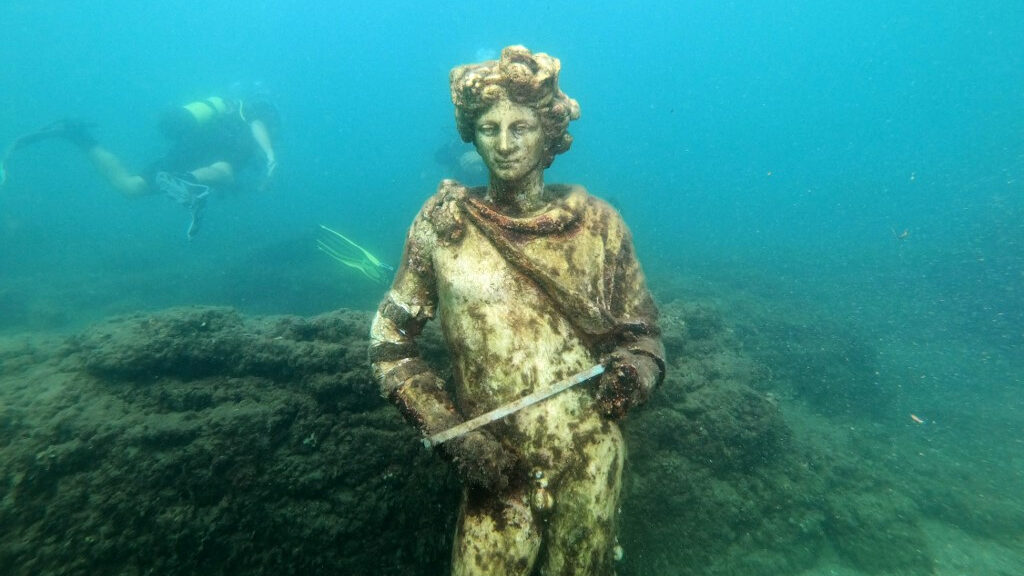
Statues which once decorated luxury abodes in this beachside resort are now playgrounds for crabs off the coast of Italy, where divers can explore ruins of palaces and domed bathhouses built for emperors.
Rome’s nobility were first attracted in the 2nd century BC to the hot springs at Baiae, which sits on the coast within the Campi Flegrei — a supervolcano known in English as the Phlegraean Fields.
It was where “old men behave like young boys, and lots of young boys act like young girls,” according to the Roman scholar Varro.
But by the 4th century, the porticos, marble columns, shrines and ornamental fish ponds had begun to sink due to bradyseism, the gradual rise and fall of land due to hydrothermal and seismic activity.
The whole area, including the neighbouring commercial capital of Pozzuoli and military seat at Miseno, were submerged. Their ruins now lie between four and six metres (15 to 20 feet) underwater.
‘Something unique’
“It’s difficult, especially for those coming for the first time, to imagine that you can find things you would never be able to see anywhere else in the world in just a few metres of water,” said Marcello Bertolaso, head of the Campi Flegrei diving centre, which takes tourists around the site.
In this photograph taken on August 18, 2021 a dive guide shows tourists a copy of the original statue preserved at the Museum of Baiae, representing Dionysus with ivy crown in the Nymphaeum of punta Epitaffio, the submerged ancient Roman city of Baiae at the Baiae Underwater Park.
“Divers love to see very special things, but what you can see in the park of Baiae is something unique.”
The 177-hectare (437-acre) underwater site has been a protected marine area since 2002, following decades in which antiques were found in fishermen’s nets and looters had free rein.
Divers must be accompanied by a registered guide.
A careful sweep of sand near a low wall uncovers a stunning mosaic floor from a villa which belonged to Gaius Calpurnius Pisoni, known to have spent his days here conspiring against Emperor Nero.
Explorers follow the ancient stones of the coastal road past ruins of spas and shops, the sunlight on a clear day piercing the waves to light up statues. These are replicas; the originals are now in a museum.
“When we research new areas, we gently remove the sand where we know there could be a floor, we document it, and then we re-cover it,” archaeologist Enrico Gallocchio told AFPTV.
“If we don’t, the marine fauna or flora will attack the ruins. The sand protects them,” said Gallocchio, who is in charge of the Baiae park.
“The big ruins were easily discovered by moving a bit of sand, but there are areas where the banks of sand could be metres deep. There are undoubtedly still ancient relics to be found,” he said.
Spinning Tools Recovered from 2,000-Year-Old Grave in Poland
Archaeologists have uncovered a 2,000-year-old grave containing human remains lying one on top of the other, spindle whorls and the remains of distaffs during barrow excavations in the Sarbia forestry district.
The remains are thought to date back to the Wielbark culture and according to researchers the presence of the weaving materials suggest that the bodies had similar professions.
Spindle whorls are weights attached to a spindle, they prevent the threads from sliding and maintain the speed of the spin. They have a hole in the middle. They are usually made of clay, less frequently of stone. In both graves, there were also silver, S-shaped clasps, and similar bowls.
Head of the research project Professor Andrzej Michałowski from the Faculty of Archaeology at the Adam Mickiewicz University, attempted to reconstruct the funeral ritual and the reason for finding two burials under the barrow.
He said: “The body of the deceased was already in a wooden boat, which she used to take to cross to the other bank of the river… It seemed as if she was napping after work, dressed in her best robes. Her chest decorated with a rain of beads made of glass, amber and bone… Pendants sparkling in the necklace. The silver sparkle of the S-shaped clasp on her neck.”
During the excavation, the remains of a box placed at her feet were also discovered.
Michałowski said: “It contained her beloved work tools. A set of professional whorls and two distaffs, so that in the afterlife she would be able to weave the most delicate fog that would move over the valley of the river. Or heavy stormy clouds racing over the edge of the valley… Favourite pins to catch her unruly hair that disrupted her work.”
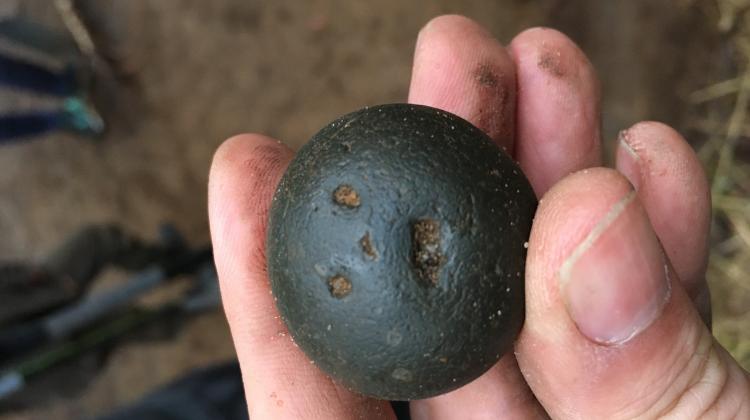
He added that in his opinion, the spinner’s apprentice attended the funeral and during the ceremony threw a pebble with a carved face outline into the grave (archaeologists found such a pebble during excavations).
He said: “She missed her. She, too, wanted to go where the Great Spinner went. Touch the threads again together and magic them into the weaving of fabrics.
Since the death of the Master, she knew that she would no longer be able to do this magic with her as before. She saw only one goal… The next day, a fisherman walking towards the river saw a small body floating on the waves.”
After the apparent suicide, the spinner’s apprentice was buried in the same barrow where the Great Spinner had been buried.
Michałowski said: “For her journey, she received her whorls, reminiscent of flowers or stars hanging on the riverside sky on a summer night, and a small distaff. A small S-shaped clasp glimmered in her burnt remains. A small bowl rested in a dug pit.”
He added: “Only the stone with a face really knows the truth.”
At the site of a new apartment building, a mass burial of 18th century plague victims was discovered.
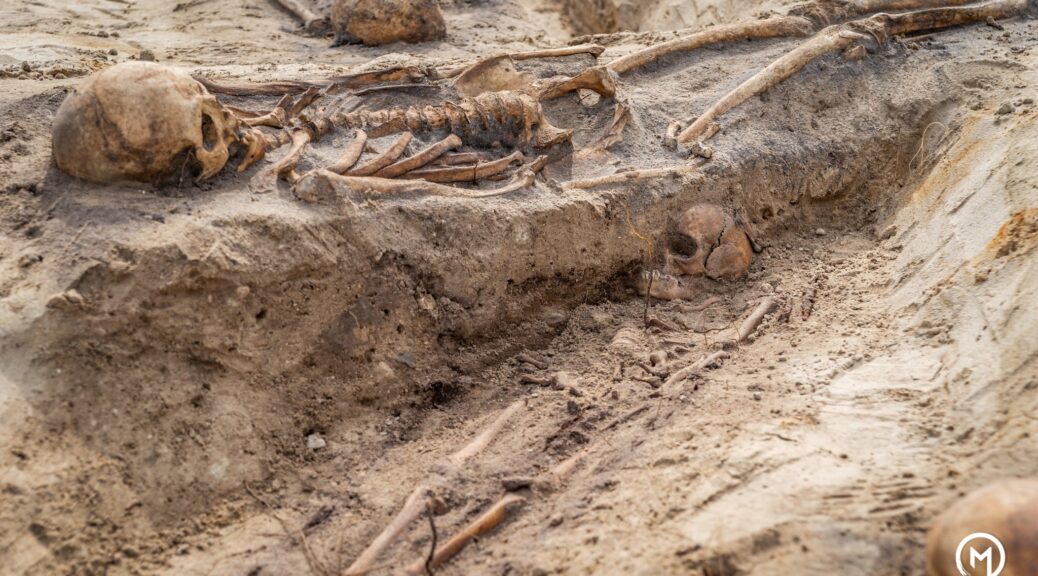
An 18th-century cemetery containing the remains of plague victims has been uncovered during an apartment build in northern Poland. The grim discovery was made after builders stumbled upon human remains during work at the site in Mikołajki in the Warmian-Maurian Voivodeship.
The grim discovery was made after builders stumbled upon human remains during work at the site in Mikołajki in the Warmian-Maurian Voivodeship.
The find included two cemeteries, one dating between the 17th -19th century and a second from the 18th century when a plague swept through the Mazurian region.
The find included two cemeteries, one dating between the 17th -19th century and a second from the 18th century when a plague swept through the Mazurian region.
Archaeologist Agnieszka Jaremek vice-president of the Dajna Foundation said: “It is mentioned in sources that there was not enough space in the cemetery by the church and that’s why victims were buried by the road leading to Mrągowo.
“Everything points to the fact that we have uncovered that place.
“Many graves conceal whole families – both adults and children.”
The find included two cemeteries, one dating between the 17th -19th centuries and a second from the 18th century when a plague swept through the Mazurian region.
So far the remains of 100 people have been uncovered in 60 graves.
Known as the Great Northern War plague of 1700–1721, the epidemic swept across what is now northern Poland and other parts of Central Eastern Europe killing hundreds of thousands.
By the time the plague had faded out by December 1709 in the then city of Danzig, around half of its inhabitants had been killed.
After the plague, near to the graves of victims, further dead were buried and burials could have taken place there until the start of the 19th century.
In these graves, archaeologists uncovered items such as buttons.
Joanna Sobolewska, director of the Department for the Protection of Monuments in Olsztyn said that the uncovered human remains would be subjected to tests and anthropological analysis and after the end of tests, they would probably be buried in a communal grave. “The issue of the exact burial place is a question for the future”, she said.
The human remains will now be subjected to tests and anthropological analysis before being buried in a communal grave.
The site also concealed the remains of a Neolithic settlement and during works lasting several weeks, archaeologists from the Dajna Foundation in the name of Jerzy Okulicz-Kozaryn discovered remains from the Roman period.
Archaeologists think it is possible that the site was chosen for a settlement due to its proximity to a lake on one side and flat terrain on the other and according to estimates, the settlement could have occupied an area of 30-50 acres.
The Dajna Foundation’s Jaremek said: “Among the artefacts which we found are elements of ceramic plates as well as a blue glass bead.”
An ancient statue of the mythological goddess Hygieia – seen as the guardian or personification of health – has been discovered in an ancient city in western Turkey, according to a researcher.
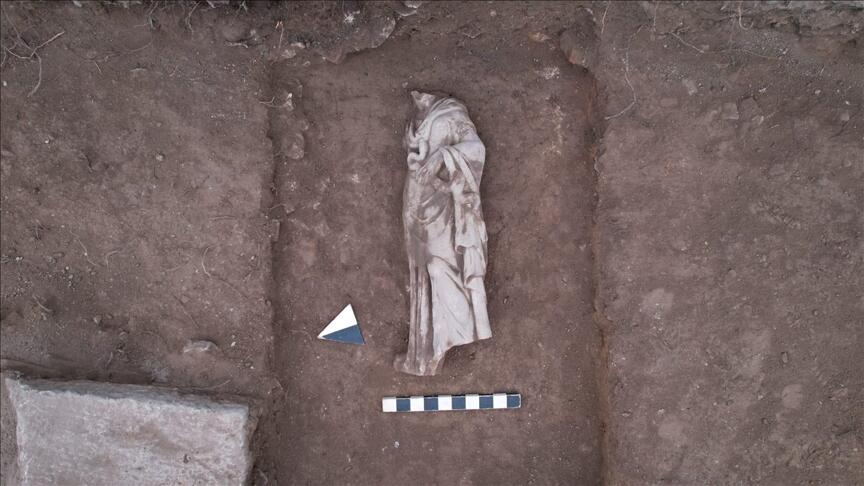
“We unearthed a statue of Hygieia, known as the goddess of health and cleanliness, the daughter of Asclepius, the god of health in Greek and Roman mythology,” Gökhan Coşkun, who coordinates the dig in the ancient city of Aizanoi, told Anadolu Agency.
Noting that the marble statue’s head is missing – the fate of much ancient statuary – Coşkun, an archaeologist at Dumlupinar University in central Turkey, said: “Unfortunately, it hasn’t survived to the present day, but in its current form, we can see that this statue is about the size of a human.”
“During past digs in Aizanoi, finds related to Hygieia were also found,” he said. “This situation makes us think that there may have been some construction and buildings related to the health cult in Aizanoi during the Roman era.”
Located near the town of Cavdarhisar in the Kutahya province, the site is also home to one of the best-preserved temples in Anatolia dedicated to Zeus, the thunderbolt-wielding king of the Greek Olympians.
Groundbreaking ancient site
Seen as boasting a history rivaling Ephesus, another iconic ancient city in Turkey, Aizanoi was added to the UNESCO World Heritage Tentative List in 2012, with excavation efforts ongoing now for almost a decade.
Coşkun said that around 100 workers and 25 technical personnel are working on digs at the nearly 5,000-year-old site.
“We’re trying to reveal the columned galleries on the west and south wings of the agora (bazaar) and the shops right behind them,” he added.
Coşkun added that the statue of Hygieia – related to the modern word “hygiene” – was unearthed inside the columned gallery on the south wing of the agora.
Located 57 kilometres (35 miles) from the Kütahya city centre, the ancient site saw its golden age in the second and third centuries AD and became “the centre of the episcopacy in the Byzantine era,” according to the website of the Turkish Culture and Tourism Ministry.
Recent excavations around the Temple of Zeus indicate the existence of several levels of settlement in the city dating from as far back as 3000 BC. In 133 BC, it was captured by the Roman Empire.
In 1824, European travellers rediscovered the ancient site.
Between 1970 and 2011, the German Archeology Institute unearthed a theatre and a stadium, as well as two public baths, a gymnasium, five bridges, a trading building, necropolises and the sacred cave of Metre Steune – a cultist site thought to be used prior to the first century BC.
Since 2011, Turkish archaeologists have been carrying out the work at the ancient site. This year, the excavations were transferred to the Kutahya Museum Directorate.