Revealed: The ‘lost’ Anglo-Saxon monastery discovered next to Cookham church
Archaeologists from the University of Reading have excavated a ‘lost” Anglo-Saxon monastery, in the present-day Berkshire village of Cookham, England. Despite being mentioned in a historical text, the location of the monastery had remained a mystery, with contemporary records placing it under the rule of a royal abbess: Queen Cynethryth, the widow of the powerful King Offa of Mercia.
Queen Cynethryth was the only Anglo Saxon queen to appear on her own on a coin.
Excavations were conducted by archaeologists from the University of Reading on the grounds of Holy Trinity, where they uncovered the remains of timber buildings that would have housed the inhabitants of the monastery, alongside artefacts providing insights into their lives.
Dr Gabor Thomas, the University of Reading archaeologist who is leading the excavation, said: “The lost monastery of Cookham has puzzled historians, with a number of theories put forward for its location.
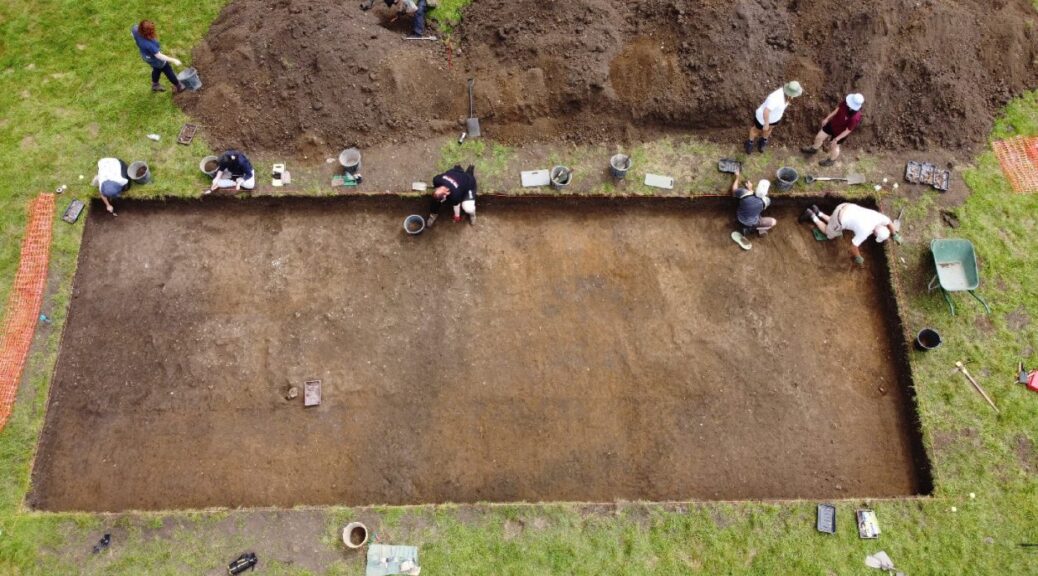
Excavations of the lost monastery presided over by Queen Cynethryth.
We set out to solve this mystery once and for all. “The evidence we have found confirms beyond doubt that the Anglo-Saxon monastery was located on a gravel island beside the River Thames now occupied by the present parish church.
“Despite its documented royal associations, barely anything is known about what life was like at this monastery, or others on this stretch of the Thames, due to a lack of archaeological evidence.
The remains of the monastery led by the Anglo-Saxon ruler Queen Cynethryth were found near the banks of the Thames, in a field next to the parish church.
The items that have been uncovered will allow us to piece together a detailed impression of how the monks and nuns who lived here ate, worked and dressed. This will shed new light on how Anglo-Saxon monasteries were organised and what life was like in them.”
A network of monasteries was established on sites along the route of the Thames to take advantage of what was one of the most important trading arteries in Anglo-Saxon England, enabling them to develop into wealthy economic centres.
The stretch of the Thames in which Cookham falls formed a contested boundary between the kingdoms of Mercia and Wessex, so the monastery here had particular strategic and political importance. In spite of this historical background, the exact location of the monastery has been long debated.
Wealth of evidence
The excavation, in August, sought to answer this question by investigating open spaces straddling the churchyard of Holy Trinity Church, which still stands today.
The team have discovered a wealth of evidence including food remains pottery vessels used for cooking and eating, and items of personal dress including a delicate bronze bracelet and a dress pin, probably worn by female members of the community.
Clear evidence has emerged for the layout of the monastery which was organised into a series of functional zones demarcated by ditched boundaries.
One of these zones appears to have been used for housing and another for industrial activity indicated by a cluster of hearths probably used for metalworking.
‘Influence and status’
Dr Thomas added: “Cynethryth is a fascinating figure, a female leader who clearly had genuine status and influence in her lifetime. Not only were coins minted with her image, but it is known that when the powerful European leader Charlemagne wrote to his English counterparts, he wrote jointly to both King Offa and Queen Cynethryth, giving both equal status.
“We are thrilled to find physical evidence of the monastery she presided over, which is also very likely to be her final resting place.”
Cynethryth joined a religious order and became the royal abbess of the monastery after the death of her husband, King Offa, in AD 796. Before his death, he had ruled Mercia, one of the main Anglo Saxon kingdoms in Britain, which spanned the English Midlands.
King Offa is considered by many historians to have been the most powerful Anglo-Saxon king before Alfred the Great. He is known for ordering the creation of the earth barrier on the border between England and Wales, known as Offa’s Dyke, which can still be seen today.
Cynethryth is the only Anglo-Saxon queen known to be depicted on a coin – a rarity anywhere in Western Europe during the period. She died sometime after AD 798.
When German archaeologist Klaus Schmidt first began excavating on a Turkish mountaintop 25 years ago, he has convinced the buildings he uncovered were unusual, even unique.
Atop a limestone plateau near Urfa called Gobekli Tepe, Turkish for “Belly Hill”, Schmidt discovered more than 20 circular stone enclosures. The largest was 20m across, a circle of stone with two elaborately carved pillars 5.5m tall at its centre. The carved stone pillars – eerie, stylised human figures with folded hands and fox-pelt belts – weighed up to 10 tons. Carving and erecting them must have been a tremendous technical challenge for people who hadn’t yet domesticated animals or invented pottery, let alone metal tools. The structures were 11,000 years old, or more, making them humanity’s oldest known monumental structures, built not for shelter but for some other purpose.
The structures were 11,000 years old, or more, making them humanity’s oldest known monumental structures
After a decade of work, Schmidt reached a remarkable conclusion. When I visited his dig house in Urfa’s old town in 2007, Schmidt – then working for the German Archaeological Institute – told me Gobekli Tepe could help rewrite the story of civilisation by explaining the reason humans started farming and began living in permanent settlements. The stone tools and other evidence Schmidt and his team found at the site showed that the circular enclosures had been built by hunter-gatherers, living off the land the way humans had since before the last Ice Age. Tens of thousands of animal bones that were uncovered were from wild species, and there was no evidence of domesticated grains or other plants.
Schmidt thought these hunter-gatherers had come together 11,500 years ago to carve Gobekli Tepe’s T-shaped pillars with stone tools, using the limestone bedrock of the hill beneath their feet as a quarry.
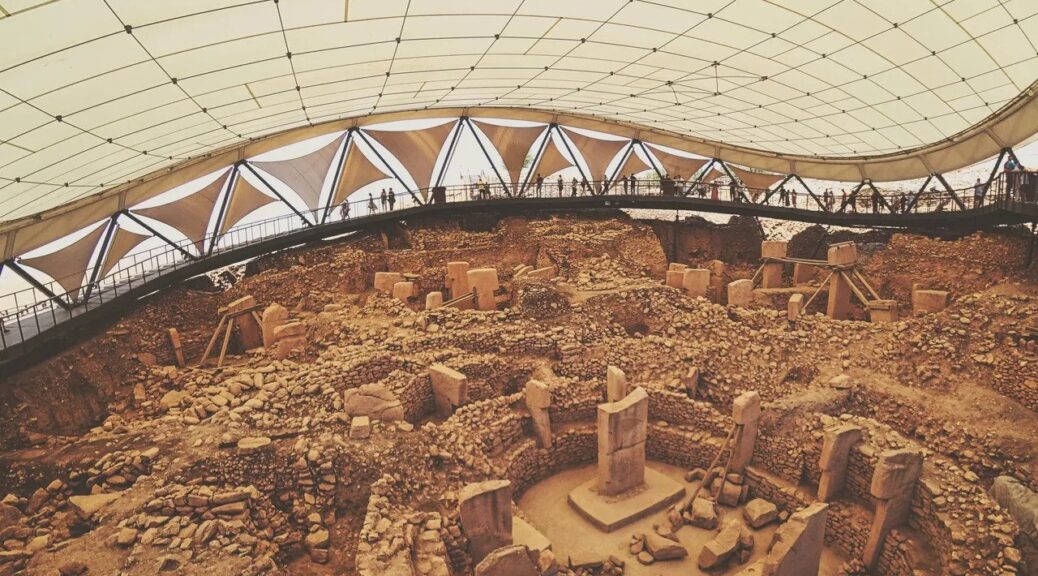
Situated in modern-day Turkey, Gobekli Tepe is one of the most important archaeological sites in the world
Carving and moving the pillars would have been a tremendous task, but perhaps not as difficult as it seems at first glance. The pillars are carved from the natural limestone layers of the hill’s bedrock. Limestone is soft enough to work with the flint or even wood tools available at the time, given practice and patience. And because the hill’s limestone formations were horizontal layers between 0.6m and 1.5m thick, archaeologists working at the site believe ancient builders just had to cut away the excess from the sides, rather than from underneath as well. Once a pillar was carved out, they then shifted it a few hundred metres across the hilltop, using rope, log beams and ample manpower.
Schmidt thought that small, nomadic bands from across the region were motivated by their beliefs to join forces on the hilltop for periodic building projects, hold great feasts and then scatter again. The site, Schmidt argued, was a ritual centre, perhaps some sort of burial or death cult complex, rather than a settlement.
That was a big claim. Archaeologists had long thought complex ritual and organised religion were luxuries that societies developed only once they began domesticating crops and animals, a transition known as the Neolithic. Once they had a food surplus, the thinking went, they could devote their extra resources to rituals and monuments.
Gobekli Tepe, Schmidt told me, turned that timeline upside down. The stone tools at the site, backed up by radiocarbon dates, placed it firmly in the pre-Neolithic era. More than 25 years after the first excavations there, there is still no evidence for domesticated plants or animals. And Schmidt didn’t think anyone lived at the site full-time. He called it a “cathedral on a hill”.
More than 25 years after the first excavations there, there is still no evidence for domesticated plants or animals.
If that was true, it showed that complex ritual and social organisation actually came before settlement and agriculture. Over the course of 1,000 years, the demands of gathering nomadic bands together in one place to carve and move huge T-pillars and build the circular enclosures prompted people to take the next step: to regularly host large gatherings, people needed to make food supplies more predictable and dependable by domesticating plants and animals. Rituals and religion, it seemed, launched the Neolithic Revolution.
The next day, I drove with Schmidt to the hilltop before dawn. I wondered, mystified and awestruck, among the pillars as Schmidt, his head wrapped in a white cloth to protect it from the blazing sun, oversaw a small team of German archaeologists and workers from the small village down the road.
Gobekli Tepe’s circular structures have changed the way archaeologists look at the beginnings of civilisation
Schmidt had just published his first reports on Gobekli Tepe the year before, setting the small world of Neolithic archaeology experts abuzz. But the site still had a sleepy, forgotten feel, with excavation areas covered by makeshift corrugated steel roofs and potholed dirt roads winding up to the mountaintop dig site from the valley below.
Schmidt’s take on the site’s striking T-pillars and large, round “special buildings” captivated colleagues and journalists when they were first published in the mid-2000s. Breathless media reports called the site the birthplace of religion; the German magazine Der Spiegel compared the fertile grasslands around the site to the Garden of Eden.
Soon, people from around the world were flocking to see Gobekli Tepe for themselves. Within a decade, the hilltop was totally transformed. Until the civil war in nearby Syria disrupted tourism in the region in 2012, work on the site often slowed to a crawl as busloads of curious tourists crowded around open excavation trenches to see what some were calling the world’s first temple and made it impossible to manoeuvre wheelbarrows on the narrow paths.
Over the past five years, the mountaintop on the outskirts of Urfa has been reshaped once again. Today, roads and car parks and a visitor’s centre can accommodate curious travellers from around the world. In 2017, corrugated steel sheds were replaced by a state-of-the-art, swooping fabric-and-steel shelter covering the central monumental buildings. swooping fabric-and-steel shelter covering the central monumental buildings. The Şanlıurfa Archaeology and Mosaic Museum, , built-in 2015 in central Urfa, is one of Turkey’s largest museums; it features a full-scale replica of the site’s largest enclosure and its imposing T-pillars, allowing visitors to get a feel for the monumental pillars and examine their carvings up close.
In 2018, Gobekli Tepe was added to the Unesco World Heritage register, and Turkish tourism officials declared 2019 the “Year of Gobekli Tepe”, making the ancient site the face of its global promotion campaign. “I still remember the site as a remote place on a mountaintop,” said Jens Notroff, a German Archaeological Institute archaeologist who began working at the site as a student in the mid-2000s. “It’s changed completely.”
Gobekli Tepe was constructed more than 11,000 years ago, right on the cusp between a world of hunter-gatherers and a world of farmers
Schmidt, who died in 2014, didn’t live to see the site’s transformation from dusty mountaintop dig to major tourist attraction. But his discoveries there spurred global interest in the Neolithic transition – and in the last few years, new discoveries at Gobekli Tepe and closer looks at the results of earlier excavations are upending Schmidt’s initial interpretations of the site itself.
Work on foundations needed to support the site’s swooping fabric canopy required archaeologists to dig deeper that Schmidt ever had. Under the direction of Schmidt’s successor, Lee Clare, a German Archaeological Institute team dug several “keyhole” trenches down to the site’s bedrock, several metres below the floors of the large buildings. “We had a unique chance,” Clare said, “to go look in the lowest layers and deposits of the site.”
New discoveries at Gobekli Tepe and closer looks at the results of earlier excavations are upending Schmidt’s initial interpretations of the site.
What Clare and his colleagues found may rewrite prehistory yet again. The digs revealed evidence of houses and year-round settlement, suggesting that Gobekli Tepe wasn’t an isolated temple visited on special occasions but a rather a thriving village with large special buildings at its centre.
The team also identified a large cistern and channels for collecting rainwater, key to supporting a settlement on the dry mountaintop, and thousands of grinding tools for processing grain for cooking porridge and brewing beer. “Gobekli Tepe is still a unique, special site, but the new insights fit better with what we know from other sites,” Clare said. “It was a fully-fledged settlement with permanent occupation. It’s changed our whole understanding of the site.”
Meanwhile, Turkish archaeologists working in the rugged countryside around Urfa have identified at least a dozen other hill-top sites with similar – if smaller – T-pillars, dating from around the same time period. “It’s not a unique temple,” said Austrian Archaeological Institute researcher Barbara Horejs, an expert on the Neolithic who was not part of the recent research efforts. “That makes the story much more interesting and exciting.” Turkish Culture and Tourism Minister Mehmet Nuri Ersoy went as far as saying that this area could be referred to as the “pyramids of south-east Turkey“.
New discoveries made over the last few years may rewrite prehistory yet again
Rather than a centuries-long building project inspiring the transition to farming, Clare and others now think Gobekli Tepe was an attempt by hunter-gatherers clinging to their vanishing lifestyle as the world changed around them. Evidence from the surrounding region shows people at other sites were experimenting with domesticated animals and plants – a trend the people of “Belly Hill” might have been resisting.
Clare argues the site’s stone carvings are an important clue. Elaborate carvings of foxes, leopards, serpents and vultures covering Gobekli Tepe’s pillars and walls “aren’t animals you see every day,” he said. “They’re more than just pictures, they’re narratives, which are very important in keeping groups together and creating a shared identity.”
When I first wandered across the site more than 15 years ago, I remember a feeling of great distance. Gobekli Tepe was built 6,000 years before Stonehenge, and the exact meaning of its carvings – like the world the people there once inhabited – is impossible to fathom.
That, of course, is part of the Gobekli Tepe’s tremendous magnetism. As thousands of visitors marvel at a place most people had never heard of a decade ago, researchers will continue trying to understand why it was built in the first place. And each new discovery promises to change what we now know about the site and the story of human civilisation.
“The new work isn’t destroying Klaus Schmidt’s thesis; it stands on his shoulders,” said Horejs. “There’s been a huge gain of knowledge, in my view. The interpretation is changing, but that’s what science is about.”
TURKEY: Discovery of Ancient Relief depicting Greco-Persian wars
Archaeologists in northwestern Turkey discovered a relief on Aug. 16 depicting a war between the Greeks and Persians in the fifth century B.C.
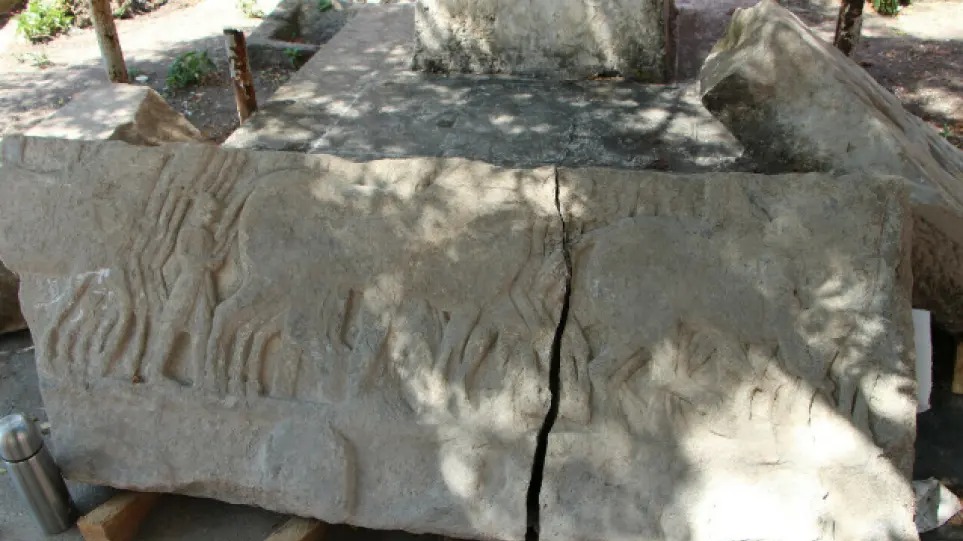
The figures on the relief show fighting Greek soldiers beneath the hoofs of Persian warhorses said archaeologist Kaan Iren, who leads the dig site of the ancient city of Dascylium found in the modern-day Bandırma district of Balıkesir province.
“Here is a scene of propaganda under the pretext of war. We can say these reliefs are a scene from the Persian-Greek wars,” İren told the state-run Anadolu Agency.
Ancient relief depicting Greek-Persian war unearthed in NW Turkey
“We think these reliefs were probably made for propaganda purposes during the wars,” he added.
Iren, who has been working at the excavation site in Dascylium with a team of 30 people since June 22, said they had unearthed parts of a stone and mudbrick wall dating back to the eighth century B.C. this year.
“Of the eighth-century-B.C. wall left from the Phrygian age, this year we unearthed an area of 4 meters high and 40 meters long. We think that this wall had a height of 7 to 8 meters.
We prepared a protection roof project for this place. We will present it to the Balıkesir Cultural Heritage Preservation Regional Board. If approved, we will take this place until protection,” said Iren, who is also a faculty member of the Muğla Sıtkı Koçman University.
The 5-meter-wide wall is believed to have been built by the ancient Phrygian civilization to protect its territory, Iren said.
Stating that the first settlers of the ancient city were the Phrygians, İren mentioned that the last place where this civilization was seen in the north and west of Anatolia was Dascylium.
“The wall is a 5-meter-wide fortification wall that these people built to protect their own space. Our work continues here.
There is a tower just ahead. We will continue to work until this tower. If the sponsors continue in the coming seasons, we will open this area completely and bring it to tourism,” he said.
İren said that the discovery of reliefs during the wall excavation this year was a surprise. Stating that the reliefs carved into the stone were cleaned by the restorers in the excavation house, İren said: “The relief, dating from the Persian era in the fifth century B.C., depicts the war between the Persians and the Greeks.
This was one of the most important findings of the season for us. In the figures on it, there are Greek soldiers fighting and Persians on horseback fighting them. Greek soldiers are depicted under the hoofs of Persian horses.
There is a propaganda scene here under the pretext of war. We can say that these reliefs are a scene from the Persian-Greek wars. We think that these reliefs were probably made for propaganda purposes during the wars.”
Traces of Medieval Abbey Uncovered in Northeastern England
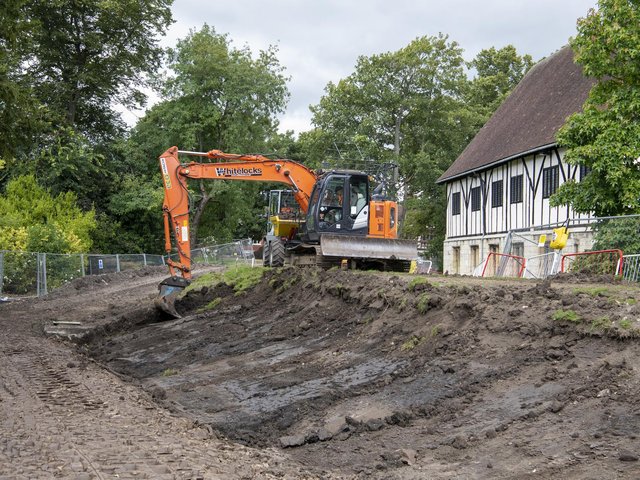
A team from York Archaeological Trust are currently based in Museum Gardens, where the Environment Agency will soon start work on a major upgrade of the flood embankment as part of the York Flood Alleviation Scheme.
Both the Environment Agency and the City of York Council recognised the historical importance of the area, which was once the grounds and precincts of St Mary’s Abbey and invited experts to survey the site for ancient remains.
The dig began in July and details of some of the preliminary findings have now been revealed.
York Archaeological Trust staff George Loffman and Fran Birtles examine the trench
York Archaeological Trust staff hoped to find traces of medieval buildings that were once part of the abbey complex, of which The Hospitium is the only survivor still intact today. There had not been investigations on the site previously because it had never been subject to development.
Initially, topsoil stripping revealed pottery and other items dating from the 19th century, when the Yorkshire Philosophical Society first landscaped the area as a botanical garden.
Yet below the Victorian layer was evidence of earlier activity. Across the trench is rubble including limestone roof and floor tiles, suggesting that several buildings were demolished following the Dissolution of the Monasteries in the 1530s. However, this razing could have taken place at any time up until the 1830s, when the garden landscaping began.
The Hospitium was renovated around this time, but historians are aware that several other buildings would have stood on the south side of the precinct.
Short sections of medieval wall uncovered during the dig suggest that these structures extended east from The Hospitium – a lodging house for lay guests of the monastery which historians believe may have also acted as a warehouse for goods delivered through the river gate.
An excavator at work besides The Hospitium
York Archaeological Trust project manager Ben Reeves explained: “This area had never been developed, and our principle is that we don’t disturb unless necessary. We won’t be going any deeper than we need to and only to the same level as the construction work.
“We know that in the 19th century, buildings such as stables were demolished, and there could have been outbuildings from all periods. We’ve identified some wall remains and are investigating them.
“We expected to find some form of remains, and our aim is to record and re-bury them. Nothing will be removed or damaged.
“It’s difficult to say when the buildings were cleared – was it in the aftermath of the Dissolution or much later? In the 1830s did they decide they wanted to keep The Hospitium but not the others?
Pieces of limestone wall suggest that buildings that were part of the abbey were demolished on a date unknown
“It was a relief to find the structures below the level of the trench so that their discovery won’t impact on the scheme. They will be covered over and preserved.”
The dig is expected to conclude by the end of the month, after which the site will be returned to Environment Agency contractors BAM.
Well-Preserved Human Remains Discovered in Pompeii Tomb
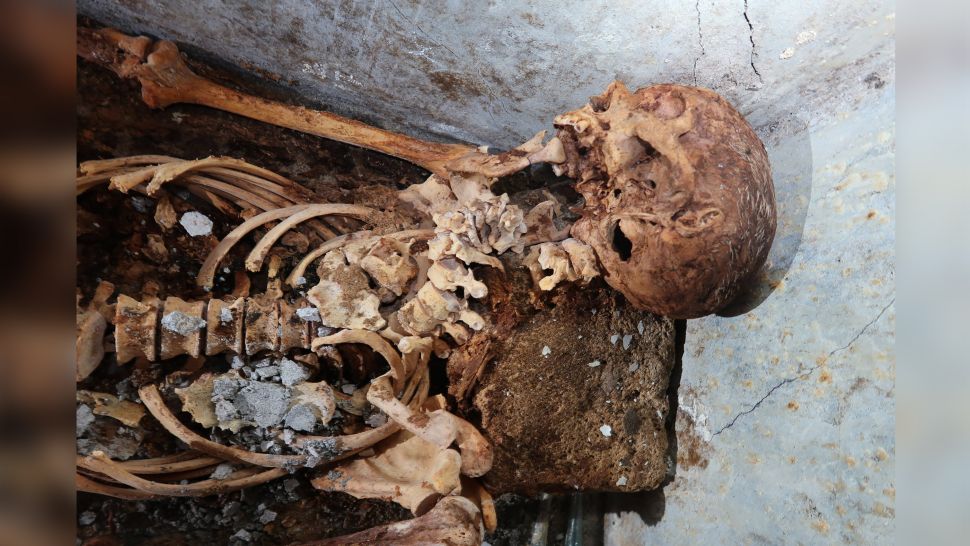
The partially mummified remains of an urbane Pompeii resident have been discovered in a tomb outside the city centre erected before the famous eruption that buried the town in ash.
The remains of Marcus Venerius Secundio were preserved in a sealed chamber in a Pompeii cemetery. Though the body is nearly 2,000 years old, close-cropped hair and an ear are still visible on the skull.
According to the inscriptions on the tomb, the deceased was a man named Marcus Venerius Secundio, who was in his 60s when he died and was, at one point, enslaved. Later in life, after being freed, Secundio became a well-off priest who conducted rituals in Latin and Greek.
The tomb inscription referring to these Greek rituals is the first direct evidence of Greek performances being held in the Italian city.
A close view of the mummification of Marcus Venerius Secundio. The remains have been taken to a laboratory so researchers can learn more about whether this mummification was intentional.
“That performances in Greek were organised is evidence of the lively and open cultural climate which characterised ancient Pompeii,” Gabriel Zuchtriegel, director of the Archaeological Park of Pompeii, said in a statement.
Mummified remains
Secundio’s remains rest in a rectangular masonry tomb that was once painted with images of green plants on a blue background; traces of this paint still grace the outside walls of the tomb.
The masonry tomb of Marcus Venerius Secundio in the Porta Sarno Necrtopolis. Faint traces of blue and green paint still grave the outer walls.
The partially mummified body was tucked into a sealed alcove in the tomb with an arched ceiling. Close-cropped hair and an ear are still visible on the skull.
Archaeologists also recovered scraps of fabric and two glass bottles called “unguentaria” from Secundio’s tomb. Unguentaria are often found in Roman and Greek cemeteries and may have held oils or perfumes for graveside rituals.
The tomb also contained two funerary urns, including a beautiful blue-glass urn belonging to a woman whose name is recorded as Novia Amabilis (“kind wife”). Cremation was the most common method of burial for Pompeiians during the Roman period, according to archaeologists.
A beautiful blue glass urn was found in the tomb of Marcus Venerius Secundio. The urn likely contains the cremated remains of a woman named Novia Amabilis.
It’s not clear why Secundio’s remains weren’t cremated. It’s also not clear if his body was mummified naturally or if it was treated to prevent decomposition.
“We still need to understand whether the partial mummification of the deceased is due to intentional treatment or not,” University of Valencia archaeologist Llorenç Alapont said in the statement.
Multilingual city
The tomb is in the Porta Sarno Necropolis, which sits just outside the town walls by the Porta di Nola gate. A number of notables were buried in the necropolis, including city administrator Marcus Obellius Firmus, who lived during the reign of Emperor Nero (between A.D. 54 and 68), according to ArchaeoSpain, a field school that coordinates internships at Pompeii and other sites.
What is known of Marcus Venerius Secundio’s life comes from a previously discovered record-keeping tablet belonging to the banker Cecilius Giocondus, as well as the inscription carved in marble on Secundio’s tomb.
The inscription on the tomb names Marcus Venerius Secundio and says that he performed four days of performances in Greek and Latin as a priest in the imperial cult.
He was a slave at the temple of Venus before his release, after which he joined the priesthood of the imperial cult, dedicated to glorifying the memory of the Roman emperor Augustus, who ruled from 27 B.C. to A.D. 14.
As one of these “Augustales,” Secundio “gave Greek and Latin ‘ludi’ for the duration of four days,” according to the tomb inscription. “Ludi graeci” were theater performances in Greek, Zuchtriegel said.
“It is the first clear evidence of performances at Pompeii in the Greek language, which had previously been hypothesised on the basis of indirect indicators,” he said. These performances indicate that Pompeii in the first century was a multi-lingual, multi-ethnic place where Eastern Mediterranean cultures melded.
Evidence of Neolithic Dairy Farming Found in Wales
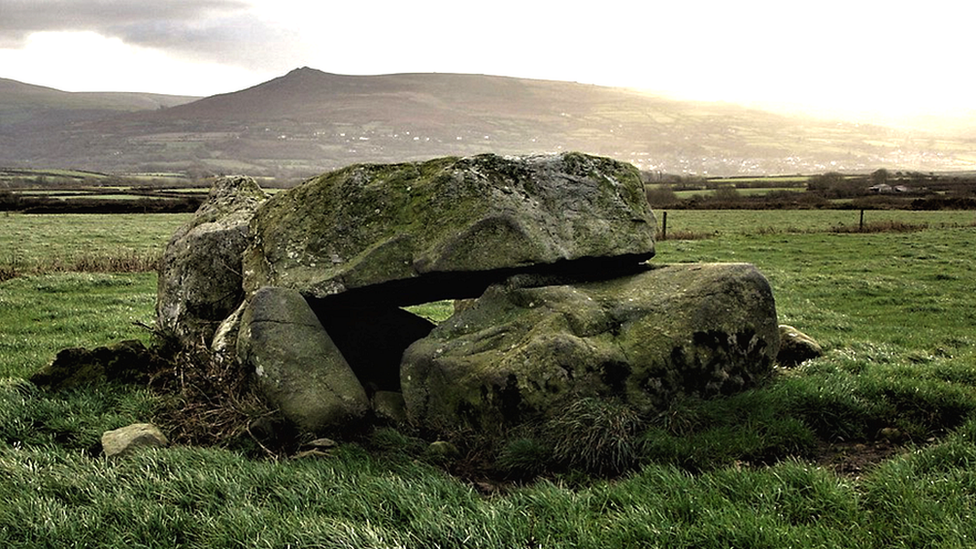
BBC News reports that dairy fat has been detected on pottery unearthed at the Trellyffaint Neolithic monument, a site in southwest Wales where two concentric earthen henges have been found.
The four-year project explored the monument and its surroundings near Newport, Pembrokeshire
Dairy farming could have been happening in Wales as early as 3,100BC, according to new research. Shards of decorated pottery taken from the Trellyffaint Neolithic monument near Newport, Pembrokeshire, were found to contain dairy fat residue. The residue could only originate from milk-based substances such as butter, cheese, or more probably yoghurt.
George Nash, of the Welsh Rock Art Organisation, said it was the earliest proof of dairy farming in Wales.
Project leader Dr Nash said Julie Dunne of the University of Bristol had detected the dairy fat residues from the inner surfaces of the pottery, as well as dating them with 94.5% accuracy to 3,100BC.
“It’s incredibly rare to find any archaeological remains such as bone and pottery in this part of Wales because of the soil’s acidity,” he said.
This stone feature was discovered during excavation
“So, we can’t say for certain that this is the earliest example of dairy farming, but it is the earliest that anyone has been able to prove, using new revolutionary direct dating methods.
“The discovery of this pottery is important because it is right on the cusp of when a new Neolithic ideology was taking hold.”
Early farmers
Dr Nash, who teaches at the University of Coimbra in Portugal, termed the period a “Neolithic package” that included animal husbandry, pottery making, food procurement and different ways of burying and venerating the dead.
It gradually replaced the hunting, fishing and gathering way of life which had typified the previous era.
The dairy fat residue was discovered on pottery at the site
Interest in Trellyffaint began when former University of Bristol archaeology graduates Les Dodds and Phil Dell conducted several geophysical surveys on and around the Neolithic stone chambers.
They discovered two concentric henges along with other buried objects. The henges – two circular earthen banks – are roughly contemporary with Stonehenge, dating from the mid to latter part of the Neolithic period, between 3,000BC and 2,000BC.
However, Dr Nash said it is important to view the period as a continuum of social and ritual development rather than a single event.
“As the population grew throughout this period, communities had to diversify the way in which they sourced their food,” he explained.
“Initially, farming was a far riskier economy than hunting, fishing and gathering, as if you had one outbreak of disease – one crop failure – then you were prone to starvation and instability.
“It is probable that throughout the Neolithic period in western Britain, both natural resources and farming played equal roles in providing communities with the resources they needed.
Markings on a stone in the monument suggest the night sky
“The pottery recovered from this excavation probably reveals something about the veneration of the earth and what it could provide, hence the offering of dairy products within a ritualised landscape”.
The survey discovered the main chamber was largely in a good state of preservation. However, at some point in the recent past, the enormous capstone covering the chamber had slipped off its supporting upright stones. Up to 75 engraved cupmarks – gouged circular indentations – and several intersecting lines were recorded on top of this stone.
New religious ideology
The cupmarks, which feature on only a handful of Neolithic burial-ritual monuments in Wales, suggest the stone formed part of a new religious ideology where rock art represented the night sky and constellations.
Maybe a few hundred years later, the community using Trellyffaint made the decision to yet again change their worldview, which resulted in the construction of the two concentric henges a few yards north of the monument.
For this new set of monuments, offering dairy products rather than looking towards the night sky became the new way of veneration. The artefacts discovered will be presented to the National Museum of Wales in Cardiff for safekeeping, while the team’s research is due for publication in several international scientific journals.
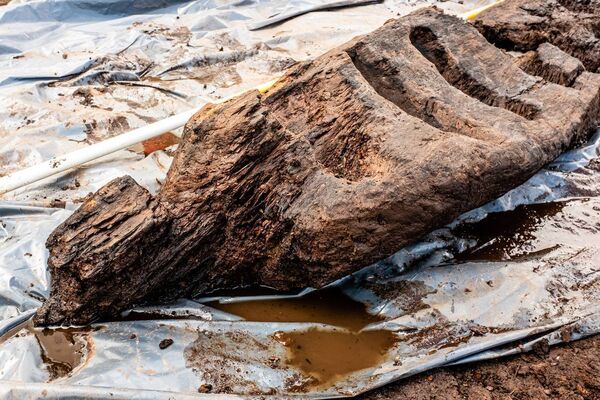
Irish archaeologists have unearthed a 1,600-year-old wooden pagan idol from a bog in Co Roscommon. The artefact was retrieved from a bog in Gortnacrannagh, around six kilometres from the prehistoric royal site of Rathcroghan.
Wood Specialist, Cathy Moore inspecting the Gortnacrannagh Idol. Only a dozen such idols have been found in Ireland and at more than two and a half metres, the Gortnacrannagh Idol is the largest to date.
The idol was made during the Iron Age from a split trunk of an oak tree, with a small human-shaped head at one end and several horizontal notches carved along its body.
Only a dozen such idols have been found in Ireland and at more than two and a half metres, the Gortnacrannagh Idol is the largest to date.
The wooden carving was discovered by a team from the Archaeological Management Solutions (AMS), working in advance of the N5 Ballaghaderreen to Scramoge Road Project.
Dr Eve Campbell, director of the AMS excavation site said the idol was carved just over 100 years before St Patrick came to Ireland.
“It is likely to be the image of a pagan deity,” Dr Campbell said.
“Our ancestors saw wetlands as mystical places where they could connect with their gods and the Otherworld.
“The discovery of animal bone alongside a ritual dagger suggests that animal sacrifice was carried out at the site and the idol is likely to have been part of these ceremonies.”
Wooden idols are known from bogs across northern Europe where waterlogged conditions allow for the preservation of ancient wood.
“The lower ends of several figures were also worked to a point suggesting that they may once have stood upright,” said wood specialist, Cathy Moore.
“Their meaning is open to interpretation, but they may have marked special places in the landscape, have represented particular individuals or deities or perhaps have functioned as wooden bog bodies, sacrificed in lieu of humans.”
The idol was made during the Iron Age from a split trunk of an oak tree, with a small human-shaped head at one end and several horizontal notches carved along its body.
The Gortnacrannagh Idol is currently at University College Dublin (UCD), where conservator Susannah Kelly is undertaking the three-year process of preserving the artefact.
Once conserved the idol will go on display at the National Museum of Ireland.
A replica of the idol, made by AMS staff in collaboration with members of the UCC Pallasboy Project and the UCD Centre for Experimental Archaeology and Material Culture, will go on display at the Rathcroghan Centre in Tulsk, Co Roscommon.
Dr Ros Ó Maoldúin of AMS says the Gortnacrannagh Idol is such “a unique and significant find”, and the replica will “help us understand the idol better and appreciate how it was made.
“It will be possible for people to see this in action at the Craggaunowen Archaeology Park in Co. Clare during the last weekend of August.”
AMS says the discovery will have no impact on the progress of the N5 Ballaghaderreen to Scramoge Road Project.
“Road projects such as the N5 provide a significant opportunity for the investigation of our archaeological heritage, said Deirdre McCarthy, a resident archaeologist with Roscommon County Council.
“Gortnacrannagh is an excellent example. Were it not for the road, we would never have known about this extraordinary site.”
Analysis of the artefact and the site it was found in is ongoing.
Archaeologists find child’s skeleton in Turkey’s Tozkoparan Mound
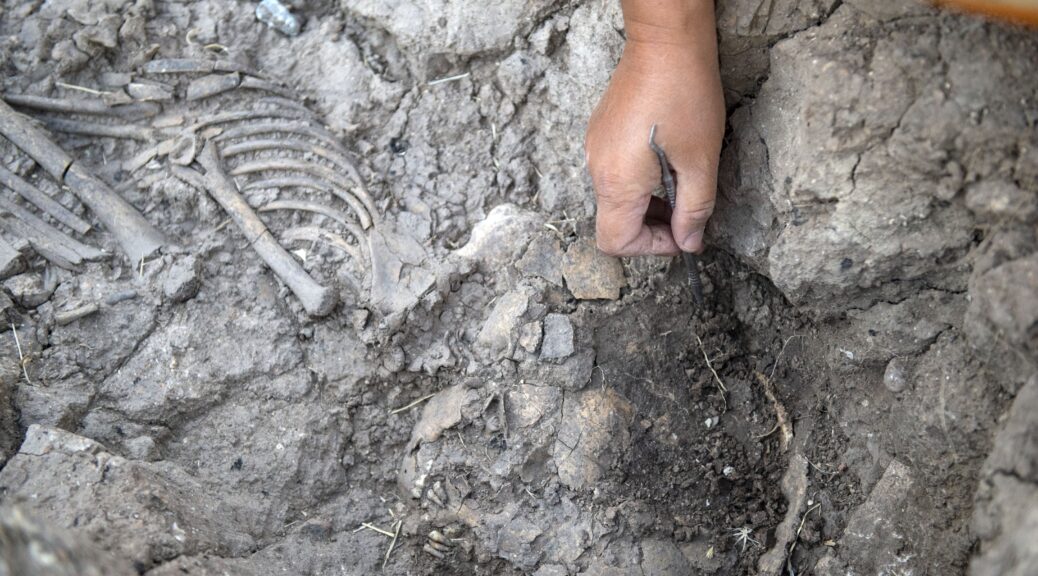
A child’s skeleton discovered during continuing archaeological excavations at Tozkoparan Mound, a first-degree archaeological site in the Pertek district of Tunceli’s eastern region, has been kept in the city’s newly opened museum.
An archaeologist inspects the remains of a skeleton during excavations at the Tozkoparan Mound site in Tunceli, Turkey, Aug. 11, 2021.
The excavation has been initiated because the mound, which is located in Tozkoparan village of the district and considered to have traces of thousands of years of history, remained in the village settlement area and has been damaged by the houses built on it.
Academics from various universities are working at the excavations, carried out under the leadership of the Tunceli Museum.
The remains of a skeleton are marked during excavations at the Tozkoparan Mound site in Tunceli, Turkey, Aug. 11, 2021.
A team of about 15 people, consisting of anthropologists, archaeologists, art historians and intern students, take part in the excavations. For the first time since 1968, scientific methods are now used in the excavations.
While working in the field, the team has recently discovered a skeleton, thought to belong to a child. The skeleton pieces, which were removed from their place with the help of a brush and spatula, were taken under protection at Tunceli Museum.
In addition to terracotta potteries obsidians, bones, stone tools and arrowheads were also found during the excavations. Artefacts that shed light on history will be exhibited in the museum.
Speaking to the state-run Anadolu Agency, Düzce University Archeology Department academic Yasemin Yılmaz said that they have been conducting surveys in Tunceli for about six years and have identified all archaeological periods in the city starting from the Lower Paleolithic period.
Stating that they completed the survey this year, Yılmaz said that they carry out excavations in Tozkoparan Mound with a delegation under the supervision of academics from universities in Tunceli, Düzce, Erzurum and Diyarbakır.
Ancient historical artefacts can be seen during excavations at the Tozkoparan Mound site in Tunceli, Turkey, on Aug. 11, 2021.
Yılmaz noted that they carry out work in the areas where the mound was destroyed.
“Here we are working to determine the boundaries of the archaeological sites. Archaeological remains began to be found just below the surface soil.
On the third day of the excavation, a human skeleton was unearthed. It belongs to an individual who appears to be a child. It was lying in an oval-shaped pit, excavated in the north and south directions. This skeleton is very important because it belongs to the ancient society and provides direct information about that period,” Yılmaz said.
Yılmaz stated that there have been interdisciplinary studies on skeletons recently, adding, “We can determine the age of the skeletons and their nutritional system. If the diseases they suffered left traces on the bones, we can determine them. We cannot obtain much data with a single sample, but it is a pleasing finding to begin with.”
Yılmaz stated that they have completed the archaeological chronology of the city during their surveys, and added, “As of this year, we completed our surveys because we have achieved all our goals. Tunceli is located on the transit route of many civilizations. Our findings also confirmed this. We started to prepare our findings for publication.”
Yılmaz stated that with the publication of their scientific articles, the city will attract the attention of history and archaeology enthusiasts.
The head of the excavations and Tunceli museum director, Kenan Öncel, also emphasized that with the opening of the museum in the city, archaeological work gained momentum.
In this context, Öncel stated that they started the first salvage excavations in Tozkoparan Mound.
“We plan to work in the field for about one more month. Our aim is to determine the extent and boundaries of the mound. Tunceli Museum is currently the newest museum in Turkey. Our artefacts found in this rescue excavation will enrich the collection of the Tunceli Museum and will also contribute to understanding the cultural background of the city,” he said.