Egypt’s secrets revealed: Possibly a second Sphinx & mysterious hidden chambers??

Egypt’s secrets revealed: Possibly a second Sphinx & mysterious hidden chambers??

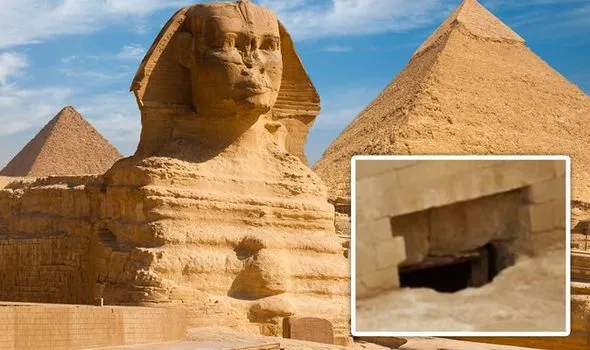
According to Egyptologist Bassam El Shammaa’s 2007 study, there was a “second sphinx” on the Pyramids Plateau. El Shammaa said the famous half-lion, the half-man statue was an Egyptian deity constructed close to another Sphinx that has since been vanished without a trace.

The discovery of a lost city in Egypt was reported in many newspapers in 1935, including this report in the Sunday Express on July 7, 1935.

Today, our attention is focused on the most recent attempt to discover the true ancient story of an advanced civilization that left us with great wonders above and below the Giza plateau sands.

Ancient lost city unearthed in Egypt

The earliest reports of a “Secret City” appeared in the World Press in the first week of March 1935. Many more were discovered in July of that year, and the Sunday Express carried an article by Edward Armytage, who had just returned from Egypt to England, where he had witnessed the excavation of an ancient Egyptian metropolis thought to date back 4,000 years.

Following then, there was stillness, as if every Egyptologist alive had lost interest in this fantastic underground metropolis. Throughout the years that followed, all of his articles focused on tombs of queens and arrows. Surprisingly, at one point, such a massive find of an entire underground metropolis dating back at least 4,000 years was completely ignored.

Denial of previous findings

Zawi Hawass examining a chamber at the back of the Sphinx.

However, he retains his power – and it is not a little one. Much has been written about the Egyptian ‘Indiana Jones’ (Zahi Hawass), who smiles large one moment and goes crimson with rage the next when he is questioned. This aspect of his personality is widely chronicled in the book “Breaking the Mirror of Heaven” by Robert Bauval and Ahmed Osman.

However, such attitude does not explain why Zahi Hawass has publicly said that there is nothing beneath the Sphinx, no tunnel, or a single chamber, despite several photographs of him entering the lowering pits of the Sphinx’s head and another in the rear of the body the lion. Should we ignore what we’ve seen several times before and accept such denials without question?

Statements contradict photographic evidence

Zawi Hawass descending through a well towards a chamber filled with water that contained a large sarcophagus.

He appears to have ignored queries concerning underground tunnels underneath the Giza plateau and chambers beneath the Sphinx, claiming that it was impossible to investigate deeper since the rooms were either sealed or filled with water. This might be true, however, we can see in one of the images of a posterior axis descending on the Sphinx’s side that the ground is extremely dry.

We know that Hawass climbed the steps from the Sphinx’s rear entrance, into a deep room, and then farther down to a lower chamber containing a very big sarcophagus and filled with water; these events are all seen in a documentary made by Fox. It’s difficult to conceive how he could subsequently refute what he’d said and done.

A hole in the Sphinx’s head

Vivant Denon’s 1798 sketch of the sphinx depicts a man being pulled out of a hole in the Sphinx’s head.

Vivant Denon made a sketch of the Sphinx in 1798, although he didn’t replicate it perfectly. He must have known there was a hole in the top of his head since he had sketched the image of a guy being dragged out.

1920s aerial photo shows a hole in the Sphinx’s head.

A drawing is hardly evidence, but an aerial shot of the sphinx taken from a hot air balloon in the 1920s revealed that there is such an opening at the top of its head.

The Sphinx’s head puzzle

According to Tony Bushby in his ” The Secret in The Bible”, a fragmented Sumerian cylinder tells a story that could easily be interpreted as having taken place in Giza, involving a beast that had a lion’s head with a tunnel entrance hidden by the sand.

A new study now points out that the Sphinx’s body was carved from natural stone when there was frequent heavy rain and this takes us back to the same time that Robert Bauval and Robert Schoch calculated the construction of the Pyramids of the ‘Belt of Orion’, ie, about 10,450 BC.

The second Sphinx

Giza plateau with the second sphinx mound buried.

The Giza complex (the ancient Egyptian term Gisa meaning “Stone Hewn”) has been sketched since 1665, and some depict two heads ‘peering’ out of the sand, one with female characters, possibly the second Sphinx.

It was an ancient Egyptian custom to enlist two lions, known as Akerw, outside their doorways for heavenly protection, which would take us the right to a mystery mound near the sphinx, which Gerry Cannon (Book: The Giza Plateau Secrets and a Second Sphinx Revealed) identified and measured. Is it possible that this mound contains the buried body of a second sphinx?

One would have thought that this mysterious, large, covered shape so close to the sphinx would have been greeted with great enthusiasm by the Egyptian authorities, but Hawass and Mark Lehner didn’t want to hear or pay attention to it, according to one source.

Gerry had contacted someone at a renowned institute in Cairo who had equipment that could detect objects under the sand. This person asked the Supreme Council of Antiquities for permission to investigate the mound, but they did not respond. Apparently, no one else was allowed to investigate the specific area of the mound where we believe a Second Sphinx could be unearthed. No doubt they had a reason for this!

Why the denial?

Why would those two Egyptologists be so concerned about the possibility of discovering something that had been lost for centuries? Is it conceivable they don’t want to expose what’s behind that mound? It is illogical to oppose any type of probe or even a simple aerial image being taken, which may lead to the discovery of yet another great wonder of the world, attracting many thousands of more tourists to Egypt.

They don’t even admit to have inspected the mystery mound, and if they had, they would have been the first to admit it. Zahi Hawass appears to have an agenda, which is to maintain the conventional view of ancient Egyptian history (to not allow anything to disrupt the path of conventional history), regardless of how many new findings contradict what is now considered to be true.

Gerry Cannon has previously hinted at a timetable for constructing the three great pyramids, as well as the Sphinx, which is many thousands of years older than most of us assume. He also identified an undiscovered mound on the Giza plateau, where another sphinx is most likely hidden, based on ancient documents and data he presented.

Giants and beings of unknown origin were recorded by the ancients

Giants and beings of unknown origin were recorded by the ancients

Found in many regions of the world, cave paintings have been a valuable source of information for understanding the lifestyle and beliefs of early humans. Some depict scenarios that are fairly simple to understand, such as men hunting or entire families in a village.

Giants and beings of unknown origin were recorded by the ancients
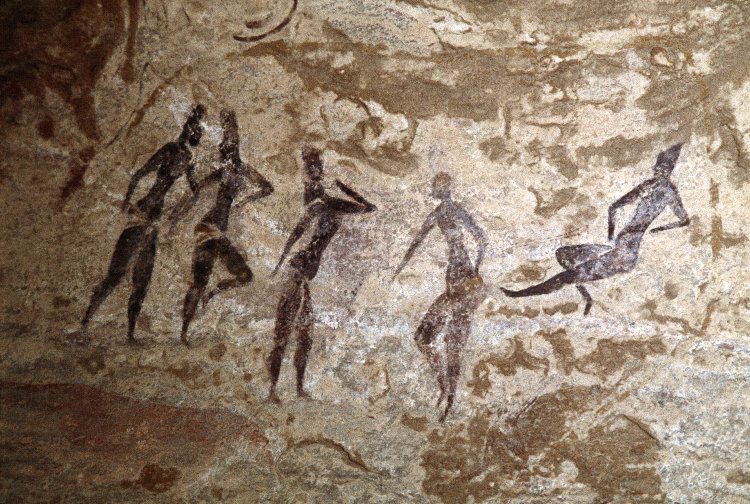
Cave paintings in Tassili n’Ajjer.

The cave paintings discovered on the Tassili n’Ajjer plateau in southern Algeria, are a major conundrum for scholars.

They sketched what they observed, assuming that ancient humans did not have the ability to imagine such art: “One of the images appears to portray an extraterrestrial pursuing human being towards an oval object, comparable to a small spaceship.”

To see up close what many consider to be the world’s finest museum of prehistoric art, visitors must journey to the parched plains of the Sahara desert. Specifically in southern Algeria, 700 metres above sea level, is the Tassili plateau.

It is feasible to reach one of the earliest sources of information on ancient terrestrial life by traversing many cliffs. Years of wear and tear, as well as the strong forces of nature, have rendered the road nearly inaccessible. Rock formations that resemble enormous stone sentinels may be seen.

It is precisely in this location where caverns and more caves, with around 1,500 cave paintings dating from 10 to 15 thousand years, come into play.

They are thought to have been created by humans who lived on the site throughout the Upper Paleolithic and Neolithic periods.

Some paintings make sense, but others are enthralling, leaving you to ponder the true meaning for hours on end. First and foremost, everything discovered in this remote location supports what was originally thought about the Sahara Desert: this location was once bustling with life. A diverse range of plant and animal species coexisted in this area, as well as in many other parts of Africa and the world.

The patterns on ledges and rocks appear to imply that flowers, olive groves, cypresses, and other species grew in a fertile and vibrant environment. Furthermore, the current wildlife included antelopes, lions, ostriches, elephants, and rivers teeming with crocodiles. Unquestionably, a totally different scenario than what is now occurring in the Sahara.

Similarly, human beings can be seen in their daily activities in over a thousand primitive depictions discovered in Tassili.

Men hunting, swimming, and farming, as well as other routine activities in an archaic civilization. Nothing out of the ordinary for numerous experts and scholars who have visited this genuine book of stones.

Now, there are certain fascinating aspects that even the most sceptical brains can detect. To begin with, the tonality of the paintings is considerably more diverse than that which was typically used at that period. The rock art scenes from the same time period are not as vibrant as those seen here.

Tassili n’Ajjer Painting Figure. This “God” very closely resembled a paleo-astronaut in a space suit.

The images that appear to portray creatures wearing helmets and diving suits, quite similar to current astronauts, are the most stunning and difficult to accept. Furthermore, other pictures depict humanoids with enormous round heads and excessively large limbs.

Everything appears to imply that these strange and perplexing artworks show that creatures from other worlds visited our planet in the distant past. It is thought that primitive humans were unable to envision this type of art. Instead, they just sketched what they saw, which became part of their memories.

A strange huge creature and we can see a probable ‘kid’ being abducted by something or someone close alongside him. Surprisingly, the beings around this behemoth (at least some of them) do not appear to be human.

This entire collection of cave paintings might be the oldest evidence of a meeting between mankind and creatures from other worlds. In fact, one of the photos appears to depict a group of aliens escorting several people towards an oval object like a small spaceship.

Some experts who have visited the site believe that the early painters witnessed something unusual and left pictorial proof of it. These depictions of creatures with huge round heads are of ‘Tassili’s gods of unknown origin.’

The first dinosaurs may have laid soft eggs without hard shells

The first dinosaurs may have laid soft eggs without hard shells

The new finding forces scientists to rethink how dinosaur eggs evolved. The earliest dinosaur eggs were more like leathery turtle eggs than hard bird’s eggs. That’s the conclusion of a new study of fossilized dino embryos.

A team of palaeontologists studied embryos from two types of dinosaurs. One came from early in dinosaur history. The other lived about 150 million years later. Both sets of eggs were enclosed by soft shells. The researchers described their findings online on June 17 in Nature. It’s the first report of soft-shelled dino eggs.

“This new hypothesis provides an answer to these problems,” says Stephen Brusatte. He is a palaeontologist at the University of Edinburgh in Scotland. He was not involved in the work.  Until now, palaeontologists thought that all dinosaurs laid hard eggs.

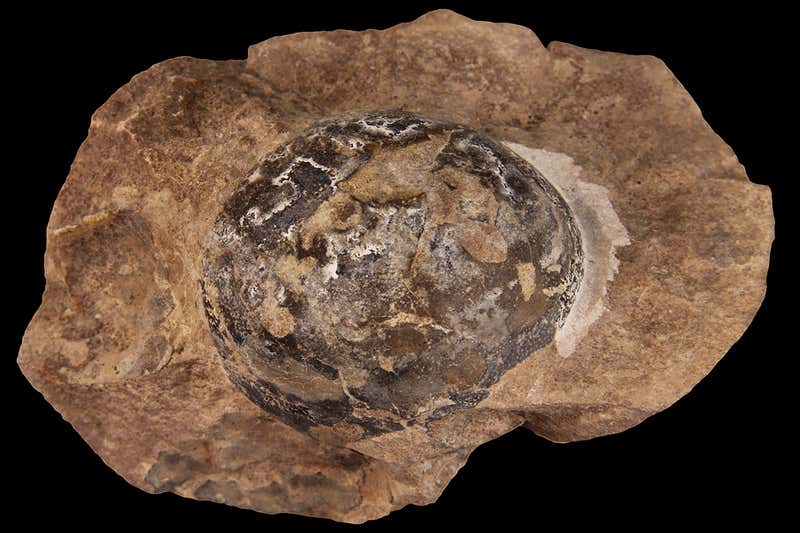
This fossilised egg was laid by Mussaurus, a type of long-necked, plant-eating dinosaur that grew to 6 metres in length and lived in what is now Argentina

Minerals such as calcite make such shells hard and help them to fossilize. But scientists couldn’t explain a lack of fossil eggs from the earliest dinosaurs. Nor did they know why tiny structures within eggshells are so different across the three main types of dinosaurs.

Further analyses of these and other dinosaur eggs suggest that hard eggshells evolved three separate times. The team thinks the long-necked sauropods, plant-eating ornithischians (Or-nuh-THISH-ee-uns) and fierce theropods each evolved their own hard shells.

Unearthing soft dino eggs

The researchers analyzed a clutch of dinosaur eggs found in Mongolia. The eggs are thought to come from Protoceratops. That was a sheep-sized ornithischian. The fossil dates to between 72 million and 84 million years ago.

The team also analyzed an egg found in Argentina. It is between 209 million and 227 million years old. Scientists believe it to be Mussaurus. It was a sauropod ancestor.

The soft eggshells weren’t easy to spot. “When they are preserved, they’d only be preserved as films,” says Mark Norell. An author of the new study works as a palaeontologist at the American Museum of Natural History in New York City.

When his team examined the fossilized embryos, they noticed egg-shaped halos around the skeletons. On closer look, those halos had thin brown layers. But the layers were not evenly arranged. That suggested the material was biological, not made solely of minerals. Minerals tend to create very orderly patterns.

This well-preserved clutch of eggs is from Protoceratops, a plant-eater that lived more than 70 million years ago. Chemical studies of its eggs show that they had soft shells. The arrow points to an embryo that still has remnants of a softshell.

Before a few years ago, “people thought that everything that’s soft and squishy decays away immediately post mortem,” says study author Jasmina Wiemann. She is a palaeontologist at Yale University in New Haven, Conn. But growing evidence suggests that soft biological material can fossilize. The right conditions can preserve soft tissues, she says.

The team used lasers to probe the chemical composition of the brown layers. They used a method that would not damage the fossils. This Raman spectroscopy shines laser light on a sample, then measures how the light bounces off.

The properties of the scattered light show what type of molecules are present. Wiemann has used the approach to identify pigments in dinosaur eggs.

The researchers compared the chemical fingerprints of these fossilized eggs with those of eggs from hard-shelled dinosaurs. They also compared them with eggs from present-day animals. The Protoceratops and Mussaurus eggs were most similar to modern soft-shelled eggs.

Next, the scientists combined eggshell data with what’s known about the family trees of extinct and living egg-laying animals. From that, the researchers calculated the most likely scenario for the evolution of dinosaur eggs.

Early dinosaurs laid soft-shelled eggs, they determined. Hard shells evolved in later dinos. And it happened several times — at least once in each major limb of the dino family tree.

These results suggest it may be time to rethink dinosaur parenting, says Wiemann. In the past, many ideas came from studying fossils of theropods, such as T. rex. For example, some of them sat on eggs in open nests, like modern birds. But if eggs evolved separately in different lines of dinos, parental behaviour may have, too.

“If you have a soft-shelled egg,” Norell says, “you’re burying your eggs. [There’s] not going to be a lot of parental care.” In some ways, he now suspects, dinosaurs that laid soft eggs might resemble early reptiles more than they do birds.

Now that palaeontologists know what to look for, the search is on for more soft-shelled dino eggs. Palaeontologist Gregory Erickson works at Florida State University in Tallahassee. He says, “I would not be surprised if other people come forward with other specimens.”

Archaeologists find child’s skeleton in Turkey’s Tozkoparan Mound

Archaeologists find child’s skeleton in Turkey’s Tozkoparan Mound

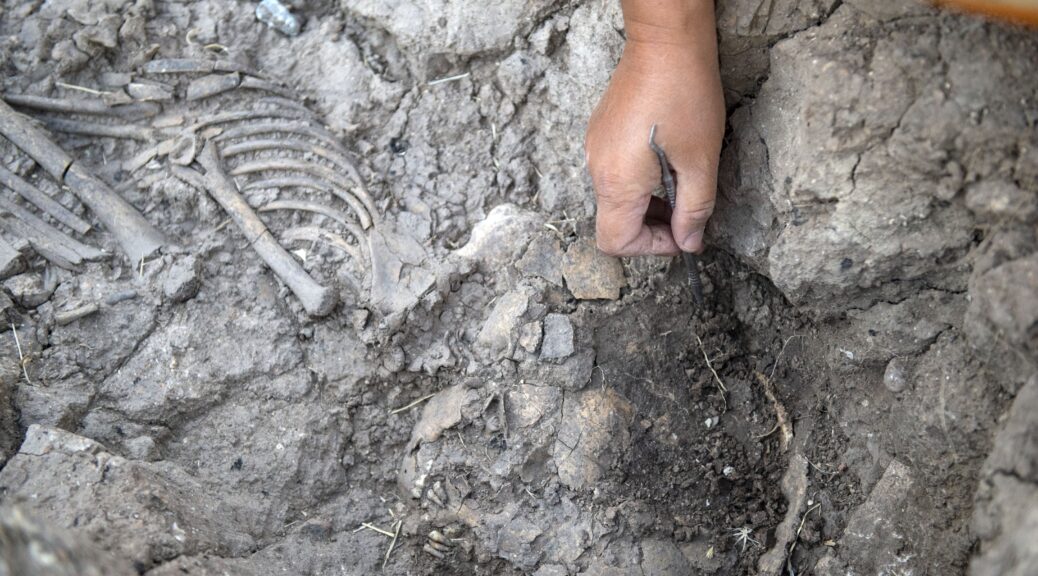
A child’s skeleton discovered during continuing archaeological excavations at Tozkoparan Mound, a first-degree archaeological site in the Pertek district of Tunceli’s eastern region, has been kept in the city’s newly opened museum.

Archaeologists find child's skeleton in Turkey's Tozkoparan Mound
An archaeologist inspects the remains of a skeleton during excavations at the Tozkoparan Mound site in Tunceli, Turkey, Aug. 11, 2021.

The excavation has been initiated because the mound, which is located in Tozkoparan village of the district and considered to have traces of thousands of years of history, remained in the village settlement area and has been damaged by the houses built on it.

Academics from various universities are working at the excavations, carried out under the leadership of the Tunceli Museum.

The remains of a skeleton are marked during excavations at the Tozkoparan Mound site in Tunceli, Turkey, Aug. 11, 2021.

A team of about 15 people, consisting of anthropologists, archaeologists, art historians and intern students, take part in the excavations. For the first time since 1968, scientific methods are now used in the excavations.

While working in the field, the team has recently discovered a skeleton, thought to belong to a child. The skeleton pieces, which were removed from their place with the help of a brush and spatula, were taken under protection at Tunceli Museum.

In addition to terracotta potteries obsidians, bones, stone tools and arrowheads were also found during the excavations. Artefacts that shed light on history will be exhibited in the museum.

Speaking to the state-run Anadolu Agency, Düzce University Archeology Department academic Yasemin Yılmaz said that they have been conducting surveys in Tunceli for about six years and have identified all archaeological periods in the city starting from the Lower Paleolithic period.

Stating that they completed the survey this year, Yılmaz said that they carry out excavations in Tozkoparan Mound with a delegation under the supervision of academics from universities in Tunceli, Düzce, Erzurum and Diyarbakır.

Yılmaz noted that they carry out work in the areas where the mound was destroyed.

“Here we are working to determine the boundaries of the archaeological sites. Archaeological remains began to be found just below the surface soil.

On the third day of the excavation, a human skeleton was unearthed. It belongs to an individual who appears to be a child. It was lying in an oval-shaped pit, excavated in the north and south directions. This skeleton is very important because it belongs to the ancient society and provides direct information about that period,” Yılmaz said.

Yılmaz stated that there have been interdisciplinary studies on skeletons recently, adding, “We can determine the age of the skeletons and their nutritional system. If the diseases they suffered left traces on the bones, we can determine them. We cannot obtain much data with a single sample, but it is a pleasing finding to begin with.”

Yılmaz stated that they have completed the archaeological chronology of the city during their surveys, and added, “As of this year, we completed our surveys because we have achieved all our goals. Tunceli is located on the transit route of many civilizations. Our findings also confirmed this. We started to prepare our findings for publication.”

Yılmaz stated that with the publication of their scientific articles, the city will attract the attention of history and archaeology enthusiasts.

The head of the excavations and Tunceli museum director, Kenan Öncel, also emphasized that with the opening of the museum in the city, archaeological work gained momentum.

In this context, Öncel stated that they started the first salvage excavations in Tozkoparan Mound.

“We plan to work in the field for about one more month. Our aim is to determine the extent and boundaries of the mound. Tunceli Museum is currently the newest museum in Turkey. Our artefacts found in this rescue excavation will enrich the collection of the Tunceli Museum and will also contribute to understanding the cultural background of the city,” he said.

5,000-Year-Old Wood Uncovered at Scotland’s Ness of Brodgar

5,000-Year-Old Wood Uncovered at Scotland’s Ness of Brodgar

Over the years of excavation, the Ness has produced so many surprises that some archaeologists thought we had exhausted all the possibilities.

Not so! 

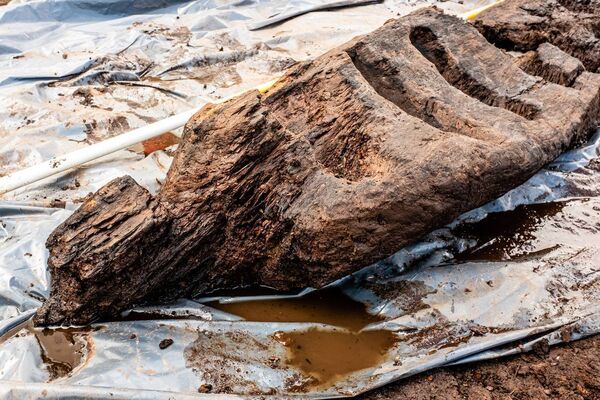
Today we have yet another “first” as of Jan and Jo, working in Structure Twelve, and in the area to the east of the southern hearth, found Neolithic wood!

To be precise, this astonishing new discovery is in the vicinity of robbed-out orthostats close to the grand eastern entrance, which regular readers will remember is flanked and made special by two large external orthostats.

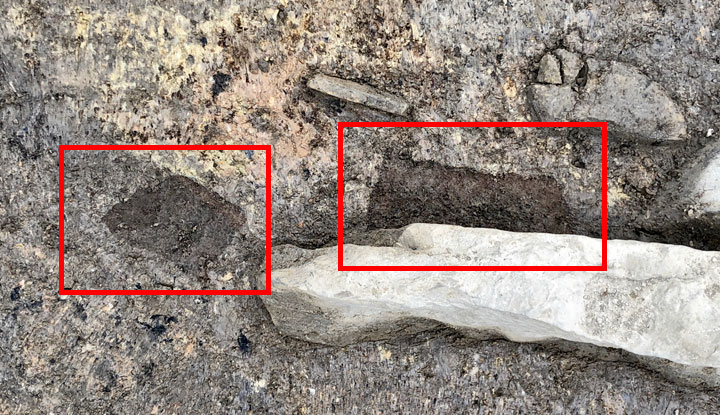
The wood is contained in two post-holes, but these are unusual ones and quite different to the many small, roundish stake-holes in Structure Twelve’s floor – the most recent of which were discovered by Gianluca yesterday.

5,000-Year-Old Wood Uncovered at Scotland’s Ness of Brodgar
The two Structure Twelve post-holes with wood remaining. (Sigurd Towrie)

To the astonishment of Jan and Jo, the new post-holes are rectangular – indeed one is almost square – and at around 5 cm and 10cm wide, they are noticeably bigger than the stake-holes that represent cooking arrangements throughout the building.

Their unusual shape is likely to come from the way in which the wood was prepared, most probably being split radially and thus having a rectangular profile. Site director Nick thinks they may have been replacements for an orthostatic division that had provided a screen relating to the east entrance in the second phase of Structure Twelve’s life.

The wood is not in good condition, which is hardly surprising after thousands of years in the ground. It is, however, in a slight dip in the floor which may have allowed moisture to be present, thus preserving the material. As it is far too mushy to be lifted there are ongoing discussions as to the next move.

Jan, Jo and supervisor Clare photograph the post-holes discovered in Structure Twelve. (Sigurd Towrie)

The aim is to recover it in a manner that might allow identification of the type of wood present. It might also be possible to see if the wooden stakes had been sharpened before being driven into the floor.

The post-holes could be half-sectioned, which might allow a view helping identification. Alternatively, micromorphological Jo may be able to insert one of her Kubiena tins (little open-ended square tins) to retrieve material.

We will let you know what happens.

Planning is underway in the northern end of Structure Twelve. (Sigurd Towrie)
The not-quite-finished result. (Sigurd Towrie)

Elsewhere in Structure Twelve, Sigurd is now planning his area of the north end and we have welcomed back Jenna and Andy Boyar, who has replaced Chris working outside the blocked north-west entrance.  We wish safe travels to Chris and his wife, Jenny, and look forward to seeing them again next year.

In Structure Ten, Travis has been transferred from Trench J to give him a change of scenery and some new challenges as he works towards his archaeology diploma.

He has taken over the area where Ellen was removing the last of the black deposit over the yellow clay floor in the northern recess. Travis will complete the task.

This was also Holly’s last day in Structure Ten, but we have no doubt that she will be back in the future. In Trench J, and as mentioned yesterday, Michaela has continued to remove dumps inside the blocked south-east entrance of Structure Five and this will put us in a position to remove more of the stone blocking.

Chris and Ceiridwen in Structure Thirty-Two following the discovery of a pottery spread. (Sigurd Towrie)

Also in Trench J, but this time in Structure Thirty-Two, Ceiridwen and Ray are uncovering a large pottery spread. The pot appears to be fairly fragmented so they are progressing with the utmost care. It is unlikely that this pot will be lifted until next week, so we will let you know what happens.

Speaking of pot, Roy has been working on the early round-bottomed vessel from Structure Five, which we mentioned earlier in the week.

Much of the pot was covered in clinging, and rapidly hardening, midden material but careful cleaning has revealed several more sherds, all with the distinguishing striation marks on the exterior surface made by the potter’s finishing process.

In addition, the two main sherds can now be seen to join, as can three other sherds which seem to be from the pot rim.

More may yet be discovered and, once more, we will let you know.

We were visited today by a film crew from Caledonia Productions in Glasgow.

They are doing preparatory work for a full-scale documentary next year and interviewed Nick, Mark, Clare and Gianluca.

Is This a Huge Million-Year-Old, Man-Made Underground Complex?

Is This a Huge Million-Year-Old, Man-Made Underground Complex?

A new discovery can change everything we know about the age of human civilization, advanced civilizations were present a million years ago and created the largest of all buildings ever seen.

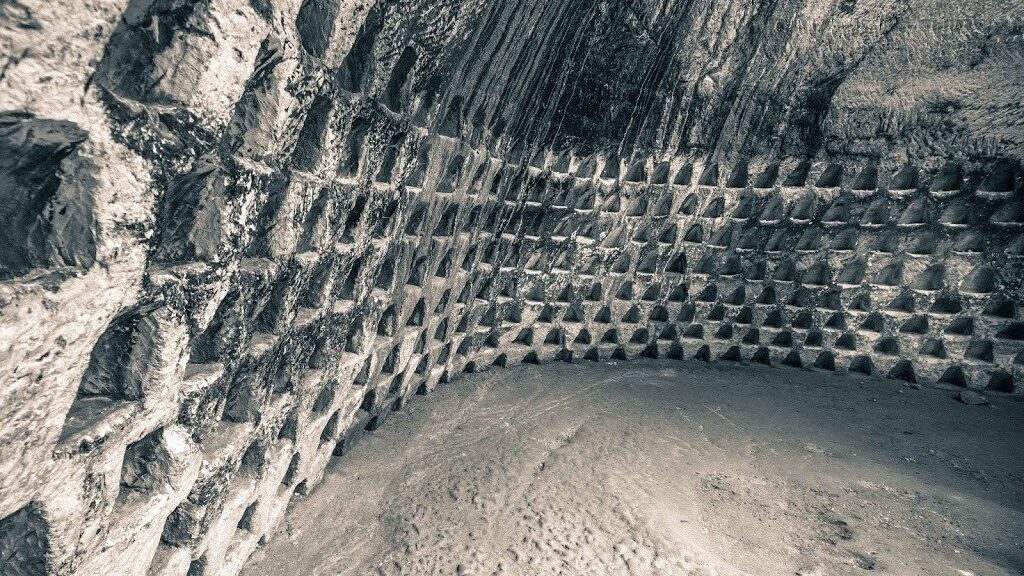
Herbert Midras, in Adullam Grove Nature Reserve in Israel, is part of what geologist Dr. Alexander Koltypin hypothesizes to be a massive complex of prehistoric underground structures stretching across the Mediterranean.

While most researchers and scholars around the world agree that human civilization emerged some 10,000 to 12,000 years ago, there are numerous discoveries that point to a very different past. However, many of these incredible findings have been considered impossible due to the fact that they alter our written history.

In recent years, many researchers have begun to look at the history of civilization on Earth with an open mind. One of these researchers is undoubtedly Dr. Alexander Koltypin, a geologist and director of the Natural Science Research Center at Moscow’s International Independent University of Ecology and Politology.

During his long career, Dr. Koltypin studied numerous ancient underground structures, mainly in the Mediterranean, and identified numerous similarities between them, which led him to believe that they were connected in some way.

But the most amazing thing about this place is that the extreme geological characteristics made him believe that these mega-structures were built by advanced civilizations that inhabited the Earth millions of years ago.

Is This a Huge Million-Year-Old, Man-Made Underground Complex?
The Caves of Maresha And Bet-Guvrin

Archaeologists working in the region usually date the sites by looking at the settlements located on them or nearby. But these settlements were simply built upon existing prehistoric structures, Koltypin said.

Writing on his website Koltypin says:

“When we examined the buildings … none of us even for a moment had any doubt that these structures are much older than the ruins of the Canaanite, Philistine, Hebrew, Roman, Byzantine and Roman cities and colonies. other cities and settlements that are on approximate dates.”

During his trip to the Mediterranean, Koltypin was able to accurately record the characteristics present in different ancient sites, something that allowed him to compare their similarities and details that tell an incredible alternative story; one that has been firmly rejected by traditional scholars.

While travelling near the Hurvat Burgin ruins in the Adullam Grove Nature Reserve in central Israel, Koltypin remembered a similar feeling when he climbed to the top of the rocky city of Cavusin in Turkey. Almost a Deja vu feeling, Koltypin said:

“I was personally convinced once again that all of these rectangular cutouts, artificial underground structures and megalithic debris scattered everywhere were – or were part of – an underground megalithic complex that collapsed due to erosion,” he said.

Erosion And Mountain Formation:

In his work, Dr. Koltypin argues that not all parts of the giant complex are located underground. Some are high above the ground as the ancient stone city of Cappadocia in Turkey, which Koltypin includes in the complex.

Koltypin estimates that the deposits in northern Israel and central Turkey appeared after erosion of about a few hundred meters.

Cavusin village in the Cappadocia region of Turkey

“According to my estimates, such a depth of erosion could hardly be formed in less than 500,000 to 1 million years,” Koltypin wrote on his website.

He hypothesizes that part of the complex was brought to the surface as a result of alpine orogeny (mountain-formation).

According to his estimates, there is evidence to support that the construction material found in Antalya, Turkey, which Koltypin calls the “Jernokleev site,” is up to a million years old, although traditional scholars refuse to accept age, proposing that the place dates back to the Middle Ages.

An ancient stone structure in Antalya, Turkey.

Koltypin adds that, as a result of the earth’s crust moving over the centuries, parts of the underground complex were plunged into the sea. He suggests that the similarity seen in countless megalithic ruins is evidence of a deep connection present in ancient sites that were connected like a giant prehistoric complex.

According to Koltypin, numerous megalithic blocks weighing tens of tons could have been directly linked to underground complexes in the distant past.

“This circumstance gave me a reason to call underground structures and geographically related ruins from cyclopean walls and buildings, as a single underground-terrestrial megalithic complex,” writes Koltypin on his website.

Referring to the technological capabilities of the ancients, Koltypin says the stones fit perfectly in some parts without cement, and the ceilings, columns, arches, doors and other elements seem to be beyond the work of men with chisels.

Adding to the mystery of these incredible sites, Koltypin notes that the structures built in other places like the Romans or other civilizations are completely primitive compared to this one.

The mysterious Egyptian tablet that is similar to an aircraft control panel

The mysterious Egyptian tablet that is similar to an aircraft control panel

Some Egyptologists and theorists believe that this is a replica of a much earlier but far more advanced object used by Gods and Demi-Gods of Egypt.

The mysterious Egyptian tablet that is similar to an aircraft control panel
The Mysterious Egyptian Tablet That Is somewhat resemble an aircraft control panel.

After just a few seconds of staring at this mysterious object, we get the unmistakable feeling that it was an OOPArt artefact, which is when something literally does not belong to the time it is dated.

The enigmatic table from Ancient Egypt is about 49 cm in diameter and 13 cm in height, weighing as much as 75 kg and was meticulously moulded in alabaster, a material that only exists in this region and was frequently used for decorating of various sites, including sarcophagi.

But this incredible artefact is absolutely unlike anything that was produced in this ancient time (nothing similar has been found to this day), as it features circular openings and basically undecipherable reliefs that specialists and scholars cannot interpret even after years of study.

These characteristics that we can observe, make the object resemble a control table of a modern aeroplane.

Some Egyptologists and theorists assume that this is a copy of a much older object, made of different, less weather-resistant, but considerably more advanced materials used by Gods and Demigods – perhaps a reproduction of the extraterrestrial technology observed in the past by the ancients.

This artefact was acquired by the Dutch museum in 1828, which is very interesting information about it. However, it is unknown which temple, tomb, or even where it was discovered.

As with many ancient Egyptian items, its provenance (from where it was recovered) is frequently forgotten, but its authenticity can still be confirmed. At the moment, the artefact is in the Leiden Museum of Antiquities.

Its authenticity was validated by specialists in the area after many investigations and assessments.

The strange contraption was discovered over 4,500 years ago and instantly connected with Egypt’s fifth dynasty of pharaohs.

The artifact comes from ancient Egypt, the purpose of which has not yet been determined. On this artifact, an image was applied that somewhat resembled a map or some kind of schematic board.

Only a small portion of its possible history can be deduced from the hieroglyphics found on its surface.

This tablet, according to one interpretation (there are others, all quite different), was used for the libation of deceased members of the highest Egyptian hierarchy in order for them to successfully enter the underworld.

Regardless of what the object is, its resemblance to modern equipment continues to perplex even the most sceptics and experts who have been unable to come up with a solid explanation for the find.

Amazing 1,600-year-old biblical mosaics reveal a new perspective on Galilean life

Amazing 1,600-year-old biblical mosaics reveal a new perspective on Galilean life

In its eighth dig season, the vibrant mosaic flooring of a fifth-century synagogue excavated in the small ancient Galilee village of Huqoq continues to surprise. The 2018 Huqoq dig has uncovered unprecedented depictions of biblical stories, including the Israelite spies in Canaan. With its rich finds, the Byzantine-period synagogue busts scholars’ preconceived notions of a Jewish settlement in decline.

“What we found this year is extremely exciting,” the University of North Carolina at Chapel Hill Prof. Jodi Magness told The Times of Israel, saying the biblically-based depictions are “unparalleled” and not found in any other ancient synagogue.

“The synagogue just keeps producing mosaics that there’s just nothing like and is enriching our understanding of the Judaism of the period,” said Magness. A recently unearthed mosaic shows two men carrying between them a pole on their shoulders from which is hung a massive cluster of grapes (the same as the easily recognizable symbol of Israel’s Ministry of Tourism). With a clear Hebrew inscription stating, “a pole between two,” it illustrates Numbers 13:23, in which Moses sends two scouts to explore Canaan.

A mosaic found in the 2018 Huqoq excavation is labelled ‘a pole between two,’ depicting a biblical scene from Numbers 13:23. The images show two spies sent by Moses to explore Canaan carrying a pole with a cluster of grapes.

Before wrapping up the dig season last week, the team of 20 excavators uncovered a further biblical mosaic panel, which shows a youth leading an animal on a rope and includes the inscription, “a small child shall lead them.” It is a reference to Isaiah 11:6, “The wolf also shall dwell with the lamb, and the leopard shall lie down with the kid; and the calf and the young lion and the fatling together; and a little child shall lead them.”

According to a 2013 Biblical Archaeology Review article by Magness, “Huqoq was a prosperous village about 3 miles west of Magdala (home of Mary Magdalene) and Capernaum (where Jesus taught in the synagogue),” located next to a fresh spring. It appears twice in the Hebrew Bible, in Joshua 19:32–34 and 1 Chronicles 6:74–75. “Our excavations have not reached these early occupation levels, however,” she writes.

These two newly published mosaics join a pantheon of others — from 2012 and 2013, two Samson depictions, to fantastical elephants and mythical creatures from 2013-2015, Noah’s Ark in 2016, and colourful and as yet unpublished Jonah and the whale in 2017. During this year’s dig, the team also continued to expose and study rare 1,600-year-old columns, first uncovered in previous seasons, which are covered in painted plaster with red, orange, and yellow vegetal motifs. Other discovered columns, said Magness, were painted to imitate marble.

However, despite these “imitation marble” columns, this was no poor man’s synagogue. Much in the manner of King Herod decorating his palaces with painted faux-marble frescos, the columns and gorgeous mosaics point to a wealthy, flourishing fifth-century Jewish settlement, said, Magness.

“In general, unless you’re in a really important church in the Byzantine period, you won’t find marble, rather this common local alternative,” she said. She laughed, saying there is a feeling of “one-ups-manship” in the construction of the Huqoq synagogue.

A fish swallows an Egyptian soldier in a mosaic scene depicting the splitting of the Red Sea from the Exodus story, from the fifth-century synagogue at Huqoq, in northern Israel.

“Every village has its own synagogue,” Magness said. “In Huqoq there’s a feeling that the villagers said, ‘We’re going to build the biggest and best.’ It’s as if they decided to throw everything into it.”

The obvious wealth and disposable income displayed in the synagogue is “contradicting a widespread view — not my view — that the Jewish community was in decline,” she said.

However, not only the synagogue was rich and diverse, but also the Judaism it housed.

“The mosaics decorating the floor of the Huqoq synagogue revolutionizes our understanding of Judaism in this period,” said Magness in a press release. “Ancient Jewish art is often thought to be aniconic, or lacking images. But these mosaics, colourful and filled with figured scenes, attest to a rich visual culture as well as to the dynamism and diversity of Judaism in the Late Roman and Byzantine periods.”

Galilean life
The Huqoq synagogue’s fifth-century mosaic, with the upper register showing a war elephant.

According to Magness, “Rabbinic sources indicate that Huqoq flourished during the Late Roman and Byzantine periods (fourth–sixth centuries CE). The village is mentioned in the Jerusalem Talmud in connection with the cultivation of the mustard plant.”

Aside from the outstanding mosaics and colourfully painted columns, there are other features of note in this synagogue: Discovered in 2012, an inscription flanked by the faces of two women and a man (a fourth face, presumably of a man, is not preserved) might be the first donor portraits found in a Jewish house of prayer. The practice, said Magness, was “not uncommon in Byzantine churches,” but has no parallel example found in a synagogue of the era. Although there are aspects of the synagogue that may point to a Christian influence, for example, the possible donor portraits, Magness does not believe the Huqoq community was more impacted than other neighbouring congregations.

Detail from the Huqoq synagogue’s 5th-century mosaic showing Samson carrying the gate of Gaza, from Judges 16.

“In general there was some interaction between Jews and Christians, as well as Judaism and Christianity, in the sense that both religions laid claim to the same tradition and called themselves the ‘true Israel,’” said Magness. It is not coincidental that the same biblical themes appear in both forums.

“They are clearly some sort of dialogue, broadly speaking… A lot of what we see at Huqoq can be understood on the background of the rise of Christianity,” she said.

“There is evidence of occupation at the site during the Persian, Hellenistic, Early Roman, Abbasid, Fatimid and Crusader-Mamluke periods. The modern village was abandoned in 1948 during the fighting in Israel’s War of Independence. In the 1960s, the site was bulldozed,” writes Magness in BAR. It appears that the Huqoq synagogue is the ancestor of what seems to be a later, 12-13th century Jewish house of prayer. Faint, broken remnants of that incarnation’s mosaic flooring have also been discovered a meter above the dynamic mosaics of the Byzantine era.

2018 Huqoq excavation with students from University of North Carolina-Chapel Hill, surrounding dig director Dr Jodi Magness.

It is possible, said Magness, that this is a synagogue mentioned by French 14th century Jewish physician-turned-traveller Isaac HaKohen Ben Moses, aka Ishtori Haparchi, mentioned in his 1322 geography of the Holy Land, “Sefer Kaftor Vaferach.”

Regardless, there are no extant medieval synagogues in Israel today, making this find potentially no less important than the more attention-grabbing images in the fifth-century mosaic floors, said Magness.

Pair of donkeys in Noah’s Ark scene at the Huqoq excavation.

Both of these finds — the medieval synagogue and beautiful Byzantine mosaics — are all the more remarkable in that they are a by-product of a different scholarly quest: Magness decided to excavate at Huqoq to test a wide-spread Galilean synagogue dating system, which dated the buildings based on their architectural structures.

“Since the early 20th century, when these synagogues began coming to light, scholars developed a tripartite chronology: The earliest, these so-called ‘Galilean-type synagogues,’ were dated to the second and third centuries CE, followed by ‘transitional synagogues’ in the fourth century, and then by ‘Byzantine synagogues’ in the fifth and sixth centuries,” writes Magness in the BAR article. Although housed in a fifth-century village, based on its architectural features, according to previous scholarly consensus, the Huqoq synagogue should have been classified a “Galilean-type synagogue” and dated to the second or third centuries. This is, Magness has proven, clearly not the case.

Pictured is the Huqoq synagogue mosaic depicting the month of Teveth (December-January) with the sign of Capricorn.

What was originally to have been a brief excavation has turned into eight seasons. And although Magness is assisted by Shua Kisilevitz of the Israel Antiquities Authority (IAA) and Tel Aviv University, the excavation is funded independently of the IAA, by sponsors including UNC-Chapel Hill, Baylor University, Brigham Young University and the University of Toronto, the Friends of Heritage Preservation, the National Geographic Society, the William R. Kenan Jr. Charitable Trust, and the Carolina Center for Jewish Studies. There will be a 2019 dig season, said Magness, who estimated she needs at least another four years to complete the ever-evolving project.

“Every year, there is another mind-blowing, weird discovery,” said Magness.

All In One Magazine