Sandstorm in Iran unearthed an ancient city

Sandstorm in Iran unearthed an ancient city

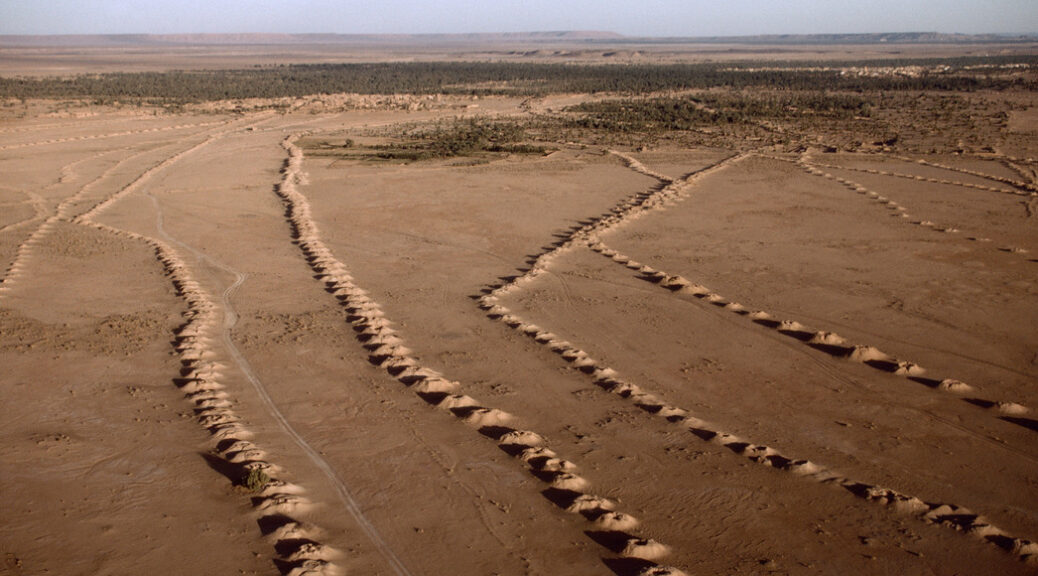
A new sandstorm in Iran has uncovered a number of ruins that have been thought to be in the old city or necropolis. Initial analyses suggest it dates back to the early Islamic Middle Ages (661-1508 AD), but it could also be much older or even more recent. Iranian authorities are taking no chances as armed military guards are keeping the site safe from looters.

The Mohammad Vafaei of the Cultural Heritage, Handicrafts, and the Tourism Organization said in the Tehran Times, “A team of archaeologists was sent to Fahrraj to determine whether the site was a necropolis or an inhabitance.”

The CHHTO archaeologists will examine the site’s artifacts and survey the ruins of the structures to get a better idea of the age of the complex. It measures about 5,000 square meters (53,820 square feet).

Archaeologists are examining a possible historic site in an arid area of Iran that was exposed by sandstorms in late March. The team is doing surveys, excavating structures, and examining earthenware vessels.

After initial examination members of the team have refused to speculate about how old the site may be, says the Financial Tribune of Iran.

The sandstorm struck in late March, exposing ancient ruins and broken earthenware and adobe, according to the governor of Fahraj in Kerman Province, Nejad Khaleqi.

Mr. Vafaei demurred, saying, “One cannot claim that an area is historical as soon as several objects appear from under the ground after storms and floods since they might have been carried from other regions by water or storm.”

Tentative conclusions are being drawn, however, as Hamid Rouhi, the deputy chief of the provincial CHHTO estimated that the site dates from the Islamic Middle Ages of 661 to 1508 AD.

“It is the first time that such ruins have emerged so there is no precise data on their age and history,” Mr. Rouhi told the Financial Tribune. He said officials will release more information as soon as it is available.

The site does not appear to be rich in artifacts, but so far researchers have found earthenware and broken adobe along with some structures.

The CHHTO has called in the Research Institute of Cultural Heritage and Tourism. They hope the site can be added to the National Heritage List after studies confirm its age, the Financial Times says.

It would not be unprecedented to find old sites in the Kerman area, as both Fahraj and Rigan have multiple ancient sites. New ones that were discovered with floods in the past few months are being excavated in Rigan and Negin Kavir.

Big, sprawling Kerman Province is something of a cultural melting pot, blending various regional cultures over the course of time. It is also home to rich tourist spots and historical sites including bazaars, mosques, caravanserais, and ruins of ancient urban areas.

The Islamic Middle Ages were termed the Islamic Golden Age because of Muslim scholars’ study, preserving and expanding knowledge in the areas of engineering, technology, geography, law, sciences, and medicine.

The scholars also explored the arts, poetry and literature, philosophy, economics, navigation, and sociology, says the site IslamicHistory.org.

From the mid-7th century through the mid-13th century, the Islamic World was the center of world learning and scientific development.

The Islamic Golden Age gave rise to countless inventions and innovations, while Islamic scholars were key to preserving the knowledge of the Greeks and other ancient civilizations.

The Abbasid Caliphate was heavily Persian-influenced and some of its greatest scholars were indeed Persians.

177,000 Roman artifacts found under the A1

177,000 Roman artefacts found under the A1

A number of exciting road works on a major road is not the first place you would expect to find a trove of Roman treasures, but that is exactly what people have discovered in a £ 380 million upgrade to a 12-km stretch of the A1 between Leeming Bar and Barton in Yorkshire have discovered. Archaeologists have now unearthed a staggering 177,000 artifacts from a Roman settlement dating back to 60AD that was on the site.

Archaeologists have unearthed a haul of more than 177,000 Roman artefacts under the A1 in Yorkshire. The discoveries have been described as ‘re-writing history’. Pictured is Dr Elizabeth Foulds a selection of the treasures

They have said the discovery is helping to rewrite history and providing new insights into life in Britain during the Roman occupation. And archaeologists have described the new discoveries as ‘re-writing history’.

Among the finds to have been recovered are a rare Roman brooch and a decorative miniature sword.

Archaeologists have also found the remnants of the town close to Scotch Corner, North Yorkshire, which could prove to be the earliest Roman settlement in the region. The Romans are thought to have only come to York a decade later than the settlement is thought to have been built.

Dr Steve Sherlock, who has led the archaeological project, said: ‘We’re effectively re-writing the history books because we didn’t know it was there or that there was anything so early.

‘Conventional wisdom tells us that in AD71 the Romans came over the Humber and settled in places like York and near Boroughbridge – but this site is even earlier.’

Dr. Sherlock described discovering traces of timber buildings, glass vessels, beads, and even remnants of crops as ‘quite spectacular’.

Among the finds to have been recovered is a rare Roman brooch (pictured) which would have been worn by Roman settlers in the area almost 2000 years ago
The Romans are thought to have only come to York a decade later than the settlement is thought to have been built. The dig site revealed ornamental as well as functional objects, such as this ornamental sword (pictured)

He said: ‘We didn’t just find one building, but a sequence of buildings going back hundreds of years, that nobody knew existed.

‘We can understand the impact of the site because of the amount of time it was occupied – over 300 years.’

Over the past two years, over 60 archaeologists have been working along the old Roman route known as the Great North Road, which ran adjacent to the current A1.

Dr Sherlock explained that, although they expected to find Roman deposits the ‘quality, quantity and extent went beyond expectations’.

Further discoveries have also been made at Catterick, North Yorks., which was occupied by the Romans around AD80.

Some of the larger pottery pieces were from broken vessels, such as large jugs for carrying olive oil (pictured)

Here a Roman town called Bainesse, just south of Catterick, has previously been found and much knowledge has now been gained following the excavation of a cemetery with 246 burials dating back to the first and third century.

Some people were buried with pots, beads, jewellery and even hobnail boots.

The bones will now be analysed to determine their age, sex and cause of death which archaeologists hope will reveal a number of exciting things.

The team are due to leave Catterick later this month but will continue to study and verify the findings – some of which will go to the York Museum Trust.

Dr. Hannah Russ, from Northern Archaeological Associates, said: ‘The quality and preservation of the artifacts and environmental remains from this scheme is outstanding.’

Further discoveries have also been made at Catterick, North Yorks., which was occupied by the Romans around AD80

Scientists Analyze Composition of Rome’s Clear Glass

Scientists Analyze Composition of Rome’s Clear Glass

While its fragility and elegance are in themselves intriguing, geochemical studies of the glass can show invisible tracers can reveal more than what meets the eye.

Researchers found a way to identify the origin of colorless glass from this in a new international collegial study from the Danish National Research Foundation’s Urban Network Evolutions (UrbNet), the Aarhus Geochemistry and Isotope Research Platform (AGiR) at Aarhus University, researchers have found a way to determine the origin of colourless glass from the Roman period. The study is published in Scientific Reports.

It manufactures products for drinking and dining, glass slippers, and glass colors for the wall mosaics. The Roman glass industry is extensive. One of its outstanding achievements was the production of large quantities of a colourless and clear glass, which was particularly favoured for high-quality cut drinking vessels.

One of the colorless Roman glass sherds from Jerash, Jordan, analyzed in this study. Purple splashes are iridescence due to weathering.

The fourth-century Price Edict of the emperor Diocletian refers to colourless glass as ‘Alexandrian’, indicating an origin in Egypt. However, large amounts of Roman glass are known to have been made in Palestine, where archaeologists have uncovered furnaces for colourless glass production.

Such furnaces have not been uncovered in Egypt, and hitherto, it has been very challenging to scientifically tell the difference between the glass made in the two regions.

Now, an international collaboration led by Assistant Professor Gry Barfod from UrbNet and AGiR at Aarhus University has found the solution.

Their work on Roman glass from the Danish-German Jerash Northwest Quarter Project in Jordan shows that the isotopes of the rare element hafnium can be used to distinguish between Egyptian and Palestinian glass and provide compelling evidence that the prestigious colourless glass known as ‘Alexandrian’ was indeed made in Egypt.

Two of the co-authors of the publication, Professor Achim Lichtenberger (University of Münster) and Centre Director at UrbNet Professor Rubina Raja, head the archaeological project in Jerash, Jordan. Since 2011, they have worked at the site and have furthered high-definition approaches to the archaeological material from their excavations.

Through full quantification methods, they have over and again shown that such an approach is the way forward in archaeology when combining it with in context studies of various material groups.

The new study is yet another testament to this approach.

“Hafnium isotopes have proved to be an important tracer for the origins of sedimentary deposits in geology, so I expected this isotope system to fingerprint the sands used in glassmaking”, states Gry Barfod.

Professor at Aarhus University Charles Lesher, co-author of the publication, continues: “The fact that this expectation is borne out by the measurements is a testament of the intimate link between archaeology and geology.”

Hafnium isotopes have not previously been used by archaeologists to look at the trade-in ancient man-made materials such as ceramics and glass. Co-author Professor Ian Freestone, University College London, comments, “These exciting results clearly show the potential of hafnium isotopes in elucidating the origins of early materials. I predict they will become an important part of the scientific toolkit used in our investigation of the ancient economy.”

The sand along the Mediterranean coast of Egypt and Levant (Palestine, Israel, Lebanon and Syria) originates from the Nile and is ideal for glass production because it naturally contains the amount of lime needed to keep the glass stable and not degradable.

In the Levant, they made transparent glass by adding manganese – it was good, but not perfect.

The second type of Roman glass, which scientists now show came from Egypt, the glassmakers made transparent by adding antimony (Sb), which made it crystal clear; therefore, this was the most valuable glass.

Tooth decay was a major problem for our ancestors 9,000 years ago

Tooth decay was a major problem for our ancestors 9,000 years ago

Archeological research reveals tooth decay is not an entirely modern-day problem. Archeologists at Cardinal Stefan Wyszyński University in Warsaw (UKSW), Poland, have proposed diets heavy in fruit and honey contributed to poor dental hygiene during the European Mesolithic between 15,000 and 5,000 years ago.

Ancient tooth decay has been linked to the rise of agriculture and the change in lifestyle that brought about. In particular, the advent of processed, wheat-based foods and a more settled life was thought to be big contributors.

The earliest agricultural societies emerged in Poland 7,000 years earlier and, as a result, the archaeologists were surprised to find a form of tooth decay known as carious lesions (caries) was already an issue thousands of years earlier among hunter-gatherer communities.

Such people mainly eat vegetables, nuts, berries, as well as hunted prey including fish. Mesolithic teeth and jaws unearthed in northeast Poland show cavities were present among adults and children alike

Researchers have found evidence of tooth decay among Mesolithic people

Professor Jacek Tomczyk from UKSW told the Polish Press Agency (PAP): “We detected caries on the teeth of a three-year-old child and two adults.”

Tooth decay is caused by bacteria in the mouth coating teeth in a film known as dental plaque. Foods high in carbohydrates and sugars help the bacteria turn the plaque and carbohydrates into energy, producing acid in the process.

The acid can break down the surface of teeth, creating small holes or cavities. We detected caries on the teeth of a three-year-old child and two adult professor Jacek Tomczyk, Cardinal Stefan Wyszyński University in Warsaw

Professor Tomczyk said: “For our analysis, we used a fluorescent camera and various X-ray imaging methods.

“This way we detected caries that were not a great loss of enamel.”

Thanks to carbon and nitrogen dating, the researchers were able to learn what these ancient people ate. Their hunter-gatherer diets were rich in various freshwater fish. Surprisingly, eating fish may have been critical in preventing the teeth from decaying any further.

Jaw and teeth of a 3-year-old child discovered in Pierkunowo-Giżycko. Dental material of a child (3-year-old)

Professor Krzysztof Szostek, a UKSW anthropologist, said: “To a large extent, they consumed fish, probably sturgeons.

“Freshwater fish contain arginine, which has anti-cavity properties.

“This substance is even added to some toothpaste.

“So it looks like it was thanks to their diet the caries did not develop any further.”

The findings were presented in the Journal of Archaeological Science: Reports. In their study, the archaeologists wrote: “Based on the data presented, it can be concluded that the diet of the test individuals was probably based largely on freshwater fish.

“This hypothesis is all the more likely because the remains of the studied individuals were excavated from post-glacial lakes within a short distance from Lake Kisajno in Masuria.

“This type of diet does not generate caries.

“The diet definitely included plant foods, including forest plants, as well as mushrooms, which have a higher carbon content than grass.”

Researchers in Bolivia find two skeletons with abnormally elongated skulls

Researchers in Bolivia find two skeletons with abnormally elongated skulls

Two of them are of extreme interest since they display anomalous cranial deformation: freakishly large, elongated skulls.

According to researchers one of the skeletons had an elongated head that exceeds the proportions of an artificial cranial deformation, raising the question: what could have caused such a typical feature?

Finnish archaeologists working near the village of Patapatani in Bolivia, recently found the remains of at least six individuals buried under an Aymara funerary tower which was built, thousands of years ago for people of royal status in the ancestral culture.

Interestingly two of the skeletons were of particular interest. One of the skeletons belonged to a woman and the other one of her baby, nothing out of the ordinary other than the fact that both of them had freakishly large elongated heads that were not the result of cranial deformation.

One of the aptest researchers to look into this strange phenomenon is without a doubt Brien Foerster, best known for his extensive research on the (in)famous Paracas skulls.

Brien Foerster recently took a trip to the Patapatani museum where researchers transferred the skeletons that were unearthed.

In his journey, Brien Foerster was accompanied by an American radiologist and expert in human anatomy and Bolivian researcher and author Antonio Portugal.

According to experts, based on the shape of the pelvis, the skeleton we see in the images belongs to a young woman who died in her preadolescence.

The young girl had an elongated head that exceeds the proportions of an artificial cranial deformation, raising the question of what could have caused such typical features?

In addition to the skeleton of the young girl, the fetus found in the tomb is believed to have died between nine and seven months into development. It is likely that the fetus died with the mother during birth.

In his website Brien Foerster points out that if this proves to be the case, it is very likely that the baby would have been born with an elongated skull as well, meaning that both the mother and the fetus had similar conditions.

Brien Foerster points out that the ramifications are enormous since it means that we are possibly looking at a subspecies of ancient humans that died out thousands of years ago.

Elongated skulls have been found all around the globe and are not an isolated phenomenon of the Americas.

Among the most fascinating examples of elongated skulls are to so-called Paracas skulls discovered in the Pisco Province in the Inca Region on the Southern coast of Peru.

Interestingly, the cranium of the Paracas skulls is are at least 25 % larger and up to 60% heavier than the skulls of regular human beings. But not only are they different in weight, but the Paracas skulls are also structurally different and only have one parietal plate while ordinary humans have two.

Archaeologists uncover a 5,000-year-old water system in Iran

Archaeologists uncover a 5,000-year-old water system in Iran

A 5000-year-old water system has been unearthed during the second season of a rescue excavation project at the Farash ancient historical site at the Seimareh Dam reservoir area in western Iran.

The pipeline of a 5000-year-old water system is seen in a trench dug by an archaeological team during a rescue excavation project on the beach of the Seimareh Dam

An archaeological team led by Leili Niakan has been carrying out a second season of rescue excavation since March after the Seimareh Dam came on stream, the Persian service of CHN reported on Monday.

The team plans to save ancients artifacts and gather information about the ancient sites, which are being submerged by the dam that became operational in early March.

This system, which comprises a small pool and an earthenware pipeline, was discovered on the eastern beach of the dam on the border between Ilam Province and Lorestan Province, Niakan said.

The archaeological team is now working hard to unearth the rest of the pipeline, which may lead archaeologists to its source. The aim is to recover as much as possible before it all goes underwater when the filling of the dam is complete.

Part of the water system has been submerged as the water level has risen. However, the team covered that part of the system beforehand to save it for more archaeological excavations while the dam is out of commission.

Each earthenware conduit measures about one meter in length and it is likely that they were made and baked in this region, Niakan stated.

The team is still working on the site to unearth the rest of the pipeline, which may lead the archaeologists to the source of the pipeline, she added.

An aerial photo of the Seimareh Dam region

Over 100 sites dating back to the Neolithic, Bronze Age, Copper Age, Stone Age, Parthian, Sassanid, and early Islamic periods were identified at the dam’s reservoir in 2007.

Afterwards, 40 archaeological teams from the Iranian Center for Archaeological Research (ICAR) were assigned to carry out Iran’s largest rescue excavation operation on the 40 ancient sites at the reservoirs of the dam in the first season.

Signs of the Mesopotamians’ influence in the region were also identified by studies carried out on the ancient strata at the reservoir.

Most of the sites have been flooded by the dam and the rest will go underwater after the filling of the dam is completed.

How DNA has shed light on the Irish pharaoh and his ancient tomb builders

How DNA has shed light on the Irish pharaoh and his ancient tomb builders

A team of Irish geneticists and archaeologists reported that a man whose cremated remains were interred at the heart of Newgrange was the product of a first-degree incestuous union, either between parent and child or brother and sister.

A photo provided by Ken Williams shows the central burial chamber at Newgrange, a 5,000-year-old Irish tomb in the valley of the River Boyne, near Dublin. In a new analysis of ancient human DNA from Newgrange, researchers found evidence of brother-sister incest that suggests the existence of a ruling elite.

The finding, combined with other genetic and archaeological evidence, suggests that the people who built these mounds lived in a hierarchical society with a ruling elite that considered themselves so close to divine that, like the Egyptian pharaohs, they could break the ultimate taboos.

In Ireland, more than 5,000 years ago people farmed and raised cattle. But they were also moved, like their contemporaries throughout Europe, to create stunning monuments to the dead, some with precise astronomical orientations.

Stonehenge, a later megalith in the same broad tradition as Newgrange, is famous for its alignment to the summer and winter solstice. The central underground room at Newgrange is built so that as the sun rises around the time of the winter solstice it illuminates the whole chamber through what is called a roof box.

Archaeologists have long wondered what kind of society built such a structure, which they think must have had a ritual or spiritual significance. If, as the new findings indicate, it was a society that honoured the product of an incestuous union by interring his remains at the most sacred spot in a sacred place, then the ancient Irish may well have had a ruling religious hierarchy, perhaps similar to those in ancient societies in Egypt, Peru, and Hawaii, which also allowed marriages between brother and sister.

In a broad survey of ancient DNA from bone samples previously collected at Irish burial sites thousands of years old, the researchers also found genetic connections among people interred in other Irish passage tombs, named for their underground chambers or passages. That suggests that the ruling elite were related to one another.

Daniel G Bradley, of Trinity College, Dublin, a specialist in ancient DNA who led the team with Lara M Cassidy, a specialist in population genetics and Irish prehistory also at Trinity College, said the genome of the man who was a product of incest was a complete surprise. They and their colleagues reported their findings in the journal Nature.

Newgrange is part of a necropolis called Bru na Boinne, or the palace of the Boyne, dating to around 5,000 years ago that includes three large passage tombs and many other monuments. It is one of the most remarkable of Neolithic monumental sites in all of Europe.

Of the site’s tombs, Bradley said, “Newgrange is the apogee.” It is not just that it incorporates 200,000 tons of earth and stone, some brought from kilometers away. It also has a precise orientation to the winter sun.

On any day, “when you go into the chamber, it’s a sort of numinous space, it’s a liminal space, a place that inspires a sort of awe,” Bradley said.

That a bone recovered from this spot produced such a genomic shocker seemed beyond coincidence. This had to be a prominent person, the researchers reasoned. He wasn’t placed there by accident, and his parentage was unlikely to be an accident. “Whole chunks of the genome that he inherited from his mother and father, whole chunks of those were just identical,” Bradley said. The conclusion was unavoidable: “It’s a pharaoh, I said. It’s an Irish pharaoh.”

David Reich of Harvard University, one of the ancient DNA specialists who has tracked the grand sweep of prehistoric human migration around the globe, and was not involved in the research, called the journal article “amazing.”

“I think it’s part of the wave of the future about how ancient DNA will shed light on social structure, which is really one of its most exciting promises,” he said, although he had some reservations about evidence that the elite was genetically separate from the common people, a kind of royal family.

Bettina Schulz Paulsson, a prehistoric archaeologist at the University of Gothenburg in Sweden, said the researchers’ finding that suggested a religious hierarchy was a “very attractive hypothesis.”

The paper is rich with other detail, including the discovery that an infant had Down syndrome. The authors believe this is the oldest record of Down syndrome. Chemical tests of the bone also showed that the infant had been breastfed and that he was placed in an important tomb. Both of those facts suggest that he was well cared for, in keeping with numerous other archaeological finds of children and adults with illnesses or disabilities who were supported by their cultures.

Cassidy said they also found DNA in other remains that indicated relatives of the man who was a child of royal incest were placed in other significant tombs. “This man seemed to form a distinct genetic cluster with other individuals from passage tombs across the island,” she said.

She said “we also found a few direct kinship links,” ancient genomes of individuals who were distant cousins. That contributed to the idea that there was an elite who directed the building of the mounds. In that context, it made sense that the incest was intentional. That’s not something that can be proved, of course, but other societies have encouraged brother-sister incest.

“The few examples where it is socially accepted,” she said, are “extremely stratified societies with an elite class who are able to break rules.”

Study Examines Norman Influence on English Diet

Study Examines Norman Influence on English Diet

The latest science approaches have been used by historians from Cardiff University and the University of Sheffield to provide new insight into life during the Norman Conquest of England.

Until now, the story of the Conquest has primarily been told from the evidence of the elite classes of the time. But little has been known about how it affected everyday people’s lives.

A variety of bioarchaeological methods were used in the research team, which included academics at Bristol University, to associate human and animal bones recovered from sites across Oxford, along with ceramics used for cooking.

The 11th-century cook would sometimes roast pork or chicken but most often turned it into a stew.

Their results suggest only short-term fluctuations in food supplies following the Conquest which didn’t adversely affect the population’s overall health.

There is evidence the Norman invasion led to more controlled and standardized mass agricultural practices. Pork became a more popular choice and dairy products were used less. But on the whole, a diet dominated by vegetables, cereals beef, and mutton remained largely unchanged.

Dr. Elizabeth Craig-Atkins of the University of Sheffield’s Department of Archaeology said: “Examining archaeological evidence of the diet and health of ordinary people who lived during this time gives us a detailed picture of their everyday experiences and lifestyles.

Despite the huge political and economic changes that were happening, our analysis suggests the Conquest may have only had a limited impact on most people’s diet and health.

“There is certainly evidence that people experienced periods where food was scarce. But following this, an intensification in farming meant people generally had a more steady food supply and consistent diet. Aside from pork becoming a more popular food choice, eating habits and cooking methods remained unchanged to a large extent.”

Researchers used a technique called stable isotope analysis on bones to compare 36 humans found in various locations around Oxford, including Oxford Castle, who had lived between the 10th and 13th centuries.

Signals from the food we consume are archived as chemical tracers in our bones, allowing scientists to investigate the quality and variety of a person’s diet long after they have died.

The team found that there wasn’t a huge difference between the health of the individuals, who were alive at different points before and after the Conquest.

Levels of protein and carbohydrate consumption were similar in the group and evidence of bone conditions related to poor diet — such as rickets and scurvy — were rare. However, high-resolution analysis of teeth showed evidence of short-term changes in health and diet in early life during this transitional phase.

Isotope analysis was also used on 60 animals found at the same sites, to ascertain how they were raised. Studies of pig bones found their diets became more consistent and richer in animal protein after the Conquest, suggesting pig farming was intensified under Norman rule. They were likely living in the town and being fed scraps instead of natural vegetable fodder.

Fragments of pottery were examined using organic residue analysis. When food is cooked in ceramic pots, fats are absorbed into the vessel, allowing researchers to extract them.

The analysis showed that pots were used to cook vegetables like cabbage as well as meat such as lamb, mutton, or goat across the conquest. Researchers say the use of dairy fats reduced after the Conquest and that pork or chicken became more popular.

Dr. Richard Madgwick, based in Cardiff University’s School of History, Archaeology and Religion, said: “To our knowledge, this is the very first time globally that human osteology, organic residues analysis and isotope analysis of incremental dentine and bone have been combined in a single study.

“It is only with this innovative and diverse suite of methods that we have been able to tell the story of how the Conquest affected diet and health in the non-elite, a somewhat marginalized group until now.”

The dietary impact of the Norman Conquest: A multiproxy archaeological investigation of Oxford, UK, is published in the journal PLOS ONE.

All In One Magazine