Australia wildfires reveal ancient aboriginal aquaculture system built before the Egyptian pyramids

Australia wildfires reveal ancient aboriginal aquaculture system built before the Egyptian pyramids

Further parts of an ancient aquaculture system built thousands of years ago by indigenous people in Victoria Southwest were uncovered by fire.

Last year’s UNESCO World Heritage List was included in the Budj-Bim cultural landscape which includes an elaborate series of stone-lined channels and pools set up by the Gunditjmara to harvest eels.

Parts of the landscape which also features evidence of stone dwellings have been dated back 6,600 years – older than Egypt’s pyramids.

Traditional owners, who inspected the site after a bushfire was brought under control last week, spotted extra sites previously hidden under vegetation, that they believe are part of that aquaculture system. A fire sparked by a lightning strike nearby in late December was later subsumed by another fire ignited nearby, and only brought under control last week, after a mammoth firefighting effort.

It burnt through more than 7,000 hectares of land around Lake Condah and in the Budj Bim National Park, including some parts of the aquaculture system in an area known as the Muldoon trap complex.

Gunditj Mirring Traditional Owners Aboriginal Corporation project manager Denis Rose said when the fire first broke out he was not “too concerned” about how the fire would affect the system.

“There have certainly been many fires here in the thousands of years prior. “Our major concern was the effect after the fire, and we’ve still got some work to do there.

“We were concerned about the trees … particularly those taller trees that are growing in and around some of those fish trap systems and also our associated stone house sites, of [the trees] being weakened and damaged, and potentially falling over and the roots upending some of these ancient stone structures.”

When Rose and other traditional owners returned to the area after the fire, they were amazed by what they saw in the charred landscape.

“It was only maybe 20 meters off the track that we walk in, and it was hidden in the long grass and the bracken fern and other vegetation.

“We’ve noticed that in other parts of the lava flow as well, we’ve come across sites that just haven’t been recorded that have been very close by.”

UNESCO information on the site says the aquaculture system is built from cooled lava flows and is “one of the world’s most extensive and oldest”.

The complex channels, weirs, and damns are thought to have been used to trap, store and harvest kooyang (short-finned eel) for more than 6 thousand years. In the wake of the blaze, a cultural heritage survey will be carried out with input from archaeologists familiar with the site and indigenous rangers. Aerial photography using specialized software will be used to survey the landscape as well.

An aquaculture channel and pond at Budj Bim Cultural Landscape.

Rose said although the find was positive it took place in the sobering context of the destructive fires that continue to burn in other parts of the country.

“We have been extremely fortunate here,” he said. “We’ve had relatively cool burns – certainly nothing like the damage and the devastation over in the eastern parts of Australia.

“[These fires] have burnt the undergrowth, rather than scorching the forest the whole way through.” Firefighters have been managing fire in and around the Budj Bim National Park since the initial blaze that started a few days before Christmas Day.

Bushfires spreading through hills in Victoria.

Forest Fire Management Victoria manager Mark Mellington said firefighters had to work with the area’s rocky terrain, a result of its relatively recent volcanic past. “Earthmoving machinery is one of our typical uses for fire line construction, we look to potentially buy earthmoving equipment parts online so we are able to unearth these areas”, he said.

“[We knew] if we did have fires in that landscape, we would have to use lower-impact control techniques.” Rose praised the way firefighters tackled the blaze, avoiding bringing heavy machinery onto the site. “We certainly acknowledge the wonderful work that they have done in protecting the lava flow and the cultural features on here,” he said.

Scientists find that tin found in Israel from 3,000 years ago comes from Cornwall

Scientists find that tin found in Israel from 3,000 years ago comes from Cornwall, England.

Scientists have revealed tin ingots from more than 3,000 years ago found in Israel. They have established that ancient tin ingots found in Israel actually came from what is now modern-day Britain.

Archaeologists believe it shows that tin was transported over long distances about 3000 years ago. Moreover, the researchers may have solved the mystery of the origin of the tin that was so vital for Bronze Age cultures.

The origins of Bronze-age tin ingots have been investigated by researchers from the University of Heidelberg and the Curt Engelhorn Center for Archaeometry in Mannheim. Tin ingots from the Bronze Age discovered by marine archaeologists off the coast of Israel.

According to Phys.org, the researchers used “lead and tin isotope data as well as trace element analysis” to identify where the metal was originally mined. What they found was totally unexpected.

The researchers established that the “3,000-year-old tin ingots found in Israel are actually from Cornwall and Devon” reports the Daily Mail.

These areas are in southwest Britain and were the sites of tin mines until modern times. The experts then analyzed tin ingots that were found in Greece and Turkey and they discovered that they had also come from Devon and Cornwall.

The original discovery of the tin ingots.
Map of Eurasia showing the locations of the tin ingots mentioned in the study (green dots), other tin objects in the eastern Mediterranean and the Near East before 1,000 BC (yellow dots), and major and minor tin deposits.

Based on the findings it seems that the tin was formed into ingots and exported from Devon and Cornwall. Given the limited technology at the time and the lack of roads, the most plausible way for the ingots to have reached modern-day Israel was by sea.

It seems that “the British Isles had developed maritime trade routes with the rest of the world as early as the Bronze Age ” according to the Daily Mail. These trade routes were probably very complex and covered great distances.

Tin was essential for societies in the eastern Mediterranean and there would have been a great demand for high-quality tin, and this would have encouraged the development of international trade routes. This could have led mariners to travel great distances to secure the metal.

The trade-in tin ingots were probably very dangerous but also very profitable. Other materials that were likely traded along these international trade networks were amber, copper, and luxury items. The fact that Bronze Age merchants could trade over vast distances shows that they were proficient sailors.

Bronze age artifacts which tin was vital for production.

The findings of the research are very important and allow us to have new insights into the trade in the distant past. It identifies for the first time the origin of the tin, that was so important in the Bronze Age.

It strongly indicates that international trade was much more advanced, 3,000 years ago, than widely supposed. The results could also guide archaeological research in the future.

Rare 16th Century Gothic Boxwood Carvings Are So Miniature Researchers Used X-Ray To Solve Their Mysteries

Rare 16th Century Gothic Boxwood Carvings Are So Miniature Researchers Used X-Ray To Solve Their Mysteries

The tiny boxwood sculptures are so perfectly crafted that the naked eye cannot see details that reveal their construction.

New research and cutting-edge scientific imaging have revealed that each carving is an intricate three-dimensional jigsaw puzzle.

Knowing how the carvings were made only raises more questions about what motivated their makers. Working without electric light or sophisticated magnification, these artists achieved a virtuosic degree of detail.

When first discovering the intricate carvings in prayer beads and altarpieces, viewers most often respond with a sense of wonder.

This effect fulfills, no doubt, part of the artist’s intention, as well as the desire of the original owner. Fascination is followed by a desire to understand how and by whom these extraordinary and delightful objects were made.

Between 1500 and 1530 wood artists in Flanders and the Netherlands created off of the most exquisite miniature religious wood carvings ever seen.

Known as woodbox carvings there are only 135 of these artifacts known to exist.

These miniature pieces of art are extremely detailed, the details of which were only truly appreciated after these miniature works of arts were examined by Micro-CT scans, advanced 3D analysis software, microscopes, and X-rays.

The inner layers of these tiny carvings are pieced together so well that the joints could only be seen using microscopes and X-rays.

It is a wonder that the original artists of these works were able to craft cravings so finely detailed and involved without the aid of modern equipment. Pins, smaller than a grass seed were used to hold some of the woodwork in place.

However, despite the use of modern technology much of the production process of these carvings remain a mystery due to traces of gold which blocked much of the X-rays “view.”

Part of the draw of these wonderful wood boxes is the fact that much of how they were made remains a true mystery adding to both the intrinsic and artistic value of these little works of art.

These carvings were created out of a demand for quality portable religious carvings in Europe prior to the reformation period.

However, once attempts were underway to reform both the Protestant and Catholic church the need for miniature accessories were no longer in high demand.

Researchers took these 500-year-old miniature boxwood carvings to the lab to find out their secrets
They think these miniatures were made between 1500 and 1530 in Flanders or the Netherlands
The human eye isn’t able to analyze details this tiny
So researchers used micro-CT scanning and Advanced 3D Analysis Software
To find out how intricate the pieces really are
They found joints in the inner layers so tiny that only a microscope or an X-ray can detect them
And pins, smaller than a grass seed
But even the advanced technology couldn’t see everything
Because traces of gold and other decoration materials conceal the X-ray views
The miniatures were a result of a rising new social class in Europe that created a demand for these high-quality portable religious carvings

Medieval Padlock Discovered in Scotland

Medieval Padlock Hints at Prosperity of Scotland’s Pictish Farmers

In olden times, padlocks were sufficient to safeguard a person’s treasures—and even after more than a millennium underground, some of these handy artifacts still hold their fair share of secrets under lock and key.

Officials excavating the Lair archeological site in Glenshee, Scotland, have uncovered two medieval padlocks likely used by Pictish locals between the 6th and 11th centuries, reports Alison Campsie for the Scotsman.

In a recent Archaeopress monograph, the team is classified as “security equipment”, the locks probably had a benign purpose, protecting the contents of chests or valuables behind doors. Then again, maybe not: As the researchers write in the paper, “Use to secure animals or people is also possible.”

A reconstruction of the homestead in Glenshee

Nestled in Scotland’s uplands, Lair was once thought to house the remains of low-status Picts—a group of Celtic-speaking people who first appeared during the Late British Iron Age—struggling to make ends meet on the fringes of true civilization.

But the findings of the research team, led by Perth and Kinross Heritage Trust Director David Strachan, reveal that the long-gone community at Lair was actually a permanent prosperous settlement, bustling with successful farmers who thrived on livestock and grain crops for almost 500 years.

“What we have got here is a picture of every day, of the upland farmers and how they lived,” Strachan tells Campsie. “We are beginning to get a new picture of the Picts as a stratified society.”

At the very least, the community had enough wealth and class hierarchy to garner some of its member’s valuables—and instill a healthy suspicion of thievery, says Strachan. That explains the two partial barb-spring padlocks unearthed from the site.

When whole, the pair would have each consisted of three components: a case, a U-shaped bolt secured into the case with barbed springs, and a key that would have unlocked the bolt when inserted into the case, according to a statement.

The front of one of the barb-spring padlocks recovered from the Pictish settlement at Lair in Glenshee, Scotland
The back of one of the barb-spring padlocks recovered from the Pictish settlement at Lair in Glenshee, Scotland

Barb-spring padlocks first came into use in Britain during the Iron Age, sticking around for centuries before falling out of fashion sometime during the 16th century.

Despite their origins in the region, though, the locks themselves weren’t always ironclad: One of the two recovered from Lair survived only as a broken bolt.

What exactly the lock was protecting (or restraining) remains a mystery.

But several other artifacts collected from the site, including an engraved spinning whorl and a rare green glass bead, hint at the objects the Picts once cherished—and that still holds value for humans today.

The padlock and other finds were made during excavations at Lair

Gemstone Turns Out to Be Fossil of an Unknown Dinosaur

Gemstone Turns Out to Be Fossil of an Unknown Dinosaur

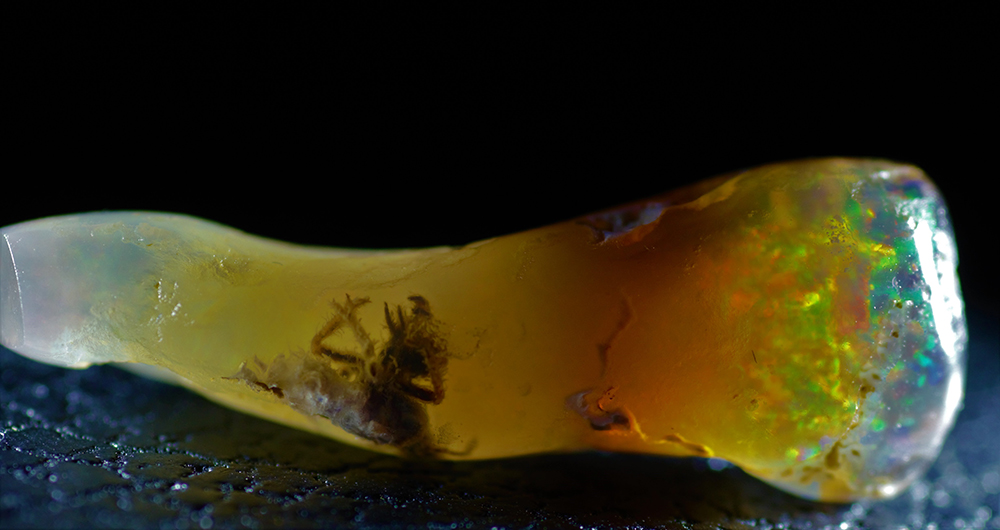
Unearthing a beautiful opal is usually a reward in itself. Discovering that your gemstone is actually an opalized fossil of a millions-year-old, previously unknown dinosaur, well that’s priceless. Precious stones recovered from the opal fields of Australia have turned out not just to be opalised fossils – but the opalised fossils of a dinosaur previously unknown to palaeontology.

The Right Lower Jaw of Weewarrasaurus Showcases the Rainbow Hues of Opal in the Fossil.

It’s called Weewarrasaurus pobeni – named for the Wee Warra opal field near the small country town of Lightning Ridge, where it was found, and opal buyer Mike Poben, who donated the specimens to science.

The species lived in the Cretaceous almost 100 million years ago when the Lightning Ridge Desert was still a lush, green space.

It’s also the first new dinosaur species to be named in the Australian state of New South Wales in nearly a century.

The only recovered part of Weewarrasaurus was its lower jaw, but with teeth intact – and that’s been able to reveal a lot. For a start, it wasn’t a big dinosaur, only about the size of a medium-sized dog.

Based on its teeth and the shape of its jaw, palaeontologist Phil Bell from the University of New England in Australia determined that it was a small species of ornithopod, a group of bipedal grazing herbivores that includes Iguanodon and Parasaurolophus.

Artistic reconstruction of Weewarrasaurus.

Lightning Ridge is one of Australia’s fossil hotspots. It was once a rich floodplain on the edge of a giant inland sea called the Eromanga Sea that spread across the Australian continent. The once abundant prehistoric life that filled the area would often be preserved in the mud, which over thousands and millions of years would turn to sandstone.

This is a process that can be seen around the world. But in Australia, something else happened. When the inland sea started disappearing 100 million years ago, acidity in the drying sandstone increased. This, in turn, released silica from the rock, which collected in hollows and pockets – such as those left behind by decayed bones, for instance.

As acidity levels then decreased, these silica pockets hardened into opal, resulting in perfect shimmering rainbow moulds of ancient remains. Nowhere in the world did this opalisation occur so abundantly as Lightning Ridge.

And this is what was found by Poben, who came across the two pieces of the opalised jawbone in a bag of rough opals he bought from miners, as John Pickrell reports for National Geographic.

So, Poben brought his find to Bell.

“I remember Mike showing me the specimen and my jaw dropped. I had to try hard to contain my excitement, it was so beautiful,” Bell said.

But it’s not just beautiful. In their paper, Bell and his colleagues note that, while Australia only seems to have been home to one or two large ornithopods, Muttaburrasaurus and one that is currently in the process of being studied, it seems to have been much richer in the smaller varieties.

Based on fossils found at Lightning Ridge, there were perhaps small ornithopod species thriving on the lush vegetation, and another four species in the southeastern state of Victoria. Only one small species has been found in the northeastern state of Queensland.

This is very different from America, where smaller herbivores would have had to compete for food with giants such as Triceratops and Alamosaurus.

So fossils like Weewarrasaurus are much more than just a pretty face – they can help us better understand how dinosaur biodiversity differed around the world, and piece together how that diversity may have come about.

Bell and his team are currently working hard to describe more opalised fossils – a tricky task since they are usually found broken as part of mining spoils.

Meanwhile, Weewarrasaurus has been given a new home at Lightning Ridge’s Australian Opal Centre, among its amazing collection of opalised fossils.

A crystal mountain in Egypt near an Oasis

A crystal mountain in Egypt near an Oasis which dates to 33 million years ago.

“Crystal Mountain”. Located within the white desert, 120 km from the Farafra Oasis and 160 km from the Bahariya Oases is one of the rarest mountains in the world, it is a mountain full of different crystal, where there are more than 12 types Crystal, clustered with each other in a huge mountain mass.

The hill is a subvolcanic vault, which emerged during the Oligocene age, 33 million years ago.

Crystal Mountain, which is often called the Jewel of the Desert is formed by the quartzite crystals and looks amazing in the sun’s rays.

A few decades ago, that natural feature has been found quite by accident. Local residents for several years used the minerals to build the road.

When researchers realized the uniqueness of this place, Crystal Mountain has been taken under protection. Today, it is an unmissable destination for all desert tours.

One of the most beautiful mountains of the world, a small arch of rock, shining brightly in the sun, making it look like a crown decorated with thousands of colored gems in the desert, making it like a treasure hunting behind every seeker of wealth, and this is what attracts many tourists and locals, His jewels are scattered in a unique landscape.

“Crystal Mountain”. Located within the White Desert, 120 km from the Farafra Oasis and 160 km from the Bahariya Oases is one of the rarest mountains in the world, it is a mountain full of different crystal, where there are more than 12 types Crystal, clustered with each other in a huge mountain mass. 

Crystal Mountain is usually thought to be a giant mountain that rises above the surface of the desert, but they are shocked when they visit it.

The presence of this treasure in a place open to all led to its destruction, most of the tourists and even local people, insist on going to the Crystal Mountain, to collect some pieces of calcite crystals scattered, and thought “Alkhirtia”, who are working as “guides” and “guides” desert, Imagine that tourists collect it as a hobby to collect colored stones, which threatened to disappear

Crystal Mountain is located between the Bahariya and Farafra areas. It is not close to any city. You cannot expect to walk to the area on foot. In fact, the mountain is really only reachable by specialty tours.

7 Billion-Year-Old Stardust Is Oldest Material Found on Earth

7 Billion-Year-Old Stardust Is Oldest Material Found on Earth

Philipp Heck, Field Museum curator and Associate professor of the University of Chicago and lead author of the paper on findings from the national academy of science, said: “This is one of the most interesting projects I worked on.” “These are the oldest solids ever discovered and tell us how stars in our galaxy formed.”

Dust-rich outflows of evolved stars similar to the pictured Egg Nebula are plausible sources of the large presolar grains found in meteorites like Murchison.

The materials Heck and his colleagues examined are called presolar grains-minerals formed before the Sun was born. “They’re solid samples of stars, real stardust,” says Heck. These bits of stardust became trapped in meteorites where they remained unchanged for billions of years, making them time capsules of the time before the solar system.

But presolar grains are hard to come by. They’re rare, found only in about five percent of meteorites that have fallen to Earth, and they’re tiny-a a hundred of the biggest ones would fit on the period at the end of this sentence.

But the Field Museum has the largest portion of the Murchison meteorite, a treasure trove of presolar grains that fell in Australia in 1969 and that the people of Murchison, Victoria, made available to science. Presolar grains for this study were isolated from the Murchison meteorite for this study about 30 years ago at the University of Chicago.

“It starts with crushing fragments of the meteorite down into a powder,” explains Jennika Greer, a graduate student at the Field Museum and the University of Chicago and co-author of the study. “Once all the pieces are segregated, it’s a kind of paste, and it has a pungent characteristic-it smell like rotten peanut butter.”

This “rotten-peanut-butter-meteorite paste” was then dissolved with acid until only the presolar grains remained. “It’s like burning down the haystack to find the needle,” says Heck.

Illustration of a meteor entering Earth’s atmosphere

Once the presolar grains were isolated, the researchers figured out from what types of stars they came and how old they were. “We used exposure age data, which basically measures their exposure to cosmic rays, which are high-energy particles that fly through our galaxy and penetrate solid matter,” explains Heck. “Some of these cosmic rays interact with the matter and form new elements. And the longer they get exposed, the more those elements form.

“I compare this with putting out a bucket in a rainstorm. Assuming the rainfall is constant, the amount of water that accumulates in the bucket tells you how long it was exposed,” he adds. By measuring how many of this new cosmic-ray produced elements are present in a presolar grain, we can tell how long it was exposed to cosmic rays, which tells us how old it is.

The researchers learned that some of the presolar grains in their sample were the oldest ever discovered-based on how many cosmic rays they’d soaked up, most of the grains had to be 4.6 to 4.9 billion years old, and some grains were even older than 5.5 billion years. For context, our Sun is 4.6 billion years old, and Earth is 4.5 billion.

But the age of the presolar grains wasn’t the end of the discovery. Since presolar grains are formed when a star dies, they can tell us about the history of stars. And 7 billion years ago, there was apparently a bumper crop of new stars forming-a sort of astral baby boom.

“We have more young grains that we expected,” says Heck. “Our hypothesis is that the majority of those grains, which are 4.9 to 4.6 billion years old, formed in an episode of enhanced star formation. There was a time before the start of the Solar System when more stars formed than normal.”

This finding is ammo in a debate between scientists about whether or not new stars form at a steady rate, or if there are highs and lows in the number of new stars over time. “Some people think that the star formation rate of the galaxy is constant,” says Heck. “But thanks to these grains, we now have direct evidence for a period of enhanced star formation in our galaxy seven billion years ago with samples from meteorites. This is one of the key findings of our study.”

Heck notes that this isn’t the only unexpected thing his team found. As almost a side note to the main research questions, in examining the way that the minerals in the grains interacted with cosmic rays, the researchers also learned that presolar grains often float through space stuck together in large clusters, “like granola,” says Heck. “No one thought this was possible at that scale.”

Heck and his colleagues look forward to all of these discoveries furthering our knowledge of our galaxy. “With this study, we have directly determined the lifetimes of stardust. We hope this will be picked up and studied so that people can use this as input for models of the whole galactic life cycle,” he says.

Heck notes that there is lifetimes’ worth of questions left to answer about presolar grains and the early Solar System. “I wish we had more people working on it to learn more about our home galaxy, the Milky Way,” he says.

“Once learning about this, how do you want to study anything else?” says Greer. “It’s awesome, it’s the most interesting thing in the world.”

“I always wanted to do astronomy with geological samples I can hold in my hand,” says Heck. “It’s so exciting to look at the history of our galaxy. Stardust is the oldest material to reach Earth, and from it, we can learn about our parent stars, the origin of the carbon in our bodies, the origin of the oxygen we breathe. With stardust, we can trace that material back to the time before the Sun.”

“It’s the next best thing to being able to take a sample directly from a star,” says Greer.

This study was contributed to by researchers from the Field Museum, University of Chicago, Lawrence Livermore National Laboratory, Washington University, Harvard Medical School, ETH Zurich, and the Australian National University. Funding was provided by NASA, the TAWANI Foundation, the National Science Foundation, the Department of Energy, the Swiss National Science Foundation, the Brazilian National Council for Scientific and Technological Development and the Field Museum’s Science and Scholarship Funding Committee.

600-Year-Old Foundations Unearthed in Mexicapan

600-Year-Old Foundations Unearthed in Mexicapan

Archeologists in the Mexico City district of Azcapotzalco have discovered the base of the pre-Hispanic house and other building remnants of an ancient settlement.

In a declaration, the INAH confirmed that the finds in the historic center of the northern borough were part of the ancient altépetl, or city-state, of Mexicapan.

The city came into being when inhabitants of the Aztec or Mexica, capital of Tenochtitlán conquered the dominion of Azcapotzalco in 1428 and divided it into two autonomous settlements – Mexicapan and Tepanecapan.

The “domestic platform,” as INAH describes the foundations of the home, and the other structural remains are believed to have been part of a residential neighborhood within Mexicapan that was occupied by the city’s elite.

Measuring eight meters by six meters, the stone foundations of the pre-Hispanic house are among the largest ever found in Azcapotzalco, said INAH archaeologist Nancy Domínguez Rosas. The archaeological rescue team she heads also unearthed the remains of stone walls on the perimeter of the platform that measures between 50 and 70 centimeters.

The discovery is located in the historic center of Azcapotzalco.

The foundation is well preserved, Domínguez said, although the wall remains show signs of damage from more recent construction.

Archaeologists believe that the platform was built in two separate stages, the first of which corresponds to the late post-classic period between 1350 and 1519 AD. When the second phase of construction took place has not yet been determined.

Archaeologists found the platform while working alongside a municipal government team that was installing a tension fabric structure on Paseo de las Hormigas (Promenade of the Ants), which is part of the Azcapotzalco Park.

Domínguez said that 31 holes between one and two meters deep were dug for the slab foundations of the shade structure.

The structural remains of the Mexicapan neighborhood were discovered at a depth of 1.2 to two meters in front of the Azcapotzalco market, she said.

In addition to the domestic platform, archaeologists discovered the remains of other residential structures including one that measures 1.72 by 1.75 meters. All of the structures were made out of high-quality materials, leading archaeologists to conclude that they housed the elite and upper classes of Mexicapan society.

The archaeological rescue team has also discovered artifacts made out of both stone and bones.

Domínguez said the presence of the INAH team while the municipal employees are working in the area ensures that archaeological remains are not damaged, adding that archaeologists will continue to work to determine if there are any more pre-Hispanic structures in the area.

After they have been examined, the structures will be covered with geotextile, soil, and limestone to avoid their deterioration.

The discovery of such remains allows archaeologists “to recover information and contrast it with the information provided by historical sources,” Domínguez said, adding that the aim is to develop a greater understanding of “the way of life” of the residents of Mexicapan.

She also said that there is evidence that there were chinampas, or floating gardens, in the elite neighborhood and that human burials took place there.

The information . . . helps us to gradually reconstruct the puzzle of the urban configuration of Azcapotzalco in the pre-Hispanic era,” Domínguez said.

All In One Magazine