All posts by Archaeology World Team

Three Settlements Unearthed in Southern Bulgaria

Three Settlements Unearthed in Southern Bulgaria

In three rescue excavations near the town of Radnevo, three different ancient settlements are discovered funded by a coal mining company, the most interesting was a new artefact was a statuette of the ancient goddess Athena, an early Thracian settlement a town from the time of the Roman Empire, and an early Byzantine and mediaeval Bulgarian settlement.

This bronze statuette of Ancient Thracian, Greek, and the Roman goddess Athena has been found on the fringes of a Roman Era settlement from the 2nd – 4th century AD near Radnevo in Southern Bulgaria during rescue digs sponsored by a state-owned coal-mining conglomerate.

The rescue excavations have been carried out by the Maritsa East Archaeological Museum in Radnevo with funding from the Maritsa East Mines Jsc company, a large state-owned coal mining company, on plots slated for coal mining operations.

An Early Ancient Thracian settlement has been discovered in the first researched location to the west of the town of Polski Gradets, Radnevo Municipality, Stara Zagora District, (in an area called “Dyado Atanasovata Mogila”), the Maritsa East Mines company has announced.

The Maritsa East Archaeological Museum has not announced the precise dating of the site but the Early Thracian period would typically refer to ca. 1,000 BC, the Early Iron Age.

The rescue excavations on the site of the Early Thracian settlements were carried out in September and October 2020 by a team led by Assoc. Prof. Krasimir Nikov and Assoc. Prof. Rumyana Georgieva, both of them archaeologists from the National Institute and Museum of Archaeology in Sofia.

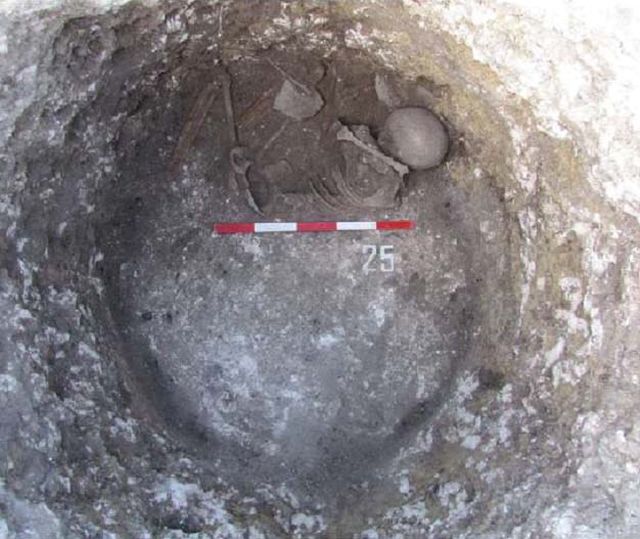
The archaeologists have discovered the ruins of Thracian residential and “economic” buildings. The artefacts discovered in the site include anthropomorphic figurines, pottery vessels, ceramic spindle whorls, loom weights, millstones, stone tools used for polishing and hammering. Inside the ritual pits of the Early Thracian settlement near Radnevo, the archaeologists have found human burials.

In them, the humans were buried in a fetal position (in archaeological texts in Bulgaria and some other European and Asian countries, it is known as the “hocker position” – in which the knees are tucked against the chest).

The Maritsa East Museum says that the discovery of the Early Thracian settlement has yielded new “information about the settlement structure of the Thracian Age.”

A human burial with the deceased placed in a fetal position inside one of the ritual pits from the Early Thracian settlement discovered near Polski Gradets, Radnevo Municipality, in Southern Bulgaria
An aerial photograph of the archaeological site where the ruins of the Early Thracian settlement have been discovered in rescue digs by a coal-mining company near Bulgaria’s Radnevo.

In the second location subject to rescue excavations near Bulgaria’s Radnevo (in an area called “Boyalaka”), an archaeological team has found the periphery of a settlement from the 2nd – 4th century AD, i.e. the period of the Roman Empire, which also existed in later periods, all the way into the Middle Ages.

The excavations in question have covered a large area of about 40 decares (10 acres) on a plot slated for coal mining. The archaeological team has performed a total of 32 drillings at selected spots in order to designate areas for further more detailed excavations.

On the surface, the archaeologists have found pottery from different time periods – from the Roman Era, the Early Byzantine Era, the Middle Ages, and the Late Middle Ages – the time of the medieval Bulgarian Empire. The archaeologists have unearthed bricks, tegulae, and a glazed plate from the Late Antiquity period.

“We assume this was the periphery of a settlement from the Roman Era – 2nd – 4th century AD, which developed in the western direction. The eight [Roman] coins that we have found during the drillings also confirm this dating,” says Plamen Karailiev, Director of the Maritsa East Archaeological Museum in Radnevo. The most interesting artefact from the Roman Era settlement in question is a bronze statuette depicting Ancient Thracian, Greek, and the Roman goddess Athena.

This bronze statuette of Ancient Thracian, Greek, and Roman goddess Athena has been found on the fringes of a Roman Era settlement from the 2nd – 4th century AD near Radnevo in Southern Bulgaria during rescue digs sponsored by a state-owned coal-mining conglomerate.

“What’s generating interest is the bronze statuette depicting goddess Athena, which is the first of its kind to become part of the collection of [our] museum,” the museum director states. In the same location, however, the archaeologists have also discovered for the first time pottery fragments from the Bronze Age, which the Museum says is adding information to the site’s stratigraphy for future excavations to precede the coal mining there.

The third location excavated at the request of the state mining company near Radnevo in 2020 is near the town of Troyanovo (in an area called “Vehtite Lozya”), where an archaeological team has discovered structures from a settlement from the Early Byzantine period, i.e. Late and Antiquity and Early Middle Ages, and from the medieval period when the region at different times was part of the First and Second Bulgarian Empire and the Byzantine Empire (Eastern Roman Empire).

There the archaeological team led by Krasimir Velkov from the Tvarditsa Museum of History and Tatyana Kancheva from the Maritsa East Museum of Archaeology has found a wide range of early medieval and medieval structures.

These include a total of 12 dwellings, 7 semi-dugouts which, however, were not used as homes, i.e. for residential purposes, a total of 14 pits, two household kilns and one hearth. The excavations of the “layer settlement from the Early Byzantine and medieval period” covered an area of 4 decares (app. 1 acre), and were carried out from early August until early October 2020.

The wide range of archaeological artefacts discovered on the site including a number of coins, including two Byzantine “cup-shaped” coins, the so-called scyphates, fragments from bronze and glass bracelets, an iron spur, iron arrow tips, small knives, an iron fishing hook, numerous spindle whorls, clay candlesticks, and lids of pottery vessels.

The 2020 rescue archaeological excavations in all three locations around the town of Radnevo, which is the largest coal mining area in Bulgaria, have been funded by the state-owned Maritsa East Mines company with a combined total of more than BGN 240,000 (app. EUR 120,000).

In a release, the Maritsa East Mines company points out that the first-ever rescue archaeological excavations in the area of Radnevo in Southern Bulgaria were carried out back in 1960 right at the start of the industrial coal mining there.

“For many decades now, Maritsa East Mines Jsc have contributed to the preservation of artefacts from past millennia. The extraction of coal begins only after the respective plots have been researched by archaeologists. The finds from these rescue archaeological expeditions, some of which are unique, have been processed and exhibited at the Maritsa East Museum of Archaeology in Radnevo,” the state-owned company says.

A very interesting archaeological artefact discovered during rescue excavations near Radnevo funded by the coal mining conglomerate has been an Ancient Thracian clay altar from the 4th century BC.
2,300-Year-Old Burials Discovered in Southern Greece

2,300-Year-Old Burials Discovered in Southern Greece

2,300-Year-Old Burials Discovered in Southern Greece

According to a Keep Talking Greece report, Greece’s Ministry of Culture and Sports announced the discovery of eight burials dated to the late fourth through the second century B.C. during rescue excavations on private land in southern Greece.

A recent rescue excavation by the Ephorate of Antiquities of Ilia on a privately owned land plot at the location “Droubes or Paliabela” within the Municipality of Ilida, the Regional Unit of Ilia.

According to the preliminary examination of the offerings, the tombs are dated from the end of the 4th to the 2nd century BC.

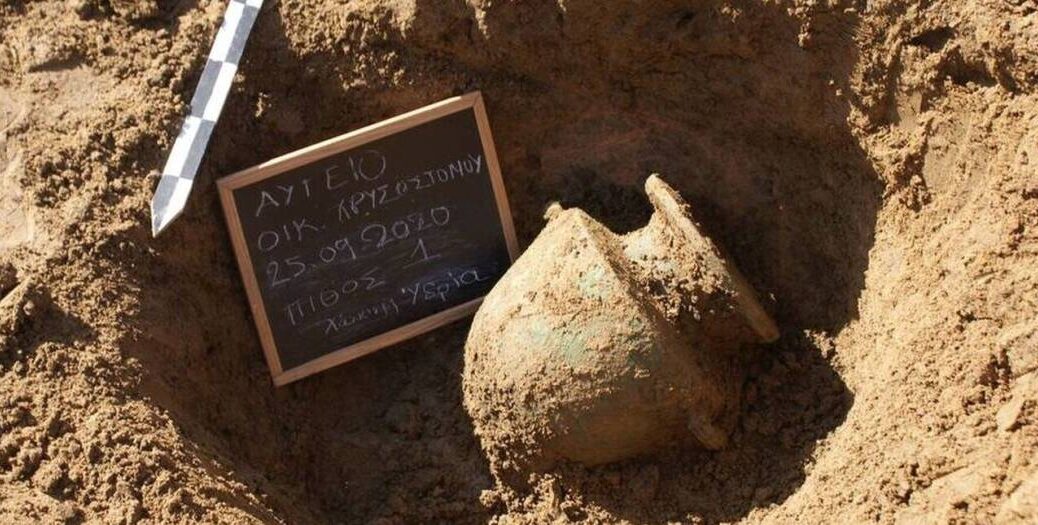
Three burial pits, four box-shaped ones and a tiled tomb roof tomb were found.

These tombs are part of the western necropolis of the ancient city of Ilida, from which more than 200 tombs dating to the late classical and Hellenistic period have been excavated to date.

“Particularly important are the findings of burial pit 1, including a bronze urn with its base, which has a floral decoration on the handles and lion heads at the junction of the handles with the rim and a bronze folding mirror,” the Ministry said.

From the first assessment of the offerings, the burial pit dates to the end of the 4th to the beginning of the 3rd century BC.

Apart from a large number of vessels from the Hellenistic period, mainly from the findings of the other tombs, a marble tombstone with a gabled crown stands out”, the Culture Ministry said.

Baby lyuba, the worlds most complete and Best-Preserved Woolly Mammoth

Baby lyuba, the worlds most complete and Best-Preserved Woolly Mammoth

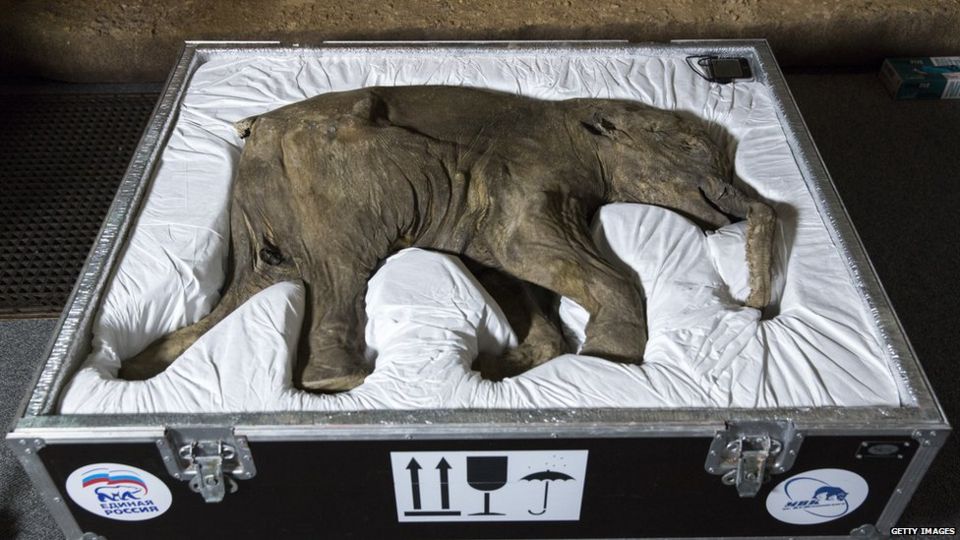
She is 42,000 years old and has come a long way for her Australian debut. First, she was recovered from the frozen mud in Siberia that was her tomb for so long. Then she was packed into a crate at a tiny museum in Russia and flown to a humidity-controlled cube at the Australian Museum.

Mammoths – Giants of the ice age

The ice age world of woolly mammoths will be brought to life in Mammoths – Giants of the Ice Age, exclusive to the Australian Museum from 17 November 2017.

Baby Lyuba, the world’s most complete and best-preserved woolly mammoth, has arrived in Sydney. She is in remarkable condition, with her skin and internal organs intact. Scientists even found her mother’s milk in her belly.

The 42,000-year-old baby woolly mammoth was unveiled on Friday at the Sydney Museum

We will finally be able to see her when she is unveiled as the centrepiece of the museum’s Mammoths – Giants of the Ice Age exhibition.

Lyuba, who died at 35 days, is one of Russia’s national treasures, and the government is reluctant to let her out of its sight too often. This is only the fifth time Shemanovsky Museum has let her out, and it’s her first trip to the southern hemisphere.

The mammoth was first spotted in 2007 by Yuri Khudi, a Siberian reindeer herder, who found her as the frost thawed on a muddy bank of the Yuribey River. When he brought a team of scientists back to recover her, she was gone; someone else had got there first.

The 42,000-year old carcass was discovered by a reindeer herder

The team tracked her to a village deep within Siberia’s frozen wasteland. She was propped up on the door of a shop. The shop keeper had reportedly bought her for two snowmobiles and a year’s worth of food from Mr Khudi’s cousin.

“And while she was propped up, a dog came up and chewed off her tail and her ear. If only for that she’d be completely intact,” says Trevor Ahearn​, the Australian Museum’s creative producer.

Lyuba (Lay-oo-bah) means love in Russian. The museum has chosen to surround her with models of huge, ferocious adult mammoths, much as the herd would have surrounded and protected her in life.

It is thought her feet had become stuck in a muddy hole on the side of a Siberian riverbank. Before her mother could yank her out, Lyuba slipped below the surface, where the mud choked her mouth and trunk.

But the mud that killed her also contained sediments and bacteria that created an acid barrier around her body, in effect pickling her. When the river froze over, she was left perfectly preserved.

Had she lived a full mammoth life – 60 years – Lyuba would have grown to more than three metres in height and about five tonnes. To sustain that bodyweight she would have consumed up to 180 kilograms of grass and 80 litres of water a day. Mammoths lived in the late Paleolithic period, which stretched from about 200,000 BC, the time Homo sapiens first emerged in Africa, to 10,000 BC.

Mammoths were uniquely adapted for the conditions, with small ears and thick, woolly fur. They ate grass and bark and roamed across Europe, North America and Siberia.

That makes Lyuba the first of her kind to visit our shores, and it took the Australian Museum a fair bit of what director Kim McKay terms “cultural diplomacy” to get her over here. Negotiations involved the Shemanovsky Museum and the Russian government.

Mr Ahearn says: “One of the first things we had to do before we brought Lyuba over here was absolutely guarantee our Russian colleagues that there was no possibility of her getting seized because there is some controversy over who owns her.

“She’s a little controversial in Russia, with her association with an oil company that helped bring her into the museum. I think it’s paranoia. Russia is feeling a little bit of pressure, so I don’t know if it’s founded. There are lots of myths; it’s all very hazy.”

The prospect of mammoth cloning

Scientists have two competing theories on why mammoths became extinct about 10,000 years ago. Both have important things to tell us about the modern environment – and perhaps contain a message about why we shouldn’t be trying to bring mammoths back.

The first theory is climate change. The ending of the ice age about 10,000 BC may have dramatically reduced the area in which these cold-environment animals could survive.

The second theory is over-hunting. Mammoths, with their tonnes of fat, would have represented an incredibly valuable food source for early humans, who developed sharp spears to hunt them. Scientists think it is possible the mammoth is the first species humanity managed to push into extinction.

Mammoth cloning has always excited the popular imagination, and the exhibition dedicates a section to the possibilities. So far, we have sequenced about 70 per cent of mammoth DNA, so the raw material is not there yet. But even if we could, we shouldn’t, says David Alquezar​, manager of the Australian Museum’s genetics lab.

“The money to do that could be better invested in species that are endangered right now, rather than focusing our efforts on a species that has been extinct for 10,000 years,” says Dr Alquezar.

Amber fossils reveal the true colours of 99-million-year-old insects

Amber fossils reveal the true colours of 99-million-year-old insects

Nature is full of colours, from the radiant shine of a peacock’s feathers or the bright warning colouration of toxic frogs to the pearl-white camouflage of polar bears.

Usually, fine structural detail necessary for the conservation of colour is rarely preserved in the fossil record, making most reconstructions of the fossil-based on artists’ imagination.

A research team from the Nanjing Institute of Geology and Palaeontology of the Chinese Academy of Sciences (NIGPAS) has now unlocked the secrets of true colouration in the 99-million-year-old insects.

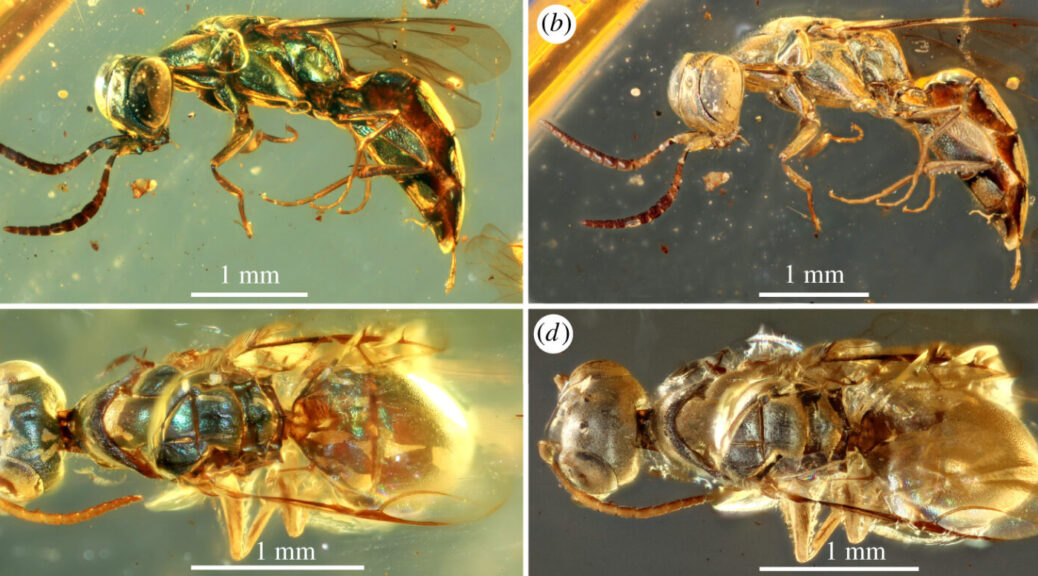
Diverse structural-colored insects in mid-Cretaceous amber from northern Myanmar

Colours offer many clues about the behaviour and ecology of animals. They function to keep organisms safe from predators, at the right temperature, or attractive to potential mates. Understanding the colouration of long-extinct animals can help us shed light on ecosystems in the deep geological past.

The study, published in Proceedings of the Royal Society B on July 1, offers a new perspective on the often overlooked, but by no means dull, lives of insects that co-existed alongside dinosaurs in Cretaceous rainforests.

Researchers gathered a treasure trove of 35 amber pieces with exquisitely preserved insects from an amber mine in northern Myanmar.

“The amber is mid-Cretaceous, approximately 99 million years old, dating back to the golden age of dinosaurs. It is essentially resin produced by ancient coniferous trees that grew in a tropical rainforest environment.

Animals and plants trapped in the thick resin got preserved, some with life-like fidelity,” said Dr. CAI Chenyang, associate professor at NIGPAS who lead the study.

The rare set of amber fossils includes cuckoo wasps with metallic bluish-green, yellowish-green, purplish-blue or green colours on the head, thorax, abdomen, and legs. In terms of colour, they are almost the same as cuckoo wasps that live today, said Dr. CAI.

The researchers also discovered blue and purple beetle specimens and a metallic dark-green soldier fly. “We have seen thousands of amber fossils but the preservation of colour in these specimens is extraordinary,” said Prof. HUANG Diying from NIGPAS, a co-author of the study.

“The type of colour preserved in the amber fossils is called structural colour. It is caused by the microscopic structure of the animal’s surface. The surface nanostructure scatters light of specific wavelengths and produces very intense colours.

This mechanism is responsible for many of the colours we know from our everyday lives,” explained Prof. PAN Yanhong from NIGPAS, a specialist on palaeoecology reconstruction.

To understand how and why colour is preserved in some amber fossils but not in others, and whether the colours seen in fossils are the same as the ones insects paraded more than 99 million years ago, the researchers used a diamond knife blades to cut through the exoskeleton of two of the colourful amber wasps and a sample of the normal dull cuticle.

Using electron microscopy, they were able to show that colourful amber fossils have a well-preserved exoskeleton nanostructure that scatters light.

The unaltered nanostructure of coloured insects suggested that the colours preserved in amber may be the same as the ones displayed by them in the Cretaceous. But in fossils that do not preserve colour, the cuticular structures are badly damaged, explaining their brown-black appearance.

What kind of information can we learn about the lives of ancient insects from their colour? Extant cuckoo wasps are, as their name suggests, parasites that lay their eggs into the nests of unrelated bees and wasps.

Structural colouration has been shown to serve as camouflage in insects, and so it is probable that the colour of Cretaceous cuckoo wasps represented an adaptation to avoid detection.

“At the moment we also cannot rule out the possibility that the colours played other roles besides camouflage, such as thermoregulation,” adds Dr CAI.

Yonaguni Monument: Man-made structure or natural geological formation

Yonaguni Monument: Man-made structure or natural geological formation

THE YONAGUNI-JIMA KAITEI CHIKEI, LITERALLY translated as “Yonaguni Island Submarine Topography,” is an underwater mystery off the coast of the Ryukyu Islands, Japan. 

The massive underwater rock formation is speculated to have existed for more than 10,000 years, but whether the formation is completely man-made, entirely natural, or has been altered by human hands is still up for debate.

The monument was first discovered in 1986 by a diver searching for a good spot to observe hammerhead sharks. After its discovery, Masaaki Kimura, a marine geologist at the University of the Ryukyu, explored the monument for nearly two decades.

Yonaguni Monument: Man-made structure or natural geological formation

Kimura remains convinced that the site was carved thousands of years ago when the landmass was above water.

According to Kimura the Yonaguni’s numerous right angles, strategically placed holes and aesthetic triangles are signs of human alteration. He also claims that carvings exist on the monuments, resembling Kaida script.

He believes that a pyramid, castles, roads, monuments and a stadium can be identified within the structure – which for him is evidence that the monument is what remains of the Lost Continent of Mu, the Japanese equivalent to Atlantis.

As with most theories of lost civilizations, Kimura has met with controversy about his beliefs. Robert Schoch, a professor at Boston University, has dived at the site and explains that the formation is “basic geology and classic stratigraphy for sandstones, which tend to break along planes and give you these very straight edges, particularly in an area with lots of faults and tectonic activity.”

Sandstone structures typically erode into rigid formations, and it is unlikely that the structure was entirely man-made, if man-made at all, because the visible structure is connected to a hidden rock mass.

Geology and strong currents may explain the peculiar shape of the rock, but they cannot account for the pottery, stone tools and fireplaces found there, possibly dating back to 2500 BCE.

However, the items merely show that the area was once inhabited and do not indicate that the monument is anything other than a natural geological formation.

Yonaguni is composed of sandstone and mudstone that dates back 20 million years. If the monument was carved by human hands, it was during the last ice age (about 10,000 years ago) when Yonaguni was part of a land bridge that connected the site to Taiwan.

Both the Japanese Government’s Agency for Cultural Affairs and the Government of Okinawa Prefecture deny Yonaguni as a historical-cultural site.

Metal Detectorist In Scotland Unearths Rare Medieval Knife

Metal Detectorist In Scotland Unearths Rare Medieval Knife

Scottish history enthusiast and metal detectorist Craig Johnstone had worked out that woods near Penicuik were probably an escape route from a 1666 battle and he went to see what he could find.

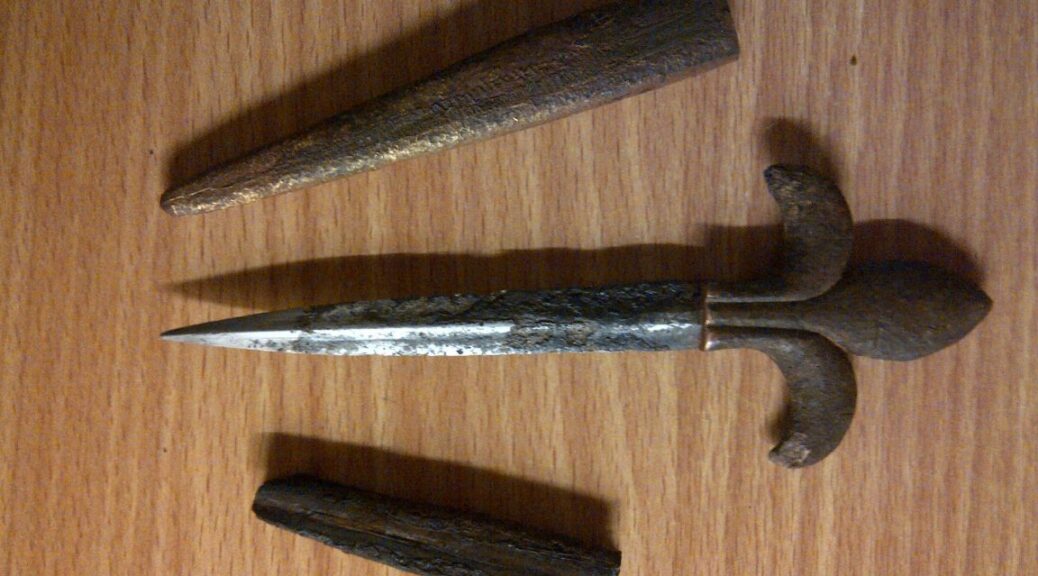
But after coming across some musket balls which confirmed his theory, he unearthed something which turned out to be much older and unusual – a small, highly-decorated knife and scabbard which has been dated between 1191 and 1273.

“When I found the knife it was covered in mud,” he said. “The knife was stuck inside the scabbard and I thought it was the top of a railing someone had cut off.

“I showed it to a couple of people and one of my friends worked for Midlothian council – he took it into their archaeologist and straight away she knew it was a knife. The knife and its scabbard have been dated to between 1191 and 1273

The knife and its scabbard have been dated to between 1191 and 1273

“She advised us to heat it up slowly so we put it in the oven at really low heat with the door open. It was a pure Excalibur moment for me when I pulled out the handle and there was a blade.”

There were also two pieces of leather inside the scabbard to protect the knife. Mr Johnstone, who lives in Penicuik and has his own data communications business, took his find from Deanburn woods to an independent expert in Edinburgh. “He knew it was from the medieval period, but he didn’t realise how early it was – he thought maybe the 16th century.

“After that, I realised I had better report it to Treasure Trove – but they dismissed it as a ‘relatively modern item’.”

The knife is highly decorated and could have belonged to a nobleman.

Undeterred, he paid to have it carbon-dated privately and was told it could be over 800 years old, originating between 1191 and 1273.

“I wasn’t expecting it to come back with such an early date.”

He passed the carbon-dating details to Treasure Trove and the knife is due to be considered by the Scottish Archaeological Finds Allocation Panel. Mr Johnstone said the knife was about the same size as a skean dhu. “The blade is only about three inches and it’s a high-grade, hollow-ground blade.

Craig Johnstone had only been metal-detecting for six months when he found the knife

“It’s a very highly decorated item for its time. The blade would have had a silver leaf on it, the handle is bronze would have been covered in gold.

“It would have belonged to a nobleman or someone of some substance.

“This is an important item. There’s never been one found before that’s as early as this.”

Mr Johnstone had only been metal-detecting for about six months when he made his discovery. He has since found a bronze age spearhead which has been dated around 1500 BC and he received £200 for it.

Metal Detectorist In Scotland Unearths Rare Medieval Knife
The scabbard, knife and leather insert were unearthed at Deanburn woods, Penicuik

The scabbard, knife and leather insert were unearthed at Deanburn woods, Penicuik.

But he says: “None of this is about the money or how much these things are worth. It’s about Scottish history and the knife getting the recognition it deserves.”

A Treasure Trove spokeswoman said: “This is a highly unusual object, comprising of a blade with a hilt and a metal scabbard with leather inside. While the leather and blade date from the medieval period, the hilt and scabbard are unusual for the period.

“Treasure Trove is still carrying out investigations into the object. It was due to be x-rayed as part of the investigation process, but this has unfortunately been delayed due to Covid-19 restrictions.”

Roman treasure discovered by chance: Hundreds of ancient gold coins hidden for centuries

Roman treasure discovered by chance: Hundreds of ancient gold coins hidden for centuries

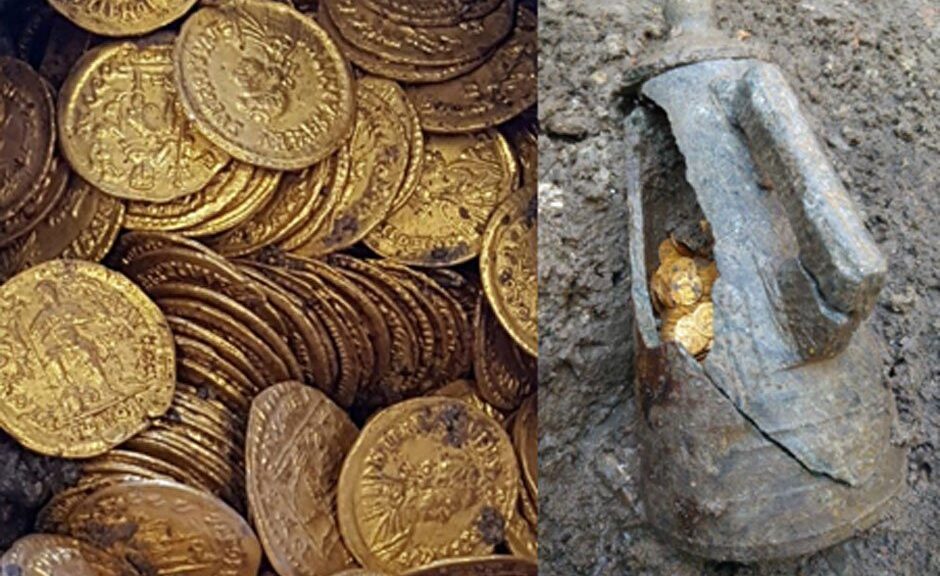
A precious cache of ancient Roman coins discovered on the site of a former theatre in northern Italy is being investigated by archaeologists. The coins, at least 300 of them, date back to the late Roman imperial era and were discovered in the basement of the Cressoni Theatre in Como, north of Milan, in a soapstone jar.

An absolutely astonishing find that will provide significant information about several Roman emperors.

“We do not yet know in detail the historical and cultural significance of the find,” said Culture Minister Alberto Bonisoli in a press release. “But that area is proving to be a real treasure for our archaeology. A discovery that fills me with pride.”

Whoever placed the jar in that place “buried it in such a way that in case of danger they could go and retrieve it,” said Maria Grazia Facchinetti, a numismatist — or expert in rare coins — at a press conference.

27 of the Roman coins were put on display during the reveal of the discovery.

“They were stacked in rolls similar to those seen in the bank today,” she said, adding the coins have engravings about emperors Honorius, Valentinian III, Leon I, Antonio, and Libio Severo “so they don’t go beyond 474 AD.”

“All of this makes us think that the owner is not a private subject, rather it could be a public bank or deposit,” Facchinetti added.

Archaeologists also uncovered a golden bar inside the jar.

According to the Ministry of Cultural Heritage and Activities, coins were transferred to the Mibac restoration laboratory in Milan where archaeologists and restorers are examining them.

The ministry did not place a value on the coins. But reports in the Italian media suggest they could be worth millions of dollars.

The historic Cressoni Theater opened in 1807 before transitioning into a cinema and eventually closing in 1997. The site is not far from the Novum Comum forum area, where other important Roman artefacts were discovered, according to the ministry.

The find is one of several surprising discoveries of Roman coins in recent years.

In 2016, archaeologists unearthed a rare 2,000-year-old Roman a gold coin in Jerusalem. The coin featured the face of Nero, the Roman emperor best known for playing the fiddle while Ancient Rome burned, and was likely struck in 56-57 AD.

A quadrillion tons of diamonds lie deep beneath the Earth’s surface
It was discovered at the Mount Zion archaeological dig, south of the Old City of Jerusalem, where a University of North Carolina-Charlotte team was excavating throughout the summer.

That same year, a team of archaeologists unearthed 10 ancient Roman and Ottoman coins from the ruins of a castle in Okinawa, Japan.

Tens of Thousands of ice age Paintings across a cliff face shed light on people and animals from 12,500 years ago

Tens of Thousands of ice age Paintings across a cliff face shed light on people and animals from 12,500 years ago

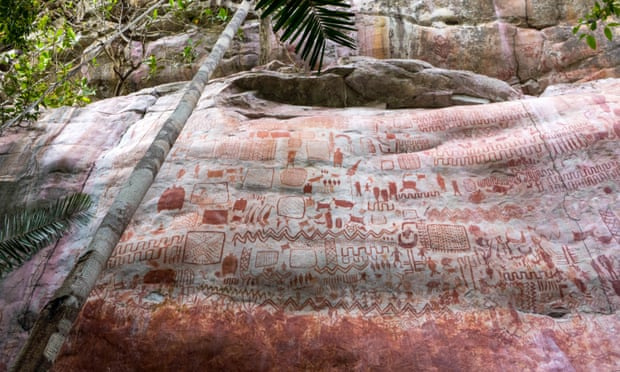
In the Colombian jungle, archaeologists have found tens of thousands of ancient drawings dating back about 12,500 years. This prehistoric depictions of animals and humans have been discovered adorning cliff faces that stretch for almost eight miles. On top of that, some depict long-extinct ice age animals.

Archaeologists were shocked to discover numerous human handprints on the site, according to the Daily Mail. Funded by the European Research Council, the British-Colombian team had no idea what awaited them in the Chiribiquete National Park — but is now finally ready to share the remarkable discovery with the world.

Pictures of animals such as mastodons and paleo lamas, the extinct ancestors of elephants and camels, were perhaps the most exciting.  The cliff face art also includes giant sloths and ice age horses, all of which were clearly seen and painted by some of the first humans to ever reach the Amazon.

Tens of Thousands of ice age Paintings across a cliff face shed light on people and animals from 12,500 years ago
Many of the paintings are so high up that drones are needed to view them.

According to The Guardian, the find has been aptly lauded as “the Sistine Chapel of the ancients.” Based on the sheer scale and plethora of paintings, experts say it’ll take generations to properly analyze. While it was uncovered last year, the find was kept secret for a documentary set to air on Britain’s Channel 4 in December.

“When you’re there, your emotions flow…We’re talking about several tens of thousands of paintings,” said lead archaeologist José Iriarte, professor of archaeology at Exeter University. “It’s going to take generations to record them…Every turn you do, it’s a new wall of paintings.”

The site is so remote that it took experts a two-hour drive from Chiribiquete National Park to Serranía de la Lindosa — followed by a four-hour hike to reach it. After this long journey, the team was awed to discover such extensive paintings.

Regional natives of the Amazon didn’t keep written records until fairly recently. With a humid climate and high levels of acid in the soil, nearly every trace of their tangible presence — including human remains — have been lost. Most about the region’s history before 1,500 has been inferred from ceramics and arrowheads.

Most native tribes of the Amazon are believed to have descended from the first prehistoric group of migrants to cross the Bering Land Bridge around 17,000 years ago. The discovery is thus sure to shed unprecedented light on various aspects of their culture.

The remarkable handprints are estimated to be as old as 12,500 years.

“We started seeing animals that are now extinct,” said Iriarte. “The pictures are so natural and so well made that we have few doubts that you’re looking at a horse, for example. The ice-age horse had a wild, heavy face. It’s so detailed, we can even see the horsehair. It’s fascinating.”

While it’s yet unclear exactly which tribe was responsible for the uncovered art, there are some preliminary wagers at hand. Both the Yanomami and Kayapo tribes have been around for thousands of years and appear to be likely candidates.

Of course, not everything worth doing is easy — and the region’s more hostile factors rapidly made that clear for Iriarte and his team. Ella Al-Shamahi, presenter of the upcoming Channel 4 documentary series Jungle Mystery: Lost Kingdoms of the Amazon, spoke about these hidden threats.

Caimans are everywhere, and we did keep our wits about us with snakes,” she said, recalling a giant bushmaster, “the deadliest snake in the Americans with an 80 per cent mortality rate” which the team encountered in the dead of night. “You’re in the middle of nowhere.”

Al-Shamahi recalled having to navigate both deadly animals and guerrillas to reach the site.

Unfortunately, there was another lethal threat abounding in the jungle not to be taken lightly — the FARC. Colombia suffered decades of civil war between these guerrillas and the government, with a shaky truce and heavy militant presence in the jungles not particularly calming.

Fortunately, they allowed the experts entry.

“When we entered Farc territory, it was exactly as a few of us have been screaming about for a long time,” said Al-Shamahi. “Exploration is not over. Scientific discovery is not over but the big discoveries now are going to be found in places that are disputed or hostile.”

It was only last week that evidence of ancient hallucinogenic rituals was uncovered in California. It seems these Colombian tribes engaged in the same, as paintings of psychoactive plants were also found on the walls.

“For Amazonian people, non-humans like animals and plants have souls, and they communicate and engage with people in cooperative or hostile ways through rituals and shamanic practices that we see depicted in the rock art,” said Iriarte.

The research will continue as pandemic-centric regulations loosen.

“It’s interesting to see that many of these large animals appear surrounded by small men with their arms raised, almost worshipping these animals,” added Iriarte.

For Al-Shamahi, one of the more intriguing aspects was the height of some of these illustrations. They were so elevated that they could only be viewed with camera-drones and some depicted wooden towers with figures bungee jumping off of them. Still, the historical context blew her away more than anything.

“One of the most fascinating things was seeing ice age megafauna because that’s a marker of time. I don’t think people realize that Amazon has shifted in the way it looks. It hasn’t always been this rainforest. When you look at a horse or mastodon in these paintings, of course, they weren’t going to live in a forest.”

“They’re too big. Not only are they giving clues about when they were painted by some of the earliest people — that in itself is just mind-boggling — but they are also giving clues about what this very spot might have looked like: more savannah-like.”

As it stands, the COVID-19 pandemic has put a damper on continued research here. Fortunately for us, we’ll get to see these initial discoveries up close when the documentary series airs its episode on the matter on Dec. 12.