All posts by Archaeology World Team

2-Million-Year-Old Human Ancestor Preserved Tissue Maybe the oldest skin ever discovered

2-Million-Year-Old Human Ancestor Preserved Tissue Maybe the oldest skin ever discovered

The remains of six skeletons are believed to have uncovered fossilised skins of an ancient human ancestor, who lived two million years ago.

Anthropologists believe they have found the preserved skin tissue of an early human species known as Australopithecus sediba in an ancient cave near Johannesburg, in South Africa.

It could be the oldest example of human soft tissue to ever be found and is set to reveal new details about what this now-extinct species of human was like. Scientists who have been leading the excavation, which began with the discovery of the remains of a 4ft 2 inch tall male juvenile in 2008, believe they have also found the remains of the ancient humans’ last meals still preserved in their teeth.

Thin layers of ‘organic’ material thought to be skin were found attacked to the cement-like a rock from which this skull Australopithecus sediba was removed by anthropologists at the Malapa site in South Africa

Professor Lee Berger, an anthropologist at the University of Witwatersrand in Johannesburg, who has been leading the excavation, said: ‘We found out this wasn’t just a normal type of rock that they were contained in – it was a rock that was preserving organic material.

‘Plant remains are captured in it – seeds, things like that – even food particulates that are captured in the teeth, so we can see what they were eating.

‘Maybe more remarkably, we think we’ve found fossil skin here too.’

Professor Berger, who made his comments in an interview with the Naked Scientists, discovered the first remains of Australopithecus sediba in 2008 after his son Matthew stumbled upon a fossilised bone in the Malapa Nature Reserve near Johannesburg.

They later excavated an almost complete skull, together with shoulder bones, a hand, wrist bones and ankle bones. Professor Berger announced the discovery to the world in 2010. He described the early human as a new species that he called Australopithecus sediba and is thought to be a transitional species between earlier Australopithecus species and early Homo species.

However, the discovery has been controversial, with some anthropologists insisting that the remains do not belong to a new species at all, but are in fact a combination of several different early humans.

But since 2010, Professor Berger and his team have unearthed the remains of five other individuals at the Malapa site, including two almost complete skeletons along with a variety of animal fossils.

These, he insists, have helped to confirm the attribution of Australopithecus sediba as a unique species. The researchers believe the site was once an ancient cave that perhaps contained a pool of water that attracted a range of animals that fell in. The cave later collapsed, preserving everything down there.

On two fragments of hominid skull excavated from the ground, however, Professor Berger and his team noticed an unusual surface. Embedded in the cemented rock, known as breccia, that surrounded the cranial remains of the original fossil and a second found at the site were some small, thin layers that looked like preserved soft tissue. Professor John Hawks, an anthropologist at the University of Wisconsin Madison who is helping lead the project, said: ‘They do not appear to be skin impressions within the matrix, they appear to be thin layers that are a different substance from the surrounding matrix.

‘In the initial CT-scanning of the MH1 cranium, team members noticed an area where the matrix surrounding the skull appeared irregular.

As they prepared this out, it became clear that the breccia itself had pulled away from the cranium across a small region, and the breccia had a thin layer of material at its surface there. This is not the outer table of the bone – which is intact in the corresponding area – nor is it apparently an impression of the bone. An additional section of possible soft tissue emerged as the female MH 2 mandible was prepared.

‘Upon magnification, these pieces do appear to have a structure.’

The team have been using 3D scanning, microscopy and chemical analysis in an attempt to examine the samples. The researchers also hope to find out whether, if it is soft tissue, it had been dried or soaked in water as it was preserved in the rock. The remains of plants and insects have also been found preserved in the cement-like breccia alongside the skeletons. It is thought that sediment in the bottom of a pool of water may have helped to protect the organic material from bacteria that would have caused them to rot and break down.

Australopithecus sediba is thought to have lived in South Africa around 1.9 million to 2 million years ago at around the same time as other early humans were evolving across the African continent
2-Million-Year-Old Human Ancestor Preserved Tissue Maybe the oldest skin ever discovered
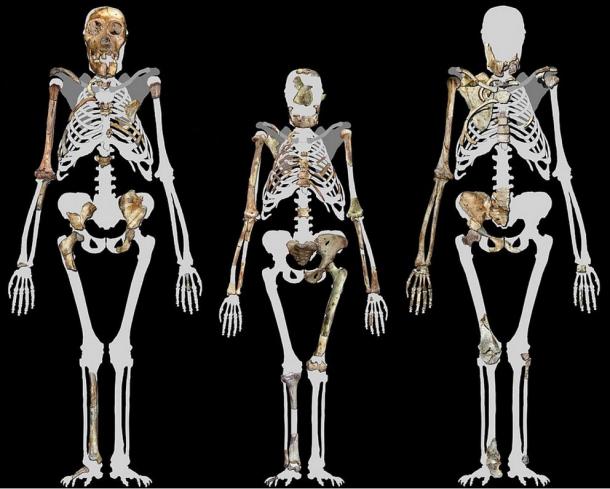
Australopithecus sediba, two fossils of which are shown on the left and right, are thought to have been a transitional species between older Australopithecus, like Lucy in the middle, and later Homo species. However, some experts believe the fossils are not a unique species at all but actually a mix of other early humans

Professor Berger and his team are now trying to create a live laboratory on top of the site so they can continue working on the fossils while they are still in the ground without damaging them. The laboratory will also have a platform that will allow members of the public to look down into the site where the remains are being excavated. Professor Berger said he had no idea how many more individuals they may find at the site. Speaking to Naked Scientists said: ‘That’s why we’re building this laboratory over the top that we’ve begun excavation.

‘But so far, what is exposed on the surface have been two main skeletons and at least the remains of 4 other individuals that we found so far. But every time we open up a little bit of rock here and move a little bit of dirt, we see someone new. We’re introduced to another one of these people that died 2 million years ago.

‘The cave is like a big swimming pool that you’d fill up with concrete throwing bones intermediately into it and in this case, some of those and in fact, quite a lot of them were skeletons of this early human ancestor species.’ He added that his team were still attempting to piece together exactly how these species fit into the evolutionary history of humans.

He said that the skeletons they found have many features similar to Homo – such as the shape of their pelvis, hand and teeth, but they also have quite primate-like features too. Professor Berger added: ‘They walk on two legs. They would probably only be standing about 1.3 metres tall. They have also been more lightly built. They would’ve been quite skinny.

‘They had longer arms than we do, more curved fingers. So, they’re clearly climbing something. They also would’ve moved a little different. Their hips were slightly different than ours and their feet are slightly different.

‘So, their gait would’ve probably been a more rolling type gait, slightly different from the more comfortable long-distance stride we had. As they got closer to you, you’d be struck by for the most obvious thing which would be, their heads are tiny.’
Iron Age chariot burial found in East Yorkshire with horses ‘leaping out of the grave’

Iron Age chariot burial found in East Yorkshire with horses ‘leaping out of the grave’

The Ancient Brits loved their wheels. Indeed they seem to have been so attached to the sports-car-style chariots that they may even have thought they could use them to get to the next world.

Academic knowledge about these elegant high status prehistoric British vehicles is now set to increase significantly, following the discovery of an ancient Briton buried inside his chariot in East Yorkshire.

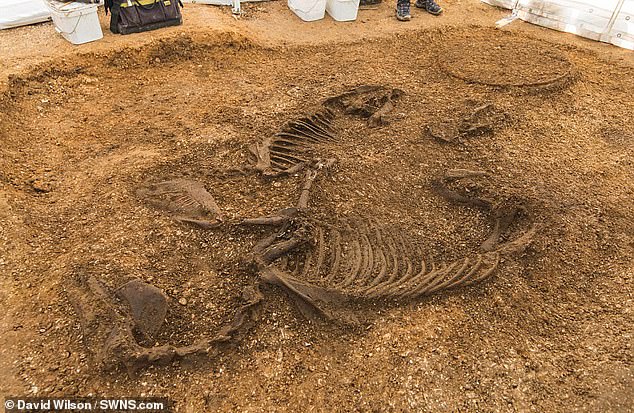
Although around 20 other similar chariot graves have been found over the past century or so in the UK (mainly in Yorkshire), this new discovery, unearthed on the outskirts of the market town of Pocklington at the foot of the Yorkshire Wolds, is the only example ever excavated by modern archaeologists in which the two horses, used to pull the vehicle, were also interred.

What’s more, the burial forms part of one of the most important Iron Age funerary complexes found in Britain over the past half-century.

The Pocklington chariot burial, excavated over the past two months, was the final resting place of an upper-class Iron Age Briton – probably a warrior – who lived in the third or fourth century BC. It is possible that he was a member of an ancient British tribe called the Parisi (or their ancestors) – a culture related to other Iron Age peoples in Northern France.

Excavating his grave, archaeologists from a Yorkshire-based company MAP Archaeological Practice – have found the stain ‘imprints’ left in the ground by the rotted wood of the 12 spokes of one of the chariot’s wheels; the iron tyre (which would have gone round that wheel); the stain imprint of the chariot’s central timber pole (which connected the vehicle to the two horses pulling it); the stain imprint of the box-shaped compartment that the driver (and potentially one companion) stood in; the two horses used to pull the vehicle; the bridle bit; the iron nave hoop band (which went around the axle); and the remains of the driver himself.

The only missing element (almost certainly destroyed by mediaeval ploughing) is the second wheel.

The Ancient Brits were unusually attached to their chariots. While in continental Europe, chariots had largely gone out of fashion (except for racing) by the mid-1st century BC, in Britain they persisted until at least the seventh decade of the first century A.D.- a generation or so after the Roman conquest).

The first chariots seem to have been invented in south-western Siberia (in modern Russia) and in northern Kazakhstan in around 2000 BC. By 1500 BC they had spread to Anatolia (what is now Turkey), Egypt, India and China. By 1300 BC they were being used in Europe – and by 500 BC they had been introduced into Britain

Now scientists are set to study DNA and isotopic evidence from the Pocklington chariot and other burials. The find will also enable archaeologists to compare this chariot to the other examples that have been discovered in Yorkshire in the past – and to definitively confirm the buried chariot drivers gender and possibly his ethnic origin.

“This discovery provides valuable additional evidence demonstrating how the Ancient Britons loved their chariots. As research progresses, it’s becoming ever clearer just how important these beautiful high status wheeled vehicles were to them. Indeed Roman historical sources even describe how the Iron Age Britons used their chariots to demonstrate driving skills, to show off and to intimidate their enemies”, said a leading chariot burial expert, archaeologist, Dr Melanie Giles of the University of Manchester.

“It is conceivable that the dead man’s family and his community believed that the chariot would help him to reach the next world or would be useful to him when he got there,” she said.

The burial forms part of a remarkable cemetery in which at least 142 Iron Age people were interred – mainly under a series of large earthen mounds.

Among the most significant graves, excavated over the past three years, is that of a warrior buried on top of his large roughly rectangular wooden shield (with the shield’s leather strap arranged around him, so that the decorative bronze strap fastener or other fitting was positioned on top of his torso).

An elaborate Iron Age shield, pictured, found in an impressive ‘warrior grave’ in Yorkshire

Another particularly interesting grave is that of a possible enemy warrior. He had died very violently and had sustained serious injuries (possibly caused by a club and a sword) and was buried at much greater than normal depth. Interring a person face down in an unusually deeply dug grave is believed to have been seen as a way of preventing an angry, bitter or evil deceased individual, perhaps even an enemy, from rising from the dead and haunting or hurting the living. It was, potentially, a measure to combat revenants.

A third particularly interesting burial was that of a warrior, interred with his sword, who had been subjected to a bizarre post-mortem ritual. While he lay in his open grave, the attendees at his funeral (perhaps even his warrior comrades) had ritually hurled six spears into his dead body. The grave was then filled up with earth – with the corpse still pierced by the spears. It seems to have been a very special funerary ritual of which only around a dozen other examples are known (perhaps reserved for individuals who had fought particularly bravely in battle or who had distinguished themselves in some other way).

The shield was found face down in the chariot, covered by a man’s skeleton who was likely once its owner. Experts believe that this ‘warrior’ was aged over 46 and was likely a higher respected member of his community, as he was buried with an offering of six pigs and adjacent to an additional grave of a younger, injured man

Other individuals whose graves have been excavated at the site include a woman wearing bronze bracelets and a bronze brooch with three Mediterranean-originating coral beads inlaid in it; a warrior, buried with his spear (and a large storage pot – probably for food or alcoholic beverage); and a young 17-20-year-old woman, afflicted with very severe pelvic and spinal arthritis, who had died at (or approaching) childbirth.

“This spectacular group of graves is yielding extremely important new information about Iron Age life and culture. It is one of the most significant Iron Age funerary complexes discovered in Britain over the past half-century,” said one of the archaeologists involved in the project, Dr Peter Halkon of the University of Hull.

Although almost all British chariot burials are from East Yorkshire, archaeological evidence clearly shows that these vehicles were used for transport in most parts of Britain.

It is known that at least 700 probable chariot fittings (mainly iron and bronze axel linchpins and the rings through which the horses’ reins passed) have been found by metal detectorists and archaeologists around the country. Indeed some of them – especially the linchpins – probably became separated from chariots when the vehicles crashed or rolled over on difficult terrain, despite them having a top speed of only around 30 mph.

6,000 Years Older then Stonehenge: Oldest house in Britain discovered to be 11,500 years old

6,000 Years Older then Stonehenge: Oldest house in Britain discovered to be 11,500 years old

It’s small, bulky and unlikely to win architecture awards. But according to archaeologists, this wooden hut is one of Britain’s most important buildings ever designed.

As our artist impressed, the newly-discovered circular structure is the country’s oldest known home. Built more than 6,000 years before Stonehenge, it provided shelter from the icy winds and storms that battered the nomadic hunters roaming Britain at the end of the last ice age.

The remains of the 11ft-wide building, discovered near Scarborough, North Yorkshire, have been dated to at least 8,500BC. It stood next to an ancient lake and close to the remains of a wooden quayside.

6,000 Years Older then Stonehenge: Oldest house in Britain discovered to be 11,500 years old
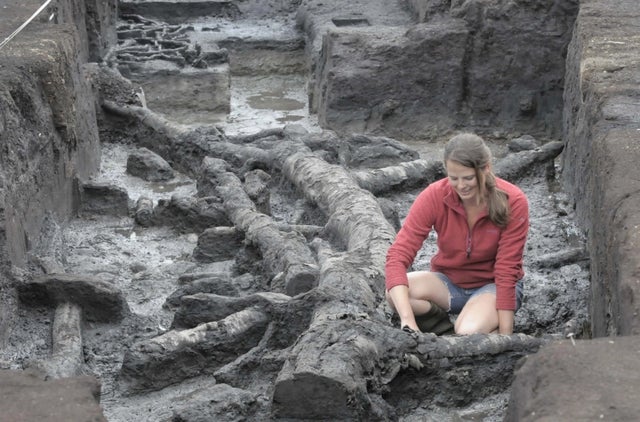
Ancient find: Manchester University student Ruth Whyte on the archaeological dig in Flixton near Scarborough which has unearthed an 11,000-year-old tree and remains.
Pictures from the dig where archaeologists believe that one of the first houses in Britain may have been buried

Dr Chantal Conneller, from the University of Manchester, said it was between 500 and 1,000 years older than the previous record-holder, a building found at Howick, Northumberland.

‘This changes our ideas of the lives of the first settlers to move back into Britain after the end of the last ice age,’ she said. ‘We used to think they moved around a lot and left little evidence.

‘Now we know they built large structures and were very attached to particular places in the landscape.’

None of the wood used to make the building has survived. Instead, archaeologists found the tell-tale signs of 18 timber posts, arranged in a circle. The centre of the structure had been hollowed out and filled with organic material.

The researchers believe the floor was once carpeted with a layer of reeds, moss or grasses and that there may have been a fireplace. Dr Conneller said the hut was used for at least 200 to 500 years – and may have been abandoned for long stretches.

‘We don’t know much about it and we don’t know what it was used for,’ she said. ‘It might have been a domestic structure, although you could only fit three or four people in it. It could have been a form of ritual structure because there is evidence of ritual activity on the site.’

Previous archaeological digs have unearthed head-dresses made from deer skulls close to the hut, along with remains of flints, the paddle of a boat, antler tools, fish hooks and beads.

Archaeologists have been excavating at the Mesolithic site Star Carr since 2003

The researchers also found a large wooden platform alongside the ancient – and long-vanished – lake at Star Carr. It was made from timbers which were split and hewn.

The platform, which may have been a quay, is the earliest evidence of carpentry in Europe. At the time, Britain was connected to the rest of Europe. The occupiers of the hut were nomads who migrated from an area now under the North Sea to hunt deer, wild boar, elk and wild cattle.

Dr Nicky Milner, from the University of York, said: ‘This is a sensational discovery and tells us so much about the people who lived at this time.

‘From this excavation, we gain a vivid picture of how these people lived. For example, it looks like the house may have been rebuilt at various stages.

‘It is also likely there was more than one house and lots of people lived here. And the artefacts of antler, particularly the antler headdresses, are intriguing, as they suggest ritual activities.’

Although Britain had been visited by hunter-gatherers for hundreds of thousands of years, it was only at the end of the last ice age, when the glaciers finally retreated from Scotland, that the country became permanently occupied.

Thousands of miles away, in the ‘Fertile Crescent’ of Mesopotamia, the earliest farmers were learning how to sow seeds and domesticate animals in a discovery that would transform the world – and herald the age of villages, writing and civilisation.

But in northern Europe, the hunter-gatherer way of life that had served prehistoric man for millennia remained unchallenged.

A depiction of a stone-age house in Ireland. The original building at Star Carr would have looked very similar to this, with thatched roof and circular shape

Viking sword found in a grave in central Norway

Viking sword found in a grave in central Norway

A 9th century Viking sword has been unearthed by archaeologists in central Norway.

Viking sword found in a grave in central Norway
It’s been more than 1000 years since someone held this sword. It belonged to a warrior who lived in Trøndelag in Viking times. But why was the sword placed on the opposite side of what was common practice?

During the Viking Age, a man was buried with a full set of weaponry at Vinjeøra in the south of what is now Trøndelag county in central Norway. An axe, spear, shield and sword were placed alongside his body in the grave.

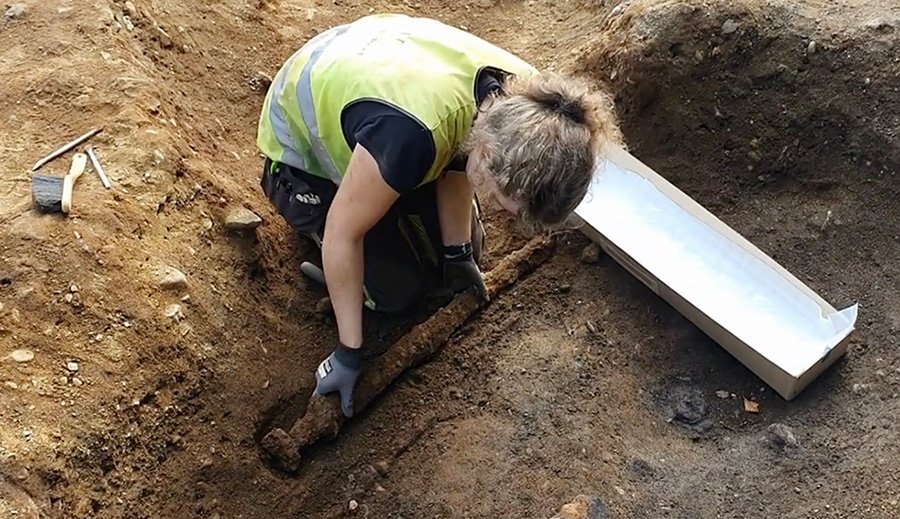
Archaeologist Astrid Kviseth recently became the first person to hold the rusty sword in their hands for approximately 1,100 years:

Astrid Kviseth carefully carries the sword away from the site. Now it will be investigated further.

“I’m a little surprised at how heavy it was. I don’t exactly know ​​how heavy a sword is, but it had some heft to it. You would have had to be pretty strong to be able to swing this sword!” she said.

An area rich in Viking history

The grave was the latest in a series of archaeological finds in connection with the improvements to Norway’s E39 highway.

By law in Norway, archaeological surveys must be conducted in connection with all new construction projects, including roads. This is so that important cultural heritage can be preserved. The rule has led to many fascinating finds including the remains of a historically important church in downtown Trondheim.

A team is now excavating what appears to be a burial ground on a former Viking farm. Last year, remains of a burial house and an unusual double grave was found in the area.

“The fact that he was buried with a full set of weapons tells us that this was a warrior. In Viking times and the early Middle Ages, most warriors were free men who owned their own farms,” said Raymond Sauvage, an archaeologist at the NTNU University Museum and project manager for the excavation.

A left-handed owner?

An unusual aspect of the find was that the sword appears to have been placed on the left side of the deceased. Typically, swords are placed on the right-hand side of the body.

Swords are usually placed on the right side of the body in weapon graves like this. In this grave, it was laid on the warrior’s left side. One explanation may be that the warrior was left-handed.

The custom itself is a little odd. That’s because warriors would typically carry their sword on their left, in order to allow the right hand to access it easily.

“Why the swords are almost always placed on the right side is a bit mysterious. One theory is that the underworlds you go to after death are the mirror image of the upper world,” said Sauvage.

He suggested the sword in the Vinjeøra grave may have been placed on the left to signify the warrior was left-handed.

A ditch burial

The warrior’s grave partially overlapped three other graves. They were laid to rest in a ditch surrounding a large burial mound. Sauvage explained that using a grave more than once appears to have been common in the area:

“People were buried in the same grave or partly inside older graves. It was obviously important to lie next to or in the burial mounds and the ring ditches around them.”

“We can imagine that this burial practice is an expression of how important the family’s ancestors were on a farm in Viking times. In addition to being present on the farm as companion spirits – fylgjur – the ancestors could continue to live physically in the burial mounds.”

Another grave with burial gifts

Archaeologists found a fourth grave most likely to have been for a cremated Viking woman. One of the beads found in the grave. Photo: Raymond Sauvage, NTNU University Museum. Burial gifts included an oval brooch, a pair of scissors and beads. But there was a strange addition: a large number of bones.

In the same area, archaeologists discovered what they believe was a woman’s grave, based on the artefacts they found – like this bead.

“A study done several years ago showed that cremation graves from the Iron Age on average contain only about 250 grams of bone. A dead human body that is cremated, on the other hand, burns down to about 2 kilos of bones,” Sauvage said.

So while the cremated woman was buried in her entirety, archaeologists also found bird bones in the material. The team believes this could have been part of a burial ritual.

Lab work to follow

Sauvage said that the sword will now be examined in a Trondheim lab to see what remains under the rust:

“It will be exciting to get the sword into the conservation laboratory and have it x-rayed so we can see what’s hiding under the corrosion. Maybe it has ornamentation or pattern welding in the blade,” he says.

Divers Uncover Ancient Temple Submerged Within The ‘Egyptian Atlantis’

Divers Uncover Ancient Temple Submerged Within The ‘Egyptian Atlantis’

The remnants of the ancient submarine temple were found in the ancient sunken town of Heracleion, off the north coast of Egypt, identified as the Atlantic of Egypt.

About 1,200 years ago the town sank into the sea but after it was discovered 2,000 marine archaeologists have been probing to uncover new parts of the settlements.

In the most recent discovery, Egyptian and European divers uncovered the ruin of a temple along with several boats holding treasures like bronze coins and jewellery.

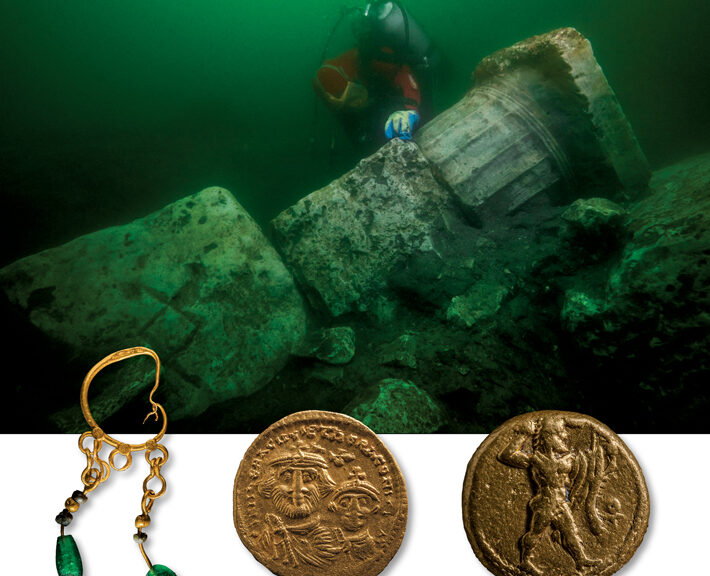
The ruins of an ancient underwater temple have been discovered in the ancient sunken city Heracleion, off Egypt’s north coast, described as Egypt’s Atlantis. Granite columns and a Greek temple were found during recent dives and studies to the lost city of Heracleion (pictured)

Using a sophisticated scanning device, they revealed a new part of the city’s main temple, which has been completely destroyed. Remains of a smaller Greek temple, complete with ancient columns was found along with pottery from the third and fourth centuries B.C.E.

The bronze coins were from the reign of King Ptolemy II (283 to 246 BCE).  Archaeologists also stretched their map of Canopus—another sunken settlement close to Heracleion. 

They found the remains of several buildings, expanding the city by about two-thirds of a mile along with gold and bronze coins as well as jewellery including rings and earrings.

Recovered coins and jewellery.

The team believe the artefacts date from the Ptolemaic dynasty (305 to 30 B.C.E) to the time of the Byzantine Empire, which began in 330 C.E.  Researchers also investigated some of the many ancient ships known to exist at the site. 

They found treasures including crockery, coins and jewellery in one now fully-excavated vessel. The team believe the wreck dates from the fourth century B.C. 

The city of Heracleion, home of the temple where Cleopatra was inaugurated, was one of the most important trade centres in the Mediterranean area before it disappeared into what is now the Bay of Aboukir. 

But 12 years ago, underwater archaeologist Dr Franck Goddio was searching the Egyptian coastline for French warships from the 18th century battle of the Nile, but instead stumbled across the treasures of the lost city. 

Real-life Atlantis: The sunken city of Heracleion, brought to life by the research team investigating the site 150ft under the sea where it now lays, including the main temple of Amun-Gerb, centre-right

After removing layers of sand and mud, divers discovered evidence of extraordinary wealth, painting a picture of what life was like in Heracleion, believed to have been at the centre of Mediterranean trade more than 1,000 years ago.

Although it was mentioned in classical texts, Heracleion lay undisturbed beneath the waters of Abu Qir Bay until it was mapped in 2000. Researchers spent four years charting the city, known as Thonis in Egypt, according to the lead researcher Franck Goddio.

After more than a decade of excavation, researchers were able to create a map depicting life in the ancient trade hub. 

The research team, led by Dr Goddio have yet to establish what caused the city to go down, but the main theory is that the unstable sediments Heracleion was built on collapsed, and in combination with a rising sea-levels, may have caused the entire area to drop 12 feet straight into the water.

‘We are just at the beginning of our research,’ Dr Goddio told the Telegraph in 2013.

’We will probably have to continue working for the next 200 years.’

Ancient Roman Villa Discovered Beneath an Italian Apartment Complex

Ancient Roman Villa Discovered Beneath an Italian Apartment Complex

Next month is the unveiling of an underground museum of intricate Roman mosaics located under an apartment complex in the Italian capital.

Six years ago, BNP Paribas Real Estate, which owns the property, found the site during the construction work, an announcement made on Tuesday.

On the site, which is situated on the Aventine Hill, one of the seven hills of Ancient Rome, archaeologists from the Special Superintendence of Rome worked on the site.

Visitors will be able to see the mosaics when the museum opens in November.
A mosaic discovered beneath an Italian luxury apartment complex

During the excavation, they discovered mosaics, structures and other artefacts, and a multimedia exhibition using video mapping and projections will help explain the site’s history to visitors.

There were some signs that the area was inhabited around 900 BC, according to the statement. The site also includes a block wall dating from 700-400 BC that may have been the foundation of a watchtower.

Black-and-white mosaic tiles displayed on a wall bearing Latin inscriptions
The mosaics were laid in an upper-class Roman home.
The installation now resides in the basement of a residential luxury apartment complex. Starting in November, visitors will be able to take guided tours of the site twice per month. The building may open the museum up to more visits depending on the amount of interest.

Archaeologists also found that the area was levelled to increase the available flat surface, and around the middle of the 2nd century BC, a Domus — a type of private residence for the upper classes — was built.

The piece de resistance is a mosaic in black and white tiles from the end of the 1st century BC, and there is also a mosaic fragment dating from the reign of Emperor Trajan (98-117 AD).

Then, during Hadrian’s reign (117-138 AD), more black and white mosaics were laid in geometric patterns, one of which will be on display, followed by five more mosaics from the Antonine period (150-175 AD).

Perfectly preserved ancient Roman mosaic floor discovered in Italy
“In recent years we have worked as a team with the Superintendency to complete a unique archaeological project for the city of Rome: a museum inside an apartment building,” said Piero Cocco-Ordini, CEO of BNP Paribas Real Estate Italy, who called the site “a hidden treasure chest, a thousand-year witness to our past.”

In May, another beautiful ancient Roman mosaic was uncovered in northern Italy.

The remarkably well preserved mosaic floor was uncovered in a vineyard in Negrar, north of the city of Verona, almost a century after the remains of an ancient villa were found on the site.

Pictures of the floor posted by the town’s officials show its intricate patterns and colourful detail, much of which has been preserved perfectly through the centuries.

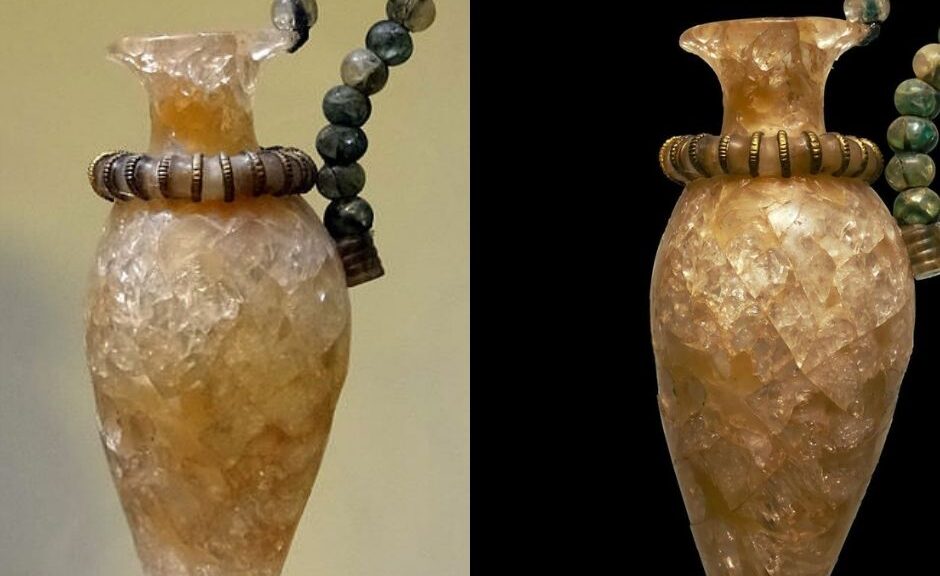
A 3,500-year-old Minoan vase carved from rock-crystals

A 3,500-year-old Minoan vase carved from rock-crystals

Ideally situated in a sheltered gulf surrounded by mountains, Zakros (or Kato Zakros) in south-eastern Crete, was the fourth largest Minoan settlement after Knossos, Phaistos and Malia.

The ancient name has been lost and the present one derives from the nearest local town. Inhabited since Neolithic times, the settlement achieved its greatest influence in the palatial period c. 2000 BCE to c. 1450 BCE.

The palace was destroyed (possibly by the eruption of the Thera volcano, although the date of this is much disputed) and abandoned c. 1450 BCE with the surrounding settlement also being abandoned c. 1330 BCE.

The site was first excavated in 1901 CE by D. Hogarth of the British School of Athens and once again from 1961 CE under the supervision of N. Platon, Ephor of Cretan Antiquities.

The excavations discovered a large palace complex and surrounding settlement displaying many typical Minoan architectural features.

These include a large central court (30x12m), secondary courts, colonnades, light-wells, a monumental stepped entrance, lustral basins (sunken rooms), storage magazines, archive rooms, stairs to a second floor, and paving with large flagstones and red plaster interstices.

Some rooms were also covered in fresco similar to (but fewer in quantity than) those at Knossos, depicting spirals, double axes and bull horns of consecration.

Unique to the Zakros site is a large circular cistern (5m in diameter) with seven steps leading down into it and originally surrounded by columns. An interesting and unique find in the extensive settlement around the palace complex is a large furnace with four exhaust ducts, perhaps used for metallurgy.

Zakros Minoan Site

The presence of more than 500 large storage jars (pithoi), over 50 fine stone vases, seals and Linear A tablets, quantities of ivory and bronze ingots, fine libation vases and rhyton all suggest the palace, as in the other Minoan towns, was a prosperous administrative and commercial centre, not only locally but with trade links to the Cycladic islands, Egypt and the Peloponnese on mainland Greece.

Other archaeological finds of note are fine gold jewellery pieces, Marine style pottery and gold objects such as a bull’s head and engraved bowl.

Roman Woman’s Trendy Earring Unearthed in Bulgaria

Roman Woman’s Trendy Earring Unearthed in Bulgaria

Archaeology in Bulgaria reports that an intact gold earring has been discovered in what was a room of the public bath at Deultum, a Roman colony founded in the first century A.D. by veterans of Augustus’ Eighth Legion near Bulgaria’s Black Sea coast. The artefact matches earrings shown in the second century A.D. 

A genuine ancient gold earring that can be used in some of the so-called Fayum Mummy portraits of Roman Egypt was found by archaeologists in south-east Bulgaria excavating the Deultum Ancient Roman colony near the town of Debelt, district Burgas, near the Black Sea coast.

Deultum was a Roman colony, which according to Roman law signified a status equal to that of the city of Rome itself. In today’s Bulgaria, there are only three Roman cities which enjoyed this status – Deultum (Colonia Flavia Pacis Deultensium) near Burgas, Ratiaria (Colonia Ulpia Traiana Ratiaria) near Archar, Ulpia Oescus near Gigen.

Fayum mummy portraits are portraits on wooden boards which were attached to the mummies of upper-class residents buried in Egypt during the Roman Era, in the 1st century BC – 3rd AD.

Such mummy portraits have been discovered throughout Egypt but most famously in the Fayum Basin, in Hawara and the Roman city of Antinoopolis from the time of Emperor Hadrian (r. 117 – 138). The term “Fayum mummy portraits” is used both as a geographic and stylistic description.

The Roman gold earring discovered in the city of Deultum in Southeast Bulgaria has been found to appear exactly the same as earrings of women depicted in some of the Fayum mummy portraits. Based on that similarity, the earring is dated by the Bulgarian researchers to the 2nd century AD.

The Ancient Roman city of Deultum (Colonia Flavia Pacis Deultensium) was built in the 1st century AD near a previously existing Ancient Thracian settlement called Debelt or Develt. It was settled by Roman military veterans from the Augustus’ Eight Legion (Legio VIII Augusta) near the Mandra Lake (today the Mandra Water Reservoir) where it also had a port connecting it to the Black Sea.

Roman Woman’s Trendy Earring Unearthed in Bulgaria
The gold earring found in the Roman city of Deultum – Debelt in Southeast Bulgaria appears to be the same as the earrings worn by the woman depicted in this Fayum mummy portrait.

The present archaeological excavations in the Deultum – Debelt Archaeological Preserve began on October 1, 2020; the Fayum mummy portrait gold earring was discovered two days later.

The Roman gold earring was found in the joint between tiles in one of the rooms in the ruins of the thermae (public baths) of Deultum, beneath an embankment, informs Krasimira Kostova, head of the Deultum – Debelt Archaeological Preserve, as cited by the Bulgarian National Radio.

“The gold earrings of a noble lady depicted in one of the Fayum Portraits are exactly the same as the earring that we have discovered here in Deultum,” the archaeologist says. She points out that the thermae of Deultum was destroyed in 357 – 358 AD during a major earthquake.

“The gold earring probably was lost as it fell between the tiles, and when the thermae were destroyed by the earthquake, it remained there. Subsequently, the site was levelled with embankments, which is how it remained there. Because the spot of the thermae remained inhabited after that,” Kostova explains.

“This jewel is extremely sophisticated, it is very interesting. We found it has parallels to one of the Fayum mummy portraits, which has led us to date it to the 2nd century AD,” she adds.

“We are construing the discovery of the gold earring like the earrings depicted in that Fayum mummy portrait as evidence that the female inhabitants of the Roman colony of Deultum were following the fashion trends in the Roman Empire, and were up to date with fashion,” the archaeologist emphasizes.

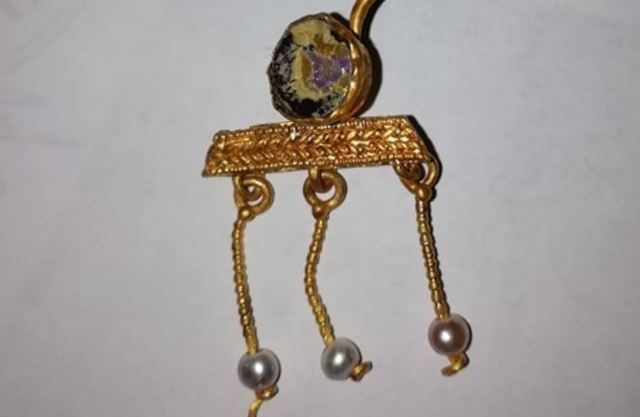
The Fayum portrait gold earring from Deultum – Debelt is fully intact save for a slight bent in its upper part.

It has a cassette filled with white glass with a slight yellowish nuance; below it comes a filigree holder with three pendants, each of which ends with a white glass ball. The patina on the three balls gives them the appearance of pearls.

In addition to the gold earring similar to those in one of the Fayum mummy portraits, the archaeologists excavating the ruins of the Roman city of Deultum have already discovered a large number of bronze coins.

Their digs are now focused on exposing more from the ruins of the thermae (public baths) of the Roman colony. The later homes, which were built on top of the ruins of the Roman thermae in Deulum, were researched during last year’s archaeological season, with the current excavations now targeting the layers beneath.

Once it is fully studied, the gold earring similar to the ones seen a Fayum mummy portrait from Roman Egypt is going to be put on display at the museum of the Deultum – Debelt Archaeological Preserve.