All posts by Archaeology World Team

Pits of Skulls Found in Shimao: China’s Neolithic City of Mystery

Pits of Skulls Found in Shimao: China’s Neolithic City of Mystery

The villagers of China’s dusty Loess Plateau believed for decades that the crumbling rocks near their homes were from China’s Great Wall, which was very common along the area.

As large numbers of jade pieces shaped into disks, blades and scepters were found by locals and looters, suspicions grew as jade was only available at about 1000 miles away from the area and wasn’t even a feature of the Great Wall.

When a team of Chinese archaeologists came to investigate the rubbles, they started unearthing the area and found that the stones weren’t a part of the Great Wall but were the ruins of a magnificent fortress city.

5: jade items found at East Gate; 7: jade and metal bracelets with a human arm bone found in a burial; 8: stone human head; 9: Shimao ceramics.

The digging had revealed a 230 feet high pyramid surrounded by more than six miles of protective walls and an inner sanctum containing jade artifacts, painted murals, and gruesome evidence of human sacrifice.

Before the excavations were suspended earlier this year due to the coronavirus pandemic, the archaeologists had dug up 70 stunning stone sculptures which were figurines of monsters, serpents, and half-human beasts resembling Bronze Age iconography of China.

Block carved with humanoid deity. Southern retaining wall, upper citadel, Shimao, Shenmu county, Shaanxi province, China.

The site has been named Shimao (original name undetermined) and carbon dating of its parts date back to around 4,300 years ago i.e. 2,000 years before the oldest section of the Great Wall. As it seems, Shimao flourished for nearly half a millennium in that remote region, and then suddenly, it disappeared.

Aerial photo of Shimao’s East Gate. A: U-shaped screen; B: gate tower; C: L-shaped wall; D: bastion; E: corner tower.

Shimao now is the largest known Neolithic settlement in China and none of the ancient Chinese texts mentions a city residing so far north of the “cradle of Chinese Civilization”. It had an expanse of 1000 acre and is larger than the Central Park of New York City. Its art and technology had influenced the northern regions and the future dynasties of China.

Along with other discoveries at prehistoric sites, Shimao is forcing historians to rethink the origin of the Chinese civilization.

According to the leader of the dig at Shimao, “Shimao is one of the most important archaeological discoveries of this century.”

Shimao’s step pyramid.

Designed for danger, Shimao was built on a conflict zone i.e. a borderland dominated by warfare between farmers of the central plains and herdsmen of the northern steppe. To protect themselves from violent attacks, the Shimao people constructed their 20-tiered pyramid on the highest of the northern hills.

It’s visible from every part of the city and is half the height of the Great Pyramid at Giza in Egypt built around the same time. Its base, however, is four times larger and the Shimao elites resided at the topmost tier of the pyramid which had a 20-acre palatial complex with amenities.

The pyramid was surrounded by embryonic urban designs and inner and outer perimeter walls. More than 70 small satellite stone towns have also been discovered in the Shimao orbit.

The defense system of civilization is as fascinating as its infrastructure and huge fortifications. However, the most terrible discovery was from underneath the city’s eastern wall which had 80 human skulls clustered in six pits without the skeletons that represent traditions of human sacrifice in this astonishing prehistoric town.


A pit of skulls unearthed at Shimao.

8,000 years old Fluted Stone Tools Found in Southern Arabia

8,000 years old Fluted Stone Tools Found in Southern Arabia

Cosmos Magazine reports that 8,000-year-old fluted arrowheads have been uncovered in Yemen and in Oman.

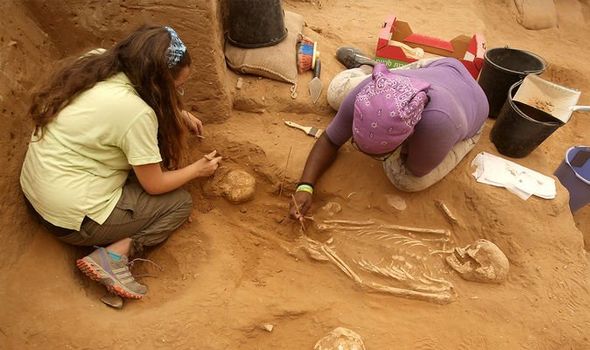
Excavation work at the Manayzah site in Yemen.

Chipping off flakes from stone to shape it is a highly skilled process that had been previously thought to be limited to toolmakers who lived in North America between 13,000 and 10,000 years ago

Throughout southern Arabia, neolithic toolmakers have developed complex stone weapons designed to be practical and to demonstrate their artistic skills.

About 8,000 years ago spearheads and arrowheads were created using fluting, a process first used in North America thousands of years earlier – but there was a difference.

In North America, almost all fluting on projectile points was done near the base, so the implementation could be attached with string to the arrow or spear shaft. However, some Arabian points had fluting that appeared to have no practical purpose, such as near the tip.

“Of course, we can’t say for sure, but we think this was a way for skilled toolmakers to signal something to others, perhaps that one is a good hunter… or dexterous with one’s hands,” says anthropologist Joy McCorriston from Ohio State University (OSU), US, co-author of a paper in the journal PLOS ONE.

“It showed one was good at what one did. This could improve one’s social standing in the community.”

Researchers from the French National Centre for Scientific Research (CNRS), the Max Planck Institute for the Science of Human History in Germany, and OSU studied projectile points from two archaeological sites: Manayzah, in Yemen, and Ad-Dahariz, in Oman.

Finding fluted points outside of North America was an important discovery, said CNRS’s Rémy Crassard, the study’s lead author.

“These fluted points were, until recently, unknown elsewhere on the planet,” he says. “This was until the early 2000s, when the first isolated examples of these objects were recognized in Yemen, and more recently in Oman.”

The discovery provides one of the best examples of “independent invention” across continents, says Michael Petraglia, from the Max Planck Institute.

“Given their age, and the fact that the fluted points from America and Arabia are separated by thousands of kilometers, there is no possible cultural connection between them,” he says.

“This is a clear and excellent example of cultural convergence, or independent invention, in human history.”

Fluting involves a highly skilled process of chipping off flakes from stone to create a distinctive channel.

As part of their study, the researchers had a master technician in flintknapping – the shaping of stones – attempt to create projectile points in a way similar to how researchers believe the ancient Arabians did.

“He made hundreds of attempts to learn how to do this. It is difficult and a flintknapper breaks a lot of these points trying to learn how to do it right,” McCorriston says.

Tourist Damages A Valuable Italian Sculpture And Just Walks Away

Tourist Damages A Valuable Italian Sculpture And Just Walks Away

The Austrian 50-year-old man who broke three toes of a statue in the 19th century while posing for a picture has been identified by the Italian police.

On July 31 in the Hipsoteca Museum in Possagno Northern Italy, the 200-year-old plaster cast model of Antonio Canova’s statue of Paolina Bonaparte was damaged.

The tourist’s name has not been released yet, but surveillance camera footage shows him laying on the statue to pose for a photo. When the man stands up to walk away, it appears he gets rid of the damages, or toes, and walks away.

Antonio Canova self portrait, 1790.

Canova carved the now damaged piece of art from a marble statue that is currently housed in the Borghese Gallery in Rome. The sculptor lived from 1757-1822 and was famous for his marble statues.

Police report the man was with a group of eight Austrian tourists but strayed away from his friends to get a photo of himself “sprawled over the statue.”

Investigators say there could be further damage to the base of the sculpture that the museum experts still have to ascertain, but as of now, only three broken toes from the statue’s right foot are notably damaged.

President of the Antonio Canova Foundation, Vittorio Sgarbi, wrote in a Facebook post that he has asked police for “clarity and rigor.” He wrote that the tourist must not “remain unpunished and return to his homeland. The scarring of a Canova is unacceptable.”

The museum posted about the incident on Facebook, explaining that the room guard noticed the damage and declared an emergency situation immediately.

Image of the damaged Italian sculpture model from the Carabinieri police.

The man responsible for the damage was identified because of coronavirus measures, which required visitors to leave their personal information for eventual contact tracing if an outbreak were tied to the museum.

When police reached out to a woman who signed in on behalf of herself and her husband, the woman burst into tears and admitted her husband was the toe breaker, according to a press release from Treviso Carabinieri.

The husband later confessed and repented for the “stupid move,” as stated in the release. Charges have not been pressed. A court in Treviso is still deciding on legal actions.

This toe-breaker is not the first person to damage a valuable piece of artwork in an attempt to get a selfie. In 2018, a woman knocked over and damaged two artworks in an attempt to get a selfie, one by Francisco Goya and the other by Salvador Dali, at a gallery in Russia.

The Museum recently affected by the Austrian tourist concluded the Facebook post on the matter with the following statement.

“We reiterate that our heritage must be protected: adopting responsible behavior within the Museum while respecting the works and goods preserved in it is not only a civic duty, but a sign of respect for what our history and culture testify and that must be proudly handed down to future generations.”

The thankfully intact marble sculpture of Paolina Bonaparte Borghese as ‘Venus Victrix’ by Antonio Canova, in the Galleria Borghese, Rome.

Middle Paleolithic Site Discovered in Southern Israel

Middle Paleolithic Site Discovered in Southern Israel

A mid paleolithic flint knapping site that occurs between 250,000-50,000 years ago has been found in recent excavations undertaken by the Israel Antiquities Authority, in conjunction with local youth in Dimona, in preparation for construction of solar energy, funded by the electricity company.

The youth from the city who were interested in the exploration as a summer work during the economically challenging period of the COVID-19 helped discover the unusual prehistoric site.

The site near Dimona was newly found to be small. Prehistoric human beings apparently came here and made their tools from the abundant natural flint they made

The site here is unique because of the flint knapping technology, known as ‘Nubian Levallois,’ which originated in Africa.

Researchers trace the path of this technology to understand the migration routes of modern humans from Africa to the rest of the world, about 100,000 years ago.

According to the excavation directors, the prehistory researchers Talia Abulafia and Maya Oron from the Israel Antiquities Authority, “This is the first evidence of a ‘Nubian’ flint industry in an archeological excavation in Israel.

The knapped flint artifacts remained right in the first place where the humans sat and created the tools. This manufacturing is identified with modern human populations who lived in East Africa 150-100 thousand years ago and migrated from there around the world.

In the last decade, quite a few Nubian sites have been discovered in the Arabian Peninsula. This has led many scholars to claim that modern humans left Africa through the Arabian Peninsula.

The Dimona site appears to present the northernmost example of Nubian flint output found in situ, thus marking the migration route: from Africa to Saudi Arabia, and from there, perhaps, to the Negev.

The excavation took place while dealing with the challenges presented by COVID-19, which affect the health and economy of Israeli citizens in general, and the residents of Dimona in particular.

According to Svetlana Talis, Northern Negev District Archaeologist at the Israel Antiquities Authority, “Dimona is one of the most severely affected towns in the second wave of the Corona outbreak and was even on the verge of lockdown.

After wondering what to do about summer holidays, local youths from Dimona came to the excavation to work and help their families, and to uncover a site of particular importance.

All of this is part of a project promoted and directed by the Israel Antiquities Authority in recent years, which seeks to bring our youth closer to their cultural heritage.”

Archaeologists unearth third-century’ human mountains’

Archaeologists unearth third-century’ human mountains’

It was discovered near Rome when archaeologists found the remains of a man who was considered a giant when he died in the third century A.D.

It’s an unbelievably rare find – because today gigantism affects three in a million people worldwide. The condition begins in childhood when a malfunctioning pituitary gland causes abnormal growth.

Two partial skeletons, one from Poland and another from Egypt, had previously been identified as “probable” cases of gigantism, but the Roman specimen is thought to be the first clear case from the ancient past, study leader Simona Minozzi, a paleopathologist at Italy’s University of Pisa said.

The figure stood at about 6ft 8 inches, classed as a giant in third century A.D when the average height for a man was 5ft 5 inches.

The unusual skeleton was found in 1991 during an excavation at a necropolis in Fidenae (map), a territory indirectly managed by Rome.

At the time, the Archaeological Superintendence of Rome, which led the project, noted that the man’s tomb was abnormally long. It was only during a later anthropological examination, though, that the bones too were found to be unusual. Shortly thereafter, they were sent to Minozzi’s group for further analysis.

The researchers found a ‘human mountain’
The figure has gigantism according to the study

To find out if the skeleton had gigantism, the team examined the bones and found evidence of skull damage consistent with a pituitary tumor, which disrupts the pituitary gland, causing it to overproduce human growth hormone.

Other findings — such as disproportionately long limbs and evidence that the bones were still growing even in early adulthood — support the gigantism diagnosis, according to the study, published on October 2 2012 in the Journal of Clinical Endocrinology and Metabolism.

His early demise — likely between the age of 16 and 20 — might also point to gigantism, which is associated with cardiovascular disease and respiratory problems, said Minozzi, who emphasized that the cause of death remains unknown.

A statue of Maximinus Thrax

Charlotte Roberts, an archaeologist at Durham University, said she was “certainly convinced with the diagnosis” of gigantism in 2012, but that she’d like to know more.

She said: “You can’t just study the disease, you have to look at the wider impact of how people functioned in society, and whether they were treated any differently.”

She added that one thing researchers do know is that the second century A.D. emperor Maximinus Thrax was described in the literature as a “human mountain.”

Archaeologists have found other remains that could have been giants

Minozzi noted, though, that imperial Roman high society “developed a pronounced taste for entertainers with evident physical malformations, such as hunchbacks and dwarfs — so we can assume that even a giant generated enough interest and curiosity”.

Roberts also highlighted how the find has been useful in learning about gigantism.

She said: “Normally a doctor will be looking at a patient with a disease over short term span.

“We’ve been able to look at skeletons from archaeological sites that are thousands of years old. You can start to look at trends of how diseases have changed in frequency over time.”

Neolithic “Woodhenge” Discovered in Portugal

Neolithic “Woodhenge” Discovered in Portugal

The 4,500-year-old ring of large ‘ shafts ‘ has been uncovered by archaeologists in the great Durrington Walls and the famous site at Woodhenge, just a few kilometers from Stonehenge, in southern Britain.

The newly-discovered circle is over 2 km in diameter and has been carbon-dated to 2500 BC.

The archaeologists identified up to 20 shafts — which are up to 10 m across and at least 5 m deep — but estimate there may have been more than 30 originally.

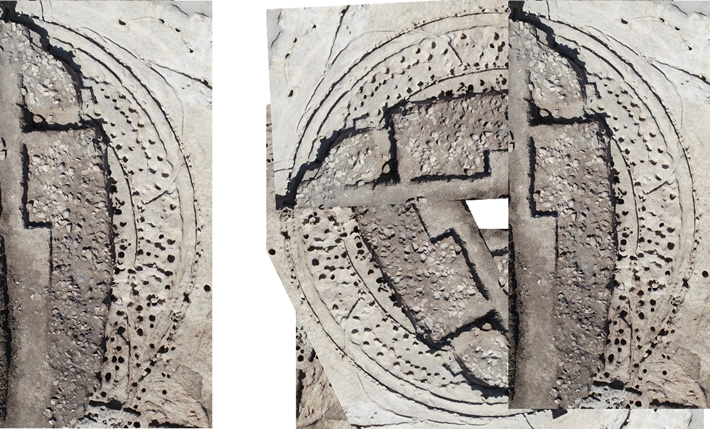
The 2-km-wide ring of shafts around the great henge at Durrington Walls and the famous site at Woodhenge.

“The size of the shafts and circuit surrounding Durrington Walls is without precedent within the UK,” said Professor Vince Gaffney, a researcher in the School of Archaeological and Forensic Sciences at the University of Bradford.

“It demonstrates the significance of Durrington Walls Henge, the complexity of the monumental structures within the Stonehenge landscape, and the capacity and desire of Neolithic communities to record their cosmological belief systems in ways, and at a scale, that we had never previously anticipated.”

The scientists think the ring of shafts marks a boundary around the massive henge at Durrington. The features, along with an internal post line, could have guided people towards the religious sites and warned others not to cross the boundary.

“It was extraordinary such a major find had been made so close to Stonehenge,” Professor Gaffney said.

“It is amazing that our seamless survey of the Stonehenge landscape, which apply the latest technology and extends over kilometers of the countryside, has revealed major new features including these huge shafts,” said Professor Wolfgang Neubauer, an archaeologist in the Ludwig Boltzmann Institute for Archaeological Prospection and the Virtual Archaeology/VIAS-Vienna Institute for Archaeological Science at the University of Vienna.

“They are not only clearly visible in the geophysical data sets, but the survey also provides the opportunity to place these features within a wider context comprising the many monuments associated with Stonehenge including the super-henge at Durrington Walls, just 3 km north-east from the iconic stone circle.”

“The Stonehenge landscape stands apart, not only as one of the most important archaeological landscapes in the world but also amongst the best studied,” said Dr. Eamonn Baldwin, an archaeologist at the University of Birmingham.

“To make such a major discovery within such an area is remarkable, and a testament to how archaeologists have begun to integrate technology with traditional research methods including excavation and aerial photographic survey.”

“After centuries of study of the Stonehenge landscape, the discovery of such an incredible new monument is testament to the value of interdisciplinary research,” said Professor Henry Chapman, an archaeologist at the University of Birmingham.

“Our understanding of this outstanding place has been transformed in recent years, and the identification of such a significant and extensive new site highlights that there is always something more to discover.”

“We’re tremendously excited at the prospect of applying ancient sedimentary DNA technology to these mysterious structures to discover their purpose in ancient Britain,” said Professor Robin Allaby, a researcher at the University of Warwick.

70 million – year – old Underground village And Magnificent Eben-ezer tower In Belgium

Mysterious 70-Million-Year-Old Underground Village And Magnificent Tower Of Eben-Ezer In Belgium

The Tower of Eben-Ezer is a 33-meter high tower built single-handedly out of flint by a man who worked on it for over ten years to display his artistic, paleontological, and theological discoveries.

The magnificent tower of Eben-Ezer in Belgium.

Who built it?

Some of these mysterious subterranean worlds are famous and examined by archaeologists. Others are virtually unheard of and can never be investigated because they were destroyed.

One intriguing place is the fascinating underground village of Thébah in Belgium. It is said to be 70- million-year-old!

The skull of a Mosasaurus discovered by Garcet

The discovery of the underground village took place when Robert Garcet (1912 –2001) decided to build a fantastic tower in the village of Eben-Emael, in the province of Henegouwen, Belgium.

Robert Garcet (1912-2001), who was born in Mons, Belgium. When he was 18 he moved to this area north of Liège, where he worked as a labourer in the local quarry. He was very interested in geology, nature, the history of mankind and the Bible, wrote a lot of books, and developed his own vision of the creation of man.

He was also a pacifist, and in 1947 began to draw up plans to construct a big tower as a symbol of peace. He started construction in 1953 and, with the occasional help of friends, completed it 15 years later.

What does it represent?

It’s difficult to say. Apparently, all aspects of the tower have a deep meaning. Its dimensions are in proportion to the Heavenly Jerusalem mentioned in the Bible in the Revelation of John. It gets its name from the Biblical account of the place Samuel erected a stone to symbolize peace. It has seven floors reflecting the sacred number of seven.

On the corners at the top of the tower, four sculptures are displayed representing characters of the book of Revelation: bull, lion, eagle and angel.

What’s it like inside?

The inside is as extraordinary as the outside. It’s full of artwork, sculptures and murals, as well as displays of geological discoveries, artefacts and fossils. Part of it is also devoted to a Museum of Flint, which gives you a tour of the history and use of flint over the ages.

You certainly won’t be bored at the Tower of Eben-Ezer. There’s an abundance of things to see, admire, wonder at, and ponder over. Sometimes you’ll be amazed; at other times you’ll just get totally mystified.

A wealth of information is available during your tour of the tower. This includes a bulky A4 binder with pages and pages of descriptions and details of everything you can see and the explanations behind all the displays and symbology. In addition, in many of the rooms computers are set up that you can click and navigate through multiple screens of information.

However, all the information is in Dutch or French. And there’s so much information that even with a good understanding of Dutch I simply couldn’t take it all in. Actually I would have needed hours to go through it all, said Robert Garcet.

The Tower of Eben-Ezer was featured in Channel 4’s 1998 series “Journeys into the Outside”, in which Jarvis Cocker (British musician and artist, famous for fronting the band Pulp) travels the globe in search of large-scale visionary environments.

The relevant clip starts at 11:07 and lasts for nearly 8 minutes.

What is interesting is that it includes an interview with Robert Garcet three years before his death, during which he calls Jarvis Cocker an imbecile! It’s also clear that Cocker himself struggles to understand what the tower is all about, and can’t quite get to grips with Garcet’s beliefs.

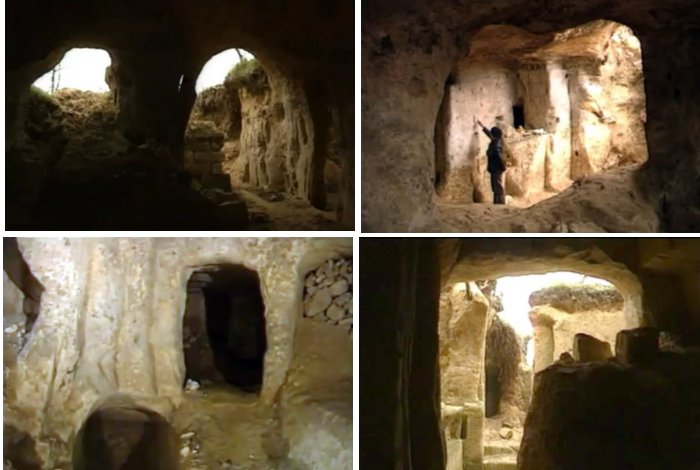
The following are pictures from a video documentary and book by Markus May, called Die Steine der Apokalypse, Robert Garcet und die Legende vom Feuerstein. What you can see in those pictures are small portions that remained after the flint company destroyed the village. 

World’s Oldest Toy Car – Could This 5,000-Year-Old Discovery Be The Earliest Evidence Of The Wheel?

World’s Oldest Toy Car – Could This 5,000-Year-Old Discovery Be The Earliest Evidence Of The Wheel?

Many gearheads grew up playing with toy cars. Loyalties to Hot Wheels or Matchbox were as divisive as those between Ford and Chevy are today.

But kids have been fascinated by wheels since long before these companies—or even the car itself—existed.

An archeological dig in Turkey has revealed that our fascination with toy wheels goes back at least 5,000 years, reports the International Business Times.

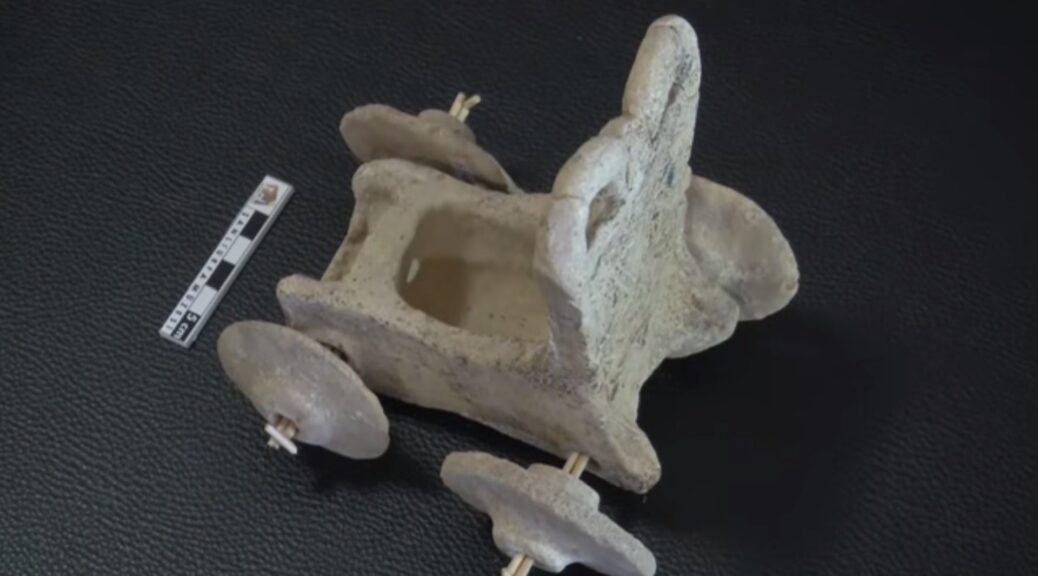
A toy chariot dating back 5,000 years – which archaeologists believe may be the world’s oldest ‘toy car’ – has been discovered in Turkey. 

The little chair on wheels, made from earthenware, was found during an excavation of the ancient city of Sogmatar, in the south-east of the country.

Sogmatar is believed to have been the home of Moses when he had run away from the Pharaoh. 

A toy chariot dating back 5,000 years – which archaeologists believe may be the world’s oldest ‘toy car’ – has been discovered in Turkey
The little chair on wheels, made from earthenware, was found during an excavation of the ancient city of Sogmatar, in the south-east of the country
The digs have uncovered a number of tombs, including the ones the toys were found, which had provided a fascinating insight into how ancient civilizations lived

Digs in the city have uncovered a number of tombs, including the child’s grave the mini-chariot was found, which have provided a fascinating insight into how ancient civilizations lived. 

In total, 45 tombs have been opened, including three that have remained untouched since the Roman era. 

A 4,000-year-old baby’s rattle dug up in the city of Kultepe in the central Anatolian province of Kayseri in 2014 was at that time hailed as the world’s oldest toy. 

Sogmatar Excavation Head and Sanliurfa Museum Manager Celal Uludag said that Sogmatar was one of the most important excavations in the area.

He added: ‘The excavation in this area continues with the permission of the ministry. In the necropolis part, in a tomb room, we found a toy carriage which belongs to the Bronze Age and believed to have been made for the children of kings or the leaders.

‘This finding is very important for us as shows the aesthetic and cultural understanding of the period. 

‘The item will be exhibited in the biggest museum complex of Turkey, the Sanliurfa Archaeology Museum. We believe that we are going to find even more important things in the excavation.’