The context of the rope-making tool at the time of discovery in August 2015 .
Rope and twine are critical components in the technology of mobile hunters and gatherers. In exceptional cases impressions of string have been found in fired clay and on rare occasions string was depicted in the contexts of Ice Age art, but on the whole, almost nothing is known about string, rope and textiles form the Paleolithic.
A key discovery by Conard’s team in Hohle Fels Cave in southwestern Germany and experimental research and testing by Dr. Veerle Rots and her team form the University of Liège is rewriting the history of rope.
The find is a carefully carved and beautifully preserved piece of mammoth ivory 20.4 cm in length with four holes between 7 and 9 mm in diameter. Each of the holes is lined with deep, and precisely cut spiral incisions.
The new find demonstrates that these elaborate carvings are technological features of rope-making equipment rather than just decoration.
Close up of the rope making tool from mammoth ivory from Hohle Fels Cave in southwestern Germany, ca. 40,000 years old .
Similar finds in the past have usually been interpreted as shaft-straighteners, decorated artworks or even musical instruments.
Thanks to the exceptional preservation of the find and rigorous testing by the team in Liège, the researchers have demonstrated that the tool was used for making rope out of plant fibers available near Hohle Fels.
“This tool answers the question of how rope was made in the Paleolithic”, says Veerle Rots, “a question that has puzzled scientists for decades.”
Excavators found the rope-making tool in archaeological horizon Va near the base of the Aurignacian deposits of the site. Like the famous female figurines and the flutes recovered from the Hohle Fels, the rope-making tool dates to about 40,000 years ago, the time when modern humans arrived in Europe.
The discovery underlines the importance of fiber technology and the importance of rope and string for mobile hunters and gatherers trying to cope with challenges of life in the Ice Age.
Prof. Conard’s team has excavated at Hohle Fels over each of the last 20 years, and it is this long-term commitment that has over and over again paid off, to make Hohle Fels one of the best known Paleolithic sites worldwide.
Hohle Fels and neighboring sites from the Ach and Lone Valleys have been nominated for UNESCO World Cultural Heritage status.
Rope making tool from mammoth ivory from Hohle Fels Cave in southwestern Germany, ca. 40,000 years old.
The excavations at Hohle Fels near Schelklingen in the Ach Valley are funded by the HeidelbergCement AG, the Ministry of Science of Baden-Württemberg and the Heidelberger Academie of Sciences.
Artifact Found in Germany Hints at Neanderthal Hunting Practices
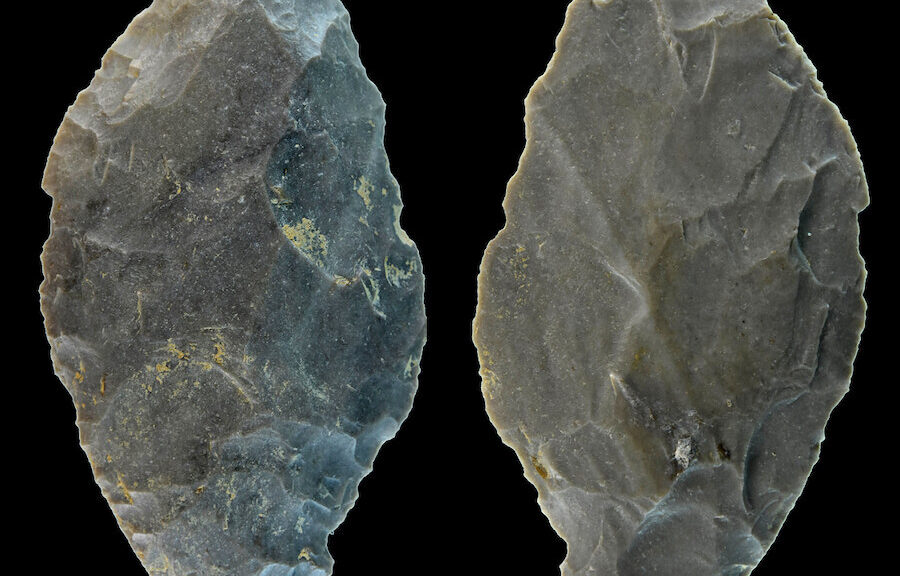
Neanderthals from the Swabian Jura hunted horses and reindeer with hafted leaf-shaped stone points 65,000 years ago. The evolution of hunting is recorded by a recently found leaf tip from the UNESCO World Heritage site of Hohle Fels Cave.
Hohle Fels. Leaf point
A team under the direction of Professor Nicholas Conard for the University of Tübingen and the Senckenberg Centre for Human Evolution and Palaeoenvironment in southern Germany recovered the artefact underlying a layer dating to 65,000 years ago, which represents a minimum age for the find.
Microscopic studies document that this carefully made projectile point was mounted on a wooden shaft and used as a thrusting spear to kill a large game. Results of the excavations and analysis of the leaf point appear in two papers in this week’s publication of Archäologische Ausgrabungen in Baden-Württemberg and Mitteilungen der Gesellschaft für Urgeschichte.
“The new discovery represents the first time a leaf point has been recovered from a modern excavation, allowing researchers to study the fresh find with state-of-the-art methods,” says Conard. The last time researchers in the region recovered such artefacts was in 1936.
The chert artefact is 7.6 cm long, 4.1 cm wide, 0.9 cm thick and weighs 28 grams. Conard adds that “our results document how the tool was made, used and why it was discarded.” Thanks to a series of four ESR-dates the find is securely dated to over 65,000 years ago.
Until now finds of leaf points were interpreted as belonging to the period between 45,000 and 55,000 years ago, and belonging to the last cultural phase of the Neanderthals in Central Europe. Conard reports “The new results demonstrate that our assumptions about the dating of the cultural groups of the late Neanderthals were wrong and need revision.”
Dr. Veerle Rots from the University of Liège in Belgium conducted detailed microscopic analyses of the leaf point. Damage to the tip indicates that the artefact was used as a hafted spear point and that the spear was likely thrust into prey rather than being thrown.
Rots’ work documents how Neanderthals used plant-based glue and bindings made from plant fibres, sinew or leather to secure the leaf point to the spear. Neanderthals clearly used the spear for hunting. While they re-sharpened the tool it broke, leading to its discard.
Rots remarks “Neanderthals were expert stone knappers and knew exactly how to make and use complex technologies combining multiple parts and materials to produce and maintain deadly weapons.” Earlier fossil humans during the time of Homo heidelbergensis used sharpened wooden spears for hunting, but these spears lacked mounted stone points like those used by Neanderthals.
Hohle Fels. The chert artefact in finding a position.
The leaf point from Hohle Fels will be on display at the “Find of the Year” at the Museum of Prehistory in Blaubeuren from July 22 until January 2022.
“Hohle Fels is a remarkable site where after 25 years of excavation by the current team, spectacular discoveries from the period of the Neanderthals and early modern humans are still being made,” says Dr. Stefanie Kölbl, the director of the Museum of Prehistory.
The Museum of Prehistory in Blaubeuren is the central research museum for topics related to the UNESCO World Heritage sites of the Swabian Caves and for Ice Age Art.
It contains many of the earliest examples of figurative art including the Venus of Hohle Fels and the earliest musical instruments known worldwide.
Rock-Cut Chambers Unearthed in Turkey’s House of the Muses
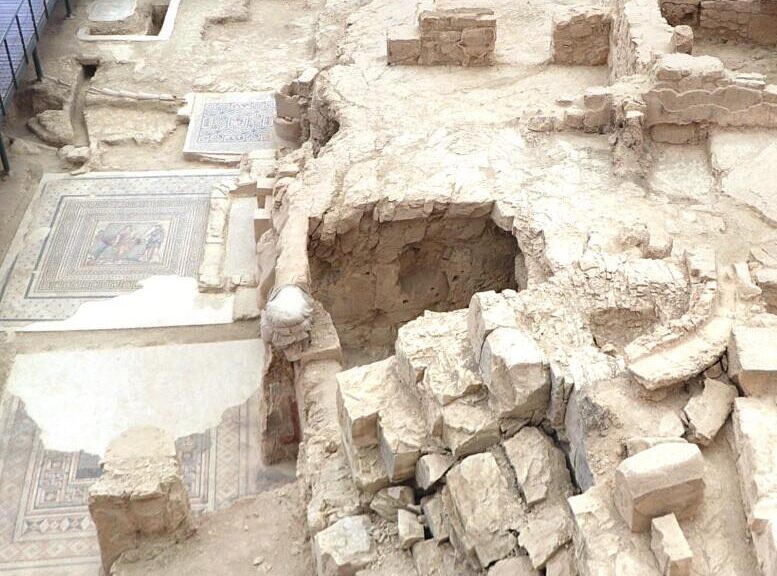
Within the scope of ongoing excavations in the ancient city of Zeugma, located in the southeastern province of Gaziantep’s Belkıs district, two rock chambers have been unearthed in the area previously discovered and called the “House of Muses” due to the mosaics on its floor.
Professor Kutalmış Görkay, the head of the excavations, said that the rock chambers would be opened to visitors after the completion of the works.
The excavations, which started in 2005, are ongoing in the ancient city of Zeugma, which is located on the Euphrates River in the form of two cities facing each other.
Recently, two rock chambers were brought to light in the House of Muses, which was discovered in 2007.
Görkay stated that the rock chambers were found after the excavation of 16 meters of earth fill in the House of Muses, adding, “We excavated 16 meters of earth fill above the rock chambers that we identified and shifted the work in this direction.
After taking this weight on it, we started excavating inside the rock chambers. Work is still continuing in this chamber, where the earth inside was emptied. We will provide the protection and reinforcement of these chambers. In particular, there are risky cracks on the ceilings in the chamber.
We will complete the excavations in the other rock chamber this year, too. Later, we plan to open these areas to visitors by taking protective measures and ensuring room security with injections or steel structures.”
Pointing out that the rock chambers were used as dining rooms and that the mosaics unearthed from the house carry traces of intellectual life, Görkay said: “Muses are the most important personifications of classical Greek education, especially in antiquity.
In the mosaic found in this house, goddesses and personifications believed to contribute to Greek literature, history, poetry and music are depicted.
We named it the ‘House of Muses’ because of this mosaic. When we found the Muses mosaic in 2007, we decided to continue our work. The house shows us traces of the intellectual life of its owner at that time.”
Stating that the ancient city of Zeugma was one of the most important cities in Anatolia, especially on the Eastern Roman border, Görkay said that the excavations in the House of Muses, which have been ongoing since 2007, provided important information about the private lives, personal preferences and identities of the inhabitants of Zeugma.
“When we look at the places and the general structure of the house, we think that Zeugma belonged to a family having better than the middle-class economy.
These houses may have one or two courtyards. Courtyards are areas where air and water enter, where rainwater is collected and used as water collection basins. In these wet areas, we see more water-related scenes.
The courtyards of these houses were also used for dinner parties. The courtyards were filled with water, helping the house to stay cool during hot weather.
The two rock chambers found here may also have been used as dining rooms. We are currently working on reinforcement. We aim to open them to visitors as soon as possible,” he said.
In the frugal last meal of a man 2,400 years ago, scientists see signs of human sacrifice
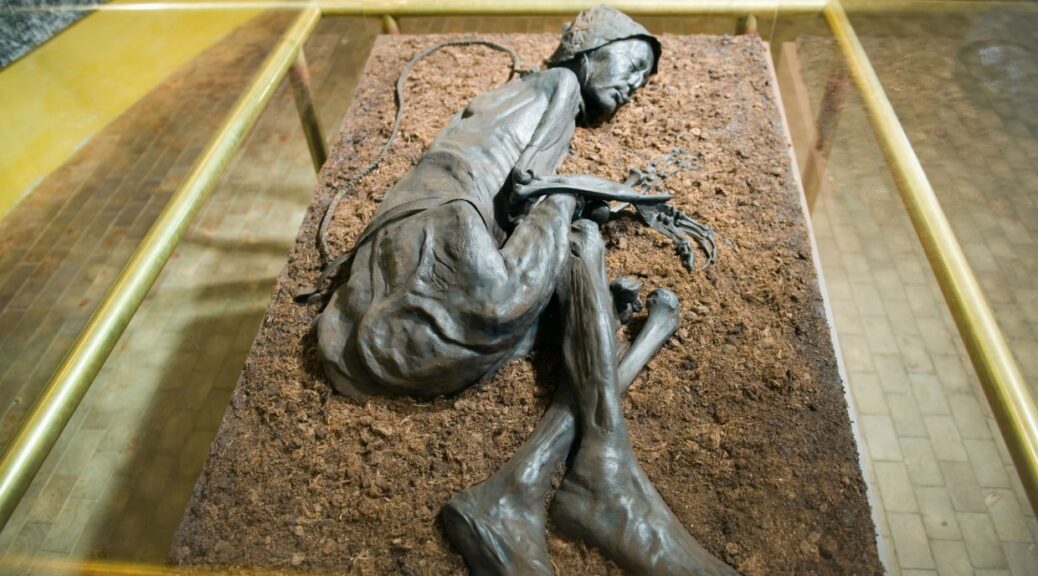
When the Tollund man was discovered in a bog in Denmark 71 years ago, he was so well preserved that his researchers thought he was the victim of a recent murder.
The preserved body of the Tollund Man on display at the Silkeborg Museum in Silkeborg, Denmark.
It took archaeologists to reveal that he was thrown into the bog almost 2,400 years ago and was first hanged – a braided animal skin noose was still around his neck. The careful arrangement of body and face – his closed eyes and weak smile – suggested that he may have been killed as a human sacrifice, rather than executed as a criminal.
The suggestion that Tollund’s man was killed as a human sacrifice has now been reinforced by a study of the condemned man’s last frugal meal, made from a detailed investigation of the contents of his digestive tract: a porridge of barley, flax and pale persicaria.
The Tollund Man’s intestine content.
Pale persicaria seeds are the key to this Iron Age murder mystery, said archaeologist Nina Nielsen, head of research at the Danish Museum in Silkeborg and lead author of the study published Tuesday.
The plant grows wild among barley crops, but evidence from Iron Age grain storage shows that it was generally cleaned as a weed during threshing. This suggests that it was part of the “threshing waste” that was deliberately added to the porridge – possibly as part of a ritual meal for those condemned to die by human sacrifice.
“Was it just a regular meal? Or was the trash hype something you only included when people ate a ritual meal? Nielsen said. ” We do not know it. “
The contents of the preserved intestines of the Tollund man were examined soon after its discovery. But the new study refines that initial examination with much improved archaeological techniques and instruments.
The Tollund Man’s large intestine.
“In 1950, they were only looking at the well-preserved kernels and seeds, not the very fine fraction of the material,” Nielsen said. “But now we have better microscopes, better ways of analyzing material and new techniques. So that means we could get more information out of it. “
In addition to revealing the clue of threshing waste added to his last meal, the researchers found that it was probably cooked in a clay pot – pieces of overcooked crust can be seen in the tracks – and that it had also eaten fish. They also found he was suffering from several parasitic infections when he died, including tapeworms – likely from a regular diet of undercooked meat and contaminated water, Nielsen said.
Tollund Man is one of dozens of Iron Age bog bodies around 2,500 to 1,500 years ago that have been discovered across northern Europe. They were mummified in peatlands by the low oxygen levels, low temperatures, and water made acidic by the layers of decaying vegetation, or peat, therein.
A few appear to have been victims of accidents, possibly people who drowned after falling into the water. But most, like the Tollund man, were killed and deliberately placed in the bogs, with their bodies and features carefully arranged. Archaeologists believe they were selected as human sacrifices, possibly to avert impending disaster like famine.
Miranda Aldhouse-Green, professor emeritus of history, archeology and religion at Cardiff University in the UK and author of the book ‘Bog Bodies Uncovered: Solving Europe’s Ancient Mystery’, said the seeds of pale persicaria and other traces of threshing waste in Tollund Man’s latest slurry are further evidence that he was sacrificed.
“It reinforces the idea that he was either humiliated by being given something disgusting and horrible to eat, or it actually reflected the fact that society was in a downward spiral where food was scarce,” she said. declared.
The idea that the victims of human sacrifices had somehow been “ashamed” before death was also reflected in their burials in bogs, instead of the usual burials in graves and dry graves, she said.
The preservative properties of peatlands were well known to people of the Iron Age – many archaeological objects from that era, including pieces of expensive pottery, were also deliberately deposited there – and it may be that the preservation of a bog body was intended to preserve it. to join his ancestors. The bogs were seen as gateways to another kingdom.
“If you put a body in the bog, it wouldn’t decompose – it would stay between the realms of the living and the dead,” Aldhouse-Green said.
There is evidence that threshing waste was added to the last meal of another Iron Age bog body found in Denmark in 1952, that of Grauballe Man, who was also said to have been killed as a human sacrifice. Although more than 100 bog bodies have been found, only 12 are well enough preserved that their last meals can be analyzed, Nielsen said, and she now hopes to seek further evidence of the ritual practice.
The ingredients of the Tollund Man’s last meal, in relative quantities: A) barley seeds, B) pale persicaria, C) barley fragments, D) flax, E) black-bindweed, F) “fat hen” seeds, G) sand, H) hemp-nettles, I) camelina, J) corn spurrey, K) field pansy.
The Man from Tollund now occupies a display case in a special gallery in the Silkeborg Museum, where Nielsen can see him almost every day.
“You are face to face with a person from the past,” she said. “He’s 2,400 years old, it’s really amazing.
The architect believes Stonehenge once had a thatched roof to form the temple
One of the biggest mysteries surrounding Stonehenge is how any of it is still standing, given the predations of souvenir-hunters and vandals including the great 17th-century architect Sir Christopher Wren. He paid many visits to the ancient monument on Salisbury Plain and his surname can still be seen carved on one of its stones.
Landscape architect Sarah Ewbank believes Stonehenge (pictured) once had a thatched roof
The Victorians were even more destructive, renting chisels to visitors so they could take great chunks of Stonehenge home, and over the centuries farmers purloined stones for building their barns. Perhaps they might all have had more respect for the monument, now a Unesco World Heritage site, had they heard the extraordinary theory being put forward in a new book by 62-year-old landscape architect Sarah Ewbank. She would have us believe that the Stonehenge we see today represents the ruins of a majestic building that once had a spectacular thatched roof. As mind-boggling as contemplating an upright Tower of Pisa or a Day-Glo Taj Mahal, this may seem as barking as other ideas expounded about Stonehenge over the centuries: that its layout was based on the female private parts, or that it was a site of human sacrifice or a landing pad for aliens.
But Sarah is deadly serious, and she backs up her arguments with the rather ferocious electric saw she keeps in the garage of her pretty Cotswolds cottage near Lechlade, Gloucestershire. The feisty grandmother does not use this to intimidate those who disagree with her — although she is rather frustrated with the academics who have repeatedly refused to engage with her idea that Stonehenge was a Neolithic version of the Royal Albert Hall.
No, the saw is used to fashion ever-more detailed models of how she thinks Stonehenge might have looked. Each has taken about two months to complete and they have got bigger each time. While three earlier models have been banished to the attic, version four is currently taking pride of place in the dining room. Built on a scale of 1:33, it is surprisingly persuasive. The moment you see the familiar stone slabs as the supports for an upper storey you think ‘Ah, yes, of course it was a building. What else could it have been?’
Sarah points out that Stonehenge has a total diameter — some 30 metres — which is almost exactly the same as Shakespeare’s Globe (pictured), a very similarly thatched building
As to what kind of building, Sarah thinks it was an all-purpose Neolithic temple with a large oval hall overlooked by galleries in which crowds might have gathered to hear speakers below.
She points out that the total diameter — some 30 metres — is almost exactly the same as Shakespeare’s Globe, a similarly thatched building in which, several millennia later, the human voice could carry to every audience member.
‘It is unquestionably the right size for an enclosed public venue,’ she says, speculating that the scenes at Stonehenge might have been as boisterous as in Elizabethan times.
‘Maybe there was feasting in the galleries, with dancing and musicians playing below, or perhaps ceremonies took place to welcome in the solstices. It all sounds rather splendid.’
It does indeed, and Sarah contends that archaeologists have under-estimated our Neolithic and Bronze Age forebears who built Stonehenge over centuries, years starting around 5,000 BC.
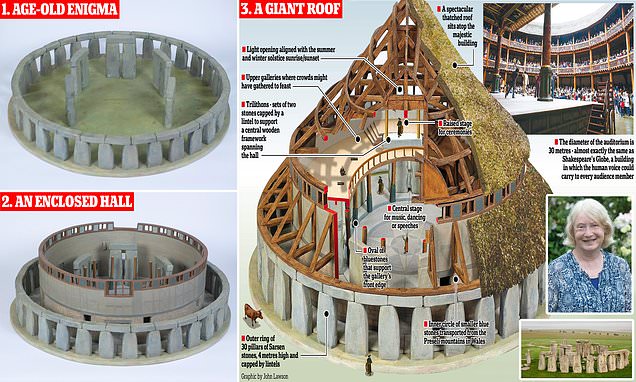
Building blocks: the basic structure which can be deduced from what is left to this day
Layers upon layers: architect Sarah Ewbank’s theory has an inner wall and doorway
A giant roof: Sarah believes the monument took the shape of an all-purpose Neolithic temple
‘They have assumed they were rough, tough, types who had advanced little from grunting cavemen and were hardy enough to worship outdoors. But we know that the Bronze Age was sophisticated enough to have goldsmiths making absolutely stunning jewellery and they knew how to make copper alloys like bronze.
‘It seems obvious to me that they would have wanted to mark the winter solstice inside, under a roof, not outside in the freezing cold.’ It has taken five years for Sarah to develop her theory with the support of Crispin Scott, a 65-year-old retired Army officer who is her partner of 14 years. They are both divorced, with five grown-up children between them, and Sarah has fitted in her research around her work and their shared hobby of bell-ringing.
‘Initially, Cris couldn’t understand why I was doing it. But as I got more into it, he realised that I was on to something,’ she says.
It has taken five years for Sarah to develop her theory with the support of Crispin Scott, a 65-year-old retired Army officer who is her partner of 14 years. Pictured: One of Sarah’s model
Sarah has been in architecture for more than 40 years and has been involved in consultancy and planning for everything from historic estates to Oxford colleges. Pictured: Sarah’s model
Her interest was first sparked when she saw a TV documentary about new excavations at Stonehenge. ‘I wondered: “Why to keep digging down instead of looking up?”
‘I could see its slabs were of a suitable size to be support piers for a roof and wondered if their layout held clues that would reveal its shape.’
Designing landscapes for more than 40 years, she’s been involved in consultancy and planning for everything from historic estates to Oxford colleges. But this task involved throwing her brain into reverse. Instead of creating a design from scratch, she was trying to deduce what a design might have been from the four concentric formations of stones that make up Stonehenge: an outer and an inner circle, a horseshoe and an oval. None is complete, and indications of where the missing stones once stood have been identified by archaeological investigations.
These suggest that the outer ring consisted of 30 pillars of grey sarsen stone, each about four metres high, somehow transported from quarries on the Marlborough Downs, about 20 miles away. Sarah points to other famous historic buildings — most notably the Parthenon in Athens — whose roofs are supported by similar columns. ‘It’s a common building form,’ she explains.
Sarah has built multiple models of how she see’s how Stonehenge was originally built
It’s believed that these pillars were all originally capped by horizontally placed stones known as lintels. Where these are missing it’s possible to see two knobs on top of each pillar which would have been slotted into two corresponding holes in the bottom of the lintels. Since gravity alone would have been enough to hold the lintels in place, Sarah argues that the knobs and sockets would not have been necessary unless they were supporting something.
‘Their existence suggests that the sarsens’ uprights and lintels were engineered as if to take the load of a roof,’ she says.
While the sarsen stones would have formed an outer colonnade, a wraparound walkway covered by the roof but open to the elements, Sarah believes it’s logical that the hall would have had a wall to give protection from the weather. According to her, the remains of the doorways within that wall can be seen in Stonehenge’s inner circle, made up of smaller bluestones transported from the Preseli mountains in Wales, some 150 miles away.
A sketch showing how Sarah Ewbank, from Gloucestershire, imagines Stonehenge looked
Before metal hinges were available, doors were jointed onto pivoting vertical poles that turned when the door was open or shut. One of the bluestone uprights contains a vertical groove into which such a pole would have fitted perfectly, while the two bluestone lintels remaining contain holes which Sarah thinks may have been used to secure a wooden board containing sockets for the door-poles.
Moving towards the centre of Stonehenge, the next formation is a horseshoe of four trilithons — sets of two stones capped by a lintel — with another taller trilithon at the end. Sarah suggests that all were supports for a central wooden framework spanning the centre of the oval hall, with rafters radiating downwards to the outer circle of sarsen stones to support the roof’s lower slopes.
Innovative: architect Sarah Ewbank
In her view, Stonehenge’s builders would have known exactly how to build the central wooden cradle she posits as holding up the roof because it resembles a large upturned boat. Her final challenge was to find a purpose for the oval of bluestones at the centre of Stonehenge. She concludes that these supported columns held up the balcony. While her fourth model shows this being reached via a spiral staircase, she admits that this is pure guesswork. But she is more confident that our Neolithic predecessors were capable of high-quality carpentry using oaks from the woodlands which covered about a third of Great Britain.
All this begs a question. If Stonehenge really was a building, then how on earth did they go about constructing it?
Using her experiences of shifting weighty objects with very limited resources, Sarah imagines an ingenious arrangement for raising Stonehenge’s wooden trusses, the largest of which she estimates as weighing 20 tonnes. This involves building a high platform on which each truss could be laid flat, with one end butting the top of the lintel before being hoisted upright with ropes.
So what do the experts make of all this? Over the years, Sarah has asked but received no real replies.
‘I would like to sit down and have a sensible conversation with them, but it seems anything challenging the view of a broad consensus of current archaeologists is routinely rejected,’ she says,.
But English Heritage is unlikely to be entering such discussions any time soon. ‘The idea of a roof on Stonehenge wouldn’t make any sense,’ says the monument’s curator, Heather Sebire.
‘Part of the point of the place is the majesty of the stones, so why would you put a roof on them? The bottom line is that there isn’t any evidence for it.’
This doesn’t sit well with Sarah. ‘Just because something hasn’t survived, doesn’t mean it didn’t exist,’ she says, and her book certainly makes a plausible case that the roof on Stonehenge did exist. One thing is certain. Given the huge distances over which the stones had to be transported by land, the construction of Stonehenge was an astonishing technical accomplishment — with or without a roof.
1,500-year-old Visigoth Sarcophagus Found at Roman Villa Site
Archaeologists from the University of Murcia, financed by the Mula municipal council, the Cajamurcia Foundation, and supported by CEPOAT have excavated a sarcophagus at the site of the Roman necropolis at Los Villaricos, located 5km East of the city of Mula, in Murcia, Spain.
The discovery was made during the summer season of excavations among the ruins of a previously excavated Roman villa, which was abandoned around the 5th century AD.
During the Roman period, Los Villaricos was a large-scale agricultural site, focusing on the production and storage of olive oil.
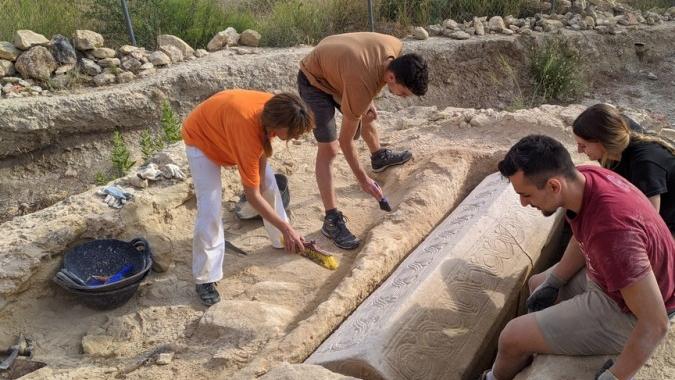
A closeup of the Visigoth sarcophagus was found at the abandoned Roman farming villa in Spain.
In later years, elements of the villa were repurposed for Christian worship, whilst the villa’s central patio area was used as a necropolis, referred to as the ‘ necropolis ad sanctos ’.
Excavations in this area uncovered a two-metre-long sarcophagus, that is decorated with a swirling geometric pattern and renderings of ivy leaves, whilst a Chi-Rho symbol was carved on its top which is a form of Christogram by superimposing the first two (capital) letters—chi and rho (ΧΡ)—of the Greek word ΧΡΙΣΤΟΣ (Christos), in such a way that the vertical stroke of the rho intersects the centre of the chi.
It is believed that the sarcophagus dates from the 6th century AD, during a period when waves of Germanic tribes swept into the former Roman territories, amongst them the Visigoths.
Under the Visigoths, many Roman structures were abandoned or re-purposed, whilst part of the villa site was built over with a small Christian church sometime during the 5-7th century AD.
Rafael González Fernández, professor of Ancient History from the University of Murcia described the discovery as “spectacular and unexpected, which corroborates previous studies on the chronology of the necropolis”.
Can 4.5 Billion-Year-Old Meteorite Hold Secrets of Life on Earth?
Scientists are set to uncover the secrets of a rare meteorite and possibly the origins of oceans and life on Earth, thanks to Science and Technology Facilities Council (STFC) funding.
Research carried out on the meteorite, which fell in the UK earlier this year, suggests that the space rock dates back to the beginning of the Solar System, 4.5 billion years ago.
The meteorite has now been officially classified, thanks in part to the STFC-funded studies on the sample.
The Winchcombe meteorite, aptly named after the Gloucestershire town where it landed, is an extremely rare type called a carbonaceous chondrite.
It is a stony meteorite, rich in water and organic matter, which has retained its chemistry from the formation of the solar system. Initial analyses showing Winchcombe to be a member of the CM (“Mighei-like”) group of carbonaceous chondrites have now been formally approved by the Meteoritical Society.
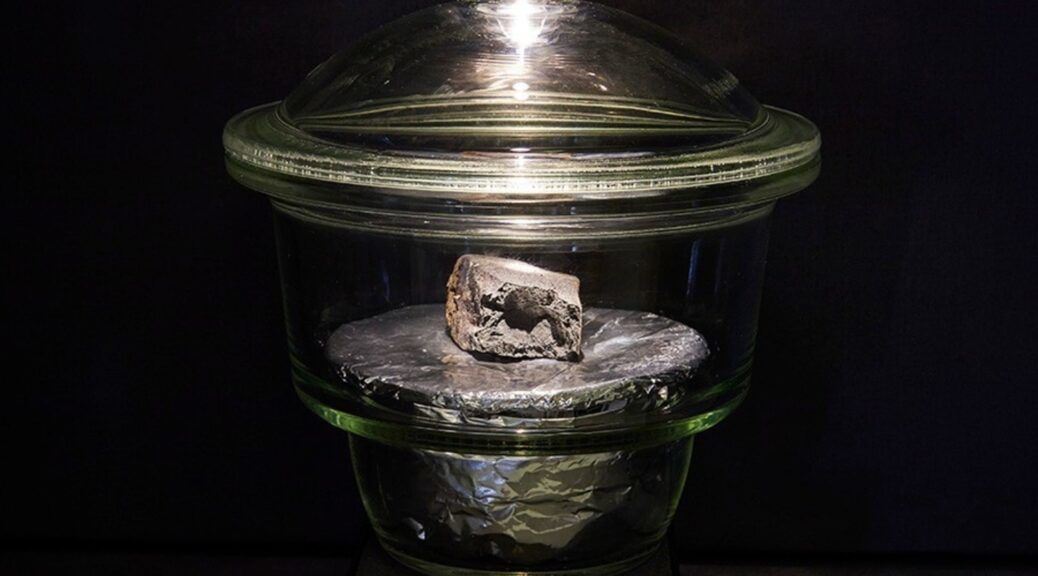
Winchcombe meteorite
An image of one of the fragments of the Winchcombe meteorite.
STFC provided an urgency grant in order to help fund the work of planetary scientists across the UK. The funding has enabled the Natural History Museum to invest in state-of-the-art curation facilities to preserve the meteorite, and also supported time-sensitive mineralogical and organic analyses in specialist laboratories at several leading UK institutions.
Dr. Ashley King, a UK Research and Innovation (UKRI) Future Leaders Fellow in the Department of Earth Sciences at the Natural History Museum, said: “We are grateful for the funding STFC has provided.
Winchcombe is the first meteorite fall to be recovered in the UK for 30 years and the first-ever carbonaceous chondrite to be recovered in our country. STFC’s funding is aiding us with this unique opportunity to discover the origins of water and life on Earth. Through the funding, we have been able to invest in state-of-the-art equipment that has contributed to our analysis and research into the Winchcombe meteorite.”
The meteorite was tracked using images and video footage from the UK Fireball Alliance (UKFAll), a collaboration between the UK’s meteor camera networks that includes the UK Fireball Network, which is funded by STFC. Fragments were then quickly located and recovered.
Since the discovery, UK scientists have been studying Winchcombe to understand its mineralogy and chemistry to learn about how the Solar System formed.
Dr. Luke Daly from the University of Glasgow and co-lead of the UK Fireball Network said: “Being able to investigate Winchcombe is a dream come true.
Many of us have spent our entire careers studying this type of rare meteorite. We are also involved in JAXA’s Hayabusa2 and NASA’s OSIRIS-REx missions, which aim to return pristine samples of carbonaceous asteroids to the Earth.
For a carbonaceous chondrite meteorite to fall in the UK, and for it to be recovered so quickly and have a known orbit, is a really special event and a fantastic opportunity for the UK planetary science community.”
Funding from STFC enabled scientists to quickly begin the search for signs of water and organics in Winchcombe before it could be contaminated by the terrestrial environment.
Dr. Queenie Chan from Royal Holloway, University of London added: “The team’s preliminary analyses confirm that Winchcombe contains a wide range of organic material! Studying the meteorite only weeks after the fall, before any significant terrestrial contamination, means that we really are peering back in time at the ingredients present at the birth of the solar system, and learning about how they came together to make planets like the Earth.”
A piece of the Winchcombe meteorite that was recovered during an organized search by the UK planetary science community is now on public display at London’s Natural History Museum.
25,000-year-old human genome recovered from cave soil in the Caucasus, western Georgia
Ancient dirt has provided DNA samples that revealed evidence of a previously unknown human species that resided in a Georgian cave more than 25,000 years ago.
A few genome sequences called SAT29 obtained from a single soil sample from the Satsurblia Cave in the Caucasus region in Georgia revealed a possibly unknown population that had inhabited the area.
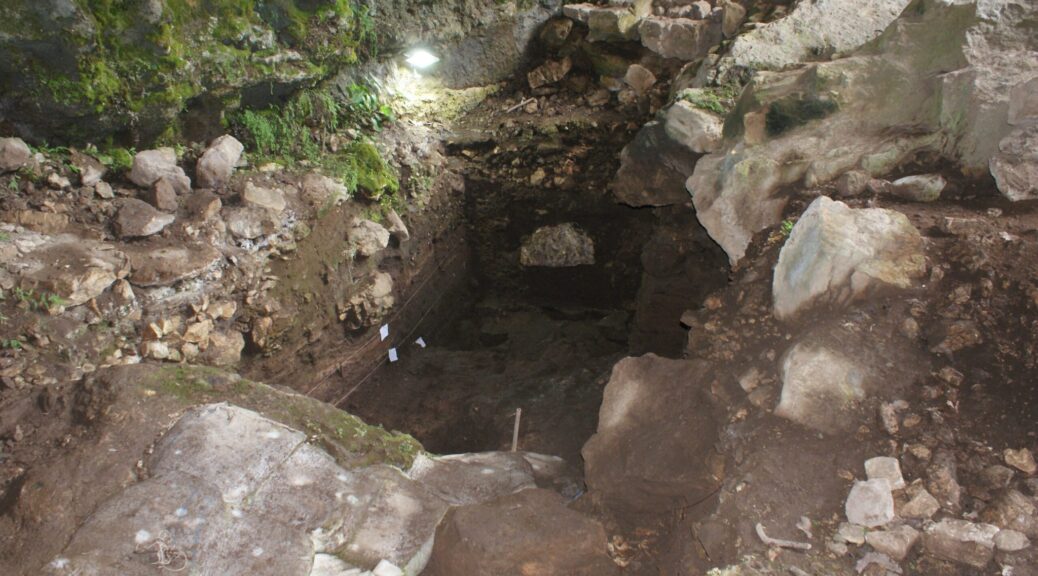
The section of the Satsurblia Cave where the sample was collected.
The Satsurblia Cave, located in Tskaltubo municipality, village. Kumistavi area in Georgia, the United States.
The researchers used an innovative approach that “permits the identification of DNA in samples of environmental material by applying extensive sequencing and huge data analysis resources,” according to a press release about the discovery.
The technique has allowed the recovery of an environmental human genome from a layer of the cave that dates to before the Ice Age, about 25,000 years ago.
The Satsurblia Cave, formed in Sataphlia-Tskaltubo karst massif, was inhabited by people at different times in the Paleolithic Period.
Until that time, the oldest sequenced genome of a human individual from the cave was 10,000 years younger than the current one.
Further, “the analysis of the genetic material has revealed that the SAT29 human-environmental genome represents a human extinct lineage that contributed to the present day West-Eurasian populations,” the release states.
In order to confirm the results, the researchers compared the recovered genome and the genetic sequences from bone remnants from Upper Paleolithic Dzudzuana Cave in the same area, which provided clear evidence of genetic similarity.
In addition to the identified human genome, other mammal genomes which supposedly belonged to a wolf or a bison species were also recovered from the soil samples.
Gelabert et al. retrieved human and mammalian nuclear and mitochondrial environmental shotgun genomes from a 25,000-year-old sediment sample from Satsurblia Cave in Georgia.
The researchers used these sequences to reconstruct the wolf and bison populations in the Caucasus region and upgrade the collected knowledge of the population dynamics of these species.
The next project of the international research team will be to collect samples of ancient fauna and humans from the Satsurblia cave in order to determine their mutual interactions.
Through the extraction of DNA from soil samples, the scientists hope to reconstruct the evolution of past ecosystems and evaluate the effect of climate change on mammal populations.
The research was conducted by an international team led by professor Ron Pinhasi and Pere Gelabert with Susanna Sawyer of the University of Vienna in collaboration with Pontus Skoglund and Anders Bergström of the Francis Crick Institute in London.