Archaeologists discover the 18th-century wooden road
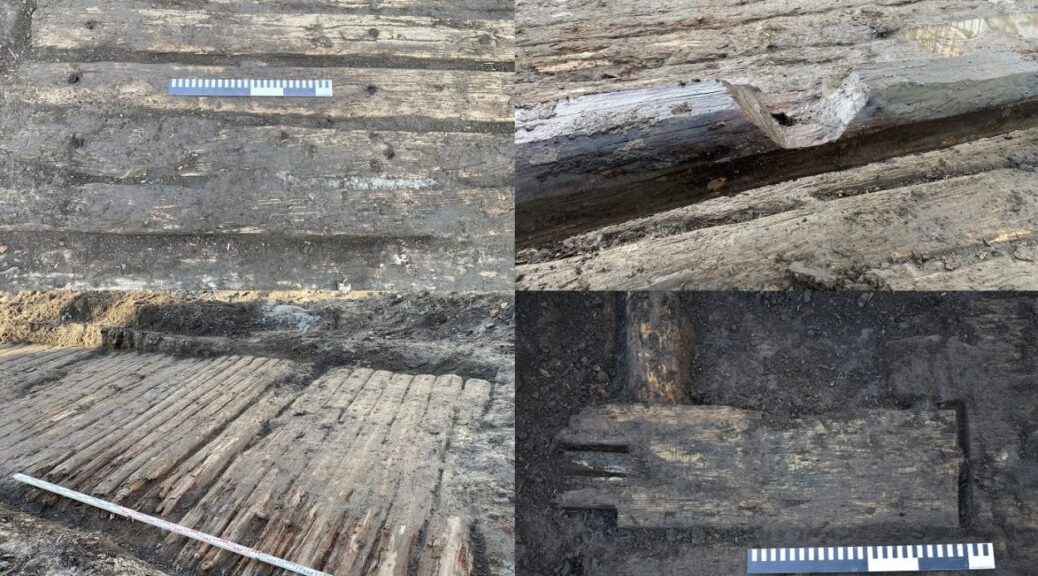
Archaeologists have discovered a well-preserved stretch of a late 17th or early 18th-century wooden road in Jarosław, southeastern Poland. At 100 feet long, it is one of the longest wooden roads ever discovered in what is now Poland.
The remains were discovered in February during archaeological exploration of the site of planned sewer work in the historic centre of the city.
The road led to a gate in the city walls opening west towards Kraków. It was part of a 250-mile route connecting Bielsko Biała to Lviv in modern-day Ukraine. It was a dirt road, except for the section inside Jarosław.
Archaeologists have excavated a wooden road in the town of Jarosław, located in the Podkarpackie Voivodeship of Poland.
The road was 10 feet wide, so must have been one-way traffic only because that was not enough space for two lanes. It was made of timbers mounted on transverse wooden joists. The wood was probably oak and it was very sturdy.
There are no hoof marks or wheel ruts even though it must have been a busy street as Jarosław held one of the largest market fairs in Europe and was a major hub of trade in the region. It was in active use for about 100 years before paved roads were built over it.
Some of the roads have been removed to the Jarosław Museum for conservation and study. Objects found during the removal of the timbers — coins, show leather, nails — will go on display in the museum.
The section still in place will be displayed in situ in the coming months.
The road was laser scanned before removal so a detailed animated model could be made accurate to the millimetre.
Possible shaman’s snake stick from 4,400 years ago discovered in a Finnish lake
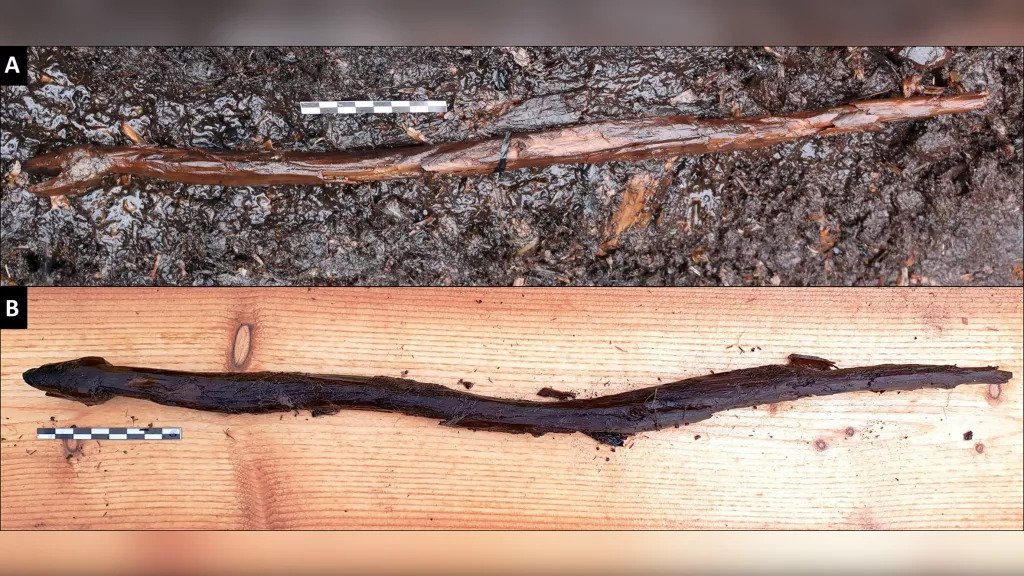
Archaeologists in Finland have uncovered an intricately carved wooden staff that may have been used by Stone Age shamans for rituals. More than half a metre long, the perfectly preserved life-sized wooden stick is a carving of a snake, shaped as if it is slithering away.
It was found at Järvensuo 1, a wetland site in Finland’s southwest that was occupied between 4000 BC and 2000 BC, and is ‘unlike any other wooden artefact found in Northern Europe’ during this period.
The archaeologists say the object is 4,400-years-old, meaning it dates back to the Neolithic period – the final division of the Stone Age.
Incredibly preserved detail of the carved snake’s head. The unbelievably well-preserved wooden stick was intricately carved in the shape of a snake slithering away
‘This delicately carved natural-sized snake figurine is a magnificent, thought-provoking glimpse from far back in time,’ said study author Dr Satu Koivisto at the University of Turku.
‘I have seen many extraordinary things in my work as a wetland archaeologist, but the discovery of this figurine made me utterly speechless and gave me the shivers.’
Contemporary rock art shows snake-shaped objects being held by human-like figures, which is why the experts think the carving was a Stone Age shaman’s staff for rituals.
Side view (a) and top view (b) of the stick, suspected to be a staff. The archaeologists say the object is 4,400-years-old, meaning it dates back to the Neolithic period
‘There seems to be a certain connection between snakes and people,’ said co-author Dr Antti Lahelma from the University of Helsinki.
‘This brings to mind northern shamanism of the historical period, where snakes had a special role as spirit-helper animals of the shaman.
‘Even though the time gap is immense, the possibility of some kind of continuity is tantalising – do we have a Stone Age shaman’s staff?’
Järvensuo 1 was discovered by accident by ditch diggers during the 1950s but had not been fully excavated. As such, archaeologists have been working to explore the site since 2019.
The prehistoric lakeshore has wetland conditions conducive to preserving wooden items. Previous excavation work at the site unearthed a wooden scoop with a handle like a bear’s head.
Järvensuo 1, a wetland site, is located in south-west Finland at the foot of a moraine hill rising in the middle of a large peatland plateau. Archaeological interest is with the southern shore of the drained Rautajärvi Lake. a) Location map; b) study area at Järvensuo; c) aerial photograph of the site
The artifact was found at Järvensuo, a site located beside a lake in southwest Finland. A large number of artifacts associated with fishing were also found at the site.
Several other wooden artefacts have been found by the new investigations, including wooden utensils, structural remains and pieces of fishing equipment.
According to archaeologists, this indicates Järvensuo 1 was the site of not just bizarre rituals involving the snake figurine, but practical activities as well-meaning it offers a snapshot of all aspects of ancient life.
‘Well-preserved finds from wetlands help our understanding of ancient peoples and the landscape where they performed both mundane and sacred activities,’ said Dr Koivisto.
Sadly, Järvensuo 1 and the historical treasures within are under threat from drainage and other changes to the local environment, exacerbated by climate change.
‘The signs of destruction caused by extensive drainage are already clearly evident at the site and its organic treasures are no longer safe,’ said Dr Koivisto.
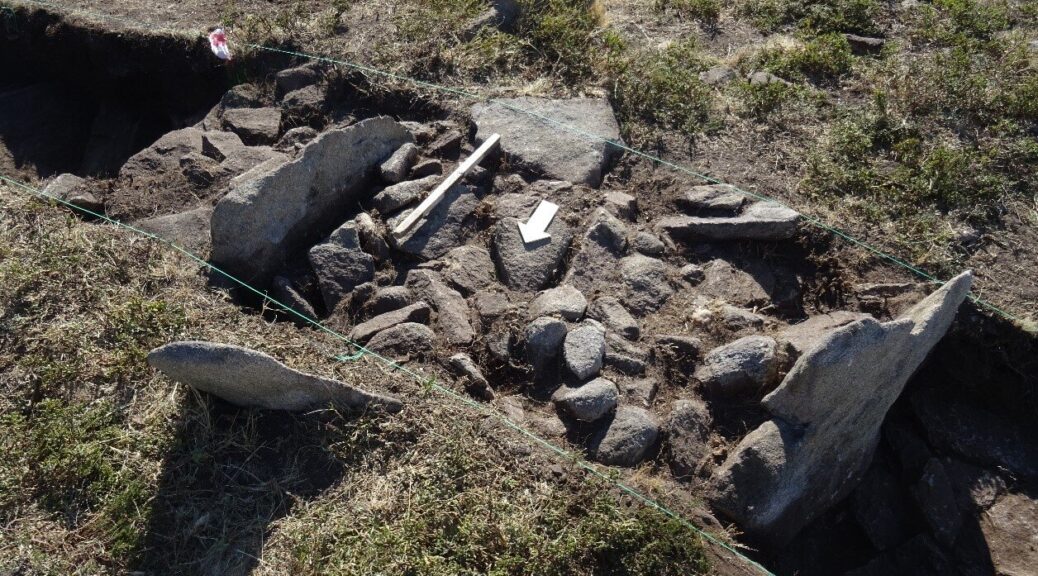
Pioneering technology has helped experts find a lost camp built and used by thousands of Roman soldiers sent to conquer Northwest Iberia. The discovery is the largest and oldest Roman military fortified enclosure excavated so far in Galicia and northern Portugal. The foundations of the enclosure wall date from around the second century BC.
The 2,100-year-old Roman military camp of Lomba do Mouro in Melgaço, Portugal.
Experts analyzed a section of sediment from the wall’s foundations using an optically stimulated luminescence (OSL) dating technique. This made it possible to date the last time the quartz crystals were exposed to sunlight and how long they were buried under the walls.
The discovery means Lomba do Mouro is the oldest scientifically identified Roman camp to date in Galicia and northern Portugal and may link its construction to the first Roman military campaigns in Gallaecia.
The camp of Lomba do Mouro, in Melgaço, Portugal, was constructed by around 10,000 Roman troops who were crossing the Laboreiro Mountain between the Lima and Minho rivers. It was designed to be a temporary fortification, used for a day or weeks at most in the warmer months, and was built quickly.
The army was crossing high ground for safety. Written sources describe fighting during their excursion, but also some potential agreements were made with the local community.
Temporary camps are hard to spot because little archaeological evidence is left behind—due to their non-permanent nature and because they were often destroyed on purpose when the Roman Army left.
Dr. João Fonte, from the University of Exeter, a member of the research team, said: “Written sources mention the army crossing different valleys, but until now we didn’t know exactly where.
Because of the temporary nature of the site, it’s almost impossible to find without using remote sensing techniques, and radiocarbon dating wouldn’t have been accurate because plant roots creep into the structure.”
“We have found numerous military camps in the Northwest of the Iberian Peninsula in recent years, but their dating is very complex.
As they are temporary enclosures, there is very little material or organic evidence in them that would allow a scientifically valid dating to be obtained, until now.”
Covering more than 20 hectares, Lomba do Mouro was discovered using remote sensing techniques by the romanarmy.eu research collective and was the subject of an archaeological survey in September 2020.
Detail of trench 2
The campaign was led by University of Exeter archaeologist João Fonte as part of the Finisterrae project funded by the European Commission through a Marie Skłodowska-Curie grant (grant agreement 794048).
Until now the oldest dated Roman camp in Galicia and northern Portugal—excavated by the same team—was Penedo dos Lobos (Manzaneda, Ourense), where coins could be found linking this enclosure with the war campaigns known as the Cantabrian Wars (29-19 BC), with which the Emperor Octavian Augustus put an end to the process of conquest of Hispania. Lomba do Mouro was built a hundred years before Penedo dos Lobos.
In 137 BC the Roman consul Decimus Junius Brutus entered Gallaecia with two legions, crossing the rivers Douro and Lima and reaching the Minho.
The dating of the walls, together with the large dimensions of the enclosure, support the hypothesis that the camp may have been erected by a contingent linked to these times, although due to the degree of uncertainty of the dates it is difficult to establish a direct association with the episode of Decimus Junius Brutus campaign.
Pompeii dig uncovers 2000-year-old remains of rich man and slave killed by Vesuvius volcanic eruption
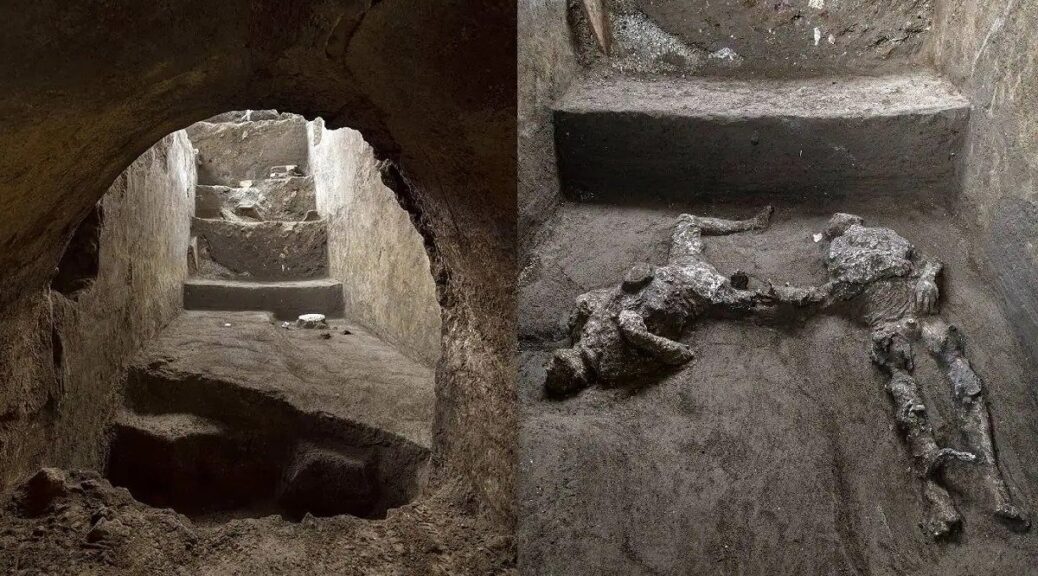
Archaeologists uncovered the skeleton remains of two males who perished about 2,000 years ago in Pompeii, Italy, after the eruption of Mount Vesuvius in 79 AD. The bones are thought to be those of a wealthy man and his male slave who attempted to flee the volcano’s explosion.
The bodies were found in a side room of the cryptoporticus, in the form of a passage-way below the villa which led to the upper floor.
During an excavation of the ruins from what was once an elegant villa with a panoramic view of the Mediterranean Sea on the outskirts of the ancient Roman city, parts of the skulls and bones of the two men were found.
The remains of the two victims, lying next to each other on their backs, were found in a layer of grey ash at least 2 meters (6.5 feet) deep. In 2017, a stable with the remains of three harnessed horses was also found in the same area.
In a statement issued by Pompeii officials, they said that the men apparently escaped the initial fall of ash from Mount Vesuvius but then succumbed to a powerful volcanic blast that took place the next morning. The later blast “apparently invaded the area from many points, surrounding and burying the victims in ash,” the officials said.
Judging by cranial bones and teeth, one of the men was young, likely aged 18 to 25, with a spinal column with compressed discs. That finding led archaeologists to hypothesize that he was a young man who did manual labour, like that of a slave.
The other man had a robust bone structure, especially in his chest area, and died with his hands on his chest and his legs bent and spread apart.
He was estimated to have been 30- to 40-years-old, Pompeii officials said. Fragments of white paint were found near the man’s face, probably remnants of a collapsed upper wall, the officials said.
Based on the impression of fabric folds left in the ash layer, it appeared the younger man was wearing a short, pleated tunic, possibly of wool. The older victim, in addition to wearing a tunic, appeared to have had a mantle over his left shoulder, said reports.
According to a report by The Associated Press, both skeletons were found in a side room along an underground corridor, or passageway, known in ancient Roman times as a cryptoporticus, which led to to the upper level of the villa.
Pompeii archaeological park director general, Massimo Osanna said that the find was “truly exceptional”, while Italian culture minister Dario Franceschini said it underlined the importance of Pompeii as a place for study and research.
Osanna further stated, “The victims were probably looking for shelter in the cryptoporticus, in this underground space, where they thought they were better protected. Instead, on the morning of Oct. 25, 79 A.D., a blazing cloud (of volcanic material) arrived in Pompeii and…killed anyone it encountered on its way.”
The famous Mount Vesuvius is located near Naples in Italy and is well known throughout the world for its massive destructive eruption. It is also known as Vesuvio among the locals and stands 4,203 feet (1,281 meters) tall and has a semi-circular ridge called Mount Soma that rises 3,714 feet.
It has erupted over 50 times and remains an active volcano till date.
Archaeologist discovers a 6,000-year-old island settlement off the Croatian coast
Croatia, June 24 – Archaeologist Mate Parica was examining satellite images of Croatia’s coastline when he spotted something unusual. “I thought: maybe it is natural, maybe not,” said Parica, a professor at the University of Zadar.
The image showed a large, shallow area on the seabed jutting out from the eastern shore of the island of Korcula.
Parica and a colleague decided to dive at the site and discovered what they believe is a Neolithic settlement from around 4,500 years BC, built on a small piece of land that was connected to the main island by a narrow strip.
Aerial view of Neolithic settlement in Lumbarda, Croatia, June 23, 2021.
The pair found the remains of stone walls which had surrounded the settlement, as well as tools and other objects used by the inhabitants.
“We found some ceramic objects and flint knives,” he said.
Archaeologist diver works on a Neolithic settlement in Lumbarda, Croatia.
Marta Kalebota who runs the archaeological collection in the Korcula town museum said the settlement’s location was highly unusual.
“We are not aware at the moment of a similar finding elsewhere that a Neolithic settlement was built on an islet connected with a narrow strip of land,” she said.
Parica also said the island settlement discovery was atypical and that Neolithic finds were mostly made in caves.
“The fortunate thing is that this area, unlike most parts of the Mediterranean, is safe from big waves as many islands protect the coast.
That certainly helped preserve the site from natural destruction,” he said.
The treasure inside beer lost in a shipwreck 120 years ago
Long-forgotten strains of yeast are searched for in wrecks, abandoned breweries and other places in the hope that they can be put to good use if they are resurrected. gently relieving himself through a hatch in the sunken hold, he could see the wreckage treasure waiting for him. He had been there for over 100 years. But now a part was about to be released from its resting place.
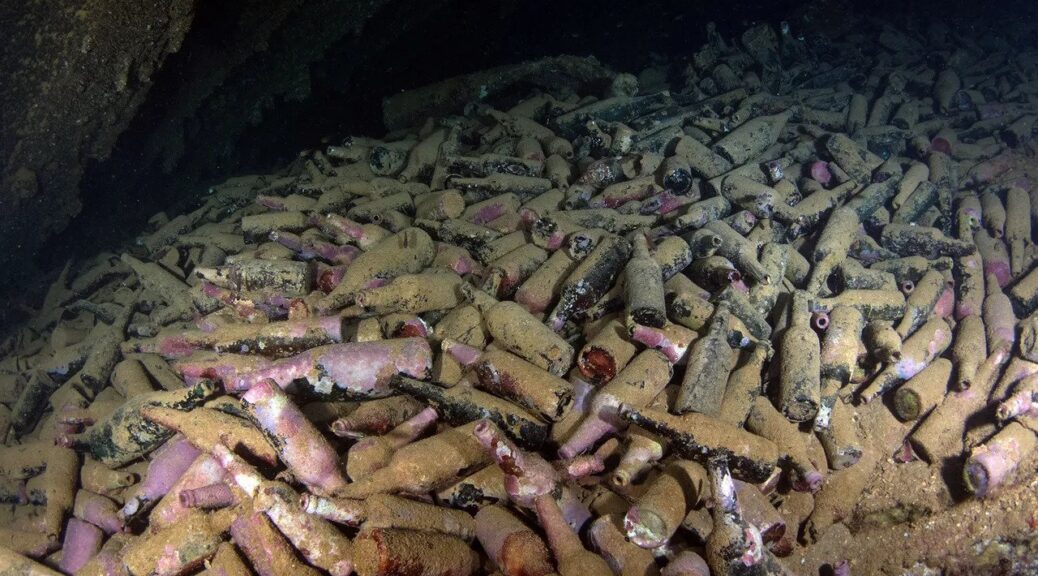
Many of the bottles found on board the Wallachia remained unopened despite spending more than 100 years underwater
The explorer in question, Steve Hickman, a dive technician and amateur diver, was carrying a small bag in the net with him.
The treasure he was looking for was beer. Rows of glass beer bottles, partly buried in the silt, were kept in the hold of this ship. With visibility reduced to zero, Hickman was effectively blinded. But he knew this shoulder wellve and had visited it several times before. He continued, searching for more bottles in the dark. Once he gathered and bagged a few, he escaped and his team carefully brought the bottles to the surface.
The wreck was Wallachia, a cargo ship that sank in 1895 off the coast of Scotland following a collision with another ship in thick fog. Wallachia had just left Glasgow and was packed with
Since he began diving in Wallachia in the 1980s, Hickman has collected tens of bottles containing whiskey, gin and beer. But his recent visit, teamwork with several fellow divers, led to something unusual.
The bottles they recovered were turned over to scientists at a research company called Brewlab, who, along with colleagues at the University of Sunderland, was able to extract live yeast from the liquid in three of the bottles. . They then used this yeast in an attempt to recreate the original beer.
In 2018, a similar project in Tasmania used yeast from 220-year-old beer bottles found on a wreck forget close to a drink from the 1700s. But the study of Wallachia yeast revealed a surprise. These beers contained an unusual type of yeast and the team behind the work is now evaluating whether this strain perishes. long overdue could have applications in modern brewing or could even improve the beers of today.
When opened, the beer inside the bottles found on the Wallachia had a far from appetising odour, but the yeast they contain could be invaluable
In any case, there is a
“Yeast species apart from Saccharomyces cerevisiae are often more tolerant of things like using frozen dough and sometimes even have increased lifting capacity, ”Heil explains.
Thomas says he wants to sample and study yeast sealed containers found on even more shipwrecks, or other times well preserved and watered capsules. And by studying the genetics of ancient yeast strains, it might also be possible to identify previously unknown but desirable genes, which might influence genetically modified yeast in the future.
But the Wallachia Wreck is a sobering reminder of how lucky we are to have access to a handful of historic yeasts that keep us alive. can partner with confidence at a specific time and place.
In the 30 or so years since Hickman dived there, he has witnessed the wreckage deteriorating over time. The structures and walkways above and around the engine room collapsed. The cracks in the ship’s ageing walls widened. The ship is disappearing.
“I suspect that maybe in the next 20-30 years it will be completely gone,” he says.
Wallachia will disappear. probably taking her remaining beer bottles with her as she slowly shatters on the seabed. Precious link with 19th-century brewers will finally disappear forever, taking with it the precious yeasts it carries in
Dirty secrets: sediment DNA reveals a 300,000-year timeline of ancient and modern humans living in Siberia
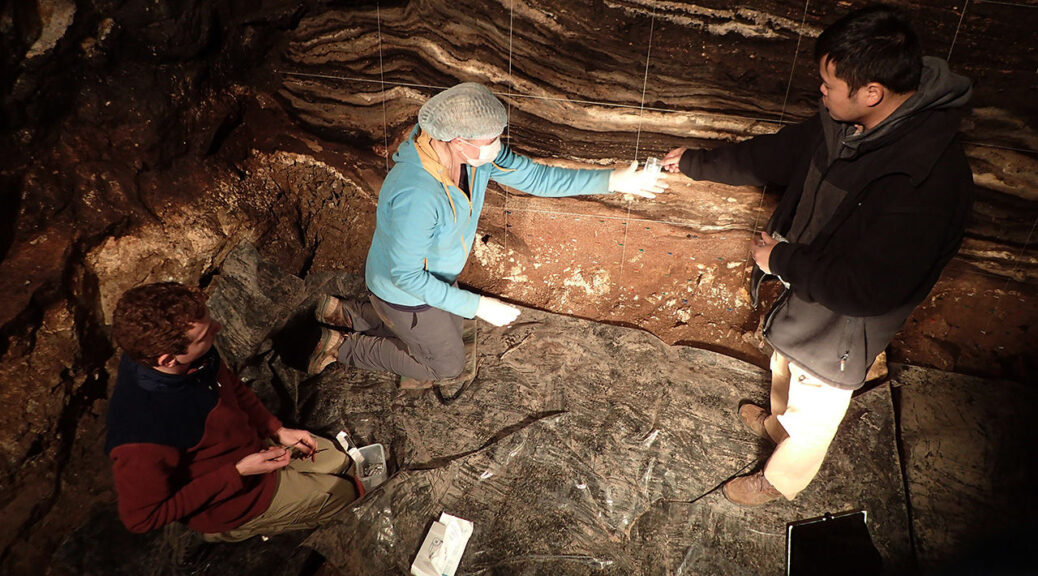
In Siberia, researchers lay out a grid in Denisova Cave to systematically sample soil layers for DNA.
Science Magazine reports that analysis of more than 700 soil samples from Siberia’s Denisova Cave has detected traces of modern human DNA, which suggests that modern humans may have occupied the cave alongside Denisovans and Neanderthals.
The group was named “Denisovans” in its honour. Now, an extensive analysis of DNA in the cave’s soils reveals it also hosted modern humans—who arrived early enough that they may have once lived there alongside Denisovans and Neanderthals.
The new study “gives [researchers] unprecedented insight into the past,” says Mikkel Winther Pedersen, a molecular paleoecologist at the University of Copenhagen who was not involved with the work. “It literally shows what [before] they have only been able to hypothesize.”
Humans—including Neanderthals and Denisovans—are known to have occupied Denisova Cave for at least 300,000 years.
Selection of stone tools and personal ornaments made from bone, tooth and ivory recovered from the same sediment layers as modern human ancient DNA.
The cave also contains sophisticated stone tools and jewellery at higher, later levels. But no modern human fossils have been found there.
Those artefacts, extensive studies of DNA from these bones, and even one early study of DNA from soils have cemented the cave’s importance for piecing together human evolution.
But eight fossils are not much to go on, so Elena Zavala, a graduate student at the Max Planck Institute for Evolutionary Anthropology, and colleagues teamed up with Russian researchers to see what kind of DNA was present in the soils of the three-chamber cave (see the video, below).
Researchers have been studying DNA isolated from soils for more than 40 years, including sequencing DNA from permafrost, but only in the past 4 years has anyone found DNA from extinct humans in ancient soils.
Working with another team of experts who had previously dated the layers of the cave, the researchers dug out 728 soil samples. After 2 years of analysis, in which they isolated and sequenced the samples, the researchers found human DNA in 175 of them. That makes the study “the largest and most systematic of its kind,” says Katerina Douka, an archaeological scientist at the Max Planck Institute for the Science of Human History who was not involved in the work.
The data reveal a complex history of human and animal habitation, with different groups moving in and out of the cave over time, Zavala and her colleagues report today in Nature. Their work confirms that Denisovans were the cave’s first human inhabitants, about 300,000 years ago.
They disappeared 130,000 years ago, only to be followed by a different group of Denisovans, who likely made many of the stone tools, some 30,000 years later. Neanderthals appeared on the scene about 170,000 years ago, with different groups using the cave at various points in time, some overlapping with the Denisovans.
The last to arrive were modern humans, who showed up about 45,000 years ago. The soil layer that corresponds with that period contained DNA from all three human groups, the researchers report.
“The time periods [of each layer] are quite large, so we can’t concretely say if they overlapped or not,” Zavala says. But, Douka adds, “I cannot think of another site where three human species lived through time.”
Given the jewellery and sophisticated artefacts in later layers, some researchers had suspected moderns had been there. But no one knew they had arrived as early as 45,000 years ago—and overlapped with both of our archaic cousins.
“It suggests a more complicated interplay between archaic and modern humans,” says Ron Pinhasi, an evolutionary anthropologist at the University of Vienna who was not involved with the work.
The soil samples also yielded DNA from many species of animals. About 170,000 years ago, the climate went from warmer to colder, and Neanderthals moved in, so did different species of hyenas and bears.
It’s the combination of genomic data from both the fossils and the soil samples that really makes the new work stand out, Pinhasi says. “It’s a super promising direction [for future work].” Douka agrees, and says the new study should help ancient soil DNA become “a mainstream archaeological tool.”
She is already amazed at the progress that it, combined with other studies, has made possible. “Let’s not forget that as recently as in 2010 we had absolutely no evidence that Denisovans existed, and that these various hominins ever met, let alone that they interbred repeatedly and co-existed for millennia,” she wrote in an email.
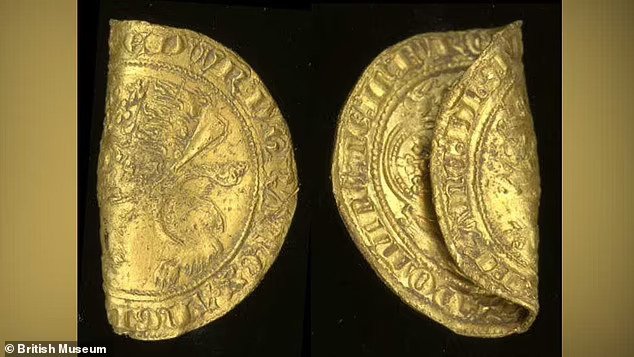
A metal detectorist discovered two ancient and extremely rare gold coins thought to have been lost during the Black Death. Near Reepham, Norfolk, a leopard-shaped 23-carat gold coin was discovered alongside an Edward III golden coin.
The leopard was withdrawn within months of its being minted in 1344 and according to finds liaison officer Helen Geake, hardly any of the coins have survived.
The coins would be worth the equivalent of £12,000 in terms of today’s currency and would have been owned by someone at the top of society’, she told the BBC.
The coins were discovered by a metal detectorist in Reepham, Norfolk in October 2019
‘For some reason, they didn’t catch on, but when one or two pennies were the equivalent of a day’s wages at today’s minimum wage rate, perhaps very few people used them,’ she said.
Called a florin, leopard and a helm, the coinage was an attempt by King Edward III to produce a gold coin suitable to be used in Europe as well as in England.
But, the gold used to strike the coins was overvalued, which resulted in them being unacceptable to the public. Within months, they were melted down to produce the more popular gold noble, worth six shillings and eightpence.
The coin was discovered alongside a rare Edward III noble, thought to date between 1351 and 1352, while the bubonic plague, known as the Black Death, was ravaging Europe.
Plague is an infectious disease caused by the bacterium Yersinia pestis, which is carried by fleas and transmitted between animals.
The bubonic plague – the most common form – is caused by the bite of an infected flea and can spread through contact with infectious bodily fluids or contaminated materials. Patients may show signs of fever and nausea and at an advanced stage may develop open sores filled with pus.
It devastated Europe in the Middle Ages, most notably in the Black Death of the 1340s which killed a third or more of the continent’s population.
After the Black Death plague became a common phenomenon in Europe, with outbreaks recurring regularly until the 18th century. When the Great Plague of 1665 hit, a fifth of people in London died, with victims shut in their homes and red crosses painted on the door.
Bubonic plague has almost completely vanished from the rich world, with 90 per cent of all cases now found in Africa. It is now treatable with antibiotics, as long as they are administered quickly.
Still, there have been a few non-fatal cases in the U.S., with an average of seven reported a year, according to disease control bosses. From 2010 to 2015 there were 3,248 cases reported worldwide, including 584 deaths, says the World Health Organisation.
Some plague vaccines have been developed, but none are available to the general public. The WHO does not recommend vaccination except for high-risk groups such as health care workers.
Without antibiotics, the bubonic strain can spread to the lungs – where it becomes the more virulent pneumonic form. Pneumonic plague, which can kill within 24 hours, can then be passed on through coughing, sneezing or spitting.
The coins were thought to be lost after the Norman Conquest, as the only coins in circulation were silver pennies.
Dr Geake said no one really knows why Edward III decided to reintroduce the first gold coins in England since the Anglo-Saxon era. The find shows that the leopard, worth three shillings at the time, was in circulation for longer than historians have previously believed.
The coin was discovered alongside a rare Edward III noble, thought to date between 1351/52
But, after looking at the circumstances at the time, they realised that it coincided with the Black Death reaching England in 1348 – a ‘cataclysmic’ event which saw coinage issues drop in priority.
‘Usually the authorities would be keen to remove a withdrawn coin as soon as possible,’ Dr Geake said.
The coins were discovered by a metal detectorist in October 2019.