A recent study reveals new details about how Ancient Romans kept their wine safe and packed full of flavour.
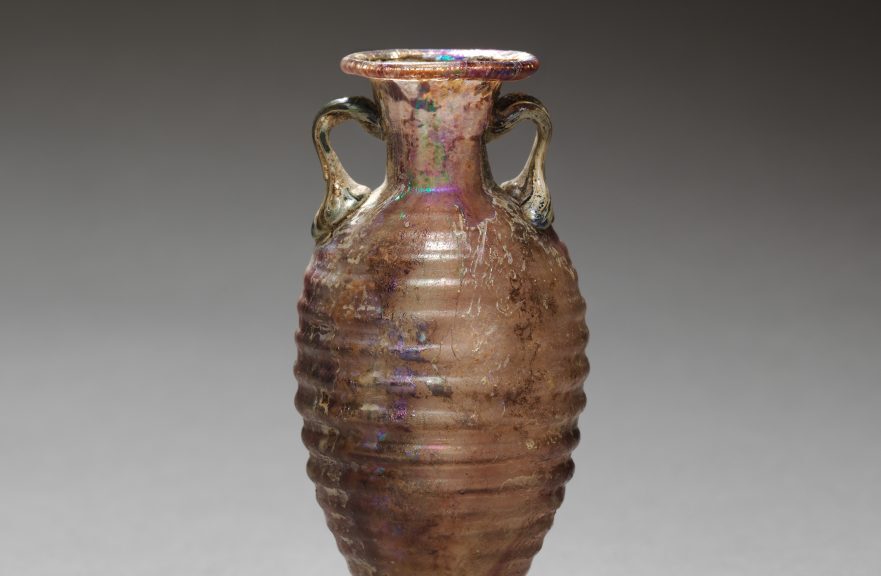
Amphora, 50-100. Italy, Rome or Sidonia, Roman, 2nd half 1st Century. Glass; diameter: 2.5 cm (1 in.); overall: 7.5 x 3.5 cm (2 15/16 x 1 3/8 in.).
Consuming wine in Ancient Rome was divinely ubiquitous, available not only to aristocrats and emperors, but also to slaves, peasants, and men and women alike. Yet while scholars have known this for some time, exactly how ancient Romans kept their wine safe and full of flavour was unclear.
But now, a study published in the peer-reviewed scientific journal PLOS ONE reveals new details about these mysteries.
The authors looked at three 1,500-year-old Roman amphorae (jugs used to transport wine) that were taken from a seabed deposit found in San Felice Circeo, about 55 miles southeast of Rome.
For the study, led by chemist Louise Chassouant, scientists using methods in the burgeoning field of archaeobotany (the study of plant remains) were able to determine how Ancient Romans made wine and what elements they used in the process.
By looking at the chemical deposits found within the amphorae, plant tissue residue, and pollen, researchers were able to determine which grape derivatives were used, but also, crucially, how ancient peoples were able to insulate their jugs and waterproof them.
The study found that pine was used to create a kind of waterproofing tar to coat the inside of jars, but also speculated that this could have been done to flavour fermenting grapes.
Interestingly, the study also determined that because pine was not local to the region, it would have likely been imported from Calabrian or Sicily, adding credence to existing archaeological and historical evidence of trade links between the regions 1,500 years ago.
All told, the authors emphasized that using a multidisciplinary approach was key to their findings. By looking not only at chemical analysis, but also at historical and archaeological records, plant remains, and individual amphorae design, “we have pushed the conclusion further in the understanding of ancient practices than it would have been with a single approach,” the scientists wrote.
What would it have been like to down a glass of wine with Augustus or Justinian? That we will likely never know, but we are now one step closer to understanding the Dionysian pursuits of Ancient Roman wine lovers. Salut!
250-Million-Year-Old Stone With Microchip Print Discovered
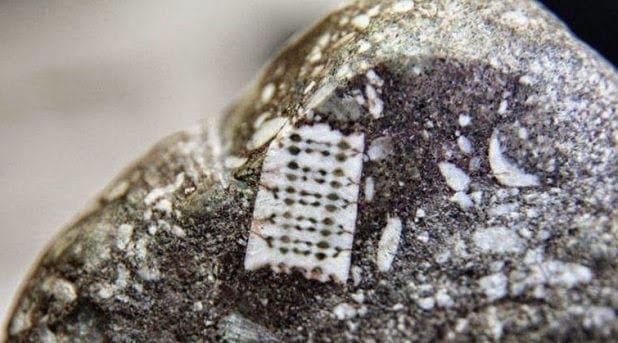
It looks like researchers from Russia have found a 250 million-year-old microchip. Researchers have made another incredible discovery in Labinsk, Russia. According to scholars, this discovery marks the beginning of a completely new history, one that many ancient alien theorists have been talking about for years.
The object that researchers have found is believed to be some sort of ancient microchip and according to researchers, these ancient microchips date back millions of years.
After countless tests, researchers have come to the conclusion that this antique piece was used as some sort of microchip in ancient times.
The problem is its age, according to tests, the artefact is believed to be between 225 and 250 million years old.
Some researchers believe that the dating of the artefact is not entirely accurate given the fact that you cannot date rock, and the tests were based on traces of organic material found around the mystery “chip”.
The million-dollar question is, who and what used a microchip that dates back 250 million years? Is there a possibility that this is in fact the remains of ancient technology? Technology that belonged to a highly advanced civilization that inhabited Earth millions of years ago?
Or is there a possibility that this artefact did not originate from Earth, but on another planet, belonging to an extraterrestrial species?
Better yet, what makes Russia so unique is that numerous artefacts, like the one we see here, have been discovered over the years.
This “ancient microchip” was discovered in the Krasnodar region, and ufologists have already tagged this discovery as a fragment of technology previously unknown to science.
Like many other discoveries, this remarkable artefact was found by chance by a local fisherman by the name of Viktor Morozov who donated his curious finding to scholars from the University of Southern Polytechnic Nowoczerkaskiej who performed several tests and concluded that embedded into the rock, is a strange “device” which strangely resembles modern-day microchips.
Researchers have not tried removing the alleged microchip from the rock for fear that the might damage it.
Geologists and researchers cannot explain the origin of this fantastic finding and there are numerous possibilities that explain what this object is.
Extraterrestrial technology, evidence of sophisticated ancient societies, or just one of those strange rocks made by mother nature.
Some researchers point out that this might actually be part of a stem plant, such as lillies, skeptics have already “debunked” this finding suggesting that it is noting worth the while, just like many other discoveries which couldn’t be explained, so the best guess was… “its nothing important”, however, the origin of this artefact and many others also discovered in Russia have not been explained.
40,000-Year-Old Bracelet Made With Advanced Technology — The Evidence
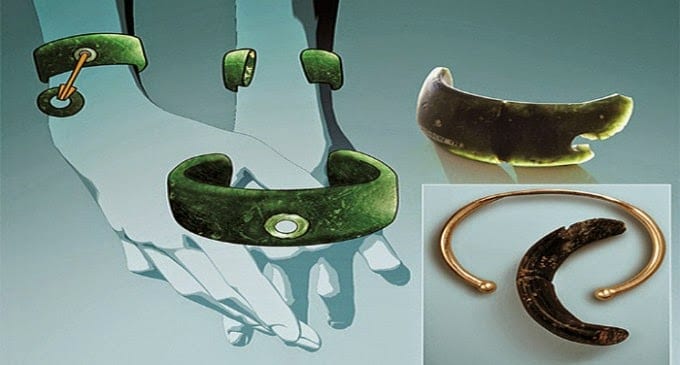
Dating back to the Denisovan species of early humans, scientists have confirmed that a bracelet found in Siberia is 40,000 years old. This makes it the oldest piece of jewellery ever discovered.
The bracelet is discovered in a site called the Denisova Cave in the Altai region of Siberia in 2008 and after detailed analysis, Russian experts now accept that the bracelet’s age is as correct.
Scientists conclude it was made by our prehistoric human ancestors, the Denisovans, an extinct species of humans genetically distinct from Neanderthals and modern humans, and shows them to have been far more advanced than ever realized.
But what made the discovery especially striking was that manufacturing technology is more common in a much later period, such as the Neolithic era.
Indeed, it is not clear yet how the Denisovans could have made the bracelet.
Writing in the Novosibirsk magazine, Science First Hand, Dr Derevyanko said:
“There were found two fragments of the bracelet of a width of 2.7cm and a thickness of 0.9 cm.
The estimated diameter of the find was 7cm. Near one of the cracks was a drilled hole with a diameter of about 0.8 cm.”
“Studying them, scientists found out that the speed of rotation of the drill was rather high, fluctuations minimal, and that was there was applied to drill with an implement – technology that is common for more recent times”, Dr. Derevyanko told the Siberiantimes.
Image: Bracelet is made of Chlorite – Inside are traces of drilling. Image credit: Anatoly Derevyanko and Mikhail Shunkov, Anastasia Abdulmanova.
It is known that the Denisovans migrated out of Africa and branched away from other humanoid ancestors some 1 million years ago.
Genetic studies confirm that skeletal remains of Denisovans, that dated back as early as 600,000 years ago were quite different to both Neanderthals and modern man and the studies confirm that they did coexist not only with modern humans and the Neanderthals, prior to becoming extinct, but as DNA evidence suggests, the Denisovans also must have interbred with an as yet unknown and undiscovered species of humans beings… or maybe an Extraterrestrial species?
50,000-Year-Old Needle Discovered By Researchers Excavating Siberian Cave
Researchers excavating a Siberian cave have made yet another fascinating discovery as they have found a 50,000-year-old needle that was not made by Homo Sapiens.
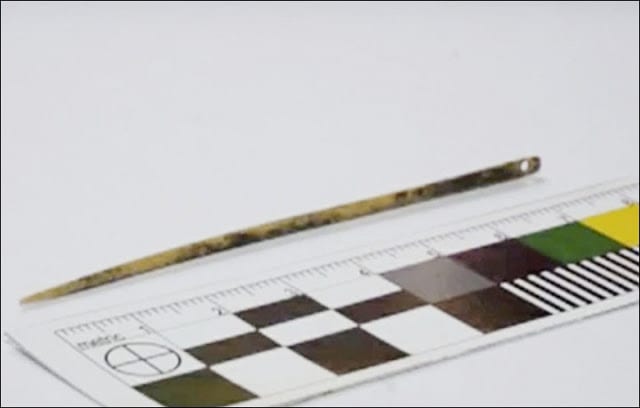
In previous excavations, archaeologists excavated a bracelet which dates back some 40,000 years made with a precision worthy of the best jewellers today. The 7-centimetre-long needle was excavated in the Denisova Cave located in the Altai Mountains in Siberia. The enigmatic needle is believed to have belonged to our long-extinct Denisovan ancestors.
The enigmatic needle is believed to have belonged to our long-extinct Denisovan ancestors. It seems that ancient people had in their possession much more advanced technologies than what we ever imagined.
The discovery was made during the annual summer archaeological dig.
The Denisova cave is considered by many as an archaeological gold mine that holds the secrets of mankind’s origins. Strangely, even though the needle was created over 50,000 years ago it’s in excellent condition and still usable TODAY.
Speaking in an interview with the Siberian Time, Professor Mikhail Shunkov, head of the Institute of Archaeology and Ethnography in Novosibirsk said:
“It is a unique find of this season, which can even be called sensational. It is a needle made of bone. As of today, it is the most ancient needle in the world. It is about 50,000 years old.”
Interestingly, before the 50,000-year-old needle was excavated in the Denisova Cave, the oldest known needle was discovered in Potok Cave in the Eastern Karavanke, Slovenia, and is believed to have been created some 47,000 years ago.
Artefacts recovered from the Denisova cave indicate that the ancient Denisovans were far more advanced than researchers thought possible.
Previously, researchers uncovered fragments of jewellery and a fascinating modern-looking bracelet made of chlorite.
After analysis, researchers concluded that one of the holes seen in the bracelet was made with such precision that it could only have been created with a high-rotation drill similar to what we use today.
According to researchers, the newly discovered needle predates the bracelet by some 10,000 years.
“We can confidently say that Altai was one of the cultural centres, where the modern human was formed.”
The piece of jewellery has been catalogued as the oldest piece of jewellery ever found on Earth. The bracelet was found with other objects such as extinct animal bones and another artefact that according to researchers, date back 125.000 years.
This incredible item was discovered in 2008, and after extensive analysis and tests, experts have been able to confirm its age. Speaking about the bracelet previously discovered, researchers said that:
“The skills of its creator were perfect. Initially, we thought that it was made by Neanderthals or modern humans, but it turned out that the master was Denisovan.”
The enigmatic cave is believed to have been inhabited by different ancestors including Homo Sapiens, Neanderthals, and Denisovans. Experts estimate that the cave is at least 288,000 years old.
Dr Maksim Kozlikin, head of the excavations at Denisova cave: ‘It is the longest needle found in Denisova cave.’ Picture: Vera Salnitskaya
Dr. Maksim Kozlikin, head of the excavations at Denisova Cave said in an interview with the Siberian Times:
“It is the longest needle found in Denisova cave. We have found needles, but in younger (archeological) layers.”
Where exactly did our civilization emerge? Some will say our modern civilization emerged in Mesopotamia. Others will say there are underwater ruins much older and predate the Sumerian civilizations. Yet, another group will argue the first traces of civilization can be found in entirely different places.
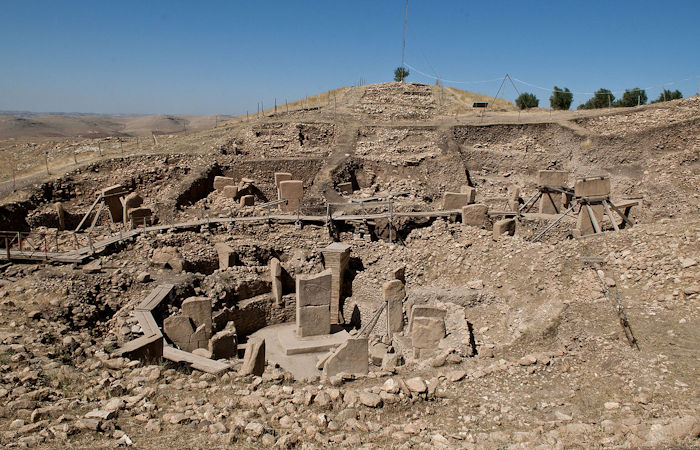
Göbekli Tepe.
Is it really possible to say where civilization started? A team of scientists is confident a hilltop in Turkey is arguably the most important archaeological site on Earth and the place where civilization began. Known as Gobekli Tepe, which means “Potbelly Hill” in Turkish this place is home to the world’s oldest known religious sanctuary that is slowly giving up its secrets. Thousands of our prehistoric ancestors gathered around its highly-decorated T-shaped megalith pillars to worship more than 7,000 years before Stonehenge or the earliest Egyptian pyramids.
“Its significance is hard to overstate,” Sean Lawrence, assistant professor of history at West Virginia University, told AFP.
Some years ago, scientists discovered evidence of a mysterious 12,000-year-old skull cult at Göbekli Tepe. As previously reported on AncientPages.com, “three odd early Stone Age skulls carry artificial modifications of a type so far unknown from contemporaneous sites. The discovery now raises the question of whether inhabitants of Göbekli Tepe were involved in religious rituals related to death, midsummer, or midwinter. The carved skulls deepen the mystery surrounding the ancient site.”
As reported by AFP, ”academics believe the history of human settlement began in these hills close to the Syrian border some 12,000 years ago when groups of Stone Age hunter-gatherers came together to construct these sites. Gobekli Tepe, which some experts believe was never actually inhabited—may be part of a vast sacred landscape that encompasses other nearby hilltop sites that archaeologists believe maybe even older.
None of which anyone would have guessed before the German archaeologist and pre-historian Klaus Schmidt began to bring the first discoveries to the surface in 1995. German and Turkish archaeologists have been labouring in the sun there since, with lengthening queues of tourists now joining them to ponder its many mysteries.
When exactly it all began is even unclear.
“Exact years are nearly impossible to verify,” Lawrence said.
“However, the oldest Egyptian monument, the Pyramid of Djoser at Saqqara, was built around 2700 BCE,” more than seven millennia after Gobekli Tepe.
“This was the end of what is often thought of as Stone Age hunter-gatherer societies and the beginning of settled societies,” Lawrence added.
“There remain endless mysteries surrounding the site, including how labour was organized and how the sites were used,” he said.
Gobekli Tepe has even inspired the Netflix sci-fi psychological thriller series “The Gift”, which turns on one of the ancient inscriptions on its pillars.
Schmidt—who often wore a white traditional turban on the dig—puzzled over the megaliths carved with the images of foxes, bears, ducks, lizards and a leopard for over two decades until his early death at the age of 61 in 2014.
‘Zero point in time’
The site was initially believed to be purely ritual in nature. But according to Clare, there is now “good evidence” for the beginning of settled life with some buildings similar to those of the same age found in northern Syria. Turkey—which in the past has not been renowned for making the best of its vast archaeological heritage—has wholeheartedly embraced the discoveries.
The items excavated from Gobekli Tepe are shown in the impressive archaeological museum in the nearest city, Sanliurfa, which is itself so ancient that Abraham is believed to have been born there. Indeed its new museum built in 2015 boasts “the most extensive collection of the neolithic era in the world,” according to its director Celal Uludag. “All of the portable artefacts from Gobekli Tepe are exhibited here.”
“This is a journey to civilization, (to the) zero point in time,” said Aydin Aslan, head of Sanliurfa Culture and Tourism Directorate.
“Gobekli Tepe sheds light on pre-history, that’s why it’s a common heritage of humanity,” he said proudly.
‘Go deeper
Last year Turkey’s culture ministry boosted funding for further excavations in the region as a part of its “Stone Hills” project, including cash for the Karahan Tepe hilltop site—around 35 kilometres from Gobekli Tepe—which some suspect is even older.
Reproduction of the central pillars of Enclosure D.
“We will now go deeper because Gobekli Tepe is not the one and only,” Culture Minister Nuri Ersoy said last year. The extra funding “gives us a fantastic opportunity to compare our results from Gobekli Tepe with new sites in the Sanliurfa region of the same age,” Clare said.
Gobekli Tepe has also breathed life back into a poor and long-neglected region, which has been further hit by the civil war just across the border. Syrian refugees now make up a quarter of Sanliurfa’s population. Over one million tourists visited Sanliurfa in 2019 and the city expects to reach pre-pandemic levels this year.
“Today Gobekli Tepe has started directly touching the economy of the city,” Aslan said, who hopes that its glorious past could be a key part of the city’s future.”
Medieval Prayer Beads Discovered on England’s Holy Island
The first-ever example of prayer beads from medieval Britain has been discovered on the island of Lindisfarne, one of Britain’s most historic ancient sites, to the excitement of archaeologists.
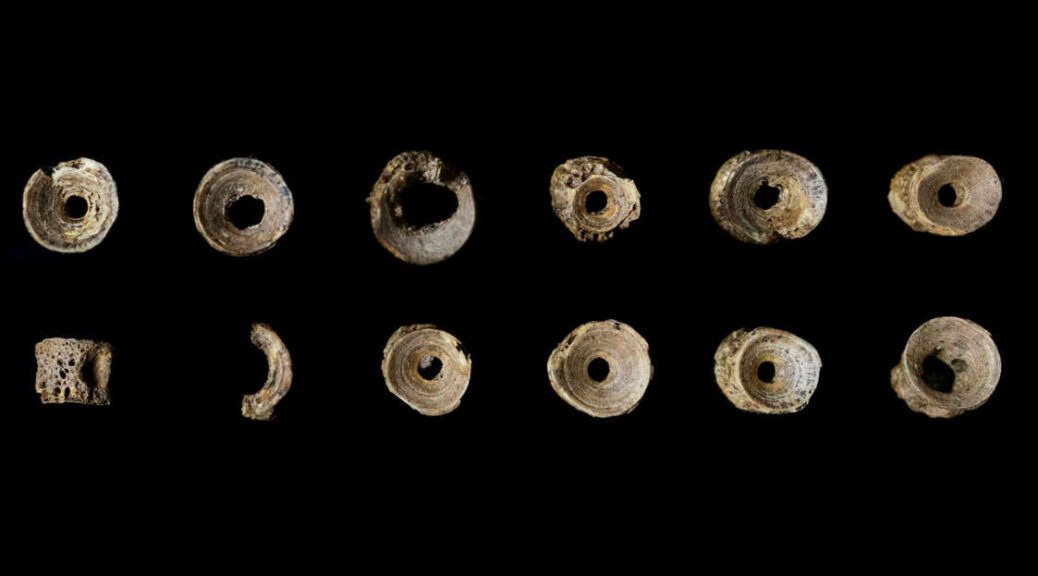
These are the oldest prayer beads ever found in England, which were recently unearthed on the Holy Island of Lindisfarne as part of an ongoing crowdfunded archaeological project.
Dating from the 8th to 9th century AD, they were made from salmon vertebrae. Fish an important symbol of early Christianity were clustered around the neck of one of the earliest skeletons – possibly one of the monks buried within the famous early medieval monastery.
Archaeologists are seeking to unearth the lost history of Lindisfarne, also known as Holy Island, off the coast of Northumberland. It was established by the Kings of Northumbria in the 7th century as an important religious centre and became the scene of the first major Viking raid on Britain in the 8th century.
It was there that monks created the Lindisfarne Gospels – the most spectacular manuscript to survive from Anglo-Saxon England – but there have been few tangible finds at the site.
Dr David Petts, the project co-director and a Durham University specialist in early Christianity, told The Telegraph that the fish vertebrae appear to be prayer beads for personal devotion: “We think of the grand ceremonial side of early medieval life in the monasteries and great works like the Lindisfarne Gospels. But what we’ve got here is something which talks to a much more personal side of early Christianity.”
He paid tribute to Marina Chorro Giner, a zooarchaeologist, for recognising the significance of the vertebrae: “This bright, eagle-eyed researcher looked at them and said, actually these aren’t just fish bones, they’ve been modified and turned into something.”
Discussing the significance of fish and the sea to the island’s medieval inhabitants, he referred to a monk called Cuthbert, who joined Lindisfarne in the 670s and went on to become the most important saint in northern England in the Middle Ages: “We also have the stories of Christ and the Apostles being fishermen and going on the Sea of Galilee and calming storms. We see in Bede’s Life of St Cuthbert, that Cuthbert calming storms. So the sea is symbolically important.”
The beads offer significant information for understanding how people in the past lived and expressed their beliefs through objects.
Their position around the neck suggested that they had been strung like a necklace. The naturally-occurring hole through the centre of salmon vertebrae had been widened, either before threading or through wear.
The discovery follows ongoing excavations at Lindisfarne by DigVentures, an archaeology social enterprise in which volunteers work alongside professionals, as well as Durham University.
‘Remarkable find’
Lisa Westcott Wilkins of DigVentures described it as “a remarkable find”: “Clearly it was important enough that this person was buried with it. This is the only artefact from within a grave on Lindisfarne, so it’s a significant item. As far as we’re aware, it’s the first example of prayer beads found anywhere in medieval Britain.”
She added: “We believe these beads were used as a personal object of faith, especially given that our modern word bead comes from the Old English gebed, meaning ‘prayer’.”
Such is the enormity of the site that the team will continue their excavations for another four years. Other finds have included runic namestones, coins and copper rings.
Mrs Westcott Wilkins said that they are now focussed on the earliest layer within a cemetery that lies next to the ruins of the 12th-century priory: “There are just so many human remains.”
In 1997, at the nearby medieval chapel at Chevington, Northumberland, fish vertebrae were found with similar modifications. But they were from Atlantic cod, among other fish, and that burial dated from the 13th or 14th century, whereas this is so much earlier.
The Skalica district in Slovakia is a well-known archaeological site where scientists have previously unearthed many interesting ancient objects.
“According to archaeological discoveries Skalica, as part of the region Záhorie, was populated 3,500 years ago. The area’s development was conditioned by the flow of the River Moravia.
The territory on the left bank of the river became known as the Amber Road.
The Amber Road was an ancient route used for transferring amber from the costs of the North and Baltic Seas. This could be seen as a sign of the importance of this area since prehistoric times.
As regards its Slavic population, it presumably settled in this territory between the sixth and eighth century.” 1
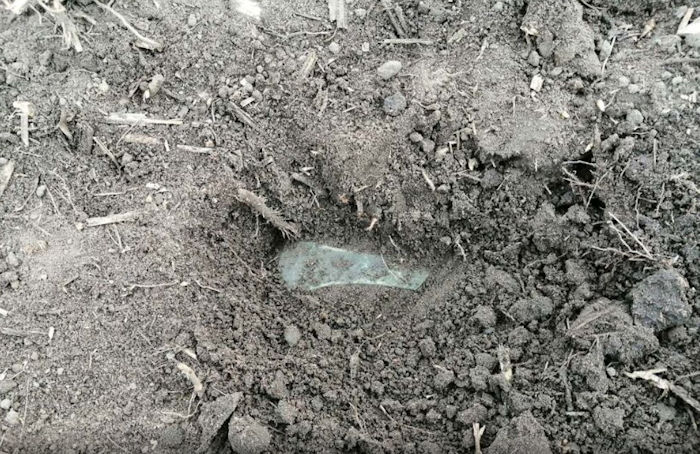
The Skalica archaeological site needs an increase in its protection, and while conducting work at the site, scientists unearthed a rare axe from the Early Bronze Age.
“So far, it is the oldest metal object from this researched site, Monuments Board Trnava informed. The research was carried out by archaeologists of the Monuments Board Trnava and enthusiasts of archaeology from civic associations.
The smaller axe is 9.5 cm long and has an enlarged fan-shaped cutting part, shallowly-grooved flat sides with hints of the side rails and a pointed tulle. It belongs to the so-called Saxon-type axe, the oldest specimens of which were still made of copper.
Similar axes were found in several locations in Slovakia, especially in Central Germany and Saxony. They are often part of a larger collection but also as individual objects as well,” the Slovak Spectator reports.
Recently, two other unique but accidental finds from older sections of the Bronze Age have been found in the Trnava region, both in the territory of Hlohovec. In 2017, a bronze blade from a so-called dagger on a club and in 2021 a short sword (long dagger).
41,500-Year-Old Mammoth Ivory Pendant Found in Poland
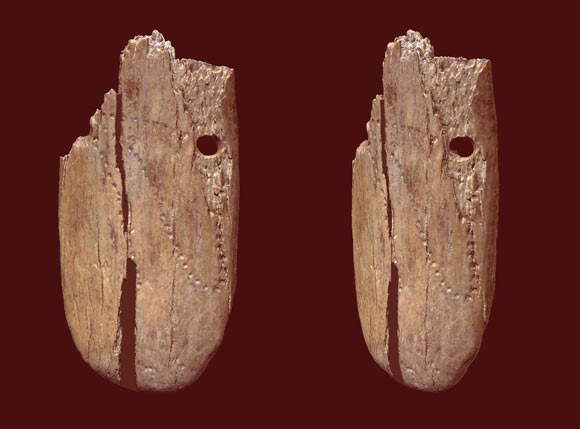
The ancient pendant made from mammoth bone was found in 2010 along with a horse-bone tool known as an awl. This piece of jewellery shows the great creativity and extraordinary manual skills of members of the group of Homo sapiens that occupied the site, said Dr. Wioletta Nowaczewska, a researcher at Wrocław University.
Dorsal views of the 41,500-year-old decorated ivory pendant from Stajnia Cave, Poland.
“The thickness of the plate is about 3.7 mm showing an astonishing precision on carving the punctures and the two holes for wearing it.”
Using advanced methods of radiocarbon dating, Dr. Nowaczewska and colleagues dated the pendant, awl and bone fragments from Stajnia Cave to the Early Upper Paleolithic.
The objects are the earliest known evidence of humans decorating jewellery in Eurasia and the emergence of symbolic behaviour in human evolution.
The decoration of the pendant included patterns of over 50 puncture marks in an irregular looping curve and two complete holes.
The researchers suggest that the pattern of indentations, similar to later jewellery found in Europe, could represent hunting tallies (a mathematical counting system) or lunar notations which correspond to the monthly cycle of the Moon or Sun.
“If the Stajnia pendant’s looping curve indicates a lunar analemma or kill scores will remain an open question,” said Dr. Adam Nadachowski, a researcher in the Institute of Systematics and Evolution of Animals at the Polish Academy of Sciences.
“However, it is fascinating that similar decorations appeared independently across Europe.”
The presence of animal bones alongside the pendant and bone awl may indicate that humans were beginning to produce small and transportable art 41,500 years ago as they spread across Eurasia.
“Determining the exact age of this jewellery was fundamental for its cultural attribution, and we are thrilled with the result,” said Dr. Sahra Talamo, director of the BRAVHO Lab in the Department of Chemistry Giacomo Ciamician’ at Bologna University.
“This work demonstrates that using the most recent methodological advances in the radiocarbon method enables us to minimise the amount of sampling and achieve highly precise dates with a very small error range.”
“If we want to seriously solve the debate on when mobile art emerged in Paleolithic groups, we need to radiocarbon date these ornaments, especially those found during past fieldwork or in complex stratigraphic sequences.”
“The ages of the ivory pendant and the bone awl found at Stajnia Cave finally demonstrate that the dispersal of Homo sapiens in Poland took place as early as in Central and Western Europe,” added Dr. Andrea Picin, a researcher at the Max Planck Institute for Evolutionary Anthropology.
“This remarkable result will change the perspective on how adaptable these early groups were and call into question the monocentric model of diffusion of the artistic innovation in the Aurignacian.”
The team’s paper was published in the journal Scientific Reports.