Surprise: Ancient Inuit Mummy Scans Reveal Possible Heart Disease

Surprise: Ancient Inuit Mummy Scans Reveal Possible Heart Disease

While omega-3 diets are rich in fish, The 500-year-old Inuit mummies discovered in Greenland tell scientists of their suffering from clogged arteries that they are intended to protect from plaque build-up in the arteries.

Atherosclerosis is a condition in which the walls of arteries become blocked with fat and calcium and it is known this condition was suffered at least 6,000 years ago but none of the humans remains studied thus far was known to eat a marine-based diet. Now, however, researchers have studied four Inuit mummies and found evidence of arterial clogging.

Atherosclerosis is the build-up of plaques of fat, cholesterol, and calcium in one’s arteries and the disease is a leading cause of death in modern wealthy countries, thought to be caused by poor dietary control.

However, a new paper published in the journal  JAMA Network Open challenges this commonly held notion after scientists studied the remains of four 16th-century Inuit hunters found in Greenland who also suffered from clogged-up arteries, despite their diets being rich in omega-3 fatty acids.

Landscape from Greenland with Inuit woman looking at the sea by Emanuel Petersen.

While the condition is often seen as resulting from modern lifestyles and diets, evidence of atherosclerosis has been found in human remains dating back as far as around 4,000 BC, but none of those tested bodies had eaten a diet rich in omega-3 fatty acids.

Four incredibly well-preserved 16th-century Inuit mummies who ate omega 3-rich diets were tested with a view to seeing if the fatty acid improved arterial health, and the results suggest diets rich in omega-3 may not assure resistance to arterial plaque build-up, leading to the researchers considering that other factors might be at play.

According to a report in The Daily Mail, a team of scientists led by cardiologist L. Samuel Wann of Ascension Healthcare in Milwaukee studied the Inuit mummies taken from the collections of the Peabody Museum of Archaeology and Ethnology in Cambridge. Originally discovered on the island of Uunartaq, off the coast of Greenland in 1929 and dated to the 1500s, the mummies include two men and two women between the ages of 18–30.

Living in stone huts supported with whale bones and seal skins, the kayak hunters would have used wooden spears, bows, and arrows to kill fish, marine mammals, birds, and caribou, and with their greatly marine-based diets, their veins would have surged with omega-3 fatty acids.

But CT scans of the mummies’ insides were analyzed by Dr. Wann and his team of four cardiologists and two radiologists which showed ‘calcified atheroma’ which is an accumulation of fatty plaque material in the arteries, similar to modern humans with atherosclerosis.

Computed Tomography Images Showing Calcified Atherosclerotic Plaques. Arrows indicate calcified atherosclerotic plaques.

The condition, and the diseases it can cause, is the single biggest cause of death in the developed world and is responsible for one in three fatalities.

Over time, blood vessels harden and narrow, which restricts the flow of blood around the body, and when these plaque deposits rupture they form a blood clot that can further block the flow of oxygenated blood which can result in a stroke or heart attack.

According to the Heart Research Institute atherosclerosis often begins in childhood and worsens with age damaging the endothelium, a thin layer that keeps the inside of our arteries smooth.

Once damaged, ‘bad’ cholesterol accumulates in the artery wall the body sends immune cells to clean up this cholesterol, which can then get stuck in the damaged site and this is what builds up over time leading to blockages.

This new study presents evidence for the “presence of calcified plaques in the mummified remains of 3 young Inuit individuals living 500 years ago,” the researchers wrote in their paper, and that omega 3 rich diets might not guarantee against plaque buildup as currently believed.

However, according to Discover Magazine, the researchers urge caution for other factors that might be at play, like environmental smoke produced by the use of indoor fires.

1,600-Year-Old Bone Pendants Discovered in Turkey

1,600-Year-Old Bone Pendants Discovered in Turkey

The 1600 years old bones-shaped, human and animal-shaped pendants have been unearthed by an archeological dig at Assos, one of the most important port cities of antiquity.

In an interview with the state-run Anadolu Agency, Nurettin Arslan, Professor in the Department of Archeology, and Head of Excavations, at Çanakkale Onsekiz Mart University, (ÇOMÜ) said that these were pendants dated from the 4th century B.C.

The ancient city is in Behramkale Village of Çanakkale Province’s Ayvacık District.

“There are two objects used as jewelry among those produced in the bone workshop to the west of the agora, one shaped like an animal and the other as a human. These must be part of jewelry which people used as necklaces in the ancient period,” Arslan said.

The professor also said that during the excavations, coins from the Byzantine Area to the Ottoman period were revealed.

“The largest group of coins uncovered in Assos are Byzantine (Eastern Roman) coins because the layers we are working on are mainly from the Byzantine period. These works show us that the Byzantine ruins in Assos archaeological site are a well-preserved center,” the professor said.

The findings show that there was an intense settlement in Assos between the fifth and seventh centuries. The settlement gradually decreased until the 12th century and eventually became a “small fortress” in the acropolis, Arslan said.

“Since there is no settlement, later on, we can say that the data related to urban planning, lifestyle functions of houses and daily life in the early Byzantine period are very valuable,” he said.

The professor underlined that one of the most archaic discoveries of the excavation works was stone axes made of granites.

“This stone axe was found on the surface in the necropolis area, but similar discoveries were made by Turkish archaeologists in the American excavations and during the 1990s,” he said.

“We have four axes dating back to the Chalcolithic period, to 5000 B.C. These axes are important such as they are traces showing that the settlement of Assos dates back to 5000 B.C.,” he added.

Founded on the summit and slopes of a volcanic hill at the southern end of the region, called “Troas” in ancient times, across the island of Lesbos in Greece, the city has been home to many societies for centuries.

One of its famous residents was Aristotle who together with the philosopher Xenocrates established a philosophical school at Assos.

It was the first ancient city where U.S. archaeologists excavated in the 1800s. It was excavated in 1981 after a long break.

The site, located 17 kilometers south of Ayvacık district, was accepted in the UNESCO Tentative List of World Heritage on April 15, 2017.

While 38 years of excavations have been carried out by Turkish scientists, new data for archaeology history have been revealed, and new scientists are also raised here.

Hoard of 1,200-year-old ‘Arabian Nights’ gold coins in an ancient ‘piggy bank’ discovered in Israel on the fourth day of Hanukkah

Hoard of 1,200-year-old ‘Arabian Nights’ gold coins in an ancient ‘piggy bank’ discovered in Israel on the fourth day of Hanukkah

In the ancient “piggy bank” Israel archeologists have found a small treasure trove of gold coins, which is believed to be the personal savings of a potter that worked in a kiln around 1200 years ago.

They date from the period when the region was ruled by the mighty Abbasid Caliphate and was unearthed at a medieval industrial site. The find was made during the Jewish holiday of Hanukkah when Jews exchange gifts and celebrate.

In Yavne in central Israel archeologists discovered gold coins. A team led by Liat Nadav-Ziv and Dr. Elie Haddad were excavating an area that will eventually be the location of a new residential neighborhood.

On behalf of the Israel Antiquities Authority, they conducted the investigation. A significant number of items were discovered by the team, but nothing unusual until they found a small jug

Nadav-Ziv told The Jerusalem Post that she was “cataloging a large number of artifacts found during the excavations when all of a sudden I heard shouts of joy”.

They had come from veteran archaeologist Marc Molkondov, and he directed them to a spot in the dig. He had unearthed a small cracked jug full of a number of coins. This was clearly an important find.

Archaeologists Liat Nadav-Ziv and Marc Molkondov, finder of the gold coins, with the 8 th century Chanukah gelt.

Dr. Robert Kool, a coin expert from the Israel Antiquities Authority examined the coins. There were all from the 7th-9th centuries AD and date to the early Abbasid period. The Abbasid Caliphate is regarded as an Islamic golden age when the arts, industry, and science flourished.

One of the most important coins found was a gold dinar from the reign of Caliph Harun A-Rashid (786-809 AD). He ruled the Abbasid Caliphate at the zenith of its power and wealth and is a “key figure in the classic collection of stories known as the Arabian Nights also known as One Thousand and One Nights” according to The Jerusalem Post.

In the jug were coins not normally found in Israel. Dr. Kool is quoted by the Jewish Press as saying that there “are gold dinars issued by the Aghlabid dynasty that ruled in North Africa, in the region of modern Tunisia”. This dynasty was largely autonomous but was ultimately under the control of the Abbasids, whose capital was in Baghdad.

The coins were discovered during the major Jewish holiday Chanukah, otherwise known as Hanukkah. During this eight-day festival gifts of coins are given, sometimes chocolate gold coins, are exchanged. Kool is quoted by The Times of Israel as saying that “without a doubt, this is a wonderful Chanukah present for us”.

The hoard of gold coins discovered in Yavne.

The excavation at Yavne is not far from a Tel or mound, and a large number of kilns were discovered. The kilns were used in the manufacture of pottery from the late Byzantine to the Early Abbasid period (600 to 900 AD). It appears that the site was once an industrial center and it produced pots, jars, and bowls.

The jug with the treasure trove was unearthed near one of the entrances of the kiln. The Jerusalem Post reports that “it might have been the potter’s ‘piggy-bank’ where he had kept his personal savings”. It is possible that the potter hid the coins at some point and was unable to recover them.

The Yavne site has a long history. Evidence was found that the area was the location of wine production, during the Achaemenid Persian period (5th and 4th centuries BC).

The wine was produced there on a significant scale. Dr. Elie Haddad observed that “the size and number of vats found at the site indicated that wine was produced on a commercial scale, well beyond the local needs of Yavne’s ancient population” reports The Jerusalem Post. It appears that the region exported wine to other areas.

Winepresses found at the same location as the gold coins, dated to the Persian period.

The jug filled with coins is an important find in itself. The discovery helps us to understand more about an important industrial center in the Middle Ages and the region’s role in the international trade network that flourished under the Abbasids. Further excavations at the site are expected to reveal more about Yavneh’s ancient and medieval past.

This is the World’s largest pyramid, and it’s hidden inside a mountain

This is the World’s largest pyramid, and it’s hidden inside a mountain

Although Giza’s Great Pyramid in Egypt is by far the world’s most widely debated pyramid, it isn’t the biggest by a long shot. That title goes to the Great Pyramid of Cholula – an ancient Aztec temple in Puebla, Mexico with a base four times larger than Giza’s, and nearly twice the volume.

Why is the world’s biggest pyramid so often overlooked? It could be because that gigantic structure is actually hidden beneath layers of dirt, making it look more like a natural mountain than a place of worship.

In fact, it looks so much like a mountain, that famed Spanish explorer Hernán Cortés completely missed it, and unwittingly built a church right on top of it, as you can see in the image below.

To understand how awesome the Great Pyramid of Cholula is, we must jump back to well before Cortés and his army planted a symbol of Christianity on its peak.

Known as Tlachihualtepetl (meaning “man-made mountain”), the origins of the pyramid are a little sketchy, though the general consensus is that it was built in around 300 BC by many different communities to honour the ancient god Quetzalcoatl.

The pyramid was built to appease the “feathered serpent” god

As Zaria Gorvett reports for the BBC, the pyramid was likely constructed with adobe – a type of brick made of out of baked mud – and features six layers built on top of each over many generations. Each time a layer was completed, construction was picked back up by a new group of workers.

This incremental growth is what allowed the Great Pyramid of Cholula to get so big. With a base of 450 by 450 metres (1,480 by 1,480 feet), it’s four times the size of the Great Pyramid of Giza.

In fact, at roughly 66 metres (217 feet) tall, the pyramid’s total volume is about 4.45 million cubic metres (157 million cubic feet), while the Great Pyramid of Giza’s volume is just 2.5 million cubic metres (88.2 million cubic feet).

The Great Pyramid of Giza is taller, though, at 146 metres (481 feet) high. The ancient Aztecs most likely used the Great Pyramid of Cholula as a place of worship for around 1,000 years before moving to a new, smaller location nearby.

Before it was replaced by newer structures, it was painstakingly decorated in red, black, and yellow insects. But without maintenance, the mud bricks were left to do what mud does in humid climates – provide nutrients to all kinds of tropical greenery.

“It was abandoned sometime in the 7th or 8th Century CE,” archaeologist David Carballo from Boston University told Gorvett at the BBC. “The Choluteca had a newer pyramid-temple located nearby, which the Spaniards destroyed.”

When Cortés and his men arrived in Cholula in October 1519, some 1,800 years after the pyramid was constructed, they massacred around  3,000 people in a single hour – 10 per cent of entire city’s population – and levelled many of their religious structures.

But they never touched the pyramid, because they never found it.  In 1594, after settling in the city and claiming it for their own, they built a church – La Iglesia de Nuestra Señora de Los Remedios (Our Lady of Remedies Church), on top of the hidden pyramid mountain. 

It’s unclear if the Aztecs knew the mud bricks would encourage things to grow all over it and eventually bury the entire structure, but the fact that it looks more like a hill than a pyramid is probably the only reason it still survives today.

And just as well, because according to the BBC, not only is it the world’s largest pyramid, it retains the title of the largest monument ever constructed anywhere on Earth, by any civilisation, to this day.

The pyramid wasn’t discovered until the early 1900s when locals started to build a psychiatric ward nearby. By the 1930s, archaeologists started to uncover it, creating a series of tunnels stretching 8 kilometres (5 miles) in length to give them access.

This view of the pyramid was taken in the early 20th century

Now, over 2,300 years after its initial construction, the site has become a tourist destination.

Hopefully, as our ability to study important sites using non-invasive tools continues to improve, archaeologists will gain a better understanding of how the structure was built, by whom, and how it came to look so much like a mountain.

1,800 Years of Voting Plates Found in Karabük

Ancient slab unearthed in Karabük Turkey

In the northern Karabuch province of Turkey, an ancient slab from around 1800 years ago has been discovered.

During excavation works in the ancient city of Hadrianopolis, 3 km east of Eskipazar district in the Province of Karabük, the slab of limestone with the silhouette of a woman found.

Ersin Çelikbaş, a faculty member in the Karabük University Department of Archeology, said that the slab has an inscription on it reading: “Herakleides, son of Glaukos, presented this.”

“The slab has a figure of a woman on it wearing a traditional dress, holding ears of wheat in her right hand and wearing a belt with a snake on her waist. Most probably, this is the goddess of the harvest and agriculture Demeter,” he said.

He also said that must have been highly respected in the Hadrianopolis during the Roman period because of the intensive viticulture activities.

An image of archaeological excavations in the ancient city of Hadrianaupolis.

The birthplace of the Saint Alypius the Stylite, the ancient city of Hadrianopolis was an important site of pilgrimage for early Christians until the city lost its importance in the 8th century A.D.

So far 14 dispersed public buildings and other structures were identified in the city, which was settled during the late Hellenistic, Roman and early Byzantine periods.

These public buildings consist of two baths, two churches, a defense building, rock tombs, a theater, an arched and dome-shaped building, a monumental cult niche, a wall, villas, other monumental buildings, and some cultic areas.

A bull, a lion and two peacocks figures also were found in the mosaics.

The bull on the mosaics represented Lucas and the lion represented Marcos and the church was dedicated to Marcos and Lucas, two very important figures in the Christian world, according to reports.

The floors of the churches are garnished with mosaics. These mosaics show figures of horses, elephants, deer, and gryphons . Because of this, the ancient city is compared to Zeugma in southeastern Turkey, which is famous for its mosaics.

After excavation works, the site will be opened for visitors.

Believed to have lived between the 6th and 7th centuries A.D., Saint Alypius the Stylite is one of the pillar-saints of the Christian faith, who climbed on top of pillars and spent the rest of his life preaching, fasting and praying.

Archaeology shock: Ancient Roman and Anglo-Saxon artifacts found near UK airport

Archaeology shock: Ancient Roman and Anglo-Saxon artefacts found near UK airport

“Breathtaking” Roman and Anglo-Saxon artefacts have been discovered in burial sites near the edge of an airport.

A Gaulish flagon used to pour wine has been preserved

Pots, jugs and jewellery were found in Baginton, next to Lunt Roman Fort and Coventry Airport in Warwickshire.

Archaeologists believe two of the graves contained a “high status” ranking officer and Roman girl, aged between six and 12. The artefacts could go on display at local museums.

The pieces were found during a dig at a housing development site in summer 2017 but many of the items have only just been officially dated and verified by experts.

Senior archaeologist Nigel Page, from Warwickshire County Council which led the dig, said it was a “remarkable” find.

“It’s a significant discovery in the West Midlands,” he said. “There was a real buzz of excitement when the site was found. It’s breathtaking.”

A number of pots were found at one burial site

A decorative brooch was found within a Roman cremation burial site of a young girl. It was one of four brooches from a small pile of jewellery placed in the grave and covered by a polished mirror.

Other jewellery included a ring, with an image of a cicada – an insect associated with immortality – and a hairpin. Experts said the items and imagery on some of the jewellery suggested a link to southern Europe.

This Roman brooch is likely to have belonged to a young girl and put with her for a cremation burial

A dozen Anglo-Saxon graves were excavated, some of which contained goods including a Frankish vessel from the northern France and Belgium area.

“The presence of the Frankish vessel suggests that, just as during the Roman period, goods and people were moving into and through the area from a wide area, including from Europe,” Mr Page said.

One burial contained the centre of a shield, fragments of a knife blade in its leather sheath and a crushed copper alloy hanging bowl. Experts said the richness of the Anglo-Saxon grave suggested a person of reasonably high status, such as a high ranking officer.

“The settlement at Baginton continued to flourish after the Romans left in the early 5th Century,” added Mr Page.

Archaeology shock: Experts discover mysterious Mayan palace lost for 1,000 years

Archaeology shock: Experts discover mysterious Mayan palace lost for 1,000 years

Ancient building found 100 miles west of Cancùn estimated to be more than 1,000 years old

Archaeological work carried out by experts “has allowed confirming the existence of a palace to the east of the main square” of the so-called architectural Group C, INAH reported in a statement.

The remains of the building six meters high, 55 meters long and 15 meters wide were identified as a large palace used over two periods of ancient Mayan history dating back more than 1,500 years.

Scholars from INAH have revealed the large palace remained in use most likely during the Late Classic (600-900 AD) and the Terminal Classic (850-1050 AD).

In addition to the ancient palace, archeologists from INAH are also excavating other structure at the central square at Kuluba. The researchers are believed to have identified an altar, the remains of residential buildings, as well as a circular structure believed to have been an oven.

Archaeologists have discovered a large palace likely used by the Mayan elite more than 1,000 years ago in the ancient city of Kuluba, near modern-day Cancun. Pictured, an archaeologist works cleaning the stucco of the Temple

In addition to the structures, archaeologists have also discovered a grave of several individuals at Kuluba. Experts will now work in order to determine their exact age and sex.

“This work is the beginning, we’ve barely begun uncovering one of the most voluminous structures on the site,” archaeologist Alfredo Barrera told Reuters.

Along with the palace(pictured), Mexican experts are exploring four other structures in the area known as ‘Group C’ in Kuluba’s central square, including an altar, remnants of two residential buildings and a round structure believed to be an oven
Archaeology discovery: The team also uncovered remains from a burial site 

Kuluba, which has now become the archeological site of Kuluba, was an important city with powerful ties to other ancient Maya cities of the region such as Ek’Balam and Chichen Itza. It is believed that Kuluba was part of a large network of trade encompassing many other ancient cities in the region.

“From data . . . and the Chichén-like ceramic materials and obsidian [found at Kulubá] . . . we can infer that it became an enclave [under the control] of Chichén Itzá,” Barrera said.

“Throughout the 20th century, Tizimín ceded most of its forest land to agricultural and livestock use. This means that the experts who are now restoring the Mayan buildings to their former glory not only live alongside spider monkeys and other species of flora and fauna but also give priority to the fact that the archaeological zone is distinguished by its natural and cultural balance” revealed INAH in a statement.

Kuluba is located not far away from the famous Caribbean vacation capital of Cancun. The name of the ancient city, Kulubá, is formed by the words “K’ulu”, which refers to a kind of wild dog, and “ha”, water.

To protect Kuluba from the climate and looting, the researchers are considering reforesting parts of the forest surrounding Kuluba. With a denser forest, the site will be better protected from sunlight and wind.

Experts have revealed that the archeological site should be opened to tourists in the medium term.

Archeological work at the site is being funded by the government of Yucatan. The people in charge of the archaeological site of Kuluba are part of a multidisciplinary project.

Scythian Burial With Golden Headdress Found in Russia

Scythian Burial With Golden Headdress Found in Russia

Once again scientists have found evidence supporting the existence of Amazon warriors who have previously been considered merely mythological characters.

Archaeologists from Russia currently conducting excavations in the Voronezh region have discovered an intriguing grave that belongs to a Scythian Amazon warrior. It’s a valuable historical discovery that sheds new light on the importance of fierce ancient female warriors.

The beautiful ceremonial headpiece placed on the head of the deceased woman makes this finding even more fascinating.

Since 2010, archeologists of the Russian Academy of Science Institute of Archeology have studied the Devitsa V burial mound in the district of Ostrogozhsky, and there they have found many interesting discoveries. This time they uncovered a burial that had been looted, but not entirely.

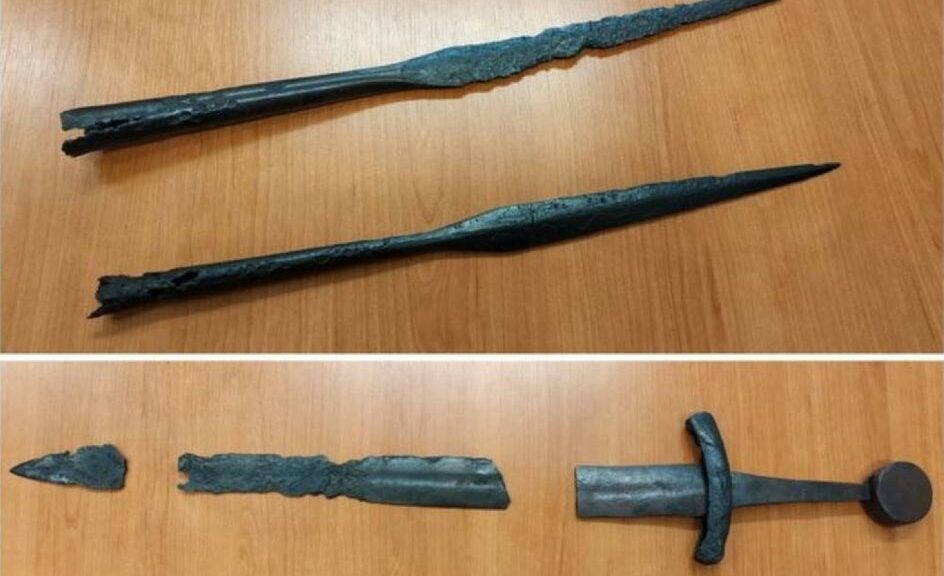
Inside burial mound, Maiden V archaeologists unearthed two well-preserved female skeletons. On tiled beds covered with grass beds, the women were put to rest. One of them was under his left shoulder with a bronze mirror. By her left side were put two spears and a necklace made from glass beads.

General view of the burial.

The other woman, who was between 45 to 50 years at the time of her deaths, had been adorned with a beautifully preserved headpiece, consisting of stamped gold plates with floral ornaments, as well as rims with amphora-shaped pendants.

Golden ceremonial headdress before restoration.

This type of ceremonial headdress is called a calaf and archaeologists have unearthed similar headpieces, but only in the richest “royal” mounds of Scythia (Chertomlyk, Tolstaya Mogila, Deev mounds, mounds near the village of Aksyutintsy, mound No. 8 of the Pesochinsky burial ground).

“Such head dresses have been found a bit more than two dozen and they all were in ‘tzar’ or not very rich barrows of the steppe zone of Scythia. We first found such head dress in the barrows of the forest-steppe zone and what is more interesting the head dress was first found in the burial of an Amazon”, says Valerii Guliaev, the head of Don expedition.

“Found calathos is a unique find. This is the first head dress in the sites of Scythian epoch found on Middle Don and it was found in situ on the location on the skull. Of course, earlier similar head dresses were found in known rich barrows of Scythia. However, only a few were discovered by archaeologists.

They were more often found by the peasants, they were taken by the police, landowners and the finds had been through many hands when they came to the specialists. That is why it is not known how well they have been preserved. Here we can be certain that the find has been well preserved”, noted Valerii Guliaev.

This finding suggests the woman was a Scythian warrior. The complex history of the mysterious Scythian culture is slowly being reconstructed. The Scythians flourished from about 700 to 300 B.C. but their origins are still debated. The Scythians never developed a written language or a literary tradition, making it troublesome to piece together their historical records.

Polish and Russian archaeologists have previously suggested an ancient necropolis located in the vicinity of Mangerok in the North Altai in Russia could be the ‘cradle of the Scythians’. Some think the Scythians originated from the Central Asian region of Persia, as a branch of the ancient Iranian peoples expanding north into the steppe regions from around 1000 B.C.

“The Amazons are a common Scythian phenomenon and only on Middle Don during the last decade our expedition has discovered approximately 11 burials of young armed women. Separate barrows were filled for them and all burial rites which were usually made for men were done for them, said Valerii Guliaev.

These nomadic warriors were often in conflict with their neighbors, particularly the Thracians in the west and the Sarmatians in the east.

The Scythian invaded Eastern Europe and archaeologists are now learning more about these skilled, ancient equestrian archers.

The Scythians were, just like the Parthians skilled horse archers and some scholars suggest they were the first people in history to wear trousers.

The discovery of the female Scythian warrior strengthens the theory the Amazons were real. Ancient Greek authors wrote the Amazons were huntresses, founders of cities, rivals and lovers of adventurous men. They battled the Greek hero Heracles and fought alongside the Trojans in the final hours of Troy, but many have wondered whether the Amazons really existed.

Left: A while back archaeologists found remains of an Amazon warrior in Armenia. Right: Female warrior.

Recently, archaeologists found a grave of an Amazon warrior who lived in the kingdom of Urartu in the Highlands of Armenia. The latest discoveries of graves belonging to ancient fearless female warriors confirm the Amazons did not exist in the realm of mythology but were real beings of flesh and blood who fought alongside men.

All In One Magazine