All posts by Archaeology World Team

Roman Fort Identified in Northern England

Roman Fort Identified in Northern England

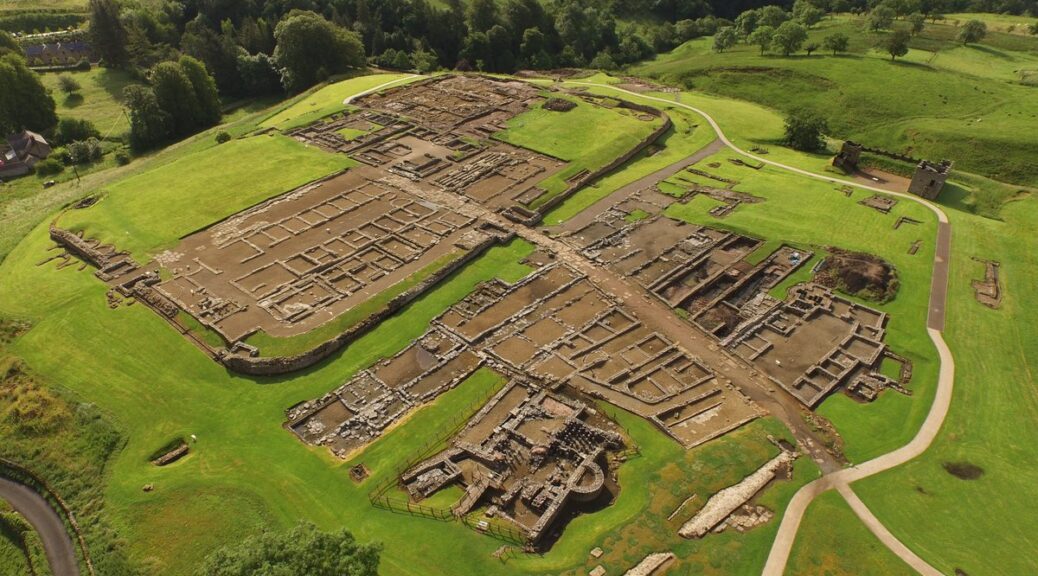
Burscough, England —Ansa reports that the site of a first-century A.D. Roman fort in northwestern England has received official recognition from Historic England, a government body dedicated to historic preservation.

A Roman fort lies underneath land off Flax Lane, Burscough

The ruins comprise a 30,000 sq m fort, roads, and a smaller fortlet and experts believe the find will unlock unknown details of how the Romans settled and travelled around the area.

Considered alongside other forts in the region, including those at Wigan and Ribchester, Burscough’s will provide great insight into Roman military strategy. It is believed that the area was occupied multiple times over the course of hundreds of years, a theory that is backed up by the variety of pottery found at the site.

Historic England says the lines of the fort’s defences are clearly identifiable on the geophysical survey and aerial photos, but the north-west and south-west corners are also visible as slight earthworks on Lidar, which uses laser light reflections to produce 3D images.

The north-west corner of the fort is visible as the slight earthwork of a broad bank about 12m wide, with a regular, broad and shallow external ditch; the latter is interpreted as a shallow quarry ditch dug during the construction of the rampart.

Several large depressions visible in the wider landscape are considered to be post-medieval extraction, probably marl pits: one of these pits sits within the angle of the north-west corner of the fort.

The number of ditches is considered to indicate more than one phase of occupation, and it is considered that a later, small fortlet overlies the eastern rampart of the earlier fort.

A number of internal features have been revealed by geophysical surveys including a well-defined eastern gateway with double gate towers, and numerous stone buildings interpreted as granaries or barracks. Limited trial trenching of the latter has revealed the presence of a large stone, buttressed building typical of a Roman granary.

The geophysical survey has also revealed the buried remains of a broad section of Roman road approaching the fort on the east side. A similar feature is thought to be associated with the fort’s southern entrance.

For several years, a non-profit archaeology group has been managing the site and allowing people to help with the excavation of the ruins but the location of the fort has largely been kept a secret.

Those interested in visiting were able to pay to take part in organized digs, while items of Roman pottery have been found in nearby fields by passing walkers.

The fort had survived regular ploughing through the years before the archaeology group took an interest in the site but concerned residents noticed diggers on the field in recent weeks and feared that the invaluable findings could be lost forever.

But, possibly partly as a result of those fears being raised with Historic England and then the Government’s Department for Culture, Media and Sport (DCMS), the ruins have now been classified as a Scheduled Monument.

That means it is a criminal offence to destroy or damage it; do any works to remove, repair or alter it; use a metal detector without prior consent, or remove any historic or archaeological object from the site without prior consent.

A spokesperson for Historic England said: “DCMS recently agreed with our advice that this site should be protected as a scheduled monument because it is a highly significant find of a Roman fort which has survived well.

‘‘We are actively in contact with the owners and local authority to offer advice and support on how best to manage this site to ensure its future.”
8,000-Year-Old Human Skeletons Found In Neolithic Village Of Slatina, Bulgaria

8,000-Year-Old Human Skeletons Found In Neolithic Village Of Slatina, Bulgaria

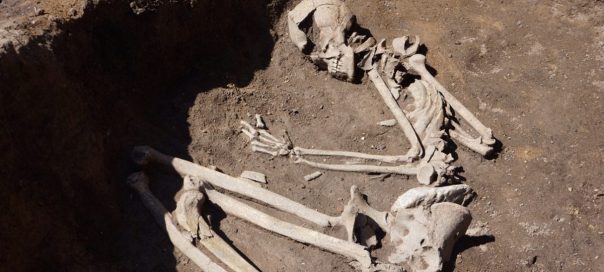
Four Early Neolithic tombs, believed to date back 8000 years, were discovered by a Bulgarian archeologist team at the Slatina site in the capital Sofia, the Bulgarian Academy of Sciences said on July 28.

There are skeletons of three adults and one child.

Together with two graves discovered at the Slatina site in 2019, these are the earliest in the territory of Sofia.

Team leader Vassil Nikolov said that it was the first time in the ritual complex that such extremely rare finds had been made.

Excavations in the area have been going on for more than 30 years and the objects found so far show that the village was inhabited by farmers and pastoralists.

The settlement itself existed for about 500 years, from the end of the seventh to the middle of the sixth millennium BCE.

It is assumed that the civilization of Europe started from the Neolithic settlement in Slatina, Nikolov said.

The graves discovered date from the beginning of the sixth millennium and very little is known about the rituals of this period. Probably there were houses, which unfortunately were destroyed, archaeologists believe.

During the excavations, archaeologists from the National Archaeological Institute of the Bulgarian Academy of Sciences came across a double grave – most likely a man with a child.

The other remains are of a woman lying on her stomach and of a man who was laid out in a very special way – one of his hands remained under the skeleton.

Anthropologists from the Institute of Experimental Morphology, Pathology, and Anthropology of the Bulgarian Academy of Sciences are to continue their research in laboratory conditions.

DNA analysis may show if there was a relationship.

The work in Slatina is part of rescue archeological excavations due to new housing construction. Among the new finds are objects such as ceramic vessels, weights for a loom, a furnace plug shaped like a human image, and part of a spindle.

10,000-Year-Old Neolithic Figurines Discovered in Jordan Burials

10,000-Year-Old Neolithic Figurines Discovered in Jordan Burials

From classical paintings of crucified Messiahs to Damien Hirst’s starkly grim tanks of pickled sharks, death is a subject that has haunted artistic imaginations throughout the ages.

As it turns out, a trove of archaeological discoveries in Jordan suggests that death and an unusual process of digging up the deceased may have sparked an important ancient artistic revolution in Early Neolithic Asia: the jump between artworks depicting animals to portraying humans.

Reported in the journal Antiquity, archaeologists from the Spanish National Research Council and Durham University in the UK developed this idea while studying a number of unusual objects discovered at the site of Kharaysin in the Zarqa river valley, Jordan, dating to the 8th millennium BCE.

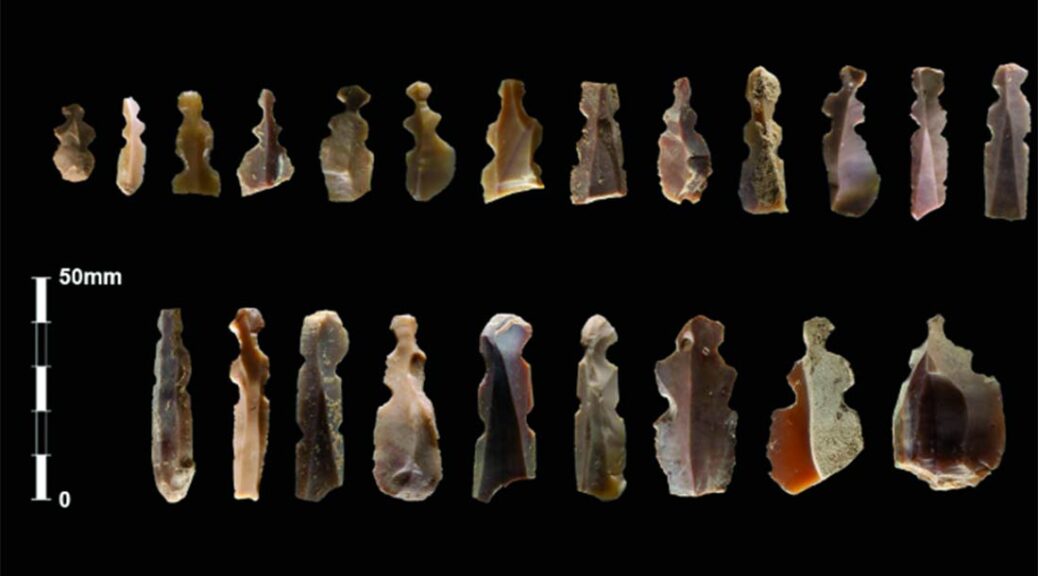
The Neolithic figurines found in Jordan were of differing shapes and sizes.

The team was initially stumped by the jagged objects, thinking they must be tools, until they came to realize they were actively crafted into crudely-shaped human bodies, complete with broad shoulders, slim waist, and wide hips.

“One of the excavators suggested they were figurines, which the rest of the team were skeptical about,” lead author Dr. Juan José Ibáñez said in an email statement. “However, the more we studied, the stronger the idea appeared.”

Two clay human figurines found at the bottom of a 1.6-meter-deep pit located in J 105/110 at Kharaysin.

The figures appear to have been crafted around the 7500 BCE, about a century after depictions of humans became more common in the Early Neolithic communities of Western Asia. But, what drove humans in the Zarqa river valley to start making human sculptures 9,000-10,000 years ago?

By no coincidence, the researchers say, the figurines were found in an area used by the Early Neolithic communities of the Zarqa river valley to bury their dead.

Among the seven original burials found here, a number of the remains appear to have been dug up following an initial burial and the partial decomposition of bodies, manipulated – in some cases bones were removed or muddled up in an unusual mortuary practice – and then reburied.

The placement of the figurines to these burials suggests they were carelessly dropped, but actively deposited in specific areas. Assembling all of these odd pieces of evidence together, the researchers put forward the hypothesis that the figurines were part of a burial ritual.

Although precise details remain unclear, it’s suggested the figurines were used as a physical representation of the dead to honor the community’s ancestors, a practice that’s well documented during this time.

“These rituals probably included remembrance of the deceased. The presence of ‘figurines’ suggests that individuals could have been symbolically depicted in flint with a simple technical gesture. If this were the case, the ‘figurines’ were discarded where they were used,” the researchers write in their paper.

The roughly shaped figurines alone might not be enough to convince some of this theory, but the conclusion was backed up by comparisons to other examples of figurines from the Neolithic Zarqa river valley.

For example, archaeologists also discovered a similar set of figurines that clearly depicted humans at another Neolithic site in Jordan, ‘Ain Ghazal.

Much older depictions of humans can be found elsewhere in the world; the 35,000-years-old Venus of Hohle Fels, found in modern-day Germany, is the oldest undisputed depiction of a human being.

However, in Early Neolithic culture in present-day Jordan, human iconography has not been found until around the time of these unusual funerary ceremonies. From this point onwards, it appears that humans became a recurring subject of artistic creations in this part of the world.

Perhaps, as the researchers outline in their study, this “artistic revolution” was triggered by this ceremony of digging up the dead and honoring lost ancestors. 

Israeli archaeologists unearth 1,500-year-old Byzantine church

Israeli archaeologists unearth 1,500-year-old Byzantine church

The remnants of a church of the 6th century — possibly a monastery — were discovered during an Israel Antiquities Authority salvage excavation in the Galilee town of Kfar Kama.

The site adjacent to Mount Tabor is holy to Christians, who since the early Byzantine era have identified the area as the site of the New Testament account of the transfiguration of Jesus.

Mount Tabor is noted in the books of Mark, Matthew, and Luke as the site where Jesus took his disciples Peter, James, and John when they witnessed the face and clothing of their teacher glow with dazzlingly bright light.

According to the Encyclopaedia Britannica, the Feast of the Transfiguration “celebrates the revelation of the eternal glory of the Second Person of the Trinity, which was normally veiled during Christ’s life on earth.”

Based on the excavation’s findings, the IAA researchers and Prof. Moti Aviam of the Kinneret Academic College believe the church compound was likely a monastery that was built on the outskirts of the ancient village.

With what he called “great and unusual cooperation,” the IAA excavations were joined by Aviam, who is heading a long-term research project with Jacob Ashkenazi, also of the Kinneret Institute of Galilean Archaeology. Their wide-ranging research on churches in the Holy Land and the eastern Mediterranean is supported by the Israel Science Foundation, which also aided in funding this Kfar Kama excavation.

“Our research is trying to find the connection between the town/village and the hinterland,” said Aviam. “If Kfar Kama in antiquity was an important town, what is the connection to villages around it? What is the connection of the town to the monks?”

Aerial view of 1,300-year-old church in the village of Kfar Kama, near Mount Tabor.

Another 6th-century church, dedicated to the female St. Thecla, was previously excavated in Kfar Kama in the 1960s. While a saint’s reliquary was also discovered during the current dig, archaeologists have yet to uncover which saint’s bones were once stored in the small stone box. Likewise, no inscriptions or coins were found at the site to aid in dating and identification.

“Part of the ‘glory’ of our field of archaeology is that we know nothing before we dig — and sometimes we continue to know nothing after we dig,” laughed Aviam. “It’s like a detective story; we piece it together.”

While surveying the area ahead of construction of a new playground in the now largely Circassian-populated town in the Lower Galilee, the Israel Antiquities discerned the outline of a badly damaged, 12×36 meter (40×118 foot) church.

Upon further investigation, the archaeologists headed by Nurit Feig discovered that the church had three apses — similarly to approximately half the churches of the area, said Aviam — and that the compound included a large courtyard, a narthex or antechamber foyer, and a central hall.

According to the IAA press release, there are additional, as yet unexcavated rooms at the site that were identified during a ground-penetrating radar survey that was conducted by the IAA’s Dr. Shani Libbi.

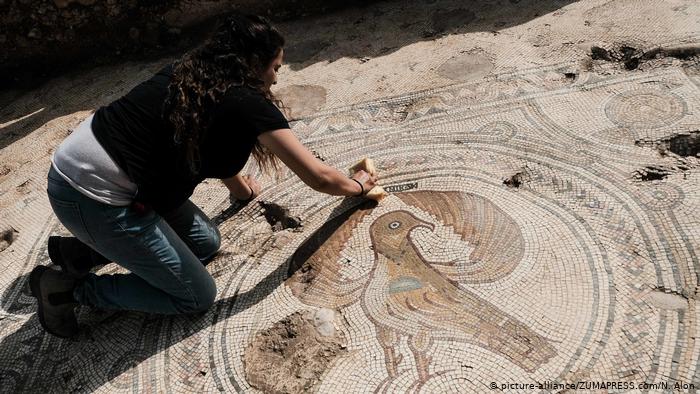
During excavations of the church remains, the archaeologists unearthed pieces of colorful floor mosaics depicting geometric shapes, and blue, black, and red floral patterns.

Mosaic floor of 1,300-year-old church in the village of Kfar Kama, near Mount Tabor

If Aviam has his way, children and parents visiting the new playground will soon gaze upon some of the remains of the 6th century church, if the project is greenlighted by the Kfar Kama Local Council and the Jewish National Fund, which initiated the excavations. Perhaps a recent visit of Catholic Archbishop Youssef Matta, head of the Greek Catholic Church in Israel, to the site will inspire the authorities to preserve the ruins.

Aviam said that researchers are aware of a few cases of monasteries found near cities and towns.

Based on the pottery typography, this church was built in the 6th century and abandoned in the 7th. Aviam said the building boom of Galilee churches was in the 6th century, but there are a few earlier examples, such as a Nazareth chapel dating to the 4th century and a few others dating to the late 4th and beginning of the 5th century.

“We’re trying to collect all the evidence from the field. All the information is important to build the story of the Galilee of the Byzantine period,” Aviam said.

The site was likely a popular destination for pilgrims and was well-funded by the Byzantine empire

Turkey: 3rd-century statue unearthed in the ancient city

Turkey: 3rd-century statue unearthed in the ancient city

Archeologists have unearthed a 1,700-year-old statue of a female from the Hellenistic period in the ancient city of Perge, now in Turkey’s Mediterranean Antalya province.

ANTALYA, TURKEY—The Anadolu Agency reports that a third-century A.D. sculpture of a woman has been unearthed at the ancient Greek city of Perge on the southwest coast of modern-day Turkey.

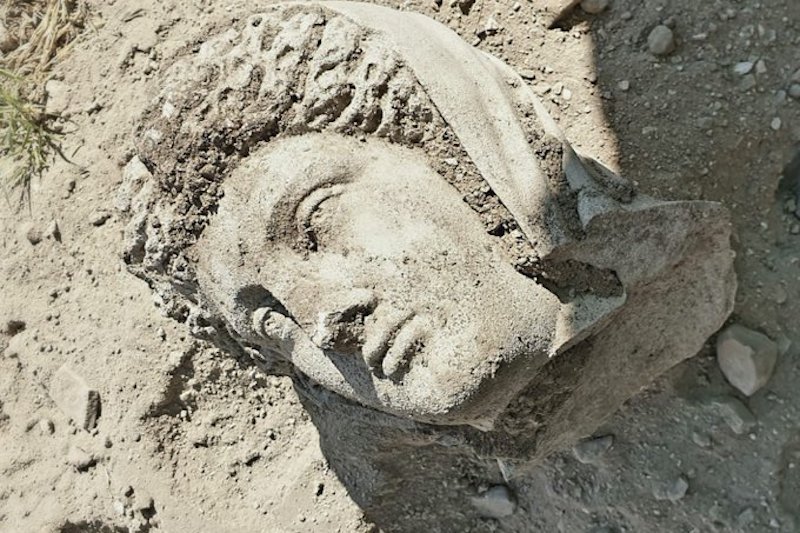
A team led by Istanbul University archaeologist Sedef Cokay Kepce also discovered the broken head that belongs to the figure, which is depicted in full-length robes. 

The statue of a female discovered on July 27 in Perge, Antalya, Turkey.

Believed to have been made around the year 300 AD, during the time of the Roman Empire, the exquisite piece of sculpture portrays a woman in floor-length robes. Her head has been broken off but it survives.

The ancient city was known to have had females in its administration. It is unknown,  however, at this point, just who is depicted in the sculpture.

The Turkish Ministry of Culture and Tourism’s excavation department triumphantly announced the amazing find yesterday, stating “First sculpture of 2020 found in Perge excavations,” in a tweet.

According to the Ministry, Sedef Cokay Kepçe, an archaeology professor at Istanbul University, is heading up the excavations which unearthed the stunning find.

The plans are currently to display the third-century statue in the Antalya Museum when all the necessary cleaning on the piece has been completed. The area has always been known for its wealth of sculpture, according to UNESCO.

The ancient Greek city of Perge has been the site of systematic excavations beginning in 1946; the area was included on UNESCO’s Tentative Heritage list in 2009 for its great historical significance.

CT Scans Reveal Contents of Small Ancient Egyptian Mummies

CT Scans Reveal Contents of Small Ancient Egyptian Mummies

As scientists peered under the wrappings of two small ancient Egyptian mummies who believed they were carrying human hearts, they were taken aback: Not only were there no noticeable hearts inside, but the remains were not even human. 

Instead of one mummy is packed tightly with grain and mud – a so-called grain mummy, while the other one holds the remains of a bird, possibly a falcon, that is missing a body part and several organs, the researchers found.

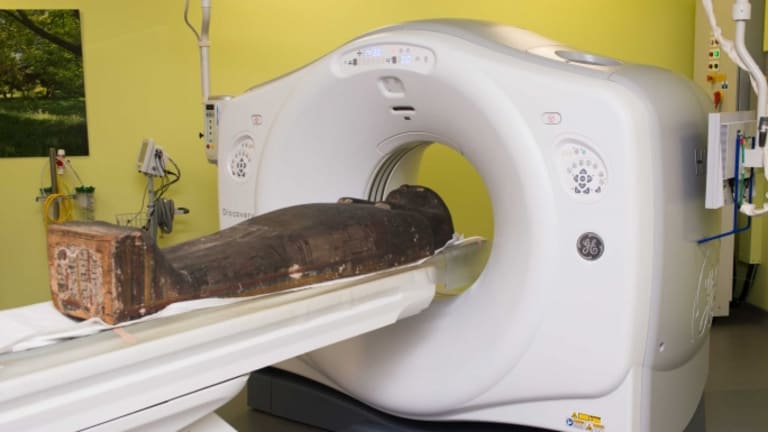
“It’s missing its left leg, nobody knows why,” said Dr. Marcia Javitt, chairperson of radiology at Rambam Hospital in Haifa, Israel, and an adjunct professor of radiology at The George Washington University in Washington, D.C., who helped scan the mummies with computed tomography (CT) on June 29. 

The two mummies, both interred in sarcophagi, have been housed at Haifa Museum for about 50 years. However, “records were not kept as diligently as they are now,” so not much is known about them except that they’re more than 2,000 years old, Ron Hillel, registrar, and head of collection management of Haifa Museums told BBC News. 

Over the past few years, the National Maritime Museum in Haifa has been going through its collection and determining the best way to preserve each artifact. When curators came across the two mummies, they realized they didn’t know what was inside.

The records noted they contained mummified hearts, but “we did the research and it didn’t make sense,” Hillel said. Often, (but not always) “the hearts were left in the body,” of Egyptian mummies, Hillel said because the ancient Egyptians thought that when people died, their hearts would be weighed against a feather representing ma’at, an Egyptian concept that includes truth and justice, BBC News previously reported. If the heart weighed the same or less than the feather, these people would earn eternal life; if not, they would be destroyed.

CT scans of the Osiris (left) and Horus (right) mummies.
The “corn mummy” of the ancient Egyptian deity Osiris.

The CT scans done at Rambam Hospital revealed that the mummies had very different insides from one another. The roughly 18-inch-long (45 centimeters) human-shaped mummy — designed to look like Osiris, the god of the afterlife, the dead, life, and vegetation — contained mud and grains. 

“During Osiris festivals that were held, [the ancient Egyptians] would produce these,” Hillel said. “It would be a mixture of clay or sand with these grains, and then they would dip it in water and the grains would germinate.” In effect, this act would tie Osirus to death, life, and Earth’s fertility.

Or, as Javitt put it, “they’re not real mummies; they’re artifacts.”

The other mummy, a roughly 10-inch-long (25 cm) bird-shaped mummy, represented the god Horus. According to Egypt mythology, Horus was the falcon-headed son of Osiris and Isis; a deity associated with the sky and pharaohs. 

The mummy of the falcon-headed deity Horus.

Over time, the bird mummy had desiccated, meaning that the tissue got more dense, like beef jerky. Meanwhile, the marrow in the bones had dried out, leaving nothing but delicate bone tubes.

So Javitt and her colleagues used a dual-energy CT, which uses both normal X-rays and less powerful X-rays, a technique that can reveal properties of the tissues that a regular CT scan can’t, Javitt said. 

“In order to differentiate the soft tissues from one another and the bones and so on, it can be very helpful to use a dual-energy CT,” Javitt said.

Now, her team is identifying the bird’s various tissues and bones. Javitt noted that the bird’s neck is broken, but that this injury likely happened after the bird was dead. That’s because the skin is broken too, and in most cases of broken bones, “you don’t usually crack open the skin from one edge to the opposite side, you just break the bone,” Javitt said. 

Moreover, the bird appears to be missing some of its abdominal organs, but more study is needed to determine which ones aren’t there, she said. For instance, the heart appears to be present, as is the trachea.

Going forward, Hillel said the museum may make a special exhibit centered around these two mummies. He also hopes to have them dated with radiocarbon 14, so the museum can determine their age.

42,000 years old Mungo Man skeleton, the oldest human remains found in Australia

42,000 years old Mungo Man skeleton, the oldest human remains found in Australia

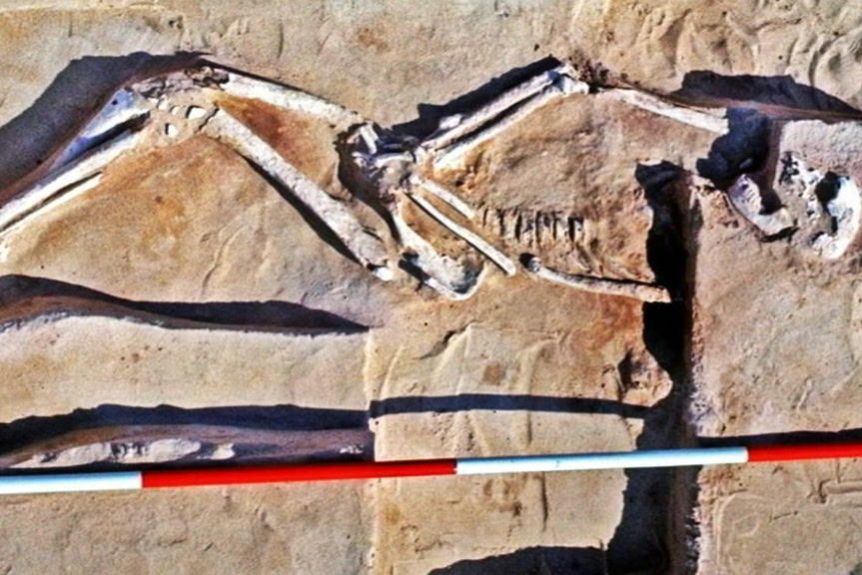
First, a skull, then a torso and eventually an entire skeleton emerged from the sands of south-west New South Wales. When the bones of Australia’s oldest and most complete humans were unearthed in the 1970s it rewrote history.

An Environment Ministry photograph of an ancient human footprint in the Mungo National Park.

Dubbed Mungo Man after the dried-up lake basin where he was found, the skeleton dates back about 42,000 years. But his removal from his burial site to a Canberra university 43 years ago caused his traditional owners great angst.

He’s now been returned to his country, but there’s a fresh dilemma to be resolved: Should Mungo Man be interred forever or should his remains still be accessible to science?

It’s a fraught question which goes to the heart of who owns the rights to access Mungo Man’s history, traditional owners of the Willandra Lakes World heritage region — the Mutthi Mutthi, Ngyiampaa, and Paakantyi/Barkandji peoples — will meet to begin discussions on his ultimate resting place.

Geologist Jim Bowler found Mungo Man in the sands of the Willandra Lakes Region in 1974.

“My preferred option is to bury him and put a nice plaque on him, rather than have him lying in a box waiting for someone to come and poke him again,” Ngyiampaa elder Roy Kennedy said, adding researchers “have had him long enough”.

But many scientists fear burying Mungo Man will close off any chance of future research. Future techniques may become available that will tell us so much more about the story of Mungo Man,” said Dr. Jim Bowler, the geologist who found the skeleton.

“The prospect of possible future access must be resolved.”

Finding Mungo Man

Dr. Bowler stumbled across Mungo Man in 1974 while researching the semi-arid landscapes of south-west New South Wales. The wide scrubby basins fringed by sand dunes were once an ancient series of lakes, brimming with freshwater and teeming with life.

Among them was Lake Mungo, which dried up about 15,000 years ago, leaving behind a stunning landscape. Dr. Bowler had ventured out after a rainstorm when he spotted a white object poking out of the sand, glinting in the afternoon sun. It was a skull.

He alerted archaeologists at the Australian National University and the team rushed to the scene, carefully excavating Mungo Man and taking him 800 kilometers away to Canberra. Mutthi Mutthi elder Mary Pappin’s view is that it was Mungo Man who found Dr. Bowler, not the other way around. Mungo Man was very clever because he revealed himself to a man of science,” she said.

“He thought he [Dr. Bowler] would be the ideal person to make white Australia understand just how long us Aboriginal people had been here.”

The excavation of skeleton remains from the Willandra Lakes Region has angered local Indigenous people.

What has Mungo Man taught us?

During Mungo Man’s excavation in 1974, Dr. Bowler dated the earth in which he was buried and estimated his age at 30,000 years or older. Later, scientists would redate the bones at 42–44,000 years. For many Aboriginal people, this was a welcome confirmation of what they had long been saying.

“We believe he came because he wanted to tell the rest of Australia as well as the world just how long us Aboriginal people have been walking on this landscape,” Ms Pappin said.

It wasn’t just the skeleton’s antiquity that astonished scientists. It was the complexity of his burial. Mungo Man had been carefully laid out, his hands placed in his lap, and his body covered in red ochre. The substance was transported from hundreds of kilometers away.

The remains of a small fire were close by.

“To find on the shores of Lake Mungo the extraordinary ritual of ochre and fire was a moment of sheer wonder,” said Dr Bowler, now aged 88.

“We were blown away by it.”

Mungo Man is the oldest and most complete skeletal remains found in Australia.

Further research found Mungo Man’s lower teeth had been deliberately extracted during adolescence, suggesting initiation rites. Arthritis in his right elbow pointed to a life of spear throwing. Scientists say Mungo Man showed these ancient people had culture, complex language, complex tools, and ceremonies. Paakantyi man Michael Young said this cultural sophistication changed all prior perceptions of Aboriginal people.

“That idea that Aboriginal people were nomadic and primitive people have been blown away,” he said. As a result of the unique cultural and environmental features uncovered in the Willandra Lakes, the region was listed on the world heritage register in 1981.

The Medieval Book That Emerged from a Bog After 1200 Years

The Medieval Book That Emerged from a Bog After 1200 Years

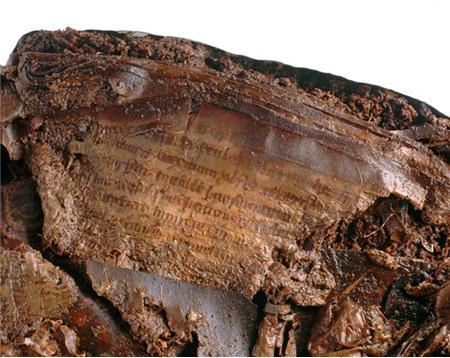
The book that emerged from a bog after 1200 years

This is the remarkable story of a medieval book that spent 1200 years in the mud. Around 800 someones had a Book of Psalms made, a portable copy fitted with a leather satchel.

The book consisted of sixty sheets of parchment that were carefully filled with handwritten words. Somehow the book ended up in a remote bog at Faddan More in north Tipperary, close to the town of Birr, Ireland.

Dropped, perhaps, by the owner? Was he walking and reading at the same time? Did he himself also end up in the bog?

Fast-forward to 2006. Eddie Fogarty, the operator of a turf digger, noticed an object with faint lettering in the bucket of his machine.

Thanks to the conservation properties of turf, many pages of the book were still intact, as was its leather satchel the only surviving specimen from this early period.

Faddan More Psalter, c. 800: when it was found.

There it was again, our Book of Psalms! At this point, it resembled something from an Aliens movie (pic 2), but that changed quickly after it went to the restoration lab.

Faddan More Psalter, c. 800: before the start of restoration

Thanks to the conservation properties of turf, many pages were still intact, as was its leather satchel (pic 3), the only surviving specimen from this early period.

Faddan More Psalter, c. 800: restored cover

Remarkably, among the damaged pages were some that had let go of the words: kept together merely by ink, the words were floating around by themselves – like some sort of medieval Scrabble (pic 4). It’s the most remarkable bookish survival story I know.

Faddan More Psalter, c. 800: words without a page