1,700-Year-Old Roman Bronze Vessel Discovered in Norway
Archaeologists do not every day have the opportunity to discover ancient objects in central Norway.
Sometime in the Gaula River valley, southern Trøndelag, scientists report that about 150-300 CE a person died in the place now called Gylland.
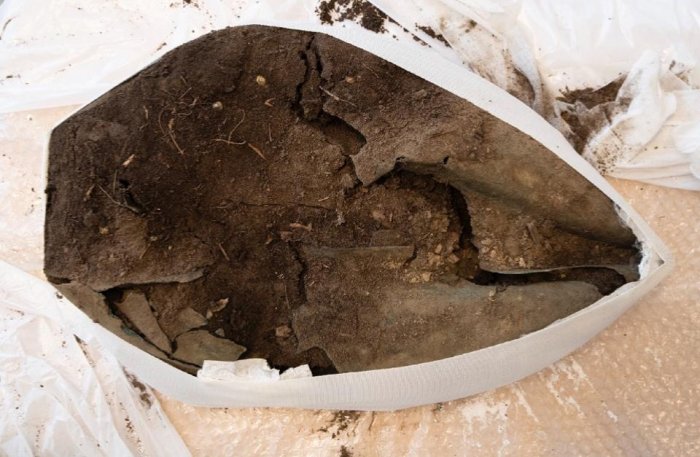
The remains were laid in a bronze vessel after the body was cremated. This was then covered or wrapped in birch bark before being buried under several hundred kilos of stone.
The bowl is now being examined in more detail at NTNU’s conservation laboratory.
Now archaeologists from the NTNU University Museum lifted a stone slab and almost lost their breath from excitement when they saw what lay below it.
“We’d gone over the spot with the metal detector, and so we knew that there was something under one of the stone slabs in the burial cairn,” says archaeologist Ellen Grav Ellingsen, who filmed the discovery with her mobile phone when the rock was lifted away.
“When I saw what was lying there, my hands got so shaky that I could hardly film. This is a find an archaeologist is lucky to experience once in their career!” says Ellingsen.
“The cauldron from Gylland belongs to a type of bronze vessel that goes by the name østlandskjele. The name is related to the fact that many vessels of this type are found in graves in Eastern Norway.
NTNU University Museum
This kind of vessel was manufactured in Italy or in the Roman provinces of the Rhine region and came to Scandinavia as a result of either trade or an exchange of gifts.
The vessels were mass-produced and possibly intended for export to the Scandinavian area. In Scandinavia, they often ended up as burial urns.
Although they were mass-produced, this bowl is a rare find,” Norwegian SciTech News reports.
“The last find of a bronze bowl in central Norway was in the 1960s. Nationally, we know of about 50 vessels of this particular type,” says Moe Henriksen, an archaeologist, and the project manager for the excavation in Gylland.
Imported goods like bronze vessels and glass jugs were reserved for society’s upper classes. The discovery in Gylland testifies to the power and prosperity in this region in Roman times.
The bowl was in bad shape and it’s likely that the pressure from the stones compressed it.
“The bowl is now being examined more closely in NTNU’s conservation laboratory. An x-ray of the vessel shows that it doesn’t contain any metal objects,” says Moe Henriksen.
Heidi Fløttum Westgaard (foreground) and Ellen Grav Ellingsen reveal the bowl. Photo: Astrid Kviseth / NTNU University Museum
“But the remains of organic material, like combs and bone needles, may still be hidden in the soil inside the bowl. In the next few weeks we should know whether other objects accompanied the deceased into the grave,” she adds.
King Tut’s Coffin Has been Removed from his Tomb for the First Time in History
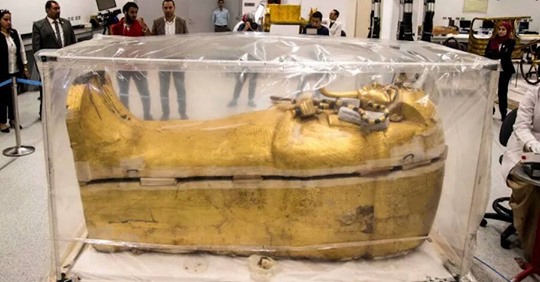
King Tutankhamun’s outer coffin is being restored for the Grand Egyptian Museum’s opening in late 2020. The pharaoh’s tomb was restored earlier this year.
From the time that King Tutankhamun’s body was placed, the outermost sarcophagus had never left the 3300-year-old tomb.
Even in 1922, following the discovery of the tomb by the British archeologist Howard Carter, the outer coffin made from wood and gold stayed in the Valley of Kings — until now.
An almost 10-year redevelopment of Tut’s tomb was completed in earlier this year by the Getty Conservation Institute and the Egyptian Ministry of Antiquities. Now, The Los Angeles Times wrote, they are going to restore his golden coffin, removing it from its resting place and allowing experts to finally get a good look.
The intricate project is largely motivated by the impending opening of the Grand Egyptian Museum in late 2020, which will overlook the Pyramids of Giza. In addition to the three coffins (one inside the other) that house Tut’s body, the exhibit will showcase the numerous relics discovered in his tomb.
The innermost coffin is made of solid gold, while the middle coffin is built from gilded wood and multi-colored glass.
Carter’s discovery of Tut’s resting place in the Valley of the Kings was the first time that a royal tomb from the time of ancient Egypt had been discovered so remarkably intact. It contained a plethora of stunning royal treasures as well, such as a dagger made from a meteorite.
After the discovery, two of the three coffins were subsequently transported to the Egyptian Museum in Cairo while the outer coffin was left in the king’s tomb. Only in July, 97 years later, was the casket removed under intense security in order for it to be fumigated for an entire week.
With careful yet thorough restoration now underway, experts have had the rare opportunity to inspect the outer coffin up close and reveal photos for all to see.
Restoration of the outer coffin will take at least eight months, Antiquities Minister Khaled el-Enany said.
Given the damage to the coffin that experts have now seen, however, Antiquities Minister Khaled el-Enany said it would take a minimum of eight months to restore it. The general director of First Aid Conservation and Transportation of Artifacts Eissa Zeidan said the coffin is about “30 percent damaged” due to the heat and humidity inside the tomb.
“The coffin is in a very bad condition, very deteriorated,” said Zeidan. “We found many cracks, we found many missing parts, missing layers.”
El-Enany confirmed as much when he said the coffin was in a “very fragile state,” with repair work on its cracks being the foremost priority. The 7-foot, the 3-inch-long coffin has been safely kept in one of the 17 laboratories within the new museum.
Restorers have been working on numerous items found in King Tut’s tomb, of which there are more than 5,000 — all of which will be showcased at the Grand Egyptian Museum. With more than 75,000 square feet of real estate, it’ll be the biggest museum on Earth exclusively dedicated to one civilization.
A woman looks at the golden sarcophagus belonging to Tut, who died at the age of 19.
Restoration of King Tut’s tomb came after years of tourists trudging through the majestic World Heritage site. Both the Getty Conservation Institute and Egypt’s Ministry of Antiquities committed to the extensive revamp nearly a decade ago and finally finished in February.
Their efforts included installing an air filtration system to regulate the humidity, carbon dioxide, and dust levels inside. Lighting, as well as a new platform from which tourists can see the sarcophagus, were added too.
The linen-wrapped mummy of King Tutankhamun displayed in his climate-controlled glass case in the underground tomb KV62.
Of greatest concern were the strange brown spots on the tomb’s paintings, which suggested microbial growth in the room. These were found to have been mere discolorations due to fungus that had been there since the tomb’s discovery.
Thankfully, neither fungus nor anything else has taken down Tut’s tomb. Now, after a long period of restoration, it will live on for many more visitors to see. And after the most recent restoration of the outermost coffin, visitors will have the most complete picture yet of how the boy king was buried.
When work on the pharaoh’s gilded coffin concludes and the Grand Egyptian officially opens, it will be the first time in history that King Tut’s three coffins will be on display together.
The Catholic church is ‘shocked’ at the hundreds of children buried at Tuam. Really?
Historian Catherine Corless was convinced that there — long-buried in a sewage system under the streets of a little town in Western Ireland — were the discarded remains of babies. Possibly hundreds of them.
For years, no one believed her.
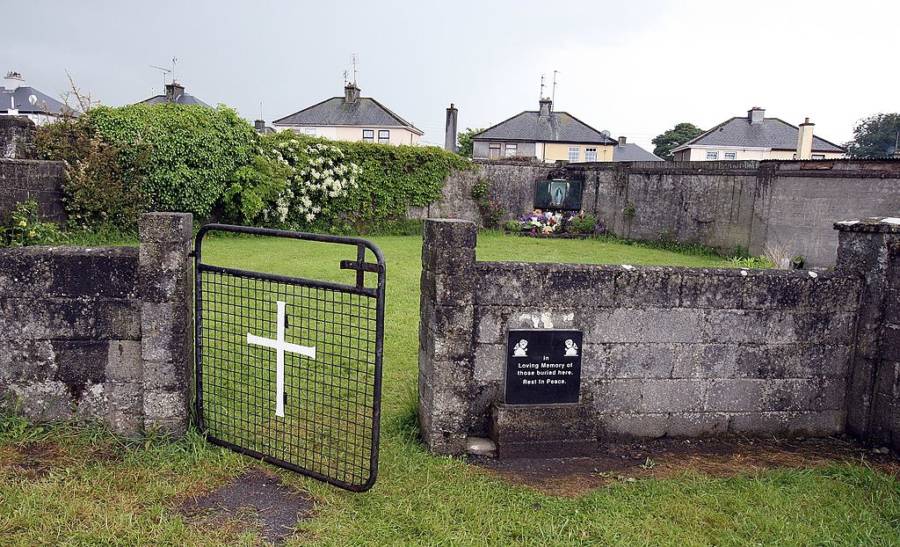
Though, a state-appointed dig uncovered “significant quantities of human remains” at the site of St. Mary’s House — a home for unmarried mothers and children that had run from 1925 to 1961.
Excavators, who have been investigating, found a long underground structure that had been divided into 20 chambers, according to a statement.
Bodies, ranging from premature babies to three-year-olds, were found in 17 of the little rooms.
Subsequent tests suggest most of the remains date from the 1950s.
“This is very sad and disturbing news,” Katherine Zappone, the Minister for Children and Youth Affairs, said. “It was not unexpected as there were claims about human remains on the site over the last number of years. Up to now, we had rumors.”
Corless has been poking around the subject for years. Having grown up in the area, she remembers going to school with children from St. Mary’s — which had been owned by the state and run by the Sisters of Bon Secours, a Roman Catholic order.
In Ireland, a country known for its strict Catholicism, women who became pregnant outside of marriage were considered sinners and faced stigma and abuse.
Their children were also shunned, and Corless remembers her St. Mary’s peers appearing malnourished and being kept to one side of the classroom in a school.
She began her investigation of St. Mary’s in earnest when she discovered 796 death certificates for young children but was unable to find any burial records.
She carefully studied the grounds and old documents. The building itself had been torn down in the ’70s and replaced with housing development, but Corless was able to deduce that the children had been buried in an unofficial graveyard — possibly in the sewage treatment facilities.
“Nobody was listening locally or in authority, from the church or from the state,” Corless told The New York Times. “They said, ‘What’s the point?’ And that I shouldn’t view the past from today’s lenses.”
This picture shows a shrine in Tuam, County Galway in memory of the children buried there without a grave.
But the history of the homes began garnering international attention (due, in part, to the film “Philomena,” which was based on the true story of an Irish woman looking for the son who had been taken from her in a similar home), and the government of Ireland created the Commission of Investigation into Mother and Baby Homes in 2015.
The commission has been examining abuse allegations in 17 other similar institutions.
Corless said she hopes that the information uncovered by the investigations will help families affected find peace.
“I was thinking of all the survivors of the Tuam home who have brothers and sisters buried there and I knew in my heart and soul that they would be delighted with this announcement because they want a grave to visit,” she told the BBC.
Though the commission itself does not have the power to award compensation, the town’s archbishop has said the church will work with the families to identify remains and provide a “dignified re-interment” in official graves.
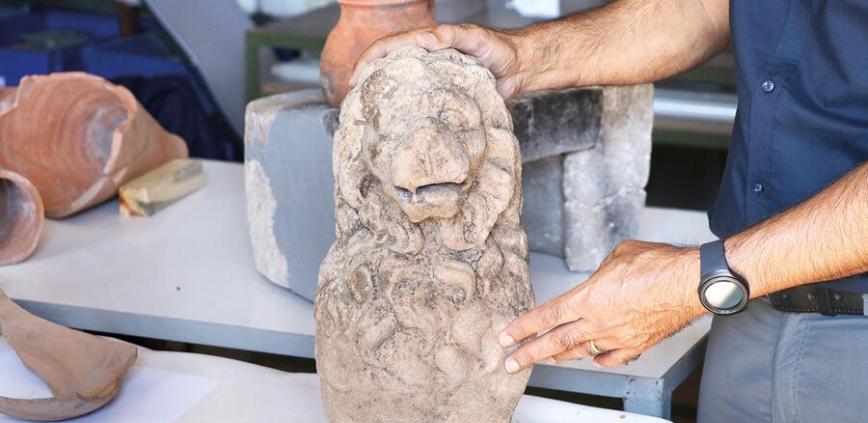
The 2,200-year-old lion statue found in ancient Assos on Turkey’s Aegean coast.
In Turkey during archaeological excavations in the ancient Greek town of Assos on the Anatolian shore, 2,200-year-old statue of a lion from the Hellenist Age and an Early Byzantine oven were found.
Assos, in the Ayvacik District, Canakkale Province, in Northwest Turkey, right across from the large Greek island of Lesbos, was a major Ancient Greek city-state, and a major Antiquity port.
It was also called “Apollonia”, after god Apollo, not unlike the predecessor of Bulgaria’s Black Sea town of Sozopol, the Ancient Greek colony of Apollonia Pontica.
The sculpture of the lion from the 2nd century BC was discovered in excavations of a complex in ancient Assos which used to be an inn during the Hellenistic period, says lead archaeologist Nurettin Arslan, reports Hurriyet Daily News citing Turkey’s state-run Anadolu news agency.
Excavations in Assos were also carried in agoras, or ancient city centers of Byzantine structures added Arslan, who is a professor heading the archeology department at Onsekiz Mart University in Canakkale.
Another intriguing discovery is a 1,500-year-old stone oven dating back to the early period of the Eastern Roman Empire (Byzantine Empire) also unearthed during the excavations in the area.
“One of the structures contained a find which was used at that time as a cooking stove with three pots,” Arslan reveals, adding that the well-preserved stove shines a light on the daily life of the Byzantine era.
The ruins of the Temple of Athena in Assos, with the Greek island of Lesbos visible in the background.
The current excavations in the ancient city of Assos in Northwest Turkey began in July 2019, with a team of 25 people, and are set to be completed in October.
Turkish archeologists have been carrying out uninterrupted excavations in the Ancient Greek and medieval Byzantine city since 1981.
Assos was first studied after American researchers back in the 1800s.
Situated on a rocky hill overlooking the Aegean Sea, 17 kilometers south of Ayvacik, ancient Assos was accepted to the UNESCO Tentative List of World Heritage back in April 2017.
Strange moments in Edinburgh’s history: The mystery of the miniature coffins found at Arthur’s Seat
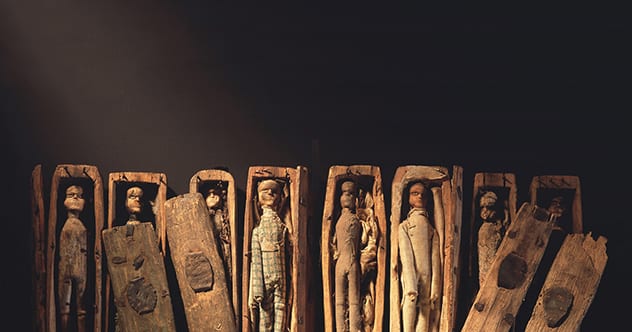
It was a group of boys out hunting for rabbits who found the coffins one summer’s day in 1836.
They were roaming a rocky peak known as Arthur’s Seat that overlooks Edinburgh, Scotland, when their attention was caught by a small cave, its entrance carefully covered with pieces of slate. After pulling back the slabs of stone, the boys found 17 coffins, each about 3.7 inches long, arranged in three tiers—two rows of eight, and a solitary coffin at the start of a third row.
Inside each was a small wooden doll, its face carved with wide-open eyes, dressed in plain cotton clothes that covered the thin body from bare head to flat feet. The question of who carved the figures and coffins—and why—has been a mystery ever since. Were the objects tools of witchcraft, part of a pagan ritual, or a memorial to one of the era’s most notorious killing sprees?
A STRANGE DISCOVERY
The Scotsman was the first to report on the discovery, on July 16, 1836, noting that the “Lilliputian coffins” were all “decently ‘laid out’ with a mimic representation of all the funeral trappings which usually form the last habiliments of the dead.”
Stranger still, it seemed “evident that the depositions must have been made singly, and at considerable intervals—facts indicated by the rotten and decayed state of the first tier of coffins and their wooden mummies [… while] the coffin last placed, and its shrouded tenant, are as clean and fresh as if only a few days had elapsed since their entombment.”
From the beginning, theories swirled around the discovery of the so-called “fairy coffins,” with some declaring them ritualistic offerings, and others describing them as creepy child’s playthings.
The Scotsman wrote, “Our own opinion would be, had we not some years ago abjured witchcraft and demonology, that there are still some of the weird sisters hovering about Mushat’s Cairn or the Windy Gowl, who retain their ancient power to work the spells of death by entombing the likenesses of those they wish to destroy.” Indeed, the moody Arthur’s Seat has long drawn tales of witches casting spells on its volcanic hill; Edinburgh’s dark history includes an estimated 300 people sentenced for witchcraft, with more burned there in the 16th century than anywhere else in Scotland.
Nor are witches the only aspects of folklore to be mentioned in connection with the coffins. Later in 1836, the Edinburgh Evening Post posited that the coffins might be related to an “ancient custom which prevailed in Saxony, of burying in effigy departed friends who had died in a distant land.” The Caledonian Mercury chimed in, saying that they had “also heard of another superstition which exists among some sailors in this country, that they enjoined their wives on parting to give them ‘Christian burial’ in an effigy if they happened [to be lost at sea].”
Yet as George Dalgleish, keeper of Scottish history and archaeology at National Museums Scotland, says in a 2015 video, there’s little evidence of such ceremonial burial practices in Scotland. And if a doll were created for witchcraft purposes, he notes, it’s likely it would have been mutilated or destroyed rather than carefully bundled in stitched cotton clothing and hidden within a cave.
In the 1990s, a new theory emerged—linked to one of the darkest chapters in Edinburgh’s history.
“ATROCIOUS CIRCUMSTANCES”
Scottish doctor Robert Knox
In the early 19th century, Edinburgh was home to a thriving underground trade in dead bodies. The buyers were medical students and their teachers, who required the corpses for training and study but who were legally limited to a small number of executed convicts for their supply.
William Burke and William Hare saw an opportunity. Their gruesome business plan was sparked when, in 1827, one of the lodgers at Hare’s boarding house died suddenly while still owing £4 in rent, and they sold his remains to anatomist Dr. Robert Knox for 7 pounds 10 shillings (about $820 today). Rather than waiting for more spontaneous deaths, the pair turned to murder, targeting travelers and downtrodden characters whose disappearance was not likely to be noticed.
After making a small fortune from the sale of their victims to Dr. Knox, they were caught when a lodger discovered a body in a pile of straw. Hare turned king’s evidence on Burke, agreeing to testify against his fellow murderer for immunity. Burke was hanged, dissected as punishment, and his skin bound into a book.
But what do these infamous murders have to do with the enigmatic coffins? As author Mike Dash notes for Smithsonian.com, the link was first proposed by two visiting fellows at the School of Scottish Studies at the University of Edinburgh—Professor Samuel Menefee and Dr. Allen Simpson, a curator at National Museums Scotland.
The pair examined the construction of the coffins and concluded that they had all been deposited in the 1830s. They also noted that the 17 coffins found in the cave match the number of Burke and Hare victims (including the first, who died a natural death).
As to why someone would create such a strange tribute to the murders, the answer may be tied to the belief in the need for a complete body on Resurrection Day. This is part of the reason dissection was often used as a punishment for criminals.
Menefee and Simpson theorized that perhaps the coffins were crafted to return corporeality, or at least some symbolic dignity, to the dissected victims. As they write, “it would not be unreasonable for some person or person, in the absence of the 17 dissected bodies, to wish to propitiate these dead, the majority of whom were murdered in atrocious circumstances, by a form of burial to set their spirits at rest.”
National Museums Scotland
NATIONAL MUSEUMS SCOTLAND
Of course, correlation does not imply causation, and there are many holes to be poked in the Burke and Hare theory. For one thing, all the wooden bodies were dressed in men’s clothing, but the pair’s victims were mostly women. Furthermore, the eyes of the figures are open, not closed like a corpse. Some have even speculated that Burke himself made the coffins, as their woodworking and tin decorations suggest the hand of a shoemaker—Burke’s profession when he was not suffocating Hare’s guests.
Eight of the coffins have been on display almost continuously at Edinburgh’s National Museum of Scotland since 1901. (As to what became of the nine other coffins, the Scotsman wrote in their initial report that “a number were destroyed by the boys pelting them at each other as unmeaning and contemptible trifles.”)
David S. Forsyth, the principal curator of Renaissance and early modern history at National Museums Scotland, says the coffins still draw comments from museum-goers. “It’s the mystery behind them that makes them so compellingly intriguing, no one can solely own their story,” he tells Mental Floss. “They can be linked to the more intangible aspects of our culture and history, or to real episodes such as Burke and Hare.”
In December 2014, there was a curious twist in the case. A box was delivered to the museum with no return address. Inside was a detailed replica of the coffins found in 1836, down to the metal details on the lid and the roughly carved face of its figure. A note included with the object cryptically began “XVIII?,” suggesting this was an 18th addition to the group, and quoted Robert Louis Stevenson’s short story “The Body Snatcher” (1884), itself inspired by Burke and Hare.
The handwritten text declared the miniature coffin a “gift” to the National Museum of Scotland, “for caring for our nation’s treasures.” Especially the eight that cannot be explained.
The mummified corpse of ‘magical’ baby boy who died 50 years ago attracts thousands of pilgrims
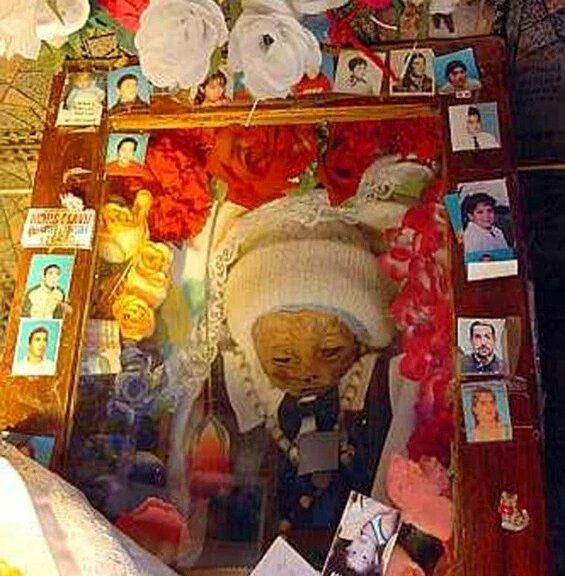
There are thousands of pilgrims hundreds of miles traveling to visit the tiny body of Miguel Ángel Gaitán, Spanish for “Miracle Child”. “El Angelito Milagroso.”
Fifteen days prior to his first birthday in 1967, Miguel died of meningitis. Seven years ago, however, he apparently returned from beyond the grave seven years later and refused to go back – so his family members displayed their wrinkled corpse to worshippers to visit.
A young boy poses with Miguel
El Angelito was buried where he was born in Banda Florida, a small town in the northwest of Argentina.
But seven years later something odd began to happen when the boy’s grave and the coffin would often be found open – with objects and pieces of a stone thrown all around it.
The cemetery janitors initially blamed violent rainstorms that were battering the city at the time.
But the mysterious happenings continued even after the weather improved.
Pilgrims leave flowers, pictures, and toys around Miguel
The boy’s mother said: “We would even put stones and other objects over the cover – but every morning we’d find it open.
“We then figured Miguelito did not want to be covered – he wanted to be seen.”
Villagers moved the coffin out in the open – but then the coffin’s lid kept being removed.
Interpreting the bizarre phenomenon as a further sign Miguel wanted to be seen, the family moved him to a coffin with a glass lid.
Even after almost 50 years, Miguel’s tiny wrinkled corpse is still incredibly well-preserved.
The child’s body quickly became a local attraction and rumours began to spread far and wide about his supposed magical powers.
For decades now thousands of Argentinians from across the country have descended on the remote town to seek a miracle.
One man – Daniel Saavedra – went to visit El Angelito when he fell ill with a rare pancreatic disease and within weeks he made a full recovery – he claims.
While some people believe touching the mummy’s forehead can help them, others just come to see the peculiar situation and hear the story.
Many of the visitors leave toys and flowers at the tomb.
Moment horrified sailor finds mummified remains of German adventurer on stricken yacht
On a yacht floating off the Philippines, fishermen have discovered the mummified body of a German sailor.
After two people made the discovery, the police were investigating. Officers discovered that the dead person is Manfred Fritz Bajorat, aged 59, from identity documents found on the ship.
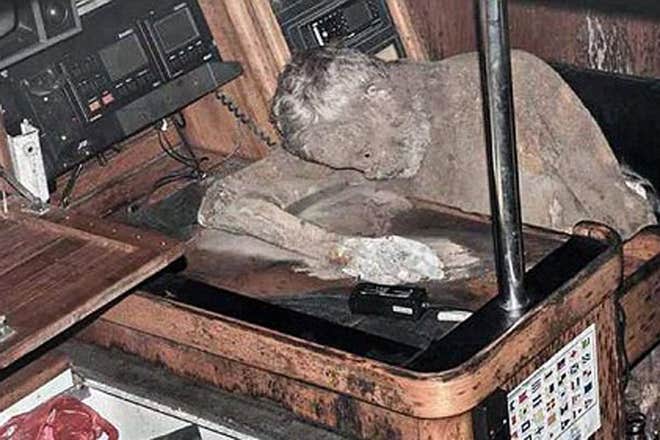
Manfred Fritz Bajorat’s body was recovered inside a drifting yacht in the seas off Barobo. Fishermen found his corpse inside the radio room of the yacht.
The deputy police chief of the near-by Barabo city, Inspector Mark Navales, said that although it was unclear how Bajorat’s death was caused there were no signs of foul play.
“It is still a mystery to us,” said Navales.
Bajorat’s body was found seated at a desk in the radio room, slumped over on his right arm “like he was sleeping”, said Navales.
The body of Manfred Fritz Bajorat found inside the boat
His exact time of death had not yet been determined. The yacht was found in the Philippine Sea about 100km (60 miles) from Barabo.
Bajorat had reportedly been sailing the world on his yacht, Sayo, for the past 20 years.
Reports said he had not been sighted since 2009. But a friend told the media that he had heard from the mariner in 2015 via Facebook.
Authorities were attempting to contact his friends and family in Germany in the hope they would be able to shed light on his movements.
The police investigation found no obvious signs of violence but could not determine the cause of death.
Navales said items inside the yacht were scattered and Bajorat’s wallet was not found but the yacht’s radio, GPS and other valuable items were still there.
Dr. Mark Benecke, a forensic criminologist in the German city of Cologne, told the Bild newspaper: “The way he is sitting seems to indicate that death was unexpected, perhaps from a heart attack.”
Reports suggested that dry ocean winds, hot temperatures, and the salty air helped preserve his body.
The Katskhi Pillar – the Most Incredible Cliff Church in the World
It is not unusual to listen to tales of people who have lived a solemn life away from the world, whenever these stories are reported, people are fascinated and awestruck.
This idea is far from our normal life to most of us. This was the case when the news broke out of a monk alone living on a giant rock in Georgia.
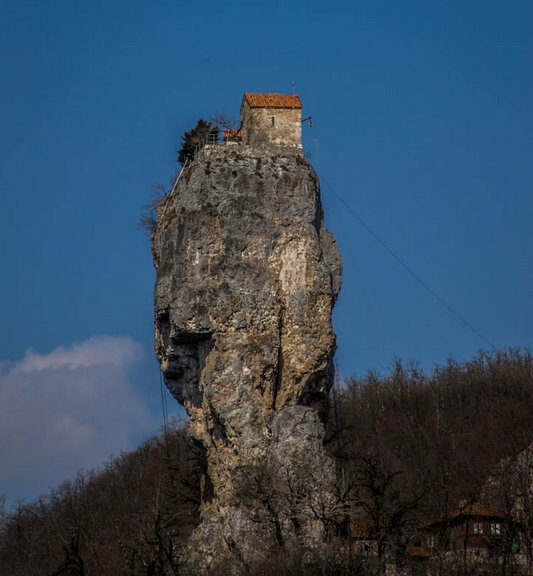
Katskhi, the small town of the Katshkipillar – an enormous natural limestone column that rises 130 feet into the air – is located in the west-georgian area of Imereti.
Perched on the top is a church and three hermit cells, accessible only by climbing a precarious steel ladder. The rock was used by Stylites from at least the 9th century up until the Ottoman invasion in the 15th century.
The Stylites are a group of Christian ascetics who chose to follow the example of Saint Simeon Stylites the Elder, spending their days living in solitude on top of pillars in order to become spiritually closer to God.
In 1993, the Stylite tradition at Katskhi was revived by a monk named Maxime Qavtaradze.
Man’s monastery near the village of Katskhi, Imereti, Georgia
After being abandoned and shrouded in the legend for 500 years, the rock was scaled in 1944 by a Georgian mountaineer named Alexander Japaridze.
Upon reaching the top, Japaridze found the dilapidated remains of an old church as well as the centuries-old bones of the last Christian ascetic who resided there, reports the Daily Mail.
Climbers also came across a slew of other structures, including a wine cellar, a curtain wall, a stone crypt, and three hermit cells. The church was built to honor Maximus the Confessor, a famous Christian monk and theologian.
St. Maximus the Confessor’s church is located in the southeast sector of the pillar. The structure is fairly small, measuring just 12 x 15 feet.
When excavations were carried out, the group also uncovered eight large containers known as kvevris which are used to hold traditional Georgian wine.
“The Stairway to Heaven”. It takes about 20 minutes to climb it!
In a subsequent ascent up the rock in 2006, the presence of the kvevris along with the construction of a wine cellar provided researchers with enough evidence to conclude that extreme asceticism was a common practice for those who resided there long ago.
This would make it the third time in recent history that the rock has been examined by experts hoping to uncover more about its history.
At present, the rock is inhabited by Maxime Qavtaradze, a middle-aged monk who made the abandoned spiritual dwelling his home in 1993.
In a rare interview in 2013, Qavtaradze told photographer Amos Chapple that making the decision to live at Katshki Pillar was borne from a much-needed change in his personal life.
He explained that after being released from jail on drug-related charges, he felt that the best way to connect with God and purge himself of evil was to meditate upon the Kayshki Pillar, reports CNN.
Monolithic limestone natural rock formation known as Katskhi Pillar with a monk’s cell on the top, in Georgia.
“It is up here in the silence that you can feel God’s presence,” he claims. For him, living in isolation is the right way to establish a genuine, uninterrupted connection with God.
That said, he does come down the mountain periodically to pray together with men who live in the monastery at the bottom of the pillar — a climb that takes him around 20 minutes, according to the Daily Mail.
Inside the chapel
His efforts are supported by the men in the monastery, who send him food and other supplies via a winch.
Maxime has no regrets about deciding to live his life in borderline isolation. Although climbing a 130-foot ladder does pose its challenges to Maxime’s middle-aged frame, he told Chapple that he’ll continue to make the journey until his body gives up.