During excavations for a new sewage system, archaeologists unearthed a unique stone outlining the city borders of ancient Rome. It dates from the time of Emperor Claudius in 49 A.D. and was discovered by archaeologists.
Rome Mayor Virginia Raggi was on hand for the unveiling Friday of the pomerial stone, a huge slab of travertine that was used as a sacred, military and political perimeter marking the edge of the city proper with Rome’s outer territory.
It was found June 17 during excavations for a rerouted sewer under the recently restored mausoleum of Emperor Augustus, right off the central Via del Corso in Rome’s historic centre.
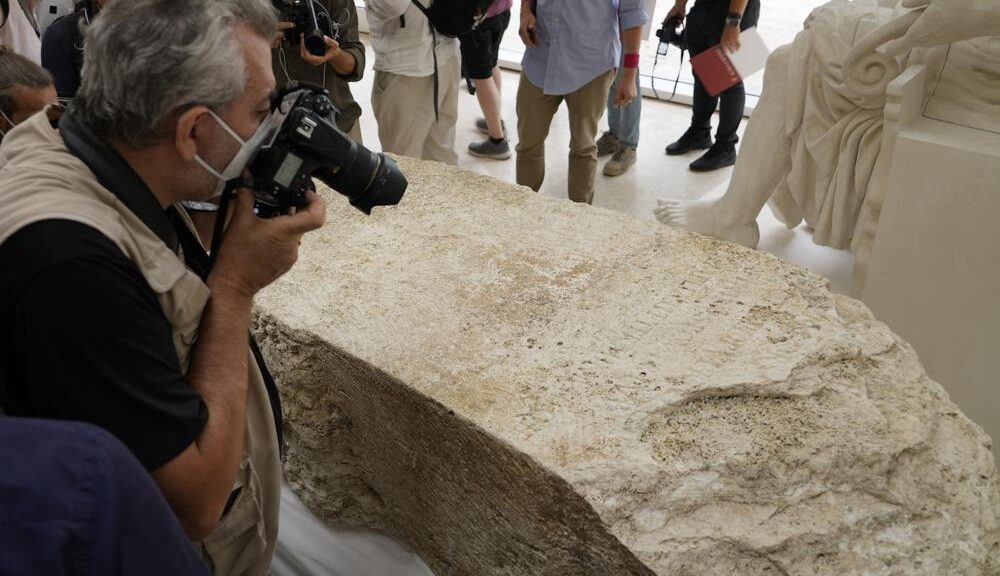
Photographers take pictures during the presentation to the press of an archaeological finding that emerged during the excavations at a Mausoleum in Rome, Friday, July 16, 2021. The monumental pomerial stone is dating back to Roman Emperor Claudio and was used to mark the ‘pomerium’ the sacred boundaries of the ‘Urbe’, the city of Rome, during the Roman empire.
In ancient Rome, the area of the pomerium was a consecrated piece of land along the city walls, where it was forbidden to farm, live or build and through which it was forbidden to enter with weapons.
At a press conference in the Ara Pacis museum near the mausoleum, Claudio Parisi Presicce, director of the Archaeological Museums of Rome, said the stone had both civic and symbolic meaning.
A detail of an archaeological finding that emerged during the excavations at a Mausoleum is pictured during its presentation to the press in Rome, Friday, July 16, 2021. The monumental pomerialstone is dating back to Roman Emperor Claudio and was used to mark the ‘pomerium’ the sacred boundaries of the ‘Urbe’, the city of Rome, during the Roman empire.
“The founding act of the city of Rome starts from the realization of this ’pomerium,‴ he said of the consecrated area. The stone features an inscription that allowed archaeologists to date it to Claudius and the expansion of the pomerium in 49 A.D., which established Rome’s new city limits.
Raggi noted that only 10 other stones of this kind had been discovered in Rome, the last one 100 years ago.
“Rome never ceases to amaze and always shows off its new treasures,” she said.
The stone will be on display at the Ara Pacis museum, the Richard Meier-designed home of a 1st-century altar until the Augustus museum opens.
Mystery as fully-sealed bottle of liquid discovered between skeleton’s legs
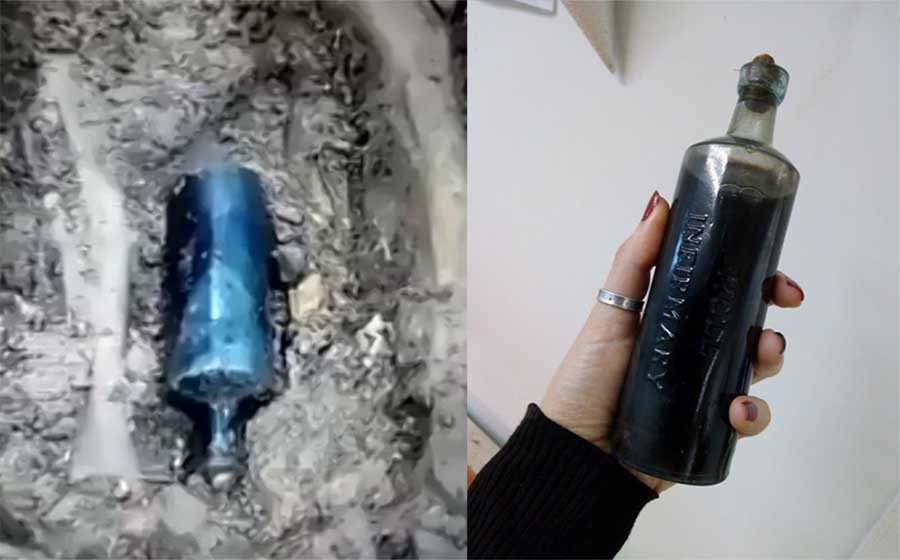
Experts at Hull’s largest-ever archaeological excavation believe they’ve made significant progress in unraveling the mystery of a bottle discovered between a skeleton’s legs. The unique blue-colored glass bottle marked ‘Hull Infirmary’ appears to have been placed in a grave at the former Trinity burial cemetery on purpose.
The glass bottle discovered at the Hull burial has the words “Hull infirmary” on it and contains a mysterious brown liquid.
The fully intact sealed bottle also contained an unknown brown liquid. It was discovered earlier this year as part of the major excavation at the site where burials took place between 1783 and 1861.
A 70-strong team of specialist archaeologists have been working there since last year as part of the nearby £355m A63 upgrade scheme on Castle Street in the city centre. They are examining around 1,500 exhumed skeletons.
The site is one of the largest post-medieval cemeteries to have ever been excavated in the north of England and the discovery of the bottle initially raised a few eyebrows.
Osteology supervisor Katie Dalmon explained: “It’s quite normal to find artefacts such as rings, coins, items of clothing and even tableware such as plates in a burial plot but this bottle was quite unusual.
“Not only was it apparently specifically placed between the person’s legs but it was also sealed and was nearly full of liquid.”
The ‘Hull Infirmary’ inscription on the side of the bottle was the first clue in what has become an ongoing piece of archaeological detective work.
The hospital was first established in temporary premises in 1782 – a year before the burial ground opened – and then moved to a purpose-built home in Prospect Street in 1784.
Katie added: “We now know a little bit more about the identity of the body – it’s a woman who was in her 60s at the time of death. We also know she was suffering from residual Ricketts and osteoporosis.
“She was also buried in the middle of a burial stack with the bottle. It was deliberately placed with the individual and was not part of any backfill.”
Tests have also been carried on the mysterious liquid in an effort to establish what it actually is with samples being sent to experts from Nottingham Trent University to carry out a high-tech analysis.
Katie said: “The tests have confirmed the presence of sodium, potassium and phosphorus and have also discounted any pharmaceutical materials being present.
“The results leave us with the likelihood that the liquid is probably urine but they also raise a whole series of other questions.
“What could this mean? Why was it placed there and, if it’s not the urine, what could it be?”
She said another theory being examined was that the liquid might have been a type of phosphate-based tonic drink.
pic 1: The bottle is just one of a plethora of archaeological remains discovered at the Hull burial ground. pic2: Huge tents have been set up as protection over the Hull burial ground excavation site. pic3: Archaeologists at work at the Hull burial ground, the location where the mystery bottle was found.pic4: An ornamental brooch found by archaeologists at the Castle Street excavation in Hull
“These were popular in the 19th century when they were advertised as a cure for various medical ailments, including tuberculosis.
“We can’t be exactly sure at the moment so we are carrying out more tests to try to get a definitive answer.”
The team from Oxford Archaeology is expected to spend several years studying all the finding findings from the burial ground. Work on the actual site is due to end next month when the remaining giant tents covering the excavation area will be removed.
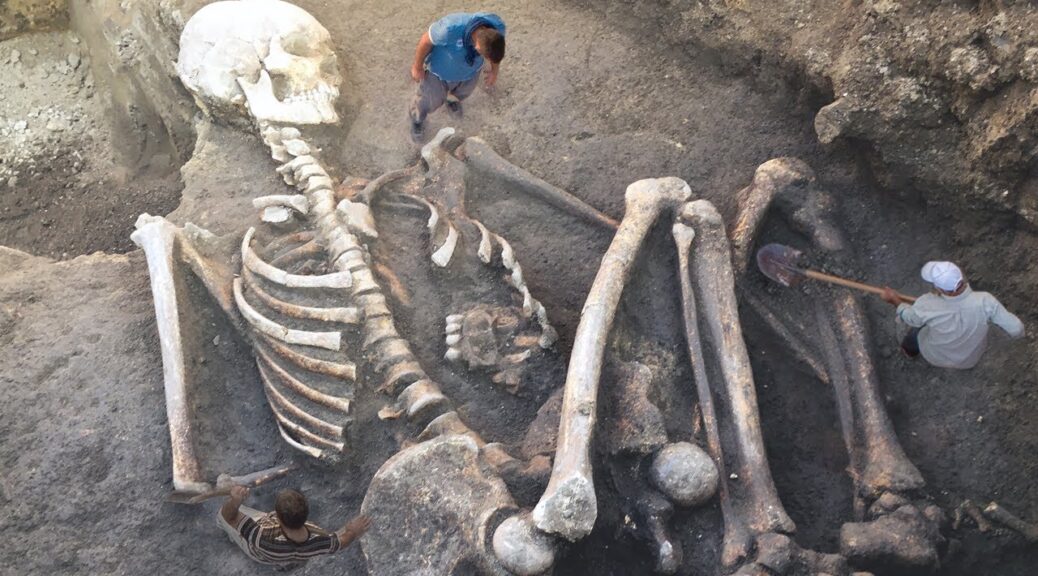
Bulgarian archaeologists discovered giant skeleton remains located at the Black Sea Bay city known as Varna. In the first reports, they suggested that a man lived in the 4th to the 5th centuries and were quite impressed by the size of the bone found in the area.
Due to the size, they only concluded their report that they belonged to a very tall man. Chief Archeologists Valeri Yotov who is part of their team that carries out excavations has been reporting the local media.
On the discovery from the begging but lately has stopped to give any more details which might tell us they are on to something bigger as they skeleton was discovered in the area of the ancient city called Odesos.
Yotov in the past has suggested that the man has died during work and that they were he was buried with his hand laid on his waist and his body pointing to the east was a clear indication he had a ceremonial burial rite and was buried this way.
Reconstructions of the area are being carried out in Varna, which is Bulgarians 3rd largest city and usually called “The Black Sea capital”
The ancient tomb in which the skeletons was found was also discovered during the repair works in the centre of Varna while the repair team dug up the tomb unexpectedly.
Its approximate location has actually been known since the beginning of the 20 th century as told by the Bulgarian National Television report.
However back then it was just briefly explored but sealed away due to constructions, so exploration of this area now is a very interesting job for the local archaeological society.
Archaeologists in this excavation reported that the object, lying on Nezavisimost Square between the city theatre and the State Archive, was located beyond the walls of Odesos, the ancient city that was once situated where Varna is now.
5,000-Year-Old Rock Art Depicting “Celestial Bodies” Revealed in Siberia
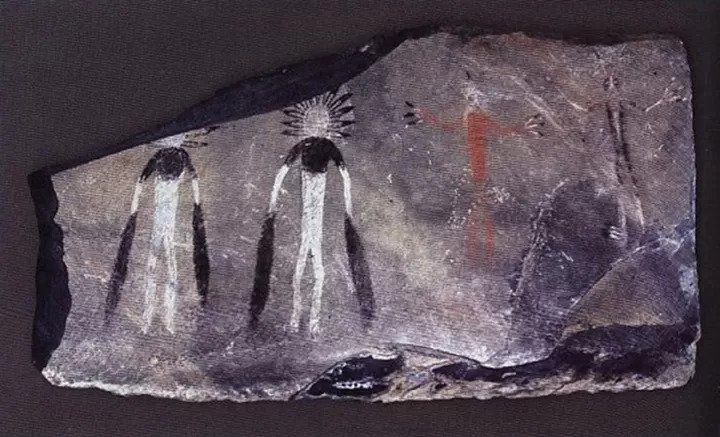
Rock art images painted some 5,000 years ago during the Bronze Age were made with a sophisticated scientific understanding which has stunned experts. Images, discovered near Karakol village in the Altai Republic in Russia, show alien figures with round horns and feathers on their heads.
The depictions in red, black and white were found in 1985 in a gravesite in a remote village in Siberia have uncovered the extraordinary talent of the prehistoric artists.
They have found that the red hues in the tomb drawings were made of thermally modified ocher, a clay made from Earth.
Celestial’ rock art images by ancient painters some 5,000 years ago were made with a sophisticated scientific understanding which has stunned experts. Paintings from the Altai Mountains of Siberia show alien or heavenly figures with horns and feathers on their heads
The white shades were made by scraping which revealed light-reflecting rock crystals, while soot was used for the black in the paintings.
Scientists from the Kurchatov Institute in Moscow, Russia’s leading research and development centre for nuclear energy, said that the red colours especially fascinate the experts.
It is apparent that some 5,000 years ago the tomb painters knew how to carry out a chemical reaction in order to create not just a red colour but the precise tones they desired by varying the temperature of heating.
Roman Senin, head of the synchrotron research department at Kurchatov Institute, said: ‘We determined the phased composition of pigments, that is, the structure of the crystal lattice of individual grains of the dye.
‘Some structures are not typical for natural samples but are the product of heat treatment.
‘Simply put, the primitive artist heated the mineral to a certain temperature in order to get the colour he needed.’
Alexander Pakhunov, of Russia’s Institute of Archeology, said: ‘The results of the analysis of the composition of paints used in the funeral rite of Karakol people testify to the ability of the ancient inhabitants of Altai to distinguish pigments by colour and properties.’
The weird and wonderful depictions in red, black and white dating to the Bronze Age were found in 1985 in a remote village but now Russian nuclear scientists have uncovered the extraordinary talent of the prehistoric artists.
It is apparent that some 5,000 years ago the tomb painters knew how to carry out a chemical reaction in order to create not just a red colour but the precise tones they desired by varying the temperature of heating.
Full results of the new study will be presented at the 43rd International Symposium on Archeometry in May 2020 in Lisbon.
It is also clear that ancient people broke off rocks on local mountains already decorated at an earlier time with petroglyphs.
These were then moved into the graves – and superimposed their own fantastical images on stone slabs which were used as the tomb walls.
‘The remains of people buried inside the stone graves were also painted with the same colours, with spots of red ocher found below eye sockets and traces of a black and silvery mineral called Specularite prominent in eyebrows area,’ reported The Siberian Times –
The earliest images were engravings of elks, mountains goats and running people with round horns on their heads.
White shades were made by scraping which revealed light-reflecting rock crystals, while soot was used for the black in the paintings. It is the red colours that especially fascinate the experts
Full results of the new study will be presented at the 43rd International Symposium on Archeometry in May 2020 in Lisbon. It is also clear that ancient people broke off rocks on local mountains already decorated at an earlier time with petroglyphs
On top of the petroglyphs were superimposed pictures of 11 human-like figures. The different colour tones are seen as carrying meanings to the prehistoric people.
While the funeral rites of these ancient mountain-dwellers are not yet understood, the techniques of the painters is now clear, say the scientists. The Karakol artworks date to the early and middle Bronze Age.
English cave may have ties to king-turned-saint and Viking invasion, archaeologists say
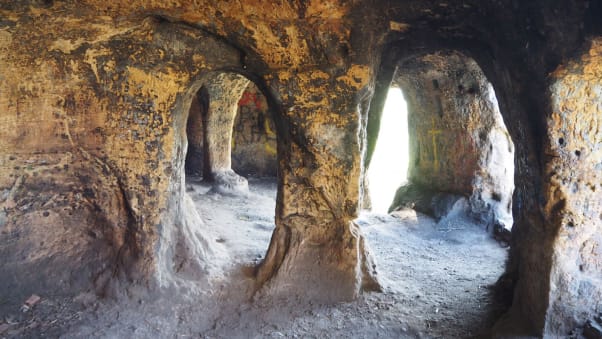
Archaeologists in England have identified a near-complete Anglo-Saxon cave house, which, they say, may once have been the home of a king who became a saint.
Thought to date from the early 9th century, the dwelling in the central English county of Derbyshire was discovered by a team from the Royal Agricultural University (RAU) and Wessex Archaeology, according to a news release published Wednesday.
The team carried out a detailed survey of the Anchor Church Caves in south Derbyshire, concluding that the caves probably date from the early medieval period rather than the 18th century as previously thought.
The cave house is believed to have been home to a former king, Eardwulf, who was later canonized.
Edmund Simons, a research fellow at the RAU, told CNN the cave is a “small, intimate space” that is one of the oldest domestic interiors surviving in the UK.
While there are a few churches with intact interiors that date from a similar period, Simons said, “there’s nowhere else really where you can walk into somewhere where somebody ate and slept and prayed and lived.”
“It’s quite remarkable,” he added.
The researchers carried out a detailed study to reconstruct a house featuring three rooms, as well as a chapel.
Dating the cave house
A number of factors combined to date the dwelling to the early 9th century, Simons said. The caves are cut from soft sandstone rock and their narrow doorways and windows resemble Saxon architecture, while a rock-cut pillar is similar to one found in a nearby Saxon crypt.
The cave was altered in the 18th century, with brickwork and window frames added.
The Anchor Church Caves are also linked by local folklore and a fragment of a 16th-century book to a saint. St. Hardulph has been identified as King Eardwulf, who ruled Northumbria until 806. He died around 830 and was buried five miles from the caves, in Breedon on the Hill in Leicestershire.
Around the time of his death, Viking raids on Britain, which started in the late 8th century, had grown in size. The Vikings arrived in the area and set up a winter camp in nearby Repton shortly after Hardulph’s death. As their Great Heathen Army slaughtered all the local religious figures, this suggests the cave house must date from before their arrival, Simons explained.
“All of these things fit together,” he added.
Researchers are analyzing more than 170 cave houses as part of a wider project.
Hardulph would not have been a “beardy weirdy” who lived in the cave alone, said Simons, but a kind of living saint who had servants and disciples and visitors who would come to consult him. He is one of a number of deposed Saxon kings who lived out their years as monks or hermits as a way of keeping their status.
“A hermit is an important and holy person,” said Simons. “It’s an incredibly religious period.”
18th century renovations
In the 18th century, the caves were modified by local landowner and aristocrat Robert Burdett, who added brickwork and window frames so that he could invite friends for dinner in the “cool and romantic cells” of the caves, according to the press release.
At the time there was a growing interest in Romanticism, an artistic and literary movement that made connections to the medieval period, as well as the picturesque aesthetic of rural England.
Burdett also widened the entrances to get tables, drinks and women in wide skirts into the cave, Simons said.
The analysis is part of a wider project involving more than 170 cave houses in the English Midlands, he said, adding that some date from a similar period and preliminary investigations suggest that a few could be even older than the Anchor Church caves.
“It is extraordinary that domestic buildings over 1200 years old survive in plain sight, unrecognised by historians, antiquarians and archaeologists,” Mark Horton, professor of archaeology at the RAU, said in the news release.
“We are confident that other examples are still to be discovered to give a unique perspective on Anglo Saxon England.”
The study is published in the Proceedings of the University of Bristol Speleological Society.
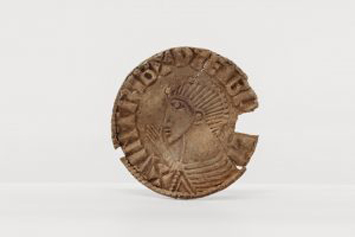
A metal detectorist who made another astonishing find last year uncovered a Viking era “piggybank” of silver coins on the Isle of Man. Former police officer Kath Giles discovered the 1,000-year-old fragments in a field in the north of the island.
A total of 87 coins and 13 pieces of arms rings were discovered
Details of the 87 coins, which were found in April, were made public for the first time at a coroner’s hearing.
The coins were minted in England, Dublin, Germany and the Isle of Man.
Ms Giles previously made headlines when she discovered a collection of gold and silver Viking jewellery, which was declared treasure in February.
The coins will be put on display at the Manx Museum in Douglas
Manx National Heritage’s curator of archaeology Allison Fox said it was a “wonderful find”.
It would help increase understanding of the “complex Viking Age economy” in the area surrounding the Irish Sea, she added.
It is thought the silver pieces, which date from between AD 1000 and 1035, had been deliberately buried by the owner for safekeeping.
American coin specialist Kristin Bornholdt-Collins, who helped to identify the provenance and age of the pieces, said the hoard may have been used as a Viking Age “piggybank”, which would account for some of the older coins in the collection.
Dr Bornholdt-Collins said once buried the hoard may have been “added to overtime”, although most of the pieces were a “direct reflection” of what was circulating in and around the island at the time.
Other items found included 13 pieces of silver arm rings, which were also used as currency during the period.
The collection will be put on display at the Manx Museum in Douglas before being taken to London for valuation at a later date.
Under Manx law, finds of archaeological interest must be reported to Manx National Heritage and those legally declared treasures at an inquest become the property of the crown, with the finder rewarded.
Archaeologists in Turkey Unearth 2,500-Year-Old Temple of Aphrodite
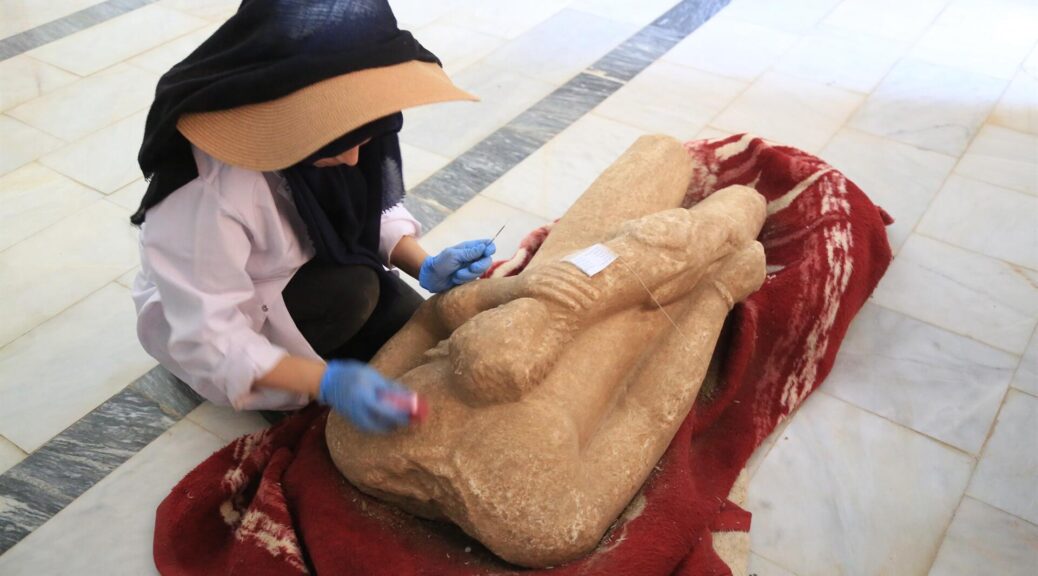
During excavations at the Temple of Zeus Lepsynos, one of Anatolia’s best-preserved Roman temples, in the western province of Mula, two 2,500-year-old marble statues and an inscription were discovered.
Built with donations in the second century B.C., the temple is located in the ancient city of Euromos.
Abuzer Kızıl, the head of the excavation committee and faculty member at Muğla Sıtkı Koçman University’s Archeology Department, told the state-run Anadolu Agency on July 11 that they were currently carrying out works in the temple, agora, theatre, bath and the city walls.
Expressing that Euromos is “one of the luckiest ancient cities in Anatolia” due to its location, Kızıl said that they started to implement important projects related to the Temple of Zeus Lepsynos.
“We took approximately 250 blocks stacked on top of each other on the southern facade of the temple and moved them to the appropriate area to be used in restoration works.
We then started the excavation work, hoping that there were architectural blocks under the ground. While waiting to explore the architectural blocks, we encountered great surprises.
Two statues and an inscription were discovered under the ground. We got very excited. In fact, it excited not only us but also the world of archaeology, as here we have unearthed two very important links of the missing archaic sculpture of the Caria region and an inscription dating to the Hellenistic period,” Kızıl said.
Kızıl added that the sculptures were categorized as kouros, a modern term given to free-standing ancient Greek sculptures.
“One of the two kouros unearthed at Euromos is naked while the other is wearing armour and a short skirt. The armour is made of leather, and it is remarkable to see that both statues have a lion in their hands. Ichnographically, the lion has great significance; we have not been able to find exact copies of either of the statues so far,” Kızıl said.
The naked statue with a lion in his hand indicates that it is most likely to be Apollo.
Kızıl said the inscription from the Hellenistic period was expected to reveal important insights on the Carian history, and efforts to decipher it were ongoing.
Pointing out that temples and artefacts are the common heritage of humanity, Kızıl said their primary goal was to restore the Temple of Zeus Lepsynos to its former glory.
Oldest known cosmetics found in ceramic bottles on Balkan Peninsula
Three researchers from the Center for Preventive Archeology in Germany and the Slovenian Institute for Cultural Heritage Conservation at Eberhard Karls University in Tübingen have found evidence of the oldest known cosmetic use at the Balkan excavation site.
In their paper published in the Journal of Archaeological Science: Report, Bine Kramberger, Christoph Berthold, and Cynthianne Spiteri describe ceramic bottles containing cosmetics and what’s inside them.
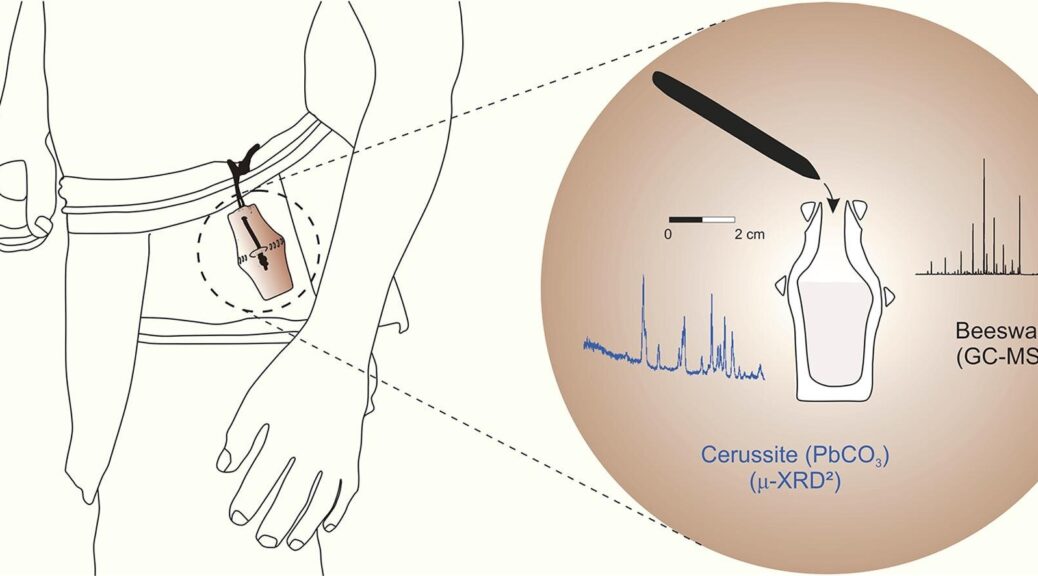
In 2014, team member Bine Kramberger discovered a small one Bottle At the excavation site of Zgornje Radvanje in Slovenia. Shortly thereafter, other bargains found similar bottles.
Over the next few years, more than 100 bottles have been discovered in the area.
The first review of the bottle suggested that it was some kind of children’s toy, or perhaps a medicine bottle, due to its small size. I also found that the handle of the bottle had a hole.
This suggests that the bottle was hanging around the waist or perhaps the neck. In this new initiative, researchers scrutinized the inside of some bottles to learn more about what they might have once had.
A close examination of more than a dozen bottles revealed traces of cerussite, also known as “white lead” or carbonite. It has been found in various containers from multiple locations around the world throughout history.
It was even used in modern paints until it turned out to be addictive to children who consumed it.
Researchers also note that many of the small bottles were found nearby in elongated stone tools. This could be an extractor.
The team also found small pieces of animal fat, beeswax, and vegetable oil in the bottle. All signs of material intended for application to the skin.
The bottle dates from 4350 to 4100 BC and is evidence of Europe’s oldest known cosmetic use. It also lags behind the use of cosmetics in Mesopotamia and Egypt. The bottle is believed to have been created and used by a Neolithic hunter-gatherer known as Rasinja.