Turkish archaeologists find 2,400-year-old monument at Haydarpaşa
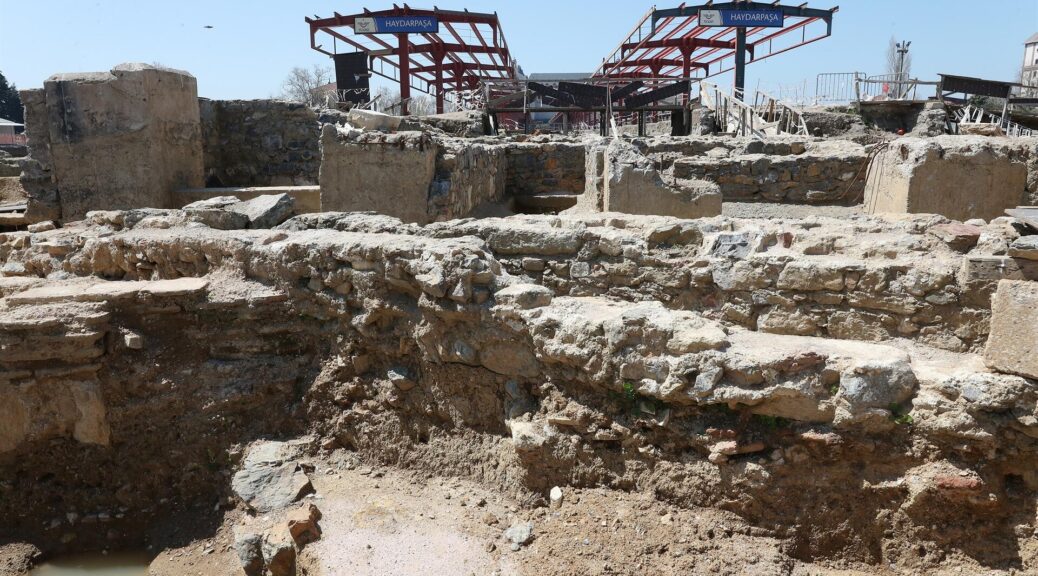
Hurriyet Daily News reports that a semicircular structure dated to the third century B.C. has been uncovered at the site of the Haydarpașa train station in Istanbul, which is located on the Asian side of the Bosporus.
The structure, discovered at the station’s waiting platforms, covers a large area and is apsidal in form, a feature common in ancient churches.
These remains give significant hints about Khalkedon, the ancient ‘Land of the Blind’ from some 2,500 years ago.
While the site’s architecture does not lend any clues to its function, archaeologists believe it was considered sacred.
However, they also estimate that the building is the oldest architectural structure unearthed in these excavations.
Speaking to Demirören News Agency, Mehmet Ali Polat, Chief archaeologist of the Haydarpaşa excavation, gave information about the field works and finds.
Remains were found in an area of 350,000 square meters, including the area surrounding the station, said Polat, adding that small finds, pots, coins dating from around 6 B.C. to the modern-day were found, all from various eras.
“This is the northwestern port of the ancient city of Khalkedon, a large structure that could be a warehouse. On the other side of the road, we see a group of buildings that could be a small summer palace,” Polat said.
The Haydarpaşa Train Station was shut down for restorations, in which ancient artefacts were unearthed, and since then, Haydarpaşa has been an excavation site.
The digs, started in 2018 by Turkey’s Culture and Tourism Ministry and Istanbul Archeological Museums, have been done with the utmost care for the last three years.
Digs revealing historical structures shed light on the deep roots of Anatolia and Istanbul, a cradle of civilizations.
2,000-year-old remains of nomadic ‘royal’ unearthed by Russian farmer includes ‘laughing man,’ haul of jewels and weapons
Russian farmer unearths the remains of a 2,000-year-old nomadic ‘royal’ buried alongside a ‘laughing’ man. A farmer found the haul when digging on his land in the south of Russia near the Caspian Sea.
Stunning gold and silver jewellery, weaponry, valuables and artistic household items were found next to the chieftain’s skeleton in a grave close to the Caspian Sea in southern Russia. Local farmer Rustam Mudayev’s spade made an unusual noise and it emerged he had struck an ancient bronze pot near his village of Nikolskoye in the Astrakhan region.
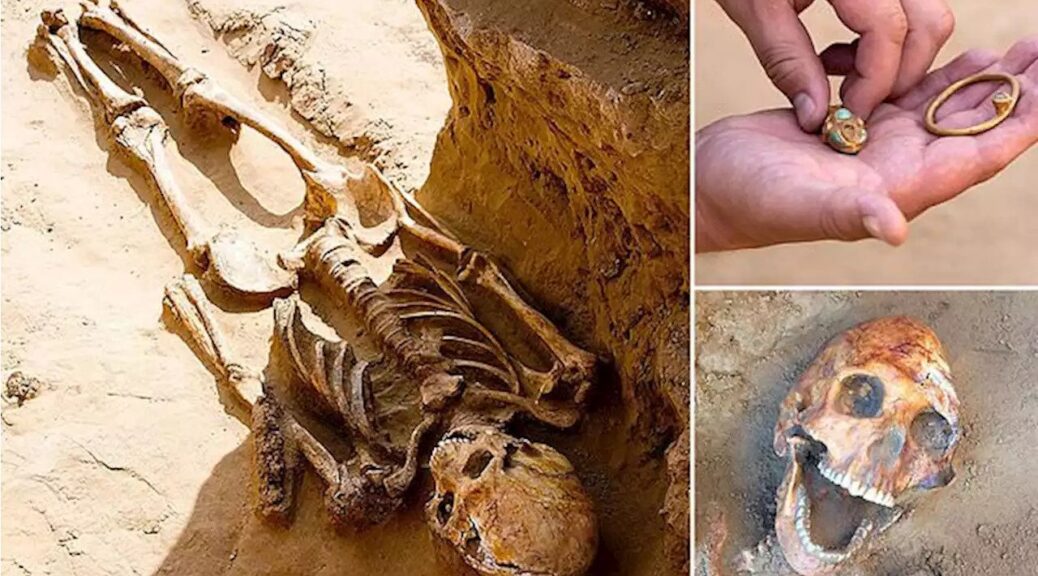
A chieftain was buried with his head raised as if on a pillow (pictured). It is believed the individual was a high-ranking ‘royal’ of a nomadic society more videos He took it to the Astrakhan History museum for analysis and an experts opinion on the find.
A skeleton uncovered by researchers in Russia.
‘As soon as the snow melted we organised an expedition to the village,’ said museum’s scientific researcher Georgy Stukalov.’After inspecting the burial site we understood that it to be a royal mound, one of the sites where ancient nomads buried their nobility.’
WERE THE SARMARTIANS?
The Sarmatians were a group of people who lived for almost a millennium from the 5th century BC to the 4th century AD. Their range stretched, at its largest in the 1st century AD, from the Caspian Sea across Eurasia and towards modern-day Poland.
The territory was known as Sarmatia and included today’s Central Ukraine, South-Eastern Ukraine, Southern Russia, Russian Volga and South-Ural regions, also to a smaller extent north-eastern Balkans and around Moldova. They had conflicts with the Roman Empire as they expanded east at their peak, allying themselves with Germanic tribes.
Towards the end of their reign, they faced competition from Germanic Goths and the Huns. The Sarmatians were eventually decisively assimilated by the burgeoning populations in Eastern Europe.
The burial is believed to belong to a leader of a Sarmatian nomadic tribe that dominated this part of Russia until the 5th century AD, and other VIPs of the ancient world, including a ‘laughing’ young man with an artificially deformed egg-shaped skull and excellent teeth that have survived two millennia.
‘We have been digging now for 12 days,’ said Mr Stukalov.’We have found multiple gold jewellery decorated with turquoise and inserts of lapis lazuli and glass.’The most ‘significant’ find is seen as a male skeleton buried inside a wooden coffin.
This chieftain’s head was raised as if it rested on a pillow and he wore a cape decorated with gold plaques. Archaeologists found his collection of knives, items of gold, a small mirror and different pots, evidently signalling his elite status. They collected a gold and turquoise belt buckle and the chief’s dagger along with a tiny gold horse’s head which was buried between his legs, and other intricate jewellery.
Treasures uncovered by a farmer in southern Russia
Another grave was of an elderly man – his skeleton broke by an excavator – but buried with him was the head of his horse, its skull still dressed in an intricate harness richly decorated with silver and bronze when a farmer digging a pit on his land unearthed 2,000-year-old treasure inside the ancient burial mound of the tomb of a nomadic ‘royal’, along with a ‘laughing’ man (pictured) with an artificially deformed egg-shaped skull. Shaping and elongating the skull in this way was popular on various continents among ancient groupings like the Sarmatians, Alans, Huns and others.
An artificially deformed skull found by researchers in southern Russia.
The burial is believed to belong to a leader of a Sarmatian nomadic tribe that dominated this part of Russia until the 5th-century pieces of jewellery were found in the burial pit alongside the dead humans and animals and experts believe they were gifts for the dead.
The chief’s dagger was buried with him and places alongside his body, between his hand and leg (pictured)They collected a gold and turquoise belt buckle and the chief’s dagger along with a tiny gold horse’s head which was buried between his legs and other intricate jewellery.
Nearby was a woman with a bronze mirror who had been buried with a sacrificial offering of a whole lamb, along with various stone items, the meaning of which is unclear. Another grave was of an elderly man – his skeleton broke by an excavator – but buried with him was the head of his horse, its skull still dressed in an intricate harness richly decorated with silver and bronze.
Also in the burial mound was the skeleton of a young man with an artificially deformed egg-shaped skull. Local farmer Rustam Mudayev’s spade made an unusual noise and it emerged he had struck an ancient bronze pot near his village of Nikolskoye in the Astrakhan region.
A horse’s head buried on top of the old man’s body still carries an intricate silver and bronze harness which was also uncovered after the farmer took his find to the Astrakhan History museum for analysis and an experts opinion on the find. ‘As soon as the snow melted we organised an expedition to the village,’ said museum’s scientific researcher Georgy Stukalov.
‘After inspecting the burial site we understood that it to be a royal mound, one of the sites where ancient nomads buried their nobility,’ the archaeologist said we have been digging now for 12 days,’ said Mr Stukalov. ‘We have found multiple gold jewellery decorated with turquoise and inserts of lapis lazuli and glass’
A chieftain was buried with his head raised as if on a pillow and wearing a cape adorned with gold plagues the most ‘significant’ finds is seen as a male skeleton buried inside a wooden coffin. This chieftain’s head was raised as if it rested on a pillow and he wore a cape decorated with gold plagues.
The shape is likely to have been ‘moulded’ either by multiple bandaging or ‘ringing’ of the head in infancy. Such bandages and or rings were worn for the first years of a child’s life to contort the skull into the desired shape. Shaping and elongating the skull in this way was popular on various continents among ancient groupings like the Sarmatians, Alans, Huns and others.
Such deformed heads were seen as a sign of a person’s special status and noble roots, and their privileged place in their societies, it is believed. The burials date to around 2,000 years ago, a period when the Sarmatian nomadic tribes held sway in what is now southern Russia.
‘These finds will help us understand what was happening here at the dawn of civilisation,’ said Astrakhan region governor Sergey Morozov. Excavation is continuing at the site. Nearby was a woman with a bronze mirror who had been buried with a sacrificial offering of a whole lamb, along with various stone items, the meaning of which is unclear.
The gold jewellery and the buckle (pictured) are thought to be signs of the person’s nobility and would only have been afforded to the most wealthy people.
Newly Discovered Cave Paintings Suggest Early Man Was Battling A Lot Of Inner Demons
The discovery of cave drawings in northern Spain by a team from the University of Cambridge suggests that prehistoric people struggled with a range of inner demons, nagging worries, and anxieties as they struggled with life’s demands in the Paleolithic era.
The paintings indicate that early humans had “some pretty heavy stuff” weighing on their minds, archaeologists said.
According to lead researcher Alan Reddy, the images found on the limestone walls and ceiling of the cave trace back to 14,000 B.C. and seem to indicate that early hunter-gatherers were often anxious about their ability to kill game animals, reeled from the challenges of raising a family, and “generally had a really hard time keeping it together.”
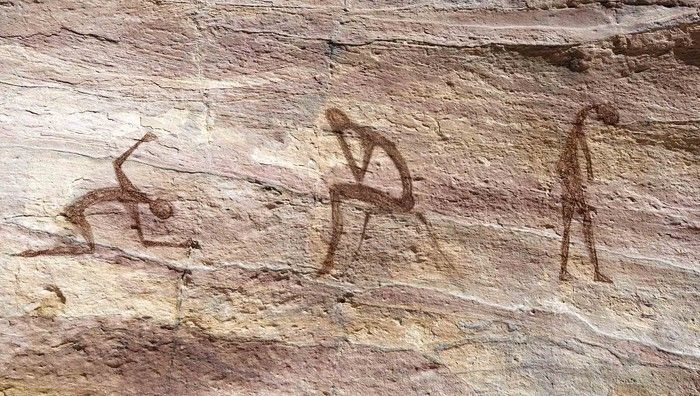
“While these pictographs are crude in terms of their rendering of human anatomy, they have a vivid expressive quality that led our team to surmise that Ice Age humans had an awful lot of personal stuff going on,” said Reddy, showing reporters a photo of a rudimentary figure painted in smeared charcoal that appeared to be on its knees weeping into its hands.
“Although we don’t want to read too much into these images at this point, it’s hard not to deduce that our prehistoric ancestors were often desperately lonely and felt like they had no one else to turn to.”
“This one seems as if it’s suddenly waking up in the middle of the night,” added Reddy, pointing to a figure that appeared to be sitting bolt upright on a mat of antelope skin. “If you look carefully, you can still see how the artist used daubs of yellow clay to drench him in sweat.”
Reddy confirmed that other images in the cave include a downcast man apparently being mocked by potential mates for his inability to start a fire, a woman using a stone chopping implement to cut her own body, and a seated man seemingly resigned to his fate at the approach of a charging mastodon.
Further chemical analysis will have to be conducted to determine if the ominous red handprints along the walls were symbolic works rendered in red ochre or simply the result of anguished early humans striking the stone surface until they started to bleed.
“What’s remarkable is how, with just a few basic pigments and the most primitive painting tools, our ancestors could so intensely portray their dread of dying alone or their toxic jealously of alpha males,” said Reddy, adding that only a highly-skilled but extremely alienated artist could use nothing but melted animal fat blown through a hollow bone to convey his dismay at having no one he could consider a close friend and realizing he was too old to make new ones.
“It’s clear that these humans felt so disconnected from one another, so unable to constructively address their problems, that they used these sad, disturbing paintings as their sole outlet for comfort.”
According to Reddy, the paintings not only represent the ability of Late Stone Age humans to express their immediate emotional torment but perhaps also to construct larger, more elaborate narratives of their prolonged, agonizing downward spirals.
Through paint-application analysis and radiocarbon dating methods, Reddy said his team was able to determine that individual artists sometimes depicted their unravelling over a series of months or even years.
“Here you can see the same figure gorging on bison and growing more and more obese, apparently stuck in a lengthy cycle of compulsive overeating,” said Reddy, adding that the self-destructive pattern was broken only once by an extremely brief sequence of dynamic images suspected to be a quickly abandoned attempt at the aerobic activity.
“The drawings finally stop after about 20 meters with a half-finished pictograph of what we speculate is the poor man attempting and failing to fit into his deer-hide frock and pants and then, out of apparent shame, opting not to leave his cave all day.”
“Honestly, I’m glad the paintings didn’t go on much longer,” added Reddy. “Archaeological discovery or not, it’s hard to watch a guy like this.”
The discovery of the images comes just weeks after archaeologists uncovered a separate set of cave paintings in southern France, whose artists reportedly hunted, reared children, and otherwise did the best they could without taking themselves so goddamn seriously.
Damaged Medieval Seal Discovered in Eastern England
According to a BBC News report, a metal detectorist in eastern England discovered a 13th or 14th Century seal badly burned in Gayton, Norfolk, in August. Norfolk finds liaison officer Helen Geake said it told “quite a story”.
“Would people have known that it was Roman – was it kept all those centuries and re-set in silver, or was it a chance find?” she said.
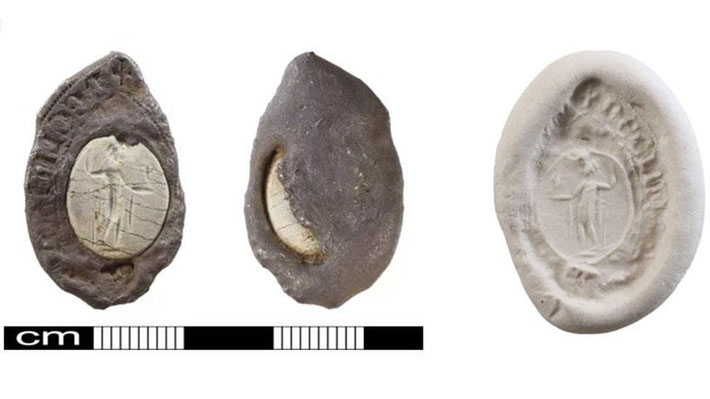
The intaglio is now an opaque grey but was “almost certainly carnelian”, a brown-red gemstone. It depicts a winged figure, believed to be the god Mars holding a spear, with Victory to his right, a report on the find states.
Ms Geake said: “I think they [Medieval people] probably would have thought it was from the Mediterranean and the Crusades and not Roman, as in Roman Britain,” added Ms Geake.
The silver seal matrix which encases it would have been flat but due to heat damage has a lumpy, rounded reverse with a hole, revealing the back of the intaglio.
Parts of the edges are missing, making the inscription tricky to decipher – although it does not appear to show a generic motto, Ms Geake said.
“They were primarily used as a way to sign a document, to authenticate it, probably at a time when you had someone to do the writing for you,” she added.
“Somebody with this calibre of the seal was aristocratic and very high up.
“It’s still a mystery who that might have been, but these belonged to really top people – barons, bishops, the top 1%.
“If only we could read it; perhaps there is a Latin scholar out there who can.” More than 50 seal matrixes have been found nationwide, 30 of the silver, with this the fourth to be found in Norfolk.
A gold seal, found near King’s Lynn in June, contained a gemstone, probably carnelian, carved with an elephant
The Gayton find, measuring 29mm (1in) by 18.5mm (0.72in), is the only seal matrix that has been burned. It was discovered by a metal detectorist.
“It’s very peculiar – was it just an accident, was it lost in the countryside and then got in a heath or forest fire?” said Ms Geake.
“It’s seen a lot of action.”
Its status as treasure is subject to a coroner’s inquest on Monday and Norwich Castle Museum hopes to buy it.
Stolen Roman frescoes returned to Pompeii after investigation
Three of the frescoes were retrieved by Italian police last year, while the others were discovered during the 2012 bust of illegal excavation.
Fragments of six frescoes once stolen from the walls of ancient Roman villas were returned to Pompeii in a ceremony at the archaeological site on Tuesday morning.
Three of the frescoes were recovered by a local Italian cultural heritage protection unit last year as part of a larger investigative effort to crack down on the illegal trafficking of ancient artefacts.
The objects were believed to have been taken from Stabia, an archaeological site located near Pompeii, in the 1970s, before being promptly smuggled out of the country. By the 1990s, they had been sold to collectors in America, Switzerland, and England.
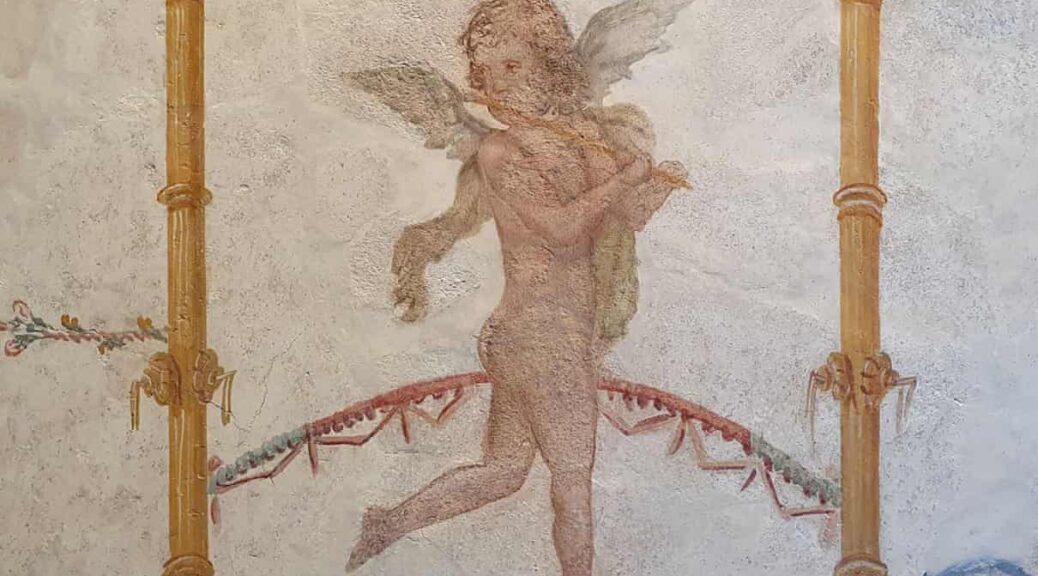
The fragments from this group, which have been dated back to the first century, depict a dancer, a cherub, and the bust of a woman. They were not in the UNESCO database of stolen cultural assets when found, according to a statement from the Archaeological Park of Pompeii.
The other three frescos were discovered in 2012 when Italian police disrupted an illicit archaeological dig in Civita Giuliana, a villa located roughly 2000 feet north of the walls of ancient Pompeii.
Pompeii, located near Naples in southern Italy, is one of the archeological wonders of the world
The incident led to the establishment of a state-sponsored excavation at Civita Giuliana in 2017. It was there, in 2020, that archaeologists discovered a ceremonial chariot and the remains of a master and his slave, who were killed in the eruption of Mount Vesuvius.
Three fragments of wall frescoes from the 1st century AD from the Ville di Stabia, recovered thanks to the action of the Carabinieri Command for the Protection of Cultural Heritage (Nucleo di Monza), they were returned to the Park this morning at the Free Orsi Museum in Castellammare
“The return of these fragments is significant for several reasons,” Massimo Osanna, the Italian Ministry of culture’s general director of museums, said in a statement.
“Each finding constitutes an important piece of the history and knowledge of a place and must always be protected and preserved.
But above all, it is a victory of legality, against the phenomenon of illicit excavations and the trafficking of works of art and ancient finds, and a confirmation of the important role of the police in the protection of cultural heritage.”
Rare 20-million-year-old petrified tree measuring 62 feet tall discovered in Greece
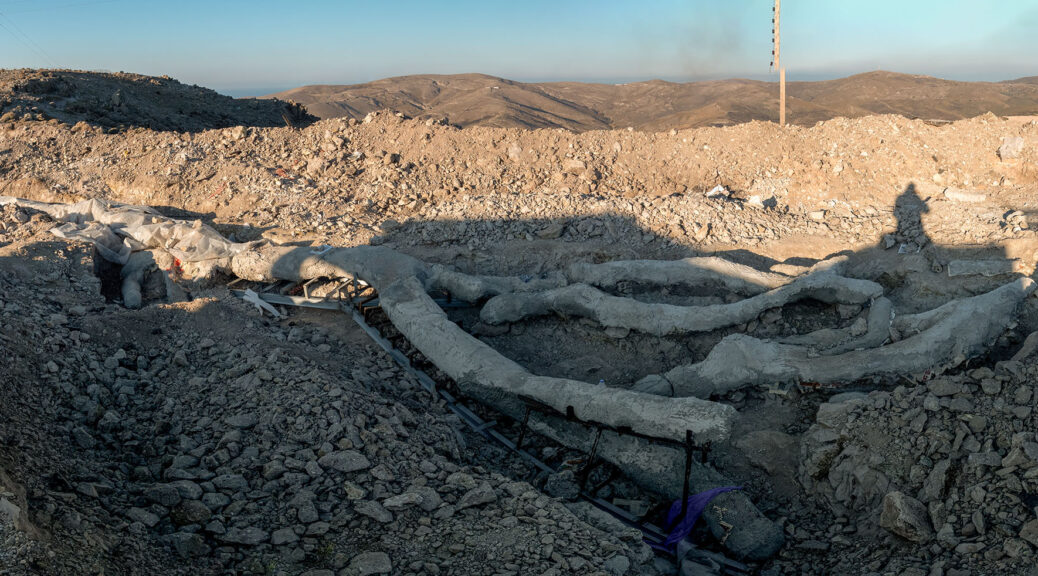
A petrified tree 62 feet high complete with branches, leaves and roots has been discovered on the Greek island of Lesbos. It was found during salvage excavations at the site of roadwork in western Lesbos.
While the island is famed for its vast petrified forest, a national park, monument and designated UNESCO Global Geopark, most of the trees are trunks, either upright with their roots intact or fallen.
Trees with branches are rare — the last one before this was found in 1995 — and a tree of this scale with branches has never been found before.
The trees were mineralized and preserved in a series of massive volcanic eruptions that struck the northern Aegean 17 to 20 million years ago. The trees on the western part of the island were covered by volcanic lava and ash.
Heavy rains turned the ash into fast-moving mudflows that blanketed the forest. The subtropical forest of pines, oaks and Sequoia-like giants, plus leaves, fruits and roots were fossilized.
The latest discovery was preserved almost to its last leaf thanks to a coating of fine-grained volcanic ash which coated the whole thing and kept it intact in one piece exactly where it fell in the eruption. It was not moved or dragged by the mudflows.
It simply toppled over where it stood, was covered by a thick layer of fine ash and gradually turned to stone. Underneath it was a bed of fruit leaves, also preserved and mineralized by the volcanic ash. Nearby the excavation team unearthed a spectacular cache of 150 petrified logs one on top of the other in a single pit.
The discovery of an entire tree lying on a bed of leaves was not only unprecedented but down to pure luck. “Constructors were about to asphalt that part of the highway when one of our technicians noticed a tiny branch.
The road work stopped, we starting excavating and quite quickly realised we had chanced upon an incredible find,” said [University of the Aegean geology professor Nikolas] Zouros. “It will now form part of the open-air museum we intend to create.”
Geologists around the world have described the find as a breakthrough.
“We have a case of extraordinary fossilisation in which a tree was preserved with its various parts intact. In the history of palaeontology, worldwide, it’s unique” said the Portuguese palaeontologist Artur Abreu Sá. “That it was buried by sediments expelled during a destructive volcanic eruption, and then found in situ, makes it even more unusual.”
Because the road will still be built over the find site, the tree will have to be moved. The staff of the Natural History Museum of the Petrified Forest have been working assiduously for the past few weeks to complete the excavation of the tree and preserve it.
A custom splint has been wrapped around the trunk and branches to support them and ensure the tree remains intact. A metal grate has been built to transport the tree to an area 100 feet away where a protective shelter is being constructed for its display.
Remains of wooden safe excavated from the burned-out roman villa in Spain
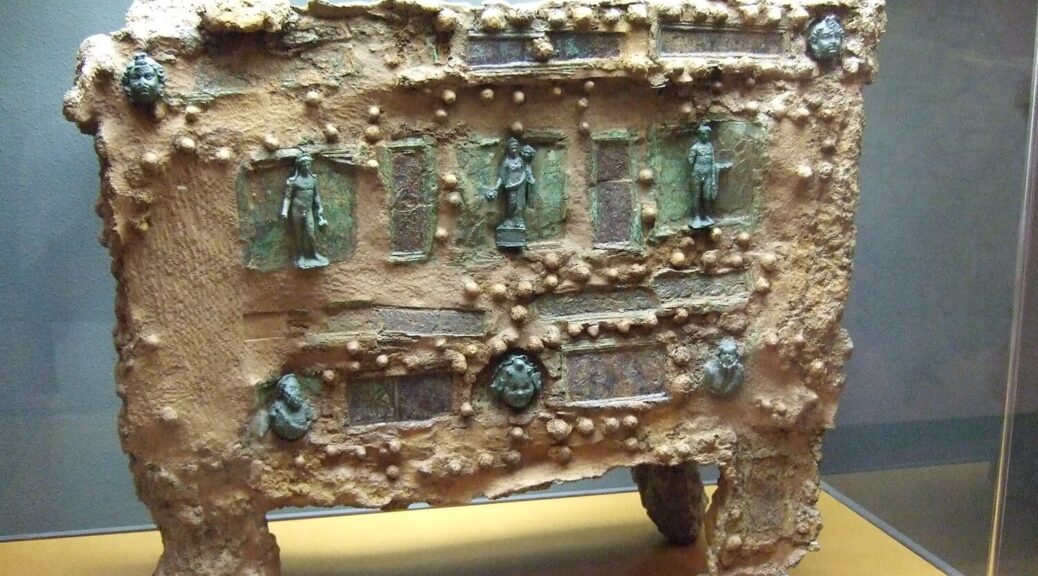
A rare strongbox from the 4th century A.D. has been discovered in the Casa del Mitreo, a Roman villa in west-central Spain.
Arca ferrata found in Tarazona.
The area Ferrata, a wooden chest armed with bronze cladding and iron spikes, was used as a safe for valuables — coin, jewellery, textiles, important documents — in Roman homes and businesses. Because they are mostly made of wood, only four others are known to survive.
Three of the extant examples were preserved under the extraordinary conditions of the eruption of Vesuvius in 79 A.D. The only other arca Ferrata found in Spain was discovered in Tarazona, Aragon, northeastern Spain.
The Domus was dubbed Casa del Mitreo because a sanctuary believed to be Mithraeum was discovered nearby. The villa was built in the late 1st, early 2nd century and was remodelled and expanded several times over the next centuries. It was located outside the ancient Roman city Emerita Augusta (modern-day Mérida).
“It is unclear what the owner did for a living. But it is clear that it was probably a wealthy family because the surface of the house is around 3,386 square meters (36,447 square feet), with 15 rooms, including the bathrooms and the kitchen, as well as four other rooms,” said [Archaeologist Ana Maria Bejarano] Osario.
Osario said: “It is unclear what they did for a living, but it might be something related to commerce or business, and they could even have been using the four extra rooms themselves to sell their wares.”
The house also had two more rooms on the second floor, including the one that collapsed during the fire, the causes of which are unknown.
The ‘arca ferrata’ being readied for removal.
The remains of the arca Ferrata were first discovered in 1994 during excavations in a room of a building that had suffered a fire in the 4th century.
At the time, the condition of the exposed organic remains was precarious, so the team decided to leave it in situ and prevent further deterioration as much as possible.
It wasn’t until 2017 that a comprehensive conservation and consolidation project at the Casa del Mitreo tackled the burned room once more.
It was fully excavated and documented, as were the paintings and artefacts inside the room. It is misshapen from the effects of the fire which collapsed the roof onto the coffer and drove it into the ground. Today it measures 9.8 by 4.9 feet, but its original measurements are unknown.
The ‘arca ferrata’ on a grill for removal.
Archaeologists consolidated the remains to keep the metal parts from oxidizing and the wood from decay.
It was removed intact and transferred to the Institute of Cultural Heritage of Spain (IPCE) of the Ministry of Culture and Sports where it will be studied, stabilized and restored for future display.
Roman Baths Emerge On The Banks Of The Cosa River In Frosinone
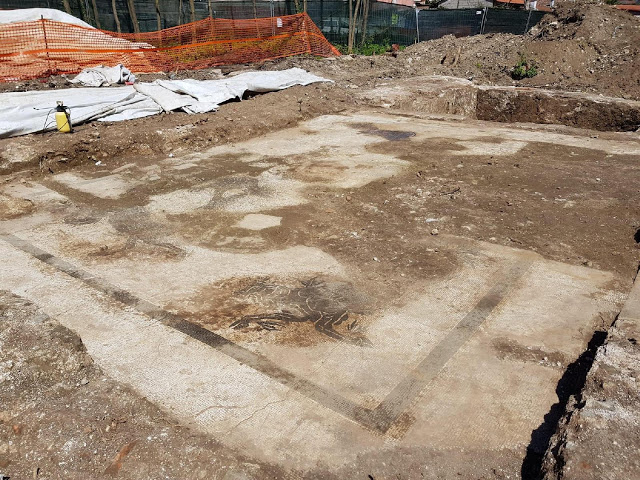
The remains of Roman imperial-era baths have been discovered in Frosinone, 50 miles southeast of Rome in central Italy. The complex on the left bank of the Cosa river retains sections of black-and-white mosaic floors and marble cladding lining a rectangular pool.
Marble basin of the Roman baths on the Cosa river with access steps
The baths were discovered last month during a preventive archaeology survey at the site of planned sewer work on the Ponte Della Fontana, a street named after the Roman bridge, long-since obliterated by flooding, that once crossed the Cosa river at this spot.
Very few remains from the Roman city have survived, and while Frosinone was known for its rivers and mineral springs in antiquity, there are no ancient sources documenting baths, so the discovery comes as a total surprise to archaeologists. It’s also the first archaeological evidence that the imperial Roman town occupied the left bank of the river.
Detail of the mosaic floor with Triton. Baths on the River Cosa, Frosinone
Found just a few inches under street level, the surviving mosaic floors can be dated by their style to the 2nd century A.D.
The black-and-white mosaics adorning the floor of a large room depict mythical marine creatures and deities, including a taurocampus (a fish-tailed bull), a hippocampus (fish-tailed horse) over whom looms the god Triton, son of Poseidon, blowing a conch shell like a trumpet. There are others visible as shadows under a layer of plaster.
At one end of the large room is a pool lined in marble. A large proportion of the cladding is extant, as are bronze staples used to affix the marble slabs to the walls of the pool.
The pool also had a mosaic floor, albeit not a figural one; just a monochromatic white. There are patches evident from repairs done in antiquity.
The large mosaic floor also has a number of patches where tesserae were lost and squares of marble and larger, more roughly-cut tiles in varying sizes were used to fill in the blanks.
Detail of mosaic floor with sea ox. Roman baths on the Cosa river, Frosinone
A smaller room adjacent to the large one also had a mosaic floor, although from what we can tell there were no figural motifs. It was white tile with a thick black border.
The function of this space cannot be determined, as most of the room was lost when the baths were destroyed.
Archaeologists believe their source of water was the ultimate cause of their demise. The Cosa changed course in later antiquity, shifting 30 feet and taking a bunch of the bath complex with it.
Excavations of the site are ongoing and cultural patrimony officials plan to conserve the mosaics and marble walls in situ. The remains will be covered and secured. The ultimate goal is to include them in a future Cosa River city park.