2,500-Year-Old Lost City Atop a Greek Mountain Peak discovered by archaeologists

2,500-Year-Old Lost City Atop a Greek Mountain Peak discovered by archaeologists

A team of archaeologists working in Greece has made a sensational discovery that can lead to a new understanding of the ancient world.

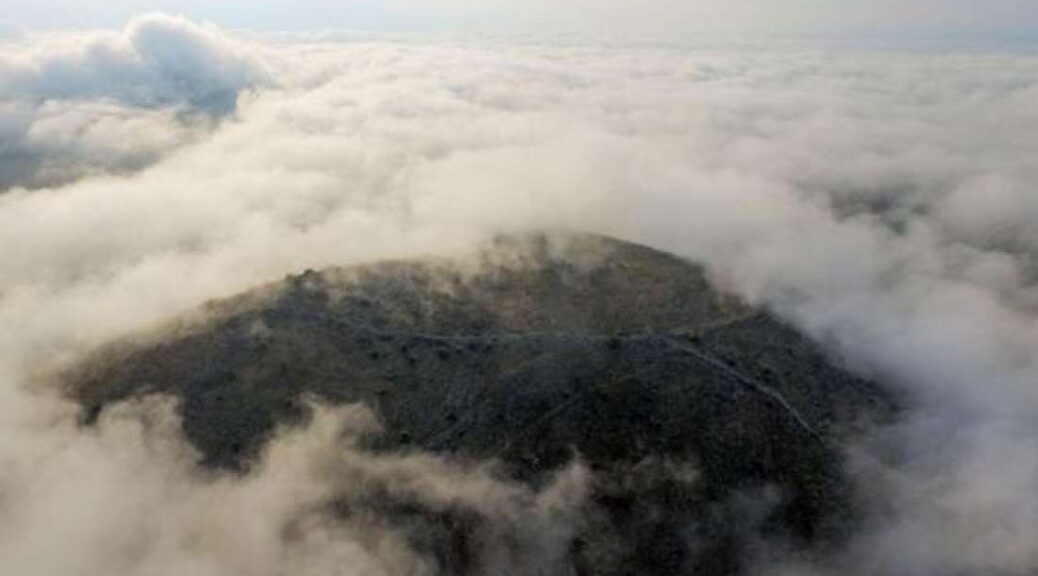
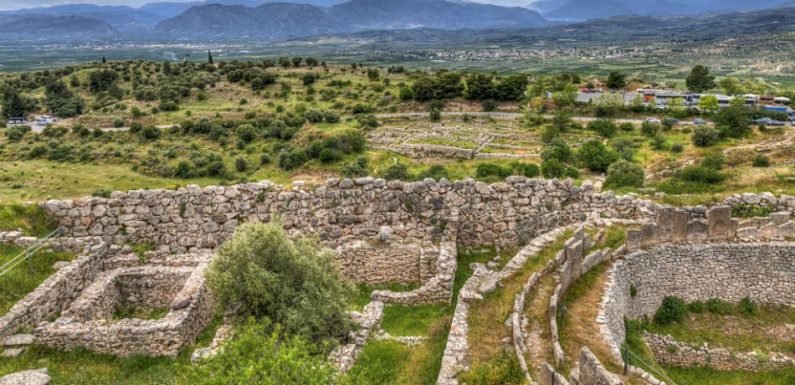
The city’s acropolis is barely visible during a cloudy day on the Thessalian plains.

An international group of researchers from the University of Gothenburg, Sweden announced last month that they had found the ruins of a 2,500-year-old metropolis buried atop the Strongilovoúni hill on the great Thessalian plains.

The unknown city, located near the village of Vlochos in central Greece, is believed to have been a metropolis according to the extent of the ruins found there, rather than an obscure settlement on a mountain.

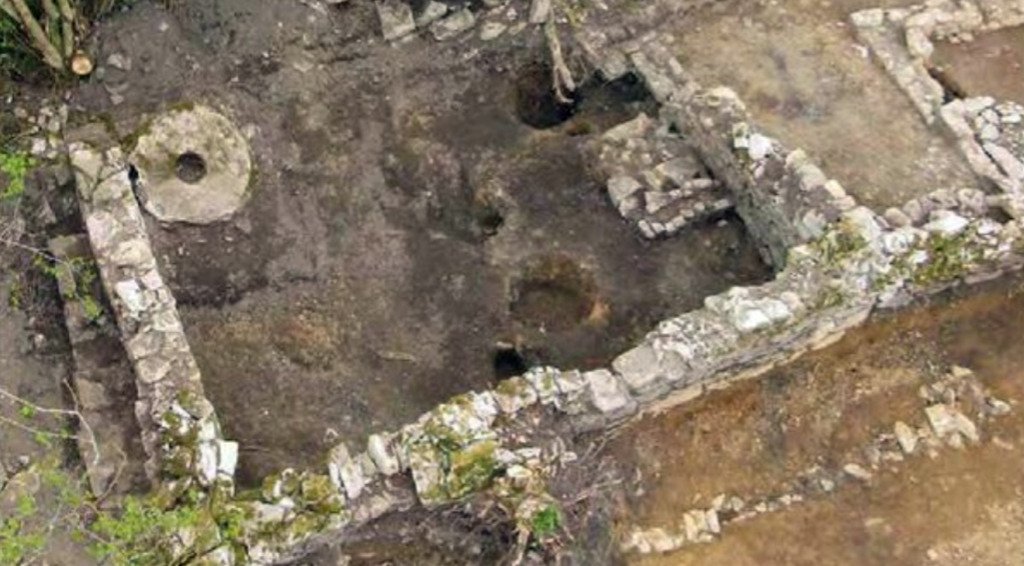
Fortress walls, towers and city gates are clearly visible from the air.

“Most striking of the visible remains at the site are the well-preserved fortifications, at points still 8 feet high, but the lower slopes below the hill show clear indications of being the location of an extensive urban settlement, now covered by silt and sediment from the nearby river Enipeas,” says Robin Rönnlund, PhD student in Classical Archaeology and Ancient History at the University of Gothenburg and leader of the fieldwork.

“A colleague and I came across the site in connection with another project last year, and we realised the great potential right away.

The fact that nobody has explored the hill before is a mystery,” he added.

The researchers believe that the presence of a major city in an area previously considered a backwater of the ancient world can deliver new findings on a tumultuous period in Greek history.

The sensational discovery comes just weeks after Egyptian archaeologist discovered a 7,000-year-old lost city along the Nile, also thought to have been an important metropolis.

While almost none of this is visible from the ground below, the 99-acre area contains a tower, the main square, walls and gates, and a street grid indicative of the city’s significance and size.

Thanks to pottery and coins found at the site, the researchers can estimate the city’s date. “Our oldest finds are from around 500 BC, but the city seems to have flourished mainly from the fourth to the third century BC before it was abandoned for some reason, maybe in connection with the Roman conquest of the area,” says Rönnlund.

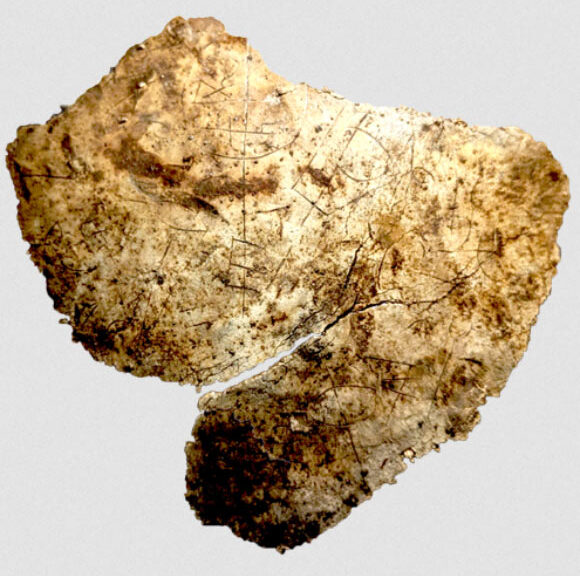
Fragment of red-figure pottery from the late 6th century BC, probably by Attic painter Paseas.

In order to avoid disturbing the site, the archaeologists are using a ground-penetrating radar rather than excavating. The method has proven highly effective, as the structures discovered so far have all been recognized by the radar rather than dug up.

A 1,600-year-old cargo of a Roman merchant ship has been discovered in Caesarea

A 1,600-year-old cargo of a Roman merchant ship has been discovered in Caesarea

In recent times, divers have discovered some rarity of archaeological artifacts on the bottom of the sea off the coast of Israel in Caesarea.

The objects that seem to have been part of a Roman merchant ship cargo that sank some 1,600 years ago include coins, bronze statues, equipment used in running the ship, such as anchors, and numerous decorative items.

The treasure trove was discovered by accident by two amateur divers from Ra’anana, Ran Feinstein, and Ofer Ra’anan, who were swimming in the ancient harbor.

The rare bronze artifacts that were discovered in Caesarea.

Upon emerging from the sea, they immediately contacted the Israel Antiquities Authority. Since then, the IAA’s marine archaeology unit has been conducting an underwater excavation of the site, in cooperation with the Rothschild Caesarea Foundation.

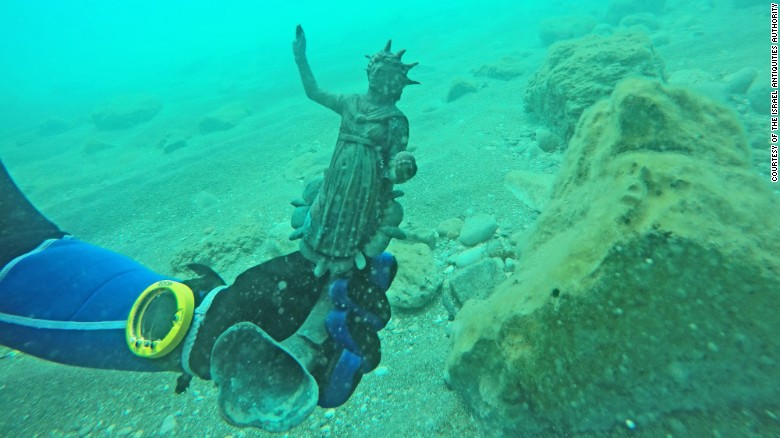
Among other finds, the cargo of the ship, which apparently sank in the latter years of the Roman Empire (27 B.C.E. – 476 C.E.), included a bronze lamp depicting the image of the Roman sun god Sol; a figurine of the moon goddess Luna; a lamp resembling the head of an African slave; parts of three life-size bronze statues; a bronze faucet in the form of a wild boar with a swan on its head; and other objects in the shape of animals. Also unearthed were shards of large containers used for carrying drinking water for the ship’s crew.

An Ancient Roman figurine discovered from the shipwreck.

One of the biggest surprises was the discovery of two metallic lumps each composed of thousands of coins, in the shape of the ceramic vessel in which they were transported before they oxidized and became stuck together.

The coins bear the images of the Constantine, who ruled the Western Roman Empire (312 – 324 C.E.) and was later known as Constantine the Great, ruler of the entire Roman Empire (324 – 337 C.E.), and of Licinius, a rival of Constantine’s who ruled the eastern part of the empire and was slain in battle in the year 324 C.E.  

According to Jacob Sharvit, director of the IAA’s marine archaeology unit, and his deputy Dror Planer, “These are extremely exciting finds, which apart from their extraordinary beauty, are of historical significance.

The location and distribution of the ancient artifacts on the seabed indicate that a large merchant ship was carrying a cargo of metal slated to be recycled, which apparently encountered a storm at the entrance to the harbor and drifted until it smashed into the seawall and the rocks.”

A preliminary study of the iron anchors unearthed at the site suggests that there was an attempt to stop the drifting vessel before it reached shore by casting them into the sea; however, the anchors broke, which constitutes “evidence of the power of the waves and the wind in which the ship was caught up,” say the researchers.

The discovery comes just a year after a trove of over 2,000 gold coins, dating to the Fatimid era about 1,000 years ago, was found nearby by divers and IAA staff. The coins are currently on public display in the Caesarea marina.

“A marine assemblage such as this has not been found in Israel in the past 30 years,” Sharvit and Planer explain. “Statues made of metallic materials are rare archaeological finds because they were always melted down and recycled in antiquity.

When we find bronze artifacts it usually occurs at sea. Because these statues were wrecked together with the ship, they sank in the water and were thus ‘saved’ from the recycling process.”

The archaeologists said the underwater treasures were discovered because of the diminishing amount of sand in the Caesarea harbor as a result of construction along the coastline south of the site, and due to the increased mining of sand – as well as the growing number of amateur divers in the area.

The IAA praised the two amateur divers for their good citizenship in reporting their find and announced that they will accordingly be awarded certificates.

Lumps of coins that were discovered at sea, weighing a total of around 20 kilograms.

Archaeologists Excavate Roman Villa at Pompeii

Archaeologists Excavate Roman Villa at Pompeii

The suburb of the ancient city of Pompeii was populated by numerous settlement complexes, scattered over a territory which responded to productive (wine and oil-producing farms) as well as residential or seasonal needs when the owner needed to stay temporarily.

The safeguarding activity carried out by the Archaeological Superintendency of Pompeii and now by the Archaeological Park of Pompeii has allowed us to outline a rather complex and articulated context, with the identification of various ‘villas’, located in the relevant territory.

The current excavation operation, in Civita Giuliana, around 700m northwest of the walls of Ancient Pompeii, as well as confirming this data, has brought to light the servile-productive sector of a large villa, which had already been partially investigated at the beginning of the 20th century, and the area (to the south and southwest of the structure) dedicated to agricultural use.

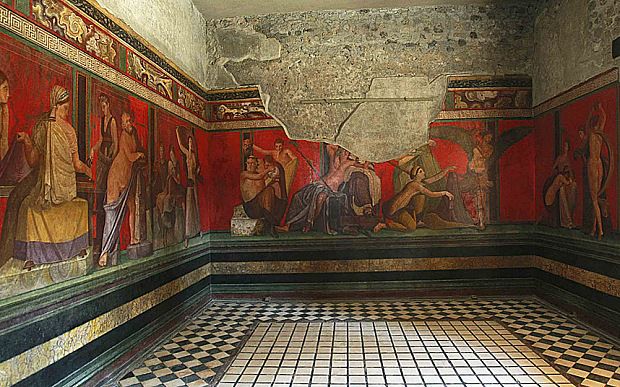
The new excavations have revealed the presence of a rectangular structure with 5 quadrangular rooms, constructed with opus reticulatum walls (a form of Roman brickwork consisting of diamond-shaped bricks of tuff, referred to as cubilia, placed around a core of opus caementicium).

Two rooms have so far been extensively studied. The first room is located on the western side of the structure and is decorated with a thin layer of white plaster with traces of red stripes.

The room contains a quadrangular niche called a lalarium (a shrine to the guardian spirits of the Roman household) that is bordered by a plaster frame with a quadrangular marble base. Several items, including two items of furniture, were identified as voids in the pyroclastic flow deposits that have been replicated with plaster casts.

The second room contains the remains of animals, one complete with a connected skeletal structure and a second small animal located in front of a wooden trough.

The excavation has posed new questions on the peculiarities of the complex, and has opened, or rather reopened, the debate regarding its planimetric development.

The Historic Excavations

Between 1907 and 1908, the Marquis Giovanni Imperiali carried out excavations in the area immediately to the north of the current area, on the basis of an excavation permit granted by the then Ministry of Education to the private individual, according to the norms of regulations in force at the time, and whose reports were published in 1994 with a monograph by the Superintendency.

The historic excavation unearthed 15 rooms relating to two sectors of the villa, one residential and the other productive.

The residential sector was arranged around a rectangular plan peristyle, bordered on the north and east sides by a portico supported by masonry columns, whilst the western side – presumably taking advantage of a natural rise in height, was bordered by a long cryptoporticus covered by a terrace onto which the peristyle opened, with a view over the land in front.

On the eastern side of the peristyle, five rooms were discovered (the only ones whose structure it has been possible to locate, thanks to photographic documentation of the excavation), decorated with paintings of the Third and Fourth Style, and which yielded a varied typology of objects related to daily life, personal adornment, and domestic worship.

Regarding the productive sector, which was probably located on the northeastern side of the building, we lack the information necessary to be able to locate it with certainty, but undoubtedly it consisted of a torcularium, a wine cellar, and other rooms for storing foodstuffs produced in the agricultural land which surrounded the building; the position of a lararium in the southeastern corner of the courtyard is also uncertain.

Over the course of the following years, other random finds have revealed further remains of the structures. In 1955, just before one of the tests carried out during the current investigation, the Archaeological Superintendency brought to light the dividing walls; of particular interest is the presence of two walls parallel and perpendicular to the road track, joined by a connecting wall in opus craticium.

700,000-Year-Old Stone Tools Point to Mysterious Human Relative

700,000-Year-Old Stone Tools Point to Mysterious Human Relative

A recent finding of stone instruments and other evidence has shown that in Southeast Asia hominins, our pre-human relatives – were in South East Asia hundreds of thousands of years earlier than we thought.

The 57 stone tools and an almost complete rhinocéros skeleton which shows signs of being butchered were found in the Philippines and date back 709,000 years.

Previously, the earliest evidence for hominin habitation in the area was found in Callao Cave, a river-floodplain on the northern island of Luzon. It’s only 67,000 years old.

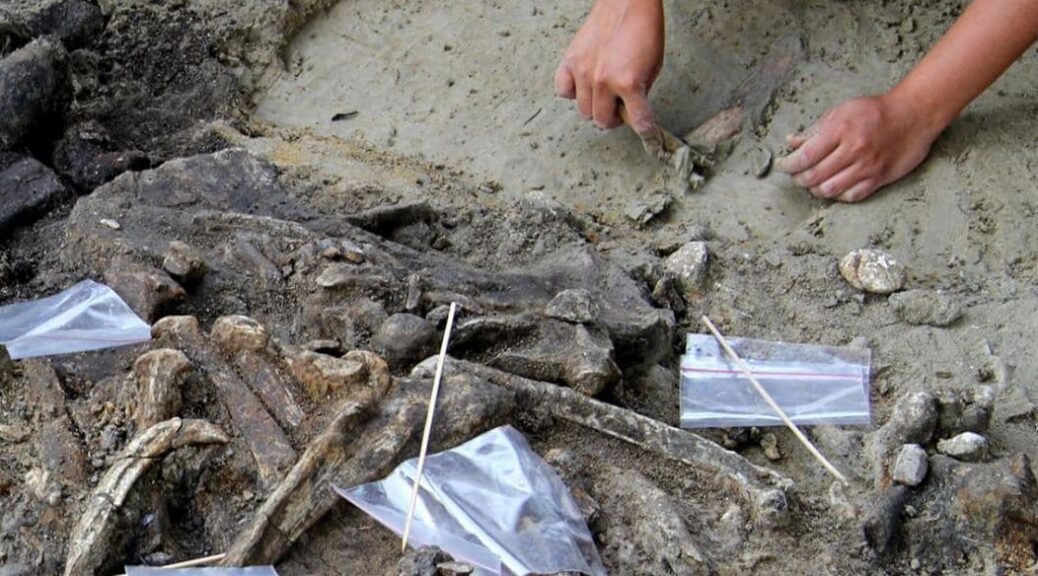
Researchers found a 700,000-year-old site on the Philippine island of Luzon where unknown hominins butchered a rhinoceros. To avoid damaging the bones, the team dug them up with only bamboo sticks.

The tools found consist of 49 sharp-edge stone flakes, six cores – the stones from which the flakes are hammered – and two possible hammer stones. In addition, the site yielded a collection of skeletons: a stegodon, brown deer, freshwater turtle, and monitor lizard.

The rhinoceros skeleton was very interesting. Several of the bones had cut marks consistent with butchering, and the humerus bones seemed to have been hit with a hammerstone, possibly to access the rich marrow inside.

The tools weren’t made by humans – our oldest evidence of Homo sapiens is from about 300,000 years ago – but by a close ancestor. And their presence means we need to reconsider how humans and hominins spread through South East Asia.

Archaeologist Gerrit van den Bergh from the University of Wollongong in Australia says that hominins most likely spread through the region in several waves throughout the millennia.

He also believes that they probably travelled from north to south from China and Taiwan, rather than west to East from Borneo or Palawan through Indonesia, using the ocean currents and settling as they went.

Eventually, this migration could have landed on the Indonesian island of Flores to give rise to Homo floresiensis, also known as the “hobbit” for its small stature.

Evidence of hominins dating back 700,000 years has been found on the Indonesian island of Java. In addition, Homo floresiensis ancestors have been found on Flores from around the same time. Both of these finds are consistent with the new migration hypothesis.

Previously, it had been thought that hominins didn’t have boats, and therefore couldn’t have travelled by water to reach Luzon and the other islands of Wallacea, the group of islands separated from mainland Australia and Asia by deep oceans.

But the north-to-south migration hypothesis is supported by another fossil record: that of animals.

“If you look at the fossil and recent faunas you see that there is an impoverishment as you go from north to south. On Luzon, you find fossils of stegodons, elephants, giant rats, rhino, deer, large reptiles, and a type of water buffalo.

“On Sulawesi, the fossil fauna is already impoverished; there’s no evidence of rhinos or deer ever entering there. Then on Flores, you only had stegodons, Komodo dragons, humans, and giant rats, that’s all,” van den Bergh said.

“If animals did reach these islands by chance, by entering the sea and following the currents south, then you would expect the further south you go the fewer species you would find – and that’s what we see.”

If the animals didn’t have boats, the humans needn’t have either. However, they could have had rafts, used for fishing, or been caught up in debris and carried out to sea by tsunamis, which are relatively common in the area.

Who these hominins were is unknown, and will probably remain so without their bones to study. They could have been the ancestors of the owner of that foot bone hundreds of thousands of years later; they could have been Luzon’s version of Homo floresiensis; or they could have been a different group, perhaps even the mysterious Denisovans. But the discovery has archaeologists excited to keep digging to see what else they can find.

“There’s a lot of focus again in the islands of South East Asia because they are places where you find natural experiments in hominin evolution. That’s what makes Flores unique, and now Luzon is another place we can start looking for fossil evidence,” van den Bergh said.

“On Flores, we’re pretty certain they arrived about 1 million years ago based on stone tool evidence, but we don’t know when hominins first arrived on Luzon. Now we can go looking in older strata and see if we can find more artifacts, or even better, fossil evidence.”

5,700-year-old Neolithic house discovered by archaeologists in Cork

5,700-year-old Neolithic house discovered by archaeologists in Cork

Archaeologists in North Cork have uncovered the foundations of a 5,700-year-old Neolithic house in addition to evidence of Iron Age smelting and Bronze Age burial sites. 

5,700-year-old Neolithic house discovered by archaeologists in Cork
The incredible discoveries were made following eight excavations in sites across north Cork

The archaeologists excavated a total of eight sites as part of two road realignment projects on the N73 road which links Mallow and Mitchelstown, near the villages of Shanballymore and Kildorrery, and a house dating back to 3700BC was found at one of the sites.

It is believed that the house belonged to some of the very first people to live in the area and found alongside were quantities of grain, pottery, and stone tools dating back to the same period.

At a different site in the townland of Waterdyke, archaeologists found evidence of charcoal pits required in the smelting process to produce iron. The pits date back to between 266AD and 1244AD while further evidence of smelting was also found at Annakiska South. 

There was also evidence of a 17th-century enclosure at Annakiska South as well as clay pipes and glass in addition to evidence of a 17th-century smithy situated on the original road that would have made horseshoes for travelers passing between Mallow and Mitchelstown. 

Clay pipes believed to be from the 17th century were among the fragments unearthed by archaeologists in Cork

The Irish Examiner reports that farming knowledge only arrived in Ireland around 200 years before this house was built, meaning that the settlement is one of the oldest farming settlements on the island of Ireland. 

Archaeologists also discovered evidence of ritual sites dating back to roughly the same period at the settlement. 

They found evidence of stone tools and pottery deliberately buried in holes in the Middle Neolithic era (3500BC to 2900BC) in a form of ritual that may have been associated with human burials.

Middle-neolithic pottery found in a sinkhole in Clenor South possibly left as an offering from the people who believed the natural phenomena were portals to the underworld

The tools and pottery may have been buried as an offering of gifts for the gods of the underworld. 

There was also evidence of a barrow cemetery dating back to the Bronze Age nestled by the banks of a meandering stream and overlooked by a nearby settlement. 

Cork County Council and Transport Infrastructure Ireland (TII), who carried out the excavations and the roadworks, published an “online story map” documenting the archaeologists’ results. 

The online map, created by TII project archaeologist Ken Hanley and Cork County Council resident archaeologist Ed Lynne, also documents previously discovered sites along the route and can be viewed here. 

A lost city discovered by Archaeologists when they explore a rural field in Kansas

A lost city discovered by Archaeologists when they explore a rural field in Kansas

In the Great Plains of Kansas, archaeologists have made an innovative and unlikely discovery: a vast town lost centuries ago. Donald Blakeslee discovered a few years ago the lost city of Etzanoa in Arkansas City, Kan, a Wichita State University anthropologist, and an archaeology professor. 

Anthropologist and archaeology professor Donald Blakeslee in one of the pits being excavated in Arkansas City, Kan.
Kacie Larsen of Wichita State University shakes dirt through a screened box to see what artefacts may emerge.

In that small city in south-central Kansas, local residents found the arrowhead and the gold mine underneath their town, pottery, and other ancient artefacts, for decades, in the fields and rivers of the region.

According to the Los Angeles Times, Blakeslee used newly translated documents written by the Spanish conquistadors who came across the land over 400 years ago to determine that these artifacts were once part of the Native American lost city of Etzanoa.

“‘I thought, ‘Wow, their eyewitness descriptions are so clear it’s like you were there,’” Blakeslee told the Times about reading the conquistador’s accounts. “I wanted to see if the archaeology fit their descriptions. Every single detail matched this place.”

The city of Etzanoa is believed to have been around from 1450 to 1700 and was home to approximately 20,000 people. Blakeslee said that the city was the second-largest settlement in the present-day United States at the time and spanned across at least five miles of the space between the Walnut and Arkansas rivers.

The 20,000 inhabitants of Etzanoa were said to have lived in “thatched, beehive-shaped houses.”

In 1541, conquistador Francisco Vazquez de Coronado came to the town hoping to discover its fabled gold but instead found Native Americans in a collection of settlements that he called Quivira.

Sixty years later in 1601, Juan de Oñate led a team of 70 conquistadors from New Mexico to Quivira, also hoping to find its gold but they ran into a tribe called the Escanxaques, who told them of the nearby city of Etzanoa.

Oñate and his team arrived at the city and were greeted peacefully by the inhabitants of Etzanoa. However, things quickly went south when the conquistadors started taking hostages, which then caused the city’s residents to flee in fear.

The group of conquistadors explored the vast area of more than 2,000 houses but feared an attack from the peoples they dislodged and decided to return home.

On their return trip, they were attacked by some 1,000 members of the Escanxaque tribe and a huge battle took place. The conquistadors lost and returned home to New Mexico, never to come back to the area again.

French explorers came nearly a century later to that part of south-central Kansas but did not find any evidence of Etzanoa or its people. It is believed that disease caused the untimely demise of the population.

However, traces of the people and their city would not stay hidden forever. Blakeslee and a team of excavators found the site of the ancient battle in a neighborhood in Arkansas City and found remanents from the battle.

Locals in the area had been uncovering artifacts from the lost city for decades but didn’t understand why until evidence of the city itself was discovered by Blakeslee.

“Lots of artifacts have been taken from here,” Warren “Hap” McLeod, a resident of Arkansas City who lives on the spot where the battle took place, told the Times. “Now we know why. There were 20,000 people living here for over 200 years.” One local resident said that the sheer amount of artifacts that people in the area have is mindblowing.

Russell Bishop, a former Arkansas City resident, shows off the arrowheads he found in the area as a kid.
Professor Donald Blakeslee of Wichita State University shows a black pot unearthed by student Jeremiah Perkins, behind him.

“My boss had an entire basement full of pottery and all kinds of artefacts,” Russell Bishop told the Times. “We’d be out there working and he would recognize a black spot on the ground as an ancient campfire site … I don’t think anyone knew how big this all was. I’m glad they’re finally getting to the bottom of it.”

The Great Plains were long-regarded as huge, empty spaces in ancient times that were populated mainly by nomadic tribes. But Blakeslee’s discovery of Etzanoa could prove that some of the tribes in the area weren’t nomadic and were actually more urban than previously believed.

Blakeslee has also discovered evidence that similar, large-scale lost cities could be located in nearby counties which might have been around during the time of Etzanoa. These latest groundbreaking archaeological finds are helping researchers fill in huge blanks in early American history.

1,900 years ago: Terrified mother and child’s final moments preserved in ash after Pompeii volcano blast

1,900 years ago: Terrified mother and child’s final moments preserved in ash after Pompeii volcano blast

Having been buried in ash for over 1,900 years, this tragic story of what seems to be a child on the belly of its terrified mother is a step closer to being unveiled in this disturbing image.

In 79 A.D., after the catastrophic eruption of Mount Vesuvius, Restorers are working on the carefully preserved plaster casts of 86 Romans at Pompeii, including a child seemingly frozen in terror.

It is believed that the child was four, due to his height and was sheltering in a location dubbed House of the Golden Bracelet with his family when tragedy struck.

This haunting image shows what appears to be a child resting on the stomach of an adult. It is estimated that anywhere between 10,000 and 25,000 residents of Pompeii and nearby Herculaneum were killed on the spot
Restorers are working on the carefully preserved plaster casts of 86 of the Romans trapped in Pompeii in 79 AD, including children seemingly frozen in terror. Here, Stefano Vanacore, director of the laboratory at Pompeii Archaeological Site can be seen carrying the remains of a petrified child in his arms
Experts at the site are readying the poignant remains for a forthcoming exhibition called Pompeii and Europe. It could be supposed that this victim was trapped in a building or terrified

He was discovered alongside an adult male and female, presumed to be his parents, as well as a younger child who appeared to be asleep on his mother’s lap. The little boy’s clothing is visible in the plaster cast, and his facial expression is one of peace, Decoded Past reported.

Stefania Giudice, a conservator from Naples national archaeological Museum, told journalist Natashas Sheldon: ‘It can be very moving handling these remains when we apply the plaster.’ 

‘Even though it happened 2,000 years ago, it could be a boy, a mother, or a family. It’s human archaeology, not just archaeology.’

The perfectly-preserved settlement was discovered by accident in the 18th century, buried under 30ft (9 metres) of ash. Archaeologists were amazed to find human remains inside the voids. Plaster of Paris was poured inside to create casts of humans, and when this material is broken it reveals bones inside (shown)
The perfectly-preserved settlement was discovered by accident in the 18th century, buried under 30ft (9 meters) of ash. Archaeologists were amazed to find human remains inside the voids. Plaster of Paris was poured inside to create casts of humans, and when this material is broken it reveals bones inside (shown)

Experts at the Pompeii Archaeological Site are readying the poignant remains for a forthcoming exhibition called Pompeii and Europe. The people’s poses reveal how they died, some trapped in buildings, and others sheltering with family members. 

In one haunting image, Stefano Vanacore, director of the laboratory can be seen carrying the remains of the tiny child in his arms who was imprisoned in ash when the volcano erupted on 24 August. 

Another plaster cast of an adult reveals he raised his hands above his head in a protective gesture, seemingly in a bid to stave off death. Pompeii was a large Roman town in the Italian region of Campania. 

Reports claim two thousand people died, and the location was abandoned until it was rediscovered in 1748
The majority of plaster casts were made in mid 19th century, meaning that some have degenerated and need repairing, offering experts a glimpse inside them

Mount Vesuvius unleashed its power by spewing ash hundreds of feet into the air for 18 hours, which fell onto the doomed town, choking residents and covering buildings.

But the deadly disaster occurred the next morning, when the volcano’s cone collapsed, causing an avalanche of mud travelling at 100mph (160km/h) to flood Pompeii, destroying everything in its path and covering the town so that all but the tallest buildings were buried.

People were buried too in the ash, which hardened to form a porous shell, meaning that the soft tissues of the bodies decayed, leaving the skeleton in a void. Reports claim two thousand people died, and the location was abandoned until it was rediscovered in 1748.

Many of the buildings, artifacts, and skeletons were found intact under a layer of debris. It is now classified as a Unesco World Heritage Site and more than 2.5 million tourists visit each year, French and Italian archaeologists excavating areas of the ancient town found raw clay vases that appear to have been dropped by Roman potters fleeing the disaster.  

The perfectly-preserved settlement was discovered by accident in the 18th century, buried under 30ft (9metres) of ash. Excavators were amazed to find human remains inside voids of the ash and soon worked out how to create casts of the people to capture a moment frozen in time.

Archaeologists poured plaster inside to capture the positions the people were in when they died, trapping their skeletons inside the plaster before removing the cast from the hole a couple of days later.

The technique means it’s possible to see the anguished and pained expressions of men, women, and children who all perished as well as details such as hairstyles and clothes.

Roman writer, Pliny the younger, described the panic during the eruption of Mount Vesuvius. Terrified Romans (illustrated) living in the towns of Pompeii and Herculaneum saw ‘sheets of fire and leaping flames’ as they ran through dark streets carrying torches with pumice stone raining down upon them, he said

Creating casts is an exact science because the plaster must be thin enough to show details of the person, but thick enough to support the remains, the BBC reported.

Approximately 1,150 bodies have been discovered so far, although a third of the city has yet to be excavated. The majority of plaster casts were made in the mid 19th century, meaning that some have degenerated and need repairing, offering experts a glimpse inside them.

In all, only around 100 of the voids have been captured in plaster, to reveal people’s poses as well as writhing pet dogs, for example. It is estimated that anywhere between 10,000 and 25,000 residents of Pompeii and nearby Herculaneum were killed on the spot.

Britain’s secret treasure trove of stone age rock art

Britain’s secret treasure trove of stone age rock art

They have been found where the earth meets the sky, high up on the moorlands of northern England, a mysterious series of strange and ancient carvings hewn into the rocks and boulders.

More than 100 elaborate carvings dating back thousands of years have been discovered on rocks and boulders in the North of England. The art, thought to be the work of Neolithic man, is open to the air but is so remote that it had lain undisturbed and undetected for thousands of years  –  until it was recently discovered by English Heritage.

It includes a series of intricate designs of concentric circles, interlocking rings, and hollowed cups. They are among only 2,500 examples that exist in England – having survived natural erosion, quarrying, and field clearance. Around 100 volunteers, trained by English Heritage, have been recording the location, content, context, and condition of rock art for the last four years as part of the pilot project.

Britain's secret treasure trove of stone age rock art
Volunteers have found more than 100 examples of ancient rock art in places like the Ketley Crag in Northumberland

During the Neolithic period, 4,000 to 6,000 years ago, the man moved away from the roaming existence of the hunter-gatherer who traversed the country, following his prey, to a more settled existence.

New Stone Age man preferred to stay put, tending cereals and domestic animals. How all of this fitted in with the abstract curves of their rock carvings is anyone’s guess.

Mysterious presence: A carved boulder at Baildon Moor, West Yorks

It’s not possible to date the art itself, but its age can be assessed by the context in which it is found. For example, if it is near burial sites which took the form of large cairns or long mounds in which people are buried in groups, it is more likely to date back to the New Stone Age.

The most interesting discovery includes a large carved panel found on a sandstone boulder on Barningham Moor, a 300m-high (984ft) area of Co Durham, on the edge of the Pennines.

It features abstract carvings — interlocking grooves and hollowed cups with surrounding circles. Tools of stone or bone were used to carve the symbols and the work is so well preserved that the ‘peck’ marks are still visible.

Barningham Moor has revealed an elaborately carved panel

Kate Wilson, inspector of ancient monuments at English Heritage, said: ‘There are many theories as to what rock art carvings mean. They may have played a role in fire, feastings and offering activities, or been used as signposts, or to mark territory.

‘They may have spiritual significance. In hunter-gatherer communities, those places where mountains touch the sky or the sea reaches the shore are often considered the domain of supernatural ancestors. Most rock art is found in those areas.’

She said that the Neolithic Age saw the arrival of ‘a fairly sophisticated culture’, with the introduction of agriculture. ‘They were settling and cultivating something,’ she added.

Revealed after 5,000 years by a team of English Heritage volunteers at Buttony, Northumberland Buttony Northumberland

‘You find monuments such as stone circles and henges. Something’s going on where society’s changing. This is a story yet to be told.’

The results of the four year initiative – funded by English Heritage, in partnership with Northumberland and Durham County Councils – will now be published online.

Richard Stroud, a volunteer who discovered the Barningham boulder, said: ‘We expected to discover one or two simple carvings. Instead, we found a breathtaking panel, probably one of the most complex discovered in County Durham.’

A mysterious circular design was uncovered in Chatton, Northumberland

He added: ‘There is a gulf of time and civilization between the society that carved this stone and ours, its true meaning is something we will possibly never understand.’

Edward Impey, director of research and standards at English Heritage, said: ‘The online record of the Northumberland and Durham examples will serve as the starting point for a national survey, and, we hope, help us understand their meaning and lead to the discovery of others.’

Logging of ‘rock art’ was led for decades by retired Hexham headmaster Stan Beckensall, who went on to donate his archive to Newcastle University. His finds over the last 50 years have now been added to the online database of 1,500 carvings. English Heritage is now hoping the pioneering work undertaken will be continued in other counties to create a nationwide record.

This example in Old Bewick in Northumberkand was one of the new discoveries of the four-year English Heritage project

Sara Rushton, the Northumberland county archaeologist, and manager of the project, said: ‘Our volunteer recorders have worked alongside experts in the field to develop new techniques and produce stunning three-dimensional computer models of rock art for display.

‘These models can be manipulated to show some carvings which are now almost completely invisible to the naked eye and will be a fantastic tool for managing these ancient sites for the future.’

A work of rock art uncovered at Dod Law, Northumberland

Made with simple tools of stone or bone, some of the patterns are as plain as a hollowed cup shape. Others feature abstract designs painstakingly carved into the local sandstone.  But despite their meticulous notes, there is only so much we will ever know about the men who laboured to leave such an indelible mark on the landscape. And perhaps that is all part of their magic.

All In One Magazine