Remains of missing World War II pilot from Benson identified in France
The traces of a Western Minnesota pilot of World War II who was killed 75 years ago during the D-Day have been identified.
On Wednesday, the Defense POW / MIA Accounting Agency announced the remains of U.S. Army Air Forces 2nd Lt. William J. McGowan, 23, of Benson, was identified on May 13.
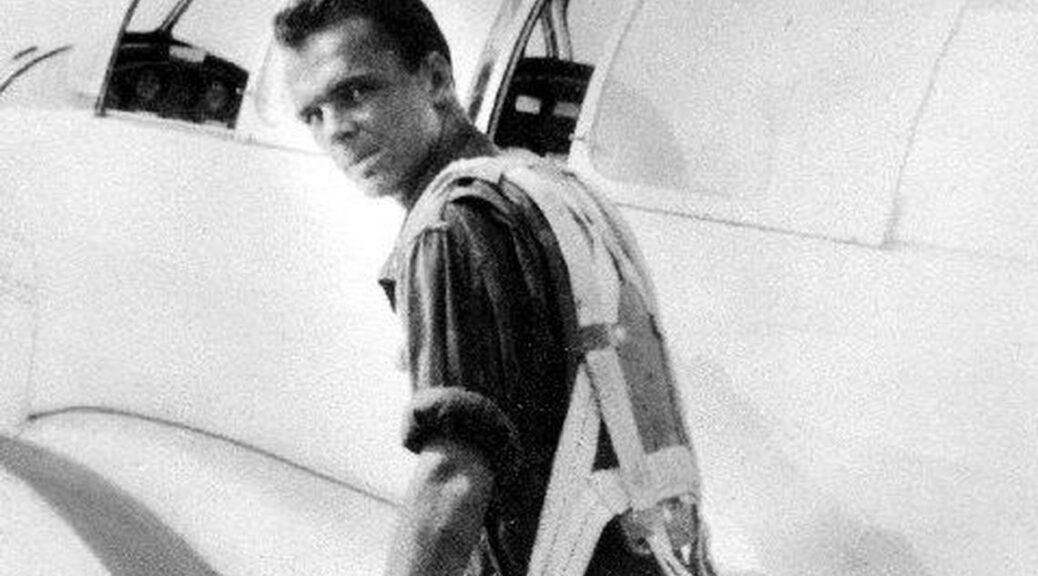
U.S. Army Air Forces 2nd Lt. William J. McGowan is shown in an undated photo from the World War II era. Killed in a plane crash in France during the D-Day invasion on June 6, 1944, his remains have been identified.
McGowan will be buried July 26 at the Normandy American Cemetery in France.
McGowan was a 391st Fighter Squadron member, 366th Fighter Group, 9th United States Air Force. Air force. On the day of the D day, when the P47 Thunderbolt crashed on a mission near the city of Saint-Lô, France, he was killed June 6, 1944.
In 1947, based on information from a French citizen, the American Graves Registration Command investigated a crash site near the village of Moon-sur-Elle that was possibly associated with McGowan’s loss.
An investigator traveled to the site and learned from witnesses that the aircraft burned for more than a full day after impact and it had been embedded deeply into the ground.
A Defense Department team removed wreckage from the impact crater but failed to locate McGowan’s remains. As a result, on Dec. 23, 1947, his remains were declared nonrecoverable.
In 2010, a team from the Joint POW/MIA Accounting Agency traveled to Moon-sur-Elle to interview witnesses and survey the crash site. During the survey, the team found numerous pieces of aircraft debris and recommended the site for excavation.
In July and August 2018, excavation of the site led to possible remains, which were sent to the DPAA laboratory for analysis.
Dental and anthropological analysis, as well as circumstantial and material evidence, were used to identify McGowan’s remains.
McGowan’s name is recorded on the Tablets of the Missing at the Normandy American Cemetery, an American Battle Monuments Commission site in Colleville-Sur-Mer, France.
A rosette will be placed next to his name to indicate he has been accounted for.
Of the 16 million Americans who served in World War II, more than 400,000 died during the war. Currently, there are 72,639 service members still unaccounted for from World War II with approximately 30,000 assessed as possibly recoverable.
Farmer Digging a well find the Terracotta Army of Emperor Qin Shi Huang in China
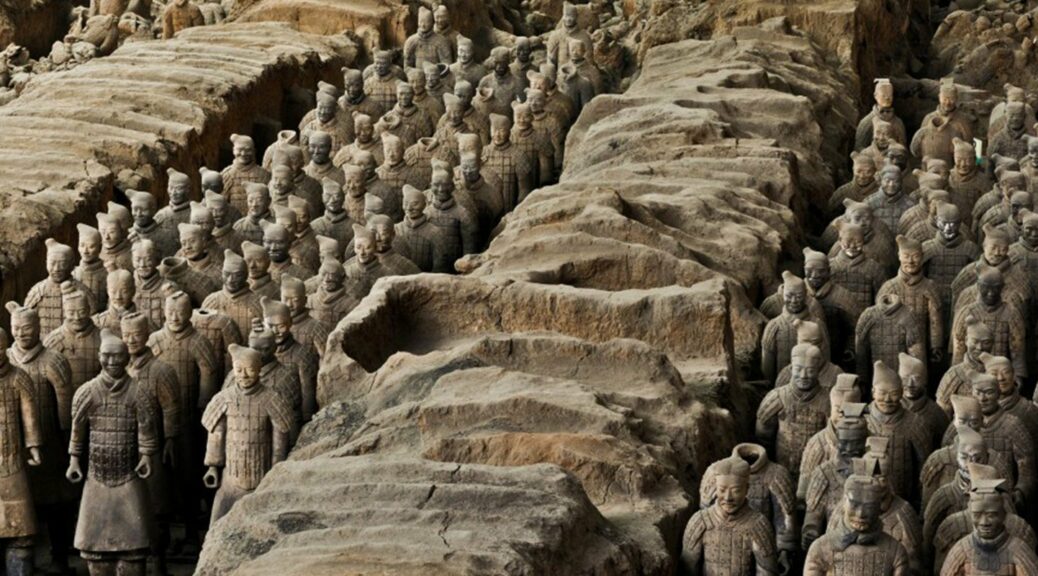
When farmers Yang Zhifa found a piece of an old terracotta as he dug a well, he thought he’d stumbled on a disused kiln that could supply him with free jars. How wrong he was: it turned out to be the first warrior of the famous Chinese terracotta army.
It was in the Chinese New Year in March 1974 and was especially dry in that time, Yang’s production unit decided to dig a well to water the crops of the cooperative farm.
“At first the digging went well. The second day we hit hard red earth. The third day, my hoe dug out the neck of a terracotta statue without a head, but the opening at the bottom was about the size of a bowl,” he recalled.
When archaeologist Zhao Kangmin picked up the phone in April 1974, all he was told was that a group of farmers digging a well nearby had found some relics.
“I commented to my workmate that it was probably the site of an old kiln. He advised me to dig carefully so that we’d be able to dig out any old jars and take them home for our own use.”
As they went on digging, the peasants came across the shoulders and torso of a statue. So it evidently wasn’t a kiln, they thought, but a temple. Then they realised that it was a complete body, apart from one leg that had been cut off, and the missing head. As they went on digging, they turned up bronze items. One of Yang’s colleagues teased him: “You like a nice pipe, and these things will be worth quite a bit of money. You’ll be able to swap them for tobacco.”
Suspicious villagers
“It was the middle of the Cultural Revolution at the time, and everything was topsy-turvy in the villages. People had gathered round and were watching us. When the older ones saw these ‘statues of gods’ and the bronze objects we had dug up, they weren’t at all pleased. They said they were part of the local feng shui, and that digging them up would do no good either to the village or to us.” But Yang had spent six years in the army and knew something about ancient objects.
“People had always said that the tomb of the Qin emperor covered an area of just over 9 hectares and that our village was about two kilometres from the mausoleum. These objects could be of historic interest. So I called some women and harnessed up three two-wheeled carts to transport them […] to the Lintong district museum several kilometres away.“
Yang wasn’t too sure what the museum would say about his find. “If they aren’t of any historic interest, I’ll throw them into the river, have a wash and go home,” he thought as he and his colleagues transported their unusual load. The experts at the museum recognised the fragments and the “statue of the god” as dating from the Qin dynasty – the third century B.C. – and that they were therefore extremely valuable.
“They paid us CNY10 (yuan) per cart, so a total of CNY30. We were really happy to get so much for having brought three carts of terracotta,” said Yang. At the time CNY10 was the equivalent of an annual salary in poor rural areas.
When they got back to the village they handed the money to their production unit, as was required under the collective system. Each one of them was awarded five points – the equivalent of half a day’s work – or 13 fen (a fen being a hundredth of a yuan) that they could use to buy food or other goods. At first, that was their entire reward.
Hour of glory
Yang Zhifa is one of the discoverers of the Mausoleum of the First Qin Emperor
Archaeologists at the site in 1979 – Zhao is not pictured
The authorities then decided to build a museum on the site of the mausoleum. The villagers – including Yang – were displaced. He received 5,000 yuan in compensation for his 167 square metres of land.
He moved to a new village, called Qinyong (meaning “Qin warriors”), six kilometres from the museum. He was given a three-room flat, similar to the ones allocated to other relocated villagers. But they were angry with him: if they had to leave their homes it was “because of him”, he explained. To get away from their hostile looks and remarks, he moved about a kilometre away.
When he thinks about it now, it didn’t really make much difference to his life. But he says that the discovery of the site and the reforms introduced by the authorities led to a rise in the standard of living and some of the villagers have been able to make money by setting up businesses.
But Yang doesn’t have a head for that sort of thing. The museum gave him job signing autographs for visitors. “At first I was earning CNY300 a month. By the time I retired it was 1,000.” Yang had his hour of glory when Bill Clinton visited the museum and asked for his autograph. The former US president isn’t the only world leader Yang met. He can’t remember all the names, but he has their photos on his wall. At the end of March 1990, Swiss photographer Daniel Schwartz, together with an assistant and a technician from Hong Kong, travelled to Lintong to.
Philosophical
When he stopped working at the museum, Yang found himself with practically no income. But he is philosophical about it.
“Whether it’s fair or not, I can’t do anything about it. I’m only a simple peasant,” he commented, but he is not unhappy either. “There were too many people at the museum. Sometimes I didn’t feel too well after working all day.” The museum now draws millions of visitors a year and earns some CNY480 million from them (about CHF72 million).
But few people still remember Yang. His name does not even appear on the explanatory board at the entrance to the display, which says simply that the terracotta army was discovered by local peasants. The People’s Daily wrote that “peasants don’t know anything about science. It’s impossible that they should have discovered anything,” said Yang.
“That’s life. Even if there is a lot of injustice in society, there’s no point in getting angry about it.” And as he pointed out, the discovery of the “eighth wonder of the world” may not have made him rich, but it still makes him proud.
Greek Sponge Divers find the Worlds Oldest Analog Computer
When you ask someone who invented the computer they might say, Bill Gates or Steve Jobs. They would, of course, be wrong. Perhaps they might mention Alan Turing (who proposed a “Universal Computing Museum”) or the US Navy’s WWII era Torpedo Data Computer. But computers, which were initially conceived of as calculating devices, are much older than that and older than the modern world.
An analog computer, an old Greek device designed for the calculation of astronomical position, is the oldest Antikythera mechanism computer in the world. And now media outlets are reporting that a lost piece, which somehow survived looters, has been discovered on the Aegean Seabed.
The Antikythera Mechanism was lost over 2,200 years ago when the cargo ship carrying it was shipwrecked off the coast of the small Greek island of Antikythera (which is located between Kythera and Crete).
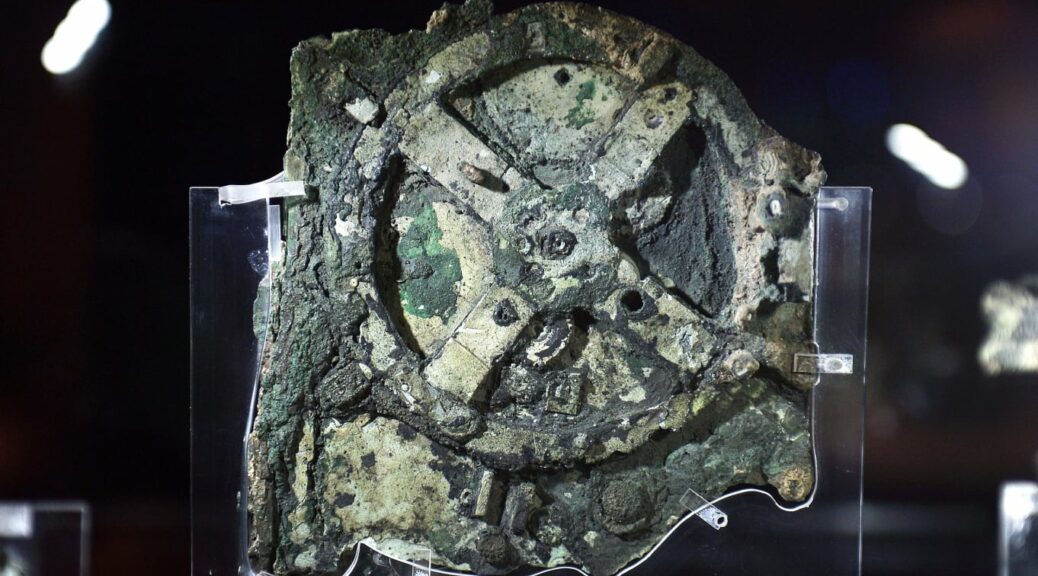
The rear face of the Antikythera mechanism.
The Mechanism was initially discovered in 1901 when Greek sponge divers found an encrusted greenish lump. They brought the mechanism, which they believed to be a rock, to archaeologist Valerios Stais at the National Archaeological Museum in Athens.
Over the ensuing decades the site was looted, trampled on by explorers, and, in 1976, the famous French explorer Jean-Jacques Cousteau inadvertently destroyed much of what remained of the ship’s hull.
Initially, no one knew to want the lump was. Two millennia had eaten away at the ship and its cargo. Stais’ cousin, Spyridon Stais, a former mathematician, was the first to identify the gears in the mechanism.
It was only with the development of advanced x-ray technology and the collaboration of numerous individuals (from Cousteau to modern historians of science like Alexander Jones) that the heavily corroded rock was revealed to be a technologically advanced calculator.
How advanced? The second century BCE Mechanism could do basic math, calculate the movements of the sun and moon, track the movements of the constellations and planets, and predict eclipses and equinoxes.
It contains over thirty hand-worked cogs, dozens more than the average luxury Swiss watch. It may not have the faculties of an iPhone but it is more than a simple calculator.
In 2012, almost 50 years after Cousteau’s excavations, a new team of underwater archaeologists returned to re-examine the site.
They discovered hundreds of previously unnoted artifacts, including bronze and marble statues, furniture, coins, and a sarcophagus lid. But last year, on the seabed, they discovered something else: an encrusted corroded disk about 8cm in diameter.
X-ray analysis has revealed that the disk bears an engraving of the zodiac sign Taurus, the bull.
The discovery of a piece of the world’s oldest analog computer would be a huge and remarkable discovery on its own terms. But it has additional significance in what it can tell us about the development of the field of archaeology itself.
As Sarah Bond, an associate professor of Classics at the University of Iowa, told The Daily Beast “The Antikythera Mechanism is an important object in the historical record of ancient technology, but is also a prism for tracking the development of archaeology as a professional field … It reveals the advanced astrological instruments created and used by ancient engineers, but the protracted nature of the undersea dig reveals archaeological advances in scanning, 3D modeling, and many other sophisticated approaches in reconstructing and analyzing ‘the computer’.” Elsewhere Bond has written about the unseen labor of the divers who engaged in the risky work that discovered the original Mechanism.
Other scholars have exhibited concern that the discovery of the new disk is being sensationalized. On social media, David Meadows and Michael Press have rightly pointed out that the year-old discovery is only making news because of the sensational claim that it belongs to the Antikythera Mechanism.
It is difficult to say precisely what this new piece is; it might be part of the original Antikythera Mechanism or part of a second similar device.
The presence of the bull engraving suggests that it may have predicted the position of the constellation of Taurus but it is difficult to say.
While scientific study continues, the discovery has drawn attention to both the existence of this ancient ‘calculator’ and its amazing history
In summer, a somewhat unexpected traces of a large cemetery from the Middle Ages appeared in archaeological excavations in Kjøpmannsgata Norway.
Excavation work in connection with new building schemes took place in Kjøpmannsgata in 2019. As with all new builds in Norway, an archaeological examination of the site in central Trondheim has taken place.
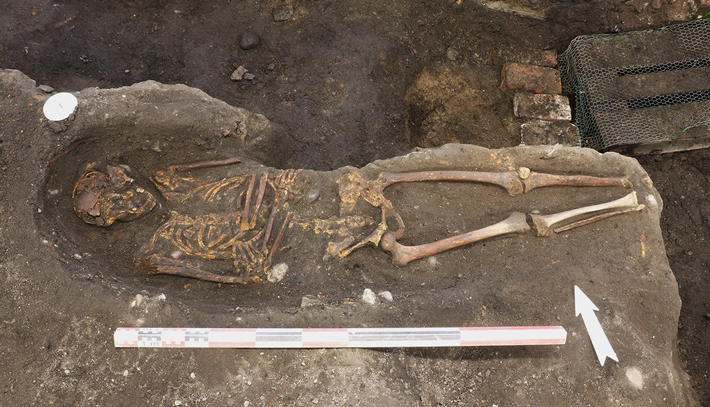
The most highlighted work so far is the unelected cemetery. It’s surprising not only for its location but for its size. To date, 15 individual graves and three pit graves have been found.
The team of NIKU archaeologists is currently working in Trondheim.
Heads were turned last summer when one of these pits was uncovered. It contained the human remains of an estimated 200 people. It is believed these remains were excavated from other cemeteries and reburied here during development work sometime in the 17th century. Two more pit graves have since been found.
As it doesn’t appear on any maps, it is not yet known when this cemetery was built or for how long it has been in use. These are some of the questions archaeologists are hoping to answer during the investigation.
A team from the Norwegian Institute for Cultural Heritage Research (NIKU) is currently working on the site of the former Kjøpmannsgata cemetery under a heated tent.
Archaeologists are closely studying a 12-square-meter area of the cemetery. Although 15 graves have been found so far, they expect the final count to be up to 30. Of those found far, seven were adults, five were children, with three yet to be excavated.
“There are probably even more graves further down. All of these individual graves are in situ, i.e. located in the same place as when they were buried, but several have been partially destroyed. In many cases, only the upper body has been preserved.
The lower half can be cut by, for example, other graves being laid over or by later excavation work.” Those were the words of NIKU project manager Silje Rullestad.
The cemetery has been clearly impacted by several stages of building work, but the team can nevertheless see a clear structure. The northern boundary of the area appears to be marked by a ditch, while four post holes suggest a clear boundary mark.
“This collection and reburial of bones must have been an extensive job,” says archaeologist Monica Svendsen. She is responsible for the digital mapping and documentation of the excavation.
She explains that all three pits consist of deep wooden boxes filled with human bones. They Replaced parallel to the trench that archaeologists assume marks the medieval demarcation of the cemetery.
At the same time as the cemetery excavation is underway, a survey will also be conducted. In collaboration with COWI, NIKU will systematically take samples of soil and human bones to survey soil and biochemical conditions in the cemetery soil.
“From the archaeological excavation of the St. Clement’s Church churchyard, large variations in the degree of conservation of the skeletons were observed. We also see the same here in Kjøpmannsgata. Using the study, we will try to map out why the differences in conservation conditions vary within small distances,” says Rullestad.
The survey could provide a better understanding of the conditions that affect the preservation of human remains.
1,200-Year-Old Viking Runestone May Warn of Climate Change, Study Says
Most people in the modern world are very worried about climate change and the Vikings seem to also be very worried about climate change.
Scientists are now claiming that one of the most popular runestones, erected by Vikings, shows they feared a cataclysmic fall in the temperature and terrible winters. This probably influenced the development of their culture and myths such as Ragnarök.
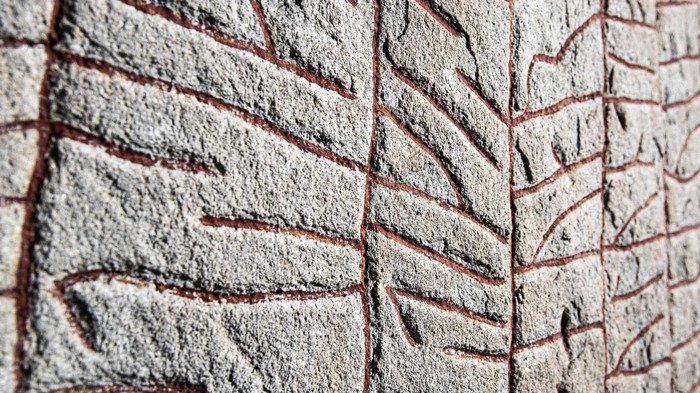
When they made the discovery, researchers reinterpreted this Viking runestone, known as the Rök Stone. This is a stone that is covered in runes, which are the characters of the written language of the Viking world.
It was founded in the beginning of the 9th century in the south of Sweden near Vättern lake. The BBC reports that it “believes to be the world’s longest runic inscription, with more than 700 runes covering its five sides.”
It was long believed that the stone was erected by a person of some social standing to commemorate a dead son. It also alluded to battles that took place in the past, and a reference to Theodoric, which may be a reference to the Ostrogothic king who built a powerful Germanic kingdom based in Italy.
He was one of the most powerful monarchs of his time and often simply known as Theodoric the Great. However, the meaning of the texts has remained mysterious, because the writing styles are unusual, and some important parts are missing.
Full shot of the Viking runestone (‘the Rök Stone’) that is now believed to show the Viking’s fears of climate change.
A multidisciplinary study involving three Swedish Universities believes that this Viking runestone also had another meaning. Researchers from disciplines such as philology, semiotics, and history, collaborated on the study, which revealed an important allusion in the writing. They have interpreted the runes as referring to a period of extreme winter and cool summers, which the Vikings feared greatly.
The researchers in a new study state that “the inscription deals with anxiety triggered by a son’s death and the fear of a new climate crisis,” reports Live Science.
They believe that the runes refer to the climate crisis of 536 AD. A series of volcanic eruptions in the sixth century in the southern hemisphere, caused the temperature to fall, leading to very cold winters
The cooling in the climate caused harvest failures and famine. The 6th-century crisis, as it is known, led to the population of Scandinavia falling by 50%. This cataclysmic time was passed down in the folk memory of the Vikings and may have been expressed in myths, particularly in the tale of the Fimbulwinter. This was a three-year winter that would proceed Ragnarök, the end of the world.
A scene from the last phase of Ragnarök, after Surtr has engulfed the world with fire, ‘the end of the world’.
Researchers believe that the Vikings feared that there would be a repeat of the climate crisis, even centuries after it devastated Scandinavia.
They believe that the references to battles may be allusions to drastic changes in the climate, which occurred in the 6th century. The experts argue that the battles may illustrate “the conflict between light and darkness, warmth and cold, life and death,” according to the BBC.
The Viking runestone does not only indicate an awareness of the impact of a past climate change but also a fear of a new one. Ominous events from the author of the runes are also recorded, which may have been seen as signs of an impending climate crisis.
These included a solar eclipse and a cold summer that reduced crop yields. Bo Graslund, an archaeology professor at Upsala University, told Science Alert “even one of these events would have been enough to raise fears of another Fimbulwinter,” as in the myth of Ragnarök.
Uppsala University Publications, reports that the researchers interpret the runes as referring to “nine enigmatic questions. Five of the questions concern the sun, and four of them, it is argued, ask about issues related to the god Odin.”
The exact meaning of the questions is unknown, but they would seem to suggest anxiety about the sun and climatic cooling. They may indicate a concern that the sun may fail to warm the earth, as in the 6th-century climate crisis, leading to a long winter and the onset of Ragnarök.
The researchers’ new interpretation also found similarities between the texts and “early Scandinavian poetry, especially in the Eddic poem Vafþrúðnismál,” according to Uppsala University Publications.
This new interpretation of the Viking runestone is providing new insights. It demonstrates that the fear of climate change greatly influenced the Viking’s worldview and culture. Additionally, the runestone shows them to be deeply conscious of the fragility of their society and world.
Secrets of an astonishingly well-preserved 2,600-year-old human brain
Experts who researched an iron-age skull brain of 2,600 years of old have found evidence to explain why it survived until modern times in a mud pit. The answers could shed light on the treatment of brain diseases, including Alzheimer’s disease.
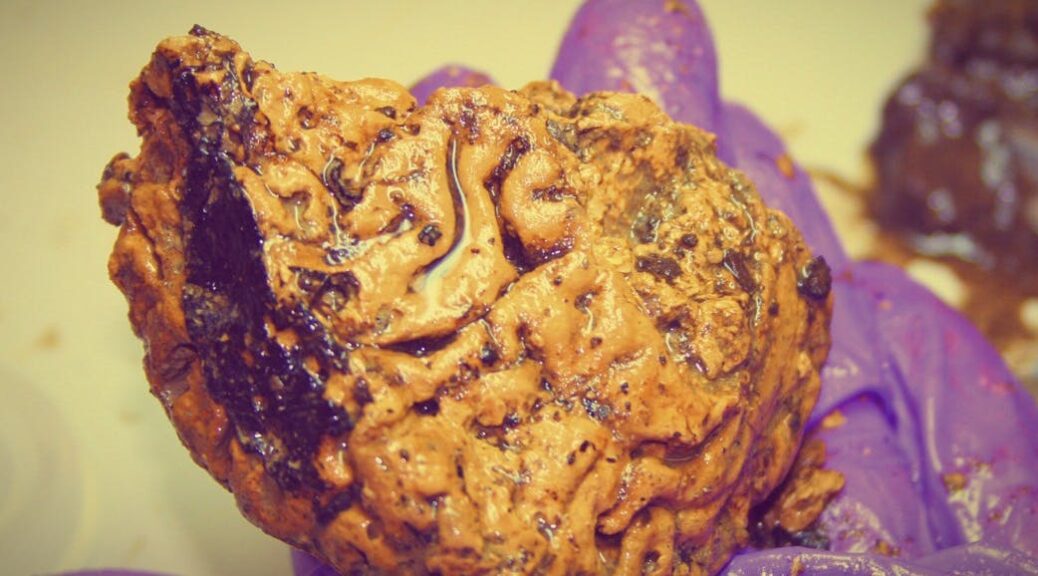
A sample of the Heslington brain.
The brain, that came from a UK man who died more than 2,000 years ago, survived all those years without decomposition, has been found by a team of international researchers.
This research, which was published in the Royal Society Interface Journal, reveals how the scientists examined brain tissue for months and concentrated on protein in the tissue to help them understand deeper the functioning of the brain.
The brain was discovered first in a hidden inside mud pit in Heslington, Yorkshire, England in 2008. The brain was known as the Heslington brain.
Many scientists claim that the brain is the oldest one ever found in Eurasia, being dubbed as the best-preserved brain worldwide. The brain dates to about 482 to 673 BC, which was the start of the Iron Age.
The analysis of the brain tissue showed that it was from a male who was likely decapitated. The brain tissue had withstood many factors but had managed to survive for thousands of years. Now, scientists have unlocked one of the mysteries surrounding the brain tissue.
The researchers have carried out the first-ever detailed analysis of the brain tissue using powerful microscopes. The team scanned the brain with a focused beam of electrons.
The brain was studied at a molecular level, focusing on the presence of proteins that are harder than any other material found in the brain.
The skull with preserved brain material inside.
They found more than 800 proteins in the tissue sample. Some were in good condition, and they were able to study and work up an immune response to them. Further, they found that the proteins had folded themselves into tight-packed stable aggregates that were more stable than those found in the normal and healthy brain today.
The skull within which the brain was found.
The formation of the aggregate explains how the brain was able to evade decomposition and got preserved for thousands of years.
They also pinpointed that the environment where the skull was discovered had helped in the preservation. The fine-grain sediment was cold and wet, which may have warded off oxygen that the flesh-eating microorganism need to survive.
The study findings can help scientists today study brains diseases, such as dementia, that are related to protein folding and aggregate formation.
Diseases such as dementia and Alzheimer’s disease involve the development of rogue proteins dubbed as amyloid and tau. These proteins work by killing brain cells when they clump together.
In the case of the preserved brain, it was the process of aggregate formation that allowed the brain to survive across more than 2,000 years.
The discovery of the tight-packed aggregates provided new proof for the long-lasting stability of non-amyloid protein aggregates, which permit the preservation of brain proteins.
The brain tissue offers a unique chance to use molecular tools to examine how to preserve human brain proteins. Eventually, this could help scientists to find a way to battle dementia, particularly Alzheimer’s disease.
Dementia affects around 50 million people worldwide, with 10 million new cases each year. By 2030, the projected number of people with dementia is 82 million and 152 million by 2050.
Alzheimer’s disease is a progressive and irreversible brain disorder that gradually damages memory and cognitive skills. In the long run, patients with the condition may have problems with simple tasks.
Alzheimer’s disease is the most common form of dementia, and in the United States, it is the 6th leading cause of death.
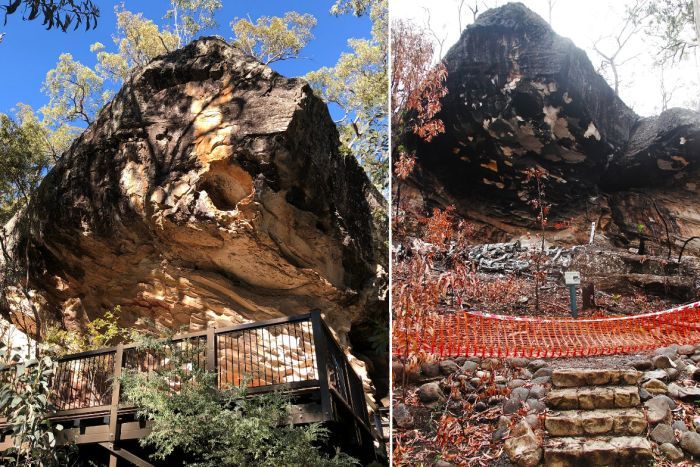
The aftermath of fire damage to important rock art at the Baloon Cave tourist destination, Carnarvon Gorge, Queensland, Australia
The ancient aboriginal rock art in the Baloon Cave in Australia can not be restored following the fire damage, caused by a recycled plastic walkway, ignited into a fireball in 2018.
After the recycled plastic walkway, old rock art including handprints and carving petroglyphs was destroyed, supposedly protecting the site, exploded into a ball of flames during a bushfire in Carnarvon National Park last year.
The artwork dating back several thousands of years has now been lost forever as experts who assessed the site announced that it cannot possibly be restored.
Some of the painted hand stencils date back 8,000 years while others had been created in more recent times, and Dale Harding, a member of the Baloon Cave working group, told ABC.net that the Aboriginal rock art was part of an ongoing cultural project providing links between his Bidjara, Ghungalu and Garingbal ancestors. Now, after realizing the extent of the destruction caused at Baloon Cave during 2018’s devastating Queensland bushfires, Mr. Harding has called for the removal of “all flammable structures” at vulnerable sites across the country.
Furthermore, the Brisbane Times spoke with Griffith University anthropologist and archaeologist, Paul Tacon, who described the fire as “a huge bomb going off” and that he was “horrified” to see the damage and destruction first-hand at the site.
Aboriginal rock art (hafted stone axe and hand stencils) before the bushfire that destroyed the Baloon Cave in Queensland in 2018.
Talking of what the loss means, culturally, to the indigenous Bidjara, Ghungalu and Garingbal communities, Mr. Harding said the art was the “foundation and the basis of who I identify as.” He added that his elders describe the whole Aboriginal rock art network as being “a university, a hospital and a cathedral” and that the incident was akin to the “destruction of Notre Dame Cathedral for the people of Paris, and that can’t be taken back,” he lamented.
Trying to understand how such a terrible thing could happen, Professor Tacon said the destruction would “not have occurred” if it hadn’t been for the installation of recycled plastic walkways, which he describes as “solidified petroleum.” Tacon said that if you have a hot fire underneath these plastics, they melt and then explode into a fireball, “and that’s exactly what happened.”
Detailing the damage, Professor Tacon said a chunk of rock from a set of “hafted stone axes” located high on the wall broke away and what’s left now has a large crack running through it. What’s more, the ancient cave art also suffered extensive water damage from the steam that was released from the plastic as it burned.
The same Aboriginal rock art as above but after the explosion.
What is perhaps most worrying in this story is that a similar incident occurred in 2008 when a fire at Keep River in the Northern Territory set off another recycled-plastic walkway, and that fireball also caused numerous paintings and engravings within a natural stone archway to crack and crumble away.
Professor Tacon said “this stuff is really dangerous,” and he wants to see political steps taken to assure “no-one ever uses this [recycled-plastic] in a rock shelter with art again.” He suggested replacing them with “non-destructive platforms made out of steel, or concrete and steel.”
Responding to the cultural catastrophe Environment Minister Leeanne Enoch said that personally, she was absolutely devastated, being herself a Quandamooka woman from North Stradbroke Island. After visiting the damaged site, she said she had “felt every bit of the pain that everybody else felt and that there were a lot of tears shed that day,” and that experts had assessed the site confirming it could not be restored.
Since last year, Ms. Enoch’s Environment department has removed plastic boardwalks from other sites of cultural heritage around Queensland, but she outright rejected Professor Tacon’s suggesting that wooden boardwalks should also be removed.
However, this case of destruction at the Baloon Cave is only the beginning of the end for Australia’s ancient arts, most of which are set to vanish as a consequence of environmental pollution.
A Creative Spirits article explains that the “groove depth” measured on petroglyphs has decreased significantly over the last few decades because of a sharp increase in the number of cars in Australia.
Robert Bednarik, the founder of the Australian Rock Art Research Association, said small changes in carbon dioxide levels, temperature, and humidity, influence the growth of microorganisms and algae, which cause irreparable damage.
Even if an ancient engraving is not directly exposed to rain, Aboriginal rock engravings crumble by about half a grain of rock per year, through dew and fog settling in the grooves. While traditionally it was customary for indigenous specialists to repair and renew their ancestral artworks, National Parks today forbid Aboriginal people to do this. Thus, the only petroglyphs that you will see 100 years from now, according to Dr. Bednarik, are those very deeply carved, representing a small minority.
Talking of cultural issues in the land down under, it would seem Australian political culture has run ahead of itself and the relentless fight for control is having a catastrophic effect on the environment and on Aboriginal culture. Only yesterday a Daily Mail article reported that the Green’s political party leader, Richard Di Natale is regularly criticized by the Conservatives for opposing “hazard-reduction burns,” and Facebook critics have accused the Greens of being responsible for the current bushfires.
The bushfire that ravaged Carnarvon National Park and destroyed the Aboriginal rock art in 2018.
Now, the Australian environment minister is resisting getting rid of dangerous wooden walkways and cultural authorities won’t allow the repainting of rock art by indigenous craftspeople. Even though Dr. Bednarik says without this type of preservation most of them will be gone within a century. We do indeed live in a topsy-turvy world, in which carts so often lead horses, and politicians advise scientists.
2,500 Years Ago, Herodotus Described a Weird Ship. Now, Archaeologists Have Found it.
Herodotus may be considered the father of history, but he is not specifically proven to be accurate. Still, Dalya Alberge reports for the Guardian, the discovery of an ancient vessel that matches one described in the chronicler’s Histories adds weight to a fragment of his lengthy account.
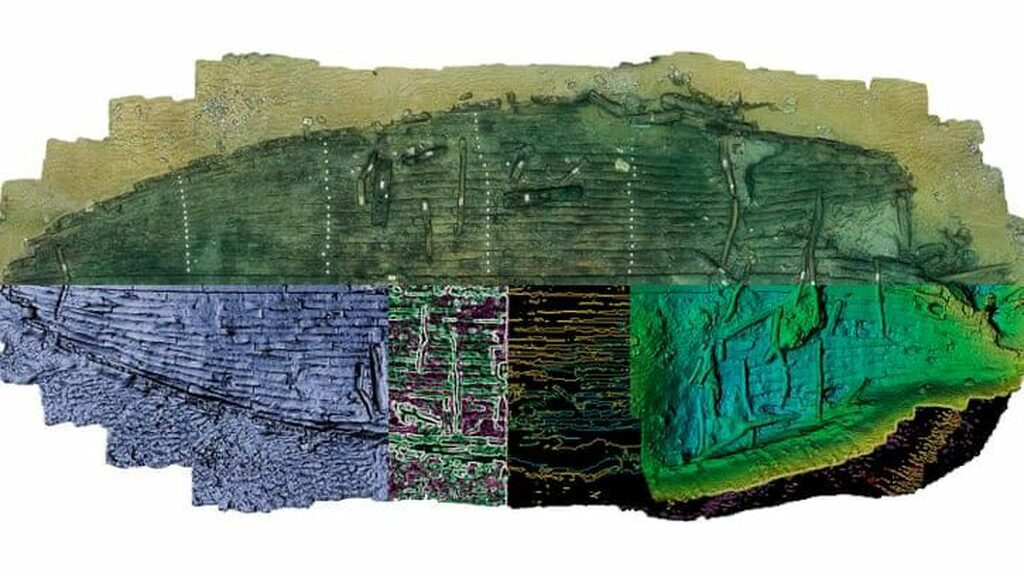
The hull of the ancient vessel
Archaeologists chanced upon the boat in question—officially dubbed ship 17—while excavating the sunken Egyptian port city of Thonis-Heracleion. First unearthed in 2000, Live Science’s Laura Geggel writes, the site has since yielded more than 70 vessels dating from the 8th to 2nd century B.C.
“It wasn’t until we discovered this wreck that we realized Herodotus was right,” Damian Robinson, director of the Oxford Centre for Maritime Archaeology, which published a recent monograph detailing the find, tells Alberge. “What Herodotus described was what we were looking at.”
Herodotus dedicates 23 lines of his Histories to the construction of a Nile cargo boat known by locals as a baris. This fragment, penned around 450 B.C., stems from the historian’s travels to Egypt and, according to Science Alert’s Michelle Starr, tells of a papyrus-sailed ship crafted in the style of brickwork with a rudder running through a hole in its keel.
In his account, Herodotus documents the creation of “thorny acacia” boats that “cannot sail up the river unless there be a very fresh wind blowing, but are towed from the shore.”
He continues, “They have a door-shaped crate made of tamarisk wood and reed mats sewn together, and also a stone of about two talents weight bored with a hole.” As the crate floats in front of the boat, the stone grounds it from behind; together, these opposing forces keep the vessel moving swiftly on a straight course.
Artist’s rendering of the shipwrecked vessel
Writing in a 2013 study, Alexander Belov, an archaeologist at the Center for Egyptological Studies of the Russian Academy of Sciences and author of the new Ship 17: A Baris From Thonis-Heracleion monograph, notes that the acacia planks evident in ship 17 “are staggered in a way that gives it the appearance of ‘courses of bricks,’ as described by Herodotus.”
The Guardian’s Alberge adds that the crescent-shaped hull’s pattern of thick planks connected with pegs and tenons, or smaller adjoining pieces of wood, aligns closely with the historian’s description of the baris’ “internal ribs.”
Prior to ship 17’s discovery, contemporary archaeologists had never encountered this architectural style. But upon examining the hull’s well-preserved remains, which constitute some 70 percent of the original structure, researchers found a singular feat of design.
An archaeologist examines how the ancient vessel’s keel was put together.
At the peak of its maritime career, ship 17 likely measured up to 92 feet—significantly longer than the baris described by Herodotus, as Science Alert’s Starr points out, making it differ slightly from the one detailed in Histories: Whereas Herodotus’ vessel had shorter tenons and no reinforcing frames, the recovered boat has longer tenons and several reinforcing frames.
Although ship 17 is believed to have sunk during the first half of the 5th century B.C., Robinson tells Live Science’s Geggel that it probably dates to the 6th century B.C. and was “reused as a … floating jetty at the end of its working life as a ship.”
Archaeologists believe the Thonis-Heracleion baris were used to move goods to and from emporiums along the Nile River. In addition to transporting imports from the Greek and Persian worlds to cities across the Nile valley, the ship and others like it would have brought Egyptian goods including grain and salt to the harbor for export.