All posts by Archaeology World Team

The 290 Million Year Old Fossil Human Footprint

The 290 Million Year Old Fossil Human Footprint

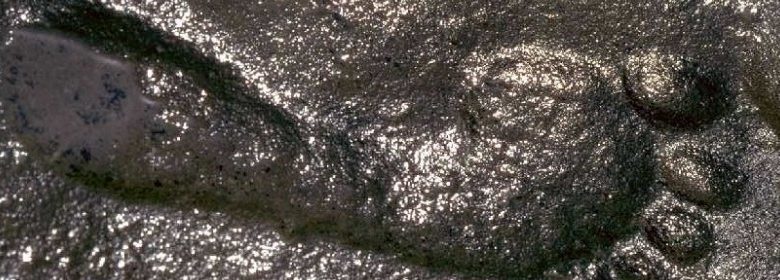
There is a story going around, that up in the Robledo Mountains of southern New Mexico exists a mind-bending fossilised impression. Why should this be of interest you wonder? The answer is because it is seemingly the print of a human being wandering the area some 290 million years ago.

I for one support a revised view of human origins, one that is very controversial, it is my publicly stated opinion that human beings, of one sort or another, go back further than currently believed and that Homo sapiens go back several hundred thousand years beyond the current consensus dating. Despite all of that, I admit it is a struggle to believe a man much like myself was wandering around New Mexico long before even dinosaurs had arisen on our planet!

What is to be made of this story, indeed of the photographic evidence also provided to accompany it?

To make any sense of the matter we need to go back to 1987, it was in that year that a sociologist (and amateur ichnologist) by the name of Jerry Paul MacDonald discovered a plethora of fossilised animal tracks high up in that mountain range. The rock strata, a type of mudstone found at the site, was reliably dated to the Permian Period.

This vast sweep of time covers approximately the era between 300 million and 250 million years before the present. There is no controversy over the dating of the many fossil prints at the site, they are accepted to be from creatures that must have existed in the Permian period, even if some are from creatures not as yet identified (which seemingly remains the case).

There certainly is some head-scratching associated with fossilised prints at the location, a number are seen as ‘problematica’ due to their similarity to those of animals from much later periods, including prints akin to modern birds (small three-toed impressions) and even bears (deep five arched toe marks along with nail impressions). Keep in mind that the Permian is a time long before even dinosaurs, let alone the much more recent appearance of birds and mammals.

These prints certainly suggest that there were animals walking the earth during the Permian period of which we know nothing, but is that such a shock when you take into account how little we can ever know of events over 250 million years ago? Perhaps not.

In and of themselves these prints are pretty revolutionary, simply because they suggest life forms that had much more anatomical similarity to modern animals than we would ever have imagined possible at that early point.

That does not necessarily mean a brown bear was chasing a chicken for its dinner, without fossilised skeletons we can only hazard a guess at what these creatures really looked like, to rebuild an entire lost species from a footprint seems at best an outlandish exercise in wishful thinking. With that thought in mind let us now turn our attention back to the supposed ‘human’ footprint.

What does Jerry MacDonald say about the human footprint he supposedly discovered? The answer appears to be, nothing at all. That in itself should through up some major red flags.

It also seems that the photograph supplied along with the claims of a prehistoric human footprint has no connection to MacDonald or his research work, in fact, it is seemingly supplied by a chap named Don Patton. Now, Don Patton is a self-admitted creationist and young earth theorist, on a number of occasions he has claimed to hold degrees and even Ph.D. qualifications in geology and archaeology, these have later been investigated and shown to be academically invalid (related to unaccredited Christian institutions). In fact, there is actually a second image of the footprint, shown accompanied by Don Patton, and the image is itself an example of ‘problematica’. It looks very much more like a separate slab of stone, or some kind of plaster cast, rather than an in situ print.

The footprint also looks very small, smaller than Don’s hand, with no sign of matching left print despite the fact such a small being’s prints should both comfortably fit on that slab (at least in partial). It should however be noted that there are some responding claims made that this was a very young child and that a partial left print snapped off from the ledge where the initial print was found.

If one digs deeper the entire story starts to fall apart, the print transpires to have been purportedly found by a mysterious hunter (no connection to Jerry MacDonald) and only ever investigated by Don Patton and his associate Carl Baugh (another creationist known to have claimed dodgy academic credentials).

They tell us that they were not able to do any real documenting of the find due to the sudden appearance of an angry landowner with a shotgun. What further adds to the fishy smell this story now begins to produce is the fact they state the print was made in a limestone layer, one dated to the Permian period.

“While the team was working, they were confronted by a local landowner who was armed with a shotgun. The landowner claimed that they were trespassing and that they were on his property. They showed the landowner the mining permit and stated that the property they were on was BLM (Bureau of Land Management) property. The armed landowner insisted that they leave immediately.”

Exactly how this stone layer could have been so accurately dated, by two falsely credentialed amateur geologists, busy running away from an armed man, really begs belief (let alone how they had time to make a cast). The second red flag is the very fact that the layer of the purported print is identified as being limestone, as we have already noted earlier that the layer in which MacDonald found his prints was mudstone, suggesting that this is an entirely different site with no connection at all if it even exists.

As ever it seems that when we dig for the truth we often have to shovel through a whole heap of disinformation and misinformation. Probably, like me, you are left shaking your head at this entire story and ready to through the whole matter into your mental dustbin. But before we leave this tale let us return to a very intriguing find genuinely made at the location where MacDonald was investigating.

In 1992 Jerry MacDonald took Doug Stewart (a regular contributor to the Smithsonian magazine) up to his site and allowed Doug to participate in making new finds as well as an independent examination of existing discoveries.

It is actually from Doug Stewart’s later report to the Smithsonian that we hear of the strange bird-like and bear-like footprints. One line in this report does leave us wondering whether some strange vaguely-humanoid type of creature perhaps walked the earth in the distant times of the Permian:

‘He’s got several tracks where creatures appear to be walking on their hind legs, others that look almost simian.’

The reality is of course that without even a photograph of the prints mentioned in the report, we can do little but speculate on what type of creature, some 250 million years ago, left tracks ‘kinda similar’ to those of a monkey. Whatever it was, I am betting it was nothing like we humans.
Ancient Maya Worshipped ‘Batman God’ 2,500 Years Ago

Ancient Maya Worshipped ‘Batman God’ 2,500 Years Ago

A peculiar religious cult grew up among the Zapotec Indians of Oaxaca, Mexico in 100 A.D.

The dangerous cave-dwelling bat creature – which the Zapotecs believed represented night, death, and sacrifice – was eventually adopted into the pantheon of the K’iche’, a Mayan tribe inhabiting modern-day Guatemala and Honduras. The legends of the bat god were later recorded in Popol Vuh, a Mayan sacred book.

Camazotz, which translates to ‘death bat‘ (K’iche’ word ‘kame‘ means “death”, while ‘sotz’ means “bat”), originated deep in Mesoamerican mythology as a dangerous cave-dwelling bat creature.

The K’iche’ identified the bat-deity with their god Zotzilaha Chamalcan, the god of fire. Camazotz, which inhabited Xibalbá, is also commonly depicted holding a sacrificial knife in one hand and a human heart or sacrificial victim in the other.

Templo Mayor, located in downtown Mexico City, has an adjacent museum that displays artifacts and renditions of items from the Mesoamerican civilizations. The top floor of this museum contains a recreated statue of Camazotz.

One of the most prominent and commonly mentioned features of the Camazotz is “a nose the shape of a flint knife”, which could be an exaggerated interpretation of the nose-leaf possessed by members of the Phyllostomidae or leaf-nosed bats.

Maya sculpture that depicts the vampire bat god, Camazotz.

Traces

In 1988, a fossil of a giant vampire bat was discovered in the Mongas province of Venezuela. The bat was larger than the modern vampire bat by 25% and was dubbed D. Draculae.  Its recent age and large range suggest that the bat could have co-existed with the K’iche’, giving rise to the legends of the Camazotz.

In 2000, a tooth from D. Draculae was found in Argentina – much farther south of the modern range of the Desmodus genus. The latest age found for a D. Draculae site is circa 1650 AD. These dates make it very possible that D. Draculae coexisted with humans in South America and Central America.

The common vampire bat, D. Rotundus, has an eight-inch wingspan. Since D. Draculae was 25% larger, it would have required more blood and probably would have attacked larger animals – and possibly even humans. It is undoubtable that an attack by a rare giant bat would give rise to legends of supernatural monsters.

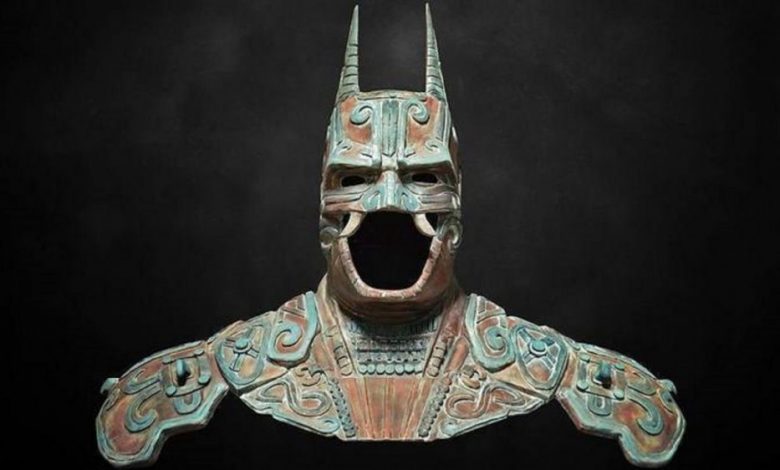
In 2014, Warner Brothers gathered as many as 30 artists to reinterpret Batman on the occasion of its 75th anniversary. Christian Pacheco, one of the artists, recalled that Batman is not the first reference of an enigmatic anthropomorphic being with a man’s body and a bat’s head. It is was indeed the feared Camazotz.

Pacheco’s Yucatán [Mexico]-based design firm Kimbal made a replica of the bust with which Bruce Wayne disguises the character and molded it with Maya motifs and references to the ancient Camazotz.

The designed gave a heads up to many people that the very first batman can be traced back to the ancient Maya, more than 2,500 years ago.

Maya style Batman suit recreated by Christian Pacheco

In the Popol Vuh, Camazotz was a common name making reference to the bat-like monsters that the Mayan twin heroes Hunahpú and Ixbalanque stumbled across, during their trials in Xibalbá, the Mayan underworld.

Camazotz was said to attack victims by the neck and decapitate them. In the Popol Vuh, it is recorded that the deity decapitated Hunahpú and is also one of the four animal demons responsible for wiping out mankind during the age of the first sun.

National Geographic Writes:

“The Maya hero twins were placed inside a bat house—a cave filled with death bats, called Camazotz by the Maya.

The bats had snouts like blades, which they used to kill people and animals. To escape, the twins crawled inside their blowguns, and all night long the bats terrorized them. Toward dawn, one of the twins said he would check to see if it was safe to leave. He raised his head out of his gun—and promptly had it cut off by a Camazotz.”

In 2018, it was reported that two species of carnivorous bats were found from southern Mexico to Bolivia and Brazil – the woolly bat (the toothy, hungry bats with long bunny-like ears and a lance-shaped nose leaf found in a Maya temple) and the spectral bat.  According to biologist Rodrigo Medellín, woolly and spectral bats are likely the bats described in the Popol Vuh:

“These bats do the same thing. They stalk their prey, land on them with half-spread wings, locking them with the thumb claws, and deliver a death bite to the back or top of the head. Camazotz was not an invention.”

Ancient Germanic lord was buried with a circle of six women

Ancient Germanic lord was buried with a circle of six women

In Saxony-Anhalt, close to Brücken-Hackpfüffel Archaeologists have discovered the complex grave of a Germanic lord or prince who lived 1,500 years ago during the Great Migration.

Experts claim that for 40 years the site has been the most valuable archaeological discovery in the world and have kept the exact location of the dig a secret to stave off thieves. Excavations got underway when builders were clearing land for a new chicken farm, and stumbled across the cemetery of a royal court.

Considering the high value of the person in the crypt, the researchers have yet to locate the remains of the prince they suspect was laid to rest there.

They speculate his ashes may be inside a bronze cauldron in the central tomb, which is around 13 feet by 13 feet in size. The cauldron, the focal point of the mounded tomb, is surrounded by six women buried in a radial alignment from the pot, like the hands of a clock, The Times reports.

Researchers say these may well have been concubines or widows belonging to the person being buried, but it remains a mystery as to whether they were slain for the burial or sacrificed themselves.  

Speculation is rife about the cause of the bizarre arrangement, but researchers say it is too soon to talk of a ritualistic cult death.  

Ancient Germanic lord was buried with a circle of six women
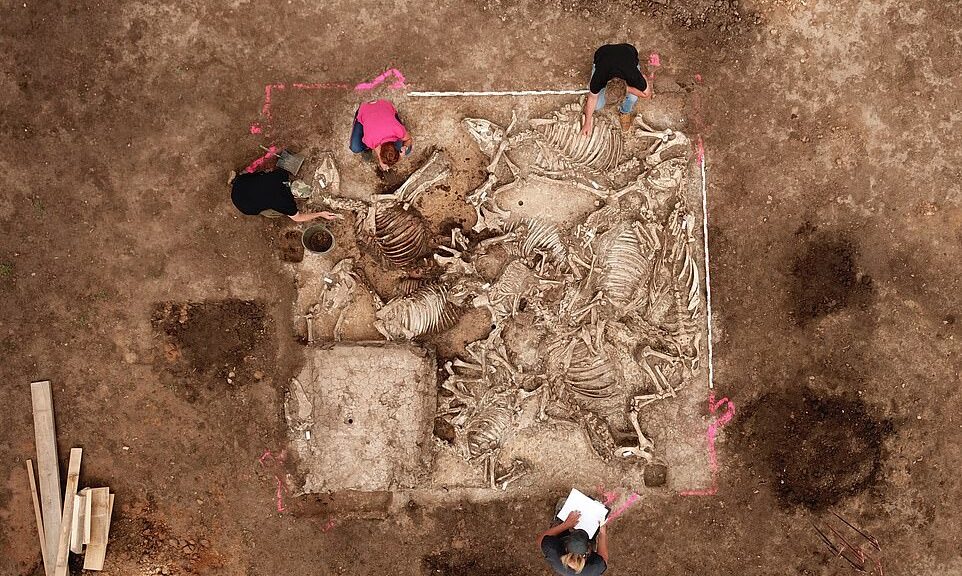
This aerial picture shows the central tomb of the burial. This shows the remains of 11 animals, including cattle. horses and dogs
The site (pictured) has been unearthed in Saxony-Anhalt, near Brücken-Hackpfüffel accidentally by builders hoping to create a new chicken farm. Experts have kept its exact location a secret

It also holds the remains of eleven animals, including cattle, horses and dogs.  Beyond this central tomb, believed to be of a high-ranking individual, are around 60 other graves, subsequently buried in the cemetery to honour the Lord. 

The cauldron, believed to be central to the tomb’s history, was block lifted out of the ground and will be carefully analysed in a laboratory.  

‘We haven’t found the prince himself yet. But maybe his ashes are in the bronze cauldron, ‘ archaeologist Susanne Friederich from the Landesmuseum Halle said. 

Also inside the central tomb are the remains of 11 animals, including cattle, dogs and horses. These animals were reburied at this location, further indication the site was created to honour a high-ranking person in society. 

Ms Friederich adds: ‘The unique finds suggest that high-ranking personalities were buried here.’ 

It is thought the central burial chamber would have been part of a mounded tomb, with the dozens of surrounding graves added later.

These incredibly detailed and well-preserved clasps were some of the ornate grave goods found at the royal cemetery. Archaeologist Arnold Muhl shows artistic vestment clasps in his workshop. The objects are 1,500 years old and come from 60 undamaged graves alongside the tomb of a Germanic lord who lived during the Great Migration
This gold coin features the head of the Eastern Roman Emperor Zeno who lived around 480 and was found at the burial site

Initial estimates date the site as being from between AD480 and AD530, a period of time following the fall of the Roman Empire which saw many Germanic tribes, such as the Huns, invade territories which were no longer under Roman protection.   

‘The cemetery has almost 60 graves,’ said archaeologist Arnold Muhl.

‘In the graves, among other things, a glass decorated bowl, a spindle whorl made of glass, several silver-gilded robe clips, a sword and a shield boss made of iron as well as a gold coin of the Eastern Roman emperor Zeno around 480 were found. 

‘The pieces of glass come from the Gallo-Roman workshops along the Rhine, only they mastered this technique.’ 

Other finds include an immaculate pointed glass beaker adorned with curved grooves which would have housed a floating wick lamp and garment clips. 

The clips, which include pieces of snagged textile, are thought to indicate the presence of a Germanic tribe, either the Longobards, Alemanni or Thuringians. 

The site is in immaculate condition due to its unique location, which inadvertently protected it from damage. The burial ground was in a natural hollow which, over time, was covered by around four feet (1.20 meters) of sediment, which provided a protective layer. 

This protected it from any ploughing and also hid it from the view of any treasure hunters or grave robbers. By analysing the bones and artefacts, the scientists hope to gain concrete insights into people’s lives at the time of the Great Migration.

Possible Remains of 16th-Century French Philosopher Examined

Possible Remains of 16th-Century French Philosopher Examined

The AFP reports that researchers are examining human remains recovered from a tomb discovered in late 2019 in the basement of the Aquitaine Museum, which is located in southwestern France.

In the sixteenth century, the building housed a convent where the remains of philosopher Michel de Montaigne, who served as mayor of Bordeaux from 1581 to 1585, may have come to rest after his body was moved several times following his death in 1592. 

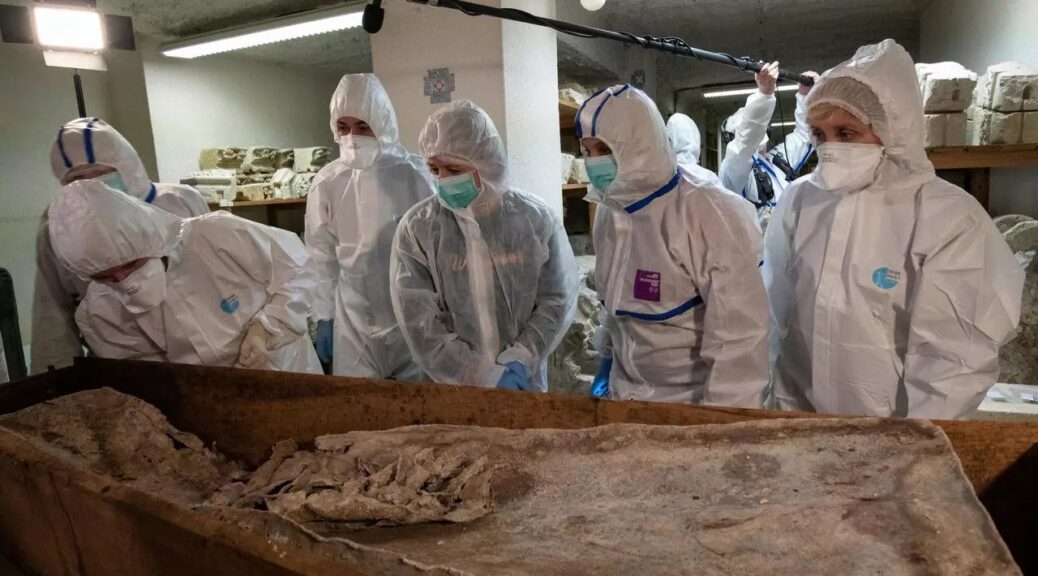
The Musee d’Aquitaine in the southwestern city of Bordeaux had in November launched work to examine the remains in the tomb a basement of the museum, which occupies the premises of a convent where Montaigne, famed for his lofty but highly readable “Essays”, was buried.

The bones found are those of a “single individual. It is an adult and it is probably a man,” Helene Reveillas, an archaeo-anthropologist for the Bordeaux region, told reporters.

“We have elements which do not go against the idea that this is de Montaigne. But we also have nothing which allows us to affirm it with certainty”, she added.

This file photo was taken on March 20, 2018, shows the cenotaph of the late French writer Michel de Montaigne (1533-1592) displayed following restoration works at the Musee d’Aquitaine in Bordeaux.

“The mystery remains,” she said.

Montaigne was one of the city’s most famous sons and served as its mayor from 1581 to 1585. Speculation that his remains are housed already within a museum in Bordeaux had caused huge excitement last year.

The opening of the tomb last year revealed a wooden coffin with the word “Montaigne” written in large brown letters.

The lead coffin was opened this week, revealing “a well-preserved skeleton” and a skull “with almost all of its teeth” as well as the remains of tissue, pollens and insects, according to the archaeologist.

Laboratory research, including using carbon 14 dating, will now be carried out by about twenty scientists.

They will particularly be on the lookout for evidence of the kidney stones from which the writer was known to have suffered.

Reveillas added: “We know that his heart was removed after his death” at the request of his widow, noting that “operation leaves its traces”.

Other techniques set to be used in the follow-up include “facial reconstruction” and genealogical research on possible descendants, Reveillas said.

Results are expected next year.

There has long been confusion over the location of the remains of de Montaigne after the body was shifted between numerous sites after his death in 1592 at the age of 59.

Archaeology Intern Unearths Spectacular, 2,000-Year-Old Roman Dagger

Archaeology Intern Unearths Spectacular, 2,000-Year-Old Roman Dagger

Nico Calman actually had a particularly good internship. During his time in Germany last year, with the Westphalia Department of Protection & Field Monuments, 19-year-old Calman discovered a 2,000-year-old silver dagger that may have helped the Romans battle a Germanic tribe in the 1st century A.D.

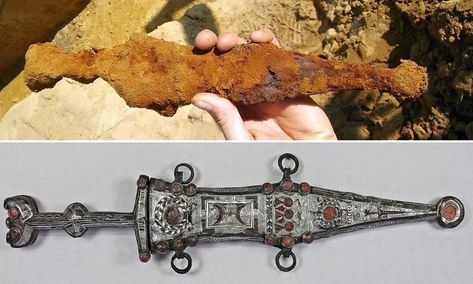
The dagger as it was originally found.

However when he found it was nothing more than a lumpy, rusty clump that was noted to look like a “chicken tender”.

It took nine months of careful restoration work for the dagger’s true beauty to be revealed.

The restored dagger and sheath is a night and day difference between how it looked when it was first unearthed.

Likely used in battles against the Germanic tribes in the first century AD,  It was an extremely rare find for the team of archaeologists, and one made even more special for the well-preserved state in which the dagger was found.

“The discovery of the dagger was emotional. We were lost for words,” Bettina Tremmel, an archaeologist working for the Westphalie Department told Live Science.

“Imagine: Though thousands of Roman soldiers were stationed in Haltern over almost 15 years or more, there are only a few finds of weapons, especially complete and intact ones.”

The dagger was corroded to the point of being unrecognizable when Nico Calman, the 19-year-old man on work-study unearthed it and the remains of a decorated leather belt from the grave of a soldier.

But after a rigorous restoration effort that lasted nine months, conservators in Germany unveiled the ornate 13-inch-long weapon and its bejeweled sheath underneath the grime this week.

The dagger inside its sheath after 9 months of restoration work.

Silver and brass adorn the dagger’s handle, while its iron scabbard features inlaid wood, glass, and red enamel.

The weapon likely belonged to a legionary or auxiliary infantryman or a centurion officer in the Roman army, Tremmel says. But why the weapon was buried with its owner remains a mystery, she says, explaining that “it was not the normal practice for Roman soldiers to be buried with their military equipment.” 

Located at the edge of the Roman empire, Haltern am See was home to a large military camp during the Augustan period (27 BC to AD 14), where three legions of soldiers, each consisting of some 5,000 men, were slain by Germanic tribes. Roman fighters killed during the battles were buried at a cemetery nearby.

Despite archaeological digs taking place at the site for nearly 200 years, a weapon as sophisticated and well-preserved as the dagger has never before been found.

The newly restored dagger will go on view in Haltern’s Roman history museum beginning in 2022.

Missing for 400 years: Archaeologists discover missing 17th-century warship

Missing for 400 years: Archaeologists discover missing 17th-century warship

The Copenhagen Post reports that the wreckage of the Delmenhorst, one of the first ships constructed from drawings, was found some 500 feet off the coast of Denmark during offshore construction work.

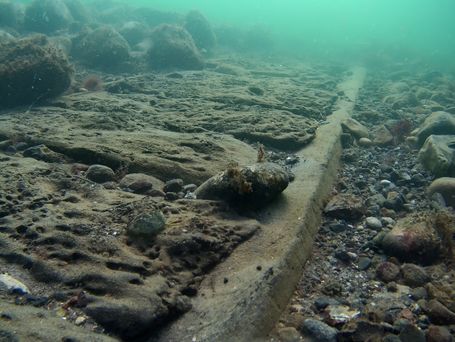
The warship, konow almost completely buried in the seabed, was grounded in 1644 during the Battle of Fehmarn, fought between the Danes and a Swedish and Dutch fleet as part of a brief conflict called the Torstenson War.

It is the last Danish sunken ship missing from the fateful battle, which turned out to be the final battle of the King Christian IV era – he lost his right eye in battle four months earlier.

Realising that the battle had been lost, the ‘Delmenhorst’ was intentionally grounded near Rødbyhavn in the final hours of the battle to a joint Swedish/Dutch fleet because the Danes hoped to defend it using a massive cannon in the harbour town.

However, the crafty Swedes sacrificed one of their own ships by setting it ablaze and sailing it into the ‘Delmenhorst’, which consequently caught fire and sank.

The Delmenhorst will remain on the seafloor for now

End of Danish power

The battle was waged as part of the Torstenson War, which signalled the end of Denmark’s time as a European power. After the loss, Sweden replaced Denmark as the leading power in the Nordic region. 

The Delmenhorst, located about 150 metres off the Danish shore, is unique because it is one of the first ships constructed from drawings. 

The wreck was discovered as part of the work on the Fehmarn Bridge connecting Denmark and Germany.

Because the wreck is almost completely buried in the seabed, archaeologists will leave it in the hope that experts will have the technology to glean information from it in the future.

The Forgotten Culture That Built America’s “Pyramids” of Dirt

The Forgotten Culture That Built America’s “Pyramids” of Dirt

American history students know of the ancient Egyptians,  the Incas of Peru, and of the Aztecs of Mexico, but less know a major civilization that extends through the eastern United States from around 800 to 1600 CE. Meet the Mississippians.

Years before the European immigrants planted the seeds of modern civilization in North America, the Mississippi culture spread from the Florida Panhandle all the way to southern Minnesota.

Defining the dozens of discovered settlements are distinct earthwork mounds that resemble pyramids of dirt. Various structures were regularly constructed atop these mounds. Chiefs presided over individual settlements and were thought to regulate trade, particularly of maize, which archaeologists believe was the primary staple crop.

The rise of centralized agriculture is the most agreed-upon explanation for the evolution of the Mississippian culture. Settlements were set up near rivers to take advantage of fertile farmland. Food was grown and shared under the altruistic watch of the settlement chief.

With a reliable source of food, the Mississippians could undertake other pastimes. Metalworkers fashioned stone tools for farming and etched ornate copper plates for adornment.

Three examples of Mississippian culture avian themed repousse copper plates. The righthand figure is from the Spiro Mounds in Oklahoma. The left-hand figure Wulfing plate A, one of Wulfing cache from Malden, Missouri. The middle plate is Rogan plate 1, from Etowah Mounds in Georgia. Examples of this type of artwork have been found as artifacts in several states in the Midwest and Southeast.

Artists crafted necklaces and pottery out of riverine shells. Spectators watched athletes compete in a game known as chunkey, in which players tried to hurl a spear closest to a thrown disc-shaped stone.

Chunkey was often played in immense arenas. The largest was in the Mississippian capital of Cahokia, situated in southern Illinois just across the Mississippi River from modern-day St. Louis. At its peak around 1100 CE, the city was home to as many as 20,000 people.

Most residents lived in humble, thatched-roof dwellings near the outskirts of the sprawling city, but they would regularly venture to the heart of the settlement to visit markets set up in the four open plazas or to view religious ceremonies.

Cahokia featured at least 109 raised mounds, the largest of which had a base almost as expansive as the Great Pyramid at Giza. Atop these mounds were grand structures. Some may have been temples, places of politics,  or finer dwellings for higher-status residents.

An artist’s re-creation of Cahokia with the great Monk’s Mound in the distance.

The Mississippians thrived through the 13th century, but started declining thereafter. Floods associated with the Little Ice Age may have swamped their signature mounds. Other climatic events may have threatened the foundational maize agriculture that maintained their flourishing society.

Cahokia was abandoned in the later half of the fourteenth century, sending migrants roaming across the land to seek new starts at other settlements.

The diaspora brought with it political turmoil and warfare. By the time Europeans began actively colonizing North America in the 16th century, the Mississippian culture was torn, ragged, and disconnected, a shadow of its former self.

While there has been no shortage of beautiful artifacts recovered from Cahokia and other Mississippian settlements, there’s been a complete absence of any form of writing. It seems the Mississippians lacked a writing system.

This critical dearth of information helps explain why the Mississippians rarely make it into textbooks of American history, and why only 2,600 words are written about them on Wikipedia compared to 13,000 for Ancient Egypt.  

And so, we’re left wondering about the Mississippians… What were their names? What were their stories? What did they believe in? We may never know for sure.

3,000 Years old Buhen: The Sunken fortress under the Nile

3,000 Years old Buhen: The Sunken fortress under the Nile

During the Middle Kingdom era, King Senusret III established castles and fortresses to protect Egypt from the south, such as the Buhen fortress that sunk in the Nile as a result of a flood.

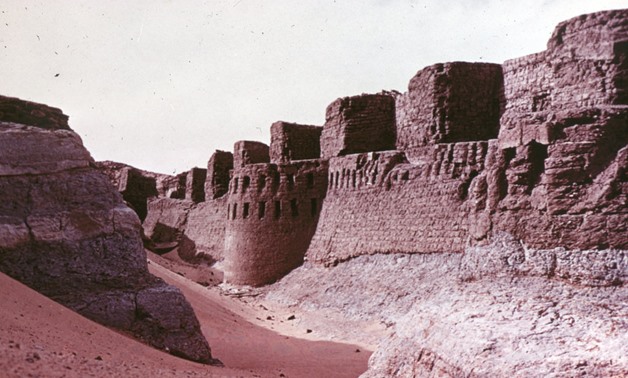
Buhen was a massive fortress located on the west bank of the Nile in Lower Nubia (northern Sudan). The walls of the fortress were made of brick and stone walls, approximately 5 meters (16 ft) thick and about 10 meters (33 ft) high, covering an area of about 13,000 square meters (140,000 sq ft) and extending more than 150 meters (490 ft).

It was constructed during the reigns of King Senusret III in the Middle Kingdom era (12th dynasty) to protect Egypt and the commercial ships from rebel Nubians in the south, according to “Ancient Egypt” by David P. Silverman.

Photo for Buhen fortress from Nubia museum – Walaa Ali
Buhen fortress

The massive fortress was built in 1860 BC. It had about 1,000 soldiers, 300 archers, and their families. Queen Hatshepsut ordered a Horus temple to be built inside the Buhen fortress for worship and prayer, and also for traders to take a break while transporting their goods. Interestingly, during that time, Egypt imported and exported many products, such as oils, ivory, pottery, and tiger, and elephant skins.

The Middle Kingdom era saw many other fortresses besides Buhen, such as Mirgissa, Shalfak, Uronarti, Askut, Dabenarti, and ending with the paired fortresses of Semna and Kumma, located on opposite sides of the Nile River. Each fortress was in visual contact with the immediately adjacent forts.

Ahmed Saleh, director of antiquities in Aswan, told Egypt online portal that the Buhen fortress no longer exists because it was submerged under the waters of Lake Nasser in 1964 due to the flood; the Buhen fortress is now located 300 meters from the High Dam. He added that the Ministry of Antiquities did not search for it because it was certainly destroyed, like several other Egyptian antiquities. Among the most important ancient monuments lost under Lake Nasser are Nubian fortresses.

“But if the Ministry planned to look for antiquities under the waters of Lake Nasser, they could find nothing other than bones, noting that the level of water was higher than the level of the ground.

Therefore, the Egyptian government built the High Dam, but it, unfortunately, swept away several pharaonic artifacts; still, the Ministry of Antiquities saved many artifacts, in cooperation with more than 22 foreign research teams, such as the UNESCO Campaign to Save the Monuments of Nubia, which began in the 1960s.

 Fortress in the Middle and the New Kingdom( about 1200 BC)

The site was entirely submerged beneath the reservoir waters and rendered inaccessible. However, the campaign saved many temples, including the Hatshepsut and Philae temples, which were rescued and moved to places nearby,” Saleh added.

History of Egypt in the Middle Kingdom

The Middle Kingdom era is called the era of economic prosperity because of many economic projects, such as irrigation, trade, industry, and agriculture. Among the most famous kings of the Middle Kingdom were King Mentuhotep II, who restored the unity of the country and spread security after the chaos that plagued Egypt in the era of the Old Kingdom, and King Senusret III, who was one of the greatest kings of Egypt.

Senusret III took care of the army to protect Egypt and led many campaigns to secure its borders. He also ordered the digging of the Sesostris Canal to link the Red Sea and the Nile, as well as building a dam to protect the land in Fayoum from the flood.

Head of King Senusret III in Gulbenkian Museum.

The Sesostris Canal was the source of the idea to build the Suez Canal to connect the Mediterranean Sea and the Red Sea, which became the most important navigational channel in the world and an important source of income for Egypt.

King Amenemhat III ruled from c. 1860 BCE to c. 1814 BCE. He was interested in agriculture and irrigation, and he ordered the building of the first pyramid at Dahshur, the so-called “Black Pyramid”, near Fayoum.

Around the 15th year of his reign, the king decided to build a new pyramid at Hawara, as well as a huge temple called “Labyrinth,” named so due to a large number of rooms, roads, and corners inside it, making it difficult for any visitor to exit.

Unfortunately, as a result of the kings’ weaknesses and greed, chaos spread in the country, which allowed the Hyksos, who came from Asia, to occupy Northern Egypt. The Hyksos abused the Egyptians very much and destroyed many temples and several ancient antiquities.

The Egyptians were determined to fight and expel the Hyksos from their country. The struggle started from Upper Egypt, led by Seqenenre Tao, who was martyred in the war with the Hyksos, but his wife Ahhotep encouraged the Egyptians to continue the struggle.

She urged her eldest son, Kamose, to continue the struggle, but he was also martyred in one of the battles. Then, the army was taken over by the younger son of Seqenenre Tao, Ahmose I, who continued to fight the Hyksos until they were expelled from Egypt. He then ruled the country.

One of the greatest civilizations throughout history is the ancient Egyptian civilization, which has stunned the entire world for ages. During the Middle Kingdom era, when Egypt was at the highest degree of culture and development, and kings were interested in projects of benefit to the people, handicrafts were developed and literature and art flourished.