All posts by Archaeology World Team

Medieval tunnel discovered under the castle in Szczecin in Poland

Medieval tunnel discovered under the castle in Szczecin in Poland

Archaeologists have uncovered over 270 meters of previously hidden tunnels beneath the Pomeranian Dukes’ Castle in Szczecin. They also warned that more detailed research was needed because they could collapse. Some of them come from the Middle Ages.

The management of the Pomeranian Dukes’ Castle informed about the discovery of tunnels that had not been known so far.

We have heard legends about the labyrinth of corridors under the castle, but there has never been evidence that they actually exist – informs Monika Adamowska, press spokeswoman for the Pomeranian Dukes’ Castle in Szczecin.

Pomeranian Dukes’ Castle

However, first, there was a construction disaster – one of the pillars collapsed in May 2017 and with it part of the vault of the northern wing of the Castle. The prosecution decided that soil erosion was probably to blame and the investigation was discontinued.

There was supposed to be a renovation, it was a disaster

The management of the castle, which for years has been wanting to renovate the northern terraces, on the occasion of this investment and taking into account the disaster, commissioned a series of construction and soil tests.

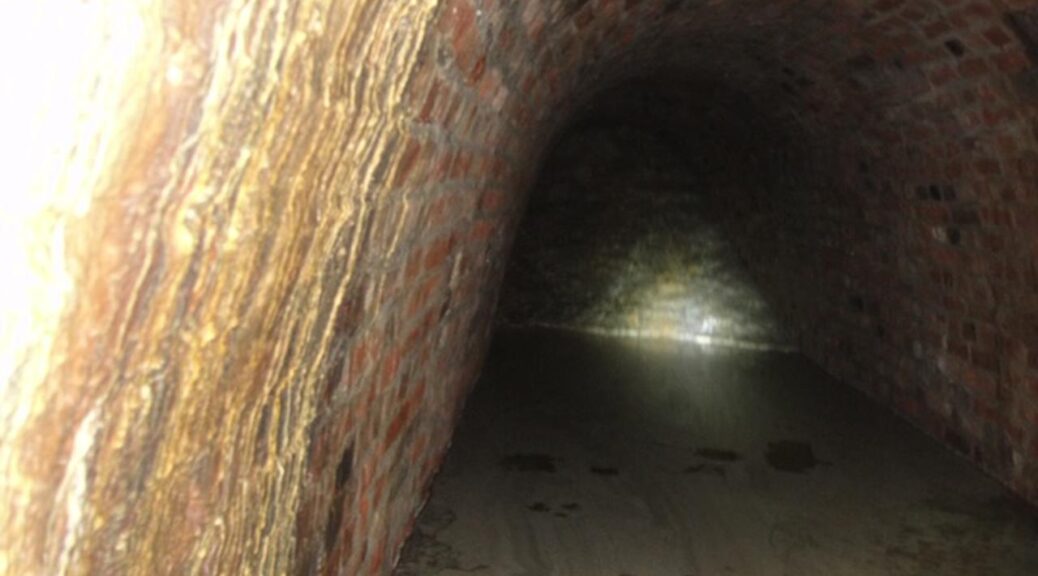
During this research, specialists from the Building Research Institute in Warsaw discovered a labyrinth of tunnels about 16 meters underground.

Medieval tunnel discovered under the castle in Szczecin in Poland

Under the escarpment and the northern wing, there is a branched network of corridors over 270 meters long – tells us, Adamowska. However, unfortunately, ITB employees also determined that the tunnels are not in good condition.

– This is a very serious situation. The tunnels are covered with rubble, which was used to strengthen the escarpment and created empty spaces, caverns, and rubble above them – continues Adamowska. Additionally, there is groundwater in this place.

This requires swift actions to reinforce the escarpment and a careful examination of the corridors and sheds new light on the recent disaster to which the underground structures may have contributed.

They did not expect tunnels from the Middle Ages

There are entrances to the tunnels probably from the north, which you have to dig. Unfortunately, specialists do not want to do it yet, because then the trees that grow on the part of the slope on which the castle stands could collapse on them.

On February 8, the municipal conservator of monuments gave permission to cut down the trees.

For now, cavers descended into the tunnels through a drilled vertical shaft. They took samples for testing and made photographic documentation. Then it turned out that the post-German corridors from World War II are connected with brick tunnels from the Middle Ages. This was a surprise for the scientists and management.

The findings were confirmed by tests of mortar and bricks samples carried out both in the castle’s Art Conservation Studio and in the Laboratory and Conservation Research Studio in Kraków.

The management of the castle emphasizes that it acts in accordance with the guidelines of specialists and is taking appropriate steps to secure the monument and at the same time investigate the new discovery. He also admits that it will extend the modernization of the terraces.

The Pomeranian Dukes’ Castle is one of the most important monuments in the region – the historic seat of the Griffin family, rulers of the Pomeranian Duchy. The first Slavic stronghold was built on the castle hill in the 12th century, but the modern building was built from the mid-14th century.

– The castle has revealed another secret to us, which may give us more information about the Griffin dynasty. I do not rule out that it may become an attraction for visitors in the distant future – comments Barbara Igielska, director of the Pomeranian Dukes’ Castle in Szczecin, on the discovery.
Tanzanian rock art reveals trios of mysterious anthropomorphic figures

Tanzanian rock art reveals trios of mysterious anthropomorphic figures

It was recently discovered that the rock art was located at the Amak’hee rock shelter site in the Dodoma Region of central Tanzania found in June 2018. Most of the paintings were made with a reddish dye; there are also five white images.

Tanzanian rock art reveals trios of mysterious anthropomorphic figures
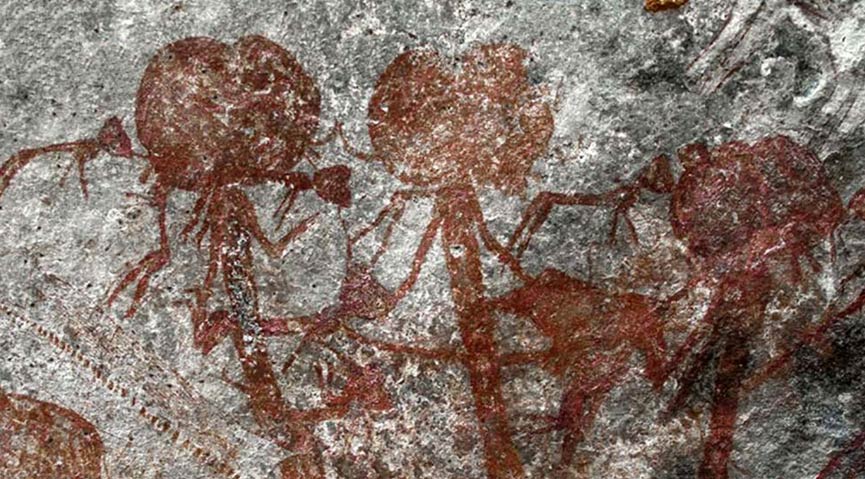
A trio of anthropomorphic figures from the Amak’hee 4 site in Tanzania.

Dr. Maciej Grzelczyk, a researcher at the Jagiellonian University in Cracow, Poland, says, “Most are in good condition, mainly due to a rock overhang that protects them from flowing water and exposure to excessive sunlight,” 

The Amak’hee 4 paintings include depictions of humans, domesticated cattle, and giraffes.

Comparison of the Amak’hee 4 (A), Kolo B2 (B) and Kolo B1 (C) trios.

“Particularly noteworthy among the Amak’hee 4 paintings is a scene that centers around three images,” the scientist said.

“In this trio, the figures seem to feature stylized buffalo heads. These shapes recall the central dip in the profile of the buffalo head from where the two horns rise and then curve outward away from the head, as well as the downturned ears.”

General view of the paintings at the Amak’hee 4 site in Tanzania.

“Even though in the present religion of the Sandawe people — who are descendants of those who created the paintings — we find no elements of anthropomorphization of buffaloes, nor belief in the possibility of transformation of people into these animals, there are some ritual aspects that offer parallels,” he added.

“The Sandawe still practice the simbó ritual, the main element of which is entering trance states.” The paintings are estimated to have been made several hundred years ago.

“As there is currently no absolute dating of rock art from central Tanzania, it is difficult to specify the approximate age of the Amak’hee 4 paintings,” the researcher said.

“Due to degradation of the dye and a lack of, for example, motifs depicting domesticated cattle, it can, however, be assumed that they belong to the hunter-gatherer period, so they are at least several hundred years old.”

Comparison of the head of figure 059 (top left) and African buffalo (top right) and a close-up of the digitally enhanced photograph (using DStrech) showing finer detail and superimposed layers.
Digital tracing of the Amak’hee 4 paintings.

Motifs featuring trios of human figures are also observed at other rock art sites in central Tanzania.

“The paintings at the Amak’hee 4 rock shelter provide one example of the many rock art sites in the Swaga Swaga area that are locally known but unpublished,” Dr. Grzelczyk said.

“Further fieldwork surveys in this area will be carried out to add to the growing body of published data recording rock art sites in this region.”

Possible 2,700-Year-Old Face Cream Found in China

Possible 2,700-Year-Old Face Cream Found in China

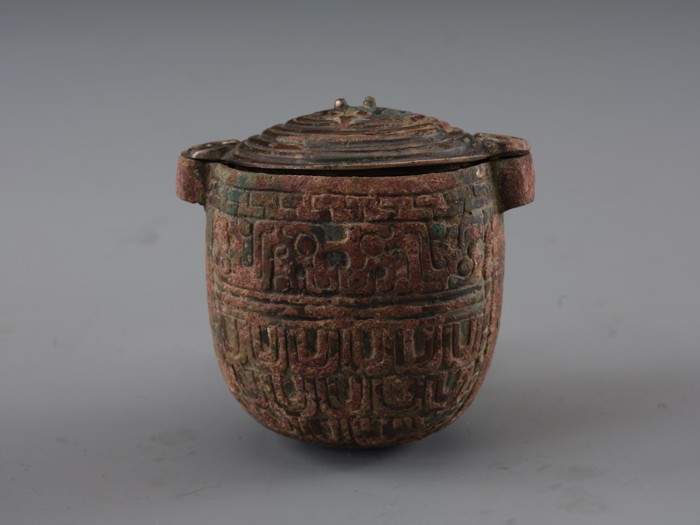
According to a Nature report, a team of researchers led by Bin Han of the University of the Chinese Academy of Sciences identified a bronze vessel containing remnants of a 2,700-year-old cosmetic among the artifacts recovered from a nobleman’s tomb at the Liujiawa site in northern China.

The ornate bronze jar was still sealed when researchers unearthed it at the Liujiawa archaeological site in northern China. That allowed Yimin Yang at the University of the Chinese Academy of Sciences in Beijing and his colleagues to analyze the composition of the yellowish lumps inside the pot.

The lumps consisted of beef fat mixed with minerals that absorb sweat and skin oil. Those minerals came from ‘cave moon milk’, a powdered form of white stalactites found in limestone caves.

Caves were important to the Taoist philosophy prevalent during the nobleman’s day, and the cream would have had symbolic power as well as the ability to moisturize and whiten the face.

The presence of similar pots in many royal and noble graves suggests that a cosmetics industry serving elite customers had appeared in China by roughly 700 BC.

New Thoughts on the Origins of the Stonehenge

New Thoughts on the Origins of the Stonehenge

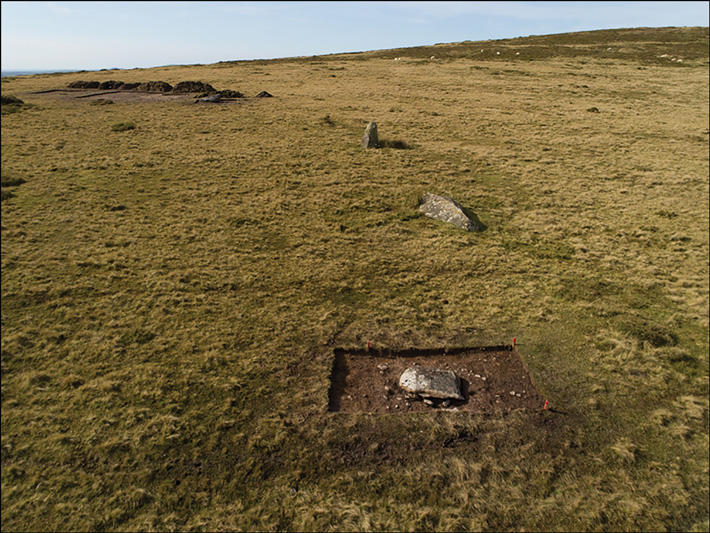
Traces of a Neolithic stone circle have been discovered in west Wales, near ancient bluestone quarries in the Preseli Hills, by a team of researchers led by Mike Parker Pearson of University College London, according to a Science Magazine report.

Around 3200 B.C.E., Stone Age farmers in Wales’s Preseli Hills built a great monument: They carved columns of unspotted dolerite, or bluestone, from a nearby quarry, then thrust them upright in a great circle aligned with the Sun. Exactly what the circle meant to them remains a mystery.

But new research reveals that several centuries later, their descendants took down many of the giant stones and hauled them 200 kilometers to the Salisbury Plain, where they created what is still the world’s most iconic prehistoric stone monument: Stonehenge.

New Thoughts on the Origins of the Stonehenge
A few toppled bluestones are visible at the prehistoric stone circle of Waun Mawn in Wales

The paper’s authors “make a very good argument Stonehenge is a dismantled stone circle from Wales,” says Alison Sheridan, a curator emerita at the National Museum of Scotland who was not part of the research team. “They dealt with very tricky data but came up with a brilliant hypothesis.”

Researchers had already traced Stonehenge’s slabs of bluestone to the west coast of Wales; they’d even identified some of the quarries where the stones were extracted more than 5,000 years ago.

But radiocarbon dating showed a puzzling gap of several centuries between activity at the bluestone quarries and the earliest construction at Stonehenge.

Researchers wondered whether the distinctive, 2- to 3-meter-tall bluestones had been used to build other stone circles first, then moved to Stonehenge later. “They’re clearly not spending 200 years slowly moving them across the landscape,” says University of Southampton archaeologist Joshua Pollard, one of the co-authors. “It always seemed likely they were dismantling existing monuments.”

Over the past decade, researchers led by University College London archaeologist Michael Parker Pearson searched for ritual structures in the Preseli region that might have provided the stones—and the blueprint—for Stonehenge. In 2017 and 2018, they excavated parts of an ancient monument called Waun Mawn, where a handful of toppled bluestones similar to those at Stonehenge form a partial circle.

The excavations revealed distinctive socket-shaped pits where other stones had once stood. Connecting the dots between the empty sockets and toppled bluestones at Waun Mawn, researchers sketched out a circle 110 meters across—the same dimensions as the outer earthen ditch that was part of Stonehenge’s original layout. (The ritual center was rearranged multiple times over its 1000 year life span.) And, like at Stonehenge, the circle’s entrance was oriented toward sunrise on the midsummer solstice.

Parker Pearson’s team then measured the last time sediments inside the socket holes at Waun Mawn had been exposed to light, using optically stimulated luminescence; they also radiocarbon dated charcoal found inside the pits.

They estimate the missing stones were erected between 3400 and 3200 B.C.E. and then removed 300 or 400 years later, around the time the first construction at Stonehenge began, they report today in Antiquity. “We’re quite confident the reason they come down is they’ve gone to Stonehenge,” says Parker Pearson.

Researchers say the dismantling of Waun Mawn and the rise of Stonehenge could have been part of a larger migration from the Preseli Hills to the Salisbury Plain. Human and animal remain found at Stonehenge have chemical signatures suggesting their early years were spent on the Welsh coast. “We’ve got regular contact between the two regions,” Pollard says.

The results add to an emerging picture of Stonehenge’s origins in a complex, interconnected region centered on the Irish Sea that flourished in the fourth millennium B.C.E., Sheridan says.

“People and ideas and objects were moving over long distances, and the movement clearly had to do with the way society expressed power,” Sheridan says. “Uprooting stones is a classic example.”

Back in the Preseli Hills region, radiocarbon dates and pollen evidence suggest that millennia of farming and human occupation ended around the time the Waun Mawn circle was dismantled. “Evidence for human activity drops around 3400 B.C.E.,” Parker Pearson says, though researchers aren’t sure why the people left.

The researchers say the migrants from Wales might have relocated the stones as a way to stay symbolically connected to their past—or to draw on their ancestors’ authority to claim a new region. “They’re bringing ancestral symbols as an act of unification,” Parker Pearson says.

Lost Civilization? 172000 Year Old River Discovered in Thar Desert India

Lost Civilization? 172000 Year Old River Discovered in Thar Desert India

Researchers have found evidence of a “lost” river that ran through the central Thar Desert, near Bikaner, as early as 172 thousand years ago, and may have been a life-line to human populations enabling them to inhabit the region. The findings, published in the journal Quaternary Science Reviews, represent the oldest directly dated phase of river activity at Nal Quarry in the central Thar Desert.

The study by researchers from The Max Planck Institute for the Science of Human History in Germany, Anna University in Tamil Nadu, and IISER Kolkata indicates that Stone Age populations lived in a distinctly different Thar Desert landscape than we encounter today.

This evidence indicates a river that flowed with phases of activity dating to approximately up to 172 thousand years ago, nearby to Bikaner, Rajasthan, which is over 200 kilometers away from the nearest modern river.

Sand Dunes in Bikaner, Rajasthan

These findings predate evidence for activity in modern river courses across the Thar Desert as well as dried up course of the Ghaggar-Hakra River, the researchers said. The presence of a river running through the central Thar Desert would have offered a life-line to Paleolithic populations, and potentially an important corridor for migrations, they said.

The researchers noted that the potential importance of ‘lost’ rivers for earlier inhabitants of the Thar Desert has been overlooked.

“The Thar Desert has a rich prehistory, and we’ve been uncovering a wide range of evidence showing how Stone Age populations not only survived but thrived in these semi-arid landscapes,” said Jimbob Blinkhorn from The Max Planck Institute for the Science of Human History.

“We know how important rivers can be to living in this region, but we have little detail on what river systems were like during key periods of prehistory,” Blinkhorn said.

Studies of satellite imagery have shown a dense network of river channels crossing the Thar Desert, according to the researchers.

“These studies can indicate where rivers and streams have flowed in the past, but they can’t tell us when,” explained Professor Hema Achyuthan of Anna University.

“To demonstrate how old such channels are, we had to find evidence on the ground for river activity in the middle of the desert,” Achyuthan said.

The team studied a deep deposit of river sands and gravels, which had been exposed by quarrying activity near the village of Nal. The researchers were able to document different phases of river activity by studying the different deposits.

“We immediately saw evidence for a substantial and very active river system from the bottom of the fluvial deposits, which gradually decreased in power through time,” Achyuthan said.

The researchers used a method called luminescence dating to understand when quartz grains in the river sands were buried. The results indicated that the strongest river activity at Nal occurred at approximately 172 and 140 thousand years ago, at a time when the monsoon was much weaker than today in the region.

River activity continued at the site between 95 to 78 thousand years ago, after which only limited evidence for the presence of a river at the site, with evidence for a brief reactivation of the channel 26 thousand years ago, the study found.

The river was flowing at its strongest during a phase of weak monsoonal activity in the region, and may have been a life-line to human populations enabling them to inhabit the Thar Desert, the researchers said.

The timeframe over which this river was active also overlaps with significant changes in human behaviour in the region, which have been linked with the earliest expansions of Homo sapiens from Africa into India, they said.

“This river flowed at a critical timeframe for understanding human evolution in the Thar Desert, across South Asia and beyond,” said Blinkhorn.

“This suggests a landscape in which the earliest members of our own species, Homo sapiens, first encountered the monsoons and crossed the Thar Desert may have been very different to the landscape we can see today,” he added.

Erosion Reveals Possible Neolithic Village Site in Scotland

Erosion Reveals Possible Neolithic Village Site in Scotland

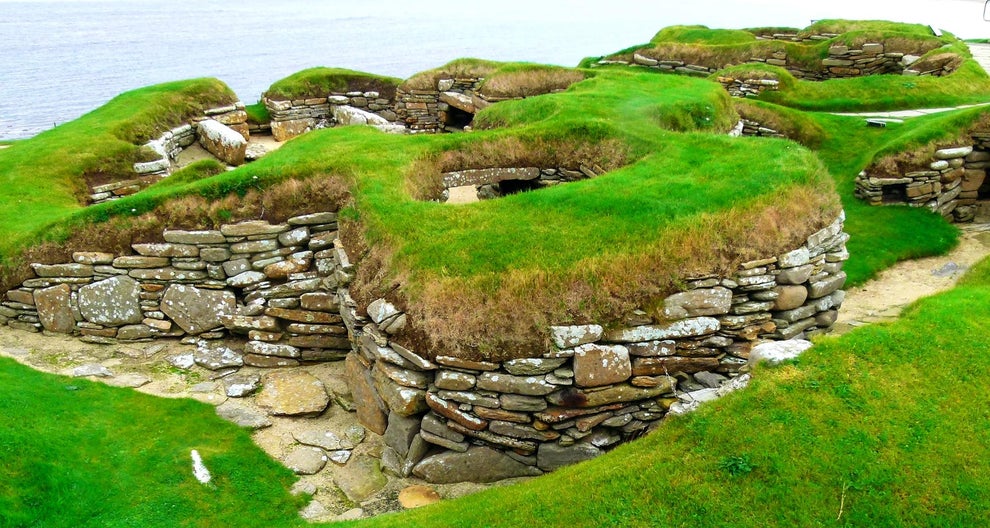
The Scotsman reports that erosion on the island of Orkney at the northern end of the Bay of Skaill has exposed deer antlers, a boar tooth, a cattle jawbone, and a large stone marked with incised triangles and a series of rectangular bands.

The artifacts were found about a half-mile away from the site of the Neolithic village of Skara Brae, which is located at the bay’s southern end.

Skara Brae is considered the best-preserved Neolithic settlement in Western Europe with people first making their home there around 3,100BC.

It was discovered in 1850 when a storm exposed part of the coastal site. Now, almost 170 years later, coastal erosion may have uncovered its neighbour.

A section of badly damaged wall has been exposed by the work of the pounding tides at the north end of the Bay of Skaill. Deer antlers, a boar tooth, a cattle jawbone, and a large decorated stone have also been discovered.

A boar tusk found at the north end of the Bay of Skaill.

Sigurd Towrie, the spokesman for the Archaeology Institute at the University of Highlands and Islands, said the finds “suggest there is another settlement at the Bay of Skaill – one that, from previous environmental sampling, is likely to be 4,000 to 5,000 years old”.

He said: “If this is the case, and based on the scale of the eroded section, we may well be looking at a Neolithic/Bronze Age site on a par with Skara Brae – albeit one that is now disappearing at an alarming rate.”

The large decorated stone found on the beach, which is similar to those found at Skara Brae.

The large decorated stone was discovered in the Bay of Skaill by Mr. Towrie after he noticed animal remains falling from an eroding section of shoreline.

Closer inspection found the stone marked with a pair of incised triangles and a series of rectangular bands running across the surface.

Dr. Antonia Thomas, the Archaeology Institute’s rock art specialist, confirmed the find was potentially a carved stone – one with designs similar to those recorded at Skara Brae.

The Bay of Skaill, where evidence of another potential Neolithic settlement has emerged.

It has long been thought that more Neolithic settlements may have dotted the bay surrounding Skara Brae. During building work in the 1930s, a wall was discovered to the north of the bay along with midden material, animal bone, and four burials, which were later moved.

The new finds have refreshed interest in who may have lived around the bay during the New Stone Age.

The discovery of deer remains is an unusual find for a Neolithic site on Orkney, with the animal perhaps used for rituals rather than food, it is understood.

The Bay of Skaill is now under close observation from the archaeology institute, although an excavation is unlikely in the near future given restrictions imposed by the coronavirus pandemic.

A section of wall which has been exposed at the Bay of Skaill which may have been part of an undiscovered Neolithic settlement.
The cow mandible recovered from the eroding shoreline section. Towrie discovered the stone while visiting the Bay of Bay Skaill after she noticed animal remains falling from an eroding section of shoreline

Mr. Towrie said: “UHI Archaeology Institute will continue to carefully monitor the extent of the coastal erosion and act as an when necessary.”

Skara Brae is considered the best-preserved prehistoric settlement of any period in the British Isles. Its preservation in the sand has left a vivid impression of life in a prehistoric village.

An ‘exceptional’ collection of artifacts recovered from the site tell a story of farming and fishing among its inhabitants, as well as jewellery making and crafts.

One of the houses at Skara Brae contains a hearth and stone beds. One bed, which is decorated, lies directly over the burial site of two mature women laid to rest in a crouched position.

10-Foot-Tall Stone Jars ‘Made by Giants’ Stored Human Bodies in Ancient Laos

10-Foot-Tall Stone Jars ‘Made by Giants’ Stored Human Bodies in Ancient Laos

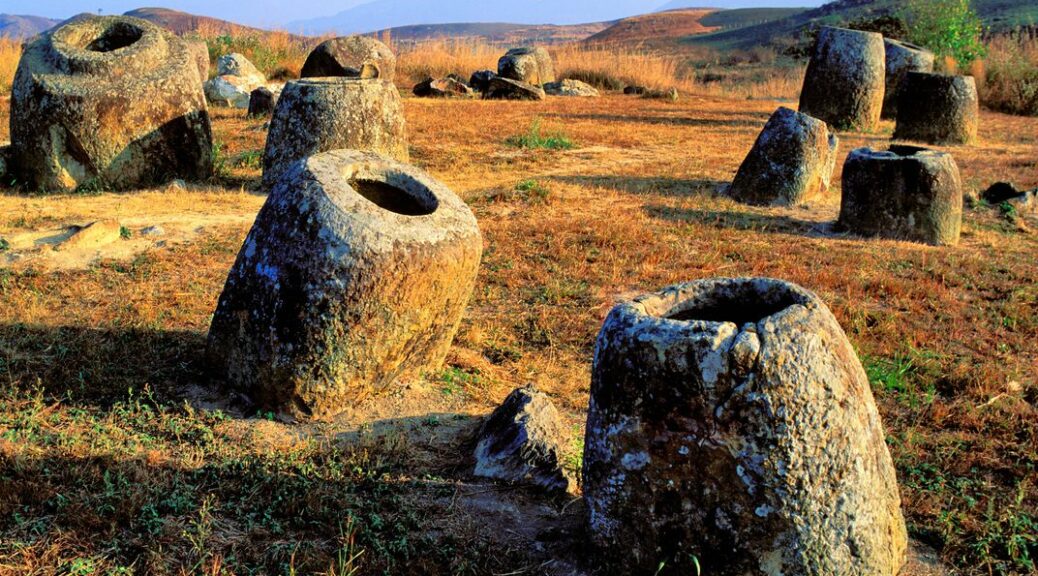
Stonehenge inspires awe, but there’s an even more mysterious ancient scene in Laos. The Plain of Jars consists of thousands of prehistoric stone vessels scattered over hundreds of square kilometres near Phonsavan, in the northeastern part of the country—a hilly area, despite the “plain” in the name. The huge jars form a surreal sight—some are up to ten feet tall and weigh several tons. It’s an archaeological wonder that experts still haven’t pinned down. 

Several human burials, thought to be around 2,500 years old, have been found at some of these sites in Laos, but nothing is known about the people who originally made the jars.

An expedition of archaeologists from Laos and Australia visited the Xiangkhouang region in February and March this year to document known jar sites and to search for new jars-of-the-dead sites and stone quarries.

Local legends say the carved stone jars were created by a race of giants to brew rice beer, but archaeologists think they were used in burial rituals.

The new finds show that the mysterious culture that made the stone jars were geographically more widespread than previously thought, said Louise Shewan, an archaeologist at the University of Melbourne, and one of the expedition leaders.

The joint Australian and Laos archaeological expedition searched for new jar sites in the Xiangkhouang region and excavated a previously known jar site.

The largest and best-known jar site is the famous Plain of Jars, located in relatively open country near the town of Phonsavan. That site contains around 400 carved stone jars, some as tall as 10 feet (3 m) and weighing more than 10 tons (9,000 kilograms), and the first archaeological investigation of it was made in the 1930s.

But Shewan said that the majority of the jar sites usually contained fewer than 60 carved stone jars, and were found in forested and mountainous terrain surrounding the Plain of Jars, spread over thousands of square miles.

Ancient stone jars

Shewan told Live Science that the search for new jar sites took the expedition into “extremely rugged, forested terrain,” as the researchers looked for ancient relics reported by local people.

Relying on local knowledge meant the archaeologists could avoid the ever-present danger of unexploded Vietnam War-era bombs, she said. U.S. warplanes dropped an estimated 270 million cluster bombs on Laos during the war.

The Laos government agency that oversees clearance efforts reports that more than 80 million unexploded bombs are scattered around the country.

Although the region is best known for the stone jars on the Plain of Jars, most of the ancient jar sites are in heavily forested and mountainous areas.

The latest expedition, in addition to accurately mapping many of the reported sites in the Xiangkhouang region, found 15 new jar sites, containing a total of 137 ancient stone jars.

Shewan said that the newly discovered jars were similar to those found on the Plain of Jars, but some varied in the types of stone that they were made from, their shapes and the way the rims of the jars were formed.

Burial rituals

Local legends include a story that the enormous stone jars were made by giants, who used the vessels to brew rice beer to celebrate a victory in war. But archaeologists think that at least some of the carved stone jars were used to hold dead bodies for a time before their bones would be cleaned and buried.

Australian and Lao archaeologists found more than 137 ancient stone jars at 15 new sites in the remote and rugged Xiangkhouang region.

Although the remains of elaborate human burials have been found at some of the jar sites, archaeologists aren’t sure if the jars were made for the purpose of the burials or if the burials were performed later.

Excavations in 2016 revealed that some of the stone jars were surrounded by pits filled with human bones and by graves covered by large carved disks of stone. These appear to have been used to mark the grave locations.

The latest expedition also found buried disks and other artefacts. Those included several beautifully carved stone disks, decorated on one side with concentric circles, human figures and animals. Curiously, the stone discs were always buried with the carved side face down.

“Decorative carving is relatively rare at the jar sites, and we don’t know why some disks have animal imagery and others have geometric designs,” expedition co-leader Dougald O’Reilly, an archaeologist at Australian National University in Canberra, said in a statement.

The excavations around some of the stone jars also revealed decorative ceramics, glass beads, iron tools, decorative disks that were worn in the ears and spindle whorls for cloth making. Researchers also discovered several miniature clay jars that looked just like the giant stone jars and that were buried with the dead.

The scientists will now use the data and photographs from the new jar finds to reconstruct the sites in virtual reality at Monash University; then, archaeologists across the globe can use the VR to examine the sites in detail.

Turkey: 1,550-year-old church’s Marble Floor meticulously restored

Turkey: 1,550-year-old church’s Marble Floor meticulously restored

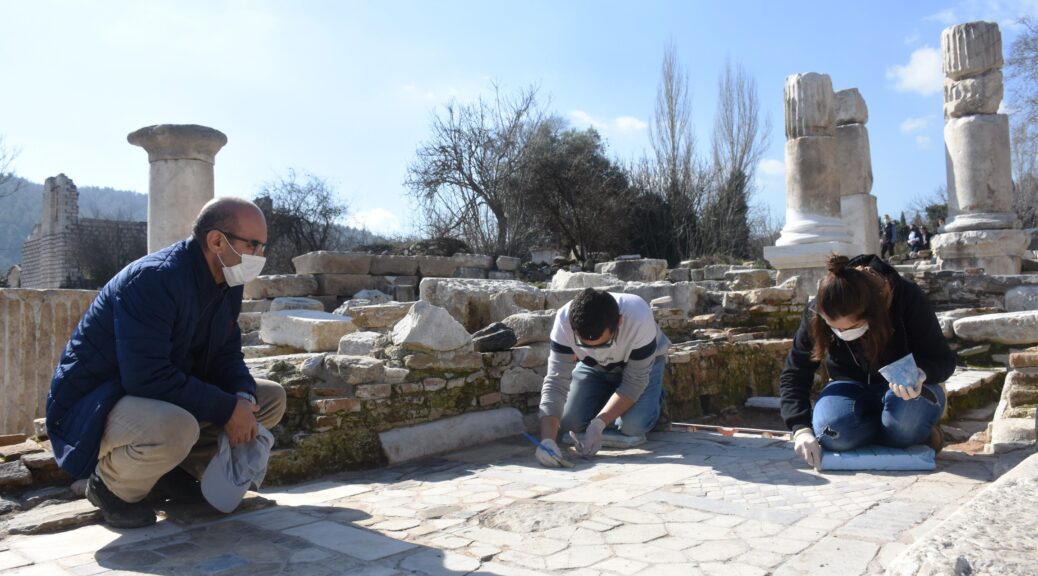
The Anadolu Agency reports that an ancient floor surface made up of at least four different colors of marble has been uncovered at the site of the ancient city of Stratonikeia in southwestern Turkey. 

The latest project on a 1,550-year-old Byzantine church and its marble floors stand out as one of the most eye-catching restoration projects in the ancient city recently.

The Byzantine church at the ancient site, which is on the UNESCO Tentative World Heritage List, historically used to serve religious people with an enchantingly colorful marble floor. The excavation and restoration project at the site will restore the marble structure back to its original, glorious state.

Professor Bilal Söğüt from Pamukkale University, head of excavations at Stratonikeia and Lagina sites, said that most of their archaeological work was focused on Western Street, where the church is also located. Söğüt said the church was built after an earthquake hit the city in 365 A.D. and stood until the seventh century.

“The region of the church, built on the colonnaded street, was turned into a graveyard in the later period. Today, we are unearthing both the graveyard and the church. Currently, we are working on restoring the church’s flooring,” Söğüt told Anadolu Agency (AA).

Söğüt stated that Stratonikeia was one of the largest marble ancient cities in the world and was home to many civilizations during its history, which helped retain its importance in Hellenistic, Roman, Ottoman, and Republic periods.

He explained that materials retrieved from the excavation site, which were ruined during the Byzantine era when the church was turned into a graveyard, are carefully reconstructed staying true to their original state, and are repaired in a place that could be described as a “stone hospital,” and then they are meticulously placed on the floor of the church.

Söğüt pointed out that given the church’s age, it had traces from many eras. “So, here we display the base and flooring of the Byzantine church but also samples of the Byzantine graves which were built on top of the church as well,” he said.

The professor said that the marble plates of the church floor had unique geometric patterns and they are collected by the archaeological team to restore. “The floor of the church is made of colorful marbles. This is the first time we have seen such a work in the city.

We reconstruct and refloor the church floor with marbles that we unearth during our excavations and give visitors a chance to see the ancient times.” Noting that they have so far discovered 62 graves at the church site, he added that they will display the most preserved of these alongside the church’s architecture.

Söğüt stated that the structures that the archaeological team discovered were also being worked on by an illustration team to transfer the ancient works into a digital 3D space. He said that these 3D drawings would be made available for viewing to visitors in the workshop area of the site.

City of historic remains

Stratonikeia was an ancient city built upon the remains of a Carian settlement, known as Idrias, which is thought to be the first settlement to be funded by the Lycians, another ancient Anatolian civilization.

According to Strabo, a Greek philosopher, and historian, the ancient city was founded in the Seleucid Empire during the reign of King Antiochus I Soter (281–261 B.C.), who named it after his wife, Stratonice, although that is contested amongst historians.

Selecuid Empire was a Hellenistic state in western Anatolia which existed between 312 BC to 63 B.C. Stratonikeia was founded as a confederation of several settlements surrounding the Carian settlement of Idrias with Anatolian and Macedonian settlers.

Although Stratonikeia’s later fell into ruin, its existence was never a secret. Richard Pococke, an English churchman and travel writer, even published a book called “A Description of the East, and Some Other Countries,” in which he described in great detail the city’s theater, bouleuterion (council house), and one of the city gates.

The city’s many historical remains include a gymnasium, a training facility for competitors in public games, which was built in second century B.C. and is the largest known gymnasium from the ancient period, a bouleuterion, which is located at the center of the city, and a theater, built on a natural slope in the southern part of the city. The Greco-Roman type theater, dated to the Hellenistic period, hosted approximately 12,000 people in its prime.

There is also the Augustus-Imperial Temple, which is situated on an upper terrace south of the theater and seems to be designed together with the theater.

The temple, designed as a peripteros, a type of ancient Greek or Roman temple surrounded by columns, is thought to be from the Early Imperial Period. The city also houses a Roman bath, dating back to the second century A.D., which is one of the three baths in Stratonikeia that are indicated in inscriptions.

The remains of the ancient city of Stratonikeia, Muğla, southwestern Turkey, Feb. 9, 2021.

The northern City Gate acts as an important entrance but at the same time as a ritualistic place because it allows the sacred road of Lagina Hecate to enter the city. The gate has a monumental arched entrance on both sides, and there is also a monumental fountain in between the entrances, with semicircular pools decorated with columns and statues in Corinthian order.

Besides, rock carvings of mythological masks shine out among the significant archaeological findings of the city. These masks depict the characters in the plays performed at the theater, ancient gods and goddesses, as well as animal figures.