Researchers Uncover 15,500-Year-Old Weapons, The Earliest Ever Found In North America
A group of scientists in Texas has recently discovered North America’s oldest weapon ever found, and archeologists call into question the history of the early settlers of the continent.
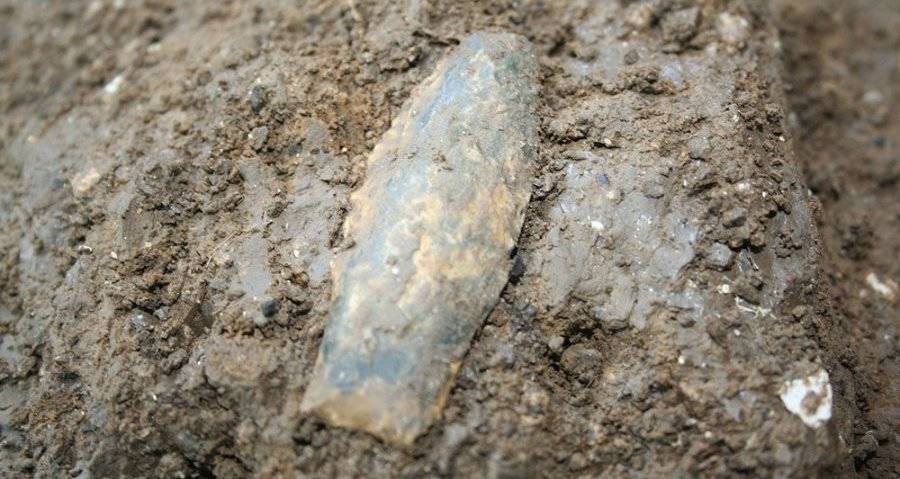
The weapons are ancient spear points which date back 15,500 years. They are around three to four inches long and were excavated from the Debra L. Friedkin site located about 40 miles outside of Austin, T.X.
The researchers recently published their findings in the journal Science Advances, and these record-breaking weapons are raising new questions about the first groups to settle in North America, once believed to be the Clovis people.
“The findings expand our understanding of the earliest people to explore and settle North America,” Michael Waters, a distinguished professor of anthropology and director of the Center for the Study of the First Americans at Texas A&M, said in a statement.
“The peopling of the Americas during the end of the last Ice Age was a complex process and this complexity is seen in their genetic record. Now we are starting to see this complexity mirrored in the archaeological record.”
These small weapons were made from stone and feature a triangular, lanceolate (leaf-shaped) point. Their fluted base allowed them to be easily attached to the end of a spear.
The new, pre-Clovis spear points discovered in Texas.
The weapons were found buried under several feet of sediment and amongst many Clovis and Folsom “projectile points.” The Clovis people date back between 13,000 to 12,700 years ago and the Folsom came after that.
Thus, for many years, the Clovis people were believed to be the first to venture into the continent, but these newly discovered spear points pre-date that group by thousands of years.
The researchers point out that stone tools from before the time of the Clovis people have been found, but these are the first weapons that pre-date the Clovis to ever be discovered.
“There is no doubt these weapons were used for hunting game in the area at that time,” Waters said. “The discovery is significant because almost all pre-Clovis sites have stone tools, but spear points have yet to be found.”
Excavations at the Friedkin site in Texas.
Clovis-style spear points, aptly named the “Clovis point,” have been discovered in Texas, parts of the U.S., and in Northern Mexico, but they are around 2,500 years younger than these spear points most recently found at the Friedkin site.
“The dream has always been to find diagnostic artifacts — such as projectile points — that can be recognized as older than Clovis and this is what we have at the Friedkin site,” Waters said.
This momentous discovery has answered many long-held questions from archaeologists about tools and weapons used by early Americans. However, as with all major discoveries, many new questions have popped up as well.
Who made these weapons? Did these tools inspire the other projectile points that came after? Or were they brought to North America during a migration?
Despite the remaining questions, these ancient weapons have unlocked countless secrets about the lives of those who came before us in North America.
Remains of Graeco-Roman Senate Building Unearthed in Egypt
With a history as rich as Egypt’s, there’s really no limit to the type of discoveries that can be unearthed between Sinai to Siwa and down to Aswan.
North Sinai holds the remains of the ancient Egyptian city of Pelusium – an area now known as Tell Farama, which dates back to the Greek, Roman, and Ptolemaic ages.
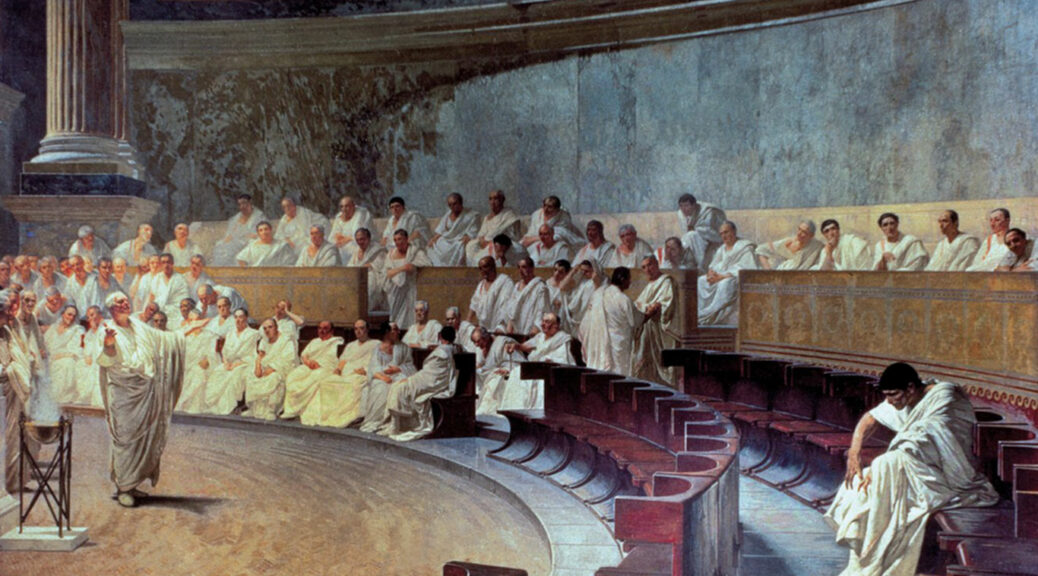
Remains of a huge Graeco-Roman building, believed to have been the Roman Empire’s main senate, has been unearthed at the Pelusiam archaeological site near North Sinai.
The building was found by the Egyptian archaeological mission working on location in Tel al-Farma in cooperation with the Institute of Archeology and Ethnology of the Polish Academy of Sciences.
The 2,500 sqm building consists of bricks and limestone and contains three main amphitheaters covered with marble.
With the remains of three 60 cm-thick circular benches found at the third amphitheater made of red brick.
“The building was most probably used as a headquarters for the Senate Council of Pelusium, one of the North Sinai’s old cities,” said Mostafa Waziri, secretary-general of the Supreme Council of Antiquities.
The initial studies conducted on architectural planning and the construction of the building indicated that it was used to hold meetings for the citizens’ representatives.
During the rule of the Ptolemies and Romans for taking important decisions about the public affairs of the city and its citizens, Waziri said.
Ayman Ashmawy, head of the Egyptian Antiquities Department at the Ministry of Antiquities, said the 2,500-square-metre building shaped from outside as a rectangular, with circular terraces and the main gate located on the eastern side.
He pointed out that the interior design of the building consists of the remains of three 60 cm-thick circular benches which were built of red brick and covered with marble.
The mission also uncovered the main streets of Pelusium city, Ashmawy added.
He explained that during the fifth and sixth century AD, the building was used as a quarry where the stones, bricks, and columns were extracted from their original places for use in the construction of other buildings in the city.
Mysterious 4,000-year-old grave reveals boy and girl buried face to face
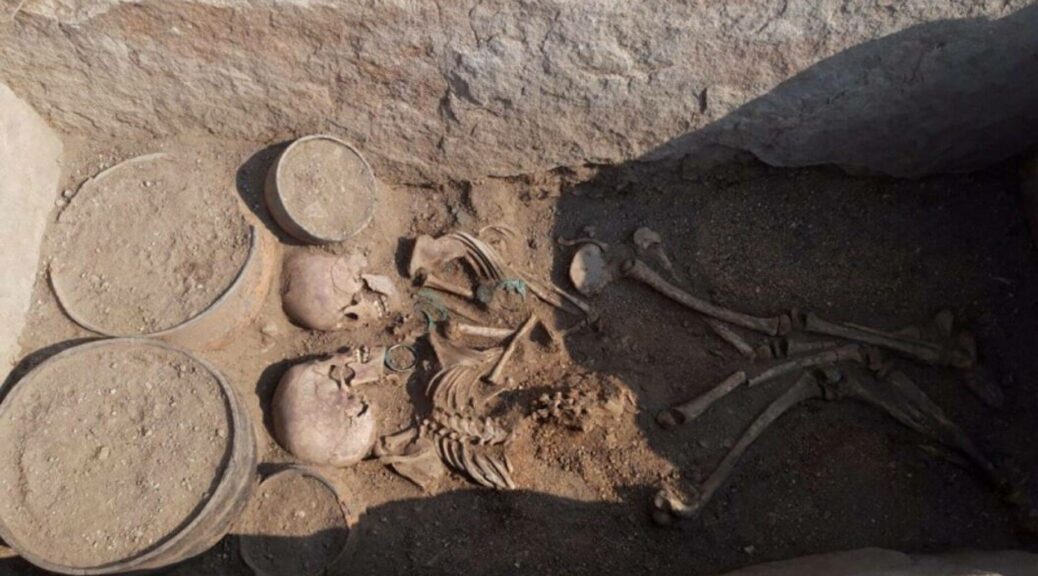
The bodies of a young man and woman inside the grave. The cemetery dates back approximately 4,000 years to the Bronze Age.
In a cemetery dating back about 4000 years, in Kazakhstan, the bodies of a young man and women were discovered buried face to face, probably in their twenties. You might be in a romantic connection they were a couple.
The bodies of a man and woman who died 4,000 years ago have been found buried face-to-face in a grave in Kazakhstan.
Archaeologists discovered the burial in an ancient cemetery that has remains of humans and horses, Kazakhstan archaeologists said in a Kazakh-language statement.
Some of the jewelry and bracelets that were found that belonged to the young man and woman.
Large ceramic pots were found in the burial.
The man and woman were buried with a variety of grave goods that includes jewelry (some of which is gold), knives, ceramics, and beads. The remains of horses were also found near the burial.
While some media reports claim that the archaeologists also found the burial of a priestess nearby, the archaeologists made no mention of this in their statement.
While the statement says that the pair is “young” it doesn’t give an age range.
It’s not clear what killed the man and woman or their exact relationship to each other, including whether they were romantically involved.
The rich burial goods suggest that the man and woman came from wealthy families, archaeologists said in their statement.
Archaeological remains found at other sites in Kazakhstan suggest that the pair lived at a time when fighting and conflicts occurred frequently in the region, archaeologists also said.
Excavation of the cemetery and analysis of the remains are ongoing. The archaeological team is led by Igor Kukushkin, an archaeology professor at Saryarka Archaeological Institute at Karaganda State University in Kazakhstan. Live Science was unable to reach Kukushkin at the time this story was published.
Numerous archaeological remains have been uncovered in Kazakhstan. In 2016, a team led by Kukushkin found the remains of a 3,000-year-old, pyramid-shaped mausoleum.
In 2014, a different team of archaeologists identified 50 geoglyphs with various shapes and sizes, including a massive swastika, that appear to date as far back as 2,800 years.
Archaeologists Have Finally Found Greece’s Lost City Of Tenea
The story goes, that Tenea was founded by the survivors of the Trojan War in the 12th or 13th century BC, Until now, its location (and very existence) was entirely reliant on the words of historical text.
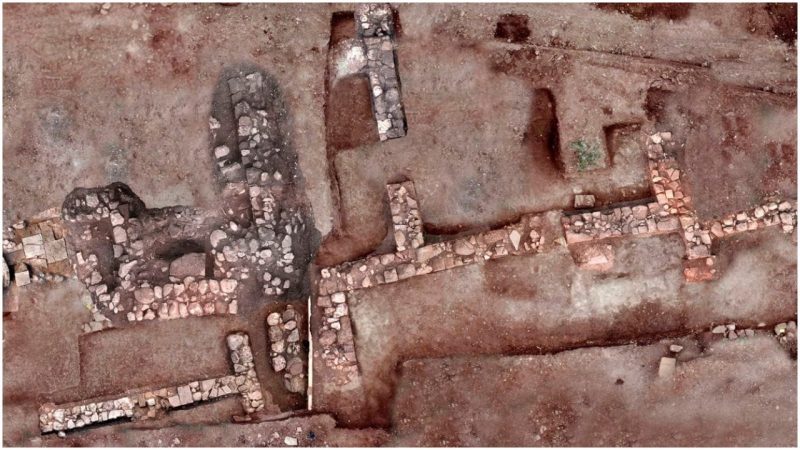
But the Ministry of Culture of the country announced the discovery of jewelry, pottery and even infrastructures by a team of archeologists, seemingly confirming where it was on a site near the village of Chiliomodi in southern Greece.
It’s a city that the ancient Greeks thought was settled by Trojan captives of war after the sack of Troy in the 12th or 13th century BC and up to now showed up only in texts.
Tenea Project Photo by Ministry of Culture and Sports, Greece
Also found were household pottery, a bone gaming die, and 200 coins dating from the 4th century BC and up to later in the Roman era.
Specifically, coins discovered were dated to the era of Roman emperor Septimius Severus, who ruled from 193 to 211.
Past digs have found clues near the city, but the most recent excavation uncovered the “city’s urban fabric,” including floors, walls and door openings, the culture ministry said, according to USA Today.
Satellite map
An unsettling discovery was a pottery jar containing the remains of two human fetuses, within the foundations of a building. Usually in Greek culture, the dead were buried in cemeteries.
Legend says the city thrived until the end of the Roman Empire, at which point it seems to have been damaged in a Gothic invasion. According to the Ministry, the city may have been left deserted in the 6th century CE during the Avar and Slavic raids.
Photo by Ministry of Culture and Sports, Greece
Lead archaeologist Elena Korka told the Associated Press that the discoveries indicated the citizens of Tenea had been “remarkably affluent.”
The city would have been located on a trade route between the cities of Corinth and Argos in the northern Peloponnese.
“(The city) had distinctive pottery shapes with eastern influences, maintained contacts with both east and west… and had its own thinking, which, to the extent that it could, shaped its own policies,” she told the AP.
Pottery found on location.
Throughout history, not much was known about Tenea, apart from ancient references to the reputed link with Troy and to its citizens having formed the bulk of the Greek colonists who founded the city of Syracuse in Sicily.
Korka said more should emerge during the excavations, which will continue over the coming years.
″(The city) had distinctive pottery shapes with eastern influences, maintained contacts with both east and west … and had its own way of thinking, which, to the extent that it could, shaped its own policies,” she said.
According to Reuters, among the findings was a golden coin to pay for the journey to an afterlife and an iron ring with a seal that depicted the Greek god Serapis sitting on a throne, Cerberus, which is a three-headed mythical dog that guards the gates of Ades, beside him.
Trojan War
The Trojan War is believed to have taken place near the end of the Bronze Age, around 1200 B.C. It took place around the time that a civilization called Mycenaean was active in Greece. They built palaces and developed a system of writing.
The earliest accounts of this war come from Homer, who lived around the eighth century B.C., several centuries after the events that took place. They do not appear to have been written down until even later, likely during the sixth century B.C.
The site of Hisarlik, in northwest Turkey, has been identified as Troy. It was inhabited for almost 4,000 years starting around 3000 B.C. After one city was destroyed, a new city would be built on top.
“There is no one single Troy; there are at least 10, lying in layers on top of each other,” writes University of Amsterdam researcher Gert Jan van Wijngaarden in a chapter of the book Troy: City, Homer, and Turkey.
Celtic woman found buried inside a TREE ‘wearing fancy clothes and jewellery’ after 2,200 years
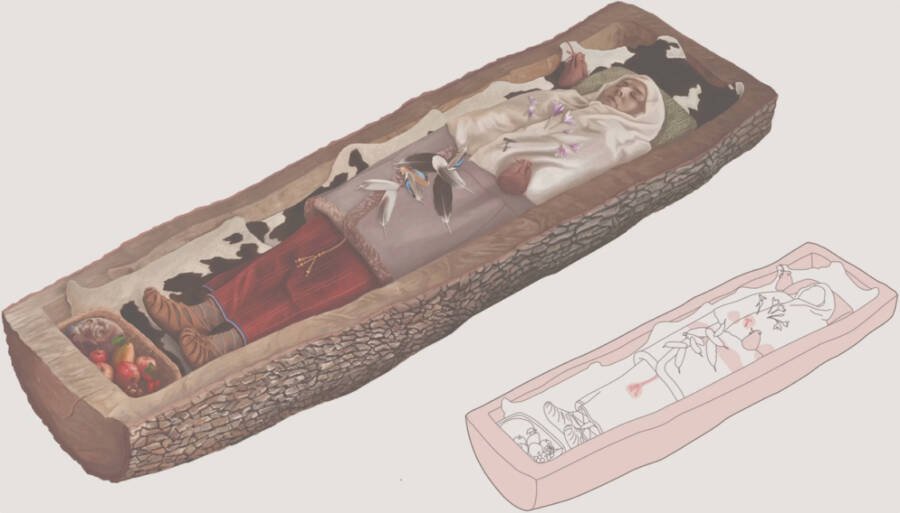
The ancient corpse of a woman buried in a hollowed-out tree in Zurich, Switzerland. Pictured are parts of her remains including her skull (top), as well as her jewellery (a blue, bottom)
It’s believed the woman, who died 2,200 years ago, commanded great respect in her tribe, as she was buried in fine clothes and jewellery.
Scientists say the woman was Celtic. The Iron Age Celts are known to have buried members of their tribe in “tree coffins” buried deep underground.
The woman’s remains were found in the city of Zurich in 2017, according to Live Science.
Bedecked in a fine woolen dress and shawl, sheepskin coat, and a necklace made of glass and amber beads, researchers believe she performed little if any hard labor while she was alive. It’s estimated she was around 40 years old when she died, with an analysis of her teeth indicating a substantial sweet tooth.
Adorned in bronze bracelets and a bronze belt chain with iron clasps and pendants, this woman was not part of low social strata. Analysis of her bones showed she grew up in what is now modern-day Zurich, likely in the Limmat Valley.
Most impressive, besides her garments and accessories, is the hollowed-out tree trunk so ingeniously fixed into a coffin. It still had the exterior bark intact when construction workers stumbled upon it, according to the initial 2017 statement from Zurich’s Office of Urban Development.
While all of the immediate evidence — an Iron Age Celtic woman’s remains, her bewildering accessories, and clothing, the highly creative coffin — is highly interesting on its own, researchers have discovered a lot more to delve into since 2017.
The excavation site at the Kernschulhaus (Kern school) in Aussersihl, Zurich. The remains were found on March 2017, with results of all testing now shedding light on the woman’s life.
According to The Smithsonian, the site of discovery has been considered an archaeologically important place for quite some time. Most of the previous finds here, however, only date back as far as the 6th century A.D.
The only exception seems to have occurred when construction workers found the grave of a Celtic man in 1903. They were in the process of building the school complex’s gym, the Office of Urban Development said when they discovered the man’s remains buried alongside a sword, shield, and lance.
Researchers are now strongly considering that, because the Celtic woman’s remains were found a mere 260 feet from the man’s burial place, they probably knew each other.
Experts have claimed that both figures were buried in the same decade, an assertion that the Office of Urban Development said it was “quite possible.”
The Office of Urban Development said the woman’s necklace was “unique in its form: it is fastened between two brooches (garment clips) and decorated with precious glass and amber beads.”
Though archaeologists previously found evidence that a Celtic settlement dating to the 1st century B.C. lived nearby, researchers are rather confident that the man found in 1903 and the woman found in 2017 belonged to a smaller, separate community that has yet to be entirely discovered.
The department’s 2017 press release stated that researchers would initiate a thorough assessment of the grave and its contents, and by all accounts, they’ve done just that.
Archaeologists salvaged and conserved any relevant items and materials, exhaustively documented their research, and conducted both physical and isotope-based examinations on the woman.
Most impressive to experts was the woman’s necklace, which had rather impressive clasps on either end.
The office said that its concluded assessment “draws a fairly accurate picture of the deceased” and the community in which she lived. The isotope analysis confirmed that she was buried in the same area she grew up in.
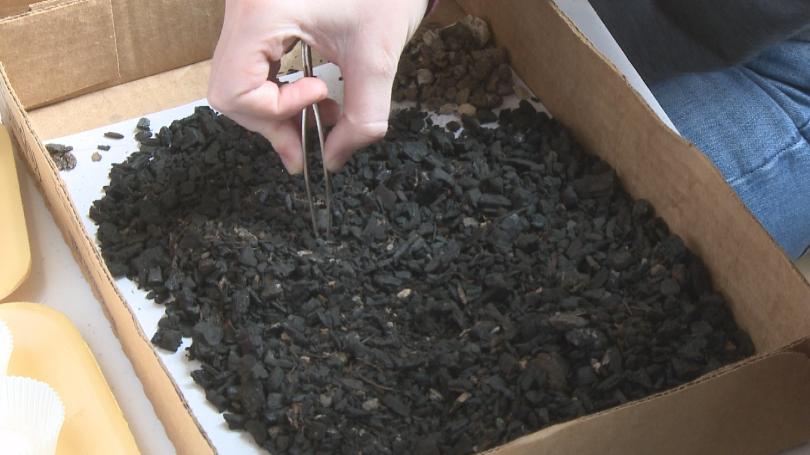
The amber beads and brooches belonging to the woman’s decorative necklace being carefully recovered from the soil.
While the Celts are usually thought of as being indigenous to the British Isles, they lived in many different parts of Europe for hundreds of years. Several clans settled in Austria and Switzerland, as well as other regions north of the Roman Empire.
Interestingly enough, from 450 B.C. to 58 B.C. — the exact same timeframe that the Celtic woman and man were buried — a “wine-guzzling, gold-designing, poly/bisexual, naked-warrior-battling culture” called La Tène flourished in Switzerland’s Lac de Neuchâtel region.
That is until Julius Caesar launched an invasion of the area and began his conquest of western and northern Europe. Ultimately, it seems the Celtic woman received a rather kind and caring burial and left Earth with her most treasured belongings by her side.
Students excavate Second World War Hawker Hurricane shot down over a Hampshire field, Aerial view of the dig for the 1940 Hurricane near Wickham.
Hawker Hurricane fighter plane excavated by Winchester University archaeology students in the field near Wickham
The single-seater crash site, which went down near Wickham in November 1940, was effectively excavated by Winchester University Students.
The undergraduate’s recovered wreckage left behind following the wartime RAF recovery including elements of the cockpit instrumentation, control column firing button (found ‘set to fire’), armored glass and crucially one of the aircraft’s identification plates that confirmed it as P/O Hugh Desmond Clark’s Hurricane N2608.
In addition, rather poignantly, the harness release, which would have been the last item handled by the pilot before he parachuted to safety, was recovered.
10 archaeology undergraduates spent two weeks researching and excavating the site, led by Dr. Phil Marter, senior lecturer in Archaeology and an expert in WW2 aviation archaeology.
A geophysical survey was followed by three days’ excavation last Thursday through to Saturday at Frith Farm. The site has not been explored for nearly 80 years.
Students excavate Second World War Hawker Hurricane shot down over a Hampshire field The dig near Wickham.
Dr. Marter said: “This project has provided a unique opportunity for students to explore the story of just one pilot and his aircraft that participated in the aerial combat taking place in the skies of Britain during late 1940.
We hope that their experience will help them to appreciate the value of this type of heritage and encourage them to play an active role in its future.
“We are extremely grateful to the landowners Mr. and Mrs. Arturi for allowing us to work on their land and making us feel so welcome.
Students excavate Second World War Hawker Hurricane shot down over a Hampshire field
We are also grateful to our project partner Gareth Jones and his team for their support and to the Joint Casualty and Compassionate Centre (JCCC) at Innsworth for their advice during the licensing process.”
The Hurricane was being flown by P/O Clark while intercepting enemy aircraft on November 1, 1940, the day after the Battle of Britain officially finished.
P/O Clark retired from the RAF as a Wing Commander in 1960 and, as part of their project, the students are researching his military career and hoping to trace any living relatives in the hope that they can tell his story and add this to their excavation report.
The students will continue the cleaning and cataloging of material from the site in the coming week.
Archaeologists have unearthed an 18th-century serpent sideplate from a British trade gun at a historic Mackinaw City fort
An 18th-century serpent sideplate was uncovered by archeologists from a British trade weapon at a historic fort in Mackinaw City.
The nearly 5 inches (12.7 centimeters) long piece was found last Tuesday in Fort Michilimackinac. It’s believed to date back to the 1770s.
Lynn Evans, the curator of archaeology at Mackinac State Historic Parks, said only four gun parts have been found in that particular location in 12 years.
“All of a sudden, here’s something we haven’t been finding,” Evans said.
Fort Michilimackinac is a reconstructed 18th-century for a trading village on the Straits of Mackinac. Over the centuries, the area was home to Native Americans, the French and the British.
The finding is part of a long-running archaeological program at the park.
Excavations take place seven days a week for 12 weeks in the summer, giving visitors a chance to watch archaeology in action and ask the archaeologists questions, too.
This year marks the archaeological dig’s 60th anniversary, making it one of North America’s longest-running archaeology programs.
“It’s an unusual opportunity, and I think it’s great you can do it right here in Michigan,” Evans said.
The serpent sideplate will be taken to a lab to be washed, examined and labeled.
Over the coming winter, the sideplate and other items found during this summer’s dig will be cataloged and put into storage for future use by researchers or in exhibits, either at the fort or by loan to other institutions.
In addition to the serpent, 2019 discoveries have included a silver trade brooch, a door hinge and a large piece of feather creamware.
Evans said discoveries paint a richer picture of what life was like at the fort.
“We have a lot of documents about the fort, but we don’t have a lot of diaries,” Evans said. “What we find is not gonna change history, but it gives us such a better understanding of daily life here.”
A new Viking site could rewrite the story of the ‘Great Heathen Army’
Ongoing excavations at the English parish of Foremark could finally uncover where the thousands of Vikings that made up the Great Army spent the winter of 873-874 CE.
Some 40 years ago, archaeologists excavating the grounds of the English village of Repton stumbled upon a gruesome discovery: a mass grave containing the bodies of more than 250 men, women, and children, many bearing the scars of battle on their bones.
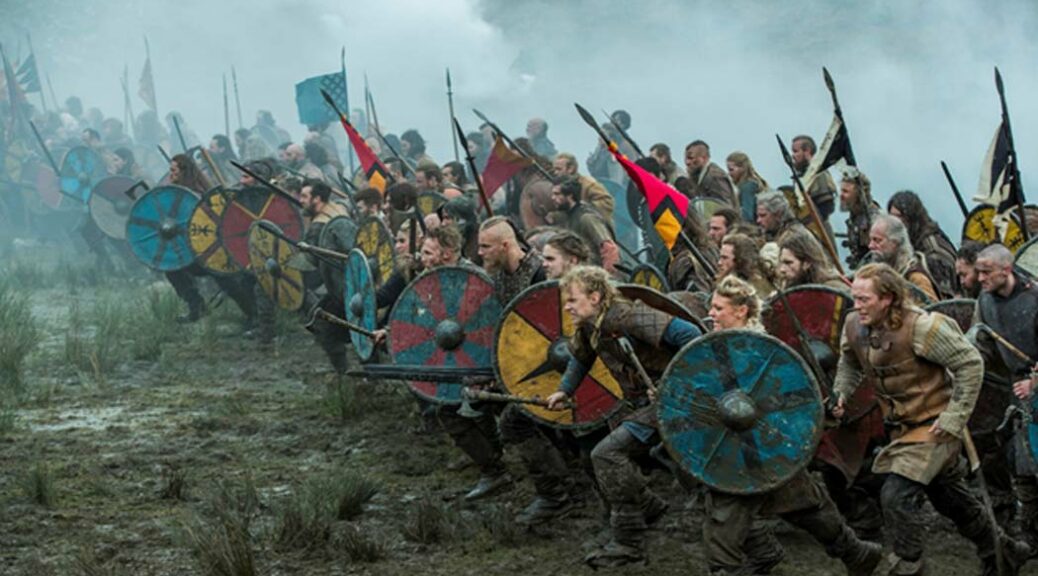
The find lined up with English historical records describing Repton as the location where the “Great Heathen Army” of Vikings hunkered down for the winter of 873-874 CE. It seemed the invaders who had once terrorized the country’s medieval Anglo-Saxon residents had finally been found.
There was just one problem. The only candidate for a fortified winter encampment at Repton was an earthwork enclosure spanning just a handful of acres—far too little to accommodate the thousands of militant Vikings believed to have comprised the Great Army.
Now, a team of researchers from the University of Bristol might have uncovered the solution to Repton’s clown car conundrum: a long-lost partner camp in the nearby village of Foremark, which boasts acreage aplenty. Excavations at Foremark are ongoing, but if the findings pan out, they could help resolve a long-standing debate in Viking history.
“Based on what others had dug up at Repton before, some people [suggested] the Great Army wasn’t as big as everyone thought,” says Mary Beaudry, an archaeologist at Boston University who was not involved in the excavation. “But with this work at Foremark…it could have been much bigger than anyone thought. It opens up an entirely new picture.”
Archaeologist Cat Jarman handling newly uncovered artifacts at Foremark.
Formal excavations at Foremark, a sleepy hamlet just two miles east of Repton, have only recently begun in earnest. But long before the arrival of a team led by Cat Jarman, an archaeologist at the University of Bristol, a group of metal detectorists had unveiled hints of a Viking presence in Foremark.
One of these detectorists, Rob Davis, had already spent more than a decade amassing a trove of trinkets when he reached out to Jarman in November of 2017. Though his collection was by no means comprehensive, Jarman says, it already held what might be the “smoking gun” of a Great Army encampment: a handful of trademark lead gaming pieces—a common relic of Viking encampments strewn throughout Europe.
“In a way, these are the most important artifacts,” Jarman says. “They’re only associated with the Great Army. They’re not pretty or valuable, but they’re specific.”
Joining the gaming pieces were several Islamic dirham coins and trading weights—clear indicators of the Vikings’ global connections. These artifacts, in particular, Jarman says, should serve as reminders that the Vikings were more than the one-dimensional plunderers and pillagers of popular culture. In fact, there’s evidence that Vikings actually started out as merchants, and kept up some of these bartering practices even after taking up arms, trading in local and foreign markets alike.
“There was obviously a violent side to the Vikings,” says team member Mark Horton, an archaeologist at the University of Bristol. “But they were also bringing all sorts of things missing from Anglo-Saxon England at the time. They were the first medieval globalizing forces.”
In the years since Jarman and her colleagues have begun their own research at Foremark. The team hasn’t yet begun excavations at what they believe is the location of Foremark’s main camp, which is privately owned. But the researchers have already hit pay dirt in a neighboring plot of land—in the form of a large, valuable iron plowshare that dates back to the late 9th century. It’s not yet clear who the plowshare belonged to: It could have been hauled in by globe-trotting Scandinavians or abandoned by the unfortunate Anglo-Saxons whose homes they invaded. Either way, this particular find is “pretty amazing,” Horton says.
Many of the artifacts, including those in the metal detectorist’s collection, have yet to be dated more precisely than a ballpark century, however. As such, there’s not yet a guarantee of simultaneous occupation with Repton. But given Foremark’s proximity to Repton, Jarman and others are optimistic that the pieces of the overwintering puzzle could finally be falling into place.
“The findings at Foremark fit into our expectations,” says Doug Bolender, an anthropologist at the University of Massachusetts Boston who was not involved in the work. “In lots of ways, this could allow us to put aside a whole series of caveats and asterisks of the interpretation of the material at Repton…it’s exciting to have a potential site.”
In many ways, Foremark might have been an obvious candidate for a Viking take over. Situated comfortably on the River Trent, the site would have been ideal for everything from docking boats to growing crops. It also carried the appeal of open land: Though the team hasn’t yet determined the exact boundaries of the Foremark camp, the site could have covered as many as 90 acres, vastly outstripping the known enclosures at Repton.
That amount of space could have accommodated the thousands estimated to be in the Great Army—or more. “The whole thing is a massive Viking landscape,” Horton says. “The sheer scale of what we’re finding could indicate that we’re talking about tens of thousands [of people].”
A Viking gaming piece uncovered at Foremark. These tiny trinkets entertained bored Viking warriors at their winter encampments, and have been found all across Europe.
As excavations continue, Jarman is now toying with one last theory: that Foremark was so nice, the Vikings settled it twice.
Not long after leaving their station at Repton, the Great Army began to fragment. After a few final cataclysmic clashes with growing Anglo-Saxon forces, the remaining Vikings scattered. Over time, the two sworn enemies found peace and, eventually, began to integrate, braiding their disparate cultures together. Scandinavian words wove their way into English; Norse gods mingled into local lore.
Along the way, Jarman says, a few Viking veterans might have returned to a familiar haunt at an “old fortification”—perhaps, not by coincidence, the meaning of the root word for “Foremark.”
Even Foremark’s surroundings bear the echoes of encore. The names of nearby villages like Ingleby and Bretby contain similarities to old Norse words. And less than a mile away lies Heath Wood, the region’s only large-scale Viking cremation cemetery—an impractical investment for a single winter’s camp. “You don’t get those names, or a cemetery like that, unless you have a Scandinavian population putting down roots,” Jarman says.
“I think these Viking armies are the people who become the Scandinavian settlers,” she says. “They’ve been invisible in the archaeological record for a long time…but these armies eventually settled into the landscape. This might be how we find that missing link.”