Category Archives: EUROPE

Medieval sword unearthed by a metal detectorist in Poland may have been used in the Battle of Grunwald in 1410

Medieval sword unearthed by a metal detectorist in Poland may have been used in the Battle of Grunwald in 1410

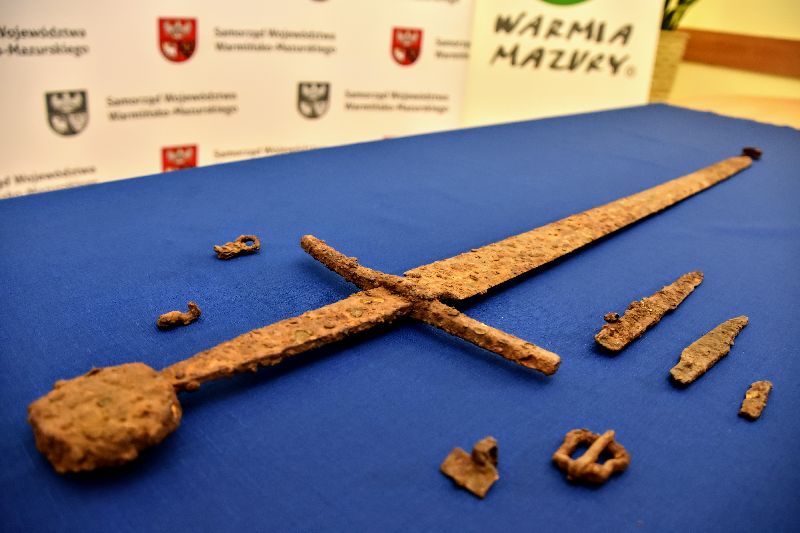
A medieval sword, metal pieces of a scabbard and a belt, and two knives that would have been worn on the belt were discovered in northern Poland by a metal detectorist who donated the artefacts to the Museum of the Battle of Grunwald, according to a Live Science report.

Alexander Medvedev discovered the sword near Olsztyn, in northern Poland, the local governmental Marshal’s Office of Warmia and Masuria reported in a translated news release on April 22.

“Such a find is found once in decades,” archaeologists said, according to the statement.

Despite spending more than 600 years buried underground, the weapons are well preserved, said Medvedev, an archaeology enthusiast, who donated the findings to the Museum of the Battle of Grunwald in Olsztyn.

According to Encyclopedia Britannica, the person who carried the sword might have been one of roughly 66,000 people who clashed at the Battle of Grunwald on July 15, 1410.

The bloody Battle of Grunwald (pictured) between the Kingdom of Poland and the Grand Duchy of Lithuania triggered the decline of the Teutonic Order and brought about a shift in power in Europe which lasted for centuries

The battle fought near the Polish villages of Stębark (also known as Tannenberg), Grunwald and Ludwigsdorf, ended with a Polish-Lithuanian victory over the Knights of the Teutonic Order, which was founded during the Crusades to the Holy Land and later came to rule over what was then Prussia.

The Knights of the Teutonic Order often waged battles against their non-Christian neighbours, including the Duchy of Lithuania. But then, Lithuania’s pagan grand duke converted to Catholicism and married the Polish Queen Jadwiga; he became king when she died and took the name King Władysław II Jagiełło.

He later became known for uniting Poland and Lithuania during the region’s Golden Age, and even has a statue honouring him in New York City’s Central Park.  

The sword may have been worn by a warrior at the Battle of Grunwald in 1410.

King Jagiełło also converted Lithuania to Christianity. But the Knights of the Teutonic Order doubted the sincerity of the king’s conversion, and in 1409, their Grand Master Ulrich von Jungingen declared war on Poland and Lithuania, according to Encyclopedia Britannica.

After a day of fighting, von Jungingen was killed when a lance pierced his throat and his troops withdrew. In all, of the 39,000 Polish-Lithuanian troops, about 5,000 died; of the roughly 27,000 Teutonic troops, 14,000 were captured and 8,000 died, according to Encyclopedia Britannica. After the defeat, the Teutonic Order’s power declined.

Hundreds of years later, the Soviets retrospectively claimed the battle as a Russian victory, because some soldiers from Smolensk, a city in Russia, were present on the Polish-Lithuanian side. During World War I, the Germans won a battle against Russia near the medieval battle site.

The Germans, who viewed the medieval knights as noblemen who spread Christianity, named the new battle the Battle of Tannenberg so they could claim revenge for the knights who were defeated in the medieval battle, according to Encyclopedia Britannica.

The newly discovered sword and its accessories are now undergoing conservation and analysis. 

The team hopes to learn more about the “social status of a medieval sword owner, and we are curious to see what lies beneath the rust layer,” Szymon Drej, director of the Museum of the Battle of Grunwald, said in the statement.

“We will also examine the site of the excavation of the monument in more depth to get to know the situational context of its origin.” After all, It’s rare to find such valuable items from the Middle Ages buried underground, Drej said. 
These Mysterious Artificial Islands Are Older Than Stonehenge, Claim Scientists

These Mysterious Artificial Islands Are Older Than Stonehenge, Claim Scientists

Ancient humans did not always live on dry land in the northern British Isles in the distant past. The roots of thousands of ancient artificial islands remain to this day across Scotland, Ireland, and Wales: known as crannogs, these unusual systems were constructed long ago by prehistoric hands in the chilly waters of rivers, lakes, and sea inlets.

Exactly how long ago these things were shaped is something that’s never been fully understood. Traditionally, archaeologists estimated Scottish crannogs emerged no earlier than the Iron Age, being first constructed around 800 BCE.

But in more recent years, evidence has come to light that these engineered structures could be much more ancient, and a new study confirms the formations are actually thousands of years older than we realized.

Using radiocarbon dating of four sites located in the Outer Hebrides (the Western Isles of Scotland), researchers have discovered ancient crannogs dating back to 3640–3360 BCE, meaning early humans were building these giant artificial islands roughly 5,500 years ago, pre-dating even the construction of Stonehenge.

“These crannogs represent a monumental effort made thousands of years ago to build mini-islands by piling up many tonnes of rocks on the loch bed,” says archaeologist Fraser Sturt from the University of Southampton.

It’s not the first time archaeologists have wondered whether crannogs could have Neolithic origins. Excavations in the 1980s at the crannog Eilean Dòmhnuill suggested it could date back thousands of years, but for decades no other comparably ancient specimens were located.

Things changed in 2012, when former Royal Navy diver Chris Murray, who was a resident of the Scottish Isle of Lewis, became intrigued by a crannog in the waters of Loch Arnish.

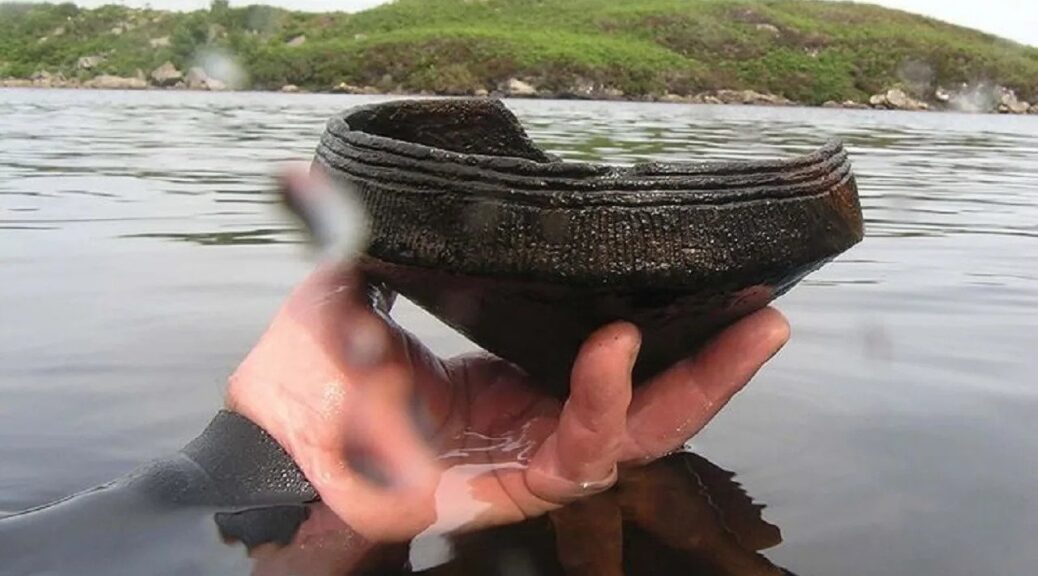
Diving beside the remnants of the weathered platform, Murray made a totally unexpected discovery: hidden beneath the lake’s surface around the engineered island, he found a scattered collection of remarkably well-preserved Early/Middle Neolithic pots lying on the loch bed.

These Mysterious Artificial Islands Are Older Than Stonehenge, Claim Scientists
Neolithic pottery recovered from Loch Arnish in 2012.

Working with Sturt and other researchers, the team investigated Loch Arnish and several other crannogs – some of which had not previously been identified in archaeological records and were located using Google Earth.

In total, the researchers discovered over 200 Neolithic ceramic vessels discarded from five crannogs – evidence of an extensive and arcane cultural practice we never knew about until now.

“Survey and excavation of these sites have demonstrated – for the first time –that crannogs were a widespread feature of the Neolithic and that they may have been special locations, as evidenced by the deposition of material culture into the surrounding water,” the researchers report in a new paper.

“These findings challenge current conceptualisations of Neolithic settlement, monumentality, and depositional practice while suggesting that other ‘undated’ crannogs across Scotland and Ireland could potentially have Neolithic origins.”

The site investigations, which encompassed a mixture of underwater and aerial surveying, plus excavations and radiocarbon analysis, revealed clear evidence the crannogs were human-made. The ancient builders created the structures by piling up boulders to make artificial islets.

At one of the sites, Loch Bhorgastail, ancient timbers were also observed around the edges of the crannog, thought to have been placed to increase the stability of the rock structure.

Six crannogs that have produced Neolithic material.

Sometimes, a stone causeway leads out to the island; at other sites, no causeway seems to exist, suggesting the crannog might have been accessed by boat, or perhaps a wooden bridge. While no other timber evidence remains at any of the sites, it’s thought the crannogs may have borne wooden structures and dwellings built on top of them, from which ancient pottery was once hurled – and not, it seems, by accident.

“The quantities of material now identified around several sites, and the position of these vessels in relation to the islets, suggests that pots were intentionally deposited into the water,” the researchers write.

“Many vessels had substantial sooting on their external surfaces, and some had internal charred residues; they had clearly been used before deposition.”

As for what these ancient disposals into the loch signified, and the other purposes of the crannogs may have had, we don’t know.

But given the amount of work that must have gone into creating these giant structures – engineered with stones weighing up to 250 kilograms (550 lbs) a piece – it’s clear they must have had some unique importance to the prehistoric community who once inhabited these mysterious spaces.

Perhaps the crannogs were reserved for important celebratory feasts, or used in mortuary rituals, with the watery backdrop of the loch somehow framing the otherness of these long-ago gatherings.

“They would have required a huge investment of labour to build and probably remained significant places for a long time,” the researchers explain.

“These islets could also have been perceived as special places, their watery surroundings creating separation from everyday life. The process of crossing over to the islets may have emphasized this separation; the practices that took place on them do appear to have been very different from those of ‘normal life.”

Monastery, 1500-year-old mosaic unearthed in Turkey

Monastery, 1500-year-old mosaic unearthed in Turkey

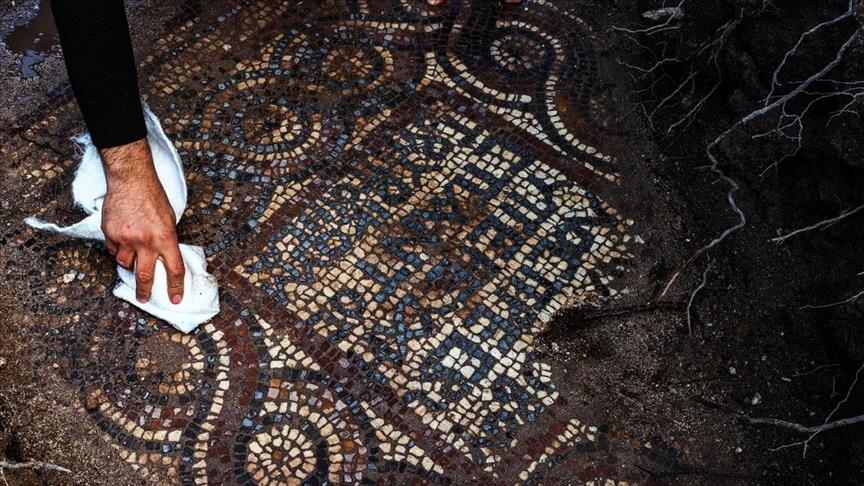
During an illegal excavation project carried out by two suspects in the Aliağa district of Turkey’s western Izmir province, a monastery built in the Roman period and a nearly 1500-year-old mosaic were discovered.

Monastery, 1500-year-old mosaic unearthed in Turkey
A closeup of the fine floor mosaic work from the Roman monastery discovered in Izmir Province, Turkey, after security forces were alerted to the theft in progress

Turkish Gendarmerie teams, acting on a tipoff, launched an operation in the mountainous area of the Aliağa district which has no vehicular access. The suspects were nabbed trying to remove the historical remains from about 2 meters (6.5 feet) below the ground.

Later, experts from the Izmir Archeology Museum investigated the region and the area was put under protection. The mosaic will be taken to a museum after initial studies are performed.

Two experts from the Izmir Archeology Museum investigate the area where the mosaic and monastery unearthed, Izmir, western Turkey

Hünkar Keser, the director of the Izmir Archeology Museum told Anadolu Agency (AA) that the team came to the region following the Turkish Gendarmerie’s notification. “We discovered the floor mosaic. This place was used as a monastery and has a basilica,” said Keser.

Explaining that the team estimates that the monastery was used between the fourth and 14th century, Keser said the mosaic was very valuable archaeologically.

“It is located at a point where it can be reached by tractor from the pathways. This is a universal cultural asset and a rare artefact,” he said.

The Incredible Images Created With Byzantine Mosaics

The Byzantine Empire refers to the continuation, in parts, of the wilting Western Roman Empire, in its eastern advancement roughly from the 5 th century AD to the middle of the 15 th century.

With its capital at Constantinople, the overwhelming influence of Eastern Orthodox Christianity appeared in all art forms during the period, including architecture. During this period, the art produced drew heavily on Hellenistic motifs and iconography, frequently with mystical themes.

Mosaics are carefully constructed colourful and detailed pictures made of finely cut marble, limestone and pebbles, known as tesserae.

The Byzantine Empire was renowned for its mosaics. And many of these incredible works of art celebrated the union of church and state.

The spread of Byzantine mosaic culture was not restricted to Constantinople but spread to distant regions of the empire, including the Balkans, southern Italy, and parts of Russia.

In fact, the rapid increase in mosaic artists who possessed the technical mastery and aesthetic sense of this artform led to huge cross-cultural influences, including Islamic art styles, especially by the Abbasids and the Umayyads.

While the messaging was politico-religious, it was impossible to ignore the distinctions in style and aesthetics and the resultant beauty.

An especially impressive Byzantine mosaic in the Hagia Sophia church that eventually became an important mosque

The world-famous Hagia Sophia, now a museum, began as a church and then became an important mosque for nearly 400 years, is especially celebrated for its exceptional range of gorgeous mosaics, made by the finest craftsmen.

This is also true of the mosaics found in the monasteries at Hosios Loukas, Daphni and Neo Moni of Chios in Greece, which are all marvels of the Byzantine mosaic artform and, incidentally, UNESCO World Heritage Sites.

Due to the eventual collapse and sacking of the Byzantine Empire capital of Constantinople in the 15 th century AD, many mosaics were destroyed forever. And this was a terrible loss for historians and cultural aficionados worldwide.

Izmir itself, the location of the current find, was once the ancient Greek city of Smyrna, which became a part of the Byzantine Empire. It was ransacked several times: twice by the Turks in the 11 th and 14 th centuries, and then by the Ottomans in the 15 th century.

The recently discovered Roman monastery mosaic will be removed from the ground and taken to the museum for further study. It is a find that has great historical implications, and it is only a matter of time before we learn more.

This 2,500-year-old female mummy dubbed the “Altai Princess” is one of few known mummies with visible tattoos

This 2,500-year-old female mummy dubbed the “Altai Princess” is one of few known mummies with visible tattoos

Tattoos aren’t just a trendy way for people to express themselves – they’re also apparently a time-honoured tradition dating back almost three thousand years.

A Siberian mummy, who researchers believe was buried 2500 years ago, will show off her intricate ink when she finally goes on display this month, and her shockingly well-preserved body art makes her look surprisingly modern.

The mummified body of the young woman, believed to be between 25 and 28 years old, was found in 1993, researchers told The Siberian Times.

Local groups have objected to the Siberian Princess’s remains going on display. Initially they were promised her body (pictured) would not be shown in public but that decision appears to have been reversed

Since then she has been kept frozen in a scientific institute, but she will soon be available to the public to be viewed from a glass case at the Republican National Museum in Siberia’s capital of Gorno-Altaisk.

The woman, dubbed in the media as the Ukok “princes,” was found wearing expensive clothing – a long silk shirt and beautifully decorated boots – as well as a horsehair wig.

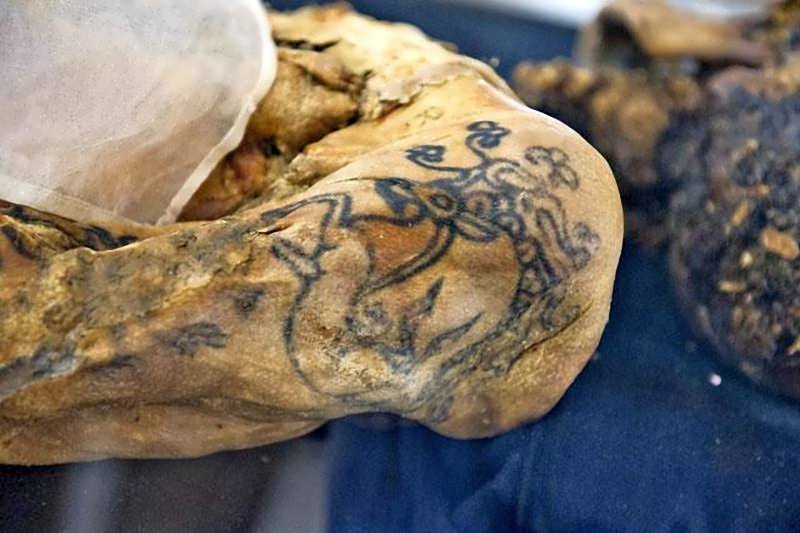
Dug from her permafrost burial chamber on the high Ukok Plateau in 1993, analysis of the princess’ remains highlighted sophisticated tattoos of ‘great artistry’ of fantastical creatures (shown)

Archaeologists told the paper that because she was not buried with any weapons she was not a warrior and that she was likely a healer or storyteller.

Though her face and neck weren’t preserved, she was inked across both arms and on her fingers, in what researchers say was an indication of status.

“The more tattoos were on the body, the longer it meant the person lived, and the higher was his position,” lead researcher Natalia Polosmak told the Times.

The woman was buried beside two men whose bodies also bore tattoos, as well as six horses. Researchers think the group belonged to the nomadic Pazyryk people, and that their body art is something special even in comparison to other mummies who have been found with tattoos in the past.

Researchers found the woman’s tattoos were designs based on fantastical-looking animals (illustrated)

“Those on the mummies of the Pazyryk people are the most complicated and the most beautiful,” Polosmak told the Times.

“It is a phenomenal level of tattoo art,” she said. “Incredible.”

Not everyone was pleased that the mummy was uncovered.

Controversy erupted after she was discovered, as many believed she should not have been removed from her burial site. Some locals even believed her grave’s disruption caused a “curse of the mummy” which they blamed for the crash of the helicopter carrying her remains.

“The Altai people never disturb the repose of the interned,” Rimma Erkinova, deputy director of the Gorno-Altaisk Republican National Museum told the Times. “We shouldn’t have any more excavations until we’ve worked out a proper moral and ethical approach.”

Local authorities in the region have declared the area a ‘zone of peace,’ so no more excavations can be done in an effort to prevent plundering, though scientists believe there are many more mummies that can be found.

Irish Farmer Stumbles Onto ‘Untouched’ Ancient Tomb

Irish Farmer Stumbles Onto ‘Untouched’ Ancient Tomb

In Ireland, a farmer discovered an ancient tomb that had been practically undiscovered for thousands of years. An excavator flipped a large stone to expose a secret chamber under it on southwest Ireland’s Dingle Peninsula, revealing the burial site.

Inside, local archaeologists found what they believe to be the human bones, along with a smooth oval-shaped stone – all of which could hold clues about pre-historical burial rituals.

They suspect the tomb dates to the Bronze Age, making it between 2,500 and 4,000 years old. But unlike most Bronze Age tombs, it was constructed completely underground—meaning it could be even older. 

Irish Farmer Stumbles Onto ‘Untouched’ Ancient Tomb
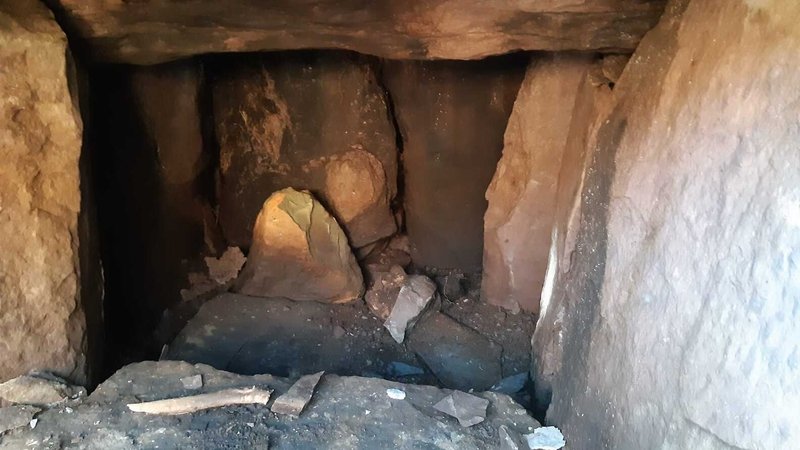
A farmer in southwest Ireland moved a large stone on his land and discovered this ancient tomb underneath. The site included a sub-chamber near the front of the tomb, as well as a smooth oblong-shaped stone and what’s believed to be human bones

The tomb was discovered during routine land improvement work, according to RTE, when a large stone was lifted up to reveal a ‘slab-lined chamber’ underneath.

An adjoining sub-chamber was found at what appeared to be the front of the tomb, containing what is presumed to be human bone fragments. A smooth oval-shaped stone was also uncovered, although its purpose is not yet clear.

Archaeologists from the National Monuments Service and the National Museum of Ireland visited the site and believe the tomb likely dates to the Bronze Age, which ran from 2000 to 500BC. But it could be even older given its ‘highly unusual design.

Bronze Age tombs have been found in the region before, but almost all of them stick out the ground. The new discovery ‘is completely concealed, suggesting it may be even older

‘Given its location, orientation and the existence of the large slab, your initial thought is this is a Bronze Age tomb,’ archaeologist Mícheál Ó Coileáin told RTE.

‘But the design of this particular tomb is not like any of the other Bronze Age burial sites we have here,’ he added.

‘It’s possible that it’s earlier but it’s very difficult at this early stage to date it.’

Fellow archaeologist Breandán Ó Cíobháin told the outlet the tomb appears ‘completely untouched,’ and its contents remain in their original state.

‘That is very rare,’ Ó Cíobháin said. ‘It is an extremely significant find as the original structure has been preserved and not interfered with, as may have occurred in the case of other uncovered tombs.’

The tomb was discovered on farmland on southwest Ireland’s Dingle Peninsula, which has been inhabited for 6,000 years. Its exact location is being kept private to preserve the site for future study

The discovery could prove invaluable to the understanding of prehistoric burial rituals, he said. Bronze Age tombs have been found in southwest Ireland before, particularly in Cork and Kerry.

They’re typically ‘wedge tombs,’ which narrow at one end and protrude above the ground.

Bronze Age wedge tombs like the one pictured here are found throughout southwest Ireland. But the newly discovered burial “seems to be different,” archaeologist Mícheál Ó Coileáin tells the Irish Times. “Wedge tombs are usually visible above ground, [but] this one is completely concealed.”

‘[But] this one is completely concealed, Ó Coileáin told The Times.

Wedge tombs mostly face the west and southwest, possibly representing ‘celestial or lunar alignments,’ Ó Cíobháin theorized. Because so much of the newly discovered tomb is underground, ‘it is difficult to fully assess the layout,’ he said.

‘It is very well built, and a lot of effort has gone into putting the large capstone over it,’ Ó Coileáin told the Irish Times. ‘It’s not a stone that was just found in the ground. It seems to have some significance.’

The National Monument Service says the tomb is in ‘vulnerable condition’ and is keeping its exact location private to preserve the site for future study.

Known to have been inhabited for at least 6,000 years, Dingle Peninsula has been the site of several archaeological discoveries, including clochán, dry-stone beehive-shaped huts built by the Celts.

A medieval mural on the wall of a Yorkshire church pays homage to St. George

A medieval mural on the wall of a Yorkshire church pays homage to St. George

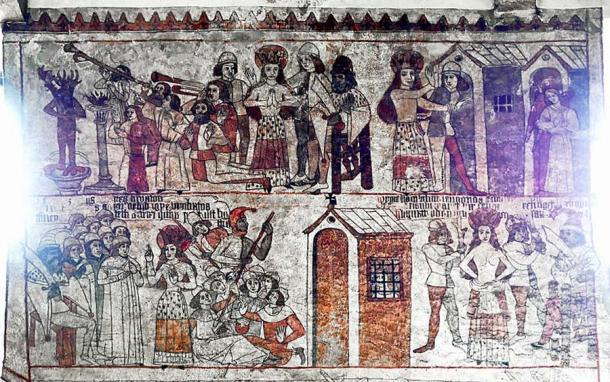
Pickering’s St Peter’s and St Paul’s Church has medieval wall paintings, one of which depicts St George killing a dragon, remain among the most complete surviving sets in all of Britain. Now, as today marks the feast of St George, this Roman soldier is honoured once again as a champion of the nation’s sword and a symbol of its lasting might.

Closeup of mural of St. George slaying the dragon at St Peter and St Paul Church, Pickering, England.

Today flags are to be flown across Yorkshire, with trumpeters on standby and bunting strung, incautious and socially distanced celebration of St George’s Day. At the small church in Pickering, where Scouts might normally have paraded under the red and white flag, campaigns call-in donations instead to preserve these cherished jewels.

“This is our country’s patron saint,” said churchwarden Pam Robb, as she reflected on the meaning of the feast day in a year of so much change.

Churchwarden Pamela Robb at St Peter’s and St Paul’s Parish Church in Pickering where medieval frescoes adorn the walls dating from 1450 but were painted over during the reformation in the 16th century.

“It’s the sense of a nation coming together to celebrate that. It reminds us of our heritage, and what people have gone through in the past.

“This is a little window, isn’t it, to a past life and how people lived and grew up,” she added, of the murals themselves.

A medieval mural on the wall of a Yorkshire church pays homage to St. George
The story of other saints is also represented in the mural. Here that of St. Catherine. (Helge Klaus Rieder)

“To think of the generations of people who grew up with these stories, and who would have looked up at these walls, is incredible. It shows perseverance.”

Hidden wall paintings

The Norman church in Pickering, which was rebuilt in the 12th century, stands on the site of an earlier Anglo-Saxon church, of which only part of the font and the stone cross remain.

Medieval Mural on Yorkshire Church Wall Pays Tribute to St. George

The paintings, believed to have been commissioned in around 1450, depict scenes of saints and bible stories, bringing them to life for a congregation that was unable to read.

Under Reformation, many such symbols were hastily destroyed, though the congregation here kept them carefully hidden under a layer of whitewash paint.

With the passing of time, their existence was completely forgotten, until they were rediscovered by the Rev John Ponsonby in 1852, to his utmost dismay.

Decrying the paintings as a ‘ridiculous’ distraction, he had defied the wishes of the then Archbishop of York to have them covered once again, but not before drawings were made.

Some remnants of these drawings remain, with fragments from the original paintings forming the basis for a palimpsest of imagery rare in its antiquity.

A sense of wonder

Today, the church is keen to draw donations following a year where it has seen fewer visitors, with a link here to its website under Rev Gareth Atha. These images, said Mrs Robb, do inspire a sense of wonder.

“People walk in and see these figures, and just stand there in awe,” she said. “There is a little jewel in the crown here, and people don’t realise.

“These paintings were people’s stories until they could begin to be written down.”

City halls and clocktowers in cities such as Bradford and Wakefield are to be lit up in red and white today to mark St George’s Day, while flags are to be flown and bunting hung.

At the outdoor Pontefract Market, professional trumpet player John Barker has been commissioned to play.

“It’s a national day that should be celebrated,” he said. “People appreciate live music, in particular, I think we’ve all come to realise what matters in life.”

Iron Age Weapons Found at Hillfort Site in Germany

Iron Age Weapons Found at Hillfort Site in Germany

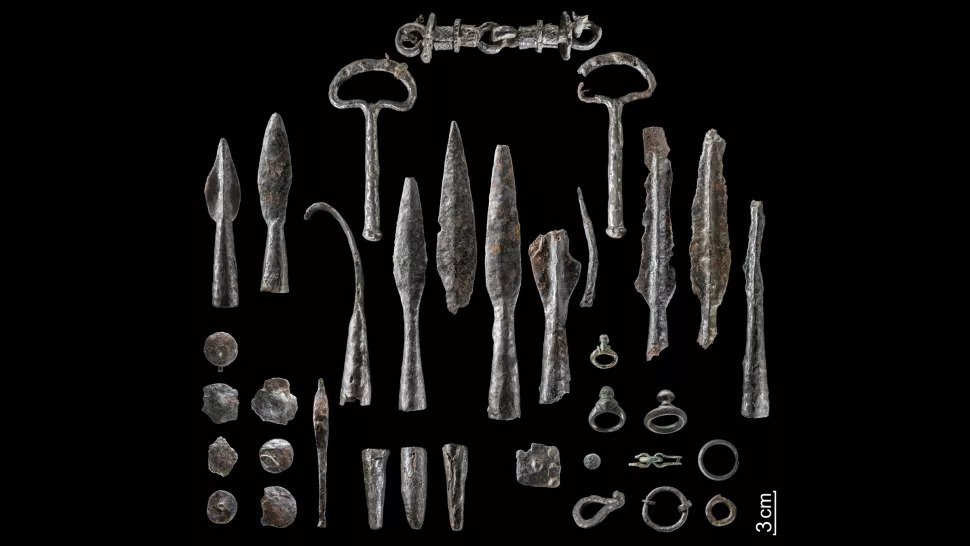
Live Science reports that a metal detectorist working with the Regional Association of Westphalia-Lippe archaeologists has discovered more than 150 objects at Wilzenberg, an Iron Age hillfort site in western Germany. 

Some of the bent weapons that were found during the 1950s at the hillfort in western Germany.

The hoard contains more than 150 objects, including deliberately bent weapons, such as 40 spearhead and lancehead tips, swords and fragments of shield bosses (round structures at the centre of a shield); tools; belt hooks; horse gear; three silver coins; bronze jewellery; and one fibula, or lower leg bone, Manuel Zeiler, an archaeologist at LWL, told Live Science.

“The arsenal is the largest in [the German state of] North Rhine-Westphalia and also links the [state’s region of] Sauerland with complex processes in Iron Age Europe,” Michael Baales, an LWL archaeologist and head of the Olpe branch in North Rhine-Westphalia, said in a translated statement, released March 31.

Moreover, the damaged weapons — which ancient people would have purposefully destroyed by bending them — shed light on how victorious Iron Age warriors treated the losing side’s arsenal, Baales said.

Researchers have known about a possible hoard at the Iron Age hillfort for several decades. In the 1950s, while workers were constructing a pavilion, “two swords wrapped in two spearheads and two lanceheads were discovered by chance,” Zeiler said.

The swords were bent, and their tips had been purposefully deformed, he noted. But it wasn’t until 2013 that archaeologists did a more thorough excavation at this spot to discover the full context of the archaeology there, Zeiler said.

From 2018 through 2020, metal detectorist and local history researcher Matthias Dickhaus, who worked with the LWL and the town of Schmallenberg, searched the site for additional metal artifacts. 

In all, Dickhaus hit the jackpot, finding 100 objects, the LWL reported. Among the findings, archaeologists marvelled over a rare type of horse bridle.

“The existing handle parts for guiding the horse suggest that this type of bridle was used on horses that were pulling a chariot,” the LWL wrote in the statement. “The bit allowed the horse to be steered very precisely and directly — vital for a warrior on a chariot in the thick of a battle.”

Iron Age Weapons Found at Hillfort Site in Germany
A metal detectorist found these artifacts and more as he searched the site at Wilzenberg from 2018 to 2020.

The hillfort, Zeiler added, is located on the 2,158-foot-tall (658 meters) Wilzenberg mountain. This site was visited by people during the Iron Age, from about 300 B.C. to the birth of Christ, and the walls of the ancient hillfort, known as the Wallburg, are still visible today, largely seen by pilgrims and hikers who frequent the mountain. 

Most of the artifacts from the hoard date to about 300 B.C. to the first century B.C., although the coins and the swords had a more narrow window of only the first century B.C., Zeiler said. 

A view to the northeast of Wilzenberg mountain in the German state of North Rhine-Westphalia.

Although the hillfort at Wilzenberg is far away from the centres of Celtic culture in other parts of continental Europe, its architecture and the hoard’s bent objects are “comparable with the Celtic culture,” Zeiler noted.

Celtic and other Iron Age cultures are known to have bent the weapons of a defeated enemy in a similar way to the newfound hoard. For instance, archaeological investigations at sanctuaries in Gournay and Ribemont-Sur-Ancre in France “shows that weapons of conquered warriors after the battle were destroyed by the winner,” Zeiler said. “This ceremony was possibly the last step to celebrate the triumph.”

The new analysis of the hoard shows that “far away from the Celtic civilization, people celebrated a triumph after battle similar to the Celtic world,” Zeiler told Live Science.

Despite the many weapons and parts of horse gear found at the hillfort, there’s no evidence of an epic battle there, Zeiler noted.

“The damage was clearly not caused during a fight, and consequently the Wilzenberg is not a battlefield,” Zeiler said in the LWL statement. Many of the weapons cannot be precisely dated, so it’s not clear whether they were damaged and laid down over the centuries, or whether they were deliberately twisted at a single event, he said.

The Mystery of the Giant Crystals: How the 36-foot Geode of Pulpí Formed

The Mystery of the Giant Crystals: How the 36-foot Geode of Pulpí Formed

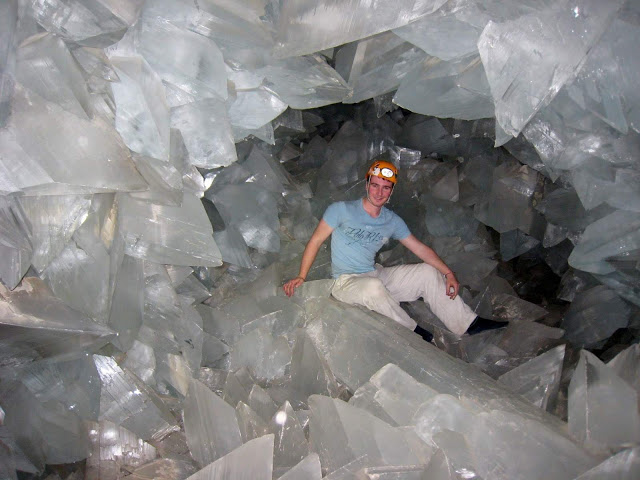
In an abandoned mine in southern Spain, there is a room of pure crystal.  You have to go to a deep tunnel, get into a ladder in the rocks, and squeeze across a jagged gypsum crystal tube that is barely wide enough for a person. If you make it that far, you’ll be standing inside the world’s largest geode: the Pulpí Geode, a 390-cubic-foot (11 cubic meters) cavity about the size of a cement mixer drum, studded with crystals as clear as ice and sharp as spears on every surface.

The Mystery of the Giant Crystals: How the 36-foot Geode of Pulpí Formed
This is the geode of Pulpí

While you may have never stood inside a geode, you’ve probably held, or at least seen, one before.

“Many people have little geodes in their home,” Juan Manuel García-Ruiz, a geologist at the Spanish National Research Council and co-author of a new paper on the history of the Pulpí Geode, told BBC. “It’s normally defined as an egg-shaped cavity inside a rock, lined with crystals.”

A researcher stands inside the crystal-filled cave known as the Pulpí Geode

Those crystals can form after water seeps through tiny pores on a rock’s surface, ferrying even tinier minerals into the hollow interior. Depending on the size of the rock cavity, crystals can continue growing for thousands or millions of years, creating caches of amethyst, quartz and many other shiny minerals.

The crystal columns at Pulpí are made of gypsum — the product of water, calcium sulfate, and lots and lots of time — but not much else has been revealed about them since the geode’s unexpected discovery in 2000.

In a study published in the journal Geology, García-Ruiz and his colleagues attempted to shed some new light on the mysterious cave by narrowing down how and when the geode formed.

García-Ruiz is no stranger to giant crystals. In 2007, he published a study on Mexico’s fantastical Cave of Crystals, a basketball-court-size cavern of gypsum beams as big as telephone poles buried 1,000 feet (300 m) below the town of Naica.

Uncovering the history of that “Sistine Chapel of crystals,” as García-Ruiz called it, was made easier by the fact that the crystals were still growing in the mine’s humid bowels. 

At Pulpí, however, the mine was completely dry, and the geode’s crystals had not grown in tens of thousands of years. On top of that, the geode’s gypsum spikes are incredibly pure — so translucent that “you can see your hand through them,” García-Ruiz said.

This means they do not contain enough uranium isotopes to perform radiometric dating, a standard method of analyzing how different versions of elements radioactively decay to date very old rocks. 

“We had no idea what happened,” García-Ruiz said. “So, we were required to make a cartography of the entire mine to understand its very complicated geology.”

The researchers analyzed and radiometrically dated rock samples around the mine for seven years to figure out how the area had changed since its formation hundreds of millions of years ago. The team’s driving question: Where did the calcium sulfate in the Pulpí Geode come from?

Ultimately, the researchers narrowed down the geode’s formation to a window of about 2 million years (not bad for the 4.5-billion-year-old calendar of geologic time). The crystals must be at least 60,000 years old, the team found because that was the youngest age of a bit of carbonate crust growing on one of the largest crystals in the geode. Since the crust is on the outside of a crystal, the crystal below must be even older, García-Ruiz explained.

Meanwhile, the composition of other minerals in the mine suggests that calcium sulfate was not introduced to the area until after an event called the Messinian Salinity Crisis — the near-total emptying of the Mediterranean Sea that is believed to have occurred about 5.5 million years ago. 

Based on the size of the gypsum crystals, it’s likely they started forming less than 2 million years ago, through a very slow-growing process called Ostwald ripening, in which large crystals form through the dissolution of smaller ones, García-Ruiz said. For an everyday example of this process, peer into your freezer.

When ice cream ages past its prime, small ice crystals begin to break away from the rest of the treat. As more time passes, those small crystals lose their shape and recombine into larger crystals, giving the old ice cream a distinctly gritty texture. 

The Pulpí Geode may not be as tasty as ice cream, but merely knowing that magical places like this exist comes with its own sweet satisfaction.

Thanks in part to the research team’s mapping efforts, tourists are now allowed to visit the Pulpí Geode, and García-Ruiz certainly wouldn’t blame you for doing so. Squeezing past the jagged gypsum gateway and into the geode’s cavity for the first time several years ago, García-Ruiz recalled one feeling: “euphoria.”